

Looking back to 2016, most automakers have not been able to grow their sales in the United States from what might have been the all-time peak for the market. Toyota is one of the few to pull off the trick, and it’s continued to claw more share nearly every year. But when Toyota hears footsteps every night on the decks, they belong to Hyundai.
The Morning Dump is all about transformation, with Hyundai transforming itself into a full-line automaker that makes everything. Having vanquished Honda, Stellantis, and Nissan, the company has Ford, GM, and especially Toyota in its sights. While Hyundai tries to beat Toyota, Ford is merely trying to match the Japanese automaker with quality.


Honda is considering joining the fight with another plant in the United States, but only if the White House will agree to confirm a trade deal. How much market is there even worth fighting for? According to a new analysis, sales continue to remain mostly stable.
Hyundai Will Launch More Than 100 New Models, Including 50+ In North America, A Ton Of Hybrids

There’s a fun chart over at GCBC that shows how major automakers fared in Q2 of 2026 compared to Q2 of 2025 and Q2 of 2016. This ten-year gap is especially interesting because 2016 was probably peak new car in the United States, with over 17.5 million cars sold, or about 1.2 million more than last year.
Over that time, GM, Ford, Honda, Steallantis, Nissan, and Mitsubishi have all lost ground. The winners? Toyota has grown 7.8%, Subaru has grown 12.5%, and Hyundai Motor Group (Hyundai + Kia + Genesis) grew an incredible 27.9%. Only Mazda grew more, increasing by 33%, but it’s still a relatively small player compared to Hyundai.
The South Korean automaker first built its reputation on low prices, then on having the longest/best warranty, and then on style and performance. Both Hyundai and Kia have gone from being the least interesting choices in most categories to, if not the best choice, at least a close second or third. The company also hired a bunch of great engineers and designers, and was careful to offer both EVs and hybrids, instead of overindexing on EVs.
GM, Toyota, and Ford are the only automakers who stand between Hyundai and the top of the sales charts in the United States, though I don’t think an outright sales victory is necessarily worth it. Hyundai can be more profitable than Ford selling fewer cars, and it’s unreasonable to expect that the automaker will ever top Ford or GM in trucks.
Can it top Toyota, though? Yeah. It might be able to top Toyota. And that seems to be the plan. CEO José Muñoz addressed reporters and investors in Seoul earlier today and his goal is clearly to compete in just about every space and to do so profitably:
“Our fundamentals have never been stronger. Hyundai Motor Group is the third-largest automotive group and the second-most profitable, which gives us the ability to invest while others are pulling back. We are bringing more than 100 new models to market by 2030 with multiple powertrain options and raising our operating margin above 9 percent. We are leveraging partnerships to scale new technologies and opportunities and becoming a physical AI company which will produce and deploy robots and robotaxis.”
The robots and robotaxis of it all I’ll leave aside for now, because I’m more interested in the 100+ new vehicles and the categories they’re shooting for:
The new Santa Fe EREV will arrive in the first half of 2027, representing an uncompromising approach to electrification. The Santa Fe EREV is expected to deliver more than 600 miles of total range, combining an EV-like daily driving experience while addressing range and charging anxiety for customers. The vehicle will be built in the United States at Hyundai Motor Manufacturing Alabama.
The momentum doesn’t stop there. The company is targeting ‘white spaces’ where the brand is underrepresented today. These segments account for roughly 29 percent of all automotive sales, highlighting significant opportunities for growth. These include body-on-frame vehicles, including a midsize pickup, and light commercial vehicles.
While body-on-frame is not a true ‘white space’ because it’s so crowded in the United States, it’s a new category entirely for Hyundai, which only has the expensive, unibody Santa Cruz for trucklet at the moment.
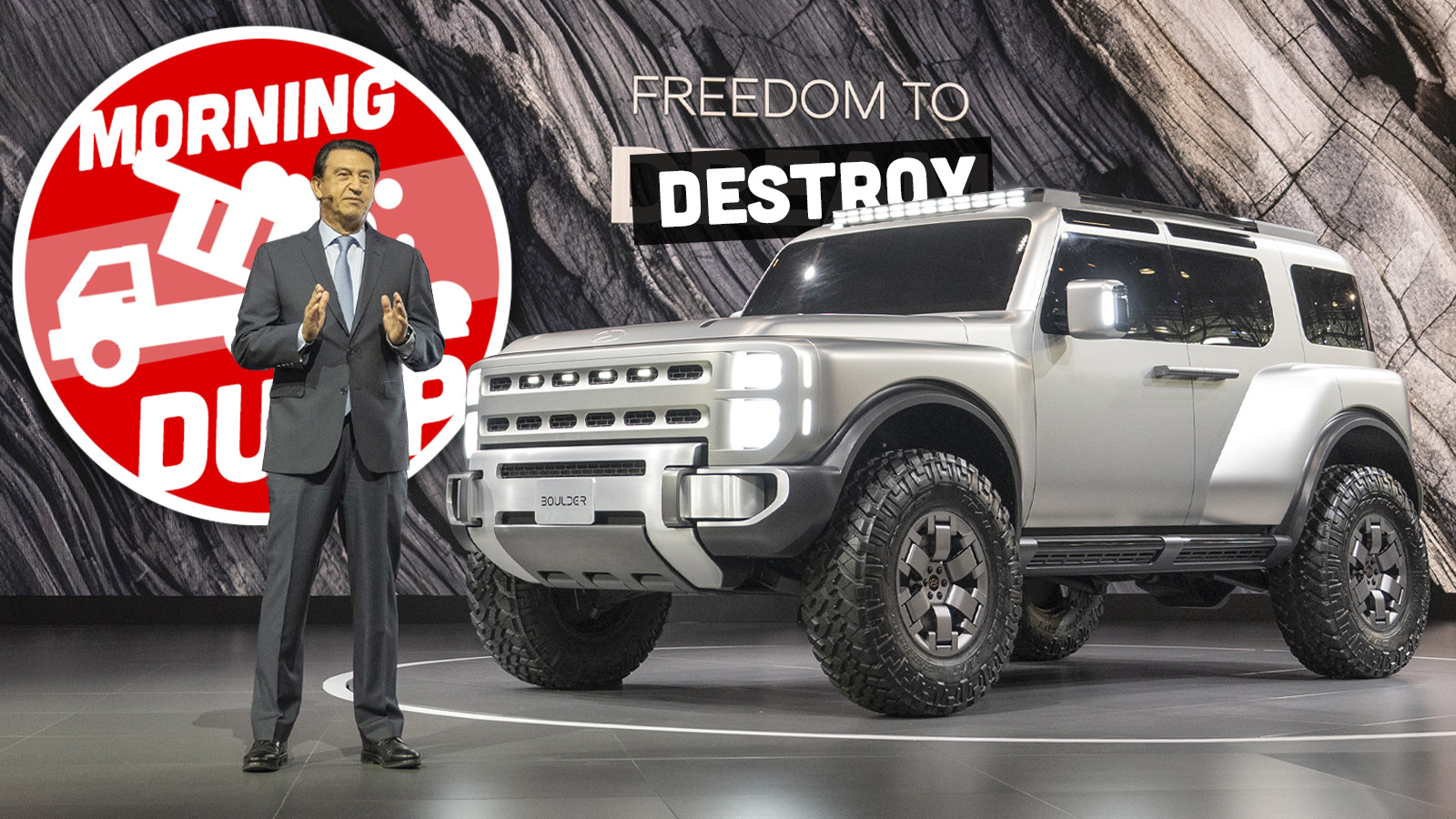
At the New York Auto Show this year, Hyundai showed the clearly body-on-frame Boulder Concept, which is essentially a Hyundai version of a Ford Bronco. While I’m sure Hyundai would be happy to nab some Bronco sales, I do think the Toyota 4Runner is the target. The same goes for the midsize truck that Hyundai is planning, which could be a real competitor to the Tacoma. And then there’s the EREV Santa Fe, which represents a great opportunity for the brand.
My whole sense of Hyundai is that it wants to find that sweet spot where it can sell a bunch of cars without sacrificing margin (the goal of all automakers, though one not every large OEM seems capable of achieving), meaning that it’s aiming way more at the space Toyota fills than either GM or Ford.
Honda Quietly Threatens To Postpone New US Plant If USMCA Isn’t Extended

Honda continues to let the current administration know that it’s likely going to be unwilling to invest the $20 billion it had slated for new production in the United States if the White House can’t the United States-Mexico-Canada Agreement (USMCA) extended.
Honda Executive Vice President Noriya Kaihara told reporters at a roundtable in Washington the automaker is close to full production capacity in North America and needs a new factory.
However, “if there is no USMCA agreement in the future, we may have to change our direction,” Kaihara said, adding the company will need to make a decision within a year or two and would like the plant to be running by around 2030.
He said currently Honda is not passing on the costs of tariffs to buyers in North America. The U.S. imposed 50 per cent tariffs on US$20 billion of Canadian products on Saturday, and Canada said it was retaliating effective September 8.
Because Honda has a decent tariff rate for its Japanese-built cars, it might, net, be cheaper and easier for the company to just import more cars, or at least easier given that Japanese automakers aren’t paying tariffs on parts its using to build cars there.
It’ll Be Years Before We Really Know If Ford Fixed Its Quality Problems

David and I got to chat briefly with Ford CEO Jim Farley in the lobby of a hotel during Car Week, and one of the takeaways is that, hopefully, Farley will come onto our podcast to explain his views on right-to-repair.
Jamie LeReau over at the Detroit Free Press also snagged time with Farley as well, and his conversation centered around the tough decision to sideline trucks until they could fix the quality. In theory, it worked, and Ford topped Lexus in the most recent J.D. Power IQS study, so the company is heading in the right direction.
Here’s a quote from that piece:
“The real impressive part of Toyota and many of the Chinese (automakers) as well, but especially Toyota, is their sustainability of what they do,” Farley said. “They never drop the ball. They never go backwards. They don’t think there’s an end. At Toyota, we had a really famous saying, that I think about every day: No problem. Big problem. In Toyota, even if you are perfect in quality and you’re beating everyone, no one is happy. You’re going for perfection.”
How long will it take? Analyst Karl Brauer tells the Freep we won’t really know if Ford actually nailed it for a while:
“The real challenge is executing high-quality new-vehicle launches and production over a period of five, 10, 15 years,” Brauer said. “That’s what Toyota has done — created a reputation for high-quality cars based on decades of producing long-lasting vehicles that suffer minimal post-purchase issues. That kind of consistency goes beyond any single person or team, because people and teams change. Toyota has mastered the art of making high-quality vehicle production a company mantra that goes beyond any single person or team. That’s what Ford has to do, and it won’t be easy.”
Check back into the TMD in five years.
August Car Sales Will Be Down A Bit, But Generally Stable
Here’s a chart:

It’s from the monthly sales estimate for August from Cox Automotive, and you’ll see it’s mostly negative. A lot of this is because last year there was a rush of buyers flocking to EVs before the tax credits ended, so the numbers are going to probably look lower in August and September of this year and then magically look a lot better in October or November.
“August new-vehicle sales continue to hold up well despite significant economic uncertainty and ongoing trade disputes dominating many news headlines,” said Charlie Chesbrough, senior economist at Cox Automotive. “High gas prices, interest rates that are trending higher, and historically low consumer confidence have not discouraged new-vehicle buyers from making a major purchase as much as might be expected. The current market continues to remind us that new-vehicle buyers today are more affluent, with excellent credit or cash reserves, and may not be as impacted by inflationary pressures as other consumers. If the economy and stock market can remain on a growing but volatile path, new-vehicle sales will likely continue to follow.”
SAAR, which is a bit more stable of a measure, is 16.3 million, which is only a little off the 16.5 million in August of last year.
What I’m Listening To While Writing TMD
There is no one single Dolly Parton song that can capture this amazing woman’s legacy, her generosity, her goodness. I’ve often said that she’s the greatest living American, and it’s impossible to imagine now who can replace her. She was an angel who shared 80 years with us flawed mortals, and the hope that cuts through all this sadness is that we now have the best case scenario for humanity advocating for us in heaven. Even though it makes me tear up every time, “Coat of Many Colors” is probably my favorite Dolly Parton song as it embraces her spirit of generosity, kindness, and her beautiful perspective on the world.
The Big Question
Who will be the three biggest automakers in the United States in 2036. In what order?
Top photo: Hyundai




TBQ
Hyundai
GM
Geely
TBQ, Slate, Ford and Hummer, that would make for an interesting mix on the road.
Traxxis
Tamiya
Kyosho
Redcat
WLToys
MJX HyperGo
Hot Wheels
Matchbox
Corgi
The Big Three of the future to me will be:
Volkswagen group. They’re gonna bounce back!
Toyota. They’re in a rough shape right now but I see them getting back to form.
GM. Never underestimate the general.
I can’t be the only one who sees Hyundai as being over-leveraged.
Why? They make a lot more than just cars, you know…
Poland Accepts First K2 Black Panther Tanks From $6.5B S. Korean Deal
Hyundai makes a lot more than cars, the CEO woke up one day and decided he wanted to make cars, so he did. He was somewhat corrupt, and in jail for his crimes until the economy of South Korea started declining, so they let him out and he really did make the economy great again.
Hyundai makes almost everything needed to make their side project of cars. They build the roads to the factories, everything to design and build the factories, the robots in the factories, the steel used in the factories, the trains to transport the cars from the factories to the shipyard, using the ships they build, powering the ships with the oil from the refineries they also build. They also build skyscrapers to work and live in, the department stores to buy everything you need and the military equipment to protect what you bought from them.
Hyundai is a huge incredibly vertically integrated conglomerate that sells just about everything needed to build and run pretty much anything you want to buy
Toyota did the smart thing by standardizing everything on the same platform – Tundra/Taco/4Runner/LC all use the same engine, same frame, same transmission.
The “good small truck” category remains ripe for the taking. Chevy had a great diesel Colorado… which they killed. Ford can’t seem to figure out what it wants to do with anything that isn’t an F-150 (Maverick? Ranger? who knows).
Hyundai, 25 years ago, was a joke. I borrowed one from a girlfriend and it was not finished anywhere as neatly as the Ford Tempo I had previously owned. It was pure driving appliance, somehow more boring than a Corolla and jankier than a Neon. *But* – Hyundai did an excellent job iterating on it. They launched a luxury brand, something I never thought was possible. The Telluride is… desired by some, as opposed to settled for.
So, Hyundai small truck? Bring it. I think the 4Runner/LC mindshare is gonna be harder to capture; lots of 4Runner owners like the weird intangibles like the rolling rear window. But plenty of Tacoma owners are squarely in the “Small truck I can pile a ton of junk on” (and that goes for the overlanders, the home repair folks, the lawn maintenance peeps, and bunches of others), and a lot of them are the same people that shop the expired-dairy-products aisle at the local grocer and will probably jump at the chance to buy a cheap Hyundai.
A hybrid with great mpg or EREV midsize truck could be a great opening for them to play in an underserved space.
If Telo can deliver on their promises, think they’ll have the best small truck. Unfortunately, they won’t sell as well because they don’t serve as a petromasculine security blanket like all the current pavement princesses.
100 new models? What constitutes a “model?” And how many of those will come to the North American markets?
I don’t think any of these companies can make any big infrastructure plans with any confidence until late 2028 at the earliest. It’s got to be incredibly frustrating and nerve-wracking dealing with the capricious crap spewing from this administration.
They could make big plans, but that is always a risk that could pay off big or lead to big losses, just look at the EV losses for that. and it’s not just in the US, even production in Europe is in turmoil.
Well, it says 50+ for NA. I’m guessing they’re counting N-line as separate, but who knows? I’m hoping that some of that “white space” is bringing smaller cars like the Inster and Ioniq 3 here once the tariff situation is resolved.
I feel like Ford is pretty Chummy with China, or at least accepting of them, I imagine there will be a merger to get Chinese vehicles into the US. Buick Style. then it will be Ford, Maybe Toyota, and then possibly GM, but I could see if Nissan sold the Titan truck stuff to Hyundai and they then actually understood and invested heavily into the truck market fully, they could get to #3.
You are seriously underestimating the brand loyalty of full size truck owners. It’s damn near a religion.
Look at how long Toyota has been in the game and then look at their full sized truck annual sales numbers.
Hyundai has a long road ahead to even reach Toyota’s numbers. A good ten years.
I am of course assuming Hyundai does not half ass the truck market. Toyota has left the work truck side as well as all trucks over half ton alone. I imagine that makes up a smaller portion of the market, but those guys that drive a 3/4 ton or better at work perhaps also end up buying the half ton or better version to get to and from work. I don’t know for sure, I am not a marketing genius, I just know that Toyota lost me when it went Turbsky 6 bangers for even the best towing rating they have, which is still not that great.
Most of the 3/4 and 1 tons I see for work are also used a commuters in my neck of the woods unless they’re part of a fleet.
TBQ:
Why? For Toyota, a well rounded lineup of popular vehicles, including trucks. For GM/Ford, I see no reason why they’d be ceding the pickup market share they have or said market will decline precipitously. There’s still a loyal contingent of domestic vehicle buyers for a large portion of the country.
Mostly, I’m curious if GM/Ford retains a significant share of the crossover SUV market in a decade or loses that to the Japanese/Koreans like they lost the sedan market.
The second question I have is if anything other than Jeep survives at Stellantis in a decade, Ram included. If there’s a path to growing truck market share, Ford and GM eating Ram’s market share seems quite plausible.
They lost the sedan market because they stopped making cars six years ago.
Detroit had ‘lost’ the sedan market by the early 2000s, as their products had to be discounted and sold mostly on the virtue of aggressive pricing rather than the inherent virtues of the vehicles themselves.
The Japanese automakers didn’t have to resort to such tactics.
A shame, as some of their sedans were really quite decent products at the end, but by that point chasing a declining market would have been a fool’s errand.
The shift to crossovers and continued reliance on trucks gave Detroit more runway than had the market remained sedan-centric.
I am curious if Detroit can keep up the competition level in the crossover SUV space, or eventually cedes that market to the Japanese/Korean competition too. After that, they’d essentially have one trick left – trucks.
Some of that had to do with inability to cover Labor and overhead costs domestically. There is a reason the maverick is made in Mexico and the old Made in the US escape is gone.
Her lesser known hit: “My Bug of many colors, daddy soldered for me…”
Tesla has increased 1000% in the last ten years in the US. A cheap FSD cybercab would make a huge difference, and I could see regulations easing in more areas.
Also, in 10 years, self driving cars could be attainable in a lot of areas. There will be a patchy map of where it’s allowed and where it isn’t.
No one else is really close to Tesla for self driving supervised cars today. Maybe Waymo will partner with manufacturers to sell a competitive product.
increasing 1000% from effectively zero is easy. How’s the next 1000% working our for them?
Tesla is increasingly uninterested in producing cars. I doubt they’ll be making any in 10 years.