

If you’re in California, it’s probably been hard to escape chatter about the “tire ban.” It’s officially the Replacement Tire Efficiency Program (RTEP), which the California Energy Commission (CEC) unanimously approved on August 18, 2026. Since then, concern is swirling about what the California Energy Commission has done, and how it will be implemented. It’s a dense subject you can’t get your arms around from soundbites, short articles, or even the few minutes a TV news feature story provides. We’re going to dig in pretty deep. We studied tire industry statements, spoke with retail and aftermarket sector representatives, and went directly to the CEC itself. Strap in, it’s a lot. And if you want to play along at home, there’s a trove of documentation here.
It’s Not A Tire Ban/It’s A Tire Ban
Despite what you may have heard about the program, the tire police are not marching. “Automotive enthusiasts should rest easy,” said Harrison Reilly, CEC Information officer. “Consumers will have access to an abundance of options for replacement tires. Our goal is to give Californians better-performing tires that save them money while preserving plenty of choices across brands, models, and price points.”


It’s not surprising that the state would be in favor of a decision made by the state. New rules about what is okay to sell have naturally led to worries and questions from the public. “I could see why people call it a tire ban,” said Christian Robinson, Senior Director for State Government with SEMA, which advocates for the automotive aftermarket industry. “They [the CEC] want to mandate that replacement tires in the state are essentially at least as efficient as [the vehicle] had when it moved off the assembly line, and they’ve come up with a rolling resistance coefficient to measure that.”

Call it what you want. Stuff that doesn’t meet the standards can’t be sold. It becomes a question of semantics; the end result is the same as a ban, whether or not the CEC sought one or not. It sure is rhetorically efficient to just call it a ban. That probably burns some asses in Sacramento.
The docket is stocked with submitted comments, some in support, but many more critical of the effort. “This legislation is a bad idea,” said Mark Skrenes in a comment submitted July 28. “Consider the possibility that by creating separate rulemaking for California you may inadvertently [be] driving up the price of tires in a way that is not captured in your economic analysis,” he said. Bryan Bergsteinsson, who identifies himself as a long-time member of the SAE and past head of product development for Toyota in the U.S. is also skeptical; “the government has no business or an effective track record on managing technology or the marketplace,” reads his comment, though he agrees that buyers benefit from information. “Rating tires for performance, yes, making decisions and taking away choice for consumers, no.”
Throughout the process, the CEC has been responsive to input from industry and individuals. “Michelin supports CEC’s proposed express terms aimed at improving tire rolling resistance and overall energy efficiency, recognizing its alignment with long-term environmental and performance objectives,” the company submitted. The tire industry made a lot of technical suggestions for adjustments to the proposed legislation, many of which were adopted into the final rules. Bridgestone said; “by integrating previous industry feedback from the initial comment period into the revised draft regulation, CEC has drafted a fuel efficiency program that is technically feasible — albeit challenging — and that advances energy efficiency goals while preserving safety, performance, and innovation within the tire industry.” The US Tire Manufacturers Association submitted 16 pages of positions and suggested tweaks in June and acknowledged the cooperative process of working with the CEC to develop the regulations; “USTMA acknowledges the Commission’s goals of improving tire energy efficiency and providing consumers with meaningful information about tire performance. These are goals that USTMA and its members share. USTMA has been engaged in this regulatory development process since its inception, engaging in public workshops, submitting comments, providing data and organizing educational opportunities for CEC staff.”
Still, the concerns about higher prices and reduced options will linger. “We wish they had gone a little bit further or even delayed it further.” said SEMA’s Robinson. “The parameters that are built into the policy give latitude for [manufacturers] to deliver real-life value and benefit to the consumer,” said Woody Rogers, senior vice president of marketing for Tire Rack. “The rules are well-written and today’s product is ready.”
As with most regulation, if nobody is entirely satisfied, it’s probably just about right.
What Is Actually Being Mandated?
Here’s what’s actually mandated, from section 3306 in the amended Express Terms in document TN271526.
Except as provided in subsections (b), (c), (d), (e), (f), (g), (h), and (i) of this section,
no tire manufacturer, tire brand name owner, or tire retailer shall sell or offer for sale in California, except as wholesale for final retail sale outside of the state, any replacement tire that has an EU correlated rolling resistance coefficient greater than the following, when tested according to the specifications in section 3303(a):(1) For tires manufactured before January 1, 2029, there is no energy performance standard requirement.
(2) For tires manufactured on or after January 1, 2029 and before January 1, 2033, 9.0 N/kN.
(3) For tires manufactured on or after January 1, 20312033, 7.1 N/kN.
That may seem pretty ban-ny at first read; let’s paraphrase it to be less stern. Beginning on January 1, 2029, replacement tires offered for sale in California must meet a target Rolling Resistance Coefficient (RRC, measured in N/kN – newtons per kilonewton, explained further below) and wet traction rating for their class. Several classes of tire have been created to cover the realities of tire efficiency for different vehicle and tire types and uses. This first phase of the program runs until 2033. Beginning January 1, 2033, RRC requirements become more stringent, and allowances for tires in categories other than the default also go into effect.
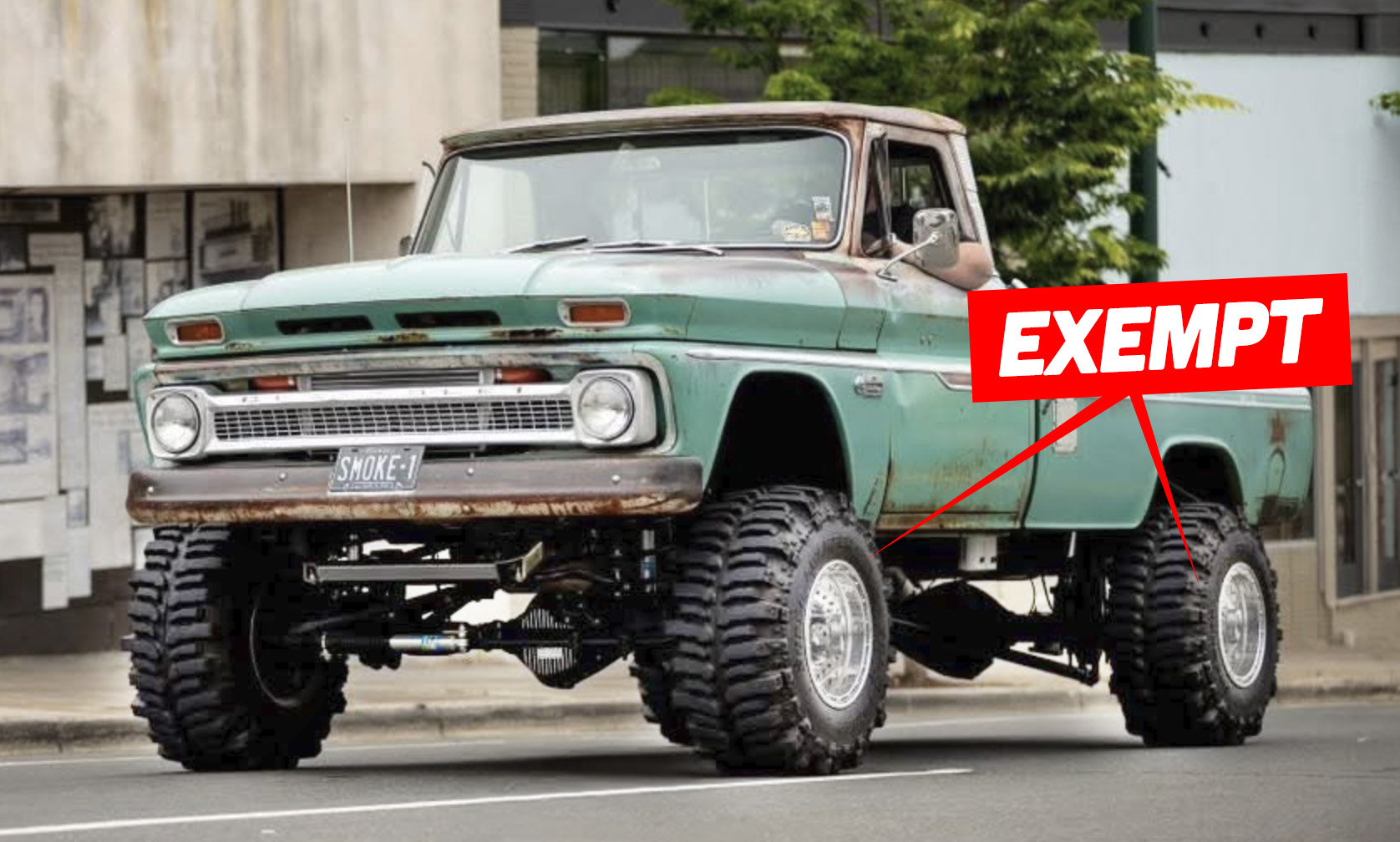
Tires have to meet the efficiency prerequisites or fit within one of the exempted categories. “Many specialty tires are entirely exempt from the standard,” said Reilly from the CEC. “These include competition tires, large off-road tires, winter snow-type tires, and all-weather winter performance tires. Niche tires are also exempted through a limited production tire exemption.”
How Do The Mandates Change Based On Type Of Tire?
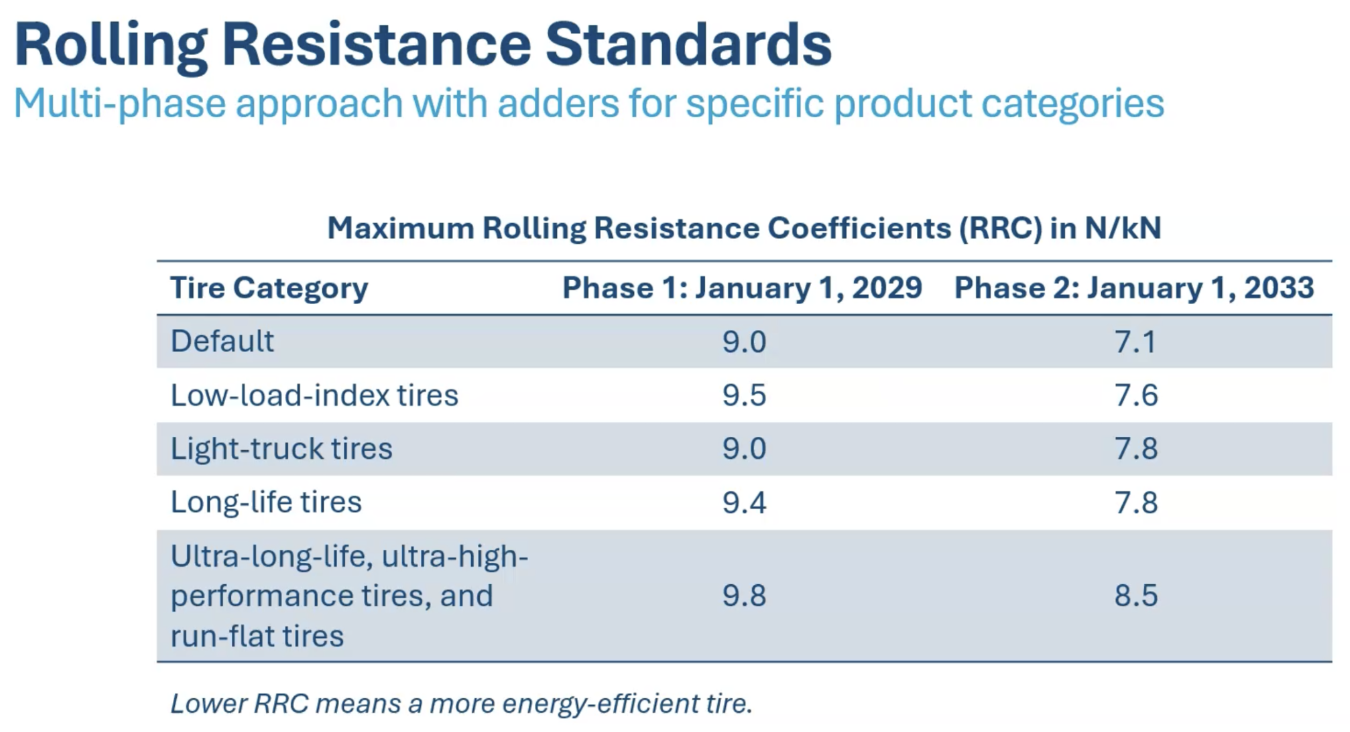
Because different vehicles need different tires – LT tires are not the answer for a Miata, for instance — the rules allow for some variation. From the Express Terms:
(b) Ultra Long-Life Tires, Ultra High-Performance Tires, and Run-Flat and Extended
Mobility Tires. No tire manufacturer, tire brand name owner, or tire retailer shall sell or
offer for sale in California, except as wholesale for final retail sale outside the state, any
ultra long-life replacement tire, ultra high-performance replacement tire, or run-flat and extended mobility replacement tire that has an EU correlated rolling resistance coefficient greater than the following, when tested according to the specifications in section 3303(a):
(1) For tires manufactured before January 1, 2029, there is no energy
performance standard requirement.
(2) For tires manufactured on or after January 1, 2029 and before January 1, 2033, 9.8 N/kN.
(3) For tires manufactured on or after January 1, 2033, 8.5 N/kN.(c) Long-Life Tires. No tire manufacturer, tire brand name owner, or tire retailer shall sell
or offer for sale in California, except as wholesale for final retail sale outside the state,
any long-life replacement tire that has an EU correlated rolling resistance coefficient
greater than the following, when tested according to the specifications in section
3303(a):
(1) For tires manufactured before January 1, 2029, there is no energy
performance standard requirement.
(2) For tires manufactured on or after January 1, 2029 and before January 1,
2033, 9.4 N/kN.
(3) For tires manufactured on or after January 1, 2033, 7.8 N/kN.(d) Low Load Index Tires. No tire manufacturer, tire brand name owner, or tire retailer
shall sell or offer for sale in California, except as wholesale for final retail sale outside
the state, any low load index replacement tire that has an EU correlated rolling
resistance coefficient greater than the following, when tested according to the
specifications in section 3303(a):
(1) For tires manufactured before January 1, 2029, there is no energy
performance standard requirement.
(2) For tires manufactured on or after January 1, 2029 and before January 1,
2033, 9.5 N/kN.
(3) For tires manufactured on or after January 1, 2033, 7.6 N/kN.(e) Light Truck and Commercial Replacement Tires. No tire manufacturer, tire brand
name owner, or tire retailer shall sell or offer for sale in California, except as wholesale
for final retail sale outside the state, any light truck and commercial replacement tire that
has an EU correlated rolling resistance coefficient greater than the following, when
tested according to the specifications in section 3303(a):
(1) For tires manufactured before January 1, 2029, there is no energy
performance standard requirement.
(2) For tires manufactured on or after January 1, 2029 and before January 1, 2033, 9.0 N/kN.
(3) For tires manufactured on or after January 1, 2033, 7.8 N/kN.(f) All-Season Winter Performance Tires. There is no energy performance standard
requirement for any all-season winter performance replacement tire.
There Are Lots Of Great Tires That Are Excluded From The Mandate
See item (f)? That’s a hidden gem. In short, anything with the 3 Peak Mountain Snowflake logo (3PMS) is exempt. Dedicated winter tires such as the Bridgestone Blizzak, Cooper Discoverer True North, or Michelin X-Ice are amazing in the snow and ice. But their soft, squishy nature leads to higher noise, reduced efficiency, and lower dynamic performance in dry and warm conditions. Across this enormous continent, it doesn’t snow enough to warrant dedicated winter tires for many people. The newer “All-Weather Tire” category still carries the 3PMS logo that means it’s outside of RTEP scope, while being quieter, grippier, and generally just normal in terms of performance.
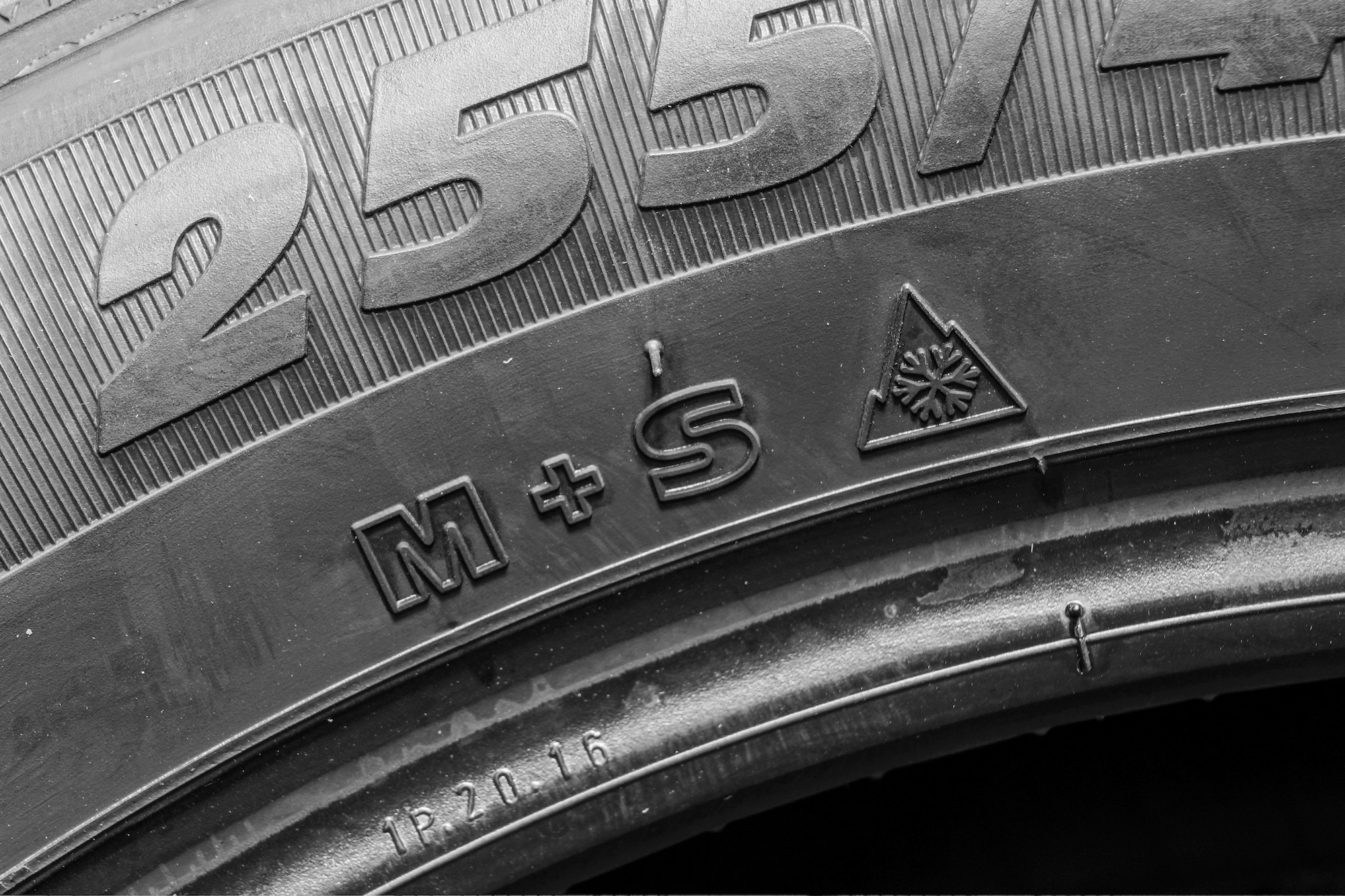
Running something like a Michelin CrossClimate, Goodyear Assurance Weatherready, or General Altimax 365 AW will be a non-event for most people. You’d probably have to look at the sidewall to discover you’re on anything fancier than a plain old all-season. Think of them as all-season tires that actually mean it; they’re able to deal with more snow than you’d otherwise expect, while also providing good wet traction, lower noise, and the durability to be installed year-round.
There’s a pretty deep list of exclusions, too, including some enthusiast favorites. Your knobbies and slicks are safe.
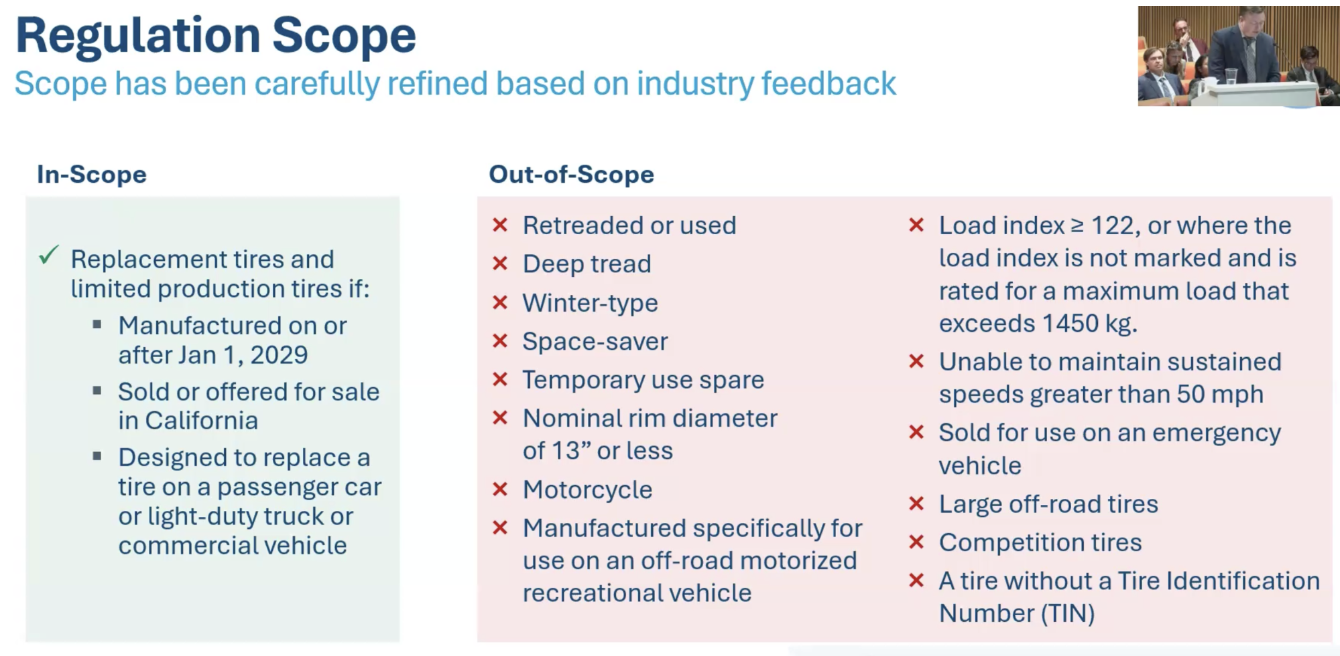
Limited Production tires – tires that sell or import fewer than 15,000 units per year in the United States. These tires can be sold in California without needing to meet the standards. The burden is on the manufacturers to certify the production or importation numbers each year with the CEC. While self-reporting may be fraught with fox guarding the henhouse vibes, getting audited and fined over a few thousand tires hardly seems worth any malfeasance.
Exempted via Petition – need some new meats for your Porsche Carrera GT? Veyron’s sitting on cracked sidewalls? If only you could get a set of proper sized Cooper Cobras for your XJ220 (white letters out, please!). A manufacturer seeking to serve these niches can petition the CEC to approve a tire that would otherwise fail to meet the criteria, so when there’s no compliant tire available, you’re not fated to a life on cinderblocks or endangering yourself or anyone else by running on vintage tires well-past the point of being safe.
Can I Still Buy Whatever Tires I Want?
Probably. “The sky is not falling for enthusiasts,” Rogers of Tire Rack told The Autopian. The company does significant business in California, thanks to both the state’s large population and its vibrant car culture. Before his marketing role, Rogers spent more than 15 years leading the tire testing program and tire information department. “I know about tires and I love tires,” he said. “What I think will end up happening is the very marginal product at the edges of the spectrum will be squeezed, or they will cheat to appear compliant.”

Other tire retailers are less sanguine. America’s Tire, also known as Discount Tire, warned the CEC about the regressive nature of cost increases. “Tires are a non-discretionary purchase,” the company said in a June 2026 comment. “Drivers cannot opt out. If highly efficient tires carry significant price premiums or meaningfully narrow the available selection, the burden will fall disproportionately on cost-sensitive consumers.” The company is concerned about cost and availability, especially once the program is fully implemented. “If the Phase 2 requirements beginning in 2031 [later revised to 2033 before passage – DR] were applied to the tires we sell in California today, roughly 70 percent of currently available options would be removed from the market,” it said.
News and other media have picked up on that estimate to fuel the “tire ban” angle, and it’s freaking people out. “I have not had [anyone] email me or call me be like, ‘oh, this is great,’” Robinson said about what people are telling SEMA. “I think there’s concern both from a consumer choice standpoint and from a cost standpoint, and that’s across the board.”
“I don’t think there’s really much of anything in our world that’s going to be impacted, especially on the first phase of this,” said Rogers, “the media is being sensational.”
As you can tell, there are competing opinions here.
[Ed Note: One concern I have is BMW i3 tires. Currently, there’s only one tire brand regularly available stateside, but every now and again MOMO Topruns come up for sale for 1/3 the price of the Bridgestone Ecopias. The issue is: The MOMOs appear to have a much higher rolling resistance. Thus, these might be banned, leaving us i3 owners with yet again only a single choice that costs $250 to $300 a tire. This would be a huge financial hit to i3 owners, especially since our cars are electric, meaning we will not gain significant money back from the increased efficiency of the Bridgestones. -DT].
Pry ‘em From My Cold, Dead Driveway
The state will not be confiscating your tires. I asked Reilly if individual owners would be subject to equipment inspections, or if having non-compliant tires on a vehicle would result in a failed inspection or fines. “Absolutely not,” he said. “We are committed to vigorous enforcement, but that enforcement will take place at the manufacturer and retailer level (including online retailers). This is similar to how other appliance efficiency standards are enforced. The scope of enforcement is at the retailer, manufacturer, and test laboratory level.”
It’s on the tire industry to live up to expectations. “The standard addresses which new tires can be sold. It doesn’t apply to a vehicle being sold or to what can be driven. The standard also applies to tires by manufacture date, so when Phase 1 and Phase 2 come into effect, the existing stock of tires on store shelves remains legal and is gradually replaced with compliant stock.”
That’s a great point about how remaining stock will be sold down.
Nothing Changes Tomorrow
Even though Phase 1 starts on January 1, 2029, don’t expect anything drastic at that time (at least in terms of automotive tires). “Today’s product at large is already meeting the [phase 1] efficiency requirement,” Tire Rack’s Rogers told me.
Phase 2 goes into effect in 2033; two-thirds of a decade from now. “It’s going to get harder,” Rogers acknowledged, “but that’s two life cycles away from where we are right now, when we look at the tire development curve. So the manufacturers are not actively developing 2033-plus tire lines yet.”
Reasonable timelines were taken into account during the rule-making. “Manufacturers have years to make updates to the remaining models through their normal product development cycles, just as manufacturers routinely redesign and improve their products,” said the CEC’s Reilly.
Robinson from SEMA voiced concerns about reduced choices and higher prices. “If you’re a smaller manufacturer, especially, you’re not going to make one set of tires for California, then one for every 49 states, you’re going to need one,” He said. “One that meets that that certain requirement. So it will have a trickle down effect one way or the other for sure.”
Cost Concerns
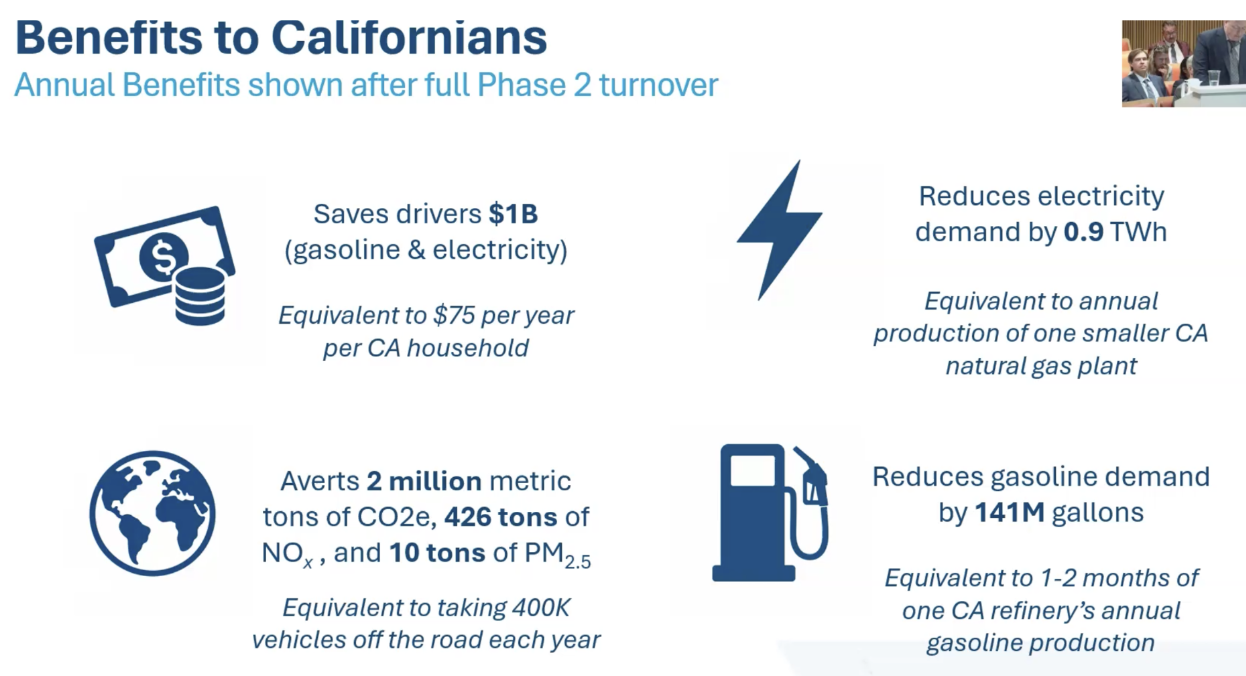
“The incremental cost for consumers is very low – only $1.50 per tire during Phase 1 (2029-2033) and $6.50 per tire during Phase 2 (2033 and beyond). A typical driver of a gasoline car with more efficient tires will save $179 of gasoline over the life of a set of tires, or about seven times the incremental cost. These savings were calculated with gasoline prices of $4.60 per gallon. At the elevated gasoline prices of mid-2026, the savings could be 25% higher than estimated.”
Some of the tire industry’s own analysis disagrees with the rosy projections. That last bit about higher gas prices making the savings even sweeter seems to ignore secondary effects. More expensive petroleum for energy and raw materials is going to make tires more expensive to produce and ship by inflating lots of line items across the budget. [Ed Note: Though this would be the case for less efficient tires, too. -DT].
Gladfelty Government Relations has represented the concerns of Goodyear to the CEC during the development process. The firm submitted comments about the cost assumptions in July, saying:
“The Commission continues to characterize Phase 2 as a low-cost consumer savings measure, estimating an incremental cost of only $26 per set of four tires. That conclusion cannot be reconciled with the Commission’s own Smithers Phase 2 testing data. The Smithers dataset demonstrates that tires meeting the proposed lower rolling resistance thresholds can carry materially higher retail prices and, in several instances, prices several times greater than many of the tires the proposed Phase 2 standard would effectively remove from the California market. Unless the Commission reconciles these actual market data with its modeled assumptions, the record does not support the conclusion that Phase 2 will reduce overall consumer costs as proposed.”
Gladfelty uses the CEC’s own data and analysis to make its point:
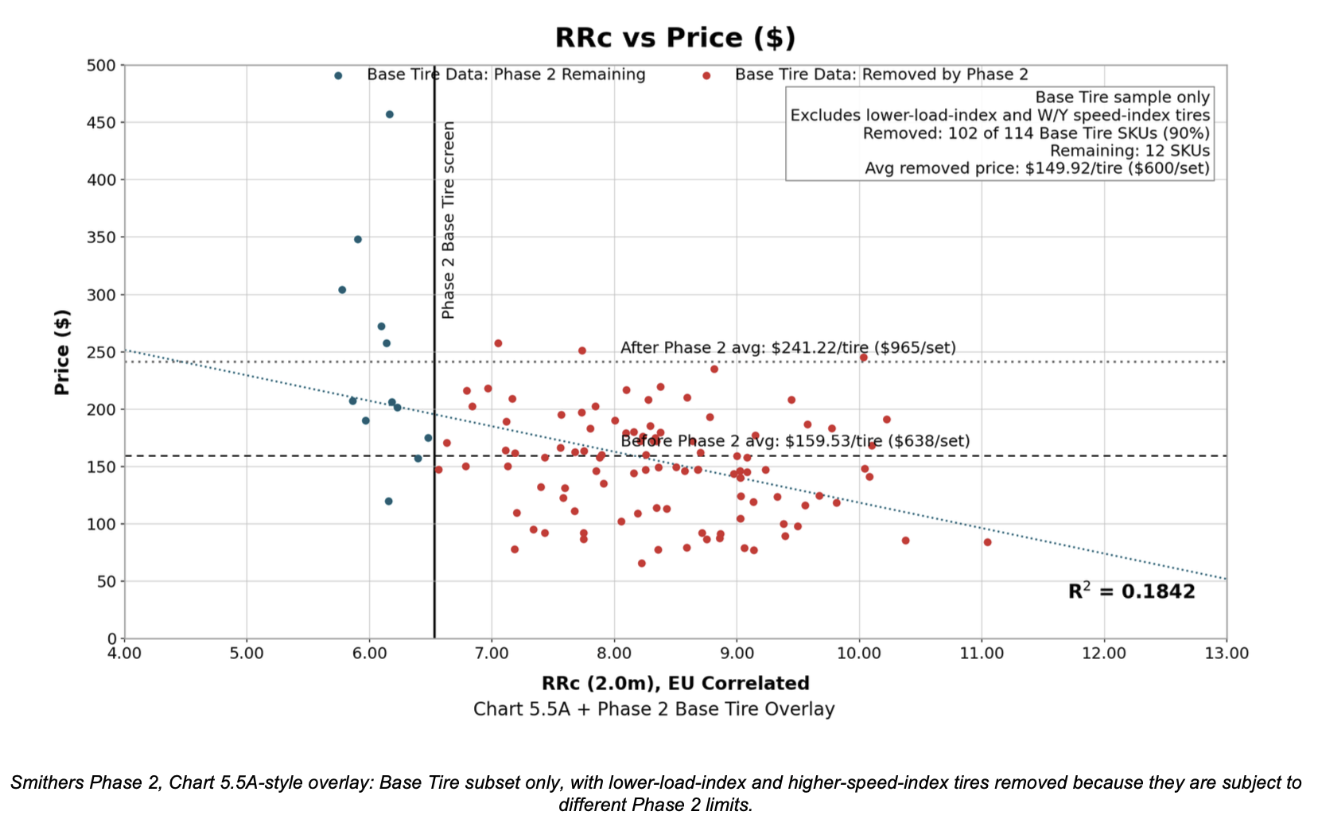
The concern is that removing lower-cost, higher RRC tires from the market will force consumers to pay a lot more, and that other costs have been left out to make the projections look better. “The proposed standard can shift consumers into a substantially higher price band,” states Gladfelty’s letter. “A household buying four tires does not experience that as a $26 change if the available compliant substitute costs $50, $100, or more per tire. Nor does CEC’s estimate appear to fully account for sales tax, installation, disposal fees, redesign costs, compliance testing, or retailer inventory effects.”

While the CEC may be trying to make it look as cheap as possible, Gladfelty may be pushing the numbers to be overly pessimistic.
“Applying the Phase 2 7.1 RCC limit to the Smithers passenger-car-tire (PCT) population shown above would remove 102 of 114 PCT SKUs (90%) and raise the average price of the remaining compliant tires from $149.92 per tire ($599.68 per set) to $241.22 per tire ($964.88 per set),”
“There is a statistically significant increase of $ 365.20 / set of tires for lower RRC tires from the CEC’s data, which is far greater than the CEC’s estimated increase of $26 / set of tires. Using CEC’s estimated $179 fuel savings over the life of a set of tires, this regulation will cost consumers $186.20.”
This goes along with the gloomy America’s Tire prediction that 70% of today’s choices will evaporate come Phase 2. Reality is likely in the middle. The 102 tires that go away today will be at least partially backfilled by other products in a similar price range, going by the prevailing wisdom we’ve gleaned from tire manufacturer and retailer statements and our own interviews. Costs may well increase, but a $100 jump in per-tire average price seems like an overshoot of its own, even though I won’t pretend to be an expert on tire prices. As for historically sticky fuel prices, well, who knows what they’re gonna do. Assume the new cheap will still be expensive.
“The CEC stands by its analysis, research, and cost analysis presented in our staff report,” the CEC’s Harrison Reilly told us. “These cost estimates were developed based on data from the U.S. EPA and NHTSA, which regularly analyze the cost of lower rolling resistance tires. Because fuel prices can be volatile, we intentionally picked a conservative value for gasoline prices: $4.60 per gallon. That number has only increased since the start of the Iran conflict, and the savings would be substantially higher at current fuel prices.”
How Will I Know What’s Good?
We’ve already been through a lot of numbers, facts, and figures; catnip for us nerds, but most people want tires that are round, black, and cheap. And if they last a decade, great!
You need to meet people where they are. That’s one of the things I learned during a decade in advertising. On my way to becoming a creative director, I learned you have to make choosing easy, and the CEC has taken all of the nerdery we’re spending a few thousand words on here and squished it into four leaves.
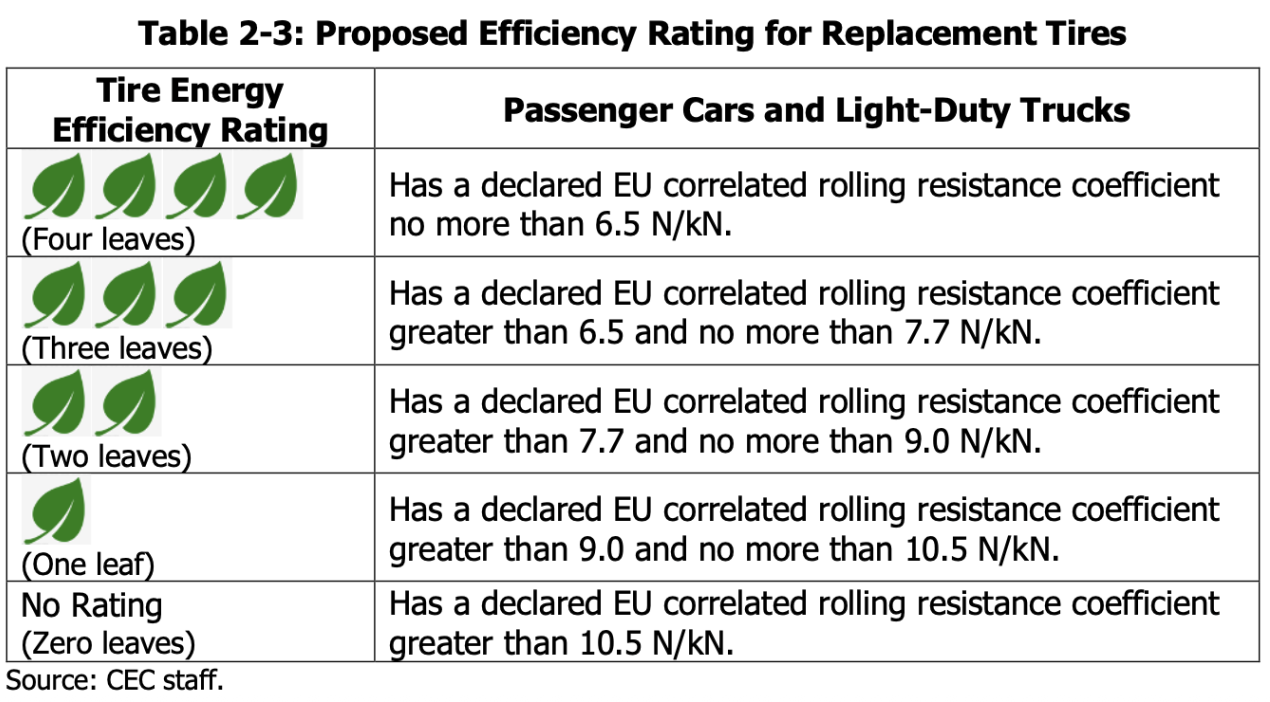
The RTEP will use a tire rating system for fuel efficiency. It’s a scale from zero to four leaves; four being the most efficient. It’s similar to the numerical-based European system that’s widely used across all sorts of consumer products, and kind of akin to EnergyStar here in the U.S., but the leaf ratings simplify comparison that much further.
Reilly explained how the inspiration came from the way the EU does efficiency ratings for much more than just tires. “The EU uses A-E to indicate efficiency level, which is a system used broadly in the EU across all products including appliances and lighting,” he said. “Consumers in the United States are not familiar with that system, so we translated it into a leaf rating (more leaves = higher efficiency) that we hope will be easier to understand. The 4-leaf rating aligns with the EU “A” level rating for efficiency, 3 leaves align with “B” and so on.”
How Did We Get Here?
The initiative started in 2003 as Californa Assembly Bill 844 (AB844), but paused in the mid-aughts while federal lawmakers tried for a nationwide tire efficiency standard as part of the now-defunct FAST act, which expired in 2021. The California Energy Commission (CEC) has spent the last six years collaboratively developing standards, rules, and processes for regulating replacement tire efficiency with the goal of creating a net savings for California car owners and reducing air pollution for all residents through related fuel efficiency gains.
Simply adopting one of the existing standards wouldn’t cut it, either. That’s why California has built on a lot of what came before, but ultimately developed its own rules. “The EU also has minimum rolling resistance targets it adopted 17 years ago, which we analyzed,” said Reilly. “The EU minimum requirements are set forth Regulation (EC) No 661/2009, with maximum RRC of 12 in the 1st stage (effective Nov 2012) and 10.5 in the 2nd stage (effective Nov 2016). Of our originally tested tires, only three products would not meet the stricter EU 2nd stage standard, and even those tires were close to meeting it. That means aligning to that standard would yield very close to zero fuel and cost savings in comparison to adopting no minimum requirement at all.”
The CEC also looked into tire efficiency rules in Japan, Brazil, China, and South Korea. That research has informed the final RTEP standards.
The Actual Standards
“CEC substantially aligned with EU requirements for a rolling resistance rating system and, to a large extent its testing procedures,” Commission Information Officer Reilly told us. The RTEP efficiency standards balance maximum rolling resistance with minimum wet grip. Tires are evaluated against a standard reference tire (as defined by ASTM F2493-2420) using the ISO 28580:2018 procedures as its main test. “We tested 537 tires,” said California Energy Commission Chariman Hochschild.

Tire Rack’s Rogers explained the methodology: “It’s around a reference that is standardized, so you have a point of comparison.” Coefficients make comparison quicker and easier. “These values are essentially connected to the tire you’re considering versus some kind of a reference. And it creates a coefficient. If it’s one for one, then it’s as good as the reference,” Rogers said. “The rules are all written that it has to be, you know, some value or better relative to a reference.”
Essential Definitions
This is how the CEC defines the terms and measurements tires are evaluated by. They will be mentioned a lot in the coming text, so this is what the shorthand means.
Rolling resistance coefficient (RRC) means the ratio of the rolling resistance
force, in newtons (N), to the load on the tire in kilonewtons (kN) as calculated
pursuant to section 3303. [Ed Note: This just the F = mu*N equation you learned in physics. -DT].Rolling resistance force means the loss of energy (or energy consumed) per
unit of distance traveled. The unit conventionally used for the rolling resistance is
newton meter per meter (N m/m). This is equivalent to a drag force in newtons (N).Run-flat and extended mobility tire means a tire structure provided with
technical solutions allowing the tire, mounted on the appropriate wheel and in the
absence of any supplementary component, to supply the vehicle with the basic tire
functions as verified by ISO 16992:2018 and labeled as such on the tire sidewall.Smaller truck and bus tire means a truck and bus tire with a load index of
121 or smaller or, where the load index is not marked, a maximum load of 1,450 kg
or lower.Sold or offered for sale in California means any sale of or offer to sell a
replacement tire or limited production tire for end use in the state, regardless of the
seller’s physical location, and includes, without limitation, internet, telephone, and
mail order transactions. For purposes of this Article, the Uniform Commercial Code –
Sales (Division 2 (commencing with section 2101) of the Commercial Code) does
not define “sold or offered for sale” or determine where sales or offers for sale occur.Space-saver tire means a temporary use spare tire of reduced size for
fitting in a confined space.Substantial change means a revision to a basic model’s declared tire energy
efficiency rating, relative wet grip braking performance index range, or qualification
for an applicable definition, performance standard, or exemption under this Article.Temporary use spare tire means a tire with a “T” in the size designation
under the ISO 4000-1:2024 specification, as incorporated by reference in section
3305, that carries a T designation on the tire sidewall and is intended for temporary
use.Tire energy efficiency rating or “leaf value” or “leaves” means the rating
under section 3307 based on the test method set forth in section 3303.Tire size designation means the nominal section width, nominal aspect
ratio, and rim diameter of a tire.Ultra high-performance means a tire that both bears a speed category
symbol of “W,” “Y,” or “(Y)” and is capable of maintaining maximum speeds of
168 miles per hour or above, and that has a relative wet grip braking performance
index of at least 1.45.Ultra long-life means a tire with a UTQG wear test score of 1,400 1,000 or
higher, as evaluated according to the treadwear rating conditions and grading
procedure in 49 Code of Federal Regulations part 575.104(e) (2023October 1,
2024).Used tire means a tire that was previously sold for end use, was previously
mounted on a motor vehicle for more than 24 hours, and is disclosed as being a
used tire when it is sold or offered for sale. Tires mounted on a motor vehicle when the vehicle is sold or resold are used tires within the meaning of this definition
regardless of whether they have been mounted for more than 24 hours or disclosed
as being a used tire when the vehicle is sold.UTQG is an acronym for the Uniform Tire Quality Grading System of the
United States Department of Transportation, National Highway Traffic Safety
Administration.Winter-type snow tire means a tire that has all the characteristics of
subsections (A), and (B) of this definition. A tire subject to the UTQG
standards is not a “winter-type snow tire.”(A) Attains a traction index equal to or greater than 112, compared to the ASTM
F2493-20 standard reference test tire when using the snow traction test on the
medium pack snow surface as described in ASTM F1805-20.
(B) Is equipped with studs or is marked with an Alpine Symbol, specified in the
Federal Motor Vehicle Safety Standards at 49 Code of Federal Regulations part
571.139 S5.5(i) (October 1, 20243), on at least one sidewall
Let’s Talk About The Testing
California is also not reinventing the wheel. To establish the RTEP standards, the CEC leaned on what’s already been done by the International Standards Organization (ISO), ASTM International (formerly American Society for Testing and Materials), and existing international testing methods and tire efficiency regulations. The RRC measurements are EU-correlated, meaning California’s numbers match up with larger programs in other global regions. Others have been here before us, and that harmonization helps tire manufacturers deliver what’s needed worldwide as efficiently as they can. In other words, there’s overlap.
The most heavily relied upon testing methods were:
- ISO 28580:2018 Passenger car, truck and bus tyre rolling resistance measurement method — Single point test and correlation of measurement results.
- ISO 23671. Standardized method for testing tire wet grip braking performance index relative to a control tire.
- ISO 15222:2025 was used to test light truck tires for wet grip braking performance.
- ASTM F2493-2420 Standard Specification for P225/60R16 97S Radial Standard Reference Test Tire. This is what candidate tires are compared against.
The ISO 28580:2018 test measures rolling resistance. The RTEP uses this testing to calculate the rolling resistance coefficient (RRC) for each tire, and it’s the same test and calculation used by Europe’s efficiency standard. It’s big and complicated, involves a lot of steps and a lot of algebra. To truly understand it warrants an article on its own. Here’s a short snippet from a single subsection:
Measurement Method. The reference laboratory shall measure each
alignment tire four times and retain the three last results for further analysis, in accordance with Section 7 of ISO 28580:2018 and under the conditions set out in Section 6 of ISO 28580:2018. The candidate laboratory shall measure each alignment tire (n + 1) times, with n being specified in subsection (a)(2)(F)(iv) of this section and retain the n last results for further analysis, in accordance with Section 7 of ISO 28580:2018 and applying the conditions set out in Section 6 of ISO 28580:2018.Each time an alignment tire is measured, the tire/wheel assembly shall be removed from the machine and the entire test procedure referred to in Section 7 of ISO 28580:2018 shall be followed again from the start. The candidate or reference laboratory shall calculate:
1. the measured value of each alignment tire for each measurement as
specified in Section 9.2 and 9.3 of ISO 28580:2018 (corrected for a
temperature of 25 °C and a drum diameter of 2 m);2. the mean value of the three last measured values of each alignment
tire (in the case of reference laboratories) or the mean value of the n
last measured values of each alignment tire (in the case of candidate);
and3. the standard deviation (σm ) as follows:
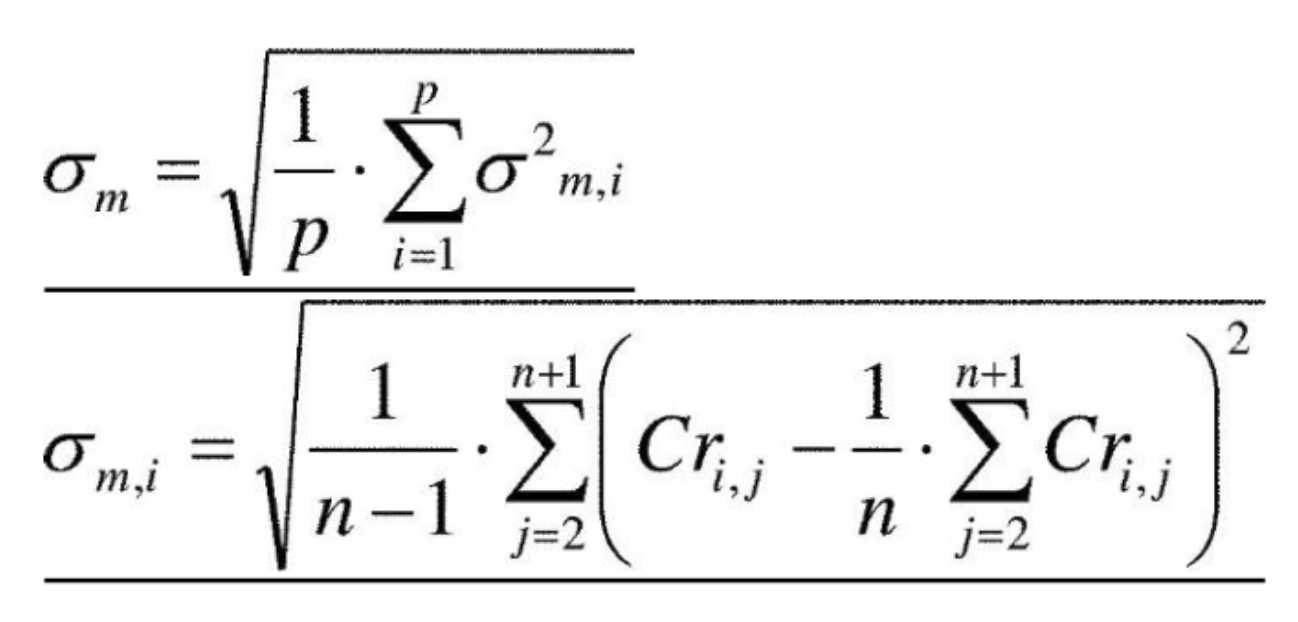
where:
i is the counter from 1 to p for the alignment tires;
j is the counter from 2 to n + 1 for the n last repetitions of each
measurement of a given alignment tire;
n + 1 is the number of repetitions of tire measurements (n + 1 = 4 for
reference laboratories and n + 1 ≥ 4 for candidate laboratories);
p is the number of alignment tires (p ≥ 5).Existing Federal Motor Vehicle Safety Standards definitions were used, as well, from Title 49, Subtitle B, Chapter V, Sections 571, 574, and 575:
-
-
571.139 – Standard No. 139; New pneumatic radial tires for light vehicles
-
574.5 – Tire identification requirements
-
575.104 – Uniform tire quality grading standards
How Much Less Efficient Aftermarket Tires Are Than Factory Tires, On Average
The CEC asserts that OE tires are tweaked for efficiency, and that even the same brand and model of tire as a replacement may not be as efficient. Moreover, the CEC says this gap is costing people money.
They’re not just vibing on opinions. Smithers International, a well-known testing lab, was engaged to do serious testing to determine that the average replacement tire has a rolling resistence coefficient (RRC) of about 8.5 N/kN; higher than the average OE tire RRC of 7.1 N/kN.
To put the N/kN (Newtons per kilonewtons) simply, it describes the amount of energy consumed by the tires’ hysterisis; the way they squish out of round due to their viscoelasticity. In other words, tires are not rigid, and they are constantly deforming as they roll. The amount of energy consumed by this deformation can be measured and expressed in N/kN. And that figure can correspond to the RRC.
What Must be Done to a Tire to Meet These Standards?
For some tires, nothing. Those are the ones that already meet the standards laid out in the RTEP. The adjustments for other tires will vary depending on what needs to change. Tread pattern, compound adjustments, and physical construction are the main categories with some adjustment possibilities.
Rogers explained that the state of tech in the tire industry now means that smaller companies can get started making great tires very quickly; it’s not just the big, old giants that can do it anymore. “There have been really significant advances in manufacturing and what tires can do in these last 5 to 10 years,” he said. “Tire manufacturing, the mixing and building capabilities, simple tire design capabilities, and what it takes to design good tires, you know, anyone with a with some simulation software and a couple of smart engineers can start [designing] really great tires.”
Possible Skullduggery
Reactionary talk in response to regulations is common. “I’ve had people joke like, oh, I’m just going to set up my auto shop right at the border of the Nevada and invite people to come change their tires there,” said Robinson. People who can skirt the rules will do it; lots of cars with Massachusetts license plates dip into southern New Hampshire for tax-free shopping, for instance. It won’t be many overall; the expense and hassle is likely to chill follow through.
As tire industry comments pointed out, tire manufacturers insulated by geography may attempt to game the system. There are safeguards in place; the limited production exemption, for example, is based on nationwide importation or production totals of a base tire model. It’s not as simple as changing the brand or the tire name after 15,000 units. If two tires are the same base tire model, it’s the underlying design that counts.
The self-reporting nature of the program means there’s the possibility of getting away with something, at least for a while. But there are enforcement teeth, and the CEC has experience overseeing these types of programs for positive outcomes.
Spokesperson Reilly said: “The CEC has decades of experience enforcing energy efficiency standards for lightbulbs, TVs, computers, air conditioners, battery chargers, and many other consumer products. To ensure a level playing field, our enforcement team takes dozens of enforcement actions against manufacturers and retailers, including those online and based outside the U.S.”
“The CEC will require manufacturer certification to a CEC database of approved tires under penalty of perjury, verified through independent laboratory testing and mandatory provision of test reports. Retailers may only sell compliant tires listed on the CEC database, verified through physical and online market surveillance. When noncompliance is identified, the CEC will issue notices of noncompliance and take legal action as necessary.”
Keep Rolling
Regulation often has an uphill challenge; nobody loves being told what to do, or the possibility of less choice. This doesn’t appear to be that. Love it or hate it, we hope you at least understand the Replacement Tire Efficiency Program a lot better now.
Top graphic images: Toyota; California Energy Commision


I would like to know tire rolling resistance, among other specs, when buying new tires. However I don’t approve of government mandates.
My FR-S came stock with Prius tires, but I was more than happy to replace them with higher rolling resistance PS4’s.
Why do people so often say this? The FR-S and BRZ came equipped with Michelin tires and the model name had the word “Primacy” – but it was a summer tire though! The Prius doesn’t come with summer tires!
Some car reviewer started it. There was one 86 trim or package that had the same tires as the Prius or something and that became “they have Prius tires!”
As if it matters. It’s one of the most magnificent handling cars ANYONE can afford and you can always put whatever tires you want on it.
I am generally for consumer protection, and tires are a huge safety item, we shouldn’t have janky tires out there for sale so I like this idea in theory. BUT this also seems to impact the lowest income people who can barely afford tires at all to now get more expensive tires. They probably won’t realize the fuel savings entirely either as they may not keep the car long enough (though hopefully their next car also has lightly used efficient tires to essentially carry that savings?).
I have become a bit of a tire snob so my initial reaction to this was GOOD! but I also remember being the person who literally sold cars once the tires were worn down as the cost of replacement tires (even the cheapest ones) was worth as much as the car since I didn’t have spare money.
Also,
From an enthusiast standpoint where I like my high performance summer tires. I feel like this would really impact those options outside of OE sizes (which I never run as I always go larger). I don’t believe those high performance summers are part of the racing/slick exemption, so I am interested to see how this works out for all those Super 200s. I don’t live in CA so it’s currently just a thought experiment from my standpoint but I hope this goes well (as in, actually makes cars more efficient, produce less tire emissions, and has a negligible impact to tire cost), but I just don’t see how they thread that needle.
Yeah, the regressive effect is my biggest concern.
The rule-making isn’t a one-and-done. There are built in review and adjustment cycles (every three years, I believe), and if there is a more acute problem, it can and definitely will be raised within those cycles.
Regulation is hard. It’s never perfect, and people immediately diagnose all the problems and risks they see.
I’m not giving anyone a pass. The public SHOULD look at this with a skeptic’s eye. But the state also SHOULD regulate. And it should definitely protect the most vulnerable; so I hope everything calms down and this delivers positive results.
CARB and EPA emissions requirements and equipment on automobiles was derided as “emissions crap” by all the old timers when I was a kid. On the other hand, I have enjoyed breathing, so…I never saw it that way. They just didn’t like change, and early systems had pretty drastic tradeoffs. But it got better.
It wouldn’t have gotten better without the regulations. We’d have stinky carbureted barges that turn into a meat grinder in crashes. Instead, we have V8s with like 800 hp and superchargers and stuff.
The “lowest income people” aren’t entitled to inexpensive brand new tires. They buy the cheapest Chinese crap at Walmart, or they can buy good used tires from Craigslist or Facebook Marketplace.
Low income people ought to prioritize figuring out how to become middle-income people. Also, buying four-dollar+ energy drinks at the AM/PM and smoking a pack a day (for those who do) will keep their pockets empty.
I’m not pointing fingers or being snooty. I had lean times while putting myself through college, but I never begged or complained.
Now that electric bicycles are easily available, getting around in town for almost nothing is easy, except in bad weather.
Having too many kids, though, is a great way to keep yourself chronically worried about money.
Wow, you’re really wrong here in a lot of ways.
If I’m wrong, then the lowest income people ARE entitled to inexpensive new tires, should not try to move up the economic ladder, should spend what little they have in their pocket on cigarettes and expensive energy drinks, should not use electric scooters, which are terrific in bad weather, and should have too many kids, because kids don’t cost very much to raise.
Kindly let us know how I was wrong “in a lot of ways”.
Nope, not doing this here.
What if someone from Big Bear wants Mickey Thompsons for the winter?
I may be old and dumb, but isn’t Newtons/kilonewtons 1/1000 by definition?
If it was just a units conversion.
This is measurement is Newtons of friction resistance opposing the direction of travel (drag) per kilonewton of down force (weight) on the tire.
Dan:
The CEC is telling me that they are SOOOOO much smarter than I am that they know what I really want. They don’t even appear to have factored in the time value of money, nor do they address that for some people the extra $450 for tires will be financed at 20% interest.
But when you wrote
I wrote you off as either a liar or an ignoramus.
Why? Gladfelty gives his source and the CEC does NOT. Gladfelty is basing his estimate on the sales numbers of tires, while the CEC is obviously lying. And I know the difference between being ignorant and mistaken and being a liar.
When I buy bicycle road tires my number one criteria is rolling resistance. Then comes puncture resistance, and then comes everything else. There is a wonderful resource for bicycle tires https://www.bicyclerollingresistance.com/ that tests tires with a standard procedure and rates them. I know of no such source for automobile tires available to the general public.
I have been burning through a set or two a year. I have tried higher RR tires a time or two. Mostly on touring bikes. I’m now running the lowest RR tires I can find. And even on a bicycle the cost difference is maybe $50 per tire.
If I lived in California, my truck (Moby Dick: the great white whale… an F350 flatbed) is exempt. It has pure off road tires to be able to drive to my construction site.
For the family car the primary thing I care about is tire noise. Then traction. Then down in the noise is the total cost of ownership.
That car burns about 175 gallons a year, mostly at speeds above 70 MPH. Aerodynamic drag is probably 65% of the energy budget. Rolling resistance is a minor issue for me, and certainly not worth giving up noise level or traction.
Simply , the delta between Gladfelty and the CEC is so large that it indicates they are staking out extremes aligned with their messaging.
Correct. But Gladfelty stated where his estimate came from. I have not seen CEC’s source, but I’m guessing it came from Bandini.
I’m close to needing tires on my car: the 225/50 17 is now a mid-range size. The lovely Michelin LRR tires are selling for around $220 each.
That size is available on Tirerack for around $100 in cheap tires. Looking at LRR tires on Tirerack the median price is around $200.
I think I know who is fudging the data…
Here you go, Chapter 8: Californias Proposed Replacement Tire Efficiency Program
If you need tires now, just get them. Or get them next year. Or the year after that. This doesn’t start until 2029.
Or one is realistic and the other is completely in la-la land. That’s the thing about deltas, they can tell you about precision but cannot make any claim to accuracy.
My point about the delta being so wide is that it usually indicates that both sides of whatever issue are working the numbers in their favor, and the truth lies within the opacity. I’m not saying it’s in the middle, but we know it’s not either extreme, either.
No, it does not usually indicate anything, and we have no idea that it’s not well past either extreme. For all we know CEC is vastly understating savings, or Gladfelty is understating the costs and the reality is actually outside both positions, which would actually make one position reasonable and not an extreme.
In this case, I would bet a decent chunk of money that sadly Gladfelty is understating how badly this will gouge cheap tire buyers (ie- they won’t exist because companies won’t sell cheap tires in CA anymore) and the CEC is, as usual for a CA gov entity, completely full of bovine excrement.
Gladfelty’s application of statistics on that data is a travesty.
He’s definitely using the data to make a pre-concieved point.
Lies, damn lies, and statistics.
Where did the CEC numbers come from? Looking at Tirerack they look like bullshit.
Here you go: Smither – Summary of Tire Testing Phase I
Not included in the cost estimate is the cost of the program, extra employees and labor at CEC and the cost of testing for the tires.
CEC is not testing the tires. Manufacturers are, and certifying.
Do any of them post their numbers? I’ve seen broad class ratings, but nothing to compare within each class.
And does anyone know of an independent source for automotive tire characteristics? Something akin to the bicycle rolling resistance web site? They post the wattage needed at different speeds and tire pressure assuming a fixed down force.
I’m aware that BRR uses a metal roller and that may impact the numbers they provide, but I would like to see some real numbers on noise levels and traction.
I think the fact that there is no independent source for automotive tire characteristics is also sorta the point here. We don’t have a measurement regime, and anyone who wanted to set one up independently would have to test everything available themselves to whatever standard they cooked up, or you can find any test data out there from tires being tested to the various ISO standards. Of course, tires sold in Europe or Japan will have published efficiency ratings for the EU or JATMA tire efficiency programs, and they use ISO standards, so the tests correlate between each other.
The great thing about the CEC doing all of this work, is that all the research is public, given that the public paid for it.
Here’s the results of Smithers testing the tires as part of the RTEP development: Smither – Summary of Tire Testing Phase I
Looking at chapter 8 of the document you linked I see the source for everything listed as “CEC staff”… So, trust us! We’re from the government and we are your friends.
Everything is footnoted and sources are either links or named.
You have to read the docs closely. There’s a lot of information and then you have to back up to the sources.
This is how a reporter writes an article 😀 – If you want to shoot darts or disagree, cool. But go do the research first.
CEC has employees that spend time on the program.
This looks to me like it will add a disproportionate cost burden to those with: a) the highest need for inexpensive replacement tires due to having to commute for work, and b) the least amount of income to cover that increased cost. It’s almost like politicians are out of touch with the people they “represent” and just want to be seen doing something to improve green initiatives so long as they won’t effect them in their BMW. In case you can’t tell, I’m a little bitter about, and VERY sick of, politicians not giving a shit about their constituents, not for anything car related where I’m at. Anywho. . . Is this the end of the world? No. Is it still an asinine exercise in politically motivated robbery and blatant coercion? Most certainly. Not that where I am is a whole lot better with its whole 70s cars have to meet 80s/90s emissions standards crap that I’ve dealt with.
Good luck to everyone stuck behind the granola curtain. I feel for you.
It does seem like a whole lot of effort for such little gain. Like maybe the money could be better spent on other efficiency gains if they really care that much.
Like perhaps re-incentivising small cars rather than the EPA’s footprint rule that incentivised mobile office buildings with frontal areas worse than a 747?
Exactly, maybe a reverse footprint tax credit. An added benefit is the small cars are likely being bought by those with less income.
I like it.
It seems like for most people, this will be a nothing-burger. For those of us that like sporty tires in OE sizes, this might be more difficult. I wore out my stock LRR tires on my Bolt EV with 1500 miles on them at the track (fun and slippery), but now put on DWS 06+. From what I understand above, I would not be able to do that in the future. BUT I think the DWS06+ have the Snowflake, so they might be exempt? Is all (Ultra) high performance summer tires banned if your car was not originally equipped with them? I have a feeling once this goes into effect and the good-ol boys with fun toys can’t buy stickier tires for their cars, this will be rolled back.
Laws and regulations are almost never rolled back. Maybe the good old boys will head to Nevada.
My only really big concerns here are A) Sticky tires in older smaller sizes may go away, and B) the terrible cheap options have their place for folks who can’t afford better. I already see too many cars in CA with cords showing through.
Doesn’t make a ton of sense. But it almost sounds like testing what tire shops are selling as oe equivalents. Will be interesting to see if it costs consumers more. Michelin and Bridgestone being so excited about it doesn’t exactly give me a warm feeling. Someone should probably check on finances coming from them to people that might have had influence.
All weather tires have come down in price and work great if they aren’t included and you can still get the Vietnam or other Asian tires cheap then it’s probably will amount to nothing for most people. Proving an EV or hybrid tire is more efficient then oe while still providing traction could be good if doesn’t add much to cost. Consumer protection is one thing if this is done right maybe that’s what it is but if it gets in the way of consumer choice then could be problematic. These things have a way of expanding scope by the people chose to lead them. If it breaks California containment it could be a huge issue. Especially if they get into regulating the all weather tires.
Like most people seem to here, I’d prefer just having the information handy rather than having cheaper options taken away. That said, this whole thing isn’t as bad as I thought it was. Thanks for the very comprehensive article, Dan!
This seems a bit heavy handed instead of just requiring that RR number be published but that is California for you. As an EV driver I would love to see real number published for rolling resistance and wet traction for all tires on the market so I can make an informed tradeoff. I will need a new set soon and want better wet grip than the conti procontact rx stocks and it would be great to have real data to figure out how much I gain and lose with each option.
Pretty sure the leaf rating makes it very easy, and the RRC and wet traction rating will be delineated
If that was all they did we wouldn’t be here right now, pretty much everyone agrees more info would be good. It’s everything else they are doing which is bad.
I was surprised by how thoughtful the process was, actually, and how much input they sought and incorporated
Neither of those are all that good in my opinion. There is not granularity to compare within a class.
Tirerack does some testing, but as far as I know they don’t cover tires that they don’t sell. Fair enough, and better than a hand wave and a wink and four leaves on the sidewall.
This is kind of a low-quality source: https://toptirereview.com/tire-rolling-resistance-data-bank-comprehensive-guide/
There was earlier testing I found done by Environ that listed results by individual tire, but it’s from 2008, so I wouldn’t consider those results timely anymore.
if you’re TRULY interested in the individual model test results, I’d suggest contacting the manufacturer and asking if they have the ISO 28580(2018) and ISO 23671(2021) test data for that particular tire they can share with you.
MOST people want to go the other way – less data, easier shorthand. So…I kinda think you’re having fun here being a contrarian. Which I also enjoy. But I think your best bet is to go ask for what you’re looking for from the tire companies.
OR – if it’s an internationally sold model, please note that the RTEP leaf ratings are correlated with the EU’s number-based efficiency ratings (noted in the article) so you can just look up the tire you’re thinking of and see what its EU energy efficiency rating is and that will help you understand right now, today.
I don’t think currently there is a publicly accessible database of tire models sold in the U.S. that has this info. It exists in different reports and of course manufacturer testing data, but that’s all behind paywalls or confidential.
Some of the Smithers reports are like $7K+ – not an uncommon price for that kind of testing and analysis, but more than most individuals are going to pay (because it’s more info than they’re ever going to need or do anything with, too. It’s very specific)
I now need to go to Nevada to do my tire changes. fun times
Vegas -no big. Or Lake Tahoe. I can do that every 5 years. Take that commies.
TireRack offers a discount if you pick up your tires at a distribution center. There is one in Reno/Sparks.
Discount Tire headquarters is in Phoenix, not too far from LA.
THANK YOU to the Autopian and this author for researching and writing a thorough and non-hyperbolic article on this topic!
This would be a huge financial hit to i3 owners, especially since our cars are electric, meaning we will not gain significant money back from the increased efficiency of the Bridgestones. -DT
Do you charge your i3 with free electricity? If you are paying for the electricity, and if the Bridgestone tire is more efficient (lower rolling resistance) than the MOMO tire, then you will be spending less money on electricity with the Bridgestone vs the MOMO. Example: My wife had a leased 2017 Chevy Bolt EV. Her driving range was approximately 200 miles when the car was equipped with the factory-installed Michelin low rolling resistance tires. At around 45K miles, the Michelins were getting thin so I replaced then with a new set of Yokohama tires with BluEarth technology. Even though these tires were ostensibly a “fuel-saving” tire, her car lost approximately 20 miles of driving range on the Yokohamas vs the factory Michelins. I wasn’t tracking the cost of electricity, but the loss in range indicates that the car was traveling a lesser distance per kW/h.
13″s or smaller are exempt. Automakers, you have until 2023 to shift your production entirely to models with 13″ or even 12″ tires!
Let the 5 year old kei imports begin. Plus the tires because those can be hard to find.
Nissan is ready. Their cars are already Rollin on 4 space savers.
Wow! $75 per year! What a savings! Especially in California where that massive pile of cash will buy you, what, half a tank of gas?
If that…
https://www.youtube.com/watch?v=A7z3J8CLlC8
Really helpful if you agree with his definition of “better”…
Aren’t rolling resistance and grip performance diametrically opposed? So yeah this sounds like the opposite of better performing for anyone who needs grip. Do they want us all to drive around on slippery tires that let you spin out easily?
today’s LRR tires are not yesterday’s. And it’s not that “every tire must be LRR” it’s that “every tire must meet an rolling resistance coefficient spec” – if your tires *need* to meet the rules (high performance tires, are, as we have all noted with varying degrees of precision, exempt), the RRC and wet braking grip are what matters. If your gumballs can hit 9.0 or 7.1 N/kN while also straining your neck muscles, you’re good.
Yes, wet grip and rolling resistance are somewhat opposite. That’s kind of the point.
Discount Tire: big mad because Senturys are fucking garbage and they know it.
It’s extra weird because they are also Tire Rack, and that guy – assuming he’s speaking in an official capacity – seems pretty chill about the whole thing.
Devil’s advocate: the worst new Sentury is still a hell of a lot better than many tires I’ve seen out in use in the real world. We got people in early 2026 with cords showing, saying they weren’t getting tires today because they already have their 2027 budget planned out. I understand it; I was that broke while I was working there; far be it from me to poverty shame or even want to do so.
I will, however, shame people looking immediate personal and public hazard in the face and thinking that God was just gonna spirit them through a trouble-free year of driving on steel belts.
I’m here for the Sentry hate
Can I still get new donut spares in case I buy an Altima?
I believe they come with three already installed and a pile of zip ties and duct tape to hold your bumpers on.
Around here they just leave the bumpers on the side of the road.
In completely unrelated news, Discount Tire just announced they will be opening Discount Tire and Casinos in Reno and Las Vegas in 2029. $50 casino credit with purchase of 4 tires and installation!
Tire Rack has a warehouse just outside Reno…with will call
Last time I bought tires from tire rack, it was actually a full set of winter tires mounted on steel wheels, I saved myself 100 bucks by driving to the warehouse in Windsor Connecticut versus having them shipped to me in Massachusetts
Yeah, loopholes big enough to drive your lifted truck with low-profile super swampers through. My one hope was that it would make it so I didn’t have to see as many trucks with 15 inch lifts and 24 inch rims w/ tiny donut tires on them, but instead it’s just going to effect the people who go to a tire shop and ask for replacements for their completely stock Rav-4s
If they’re only available occasionally, would those be small enough volume to qualify for an exemption?
Based on this article, it sounds like this will probably be a fairly minor change in practice. There are massive carveouts for specialty tires, so none of what enthusiasts care about will be affected. It sounds like many tires already meet these standards, so they’ll be entirely unaffected. If a few unusually inefficient normal tires get axed it’s probably not going to upset the applecart.
On the other hand, that does raise the question of whether this will have that much impact, and if there will be unintended consequences. Like, will the big truck driver who can no longer buy his preferred tire just throw on some mud terrains that aren’t covered by this? That’s basically what happened with CAFE requirements. Everything’s a light truck now because that makes it easier to meet CAFE, but that defeats the purpose of making vehicles more efficient.
If nothing else, I’m here for standardized tire specs. The fact that things like treadwear ratings are basically useless for comparing between brands is infuriating. Being able to see the rolling resistance numbers of different tires I’m shopping (and knowing they were achieved using the same method) would be nice.
The only effect it’ll have on me is I use 205/50-15s for the front tire of my Lotus. The RE71RZ in that size is a V speed rated tire and it’ll need to go up to a W rating.
Wow. California surely spent more on lawyers and engineers just to raise the price of replacement tires than they could ever save with the tiny fuel economy boost they may or most likely will not see.
I pity the poor schlub who was going to pay $200 for a nice set of safe tires for his or her five year old Corolla. But now they will have to pay $600 that they don’t have. And won’t realistically see a dime of difference in gas expenses.
Do I have reams of data to back up my statement? No, but I’ve bought cheap tires when I had to, to stay safe. And did. And didn’t spend any more on gas.
Hopefully the Walmart special all weathers are exempt and keep being exempt. If there is enough demand might even see their prices drop. The random gov fees that could be applied could another issue. It does feel playing with fire and hopefully doesn’t break California containment.
I suspect a lot of the shitty, cheap, rock hard no-name tires are already low rolling resistance enough to make the cut. Most of them drive like they are made out of 50% cast iron anyway.
But it would be helpful if this article contained a chart of various typical enthusiast tires and thier ratings. For example Conti DWS, Michelin AS3/4/PS/PSS, the sundry performance Generals GMAX and whatnot that we enthusiasts like to run on our dailies. Will those high-volume tires meet this new standard? Certainly winter tires and winter-rated tires being exempt isn’t much of a boon for the vast majority of Californians who live where it never snows and probably aren’t skiiers.
Ultimately, this will likely have little effect on me, being mostly in Florida. Even if Maine follows suite, one car there runs 13s, and the other is a truck. Though there is a tendency for this sort of requirement to raise prices across the board as increased costs are amortized across ALL lines, and the non-conforming options go away across the country. Kind of like tariffs – even products NOT directly affected will probably go up in price, because now they can.
Yeah, I think the more specific information about which tires are/aren’t affected, and how they’re rated, will be forthcoming as we get toward phase 1 in 2029.
Anything right now is going to be marginally useful by then, because there’s going to be a bunch of newer and updated product hitting the market by then, anyway. Companies are going to have to test and certify between now and then, too.
So a bunch of stuff to do. But if you buy tires as late as December 2028, then the situation is exactly the same as today.
Totally shooting from the hip: European and Japanese brands probably already largely meet the 2029 standards, as they’ve had to meet their own standards for a while now, anyway.
Dedicated winters aren’t what a lot of people need, I get it, but “all-weather tires” with the 3PMS logo are increasingly popular and are also exempt. I expect more advertising of these tires to do, as we say in advertising, “induce demand.”
I do worry it’ll just scale all prices upward. Because *gestures around*
But I like that there’s some territory staked out. It was done thoughtfully, even if I don’t agree with all of it. *PERSONALLY* I don’t think it’s over-reach. But I understand that some people will absolutely feel that way.
It’ll be interesting to see if this takes hold in other states. For example, if they tried it here in MD, I’d likely plan to spend a day in DE, VA, or PA if it meant getting the tire I want.
Like others here, I’m willing to sacrifice a little efficiency for better performance. I just put a set of Vredestein Quatrac Pros on my Mazda3, which it turns out are exempt from this regulation. Thanks, little Alpine symbol!
Moving on, I found this definition very interesting: Sold or offered for sale in California means any sale of or offer to sell a replacement tire or limited production tire for end use in the state, regardless of the seller’s physical location, and includes, without limitation, internet, telephone, and mail order transactions. For purposes of this Article, the Uniform Commercial Code – Sales (Division 2 (commencing with section 2101) of the Commercial Code) does not define “sold or offered for sale” or determine where sales or offers for sale occur.
That does not appear to prevent a shop from installing tires purchased elsewhere, since they’d be charging for the labor, not the tire itself. That could prove an interesting test case at some point.
Then there’s the point about vehicle inspections:
I asked Reilly if individual owners would be subject to equipment inspections, or if having non-compliant tires on a vehicle would result in a failed inspection or fines. “Absolutely not,” he said. “We are committed to vigorous enforcement, but that enforcement will take place at the manufacturer and retailer level (including online retailers).
This deserves a big asterisk; function creep is a very real thing, and I could see this turning into an inspection issue down the road (pun intended).
And, if this does end up adding significant cost to tire purchases, it won’t surprise me to see it contributing to an increase in thefts.
Final thought: I like the idea of an objective measurement of efficiency that I can use when evaluating a tire purchase. What I don’t like is government telling me I gotta; it should be up to me to decide what to do with the information and how to integrate it with my other purchasing criteria.
Great write-up, Dan; I appreciate all the detail.
I live in Washington state and will be curious to see if we and Oregon follow suit. I don’t think CA has annual safety inspections though they do smog test, suppose you could argue they could add tires into that at some point but seems like that would be a different law wherein they’d have to require not only that certain tires not get sold in CA but that it is illegal to possess tires that don’t meet the standard. Which also creates a problem for people moving from out of state etc. Which is all to say I know California gets a bad rap sometimes for its nanny state policies but even for them that seems like a pretty big jump.
Side note, l will second having a great experience with the 3 season tires on a couple of vehicles now, feels like the premise of all season tires has finally come true with the caveat of a likely lost 1-2 mpg and some tread life.
There was a bill in the WA legislature to mandate LRR tires and it didn’t pass. The state does mandate them on state owned vehicles, with an exemption for public safety related vehicles.
Likely it will come up again and again. Seattle and Olympia are out of touch with the rest of the state.
Tires generate pollution, not only as rubber dust that goes into the soil and storm drains, but also as increased fuel usage which in turn causes increased emissions. So yes, the government has the right to regulate tires for that reason. The responsibility, even.
However taking away options that people need is not the appropriate solution, and I’m thinking of grip performance and safety here which have to be balanced with mileage and durability.
The most likely practical effect will be that some sketchy tires from brands like Westlake, Blackhawk, Barkley, and similar that show up first when sorting by lowest price at Walmart will disappear from California.
I do believe that was the main intent of these regulations.