

If you’re in California, it’s probably been hard to escape chatter about the “tire ban.” It’s officially the Replacement Tire Efficiency Program (RTEP), which the California Energy Commission (CEC) unanimously approved on August 18, 2026. Since then, concern is swirling about what the California Energy Commission has done, and how it will be implemented. It’s a dense subject you can’t get your arms around from soundbites, short articles, or even the few minutes a TV news feature story provides. We’re going to dig in pretty deep. We studied tire industry statements, spoke with retail and aftermarket sector representatives, and went directly to the CEC itself. Strap in, it’s a lot. And if you want to play along at home, there’s a trove of documentation here.
It’s Not A Tire Ban/It’s A Tire Ban
Despite what you may have heard about the program, the tire police are not marching. “Automotive enthusiasts should rest easy,” said Harrison Reilly, CEC Information officer. “Consumers will have access to an abundance of options for replacement tires. Our goal is to give Californians better-performing tires that save them money while preserving plenty of choices across brands, models, and price points.”


It’s not surprising that the state would be in favor of a decision made by the state. New rules about what is okay to sell have naturally led to worries and questions from the public. “I could see why people call it a tire ban,” said Christian Robinson, Senior Director for State Government with SEMA, which advocates for the automotive aftermarket industry. “They [the CEC] want to mandate that replacement tires in the state are essentially at least as efficient as [the vehicle] had when it moved off the assembly line, and they’ve come up with a rolling resistance coefficient to measure that.”

Call it what you want. Stuff that doesn’t meet the standards can’t be sold. It becomes a question of semantics; the end result is the same as a ban, whether or not the CEC sought one or not. It sure is rhetorically efficient to just call it a ban. That probably burns some asses in Sacramento.
The docket is stocked with submitted comments, some in support, but many more critical of the effort. “This legislation is a bad idea,” said Mark Skrenes in a comment submitted July 28. “Consider the possibility that by creating separate rulemaking for California you may inadvertently [be] driving up the price of tires in a way that is not captured in your economic analysis,” he said. Bryan Bergsteinsson, who identifies himself as a long-time member of the SAE and past head of product development for Toyota in the U.S. is also skeptical; “the government has no business or an effective track record on managing technology or the marketplace,” reads his comment, though he agrees that buyers benefit from information. “Rating tires for performance, yes, making decisions and taking away choice for consumers, no.”
Throughout the process, the CEC has been responsive to input from industry and individuals. “Michelin supports CEC’s proposed express terms aimed at improving tire rolling resistance and overall energy efficiency, recognizing its alignment with long-term environmental and performance objectives,” the company submitted. The tire industry made a lot of technical suggestions for adjustments to the proposed legislation, many of which were adopted into the final rules. Bridgestone said; “by integrating previous industry feedback from the initial comment period into the revised draft regulation, CEC has drafted a fuel efficiency program that is technically feasible — albeit challenging — and that advances energy efficiency goals while preserving safety, performance, and innovation within the tire industry.” The US Tire Manufacturers Association submitted 16 pages of positions and suggested tweaks in June and acknowledged the cooperative process of working with the CEC to develop the regulations; “USTMA acknowledges the Commission’s goals of improving tire energy efficiency and providing consumers with meaningful information about tire performance. These are goals that USTMA and its members share. USTMA has been engaged in this regulatory development process since its inception, engaging in public workshops, submitting comments, providing data and organizing educational opportunities for CEC staff.”
Still, the concerns about higher prices and reduced options will linger. “We wish they had gone a little bit further or even delayed it further.” said SEMA’s Robinson. “The parameters that are built into the policy give latitude for [manufacturers] to deliver real-life value and benefit to the consumer,” said Woody Rogers, senior vice president of marketing for Tire Rack. “The rules are well-written and today’s product is ready.”
As with most regulation, if nobody is entirely satisfied, it’s probably just about right.
What Is Actually Being Mandated?
Here’s what’s actually mandated, from section 3306 in the amended Express Terms in document TN271526.
Except as provided in subsections (b), (c), (d), (e), (f), (g), (h), and (i) of this section,
no tire manufacturer, tire brand name owner, or tire retailer shall sell or offer for sale in California, except as wholesale for final retail sale outside of the state, any replacement tire that has an EU correlated rolling resistance coefficient greater than the following, when tested according to the specifications in section 3303(a):(1) For tires manufactured before January 1, 2029, there is no energy performance standard requirement.
(2) For tires manufactured on or after January 1, 2029 and before January 1, 2033, 9.0 N/kN.
(3) For tires manufactured on or after January 1, 20312033, 7.1 N/kN.
That may seem pretty ban-ny at first read; let’s paraphrase it to be less stern. Beginning on January 1, 2029, replacement tires offered for sale in California must meet a target Rolling Resistance Coefficient (RRC, measured in N/kN – newtons per kilonewton, explained further below) and wet traction rating for their class. Several classes of tire have been created to cover the realities of tire efficiency for different vehicle and tire types and uses. This first phase of the program runs until 2033. Beginning January 1, 2033, RRC requirements become more stringent, and allowances for tires in categories other than the default also go into effect.
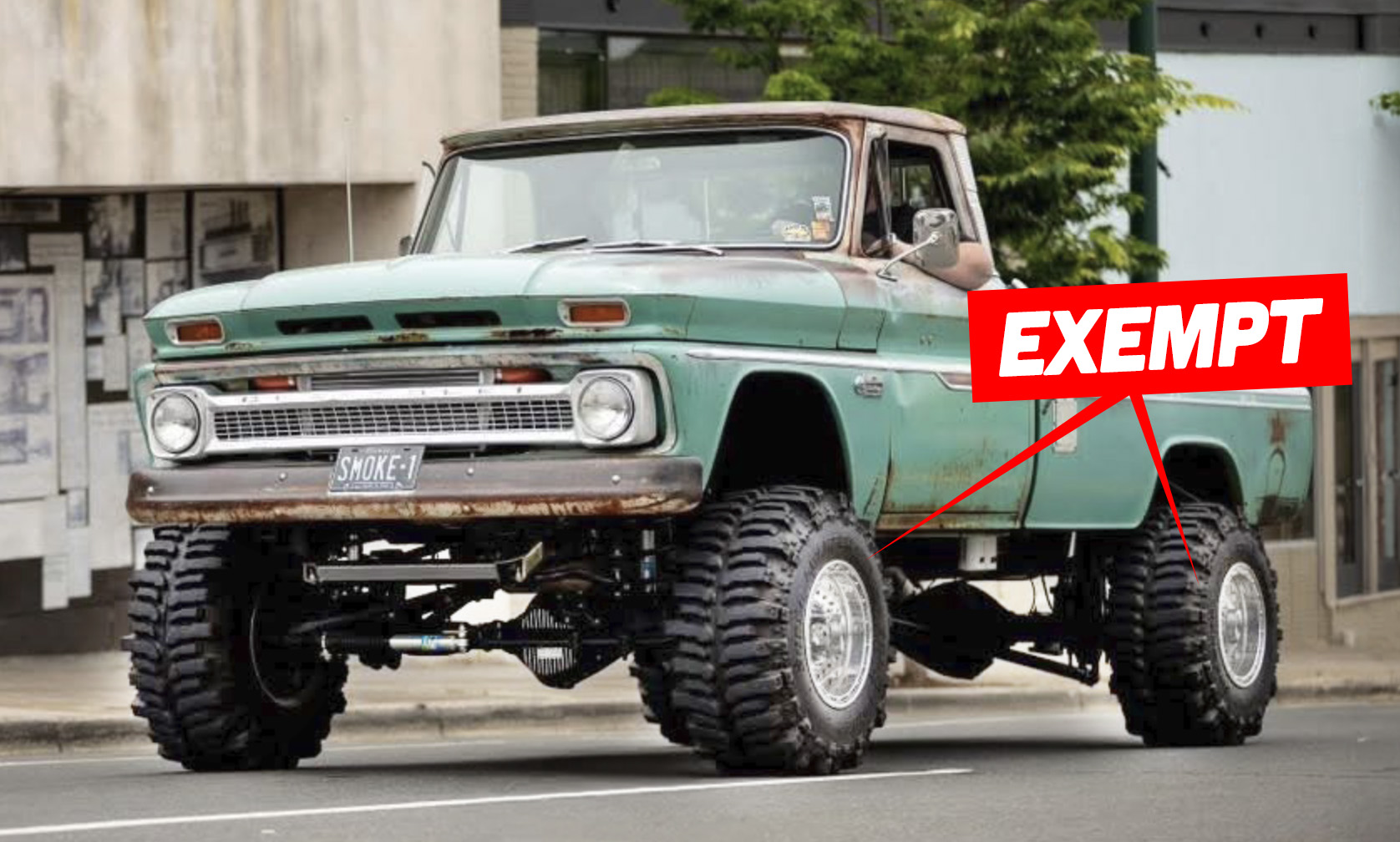
Tires have to meet the efficiency prerequisites or fit within one of the exempted categories. “Many specialty tires are entirely exempt from the standard,” said Reilly from the CEC. “These include competition tires, large off-road tires, winter snow-type tires, and all-weather winter performance tires. Niche tires are also exempted through a limited production tire exemption.”
How Do The Mandates Change Based On Type Of Tire?
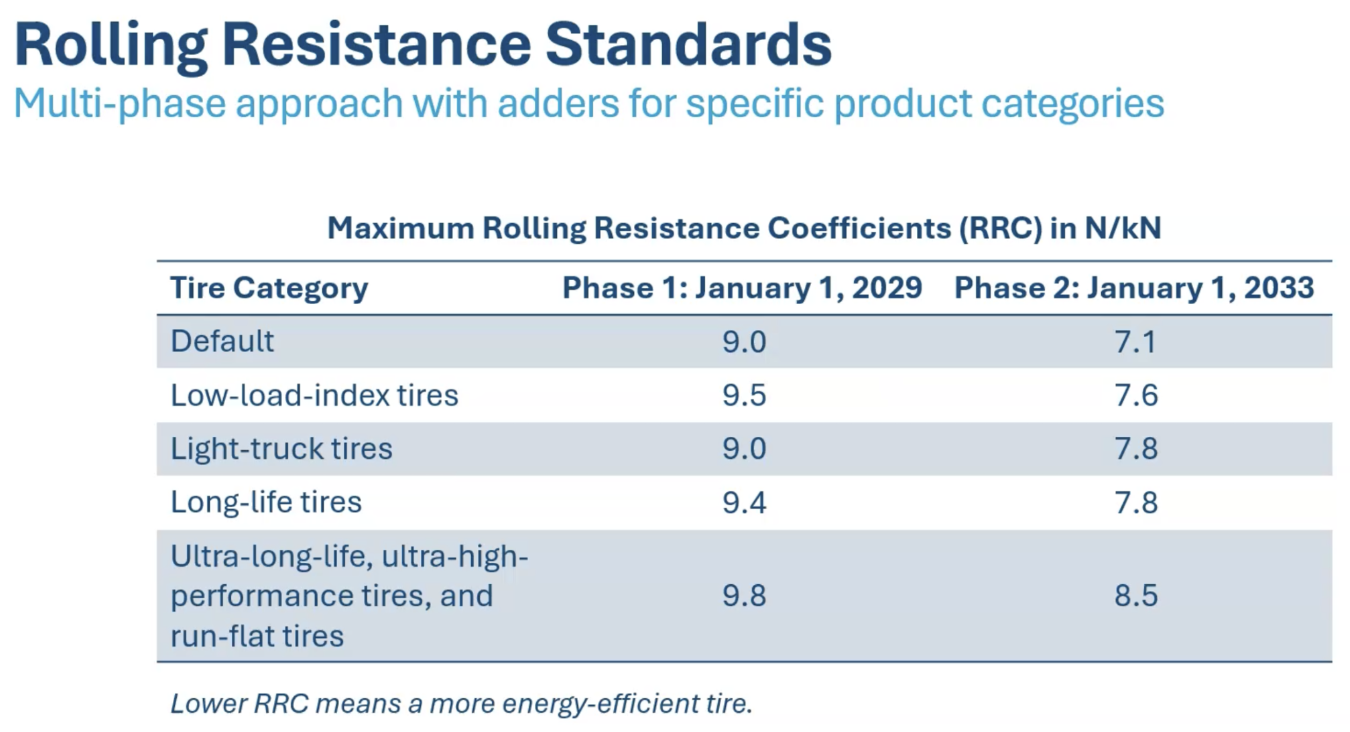
Because different vehicles need different tires – LT tires are not the answer for a Miata, for instance — the rules allow for some variation. From the Express Terms:
(b) Ultra Long-Life Tires, Ultra High-Performance Tires, and Run-Flat and Extended
Mobility Tires. No tire manufacturer, tire brand name owner, or tire retailer shall sell or
offer for sale in California, except as wholesale for final retail sale outside the state, any
ultra long-life replacement tire, ultra high-performance replacement tire, or run-flat and extended mobility replacement tire that has an EU correlated rolling resistance coefficient greater than the following, when tested according to the specifications in section 3303(a):
(1) For tires manufactured before January 1, 2029, there is no energy
performance standard requirement.
(2) For tires manufactured on or after January 1, 2029 and before January 1, 2033, 9.8 N/kN.
(3) For tires manufactured on or after January 1, 2033, 8.5 N/kN.(c) Long-Life Tires. No tire manufacturer, tire brand name owner, or tire retailer shall sell
or offer for sale in California, except as wholesale for final retail sale outside the state,
any long-life replacement tire that has an EU correlated rolling resistance coefficient
greater than the following, when tested according to the specifications in section
3303(a):
(1) For tires manufactured before January 1, 2029, there is no energy
performance standard requirement.
(2) For tires manufactured on or after January 1, 2029 and before January 1,
2033, 9.4 N/kN.
(3) For tires manufactured on or after January 1, 2033, 7.8 N/kN.(d) Low Load Index Tires. No tire manufacturer, tire brand name owner, or tire retailer
shall sell or offer for sale in California, except as wholesale for final retail sale outside
the state, any low load index replacement tire that has an EU correlated rolling
resistance coefficient greater than the following, when tested according to the
specifications in section 3303(a):
(1) For tires manufactured before January 1, 2029, there is no energy
performance standard requirement.
(2) For tires manufactured on or after January 1, 2029 and before January 1,
2033, 9.5 N/kN.
(3) For tires manufactured on or after January 1, 2033, 7.6 N/kN.(e) Light Truck and Commercial Replacement Tires. No tire manufacturer, tire brand
name owner, or tire retailer shall sell or offer for sale in California, except as wholesale
for final retail sale outside the state, any light truck and commercial replacement tire that
has an EU correlated rolling resistance coefficient greater than the following, when
tested according to the specifications in section 3303(a):
(1) For tires manufactured before January 1, 2029, there is no energy
performance standard requirement.
(2) For tires manufactured on or after January 1, 2029 and before January 1, 2033, 9.0 N/kN.
(3) For tires manufactured on or after January 1, 2033, 7.8 N/kN.(f) All-Season Winter Performance Tires. There is no energy performance standard
requirement for any all-season winter performance replacement tire.
There Are Lots Of Great Tires That Are Excluded From The Mandate
See item (f)? That’s a hidden gem. In short, anything with the 3 Peak Mountain Snowflake logo (3PMS) is exempt. Dedicated winter tires such as the Bridgestone Blizzak, Cooper Discoverer True North, or Michelin X-Ice are amazing in the snow and ice. But their soft, squishy nature leads to higher noise, reduced efficiency, and lower dynamic performance in dry and warm conditions. Across this enormous continent, it doesn’t snow enough to warrant dedicated winter tires for many people. The newer “All-Weather Tire” category still carries the 3PMS logo that means it’s outside of RTEP scope, while being quieter, grippier, and generally just normal in terms of performance.
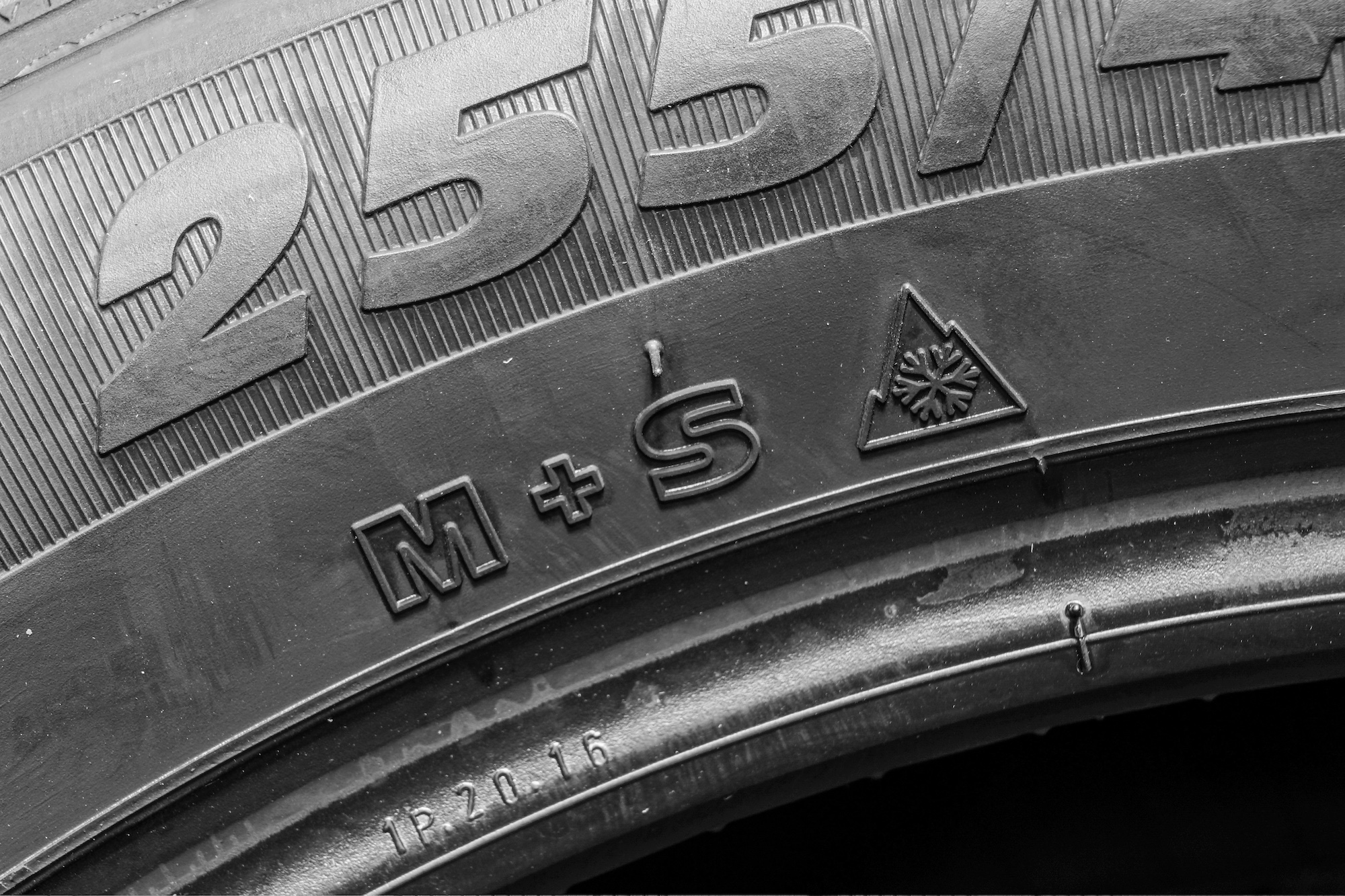
Running something like a Michelin CrossClimate, Goodyear Assurance Weatherready, or General Altimax 365 AW will be a non-event for most people. You’d probably have to look at the sidewall to discover you’re on anything fancier than a plain old all-season. Think of them as all-season tires that actually mean it; they’re able to deal with more snow than you’d otherwise expect, while also providing good wet traction, lower noise, and the durability to be installed year-round.
There’s a pretty deep list of exclusions, too, including some enthusiast favorites. Your knobbies and slicks are safe.
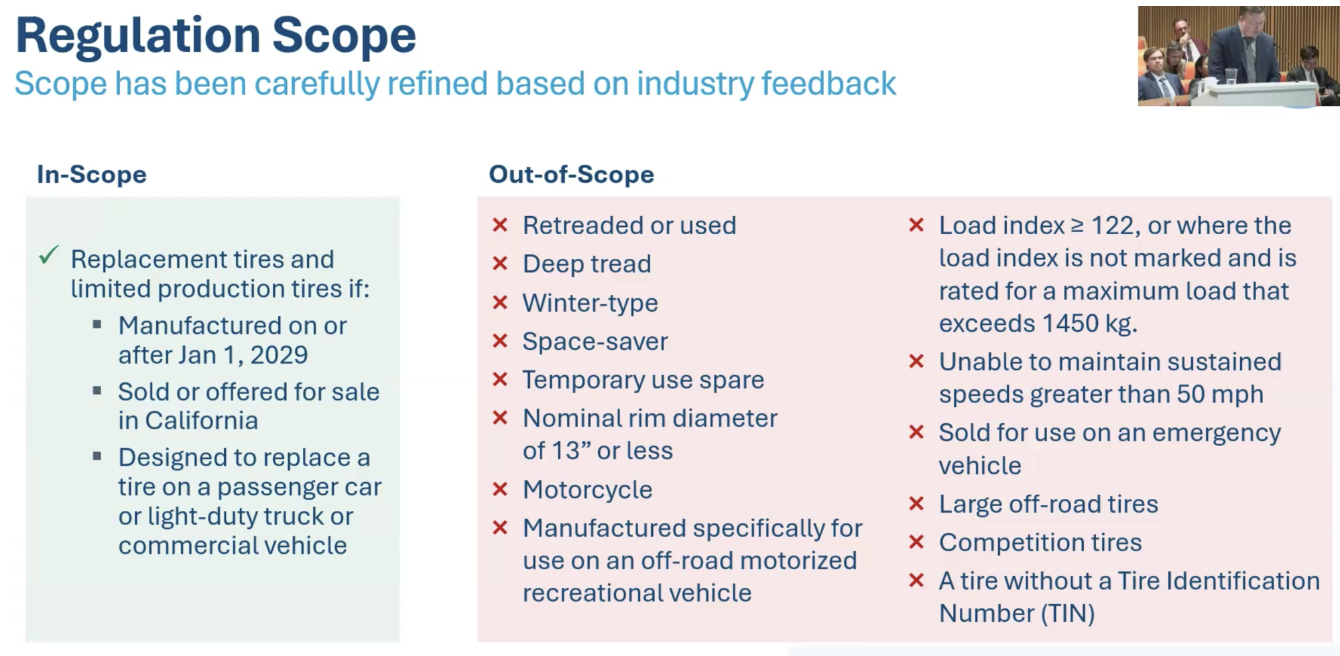
Limited Production tires – tires that sell or import fewer than 15,000 units per year in the United States. These tires can be sold in California without needing to meet the standards. The burden is on the manufacturers to certify the production or importation numbers each year with the CEC. While self-reporting may be fraught with fox guarding the henhouse vibes, getting audited and fined over a few thousand tires hardly seems worth any malfeasance.
Exempted via Petition – need some new meats for your Porsche Carrera GT? Veyron’s sitting on cracked sidewalls? If only you could get a set of proper sized Cooper Cobras for your XJ220 (white letters out, please!). A manufacturer seeking to serve these niches can petition the CEC to approve a tire that would otherwise fail to meet the criteria, so when there’s no compliant tire available, you’re not fated to a life on cinderblocks or endangering yourself or anyone else by running on vintage tires well-past the point of being safe.
Can I Still Buy Whatever Tires I Want?
Probably. “The sky is not falling for enthusiasts,” Rogers of Tire Rack told The Autopian. The company does significant business in California, thanks to both the state’s large population and its vibrant car culture. Before his marketing role, Rogers spent more than 15 years leading the tire testing program and tire information department. “I know about tires and I love tires,” he said. “What I think will end up happening is the very marginal product at the edges of the spectrum will be squeezed, or they will cheat to appear compliant.”

Other tire retailers are less sanguine. America’s Tire, also known as Discount Tire, warned the CEC about the regressive nature of cost increases. “Tires are a non-discretionary purchase,” the company said in a June 2026 comment. “Drivers cannot opt out. If highly efficient tires carry significant price premiums or meaningfully narrow the available selection, the burden will fall disproportionately on cost-sensitive consumers.” The company is concerned about cost and availability, especially once the program is fully implemented. “If the Phase 2 requirements beginning in 2031 [later revised to 2033 before passage – DR] were applied to the tires we sell in California today, roughly 70 percent of currently available options would be removed from the market,” it said.
News and other media have picked up on that estimate to fuel the “tire ban” angle, and it’s freaking people out. “I have not had [anyone] email me or call me be like, ‘oh, this is great,’” Robinson said about what people are telling SEMA. “I think there’s concern both from a consumer choice standpoint and from a cost standpoint, and that’s across the board.”
“I don’t think there’s really much of anything in our world that’s going to be impacted, especially on the first phase of this,” said Rogers, “the media is being sensational.”
As you can tell, there are competing opinions here.
[Ed Note: One concern I have is BMW i3 tires. Currently, there’s only one tire brand regularly available stateside, but every now and again MOMO Topruns come up for sale for 1/3 the price of the Bridgestone Ecopias. The issue is: The MOMOs appear to have a much higher rolling resistance. Thus, these might be banned, leaving us i3 owners with yet again only a single choice that costs $250 to $300 a tire. This would be a huge financial hit to i3 owners, especially since our cars are electric, meaning we will not gain significant money back from the increased efficiency of the Bridgestones. -DT].
Pry ‘em From My Cold, Dead Driveway
The state will not be confiscating your tires. I asked Reilly if individual owners would be subject to equipment inspections, or if having non-compliant tires on a vehicle would result in a failed inspection or fines. “Absolutely not,” he said. “We are committed to vigorous enforcement, but that enforcement will take place at the manufacturer and retailer level (including online retailers). This is similar to how other appliance efficiency standards are enforced. The scope of enforcement is at the retailer, manufacturer, and test laboratory level.”
It’s on the tire industry to live up to expectations. “The standard addresses which new tires can be sold. It doesn’t apply to a vehicle being sold or to what can be driven. The standard also applies to tires by manufacture date, so when Phase 1 and Phase 2 come into effect, the existing stock of tires on store shelves remains legal and is gradually replaced with compliant stock.”
That’s a great point about how remaining stock will be sold down.
Nothing Changes Tomorrow
Even though Phase 1 starts on January 1, 2029, don’t expect anything drastic at that time (at least in terms of automotive tires). “Today’s product at large is already meeting the [phase 1] efficiency requirement,” Tire Rack’s Rogers told me.
Phase 2 goes into effect in 2033; two-thirds of a decade from now. “It’s going to get harder,” Rogers acknowledged, “but that’s two life cycles away from where we are right now, when we look at the tire development curve. So the manufacturers are not actively developing 2033-plus tire lines yet.”
Reasonable timelines were taken into account during the rule-making. “Manufacturers have years to make updates to the remaining models through their normal product development cycles, just as manufacturers routinely redesign and improve their products,” said the CEC’s Reilly.
Robinson from SEMA voiced concerns about reduced choices and higher prices. “If you’re a smaller manufacturer, especially, you’re not going to make one set of tires for California, then one for every 49 states, you’re going to need one,” He said. “One that meets that that certain requirement. So it will have a trickle down effect one way or the other for sure.”
Cost Concerns
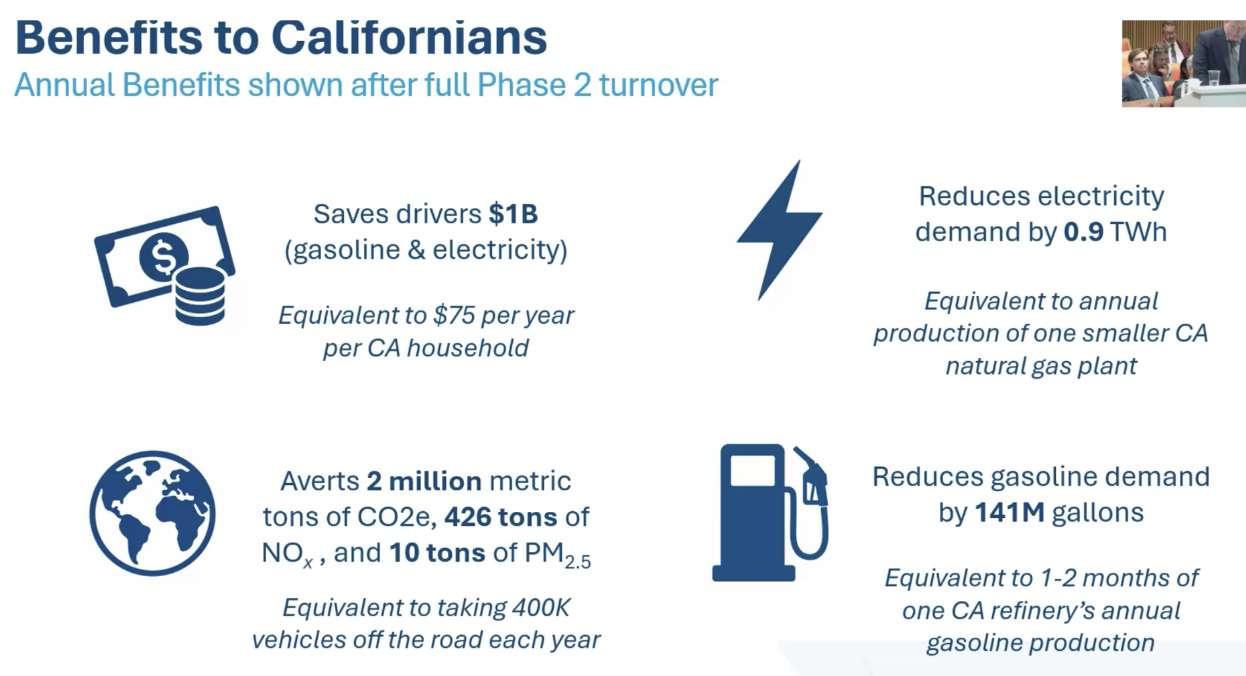
“The incremental cost for consumers is very low – only $1.50 per tire during Phase 1 (2029-2033) and $6.50 per tire during Phase 2 (2033 and beyond). A typical driver of a gasoline car with more efficient tires will save $179 of gasoline over the life of a set of tires, or about seven times the incremental cost. These savings were calculated with gasoline prices of $4.60 per gallon. At the elevated gasoline prices of mid-2026, the savings could be 25% higher than estimated.”
Some of the tire industry’s own analysis disagrees with the rosy projections. That last bit about higher gas prices making the savings even sweeter seems to ignore secondary effects. More expensive petroleum for energy and raw materials is going to make tires more expensive to produce and ship by inflating lots of line items across the budget. [Ed Note: Though this would be the case for less efficient tires, too. -DT].
Gladfelty Government Relations has represented the concerns of Goodyear to the CEC during the development process. The firm submitted comments about the cost assumptions in July, saying:
“The Commission continues to characterize Phase 2 as a low-cost consumer savings measure, estimating an incremental cost of only $26 per set of four tires. That conclusion cannot be reconciled with the Commission’s own Smithers Phase 2 testing data. The Smithers dataset demonstrates that tires meeting the proposed lower rolling resistance thresholds can carry materially higher retail prices and, in several instances, prices several times greater than many of the tires the proposed Phase 2 standard would effectively remove from the California market. Unless the Commission reconciles these actual market data with its modeled assumptions, the record does not support the conclusion that Phase 2 will reduce overall consumer costs as proposed.”
Gladfelty uses the CEC’s own data and analysis to make its point:
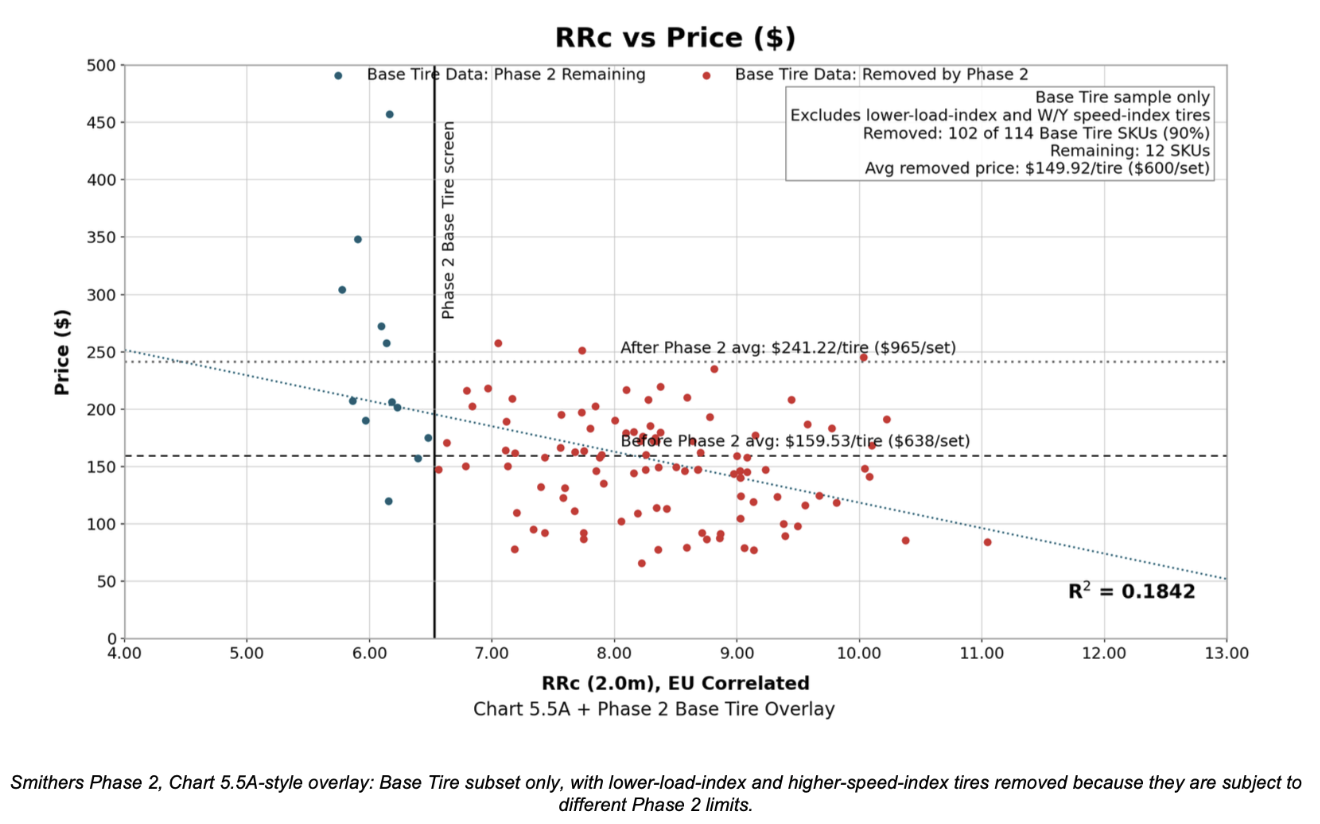
The concern is that removing lower-cost, higher RRC tires from the market will force consumers to pay a lot more, and that other costs have been left out to make the projections look better. “The proposed standard can shift consumers into a substantially higher price band,” states Gladfelty’s letter. “A household buying four tires does not experience that as a $26 change if the available compliant substitute costs $50, $100, or more per tire. Nor does CEC’s estimate appear to fully account for sales tax, installation, disposal fees, redesign costs, compliance testing, or retailer inventory effects.”

While the CEC may be trying to make it look as cheap as possible, Gladfelty may be pushing the numbers to be overly pessimistic.
“Applying the Phase 2 7.1 RCC limit to the Smithers passenger-car-tire (PCT) population shown above would remove 102 of 114 PCT SKUs (90%) and raise the average price of the remaining compliant tires from $149.92 per tire ($599.68 per set) to $241.22 per tire ($964.88 per set),”
“There is a statistically significant increase of $ 365.20 / set of tires for lower RRC tires from the CEC’s data, which is far greater than the CEC’s estimated increase of $26 / set of tires. Using CEC’s estimated $179 fuel savings over the life of a set of tires, this regulation will cost consumers $186.20.”
This goes along with the gloomy America’s Tire prediction that 70% of today’s choices will evaporate come Phase 2. Reality is likely in the middle. The 102 tires that go away today will be at least partially backfilled by other products in a similar price range, going by the prevailing wisdom we’ve gleaned from tire manufacturer and retailer statements and our own interviews. Costs may well increase, but a $100 jump in per-tire average price seems like an overshoot of its own, even though I won’t pretend to be an expert on tire prices. As for historically sticky fuel prices, well, who knows what they’re gonna do. Assume the new cheap will still be expensive.
“The CEC stands by its analysis, research, and cost analysis presented in our staff report,” the CEC’s Harrison Reilly told us. “These cost estimates were developed based on data from the U.S. EPA and NHTSA, which regularly analyze the cost of lower rolling resistance tires. Because fuel prices can be volatile, we intentionally picked a conservative value for gasoline prices: $4.60 per gallon. That number has only increased since the start of the Iran conflict, and the savings would be substantially higher at current fuel prices.”
How Will I Know What’s Good?
We’ve already been through a lot of numbers, facts, and figures; catnip for us nerds, but most people want tires that are round, black, and cheap. And if they last a decade, great!
You need to meet people where they are. That’s one of the things I learned during a decade in advertising. On my way to becoming a creative director, I learned you have to make choosing easy, and the CEC has taken all of the nerdery we’re spending a few thousand words on here and squished it into four leaves.
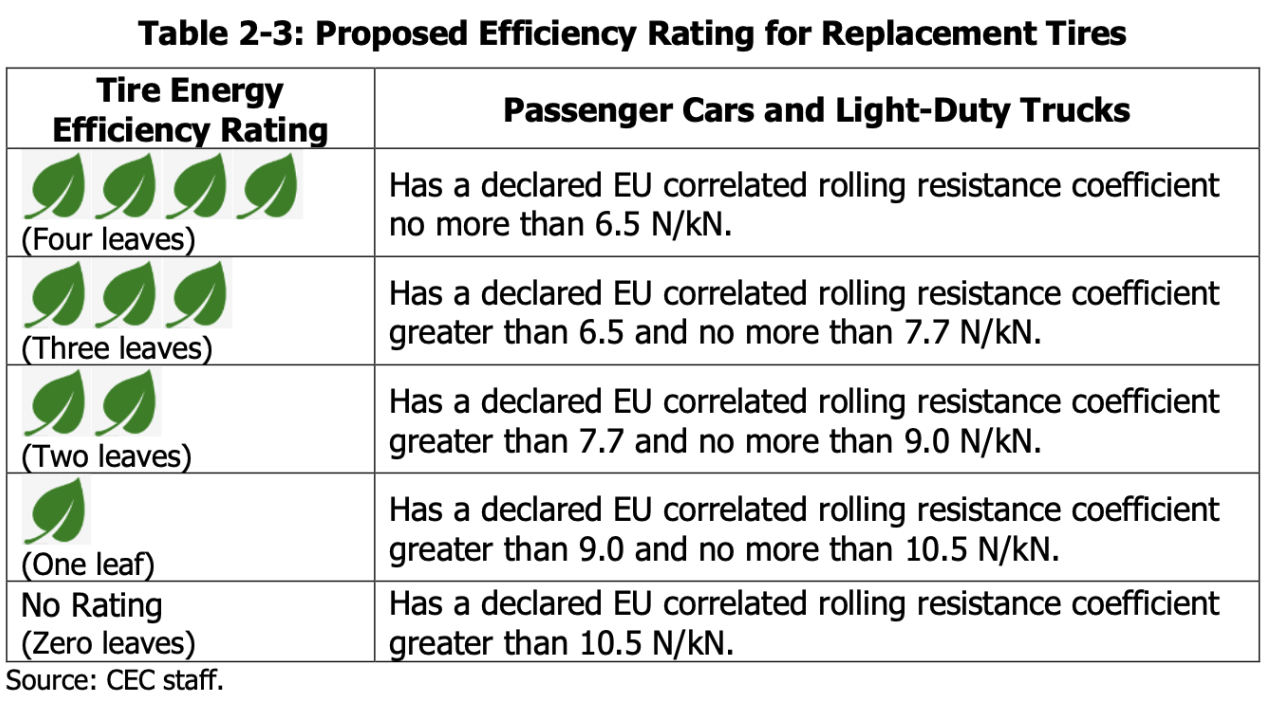
The RTEP will use a tire rating system for fuel efficiency. It’s a scale from zero to four leaves; four being the most efficient. It’s similar to the numerical-based European system that’s widely used across all sorts of consumer products, and kind of akin to EnergyStar here in the U.S., but the leaf ratings simplify comparison that much further.
Reilly explained how the inspiration came from the way the EU does efficiency ratings for much more than just tires. “The EU uses A-E to indicate efficiency level, which is a system used broadly in the EU across all products including appliances and lighting,” he said. “Consumers in the United States are not familiar with that system, so we translated it into a leaf rating (more leaves = higher efficiency) that we hope will be easier to understand. The 4-leaf rating aligns with the EU “A” level rating for efficiency, 3 leaves align with “B” and so on.”
How Did We Get Here?
The initiative started in 2003 as Californa Assembly Bill 844 (AB844), but paused in the mid-aughts while federal lawmakers tried for a nationwide tire efficiency standard as part of the now-defunct FAST act, which expired in 2021. The California Energy Commission (CEC) has spent the last six years collaboratively developing standards, rules, and processes for regulating replacement tire efficiency with the goal of creating a net savings for California car owners and reducing air pollution for all residents through related fuel efficiency gains.
Simply adopting one of the existing standards wouldn’t cut it, either. That’s why California has built on a lot of what came before, but ultimately developed its own rules. “The EU also has minimum rolling resistance targets it adopted 17 years ago, which we analyzed,” said Reilly. “The EU minimum requirements are set forth Regulation (EC) No 661/2009, with maximum RRC of 12 in the 1st stage (effective Nov 2012) and 10.5 in the 2nd stage (effective Nov 2016). Of our originally tested tires, only three products would not meet the stricter EU 2nd stage standard, and even those tires were close to meeting it. That means aligning to that standard would yield very close to zero fuel and cost savings in comparison to adopting no minimum requirement at all.”
The CEC also looked into tire efficiency rules in Japan, Brazil, China, and South Korea. That research has informed the final RTEP standards.
The Actual Standards
“CEC substantially aligned with EU requirements for a rolling resistance rating system and, to a large extent its testing procedures,” Commission Information Officer Reilly told us. The RTEP efficiency standards balance maximum rolling resistance with minimum wet grip. Tires are evaluated against a standard reference tire (as defined by ASTM F2493-2420) using the ISO 28580:2018 procedures as its main test. “We tested 537 tires,” said California Energy Commission Chariman Hochschild.

Tire Rack’s Rogers explained the methodology: “It’s around a reference that is standardized, so you have a point of comparison.” Coefficients make comparison quicker and easier. “These values are essentially connected to the tire you’re considering versus some kind of a reference. And it creates a coefficient. If it’s one for one, then it’s as good as the reference,” Rogers said. “The rules are all written that it has to be, you know, some value or better relative to a reference.”
Essential Definitions
This is how the CEC defines the terms and measurements tires are evaluated by. They will be mentioned a lot in the coming text, so this is what the shorthand means.
Rolling resistance coefficient (RRC) means the ratio of the rolling resistance
force, in newtons (N), to the load on the tire in kilonewtons (kN) as calculated
pursuant to section 3303. [Ed Note: This just the F = mu*N equation you learned in physics. -DT].Rolling resistance force means the loss of energy (or energy consumed) per
unit of distance traveled. The unit conventionally used for the rolling resistance is
newton meter per meter (N m/m). This is equivalent to a drag force in newtons (N).Run-flat and extended mobility tire means a tire structure provided with
technical solutions allowing the tire, mounted on the appropriate wheel and in the
absence of any supplementary component, to supply the vehicle with the basic tire
functions as verified by ISO 16992:2018 and labeled as such on the tire sidewall.Smaller truck and bus tire means a truck and bus tire with a load index of
121 or smaller or, where the load index is not marked, a maximum load of 1,450 kg
or lower.Sold or offered for sale in California means any sale of or offer to sell a
replacement tire or limited production tire for end use in the state, regardless of the
seller’s physical location, and includes, without limitation, internet, telephone, and
mail order transactions. For purposes of this Article, the Uniform Commercial Code –
Sales (Division 2 (commencing with section 2101) of the Commercial Code) does
not define “sold or offered for sale” or determine where sales or offers for sale occur.Space-saver tire means a temporary use spare tire of reduced size for
fitting in a confined space.Substantial change means a revision to a basic model’s declared tire energy
efficiency rating, relative wet grip braking performance index range, or qualification
for an applicable definition, performance standard, or exemption under this Article.Temporary use spare tire means a tire with a “T” in the size designation
under the ISO 4000-1:2024 specification, as incorporated by reference in section
3305, that carries a T designation on the tire sidewall and is intended for temporary
use.Tire energy efficiency rating or “leaf value” or “leaves” means the rating
under section 3307 based on the test method set forth in section 3303.Tire size designation means the nominal section width, nominal aspect
ratio, and rim diameter of a tire.Ultra high-performance means a tire that both bears a speed category
symbol of “W,” “Y,” or “(Y)” and is capable of maintaining maximum speeds of
168 miles per hour or above, and that has a relative wet grip braking performance
index of at least 1.45.Ultra long-life means a tire with a UTQG wear test score of 1,400 1,000 or
higher, as evaluated according to the treadwear rating conditions and grading
procedure in 49 Code of Federal Regulations part 575.104(e) (2023October 1,
2024).Used tire means a tire that was previously sold for end use, was previously
mounted on a motor vehicle for more than 24 hours, and is disclosed as being a
used tire when it is sold or offered for sale. Tires mounted on a motor vehicle when the vehicle is sold or resold are used tires within the meaning of this definition
regardless of whether they have been mounted for more than 24 hours or disclosed
as being a used tire when the vehicle is sold.UTQG is an acronym for the Uniform Tire Quality Grading System of the
United States Department of Transportation, National Highway Traffic Safety
Administration.Winter-type snow tire means a tire that has all the characteristics of
subsections (A), and (B) of this definition. A tire subject to the UTQG
standards is not a “winter-type snow tire.”(A) Attains a traction index equal to or greater than 112, compared to the ASTM
F2493-20 standard reference test tire when using the snow traction test on the
medium pack snow surface as described in ASTM F1805-20.
(B) Is equipped with studs or is marked with an Alpine Symbol, specified in the
Federal Motor Vehicle Safety Standards at 49 Code of Federal Regulations part
571.139 S5.5(i) (October 1, 20243), on at least one sidewall
Let’s Talk About The Testing
California is also not reinventing the wheel. To establish the RTEP standards, the CEC leaned on what’s already been done by the International Standards Organization (ISO), ASTM International (formerly American Society for Testing and Materials), and existing international testing methods and tire efficiency regulations. The RRC measurements are EU-correlated, meaning California’s numbers match up with larger programs in other global regions. Others have been here before us, and that harmonization helps tire manufacturers deliver what’s needed worldwide as efficiently as they can. In other words, there’s overlap.
The most heavily relied upon testing methods were:
- ISO 28580:2018 Passenger car, truck and bus tyre rolling resistance measurement method — Single point test and correlation of measurement results.
- ISO 23671. Standardized method for testing tire wet grip braking performance index relative to a control tire.
- ISO 15222:2025 was used to test light truck tires for wet grip braking performance.
- ASTM F2493-2420 Standard Specification for P225/60R16 97S Radial Standard Reference Test Tire. This is what candidate tires are compared against.
The ISO 28580:2018 test measures rolling resistance. The RTEP uses this testing to calculate the rolling resistance coefficient (RRC) for each tire, and it’s the same test and calculation used by Europe’s efficiency standard. It’s big and complicated, involves a lot of steps and a lot of algebra. To truly understand it warrants an article on its own. Here’s a short snippet from a single subsection:
Measurement Method. The reference laboratory shall measure each
alignment tire four times and retain the three last results for further analysis, in accordance with Section 7 of ISO 28580:2018 and under the conditions set out in Section 6 of ISO 28580:2018. The candidate laboratory shall measure each alignment tire (n + 1) times, with n being specified in subsection (a)(2)(F)(iv) of this section and retain the n last results for further analysis, in accordance with Section 7 of ISO 28580:2018 and applying the conditions set out in Section 6 of ISO 28580:2018.Each time an alignment tire is measured, the tire/wheel assembly shall be removed from the machine and the entire test procedure referred to in Section 7 of ISO 28580:2018 shall be followed again from the start. The candidate or reference laboratory shall calculate:
1. the measured value of each alignment tire for each measurement as
specified in Section 9.2 and 9.3 of ISO 28580:2018 (corrected for a
temperature of 25 °C and a drum diameter of 2 m);2. the mean value of the three last measured values of each alignment
tire (in the case of reference laboratories) or the mean value of the n
last measured values of each alignment tire (in the case of candidate);
and3. the standard deviation (σm ) as follows:
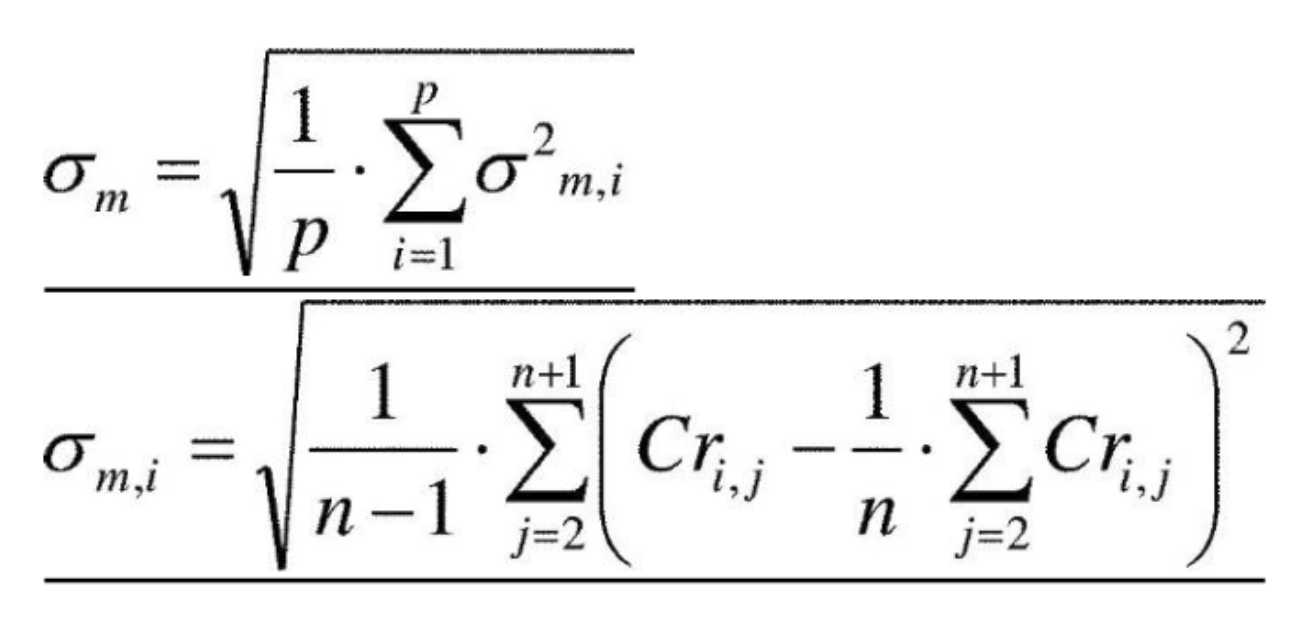
where:
i is the counter from 1 to p for the alignment tires;
j is the counter from 2 to n + 1 for the n last repetitions of each
measurement of a given alignment tire;
n + 1 is the number of repetitions of tire measurements (n + 1 = 4 for
reference laboratories and n + 1 ≥ 4 for candidate laboratories);
p is the number of alignment tires (p ≥ 5).Existing Federal Motor Vehicle Safety Standards definitions were used, as well, from Title 49, Subtitle B, Chapter V, Sections 571, 574, and 575:
-
-
571.139 – Standard No. 139; New pneumatic radial tires for light vehicles
-
574.5 – Tire identification requirements
-
575.104 – Uniform tire quality grading standards
How Much Less Efficient Aftermarket Tires Are Than Factory Tires, On Average
The CEC asserts that OE tires are tweaked for efficiency, and that even the same brand and model of tire as a replacement may not be as efficient. Moreover, the CEC says this gap is costing people money.
They’re not just vibing on opinions. Smithers International, a well-known testing lab, was engaged to do serious testing to determine that the average replacement tire has a rolling resistence coefficient (RRC) of about 8.5 N/kN; higher than the average OE tire RRC of 7.1 N/kN.
To put the N/kN (Newtons per kilonewtons) simply, it describes the amount of energy consumed by the tires’ hysterisis; the way they squish out of round due to their viscoelasticity. In other words, tires are not rigid, and they are constantly deforming as they roll. The amount of energy consumed by this deformation can be measured and expressed in N/kN. And that figure can correspond to the RRC.
What Must be Done to a Tire to Meet These Standards?
For some tires, nothing. Those are the ones that already meet the standards laid out in the RTEP. The adjustments for other tires will vary depending on what needs to change. Tread pattern, compound adjustments, and physical construction are the main categories with some adjustment possibilities.
Rogers explained that the state of tech in the tire industry now means that smaller companies can get started making great tires very quickly; it’s not just the big, old giants that can do it anymore. “There have been really significant advances in manufacturing and what tires can do in these last 5 to 10 years,” he said. “Tire manufacturing, the mixing and building capabilities, simple tire design capabilities, and what it takes to design good tires, you know, anyone with a with some simulation software and a couple of smart engineers can start [designing] really great tires.”
Possible Skullduggery
Reactionary talk in response to regulations is common. “I’ve had people joke like, oh, I’m just going to set up my auto shop right at the border of the Nevada and invite people to come change their tires there,” said Robinson. People who can skirt the rules will do it; lots of cars with Massachusetts license plates dip into southern New Hampshire for tax-free shopping, for instance. It won’t be many overall; the expense and hassle is likely to chill follow through.
As tire industry comments pointed out, tire manufacturers insulated by geography may attempt to game the system. There are safeguards in place; the limited production exemption, for example, is based on nationwide importation or production totals of a base tire model. It’s not as simple as changing the brand or the tire name after 15,000 units. If two tires are the same base tire model, it’s the underlying design that counts.
The self-reporting nature of the program means there’s the possibility of getting away with something, at least for a while. But there are enforcement teeth, and the CEC has experience overseeing these types of programs for positive outcomes.
Spokesperson Reilly said: “The CEC has decades of experience enforcing energy efficiency standards for lightbulbs, TVs, computers, air conditioners, battery chargers, and many other consumer products. To ensure a level playing field, our enforcement team takes dozens of enforcement actions against manufacturers and retailers, including those online and based outside the U.S.”
“The CEC will require manufacturer certification to a CEC database of approved tires under penalty of perjury, verified through independent laboratory testing and mandatory provision of test reports. Retailers may only sell compliant tires listed on the CEC database, verified through physical and online market surveillance. When noncompliance is identified, the CEC will issue notices of noncompliance and take legal action as necessary.”
Keep Rolling
Regulation often has an uphill challenge; nobody loves being told what to do, or the possibility of less choice. This doesn’t appear to be that. Love it or hate it, we hope you at least understand the Replacement Tire Efficiency Program a lot better now.
Top graphic images: Toyota; California Energy Commision


I’ve been away so I’m late but my 2 cents is this is still over reach. This feels a lot like the California pistol roster, which is list of guns ordinary citizens are allowed to buy, after the onerous California gun license is acquired. These are the ones deemed “safe”, and of course the police are exempt. Similarly the state is deciding what tires are correct and exempting cop ccars.As Discount Tire pointed out this becomes an unfunded mandate on everybody who needs new tires. Right now I’m not affected but Oregon politics is dominated by Californian carpet baggers so it’s likely to come.
I don’t like that this is happening. You can show standard efficiency ratings of tires, but there’s no need for the government to meddle with this.
Instead of people trying to convince me that it isn’t going to be that bad, I propose an alternative: what exactly is ‘the government’ trying to solve? Why are they getting involved?
In Europe it all started out very nicely, and the result now is there are maybe 1/4 of the options for track and street tires as in the US.
That ‘competition tires’ are exempt is no great relief, as the vast majority of track people do not run true competition slicks, among other reasons because they cost 4k.
“Ed Note: One concern I have is BMW i3 tires.”
I was more concerned about the skinny Michelins on Jason 2CV, but since he lives on the other coast, probably NBD.
I live in Washington and the Discount Tire Contis my Accord is running on are holding up very well, so I will probably have to replace them due to age, rather than wear.
I have bought a couple of sets of General tires in the last decade for other cars and the General Altimax 365 AWs or whatever they have when the time comes to replace the current footwear seem like a solid choice.
Thanks for this article. At first sniff, this seemed like a California overreach, but thanks for digging deep and it doesn’t sound as draconian/crazy as I initially thought.
You weren’t kidding when you said the dive would’ve be deep! I’m not in California (or in the US for that matter) so I for this one ‘m like a fish reading about the desert, but I’m still glad we have such good coverage here.
Interesting article. Thank you for doing the research and presenting it here.
America’s Tire now owns Tire Rack. Somehow, their spokesmen didn’t sync up their opinions on this issue – they practically contradict each other.
Looking carefully at the numbers, using conforming tires would save more than enough gasoline or electricity over the life of the tires to pay for the tires several times over. The right-wing radio mouthpieces can only spin any policy from California as kooky, though. The bottom line is that this will be a benefit in the long run, and everyone will have plenty of tire choices available. The sky is not falling.
And yet, yout right on these points.
Very well, I (you) contain multitudes.
Disagree- that’s only the case if there exists a minimum price increase from “not efficient enough” to “just efficient enough” tires that are actually sold on the market. This is 100% guaranteed to not happen, because companies like money and this rule gives them a great excuse to blame for higher margins. I don’t think it will affect performance tires in any appreciable way, but economy options are about to get considerably more expensive.
Waiting for some cup 2s with a 3pmsf symbol only to be sold in California
I agree with DT: like with pretty much everything in life, the central question is how will this impact BMW i3s owners.
Sorry, but any point made by Gladfelty appears to be a statistical travesty.
A linear fit? On that data?!
Why is the Phase 2 cut line at 6.5, when the 2033 cut is actually 7.1?
Even if we accept his gross averages, it’s only showing the impact if the rule was to set a cut of 6.5 TODAY! Which it isn’t by any possible interpretation.
So the next time I write an article with a lot of analysis that needs interpretation, I really need to have you helping me!
Your article was great! The most detailed and fair write up I’ve seen.
Here’s an updated chart with lines where they should be for the phase 1 (blue) and phase 2 (red) https://i.imgur.com/bDrd7cN.png