

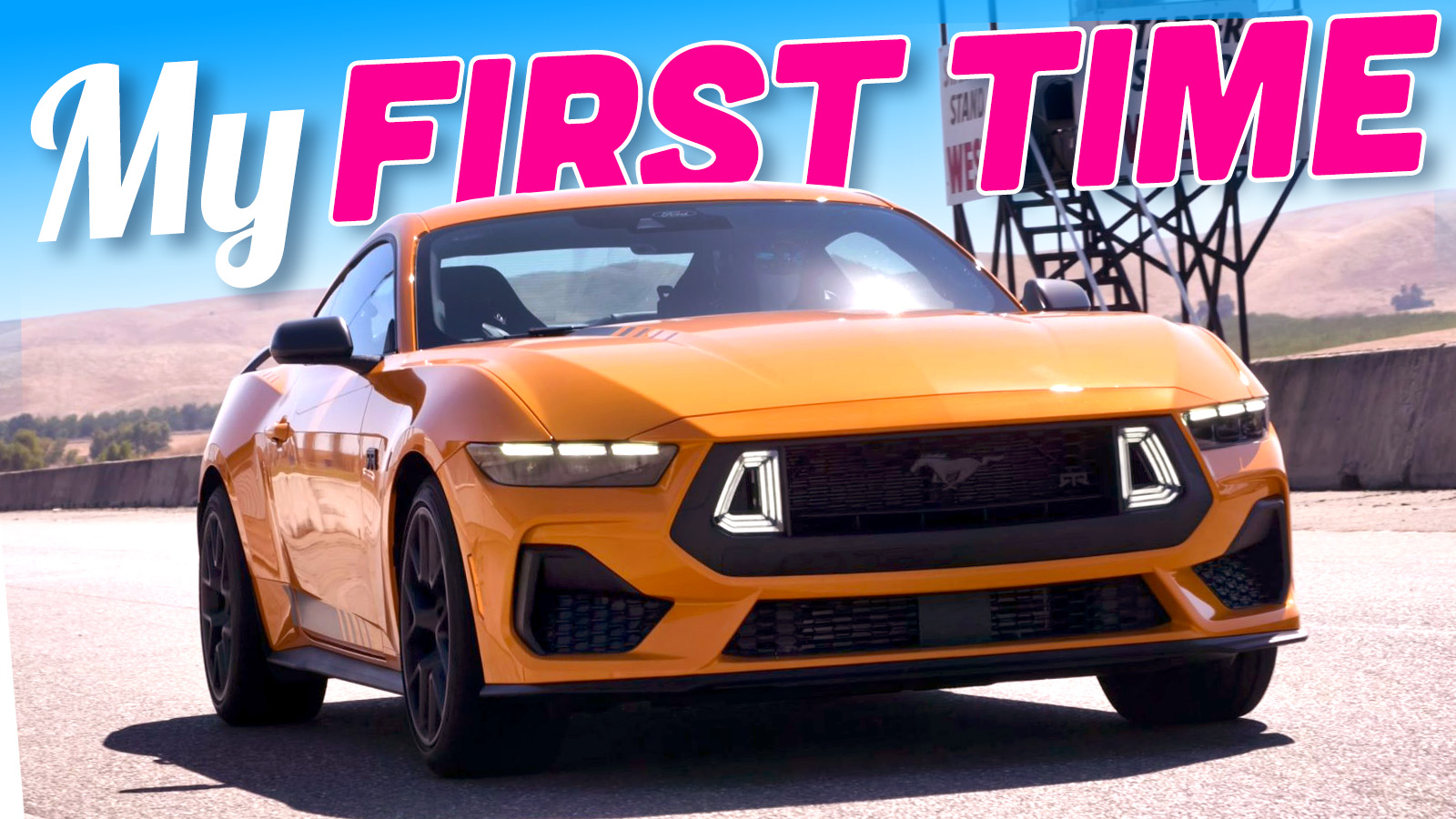
The popularity of America’s fabled pony cars has waxed and waned over the decades. We’ve lost beloved nameplates like the Mercury Cougar, the Mercury Capri, the Plymouth Barracuda, the Pontiac Firebird, and the AMC Javelin, with some of those gone before many of our readers were even born. Meanwhile, even the venerable Chevrolet Camaro and the Dodge Challenger departed for the junkyard in the sky a few years ago. But there’s one pony car that has outlasted them all, and it’s the Ford Mustang. In continuous production since 1964, the Mustang remains one of America’s favorite cars, and I finally got to try one. After driving a 2026 Ford Mustang RTR, I finally get why America keeps buying Mustangs.
I got to experience my first-ever drive in a Ford Mustang in a pretty special place. California’s Napa Valley might be known for its famous wineries, but it’s also surrounded by some of the most fun driving roads I’ve ever experienced. Napa is also not far from the Thunderhill Raceway Park, a beloved enthusiast destination to burn rubber.


Over the course of a day, I got to experience the 2026 Ford Mustang RTR on a little road trip, through heart-stopping turns, completely sideways while drifting, and banging off the rev limiter on the track. My first drive in a Mustang covered basically every way you could be expected to own one of these cars, and I’m pretty sure my smile never left my face until I went to sleep that night.

But what I found most surprising is that, between the Mustang RTR and the Mustang Dark Horse SC that I tested during the same press event, the car I thought I’d like the most was not the one that my heart fell for.
(Full Disclosure: Ford invited me out to Napa Valley, California, to experience the 2026 Ford Mustang RTR and the 2026 Ford Mustang Dark Horse SC. Ford paid for my travel, lodging in an amazing winery, and made sure I was very well-fed.)
The Basics
Engine: 2.3-liter dual overhead cam, 16-valve, twin-scroll turbocharged, cast aluminum inline-four engine.
Transmission: 10-speed SelectShift automatic transmission (only transmission choice).
Drive: Rear-wheel-drive, with a 3.55 Torsen final drive with a limited-slip differential.
Output: 315 horsepower at 5,500 RPM, 350 lb.-ft. at 3,000 RPM.

Fuel Economy: 22 MPG city, 33 MPG highway, 26 MPG combined.
Curb Weight: 3,783 pounds.
Base Price: $34,990 for a base Mustang (includes $1,995 destination fee) plus $6,520 for the RTR Package.
Price As-Tested: $55,850.
Ready To Rock

The 2026 Ford Mustang RTR is the result of a collaboration between famed Mustang customizer and drifter Vaughn Gittin Jr. of RTR Vehicles and Ford.
As the story goes, when Vaughn was much younger, he was deep in the import scene. As he looked for parts to build his Nissan 240SX, he stumbled upon people who used cars just like his in the art of losing control while remaining in control, or drifting. It wasn’t long before Vaughn was obsessed, and he started spending every dollar in his pocket to get his car sideways.
Vaughn’s obsession would reach beyond just a hobby in 2004 when he entered himself in Formula D’s inaugural season in his modded 240SX. In recalling that past, Vaughn says that it was that Formula D event in Atlanta when he even pulled his handbrake for the first time. Competitors were a bit disorganized back then, but they knew they loved the game. Vaughn loved drifting so much that he quit his tech job to embrace drifting full time.

Everything changed for Vaughn in 2004 when Ford teased the S197 Mustang through the GT-R Concept (above). It was love at first sight, and Vaughn wanted one so much that his team spent $5,000 over sticker to get a production S197 Mustang. But the Ford Mustang was more than just an object of Vaughn’s adoration; he saw an opportunity to send an American pony car into competition that was dominated by Japanese sports cars.
That year, he raced in an S197 Mustang for Team Falken. While he did not win Formula D, he did win the D1 Grand Prix USA-versus-Japan championship. By 2006, Vaughn placed fourth place overall in Formula Drift from behind the wheel of a Mustang. He proved that Mustangs had a real place in drifting. Vaughn’s green and blue Mustang would also become a bit of an icon itself. As Vaughn got enveloped in the Mustang world.

Through the Mustang community, Vaughn found enthusiasts who wanted to make cars that looked like his, or at least had their own personal touch. However, when Vaughn searched the aftermarket, he found slim pickings. If someone wanted to personalize their Mustang to their style, they were largely on their own. So, Vaughn set out to change that.
In 2009, Vaughn rolled out the limited-edition Mustang RTR-C, which sported a supercharged 550 HP V-8, a full carbon fiber body, carbon fiber wheels, Tein coilovers, and more. Vaughn also finally got Ford’s attention, and that year, the RTR Mustang became a dealer-installed package for Mustang buyers for $7,500 over the price of the donor car.

RTR (Ready To Rock) Vehicles was born, and Vaughn admits that he had no idea what he was doing, but he just wanted to keep building awesome Mustangs. Over Vaughn’s career, he would take Formula Drift championship wins in 2010 and 2020, as well as wins in the D1 Grand Prix, Ultra4 Racing, and NASCAR Canada. RTR would also grow into a modification powerhouse.
Today, RTR sells a bit of everything, from the 810 HP Mustang RTR Spec 3 to the over 870 HP Mustang RTR Spec 5. You can easily spend up to $250,000 on an RTR build, or even more if you’re a professional racer. But RTR also goes the other direction and offers cosmetic and mild performance upgrades for otherwise stock Ford Mustangs and Broncos.
The 2026 Ford Mustang RTR

That’s the end of the pool that the Mustang RTR sits in. The RTR Package costs $6,520 above the cost of a base Mustang EcoBoost, making it relatively accessible to the enthusiast. The 2026 Ford Mustang RTR also marks an important milestone for Ford and RTR, as it’s the first time that Ford’s building an RTR right out of its factory. Mustang RTRs are built at the Flat Rock Assembly Plant in Michigan right next to other Mustangs.
The 2026 Ford Mustang RTR is pretty mild when it comes to the upgrades. Most of the changes are purely cosmetic, from Ford:
Mustang RTR-specific exterior changes include:
• Mustang GT front fascia.
• RTR signature lit nostrils.
• Mustang RTR grille with RTR badge.
• Tarnished Dark Anodized pony.
• Tarnished Dark Anodized mirror caps.
• 19×9.5-inch Tarnished Dark wheels with 30-millimeter offset.
• Optional Hyper Lime brake calipers.
• RTR decklid and fender badges.
• RTR Signature Tarnished Dark Anodized hood, rocker, and rear quarter graphics.
• Tarnished Dark Anodized Mustang GT Performance Pack rear spoiler.

Optional for RTRs is the Hyper Lime Exterior Package, which gives you lime-colored calipers and graphics on the car. You can also get the Hyper Lime color on the seats, dashboard, center console, seat belts, and door pockets.
Performance upgrades are mild. RTR didn’t touch the engine, preserving its reliability while also leaving an area for an enthusiast to build up, if they want to. Vaughn felt that the 315 HP of the EcoBoost was already great for what’s supposed to be an approachable enthusiast vehicle. The RTR’s Brembo brakes come from the Mustang GT Performance Pack, which includes six-piston calipers in front and four-piston calipers following in the rear.

One change to how the engine performs is that Ford and RTR brought the Ford GT’s anti-lag system to keep the turbo in boost when in racing or drifting situations. Other parts stolen from the Ford parts bin include the front and rear sway bars, plus the rear subframe from the Mustang Dark Horse. Capping off the performance part of the build is an active valve exhaust system with driver-selectable settings.
The hook of the RTR is what the engineering team did for drifting. The RTR has an electronic brake like other Mustangs, but the engineers gave it a physical handle. In normal situations, pulling the handle just activates the parking brake. However, they also tweaked the system so that, when you turn on the Electronic Drift Brake setting, the handle works like it’s connected to a cable. Pull the handle a little bit, and you get a little bit of rear brake. Yank it hard, and you’ll get full lock.

This joins RTR-specific stability control tuning in Track Mode that allows for more slip angle and a steering rack that now has nearly three inches more travel. The final piece is a set of optional MagneRide dampers with RTR-specific tuning to make for an approachable enthusiast drift car.
That’s it. RTR didn’t make a track weapon here, but assembled a list of bits and kits that an enthusiast might want to do on their own, then paired it with slick looks and the fun drift brake.
For me, driving the RTR was a journey. Yes, it was my first time seeing an RTR Mustang outside of a video game, but it was also my first time ever driving a Mustang of any kind.
What It Was Like Riding My First Horse

Getting in was an experience on its own. I slumped into a bucket seat with bolsters firing into my sides. I adjusted my seat as the expansive dash screen flickered into life, displaying a digital version of the Fox Body Mustang’s gauges. Then, I hit the large start button and listened to the EcoBoost rumble into a high idle with a surprisingly pleasant soundtrack.
I didn’t know what to expect here. I remember back in 2014 when some Ford enthusiasts were up in arms about the Mustang’s base engine daring to be a four-cylinder. If you believed those people, you would have thought that Ford had lost the plot and that the sky was falling.
Sure, I do admit that it was a little weird hearing a raspy four come out of a body I’m used to hearing V-8 growls from, but that faded away rather quickly. Then, I hit the fuel injection pedal.

The EcoBoost takes off with alacrity, like a dog trying to run down a small animal. Throttle tip-in is aggressive and makes it somewhat difficult to drive smoothly in an urban environment. Amusingly, this quirk didn’t exist in the Dark Horse SC, which could be driven smoothly despite having more than twice the power.
Once I broke free of the little tourist town the press event’s hotel was in, I was able to unleash the “Boostang.” The EcoBoost can scoot the Mustang to 60 mph in around four and a half seconds. While that’s nothing as fast as you’d find in a Tesla or a Dark Horse SC, that’s more than fast enough on the street. It put my head into the seat and allowed me to have a few seconds of fun before I had to back down to obey the speed limit.
This was controllable power, too. The RTR rides on 255 section-width Goodyear Eagle F1 tires, which were more than capable of reining in the bolting stallion without taking out a vineyard or a crowd.

The Mustang was a great car to just cruise in. It was easy to point my long hood in a direction and just enjoy the drive. Every car in the press fleet that day had MagneRide dampers, and while the RTR was no Volkswagen Phaeton, it remained comfortable throughout the drive.
During this cruise, I had an opportunity to hypermile at exactly 60 mph for several miles. On flat ground, the fuel economy gauge was reporting between 35 mpg and 40 mpg. However, I must stress that this requires barely breathing on the pedal, constant driving without stops, and never, ever exceeding 60 mph. Still, this was great fun.
But I didn’t have all that long to marvel at how I could stretch an EcoBoost Mustang’s gas tank, as we arrived at California State Route 29. This route has so many curves that it looks like a bowl of spaghetti. They’re tight curves, too. Take them at the speeds you might drive on Angeles Crest, and you could find out how well a ‘Stang can jump.

This is where the Mustang really demonstrated just how fun it was. The RTR tackled each curve with poise, making me feel like I was a racing driver on the run to a podium finish. But here was the magic: unlike the Dark Horse SC, which felt like it was on a gentle grocery run in the mountains, the RTR used up more of its capability on the turns.
I found myself flicking through gears on the shifter paddles, accelerating out of apexes, and sometimes even hearing a squeal from the Goodyears. There was just the right amount of drama, and I didn’t have to go speeds that would put me under the jail to achieve it. The RTR was able to go a solid speed over the little signs that suggest a speed to go through a curve at, but I didn’t need to go Mach Jesus to have fun here. It was just so satisfying to downshift, hit a curve, hear the throttle blip, and punch it out of there.
Sadly, I did have a couple of complaints from the on-road portion of the drive, and it was that the Recaro seat bolsters are a bit tight if you’re a wider person, and the road noise was immense on anything but freshly paved surfaces. Seriously, at times I had to speak up so my drive partner could hear me over the roar of the tires.

Thankfully, the seats never rose to the level of being uncomfortable, but I felt like I was sitting on top of them rather than in them. I feel like my body is about the max width these seats could handle. In other words, if you spill out of the typical airline seat, you might not like the seats we had in our RTR testers.
After dozens of miles of curves and switchbacks, Ford turned us toward Thunderhill Raceway, where we got to partake in two special activities.
Getting Sideways

The first was a crash course in drifting from Vaughn and his team. They had 35 minutes to teach us how to be drifters, and amazingly, he was somewhat successful. The compacted drift school had three steps. First, you learned how to do a J-turn. Then, you learned how to do a donut. If you mastered those, you graduated to chaining drifts together for three turns.
This was exciting to me, as the bulk of my drift experience has been on dirt, snow, and ice. The only times I’ve drifted on dry pavement involved overpowered pickup trucks getting sideways in parking lots for only a few seconds. But actually using a handbrake to initiate a drift and controlling it through a chain? I’ve never done that on pavement.
This is where the RTR configuration really shines. To initiate a J-turn, I just had to yank the drift brake fast and hard, hold it for a second, release it, then punch the gas. Add some immediate opposite lock and the Mustang basically did the rest. For the donut, I just held the throttle and the lock for longer, banging the engine off its rev limiter and putting on a sideways smoke show.

What was really amazing to me was that the drift brake worked as advertised. It was like I was pulling a handle connected to a cable, but it was fully digital. If there was a lag between my brake pulls and what the rear wheels did, I didn’t notice.
Sadly, I didn’t quite fully nail chaining the drifts together. I kept on trying to show off by pirouetting around on the lit-up rear tires rather than trusting the drift brake. It often led to me over-rotating and just doing smoky burnouts. It was embarrassing. But in that true RTR spirit of just having a ton of fun, everyone cheered me on anyway.

That made the embarrassment fade away and allowed me to truly enjoy the experience. Here I was, going in circles like I knew what I was doing, and it was my first time doing any real drifting in the first Mustang I had ever driven. What a day! I see why Vaughn is into this sport. Who knew that destroying tires and getting sideways would feel so exhilarating?
Only a few journalists actually advanced to that final chain drift section. Most folks remained in the donut area. But again, there was no judgment, no anger, or anything like that. Everyone was having a blast. I’m sure if we had more than 35 minutes, Vaughn and his team could have had all of us chaining drifts together.

Part of what made it so easy, I think, is the automatic transmission. As Vaughn explained to me, while enthusiasts would love a manual, the RTR was designed to be an accessible gateway to track days and drifting. The experience floor was intentionally designed to be low, he said. To him, having a manual would have added too many extra steps. For example, to drift, you would have to clutch in, pull the drift brake, clutch out, and hit the throttle. That’s more steps than just pulling the brake and hitting the throttle.
I get it, but I’m stubborn enough that I would have wanted to try out a manual, anyway.
Blazing Down The Track

The next event at Thunderhill was hot laps, and this one was simple enough. We’d all put on a HANS device, line up at the end of the pits, and give it our all. As I said in my Dark Horse SC drive, my prior track experience is properly goofy. I’ve done hot laps in motorhomes, Harley-Davidson cruisers, and a lifted Nissan Murano CrossCabriolet, but not, you know, a car that was meant to be there.
Yet, I had the absolute time of my life. I used to play tons of racing games, and I sort of just reverted to my old gaming strategy. I pictured a racing line in my head and followed it. I suppose it also helped that I have essentially no self-preservation instinct. So, I have no qualms about going flat-out through S-curves and making those tires work hard.

What I really liked about the Boostang was that it wasn’t really powerful enough to outrun my skill. In aviation, there’s a saying that you shouldn’t get behind your aircraft. Basically, you shouldn’t be reacting to what happened in the past, and things shouldn’t be happening faster than you can process them.
That didn’t happen in the RTR. I was always with the car, right there in the moment, and I always felt I had enough time to see ahead and work out my racing line before I got there. Yet, it wasn’t exactly slow, either. I still hit 100 mph on a straight and carried a whole wallop of speed through turns. It was even better when I put on my favorite racing hype song, Bonnie Tyler’s ‘Holding Out for a Hero.’ There’s nothing quite like ending the lap with a satisfying drift as Tyler belts out “I’m holding out for a hero till the end of the night.”

What made me feel all warm and fuzzy inside was taking the passenger seat in an RTR for a lap with a pro driver. He hit all the same lines that I did, only faster. I wish I had more track time because I would have loved to see what improvements I could have made to my laps.
I’d Take An RTR Over A Dark Horse SC

I ended my day in the RTR in the passenger seat with my drive partner behind the wheel. Sadly, there was too much traffic for her to really get into the curves. But from my place as the passenger? The Mustang was a great place to decompress after a day of hot drifting and hotter laps.
I’ll even say a hot take here. Now that I’ve driven the Dark Horse SC and the RTR back-to-back? I’d rather have the RTR. Yes, the Dark Horse SC is the mind-melting halo car that accelerates like a missile and grips like its tires are made out of superglue. But here’s the thing: in 99 percent of driving situations when you aren’t on a track? A Dark Horse SC can’t even stretch its legs without breaking every single traffic law and violating ones that haven’t even been invented yet. You can’t really exercise the SC without going speeds that’ll close down Angeles Crest after you mimic a Space Shuttle launch.

But the RTR? You can have the time of your life without trying to figure out how to outrun Motorola. Everything that makes the Dark Horse SC so awesome at 130 mph is just as fun at half the speed in the RTR. It’s also hard to argue about the money, either. Only $6,520 over a base Mustang isn’t bad! Sure, you can do similar mods yourself for cheaper. But if you want a factory-built “custom” car, $6,520 extra isn’t offensive.
You don’t even need the options my $55,850 tester had. My car had a $1,160 B&O sound system that I didn’t really use, $750 lime calipers, $1,995 Recaro seats (which were tight, anyway), $1,750 MagneRide, and $3,000 for the Premier package, with its accent stitching, seat heat and ventilation, bigger displays, Ford Co-Pilot, and aluminum pedals. I could live without that stuff! I could see myself paying the $995 for the sweet orange paint and calling it a day.
I Get Why America Loves Its ‘Stangs

When we got back to the hotel, I was fully enamored by the Mustang. Finally, I got to experience the car that has captivated drivers for 62 years now. I get it now.
The Mustang isn’t just a car; it’s a whole package. It’s a car that looks good on a track or rolling up to a vineyard. It’s a car for drifters, for drag racers, for autocrossers, and for Sunday cruisers. There are even people out there off-roading Mustangs. I feel like a Mustang, even a base model one, is a car that you can be proud of. It’s a car you’ll walk away from while still staring at it, and it’s a car you’ll spend countless hours making your own.

Mustang owners come from all walks of life, too. You can just as easily find a lady with a hot pink convertible just as much as you’ll find the guy with the supercharged menace, or vice versa. I’ve seen Mustangs at Pride parades, Mustangs in local car shows, and Mustangs just everywhere, really. It makes so much sense why the Mustang is still around long after its competition punched the clock. Shoot, Ford itself doesn’t even sell cars that aren’t the Mustang anymore.
This doesn’t just apply to the RTR. Remember, what I drove was basically a pimped-out base Mustang. There’s a whole world of Mustang Convertibles, GTs, and other flavors I now need to taste. What made this Mustang so great, and why I now need to drive more of them, is the experience. The Mustang is what you make it, and it’s just so darn fun along the way.
Top photo: Mercedes Streeter


Take a drive in a 1974 Mustang 2 with the 2.3 lima motor and auto trans and get back with us dear.
For almost a decade, my daily driver was a 1985 Mercury Capri – a Mustang GT with a different snout and a glass hatchback. It was a great car, overall. Actually it had a fair number of problems but never stranded me.
As I enter the winter of my life, I’ve thought about a new Mustang or an eighties Mustang (or Capri) to relive those days. On the other hand, damn near anything new is so much better and faster.
I could say more, but so much for today’s conversation.
I drove a 2020ish model for a few hours and I have to say I came away with the opposite experience. Compared to fox body and SN95 Mustangs of old it actually felt very playful and fun up to 80%, but once you got past that it just landed with a thud. The suspension feels adequate for a sports car when driven normally, about on par with an RX8, Miata, S2000, or M3 for being a little bumpy but not harsh, but when driven hard it just falls flat on its face unlike the other cars. It also doesn’t seem to be able to make up its mind on if it wants to understeer, oversteer, or both. Brakes are good for about 5 minutes of abuse, and it somehow managed to consume more fuel in a mild 45 minute track day than my much faster lemons car in 1 hours racing. In other words, I hate it mainly because of how much it weighs, how little interior + trunk + hood space you get for that weight, and that it isn’t able to hide the weight in the turns like so many other cars have done a far better job at for over a decade. And then there’s the brakes… nuf said about that one.
The RTR is just today’s version of my 2017 Ecoboost, but I get a manual transmission. I won’t be replacing my now 10 year old car with a newer version any time soon because of that loss.
Total agreement with the lower powered car. I haven’t driven either one of these, but I don’t have any interest in owning any inaccessible over-powered cars built for speeds I’ll never do at places I’ll never be with skill I’ll never have. I don’t need to compensate for anything, I just want to enjoy the drive under normal circumstances and occasionally be able to use the power without being a psychopath.
As I understand it, Ford doesn’t offer the manual with the 4 anymore, so I’m not sure why he appeared to be justifying the automatic.
I learned J turns as a tactical driving technique (also called a “Rockford turn”) where you start off accelerating in reverse, whip the wheel to the side you want to spin the car, engage forward, and (ideally) smoothly accelerate away at the angle you intended without the car losing all directional momentum. I can state for sure that this kind of J turn is absolutely harder in a manual (but so much more satisfying).
The Mustang is about the only car I can think of that is so throughly class-defying. You can see them parked in front of mansions or on blocks next to rundown trailers and anywhere in between. There are hardcore race versions of all kinds, street fighters of different calibers, and slow cruisers that just sort of look the part. There’s no lock on age, race, or gender and almost everyone, even people who don’t care about cars or “Chevy guys” have a Mustang they like. None of its competitors can say the same and maybe that’s why it’s been the only one in constant production and is currently the last one standing.
So here’s a funny / dumb story… I originally thought a J turn was when you were going forward and needed to swap directions while peeling out. I perfected it to the point I could do a 180 at about 20MPH in just about any car with a working manual handbrake on any narrow road to impress my friends. I later learned what a J turn really was and felt really let down that that’s all it was.
I’ve still got the 2005 yellow GT convertible I ordered new from the factory. It really is a lot of fun to drive & hammer around the curves. Whats crazy is the V* in that proclaimed it was first factory non special edition Mustang to have 300 HP…. which is 15 HP less than todays 4 banger. You can’t beat the sound of my exhaust though!
Reading this made me miss the New Edge Mustang GT convertible I had in high school. With the 4.6, it wasn’t stupidly fast, but still had that beautiful V8 soundtrack while looking cool. It was also the car I learned to drive a manual in.
Dang it now I’m gonna go look at prices and be sad again.
In a world full of boring SUVs and trucks, can we not celebrate that this car even exists, whether or not “true fans” appreciate the upgrade costs? If someone gets excited about this vehicle and they need something practical yet fun, why do we not celebrate their decision? Some folks don’t have the skillset or extra funds to purchase a car, then buy thousands of dollars in mods.
To the person that buys one of these: I hope you have a blast. Enjoy the thrills it brings.
$55k for a 4cyl Mustang is wild. The ecoBoost is a great motor and I’m glad they put it in the car, but those should be sub 40k Mustangs only.
I was really hoping this was going to be a spiritual cousin to the old SVO Fox Mustang, but it’s kind of a different animal. I get what they’re saying about it being an approachable enthusiast car, and that does make sense with the spec sheet, but my eyes about fell out of my skull at that price. $55K, and you don’t even get a ten-horse bump over the base model? That doesn’t qualify as “approachable” in my book, but everything is so expensive nowadays, I suppose my scale is miscalibrated anyway. Give it ten more years and we’ll all be excited to find a two-door coupe under $95,000…
To me, there are two kinds of Mustangs. Old ones and good ones.
Old Ones were sports coupe bodies on regular passenger car chassis. Falcon, Pinto, Fairmont, and modified Fairmont were the chassis under the first 4 generations of Mustangs. The compromise of the cheaper chassis could be felt in those Mustangs.
I drove a couple Fox Body and S95 Mustangs, and just didn’t like them. Power made them fun for straight line, but I’m not really into that. The handling, even with a 03 Cobra and the IRS just wasn’t right, no matter what the numbers might say.
Then the S197 came out. It was designed to be a sports coupe from the start and didn’t share significant portions of the chassis with a normal car.
In 2012, I got a Rental Mustang, fully prepared to loath it like every Mustang before, especially with the automatic and base engine. It was shocking. The handling was MUCH more to my liking. It felt like an actual sports coupe, even with the rental spec trim and tires. This suddenly made the Mustang appealing to me.
With an actual sports coupe chassis, the Mustang makes sense. A base model is a much more fun car to drive most cars in that price range. The higher ends ones aren’t just straight line cars anymore and aren’t in danger of being embarrassed by someone with a Miata on a backroad. Given the power them make, they are fairly inexpensive.
I don’t know if I would buy a Mustang, but I fully understand the purchase now.
Mercedes, you’re missing the obvious choice of taking the Dark Horse, selling it, buying the RTR and with the left over money buying yet another Phaeton. With all that extra cash you could keep it running for at least a year