


We live in an era when absurd amounts of horsepower are so insanely accessible. You can buy family cars with power outputs that were once reserved for high-dollar supercars, and you don’t even need to pay six figures to get it. A mom in a minivan can leave an old Ferrari in her dust, all with a cup of Starbucks in hand and petrified French fries on the floor. No car has been safe from the proliferation of power, and the Ford Mustang was one of the latest recipients of comical amounts of it with the 815-horsepower GTD. Now, there’s this: the 2026 Ford Mustang Dark Horse SC. At 795 horsepower, this 5.2-liter supercharged V8 thoroughbred is both the most powerful gas-powered car I’ve ever driven and the second most powerful production Mustang in the lineup. Yet, having power that feels like being strapped to a Saturn V rocket is not the wildest part of this car.
I got to test out the 2026 Ford Mustang Dark Horse SC and the 2026 Ford Mustang RTR in Napa Valley, California. But this was more than just a scenic drive through wine country.


I got to take both cars out into their natural habitats — racetracks — to really stretch their legs. The Mustang RTR that I drove on the first day of this trip was actually the first Ford Mustang of any kind that I’ve ever driven, and you’ll get to read about my childlike fascination with it later this week. As for the Dark Horse SC, I got to experience that at the iconic Sonoma Raceway. There, Ford loosened my leash, and I got to try my absolute hardest to set the fastest time in a quarter-mile drag. Then, I got to perform real hot laps on my own. These activities alone were amazing. It was my first time on a drag strip and my first time on a paved track in a real performance car. Along the way, I learned a few things about car performance, my own driving skills, and just how much I’ve been missing out on by not having driven a Mustang until now.

(Full Disclosure: Ford invited me out to Napa Valley, California, to experience the 2026 Ford Mustang RTR and the 2026 Ford Mustang Dark Horse SC. Ford paid for my travel, lodging in an amazing winery, and made sure I was very well-fed.)
The Basics
Engine: 5.2-liter dual overhead cam, 24-valve, supercharged, aluminum cross-plane crankshaft V-8 engine.
Transmission: 7-speed Tremec dual-clutch automatic transmission with carbon fiber driveshaft.
Drive: Rear-wheel-drive, with a 3.73 Torsen final drive with a limited-slip differential.
Output: 795 horsepower at 7,200 RPM, 660 lb.-ft. at 4,600 RPM.

Fuel Economy: 10 MPG city, 17 MPG highway, 12 MPG combined.
Curb Weight: 4,263 pounds (Base) or 4,110 pounds (Track Pack).
Base Price: $108,580, including $1,995 destination fee and $2,600 gas guzzler tax.
Price As-Tested: $119,720 (Base) and $169,820 (Track Pack), both figures including destination and gas guzzler tax.
Essentially A Shelby Without The Badge

The Ford Mustang Dark Horse SC has a fascinating origin story that starts with another hopped-up horse.
The Ford Shelby GT500 was once the pinnacle of Mustang power, but not anymore. It was discontinued in 2022, and according to reporting from Ford Authority, the reason is licensing fees. Allegedly, Ford was shelling out $800 to Shelby in royalties for every Shelby Mustang sold. Eventually, Ford apparently had enough and decided to keep building fast ‘Stangs without the iconic GT500 or Shelby branding.
Since then, there had been rumors of a return to the GT500 in the seventh-generation Mustang, which launched in 2023 for the 2024 model year. The rumors were correct, sort of. Instead of reviving the Shelby name, Ford came out swinging with the Dark Horse. Then, in January of this year, Ford announced the Mustang Dark Horse SC. Splitting the difference between the regular Dark Horse and the GTD, the Dark Horse SC is essentially the spiritual successor to the GT500.

Ford has found a neat little place for the Dark Horse SC in the Mustang stable. The GTD is the ultimate halo and is essentially a racecar with road-legal lighting, mirrors, turn signals, and a Mustang’s face. The Dark Horse SC is basically the absolute peak of the regular Mustang for a third of the price of the GTD. To put it another way, the GTD is like a racecar brought to a road-legal level, while the Dark Horse SC is a Mustang brought to a track-car level.
Bred From Racing
To amplify the Dark Horse into the “SC,” engineers reached out to the Ford Mustang GT3 Racing team to find out what worked out for them. Ford then took the tricks and technology that were developed for pure racing vehicles and trickled them down to something road-legal.

One of the biggest pieces of advice the Dark Horse sc team got from racing engineers was to improve airflow by lowering the center part of the lower grille. Applying this technique, engineers achieved 60 percent more open air area compared to a regular Dark Horse. Yes, almost all of the grilles you see on a Dark Horse SC are entirely open to the world. There’s no fakery here!
Making the lower grille larger permitted the engineers to vastly improve cooling. The engine oil cooler, which lives on the lower left side of the bumper, and the auxiliary radiator, which is found on the passenger side, are double in size compared to the regular Dark Horse. There’s more. On the hood sits a functional heat extraction vent, and with the rain tray removed when on the track, the Dark Horse SC has five times the open area of a base Dark Horse.

Even that subtle flick of the heat extraction vent went through several iterations as engineers wanted to create a low-pressure area around the vent while also looking good.
Then there’s the carbon fiber wing and the ducktail trunk lid. Add those together, and the Dark Horse SC produces 620 pounds of downforce at 180 mph. The ducktail alone increases downforce by 10 percent. That’s not theoretical, either, as the car will do 180 mph on a big enough track.
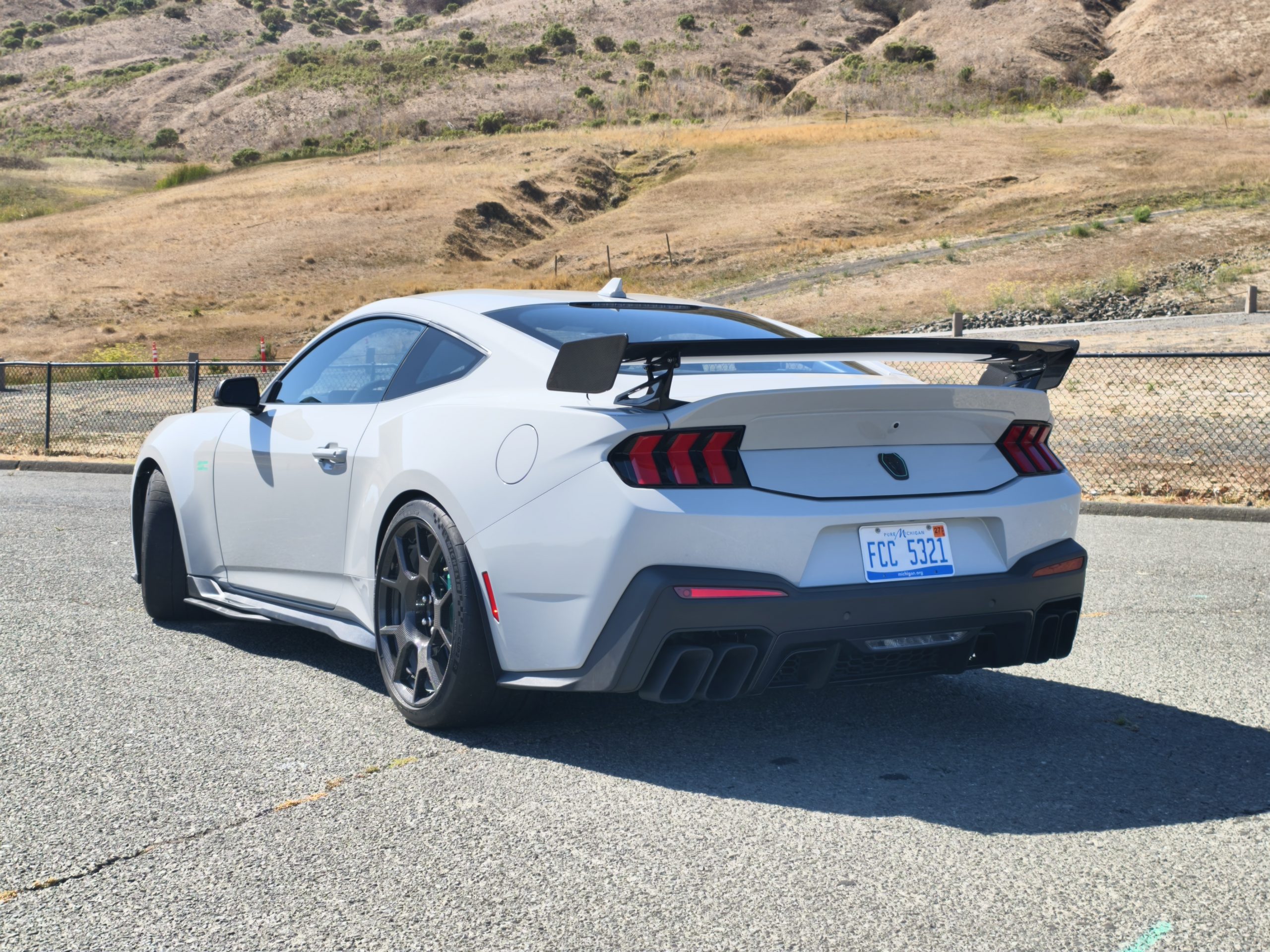
Residing in the power barn is the aforementioned 5.2-liter supercharged V-8, which fires 795 thoroughbreds through the chunky tires. A set of 305/30ZR20 Pirelli P Zero Rs keep the front planted on the tarmac, while 315s in the rear keep the stampede under control. In the Track Pack, which I’ll talk about in a moment, you get the same tire sizes, but as Michelin Pilot Sport Cup 2 R flavor.

Mercifully, Ford also gives you a four-mode active exhaust system, which ranges from so quiet that the supercharger becomes louder than the rest of the engine, to so loud that you’ll piss off an HOA in the next postal code over.
Keeping the car under control is a double-ball-joint MacPherson strut front suspension with a hollow stabilizer bar and aluminum control arms. MagneRide dampers with Dark Horse SC-specific tuning make the ride soft and compliant when you’re on the road, and ready for battle when you’re on a track. The front stabilizer bar is 36mm by 5.4mm up for the base, or 36mm by 5.7mm for the Track Pack. Supporting the rear is an integral-link independent suspension with coil springs and MagneRide dampers. The hollow rear stabilizer bar is 24.2mm in the base and 25.4mm in the Track Pack.

Ford says that the MagneRide dampers are taking measurements and making adjustments on an individual damper level thousands of times per second, limiting body roll or giving a more forgiving ride on imperfect roads. Further tightening things up is a magnesium brace that ties the two front strut towers together, which improves torsional rigidity up front.
Brakes are another area where engineers borrowed some tricks from racing. All four rotors are massive, 420mm dinner plates. However, what those rotors are made of and what chomps on them depends on the version of the car that you buy. In the base Dark Horse SC, stopping happens through two-piece directional-vane iron rotors squeezed on by six-piston fixed-bridge aluminum monobloc Brembo calipers. Friction is provided by a set of low-metallic compound pads

Opt for the Track Pack, and things get fancy with carbon ceramic rotors paired with high-performance linings. Rear brakes are a similar setup of either iron or carbon ceramic; only the rotors are 370mm, and the Brembo calipers have four pots instead of six. Ford says that, by getting the Track Pack, which pairs the carbon ceramic brakes with carbon fiber wheels, the Dark Horse SC loses 120 pounds of unsprung weight compared to the base version. That’s why there are two quoted base weights in the spec sheet above.
There is a part of the Dark Horse SC that trickled down not from Ford’s GT3 program, but from the GTD, and that’s the GTD’s variable traction control system. This controls the intensity of the traction control intervention through five levels, from full traction control for beginners to no traction control for experienced track racers.

Ford says the 2026 Mustang Dark Horse SC comes fully-loaded. That means you aren’t going to be picking seats, sound systems, or anything like that. But Ford has found rather creative ways to escalate the price of the car very quickly. It starts with the color, as any color that’s not a shade of gray will cost $495. You’re already paying over $100,000 for this, so that’s whatever. Oh, but brace yourself.
If you want a racing stripe, which is physically painted on the car and is not a decal, that’s $10,000. Then there’s the Track Pack, which adds, per Ford:
• 20″ x 11.5″ Exposed Carbon Fiber Wheels.
• Carbon Ceramic Brake Discs.
• MagneRide Damping System with Unique Tuning.
• Unique Fender, Decklid and IP Badging Color.
• Classic Package.
• Track Pack.
• Rear Seat Delete.
• Rear Adjustable Carbon Fiber Track Wing and End Plates.

That adds a whopping $36,500, or essentially the price of an entire Ford Mustang EcoBoost. I’m somehow not done yet. If you want to match your carbon fiber wheels and wing with carbon fiber trim, that’s another $10,000. If you want your car to have a splash of teal that’s inspired by an optional color that early Mustangs had, that’s $3,000. Stop here, and you’re looking at about $169,000.
There’s another way to option the car even higher. Just for 2026, there will be a Track Pack Special Edition, which will be sold in ultra-limited quantities. It’s essentially a Track Pack with red racing stripes and red Recaro seats. This will delete the lovely teal and any real color, replacing it with white or black and a price tag of $175,565.

For comparison, a completely maxed-out 2022 Ford Mustang Shelby GT500 costs $127,895. There’s no way around it; the Dark Horse SC costs some ridiculous money.
This pricing puts the Mustang Dark Horse SC into Chevrolet Corvette Z06 territory. I have not driven that car, or any Corvette, yet, so I cannot tell you how it compares. However, I can tell you what it’s like to experience this beast of a black horse as someone who normally drives pickup trucks, buses, and cars with well under 100 horsepower.
On The Road

My car was painted in a wicked blue color and did not have the Track Pack. The interior, while fairly luxurious, didn’t really prepare me for what I was about to get into. I relaxed into my throne, adjusted my seat, then hit the start button. On a cold start, the engine is so loud that I feel like I should have called out “Clear Prop!” before waking up the apparent eruption. Actually, I think I have seen planes with quieter startup sequences.
I am often a foolish person, so I committed to the bit and left the car in Track mode as I rolled out of the venue. What shocked me was how controllable the car was, even in its most hardcore mode. Throttle tip-in is really as gentle as you make it, and it’s possible to just inch the car along at what feels like a fraction of a percent of throttle input. I’m sure the DCT has something to do with that, but not even my wife’s Volkswagen Jetta SportWagen TDI has this fine of throttle control. If anything, it felt like the car had an old-school cable throttle, because I felt like I had that much control over the pedal.
I leisurely accelerated to the in-town speed limit of 20 mph, and the car moved with the kind of grace of a gentle wave. If it weren’t for the snarling exhaust, I could have been fooled into thinking I was driving something with a fraction of the power.

But then, once I was freed from the shackles of school zones, business districts, and residential speed limits, I opened up the taps. It was like I detonated some serious putty. There was an explosion of power, a panic of tires desperately trying to prevent themselves from being turned into smoke, and the scorn of an angered traction control system. The drama lasted for maybe a second before everything hooked up and the Dark Horse SC galloped into the morning mist so hard that it felt like I was riding in a Gravitron. The only thing louder than my intense laughter was the roar of the pipes.
It’s hard to describe how the Dark Horse SC’s power hits. I’m pretty sure the only vehicle I’ve driven that was technically more powerful was a Lucid Gravity, and since rescue dogs were riding with me, full-throttle pulls were ill-advised. So the Mustang Dark Horse SC is definitively the fastest car I’ve driven.
I have been in other fast vehicles, like turbofan-powered airliners, overpowered aerobatic planes, and stupid fast electric motorcycles. None of them had me as surprised as the Dark Horse SC did. To say that the Dark Horse SC had a “groundswell of power” would be an understatement; this car had an excess of power in every situation and at every speed. It accelerates faster at 100 mph than many cars accelerate to 60 mph.

Yet, just like in town, even when I was on the throttle, I felt totally in control. The Dark Horse SC didn’t try to snake around, and I always felt that my commands on the steering wheel and brakes would do exactly as I intended them to.
The drive to Sonoma from our hotel took us on a scenic route that I could only best describe as being like the son of Angeles Crest. It was longer than an hour of tight mountain switchbacks, blind curves, steep cliffs, and two-lane blacktop. The Dark Horse SC negotiated all of this madness with a composure I haven’t experienced since I drove the Lotus Emira.
It was shocking how all I had to do was point the steering wheel in the direction I wanted to go, and the Dark Horse SC just went there. It didn’t matter if I tripled the speed shown on the curve advisory signs. It didn’t matter if I hit a pothole on the way to the apex. The car, its tires, and MagneRide were entirely unbothered. The grip was simply immense, and the car wrapped around the mountain curves so hard and so fast that I started making myself feel dizzy, a sensation I had never felt as a driver before.

As for the comfort of it all, I was in my zone. My driving partner had some rather soft Bon Iver playing while I had my cooled seat and driver zone of the air conditioner blasting. The suspension, while not soft and made my boobs jiggle like Jell-O, was better than I expected for a taut track car. Sure enough, if I told the suspension to go into its hard mode, it felt like I was trying to drive an empty heavy-duty pickup truck through the turns.
I did try to hypermile the car, but no matter how light I was on the throttle, the eager V-8 didn’t want to average greater than 17 mpg. Sadly, I had only an hour and a half behind the wheel before we arrived at our track activities of the day. Well, I wouldn’t be sad for long.
At The Drag Strip

Once everyone arrived at Sonoma Raceway, Ford’s team broke us up into groups, which were loosely based on experience level. I was honest in that I had never taken a performance car onto a track before, and that the Dark Horse SC was the second-ever Mustang I had driven. The first Mustang, of course, was the RTR only the day prior.
My prior track experience is properly goofy. Earlier this year, I skidded the Autopian’s Nissan Murano CrossCabriolet around the autocross circuit of Lime Rock Park. Before that, I performed hot laps in a motorhome at the Motor Enclave. Earlier than that, I participated in a track day involving the Harley-Davidson Road Glide ST and Street Glide ST. That’s it for my paved track experience: big and heavy vehicles that weren’t really meant to be there.
I have a lot more experience on dirt tracks, but even then, my steeds there are usually rides like a Toyota Camry, a Saturn Astra, a Ford Expedition, a Ford Freestar, and a Jeep Renegade. So, I happily took my spot in the inexperienced group.

Our first activity was the drag strip. Ford’s people tell us that the Mustang Dark Horse SC could run a quarter mile in about the mid-10s with the right driver, properly warmed tires, and ideal conditions. Well, I’ll tell you what, none of those things applied to me on that day. But the Dark Horse SC does have some toys to make a pure novice like me look like I know what I’m doing.
Once I got to the strip, I engaged the car’s line lock function, which locks up the front wheels and allows the rears to spin, either to make an epic burnout or to warm up the tires for a drag run. The actual drag racer mentors at the track suggested a 3-second burnout. Well, I had so much cackling in my cloud of smoke that my burnout lasted for a full 15 seconds. Apparently, the cloud was so huge that people who were nowhere near the drag strip smelled my burning tires. There was so much smoke that I could not see outside of the windshield for a good 30 seconds. If someone told me to stop, I couldn’t hear them because I was laughing too hard.

Once I regained composure, I inched into the pre-stage portion of the tree, activated the countdown, engaged launch control, and lit the afterburners on the green light. My first run was 11.5 seconds at 127 mph. Not bad for my first-ever run at a drag strip! But now it was time to get serious.
On my second run, I tried to stop myself from spinning the tires too much, but still went for maybe six seconds. Oops. Look, the burnouts were just too fun! This time, I was laser-focused and dropped the hammer only 0.22 seconds after the green. On that run, I crossed the line in 11.2 seconds at 130 mph. Sadly, I messed up my third launch, and my time was 11.5 seconds again on my third time around. But I didn’t care. I was having way too much fun, feeling like I engaged a warp drive.

The best time of the day was another beginner who managed to hit a 10.7-second run. His secret? He did only a short burnout, set the launch control RPM a little higher, and nailed the launch. Also, his car had more than 5,000 miles on it, and the belief was that his was broken in and a little looser compared to the rest of the press cars, which had around 1,000 miles on them. Even the professional drag racer in the group was only able to hit a 10.9-second run at best.
That’s not to say that the pro racer was bad. Quite the opposite. What it showed was that the tech and gizmos made drag racing accessible to everyone that day, regardless if they were pros or had never driven a car with that much horsepower in their lives. Most of the journalists averaged in the low 11s, with only a couple of people in the 12s.

I also didn’t expect how much I’d become addicted to drag racing. Each of us was allotted only three runs, but like a kid suffering from a candy withdrawal, I begged the Ford people every way I could to give me just three more runs. I obsessed over the idea of seeing the board light up with a 10 for me. Thankfully, the Ford people pulled me away, because had I hung around that strip any longer, I would have become like Gollum from The Lord Of The Rings, only my precious was drag times.
On The Track

Thankfully, I didn’t have to wait very long to get my next fix, because now it was time to go fast. Ford set all of us up with five laps on the Sonoma Raceway’s road course with a professional driver leading.
This was just as new to me as being on the drag strip was, and I was so ready. Channeling my inner Ricky Bobby, I exclaimed, “I wanna go fast!” and “If you ain’t first, you’re last!” My only uncertainty was my unfamiliarity with the Sonoma Raceway, so I didn’t know how confident I’d be in going fast.
Coincidentally, it took until just turn 1 to blow my mind. I’ve “been” to the Sonoma Raceway before. Not in real life, but in the video games I played as a kid over 20 years ago. Back in those days, it was called the Infineon Raceway, and it was in everything from NASCAR Thunder to Gran Turismo. I’ve had to have turned thousands of laps on digital versions of this track throughout my childhood, and the shocking thing was how much it all came back to me. Yes, I was in a real car going real speeds, but I “remembered” my racing lines and the track layout from my youth. Honestly, it was a little hard to focus on my lap because I was fangirling the whole time.

But eventually, I snapped out of it and used my memory to my benefit. I treated the track like my racing games of old. I even pictured the virtual racing line that you used to get during the tutorial modes of racing games. The result? Oh, I was quick.
The Mustang Dark Horse SC was in its natural environment on the track. It was here that I was able to let all of the horses truly out of the stable, and I got to find the limits of the tires, the brakes, and myself. Something I found hard to fathom was just how much grip there was and how much braking force was in reserve. The Dark Horse SC stops so hard it feels like I got into a car crash, and pulls so hard in turns — the G-meter was showing 1.6 at times — that it felt like my organs were getting rearranged. I have no idea if the G-meter was anywhere near correct, but the only time in my life I have ever felt more G-force was the time I went 7.5-G in an aerobatic plane and blacked out.

But also, wow, those brakes. In full braking force, my necklace was actively trying to rip itself from my neck, and I felt like my eyes wanted to come out of my head. It simply boggles my mind how any car can stop that hard, and now I want to feel the stopping power of something like a Le Mans racer.
If I could describe how the Dark Horse SC handles on the track, I feel like it’s like a video game, weirdly. The steering was point-and-click sharp, and the bounds of grip were far higher than I imagined. I’m not beyond saying that this car has more capability than I have skill. As good a driver I think I am, the Dark Horse SC had more in it.

This was proved further when I took the passenger seat in the Dark Horse SC with a real racing driver at the wheel. I was relieved that the lines I remembered from my childhood were the right ones, but the guy behind the wheel did every single thing faster than I did. It was nuts that I was in a car that easily broke triple digits on the straights and cornered so hard that my GoPro could barely hold on. Yet, somehow, this thing was road legal.
Just calling this car “fast” is really underselling it. No, the Dark Horse SC is diabolical. It’s a supercar wearing the body of a Mustang. Forget drinking a coffee or a Red Bull; just get a full cup of Dark Horse SC, and you’ll be jittery all day.
A Marvel Of Engineering That You May Never Max Out

The longer I thought about how awesome the Dark Horse SC was on the track, the more a certain conclusion started populating in my head.
I adored this car. It was ferocious, yet easily drivable. It performed all sorts of burnouts, then ran quick drag times. It was a track monster, but it has a nice trunk and road-trips well. It’s a car of so many personalities.
Yet, I couldn’t escape the thought that, if you bought this car, the only way to truly wring it out would be to go Mach 1 on a track. Out there on the road? The car’s maybe seeing three out of ten of its capability, at best. You can’t exercise the engine without breaking every law in the book, and you just can’t go fast enough in the curves to even make the tires sweat. The moment you take it onto a track, your head will spin at the thought that your spirited driving in the canyons was basically a Sunday drive for the Dark Horse SC.

This car is mechanical art and a marvel of engineering. It’s incredible what Ford achieved. Not just the raw power, handling, and braking, but the fact that it’s so accessible. That’s what blew my mind about this car more than the power. The grip, the brakes, the stability, and the ease of driving the machine almost make the horsepower a footnote. [Ed Note: This is also what impressed me when I drove the GTD: It was too easy for a less-than-great driver to go fast around the track. -DT]
Yet, the limits of the Mustang Dark Horse SC are so ridiculously high that you’re almost doing the car a disservice if you never take it to a track. So, I think whether you should get a Dark Horse SC will depend on what you want to do. If you just love the way it looks, want to have it as a status symbol, or are a track rat? Absolutely, get it all day. But if you’re an enthusiast who doesn’t really go to the track and canyon carving is where it’s at for you? A lower Mustang will probably be a better fit for you.
Unfortunately, the price of it all won’t be a footnote, and there’s a legitimate question if an extra 35 horses and the other Dark Horse goodies are worth the price hike over the old GT500. Anecdotally, I have seen a ton of complaints online about how much this car costs, and that isn’t encouraging.
Still, if you have the scratch, the Dark Horse SC is awesome. I myself could never take it to its limits, and yet my heart’s RPM rises just thinking about my time on the track. I can’t believe I’ve missed out on Mustangs for this long, and for this to be my first experience in one makes me want to get behind the wheel of every other Ford pony out there.
All images: Author


Never in my life will I be driving much less owning any of these configurations, but I loved reading this, you put me in the novice drivers seat and the excitement was palpable!
Mercedes… If you haven’t driven a Corvette, you should go to Ron Fellows Corvette School. It would make an excellent story. It’s also an amazing experience!
That’s why we are here.
The front bumper on the SC is definitely a lot better than the one one the standard Dark Horse. The teal green one is my choice.
Least you can be proud of your times since you shifted it
your sel-,er ok least you pressed some buttons and changed some “settings” better than the other racers.Plus if you park it somewhere anyone wanting to steal it will find that they
can’t driv-,er nevermind yeah it will be gone faster than you can blink so lock it up.FTFY. 😛
Sounds like this is an absurdly expensive toy where you pay for a bunch of capability that 99% of people can’t and/or won’t take advantage of. Which means most of these will get bought by people who squirrel them away in a climate-controlled garage. :-/