


Owning the typical American travel trailer comes with some demands, and often, one of them is being okay with having a larger vehicle just to tow the thing. Vehicles like base-model Ford Mavericks, small crossovers, and wagons cannot officially tow much weight, leaving you scaling up in vehicle unless you get a really tiny camper. America’s first name in foldable A-frame campers, Aliner, has just the thing. It’s brought its famous Alite back from the dead, and given a base weight of under 672 pounds, even some of the least capable vehicles can pull this affordable trailer.
It probably won’t surprise you to read that the American RV industry is struggling right now. The industry set a shipment record of 600,240 units in 2021 during the COVID-19 pandemic as traditional vacation destinations remained either closed or in limited operation. Then, as soon as those cruises and other popular vacation spots fully reopened, Americans stepped away from RV dealerships. By 2023, RV shipments had fallen to 313,174 units, or below 2013’s numbers, when the industry was still recovering from the Great Recession.


Reduced demand after the pandemic wasn’t the only cause of 2023’s depressed numbers; high interest rates and uncertainty about the economy also played roles. Still, the RV industry started clawing back sales, slowly, with 333,733 shipments in 2024 and 342,220 shipments by 2025. This year was supposed to be another good one.

Now, the RV industry is in trouble again, and for the same reason why you probably skipped that cross-country road trip. Between high gas prices, historic diesel prices, high interest rates, and even more economic uncertainty, fewer people are darkening the doors of RV dealerships. According to RV dealerships interviewed by Reuters, wealthy older people are still scooping up units, but price-conscious buyers are staying away. The RV Industry Association thinks a total of 300,00 to 328,100 shipments will occur this year. That leaves the very real potential for this year to be even worse than 2023.
Several RV manufacturers have been dipping into their war chest for creative ways to survive these troubling times. One method to get people to buy an RV is to just make them cheaper and more accessible. Aliner has decided to get back to basics with its new Alite, which technically isn’t new at all. This tiny camper is so light that a diesel-powered Smart Fortwo is used for the trailer’s press imagery!
America’s Popular Purveyor Of A-Frames

Aliner bills itself as America’s first A-frame travel trailer manufacturer, and it’s a favorite brand among Autopian readers. It’s hard to argue, because the concept of an Aliner is excellent. These campers start off as compact boxes, then expand out, like a tent camper. However, unlike a tent camper, you still get hard walls. Aliners are also known for their low base weights.
Aliner was officially incorporated in 1984. Here’s what I’ve written about Aliner’s history:
Aliner’s history is a short one. Back in the early 1970s, Ralph Tait decided that he wanted to design a new camper. Working out of his garage in Bend, Oregon, he spent several weeks crafting what would become his first A-frame camper. The resulting travel trailer was like a more traditional pop-up camper, but different in one key area. While a traditional pop-up opens up into a sort of tent on wheels, Tait’s camper has hard walls. Apparently, people loved his camper enough to request their own, and eventually, Tait decided to make it into a business.
Tait’s family moved to Pennsylvania, where Ralph and his brother built the campers. A third brother hitched a completed camper up to a station wagon and drove around the country until the camper sold. Aliner says it’s been producing the campers in Pennsylvania since 1982. The Taits retired in 2007, but the company still builds the A-frame campers that you’ve probably seen on the road.

I have toured some new Aliner units in the years immediately following the pandemic, and found myself unimpressed with the fit, finish, and quality. However, multiple Aliner-owning readers have told me that their units are built pretty well. Maybe the ones I saw at the RV shows were just flukes and not indicative of overall quality. Either way, it’s great to hear that this is probably a case where I shouldn’t judge a book by its cover.
It’s even greater to see that Aliner is reintroducing one of its most beloved models.
The Alite
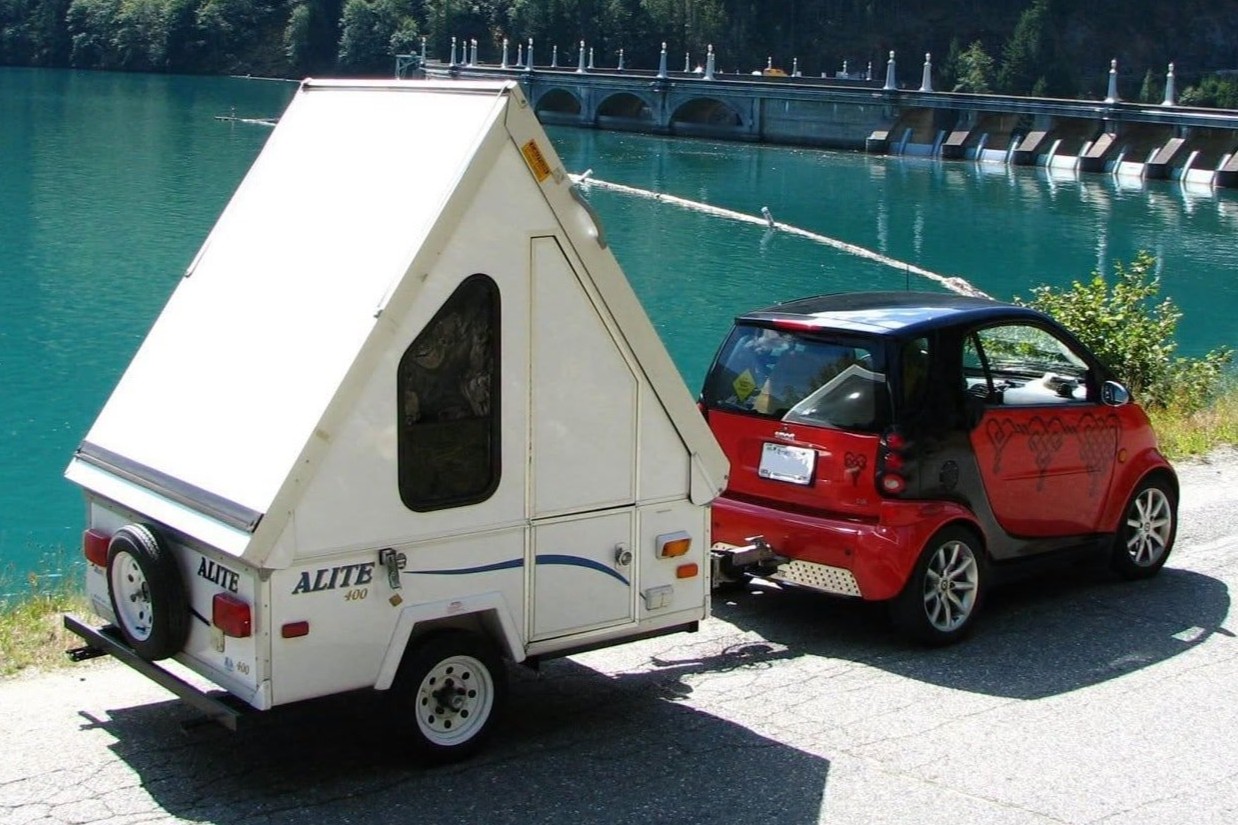
Back in 1998, Aliner unveiled a new camper concept. The Alite was built using the same formula that had made Aliner popular for over a decade by that point, but scaled down. At its lightest, the Alite weighed less than 400 pounds, and Aliner advertised the trailer as being a good fit for a large motorcycle or trike. Yet, the Alite buyer still got an aluminum body, a vent, a skylight, and a roof rack as standard.
Aliner says that the Alite almost immediately became a fan favorite. Everyone from Harley-Davidson riders to Smart Fortwo owners scooped up Alites to haul behind their vehicles.
The old Alite made a lot of sense for the owners of vehicles that couldn’t tow a lot of weight. While Smart never approved the original Fortwo for towing, there was one aftermarket trailer hitch on the market that was allegedly German TÜV-approved to tow 350 kilograms, or 771 pounds. That meant that the owner of a Fortwo could haul an Alite and have some margin for basic gear. The Fortwo used in Aliner’s advertising is one of the Fortwo CDIs that were sold in Canada, a car that I own and can routinely hit 70 mpg in. Even if the Alite slices fuel economy in half, that’s still awesome.

It’s understandable, then, that when Aliner discontinued the Alite nearly ten years ago to chase other models, Aliner fans wanted to know when the Alite would be back. Unveiled during “America’s Largest RV Show” in Hershey, Pennsylvania, this month, Aliner announced that it’s bringing the Alite back for 2027.
As a note, Aliner used AI to produce the official exterior images of this trailer, and I don’t roll with AI, so the images here are from a dealer.
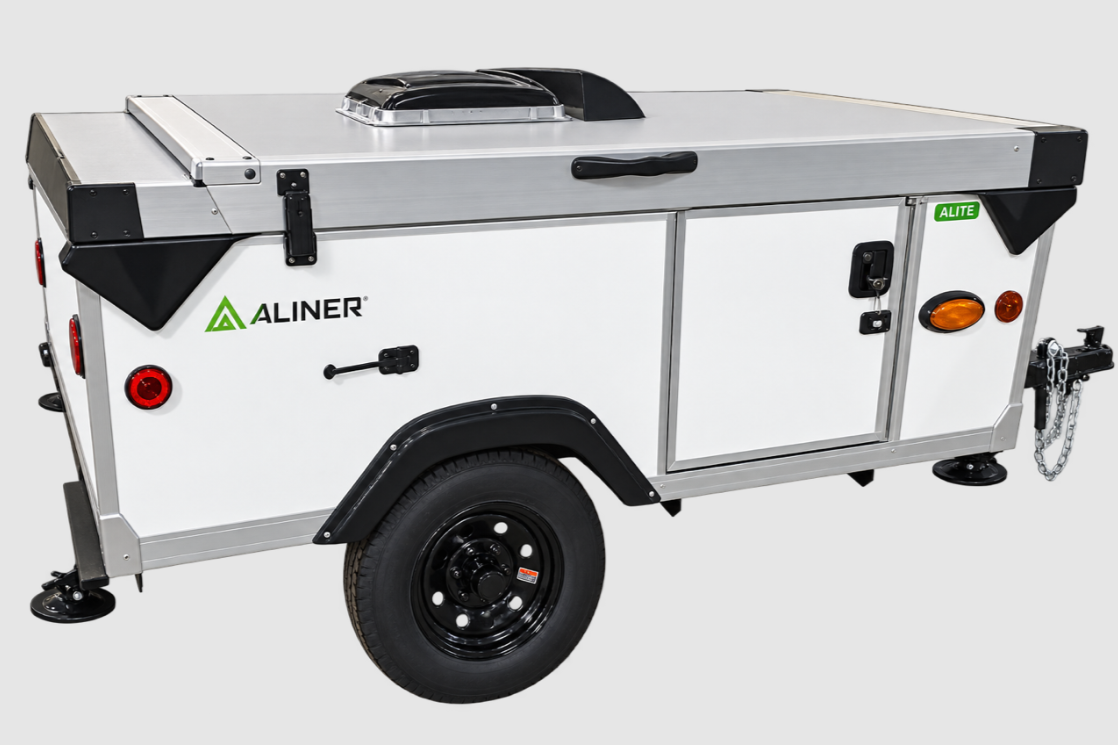
The rebooted Alite isn’t just the old camper with a new decal package. Aliner says that the Alite starts off as an all-aluminum structural design. The metal holds up walls and a roof consisting of a sandwich of vacuum-bonded fiberglass with a polystyrene core. Inside, the wall and ceiling panels are made from Azdel composites. Aliner says that there is no wood or anything else to rot. This construction already puts Aliner ahead of much of the RV industry.

With that said, I do hope that Aliner is now doing a better job at painting its frames than it did two years ago. Back then, every single Aliner Ascape that I saw at an RV show wasn’t even a year old, yet each had quite the build-up of frame rust already. I suppose the good thing is that, should your Aliner frame rust, most of the frame is easily accessible to be rust-protected.
Anyway, opening an Aliner is pretty easy. Once you pop the roof’s latches, a set of struts helps you swing the roof up and into the iconic A-shape. Then, you unfurl the wall panels and fasten everything up. Apparently, all of this can be done in 30 seconds in an Alite, which is great!

Once you have the camper all set up, Aliner says you’ll have 6.6 feet of headroom at the central point of the camper, a 58-inch by 76-inch bed, two benches, a storage box, and a roof vent. In terms of equipment, there’s a shore power hookup, 12-volt outlets, 110-volt outlets, and lights. That’s it. The camper has no tanks, no water system, no HVAC, no solar panels, and not even a cooler. Aliner doesn’t even list these things as options. If you want to use the bathroom, cook, get cooled down, or do anything else, you’ll have to bring your own gear.
If you don’t need those luxuries, the Aliner has an attractive spec sheet. Empty weight is said to be “under 672 pounds,” and tongue weight is a light 114 pounds. The trailer’s total length is just 11 feet. This trailer can basically fit into whatever nook or cranny that’s in your garage.

Not The Cheapest, But Accessible
Of course, you’re reading a Mercedes RV news article, so there’s a catch. The Aliner Alite can be found for as cheap as about $12,000 after dealer discounts. Technically, that does make it relatively affordable, but if you’re looking for features, you can get more for less. I’ve written about new trailers for $9,000 that come fully-loaded. However, those cheaper trailers are bigger, heavier, and are built with worse materials. Some dealers also
The Aliner Alite is for a specific kind of buyer. This person probably owns a small crossover or even a car with a puny tow rating, and isn’t interested in going bigger. This buyer doesn’t want a trailer with tent walls and probably wants to keep their unit for a long time. This buyer might even drive a vehicle that doesn’t have an official trailer capacity.
Of course, I would never recommend that you tow a trailer with a vehicle never rated for towing. But that’s between you, your god, your insurance, and your attorney. Regular readers know I used to tow U-Haul trailers with Smart Fortwos. What I will say is that you should consider the safety of yourself and others around you.
Otherwise, if you have something like a newer Chevrolet Trailblazer with a towing budget of only 1,000 pounds, or a standard Subaru Crosstrek with a 1,500-pound rating, the Alite might be the camper you’re looking for. In theory, you could throw some gear into your Alite and still have enough of a margin in your towing capacity — no more than 80 percent of total capacity is ideal — to be safe.
I’m just happy to see yet another company launching a camper that’s closer to the bottom of the market. I have long been a believer that RVing should be for everyone who wants to do it, regardless of their budget or desire to drive a big truck or bus. I don’t know how many people will be convinced to buy an Alite during these periods of insane fuel prices, but I do hope to see this downsizing and cheaper RV trend to continue.




Holy crap, they brought it back! I owned an original A-Lite that I sold a few years ago, and kind of regret doing that. I was able to tow it with a Hyundai Ioniq hybrid and still get 54 mpg on the highway
I looked at a few used Aliners a couple of years ago and while I like the concept, they weren’t holding up very well. Panel alignment wasn’t very good, so getting them opened and closed wasn’t as easy as it (maybe) once was. And the ones I looked at otherwise looked brand-new, with no signs of abuse. In the end the attractive pricing and ease of towing didn’t make up for seemingly all of them in my area being garbage, so I invested in a nice tent instead.