


I’ve mentioned before how, despite all logic and reason, the world of the Volkswagen Beetle seems to be an inexhaustible source of strange details and curiosities. I’ve been obsessed with these silly cars for decades, and just when I think I’ve encountered every obscure detail or bit of knowledge only the worst, most insufferable pedants like myself would find interesting, something else comes along. And something else has come along, this time from Africa.
Volkswagen had factories building Beetles in at least two African countries during the life of the car: a smaller factory in Nigeria, and a larger subsidiary in South Africa. I’ve talked before about some of the strange variations of South African Beetles, which include a weird Beetle/Super Beetle hybrid, but I just recently noticed something about Nigerian Beetles that makes absolutely no sense to me.


Let’s dig into this little mystery! It started with this page from a Nigerian Beetle brochure:
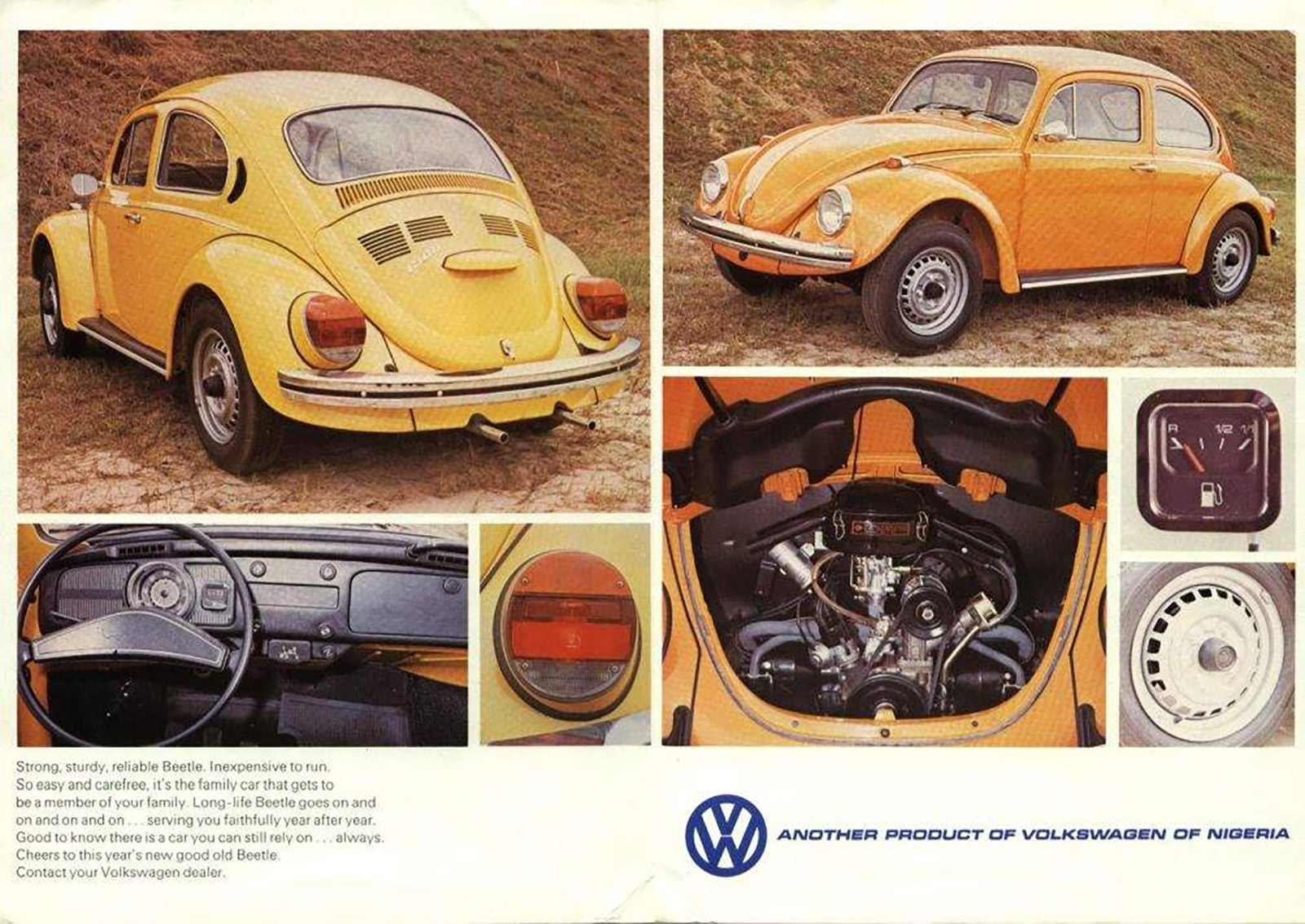
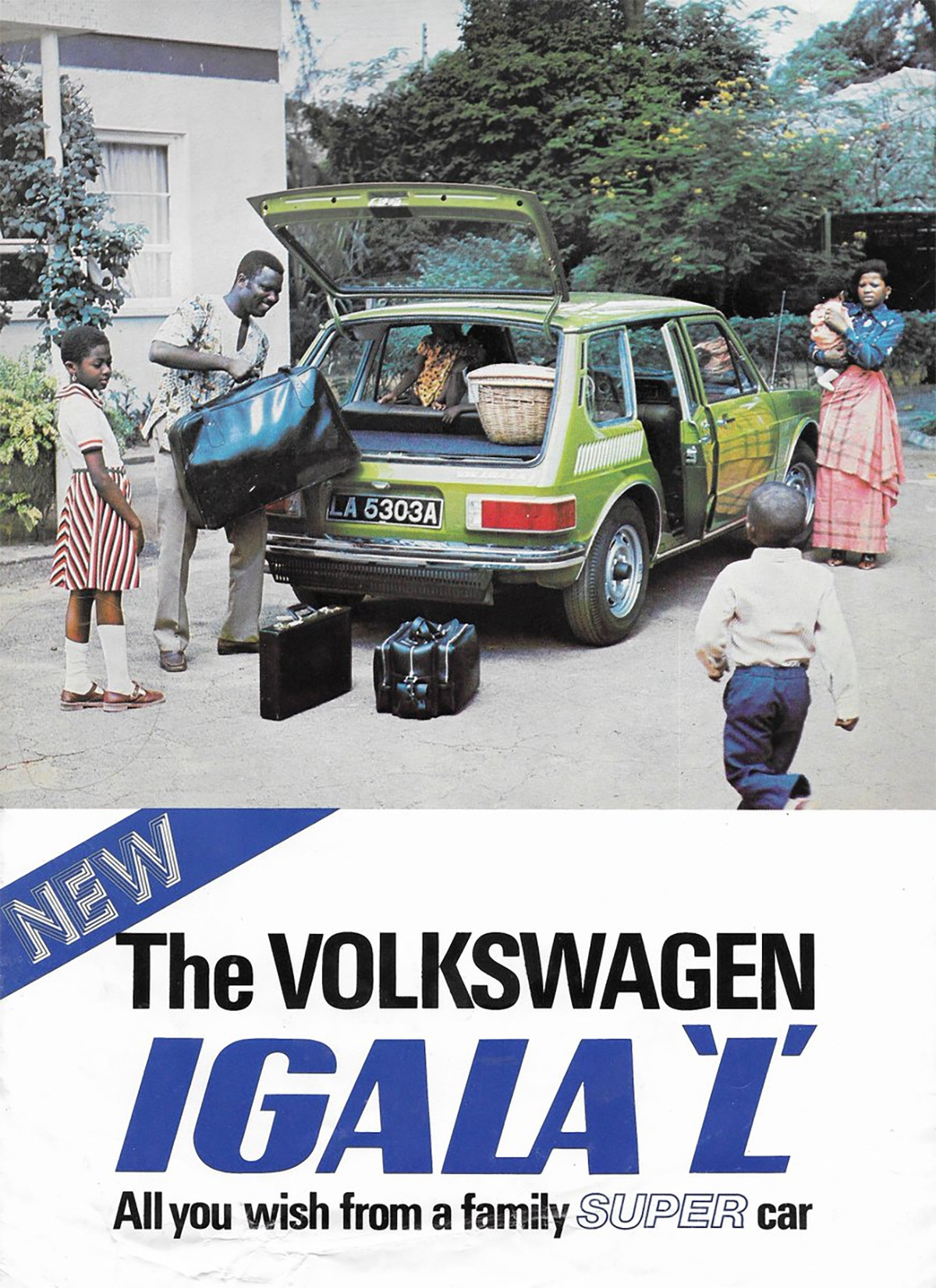
Nigera’s Lagos VW assembly plant went online in 1975, and in the air-cooled era produced Beetles, buses, and Nigeria’s own special variant of the Brazilian Brasilia, the four-door Igala:
Okay, but let’s get back to the Nigerian Beetle. The one I showed above there was from 1976 or so, and this one is from 1985-ish:

The thing that strikes me about these Beetles is that they seem to be using the same body stampings as Brazilian Beetles (they called them Fuscas). You can tell by the strange combination of old and new details, like the smaller windows and thicker pillars, while also having the little (-shaped air extraction vents behind the rear side windows. Plus, there’s the distinctive Brazilian-style engine lid, with its two sections of louvers. Here’s an example of a Brazilian Fusca so you can see what I mean:

Now, just to compare, take a look at some of the Beetles being produced at VW’s South African factory:

Look at the sizes of the windows, and the pattern of vents on the engine lid; these are far more in line with contemporary German Beetle production than what was being built in Brazil. Now, VW South Africa had their own body stamping facilities, while Lagos, at least initially, was using CKD kits for the body panels. So, based on what I can see, it looks like the Nigerian Beetles were getting their bodyshells from Brazil instead of from where you might expect, the far closer South African factory. Why?
Was it really cheaper and easier to get bodies from across an ocean instead of on the same continent? I suppose so? Maybe Brazil had excess production capacity that South African didn’t? It just seems strange to me.
View this post on Instagram
Nigerian Beetles – at least the earlier ones – are also unique in that while they have bodies from Brazilian Fuscas, they do share at least one strange trait with South African Beetles: the strange extra “cuff” used to mount the “elephant’s foot” style taillights to the rear fenders. Later ones (like the 1980s example shown eariler) just mounted the lights to the fenders themselves.
I’m talking about this:

See that funny body-colored cuff on the taillights? That was something that I thought was unique to South Africa, but it looks like Nigerian Beetles used it, too. Everywhere else in the world just mounted those big lights right to the fender:

Why these cuffs were developed and used I can’t figure out? My best guess is that the rear fender stampings were older, and couldn’t just mount the elephant’s foot lights the way they wanted? And this was cheaper than updating the fender tooling? I’m guessing here, but that seems possible. But that doesn’t explain why Nigeria used them, especially if they were using Brazilian body parts, which could accommodate these lights just fine?
And, if we really really want to get into the weeds here, which I assure you we do, then look at the lenses of those taillights. There were actually three variations. The most common two are these:

The American spec ones and the European/Mexican/”global” ones. The difference is that the US ones have four chambers, with the red middle section having a separate tail and brake bulb, with the tail section having a square-ish reflector, while the global one is just three chambers, with a combination brake/tail bulb in the middle red section and a wide, rectangular reflector.
South Africa, for reasons I can’t fathom, had their own variant, though:
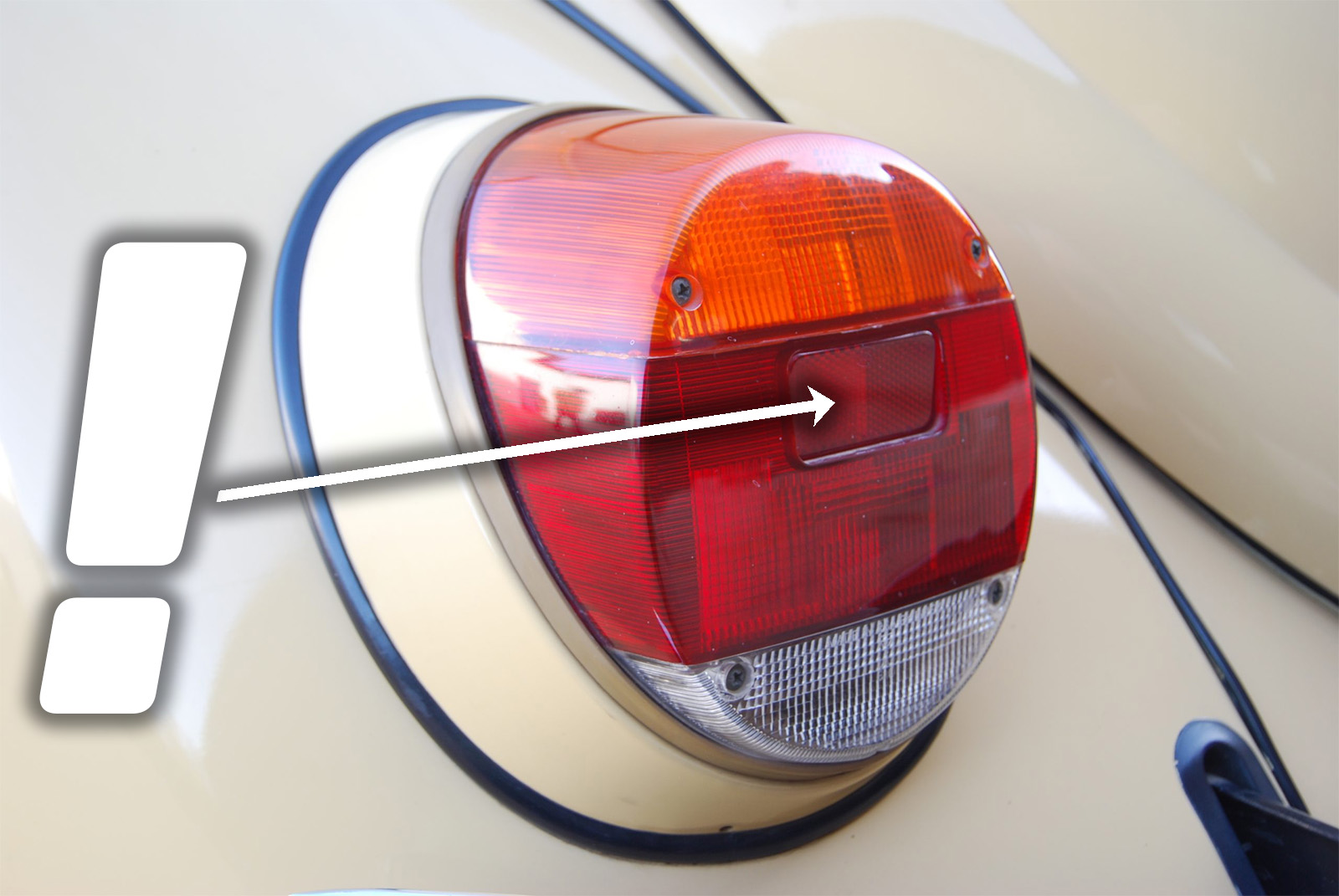
This one is like the three-chamber “global” lens, but with a smaller reflector, for some reason.
So, all of this is to say that the Nigerian Beetle uses the strange South African taillight cuff, but with the global lens, all on a Brazilian body. This makes these Beetles unique in some really unexpected ways!
This is exciting! A whole new variation I never realized! Also, oy, I have a problem.


I really like the steelies on the Nigerian-produced ones. Maybe my computer is not up to the task, but the results when I enlarge and enhance, do some of the SA ones almost look like they have five lugs? Don’t worry. I’m not a radiologist diagnosing based on imagery.
South African Beetles apparently did use 5 lugs!
And weirdly splayed ones at that.
https://www.youtube.com/watch?v=-YPZbiCnUKw&pp=ygUEYXpkYdIHCQkbDAGHKiGM7w%3D%3D <- The wheels on the car go Vay Way Vay Way Vay Way!
yeah, I think there was something going on with South Africa in the 80s that made businesses not want to trade with SA.
so it was apartheid that forced them to ship stuff from Brazil, rather than SA.
Pretty sure that it’s a shorter distance by sea from Brazil and also, might be some reason that a Black-led nation might have issues trading with South Africa during the beetle production era. Don’t you remember Lethal Weapon 2? With its two important lessons: 1. They fuck you at the drive thru. 2. Afrikaners suck. Hopefully both of those things are less true today than in those long-past days when the drive-thru was operated with a pair of soup cans and string and racism was literally the law in South Africa, but who knows?
Oy Torch, you have ignited desire within me. The Igala desire is strong.
Five kids and not a whole lot of room in back for luggage. I assume there was room for more in the frunk?
I bet Nigeria is closer to Brazil than it is to South Africa.
I just did some quick measuring on a map, and you are correct, especially if you account for the fact that the kit would need to travel by ship either way since there aren’t great rails or roads across Africa (especially not in back then).
I have no idea where in each country those factories were located, but it seems likely it was easier logistics to ship from Brazil than South Africa.
Is it me, or are those tail lights quite…large? Queue up Sir Mix a Lot.
Torch, I think you should schedule a check up soon because you’re exhibiting symptoms of Type 1 Diabeetles.
Don’t worry him, it’s probably just a bug.
Oh no, does it means he will need to restrict his carbs?
This is all due to VW’s first worldwide modular platform, the BBQ.
Always appreciate Beetle content, I could actually use more! BTW you looked at my Bug at Lemons this year… hope you were appropriately underwhelmed.
I am a Nigerian Prince who is unfairly being required to sell all of my cars. If you buy my Beetle for USD 25,000, I can buy back from you for USD 100,000 in 6 months. You can use the car, I just want someone responsible like you to own it and promise to sell it back to me.
But how can you trust me?
Having ridden a 125cc motorcycle from Nigeria to South Africa… no freaking way you are trucking car bodies up that route. Every border is a Herculean effort, not to mention the road condition, river crossings, etc… It took me four months.
And if you’re going to ship by sea, may as well use an established route with a country that isn’t an international pariah.
I know someone who rode a bicycle from Addis Ababa to Capetown. I think he managed that in about six months. The roads must be better on the east coast.
Both your and Andy Individual’s acquaintance/friend’s stories sound amazing.
No, I’m afraid I cannot.
Torch could show me all the variations side-by-side and my response would be “they’re the same picture.”
THERE ARE 4 VARIATIONS!!!
Too lazy to do it myself, but now I want to see a Photoshop of that scene with Torch as Picard. Or Torch as Gul Madred, either would be funny to me.
Just take the picture with the lights and replace them with beetle tail lights and we will get a classic 🙂
Nah, Torch as Scotty…
Good lord, I can find people in this place that have all my obsessions COMBINED!
Oh my Gawd, the swole taillights!
The tail lights remind me of the antenna on a snail with a parasite.
There is absolutely no way Nigeria would officially trade with South Africa during apartheid…
Although it was fine for VW, Ford, Nissan, and Mercedes Benz to build whopping great factories in the country during those times…. BMW too I think.
Yeah, I think that’s the most likely explanation.
Came here to say the same thing.
However, that makes the taillight cuff even more perplexing. Why use the S.A. version over the Brazilian direct-to-fender mount?
As a fellow Beetle fanatic, I am shocked I never knew about these tail-lights. Maybe it’s because I generally hate the elephant’s-foot tails so much, I try to avoid looking at them.
But seems somehow universally in order, that the biggest elephant’s feet are found in Africa..
Kinda buried the lede for us Brasília enthusiasts!
Local factory = local suppliers for some parts = specific manufacturing methods?
From the smart Ai:
The taillights seem awfully extended- I was trying to put together a “Cold start” with erect nipples joke but couldn’t quite get my hands on it.
The problem is you were using the entire hand. You should only be using the thumb and pointer finger.
Dude, we’re deep in the comment sections of an article going about the stamping differences in African Market specific Beetles from the 70-80s. I don’t think this is conducive to getting our hands nowhere near the aforementioned items!
My best guess is that the rear fender stampings were older, and couldn’t just mount the elephant’s foot lights the way they wanted?
I agree. They seem to have used pre-1974 fenders intended for the flatiron-type taillights (which are installed further down and have a cuff, too). It looks like without the cuff, the elephant feet would have been partly obscured by the rear bumper, as the cuff raises the taillight by a few inches. No idea about VW’s reasons for combining the global/Brazilian/SA features, though. Maybe the specific tools or parts were more readily available or easier to ship to Nigeria than the alternatives.
BTW, it seems like you have been implicitly banned from standardkaefer.de. They request help with the defining features of different Beetles EXCEPT information about taillights.
https://standardkaefer.de/Modelle/ZWITTER-101952-bis-31953/ (last paragraph).
One theory on why the Nigerians were importing from Brazil rather than South Africa: For a good chunk of the Beetles’ production lifetime the brutal and racist Apartheid regime in South Africa was under some form of international sanctions (observed to varying degrees around the world), it’s possible that Nigeria or another critical partner/market was not trading with South Africa. I’m not well enough versed in either Beetle or African political timelines but it would be a good first guess.
I can just imagine Musk’s mum and dad balking at the idea of driving the same vehicle as a black skinned African.
I mean, his grandfather immigrated to South Africa from Canada specifically because he loved apartheid so much, so it’s not a stretch…
Wow
I was thinking about what the road network between Nigeria and South Africa might have looked like at that time. Maybe an ocean voyage was quicker and cheaper.
My first thought too but ports in SA at the time would have been good and presumably the Nigerian ones good enough to receive the shells from Brazil, so shipping on that route probably would have been possible too?
Maybe also with both Nigeria and Brazil at the time; cheap shipping fuel supply, while SA was probably more expensive? (I am not aware if the have/had their own oil industry) There’s also the ocean currents to consider. It’s dark to think about, but they might have been following the same currents as the slave trade.
Yeah, I doubt they would have been trucking them up from South Africa, and by sea the distance from Brazil looks pretty comparable
That’s a good reminder of how enormous the African continent is
From Cape Town to Lagos is almost 3000 miles. From Sao Paulo to Lagos is about 4000 so you throw in tricky politics it becomes pretty easy which one to get beetles from.
According to the relevant Wikipedia page Nigeria did sanction ZA so this is a good point.
https://en.wikipedia.org/wiki/International_sanctions_during_apartheid
But the other answer holds true too – it was (and still is to an extent) a pain in the neck to move things around within Africa. The transport networks were designed by colonial powers who only really had an interest in moving things out of Africa.
I guess the Brazilian VW factory was really expecting that the Nigerian prince would deposit all that money directly into their account in exchange for sending the parts.