


“Heck yeah, I want to review a premium electric scooter!” This was my reply when Matt asked. I must disclose that a large part of my excitement came from me imagining a scooter with a seat, as opposed to the stand-up variety. That’s on me. However, my excitement was rekindled when Matt sent over the details on the scooter in question, the Navee UT5 Ultra X. The name evoked high-tech performance (and perhaps a high-potency urinary-tract (UT) infection medicine?) and one look at the machine’s gold finish, chunky chassis, and aircraft-looking front suspension had me eagerly anticipating the chance to put the hot-rod scooter through its paces, standing or otherwise.
(Full disclosure: Navee graciously sent over a UT5 Ultra X for me to enjoy. After sufficiently putting the scooter to use for this review, I asked Navee how I may return it to them. Navee said no need, it can become part of The Autopian fleet – so let’s call it a long-term tester.)


Navee is a Chinese brand established in 2021 that currently offers over 30 different scooter models in categories including Power Sport (at the top of which resides the UT5 Ultra X), All-Road, Urban Daily, Casual, and Kids, not to mention golf-bag pushers and … a human stamina-enhancing exoskeleton? Cool.
Unboxing And Setting Up The App

A quick perusal of reviews shows the brand is well liked for value, performance, and quality, and the UT5 Ultra X is compared favorably to the Segway GT3 Pro SuperScooter in the “super” or “hyper” scooter category. As you can see above, the Navee even borrows a few styling cues from the Segway, though I think the UT5 is actually the better-looking machine.
My UT5 experience began with hauling the boxed scooter into the house and freeing it from the cardboard. Though not heavy for what it is (indeed, it’s lighter than the Segway), I was not expecting it to weigh 90 pounds. But it makes sense; this is a dual-motor, 40+mph scooter with a claimed range of 50 miles at 25mph (full specs here). That kind of motor and battery spec can’t be light.
Once unpacked, all I had to do was install the handlebars, which was a goof-proof affair. The ‘bars are keyed to the stem so they only fit one way, and four bolts clamp the assembly down. The required hex wrench is included, ‘natch. All that was left to do was plug the UT5 in for charging, which requires 3.5 hours if you opt for the 8.8A charger, or six hours if you choose the 2.45A unit.
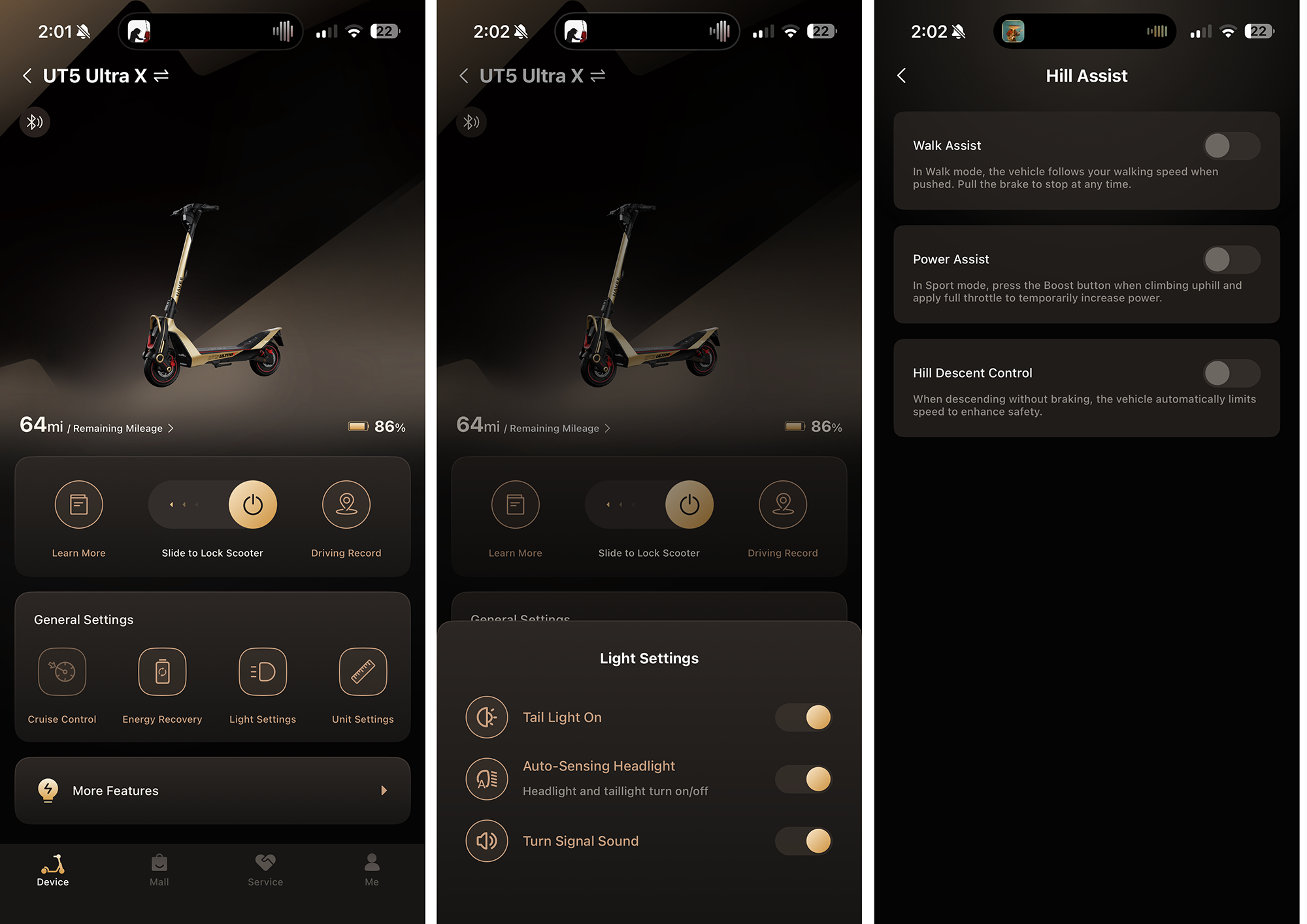
I also downloaded Navee’s app to my phone and swiped through the various settings, but left the stock setup as-is. The app connected instantly to the scooter, and even when I wasn’t running the app, I was surprised to hear the UT5 announce my phone was connected. Would you like to pipe your tunes or video audio through the UT5’s speaker (which also serves as its horn)? You can!
A Look At The Build Quality
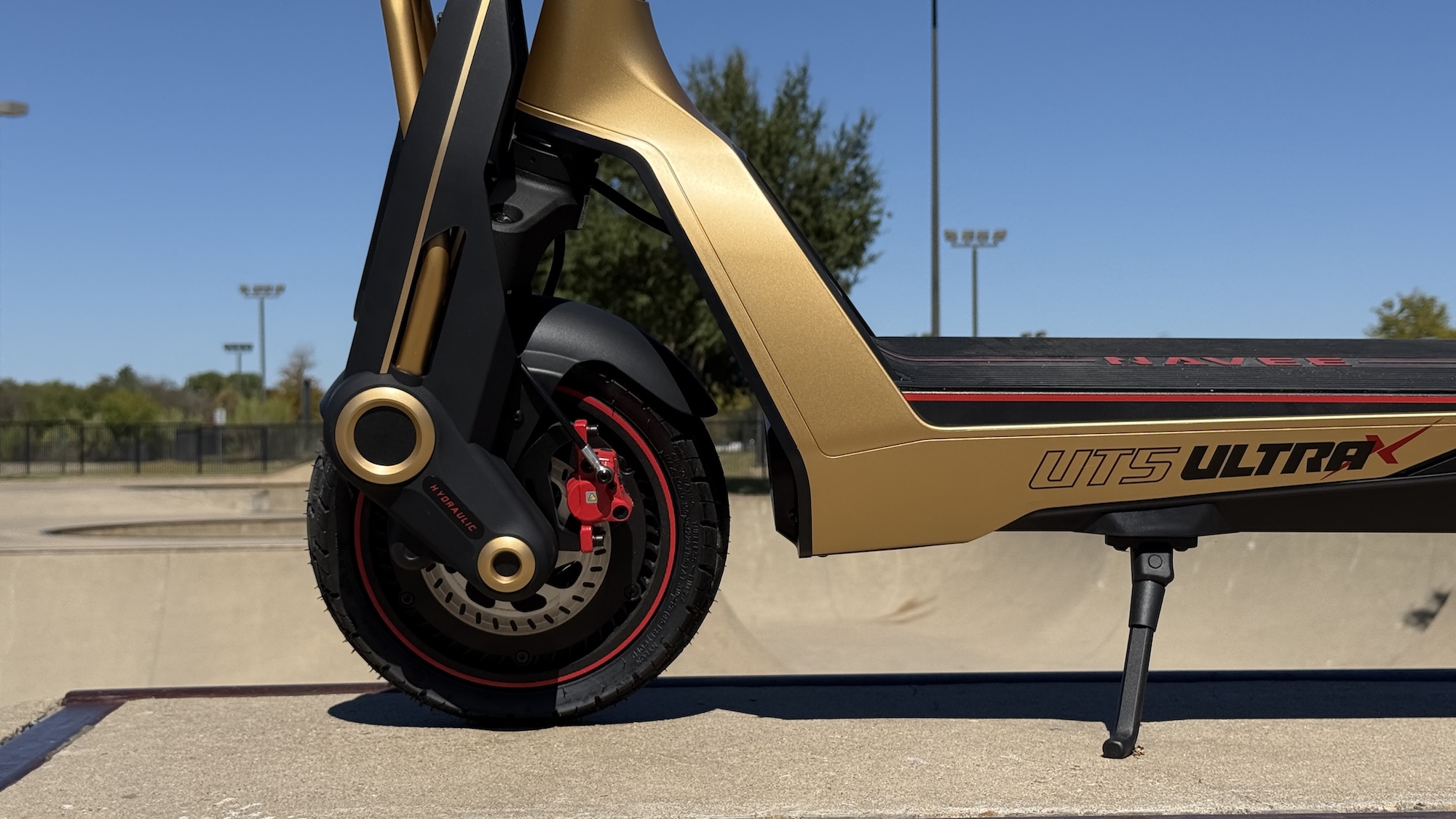
The UT5 is very solidly built. The wheels are essentially motors shod with tires, which are tubeless. Yes, this is a dual hub-motor scooter; have a look:


Each wheel wears a steel brake rotor measuring about five inches across, with a single piston about the same diameter as a quarter applying squeeze hydraulically.
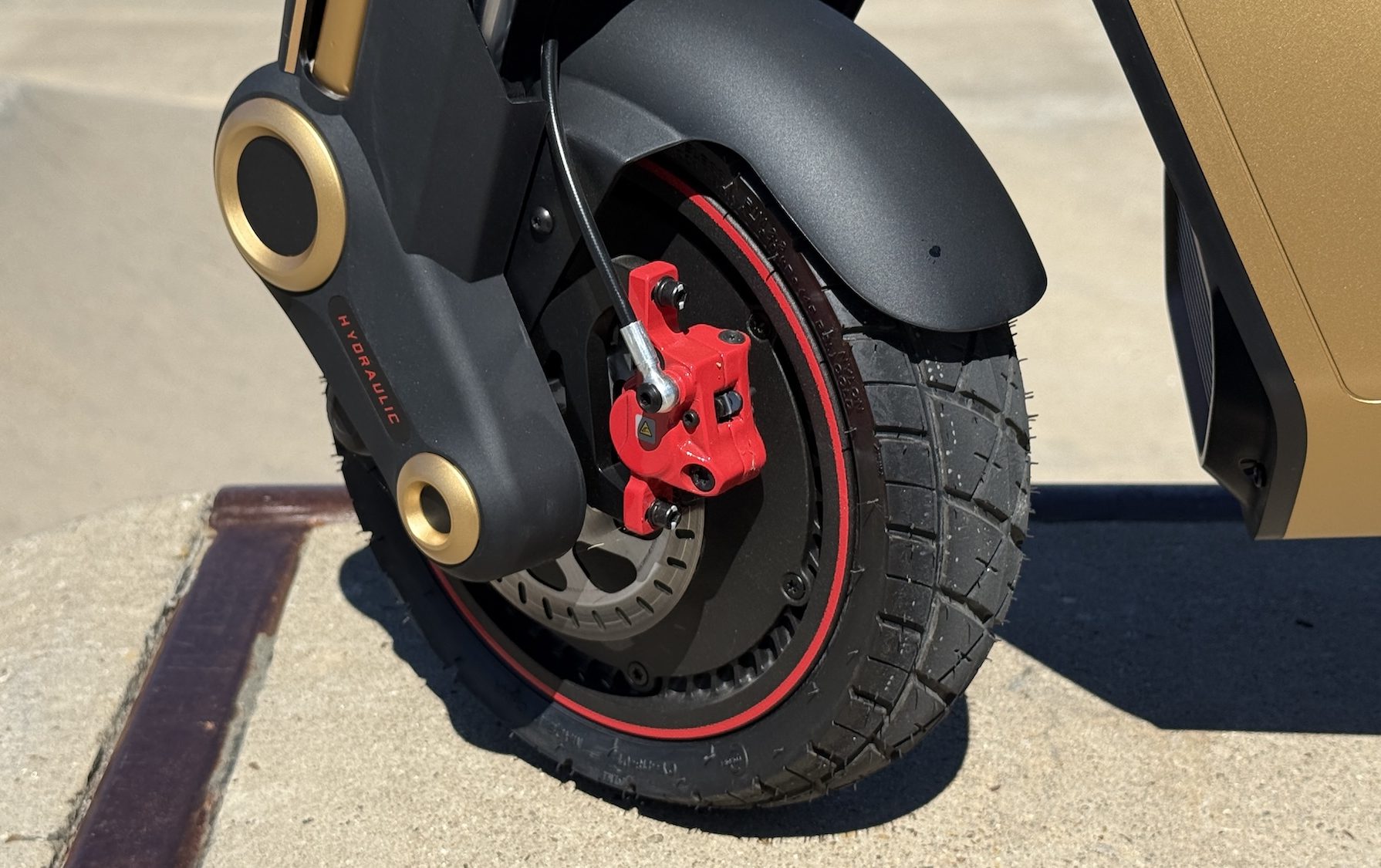

What appears to be an exotic linkage fork is actually just plastic cladding over a conventional telescoping fork. Coil springs and a hydraulic damping yields a smooth ride, with well controlled jounce and rebound.
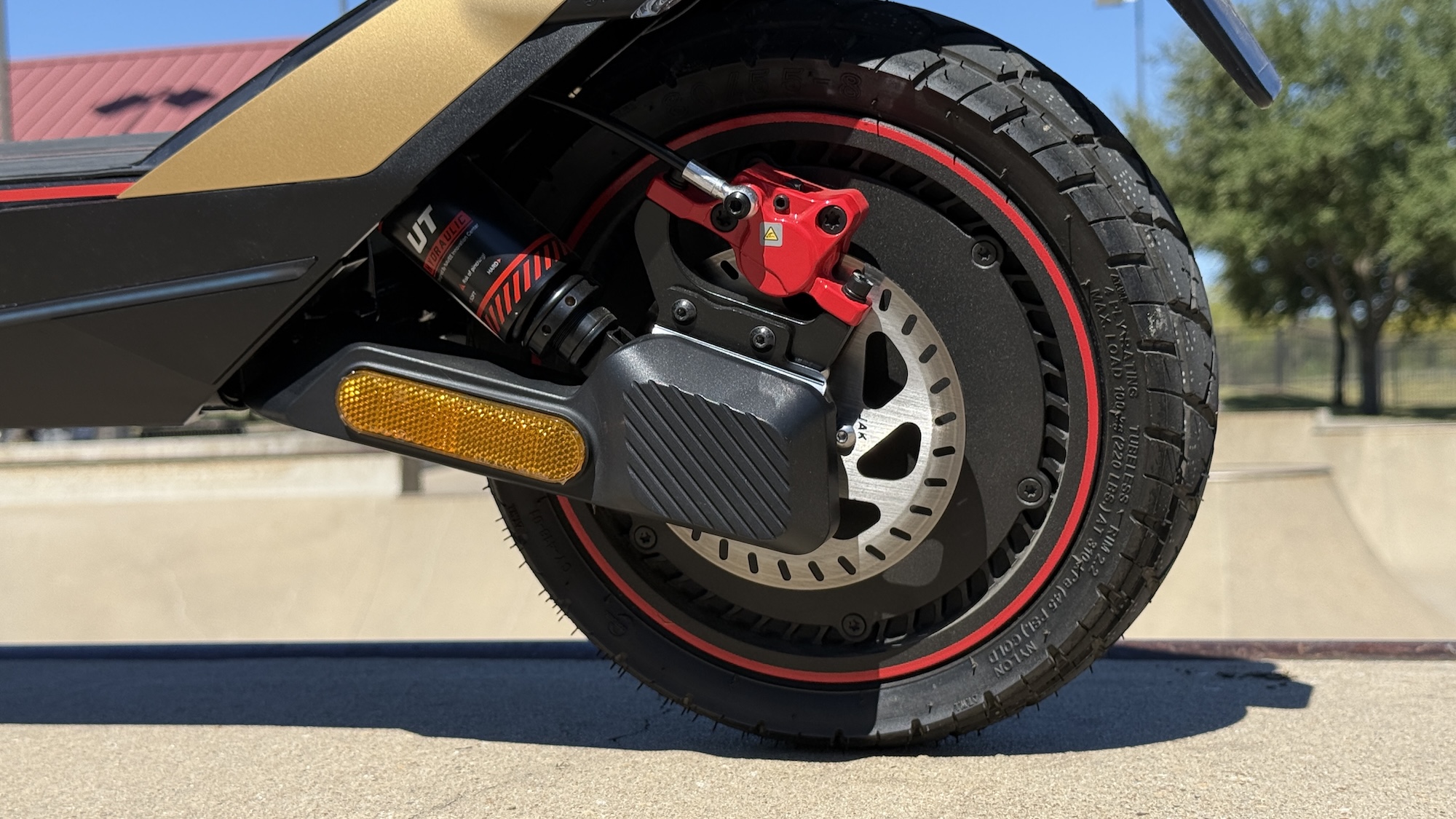

The rear wheel gets a pair of coil-springs and dampers, once again “hydraulic” according to Navee. According to Navee’s jazzy website graphics, the ride quality is adjustable between soft and hard via the collar just below the spring cover. I have no desire to mess with it; the suspension feels just right the way it rolls out of the box.
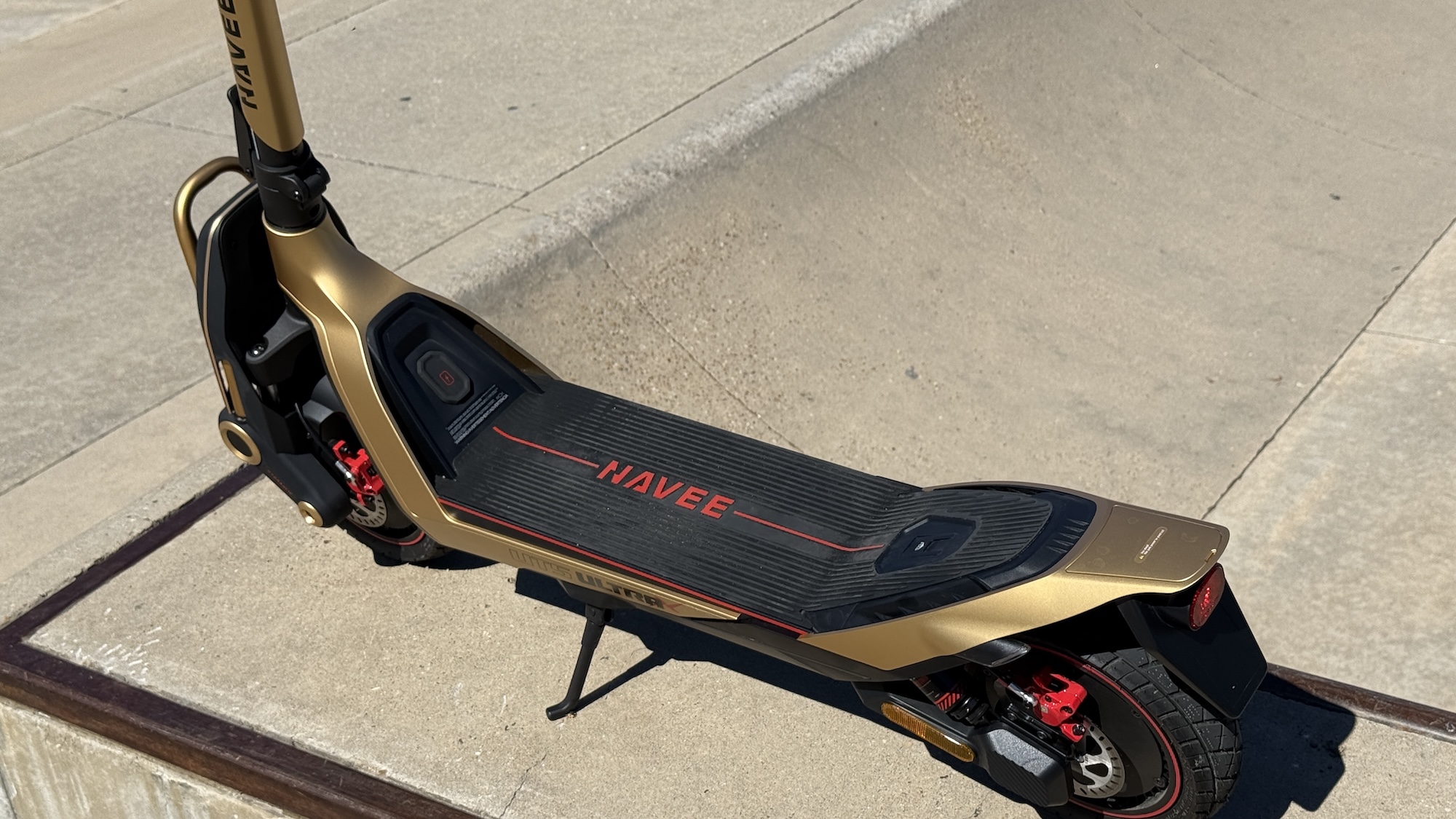
There’s ample room on the deck for my size 11 or 12 (depends on the sneakers) feet, and you can see the rubber-flap-covered charge port where the standing area kicks up at the front of the deck. The port in the rear of the deck accepts a rigid loop that pops out of the steering tube to hold it in the folded position, like so:
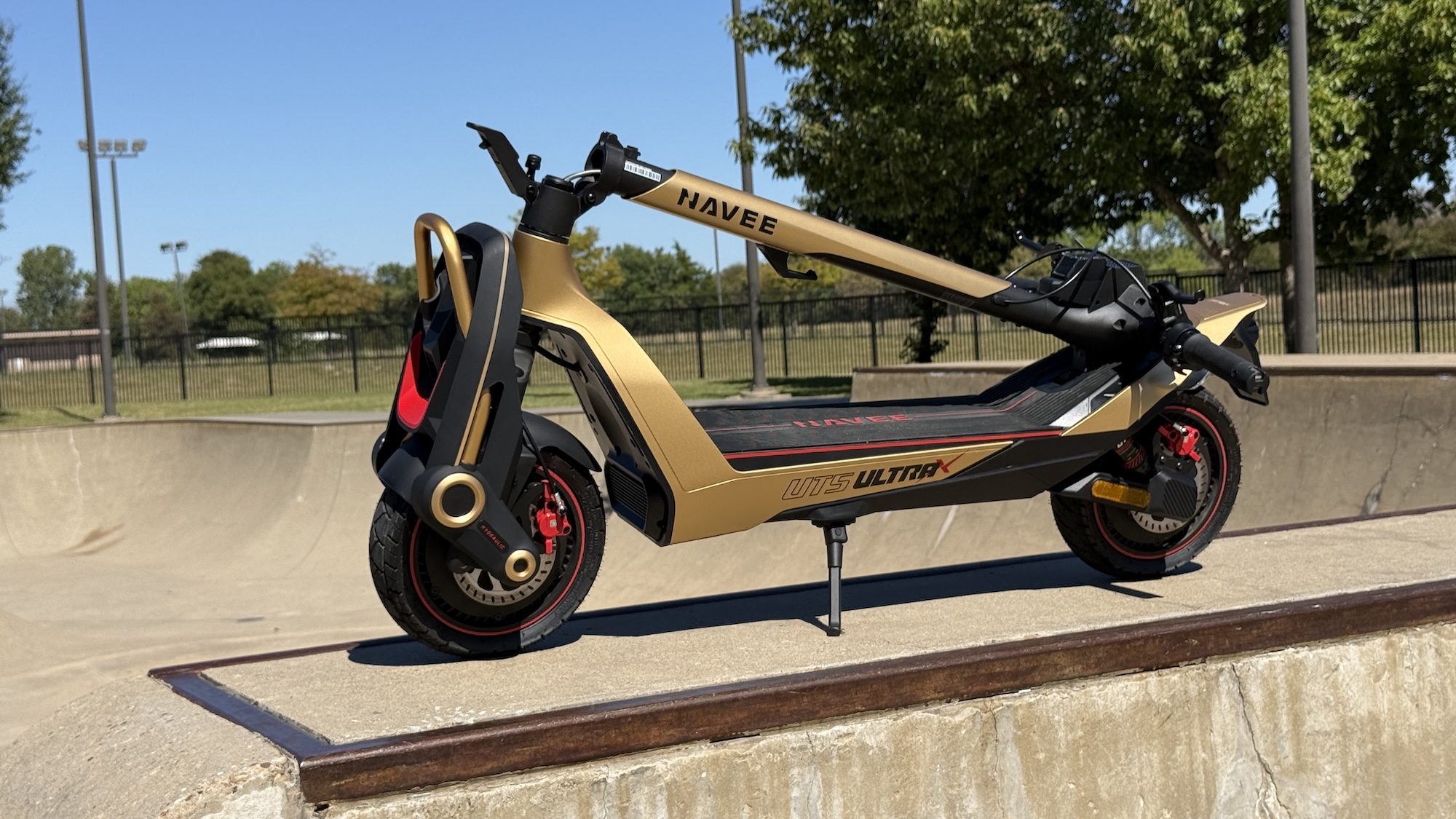
The steering tube is impressively rigid, and the mechanism that locks it upright flips open and shut far more easily than I would expect given how well it secures the steering tube (don’t worry, a tab locks the lever closed, it can’t release accidentally). I didn’t detect any play at all in the clamp.


Riding the Navee UT5 Ultra X: It’s Insanely Fast And A Full-Body Workout
The UT5 has four different drive modes to choose from:
- Walk Mode: As described, the scooter creeps along at a walking pace, just a mile or two per hour
- Eco Mode: The battery-conserving Eco Mode caps speed at 12 mph. I found this to be ideal for sidewalk use.
- Sport Mode: Here’s where you can really feel what the scooter can do. The UT5 accelerates moderately strongly to a top speed of 43mph
- Boost Mode: “Full power,” but it feels like the throttle curve is still being managed. Which is good, really. I do not need more than Boost Mode.
Range varies with mode, as one would expect. In Eco Mode, Navee claims up to 75 miles of range is possible, while going full ham in the high-power modes brings the number down to the thirties. All of the modes can be utilized with single-wheel drive or 2WD, and I found it easiest to get started in Eco Mode. Walk Mode requires finer balance to keep upright because you’re just creeping along, but Eco Mode’s gentle shove to 12mph is pleasant and confidence-inspiring. You don’t even need to mind the throttle, really; just bang it to the stop to go (gentle acceleration is programmed in) and release it to slow down via rolling resistance – or apply as much brake as you need.
About those brakes: the levers are set up motorcycle-style, in that the right lever controls the front brake. If you’re a cyclist and used to having the right lever control the rear brake, you’ll be in for a surprise on the UT5, so watch out for that. (European cyclists set their bikes up “right lever = front brake; left lever = rear brake, so they’ll feel right at home)

I tested Sport Mode in 2WD with a few strafing runs down the long, straight road that bisects my neighborhood, and while the acceleration is easily handleable, it will surprise you if you wack the throttle open and aren’t ready for it. Boost Mode hits even harder, and it was common for the front wheel to break traction (just a chirp, not a full spin) which goes to show just how powerful the UT5 is. And that’s with 200+ pounds of mid-fifties-old man on board, mind you.
The UT5 is rock solid at speed, but I will say I find the experience of going 43 mph while standing to be fairly harrowing. It feels more like 60, and you had better believe I’m always scanning the road like a Terminator for anything that might upset the little donut wheels beneath me. You definitely want to strap on a helmet for the full-power UT5 experience, if not a set of leathers.
Surprisingly – though I’d say it makes sense – the UT5 seems to ride smoother at speed than it does in Eco Mode. Cruising the sidewalk to Brahms for a cone of soft-serve verged on punishing as the wheels banged over the gaps and/or uneven heights between pavers, but with a few more mph the suspension was much more forgiving.

Nightime cruising was fun, with plenty of forward visibility via the low- and high-beam LEDs. Turn signals – amber front, red rear – are integrated into the handlebar ends and lower chassis, and the “ambient lighting” on the UT5’s flanks changes color with drive mode selection.
As the topshot shows, the UT5 is off-road capable, and I did explore a few gravel roads and smooth dirt paths at the park down the street from me, but I did not risk getting anywhere near rad. I’m old, you guys. I kept a light touch on the throttle, and the UT5 just did its thing.
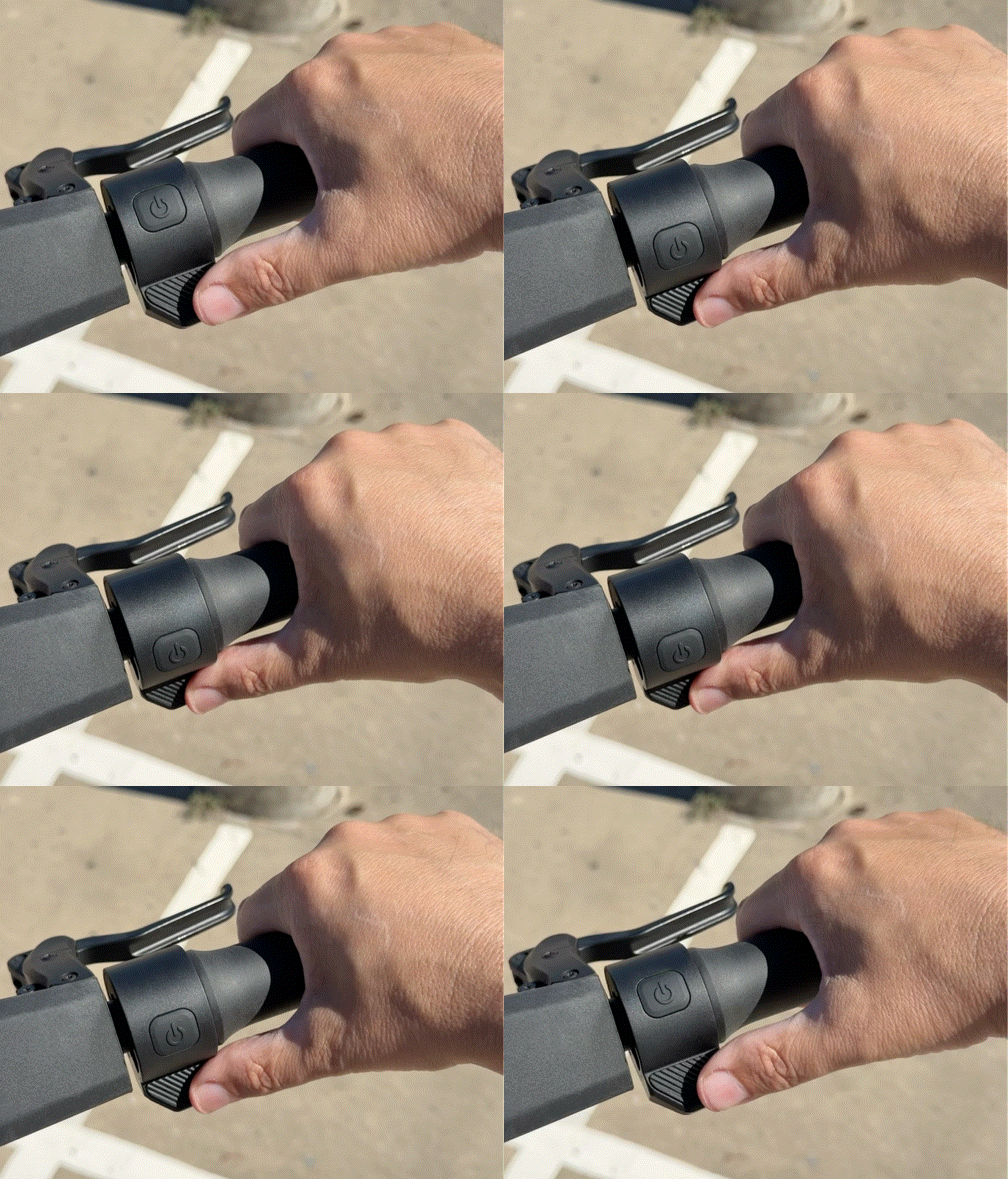
If I have one gripe about the UT5, it’s the throttle interface. The thumb throttle rotates about the handle-axis as the GIF above shows, and offers very little resistance. It’s fine in Eco Mode as I described earlier, but in Sport and Boost, it requires a very light touch.

In addition to more resistance in its action, I’d prefer the throttle rotate beneath the bar, like the throttle of an ATV or snowmobile. To me, that configuration feels more natural and affords a better grip as the design keeps your thumb under the bar.
My other gripe has nothing to do with the UT5 itself, and may have to do with my own state of health, but I gotta say: riding the UT5 outside of Eco Mode was a workout. Supporting myself while blasting around in Sport Mode had me really feeling shoulders, hip flexors, and quads as I stiffened up keep the scooter under me with each pull to full speed. Battery power means you don’t have to pump it with your leg like an unpowered scooter, but trust me, you are working when you ride the UT5 as the superscooter that it is.
Should you get a UT5 Ultra X?
I’m firmly in the sit-down scooter camp after my experience with Navee’s high-power standup, but that’s not a knock against Navee. If a stand-up scooter is your preferred way to fly, I’m confident you’ll enjoy the UT5. The build quality appears excellent, it’s easy to operate, and full of features. I think it looks pretty cool, too. It’s not as fast as the Segway GT3 Pro it seems to be targeting, but at around $2,000, the UT5 is also about $500 less expensive than the Segway. I’m looking forward to putting more miles on “my” UT5. It’s fun, and I feel like I’m starting to develop a six-pack, so that’s a nice bonus.



Thanks for wearing a helmet. I can see college kids getting TBIs at an alarming rate with these things. They’ll ride 43mph on the sidewalk against traffic and fail to understand why that driver turning left pulled in front of them.