

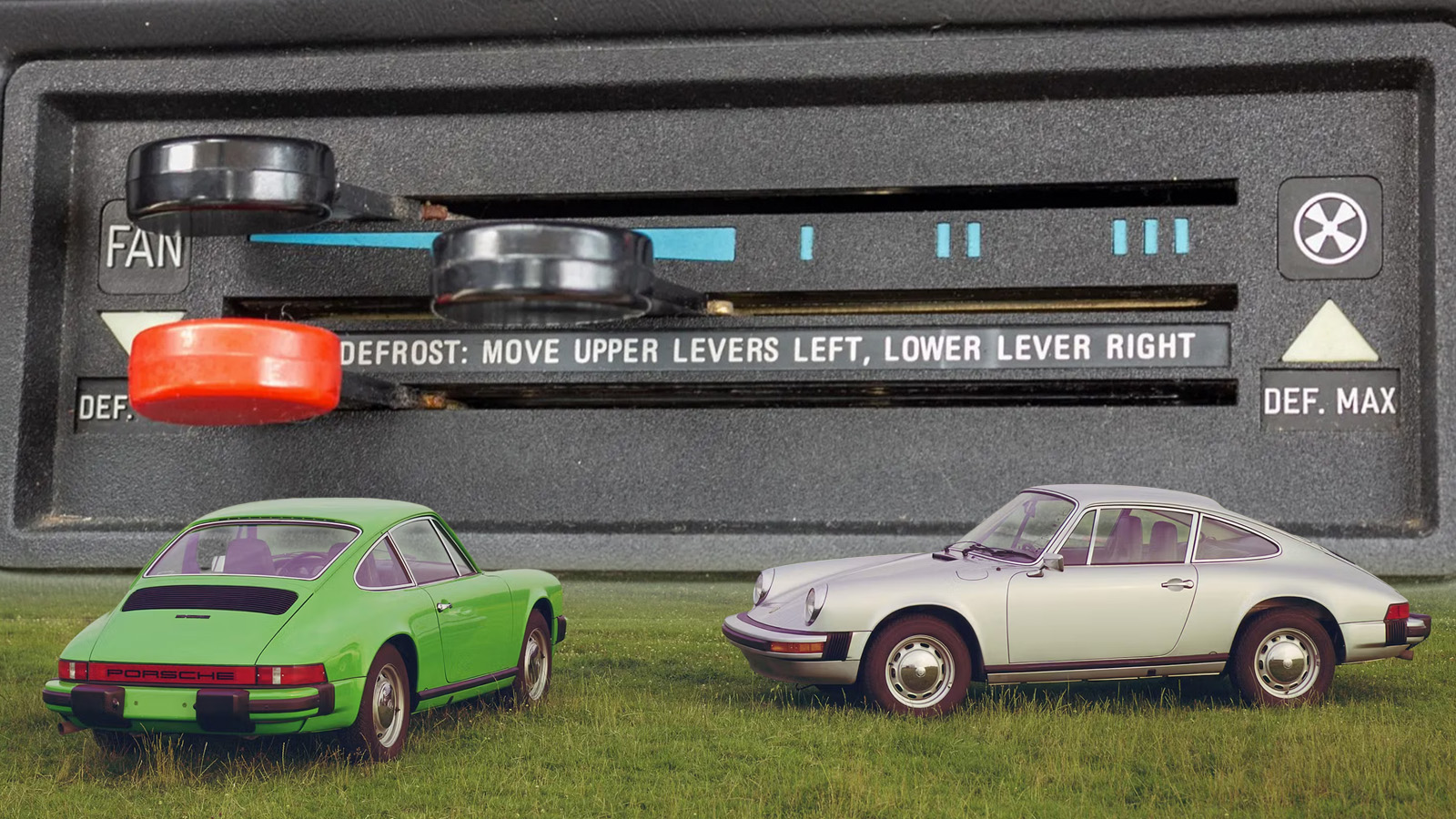
I can’t fully explain why, but for whatever reason, certain air-cooled Porsches seem to have the most needlessly convoluted HVAC controls. This is surprising because, as far as HVAC systems tend to go, the ones in older air-cooled Porsches aren’t especially complicated. Like their air-cooled ancestors, Volkswagens, the heating and defrosting system is mostly just a series of cable-actuated flaps that guide and direct fresh air heated through the engine’s heat exchangers. It’s not exactly rocket science. And yet, somehow, I think Porsche managed to make, in the case of the heating and defrosting controls on the one-year-only 1976 Porsche 912E, the most convoluted and needlessly baffling defroster/defogger controls the world has ever seen.
I’m genuinely impressed by the achievement; I think the 912E is unique among all automobiles in that it has a windshield defroster setup that would, at least for a decent period of time, baffle almost any driver, from any point in automotive history and any part of the world, even accounting for translating the surprisingly ample amount of text involved in the controls. In our modern era of HVAC controls that tend to have dedicated windshield defrost buttons or positions on a dial or even icons on a touchscreen, this may seem hard to conceive, but I’m here to show you exactly what I mean, so you can feel the same awe and wonder that I do.


First, to fully appreciate the madness of the 912E’s defroster controls, let’s just get some control samples out of the way. We’ll start with how defrosting/defogging happens in a huge number of modern cars – and I’m being really generous with “modern” since this basic method started in earnest in the 1980s. This is the “three knob” method, one that uses one knob for fan speed, one for temperature, and one for where the air blows, as in on your face, feet, or directed at the windshield, to defrost/defog it. The little “snakes slithering up a fan” icon is normally used for this. Here is this basic setup, as seen on the Slate pickup:
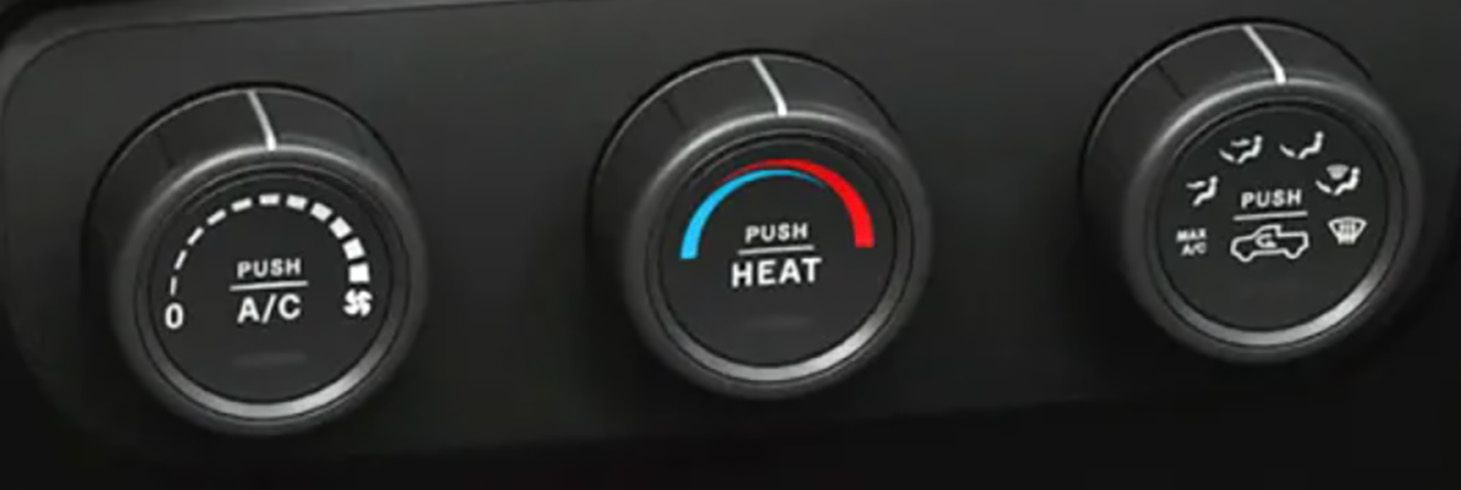
Okay, so that’s a relatively modern way. You want to defrost the windshield, you crank the heat and fan, and turn the dial to the snakes on the windshield icon. Easy!
But let’s see what some setups closer to the 912E used, as in other maybe air-cooled car setups, because those were always, let’s be honest, a little weirder. My Citroën 2CV, for example, is a bit odd, but not really difficult. There’s one funny little lever for how much heated air is coming into the car, and then there’s a little ball-topped rod you pull or push depending on if you want that heated air directed to the cabin or 0nto the windshield:
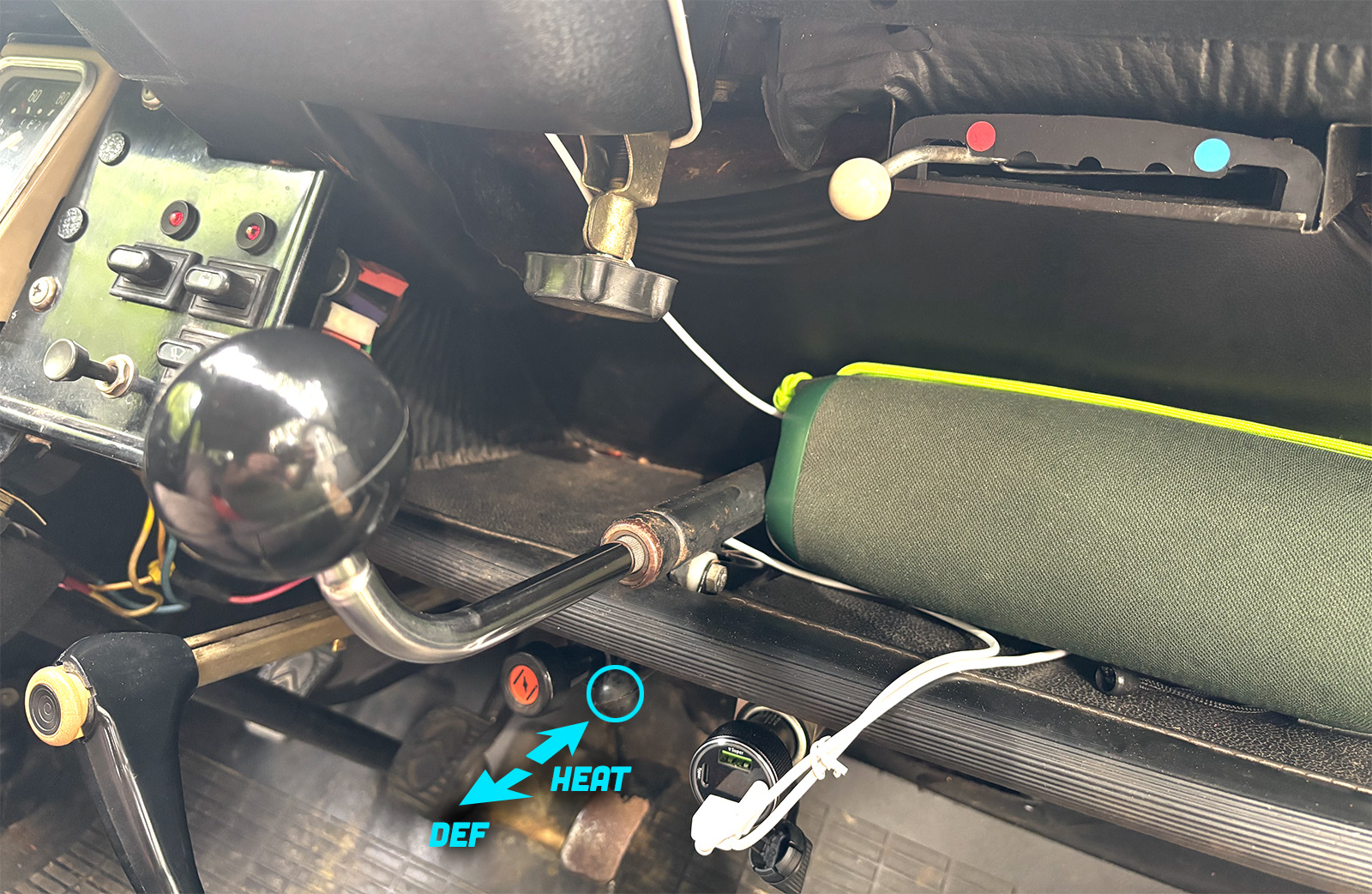
The volume of heated air lever is the thing in the upper right, with the red and blue circles. Closer to red is more heated air, blue is just regular ambient air. Pull the black ball back for windshield defrosting, push it forward for cabin heat. It’s a bit odd, but pretty simple, really, and I’m using this as an example because, fundamentally, this is all that the 912E’s HVAC system is doing, too.
Let’s look at how a VW Beetle accomplishes the same thing, because it’s similar:
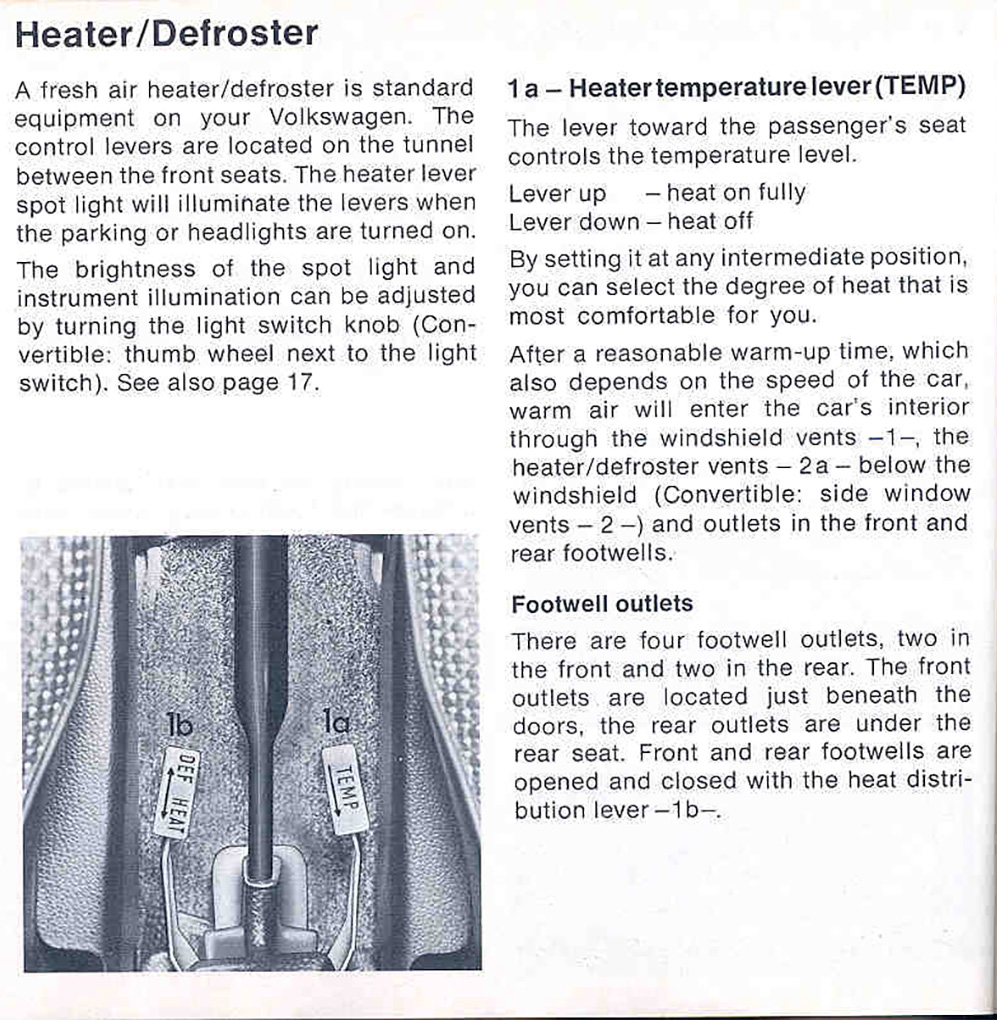
In the Beetle’s case, there’s one lever between the seats for the volume of heat coming into the car, and another lever between the seats to direct that air to either the vents by the windshield or on the floor of the cabin. Really, the same thing as the 2CV, just with a different placement of levers. If we look at the more up-market VW Type 4, the car that actually donated its engine for use in the Porsche 912E, we see a bit more complexity, but mostly just because the Type 4 has a more advanced fresh-air ventilation system and an auxiliary gas heater with such nifty features as a timer you can use to pre-heat the car on cold mornings.
Even so, the basics of windshield defrosting aren’t really different than in a Beetle:
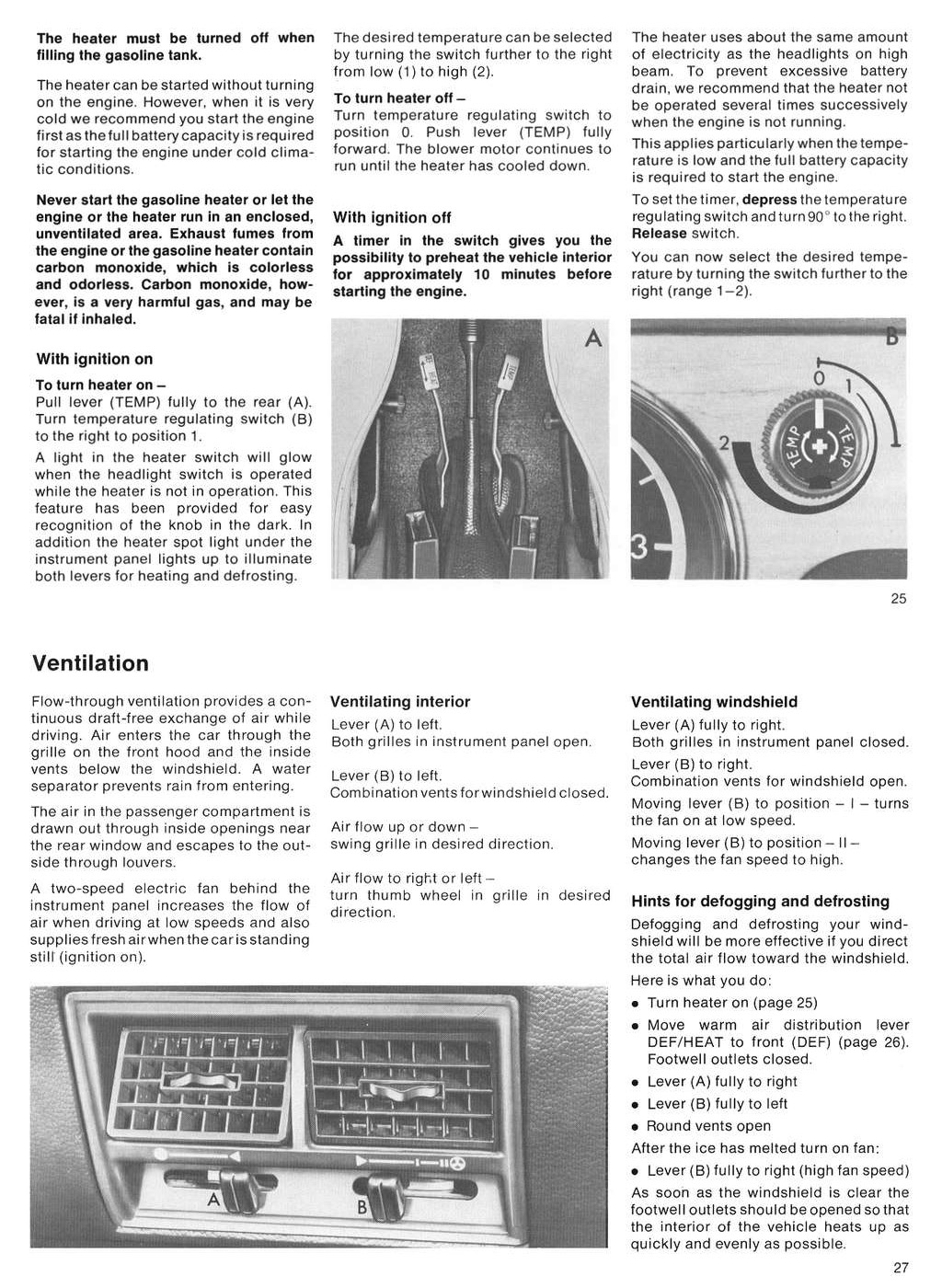
Looking past all the ventilation and gas heater stuff, if you want hot air to melt frost or clear fog from your windshield, you’re still pushing that DEF/HEAT lever to the DEF setting. That’s pretty much it!
Okay, so we’ve seen what these close siblings to the 912E ask of you if you want your windshield defrosted; let’s see what the 912E herself demands:
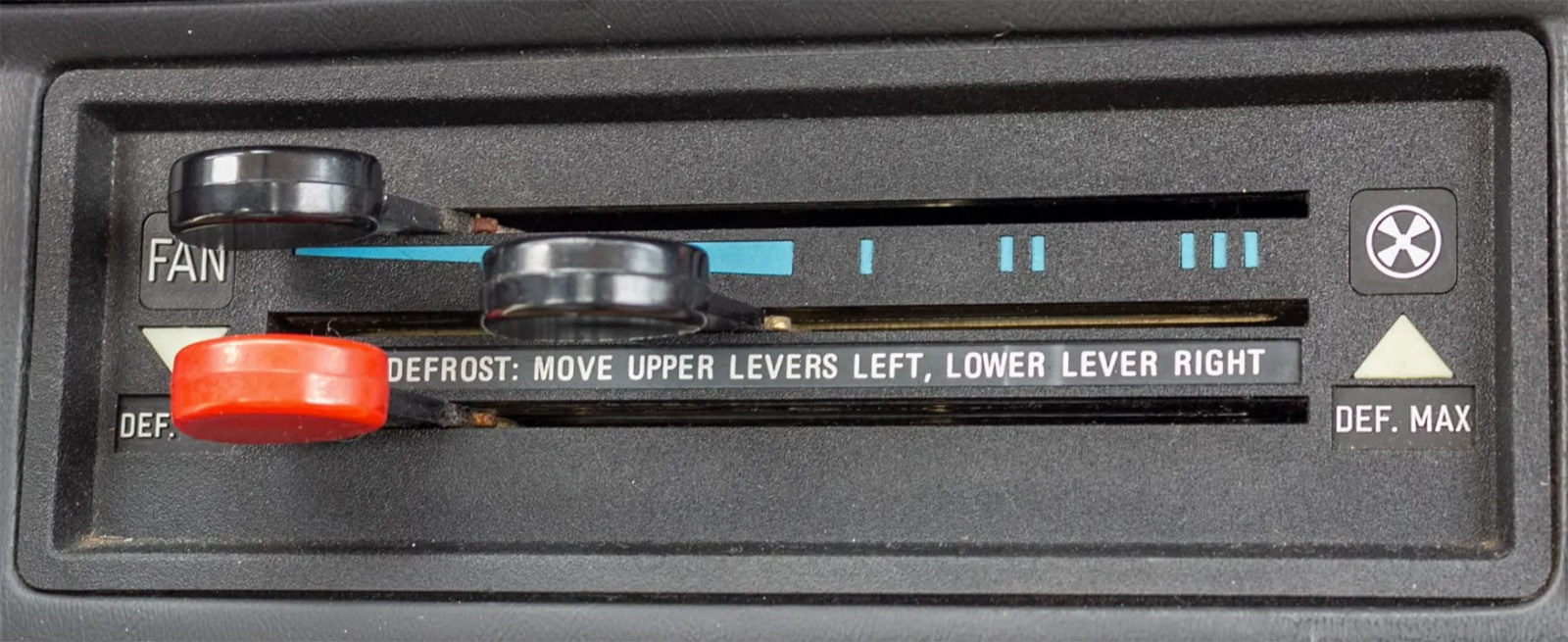
Wait. What? This is the part that gets me:
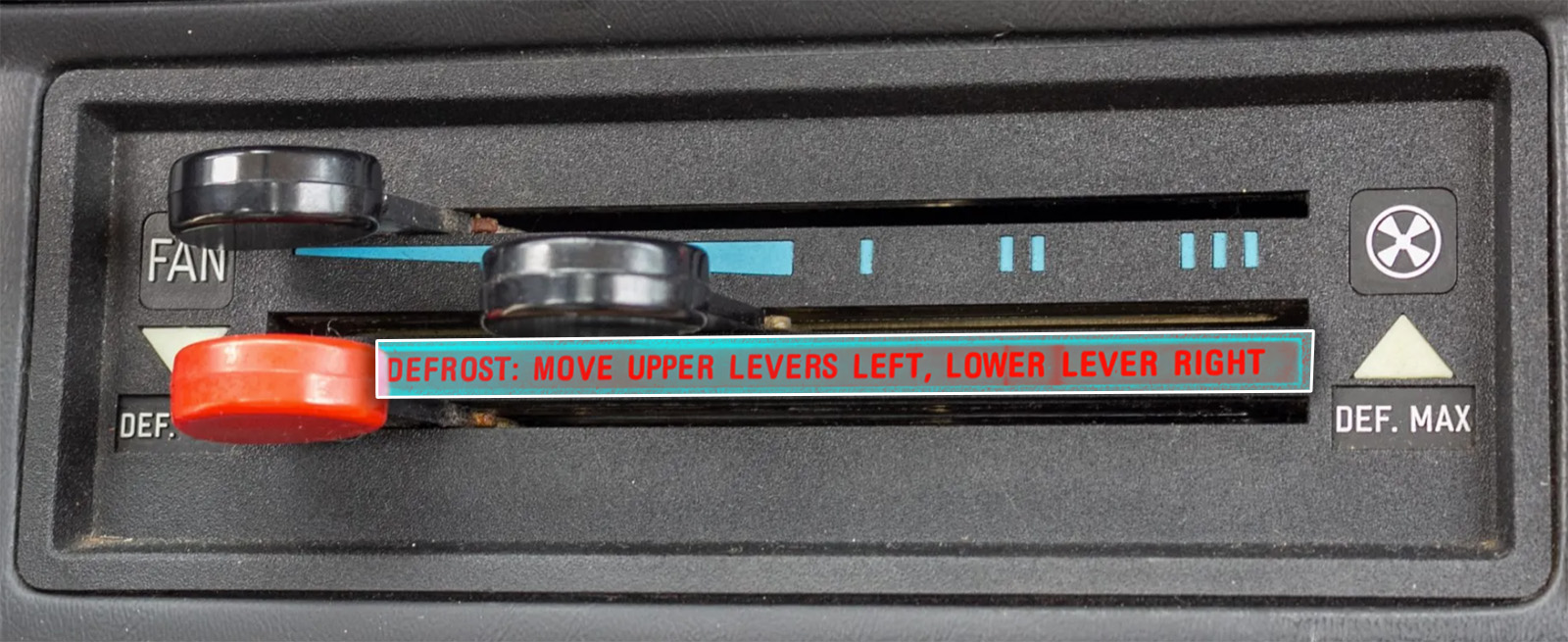
“DEFROST: MOVE UPPER LEVERS LEFT, LOWER LEVER RIGHT.”
Something about that sentence just takes a moment to process, at least for me. If I was driving and having trouble seeing out of my windshield, I don’t think I’d be able to grok it any quicker?
Okay. So, the red lever – which I think is for the volume of heated air coming in, which is sort of like temperature, in that it mixes with ambient air, in this case needs to get cranked all the way up to full heat, because it’s the lower lever, and the upper two levers both go all the way left? Okay, but that seems to mean the fan gets turned off, which I don’t understand why that would be, and then that makes me realize I don’t really know if it’s the middle lever that controls the fan or the top one, and whichever one it is, I’m not clear on what the other lever does?
Is the middle lever like the defroster/cabin slider? I think it may be, though the markings and position all make it more confusing. There are up and down arrows at each end of these right-to-left sliders, and I think it’s DEF.MAX on the right and DEF.MIN on the left, but if that’s the case, then why would I be told by that sentence to move the upper levers to the far left? Wouldn’t I want the slider to DEF:MAX for maximum defrostery?
Or is the bottom lever, the red one that suggests heat, the defrost max/min lever? Because then at least I’d be told to slide that to DEF:MAX, which makes a bit more sense? But then what does the middle lever do?
This all feels like someone way overthought this to the point of madness. It shouldn’t be this hard! And here’s the amazing thing: Porsche seems to have kept this baffling system for quite a while: the same basic setup is used on 1980s Porsche 911s, just augmented with other air-conditioning controls and the traditional between-the-seats heat/defroster levers. This guy seems delighted to show you the weirdness of it all:
I think the 911 implementation of the strange 3-slider setup is less bad than the 912E because it (A) eliminates the confusing sentence and (II) it can be mostly ignored because of the other sets of A/C and heat/defrost controls? Still, it’s hilariously obtuse.
Now Porsche isn’t the only carmaker that has managed to make defrosting strangely difficult; look at what the Fiat Brava asks you to do before you can defrost your windshield:
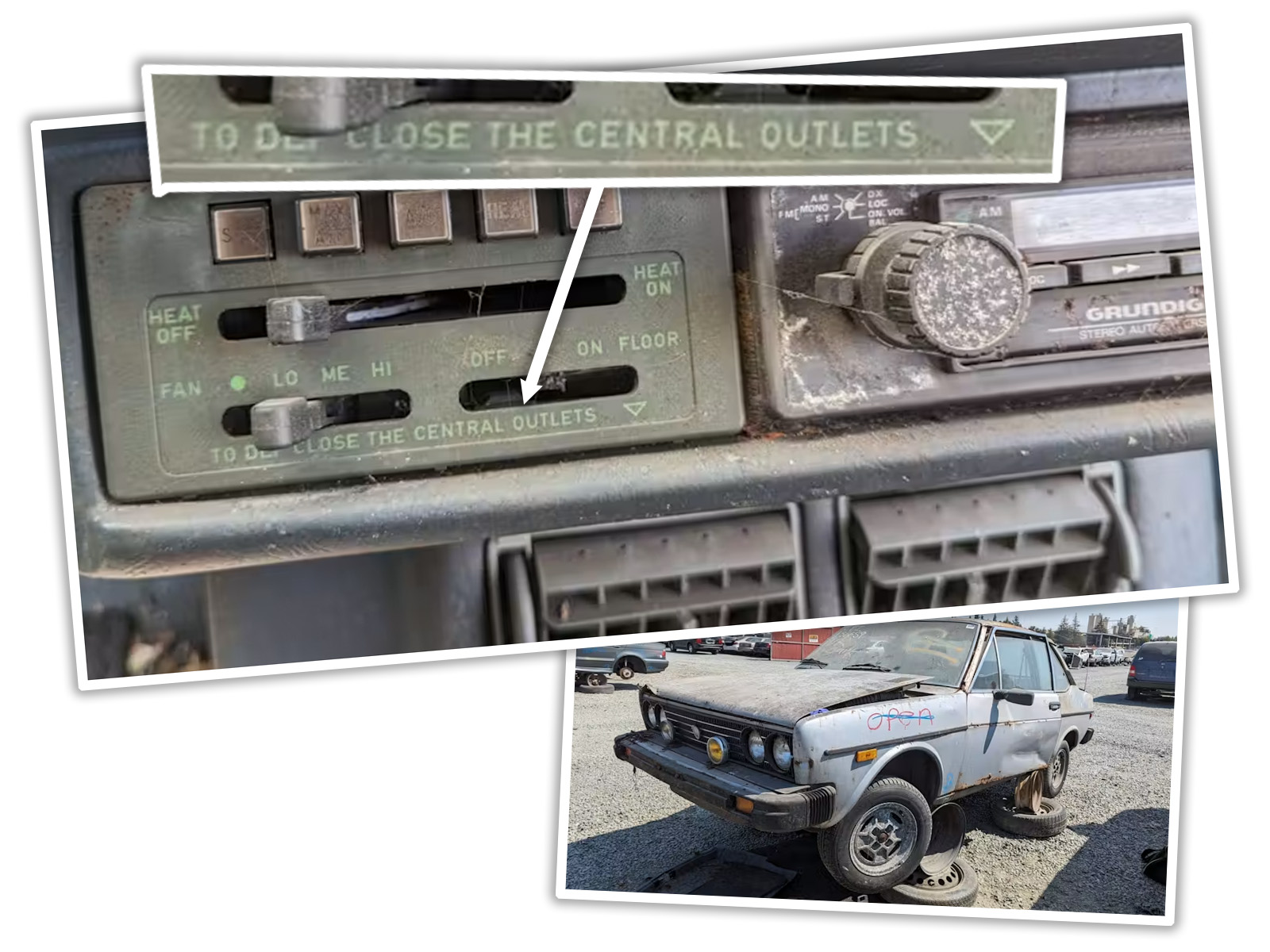
The Fiat asks that you close the central heater outlets your own damn self so the air can get re-directed to the windshield. It doesn’t really have any separate defroster controls at all, just six words that tell you how to make defrosting happen. That feels pretty lazy, but at least it’s pretty straightforward.
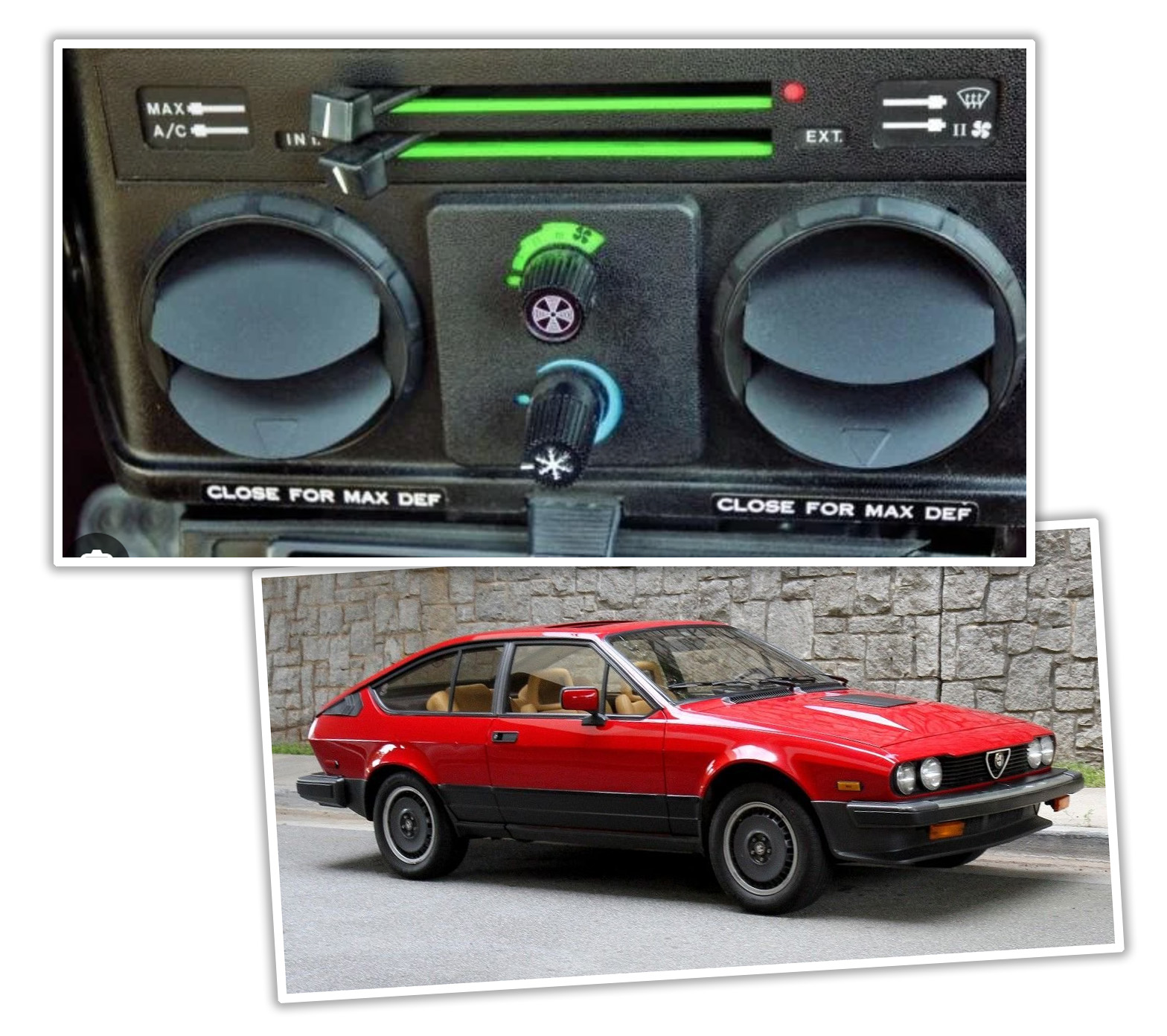
The Fiat’s cousin, the Alfa Romeo GTV6, is sort of similar; while it has a setting for defroster (slider all the way to the right, by the universal snakes-on-a-fan icon), it also takes the time to note that if you want MAX DEF (which I think just means either the defroster actually doing something or, less likely, Mos Def’s older brother) then you need to close those two central vents yourself.
A slight step up from the Brava, still not great, but still fundamentally understandable.
Either way, these are both a million BTUs better than the Porsche 912E setup which, I’ll be honest with you, I’m still not entirely sure I understand. If we have any 912E owners reading this, I’d love to know more: how exactly do you get your windshield defrosted? I really like 912s, even the odd US-market-only, one-year-only, VW-engined 912E, so please don’t consider this a slight. If I had a 912E, the baffling HVAC controls would be one of my favorite parts of the car, and I’d ask everyone I gave a ride to please, if they wouldn’t mind, turning on my windshield defroster, just so I could witness that delicious moment of perplexity and confusion.
I bet it’s really satisfying to see.



Note that in the ’70s, inexpensive Beetles got a light on the lever, whereas 50 years later we got unlabeled touch controls with no haptic feedback.
I don’t know what was in the Wasser in Germany in the 70s, because the automatic climate controls in nicer Mercedes Benzes from W116 until the late 1980s are bonkers.
The automatic climate control system, fitted to W116, W123, and R107/C107 in the late 1970s were sourced from Chrysler (squarish panel with vertical row of buttons). Mercedes-Benz developed its own automatic climate control system (rectangle panel with horizontal row of buttons) for W126 which was later fitted to W123 and R107 in 1982.
Good to know! They’re equally baffling IME.
How about moving to the late 70s through the 80s 911s that had AC. All of the same weird heat, vent, defrost controls plus a whole new set of controls just for the AC.
I’ve been driving my ’64 F100 coach-built crewcab for 50 years, and I still can’t figure out the heating controls. There are three knobs, two of which are under the dashboard, so likely installed as part of the customization, and one on the dash. I know the one on the dash changes air from below to above the dash to defrost. The other two are mystery knobs. I just push pull one or both and eventually change happens and maybe to what I desire. they have labels, but they are basically generic, like heat or air. There are no labels adjacent signifying what they do.
Well just hang on a minute! It’s not “snakes on a fan.” The symbol is “snakes on a windshield.” We know this is true because the REAR defroster icon is different: it’s more rectangular. The front defrost icon is arched because it is supposed to evoke curved windshield glass. I can forgive a VW nut not understanding this because Beetles had flat windshield glass LONG after other modern cars changed to curved glass.
I’m tired of these mfking snakes on this mfking fan!
The mention of Beetles defrost reminded me of a story my grandparents tell about their old Beetle. The defrost setting was so weak that every Minnesotan winter, just to see out the window, whoever wasn’t driving had to reach and scrape the window for basically the whole drive. And my grandfather was working construction at the time, putting up skyscrapers, so the steel dust and grime and muck would collect on the fenders and rust them out so he replaced them almost yearly. Also I forgot how good the GTV6 looks.
I don’t know, these older cars might be a little baffling at first, but the fact that there are only a few manual controls at least means that once you have figured it out it’s easy to remember. That’s nothing compared to the enduring modern annoyance of nested menus in endless touch screens that never get any easier to use no matter how long you have the car. In the end, the Porsche’s controls are just three levers that you can slide without even looking down once you know what to do. I’ll take that quirky wording any day.
For years, I found my Fiat Spider’s HVAC controls utterly baffling – layout is similar, albeit in different location. Then I bought my 911, and the seller explained them to me when I picked it up, and both cars instantly made sense.
Fresh air, hot air and (if present) air conditioning are three entirely indepedent systems – there is no blending of anything.
The top row is fresh air volume (left is full closed, right is full open)
The middle row is fresh air location (dash defroster vents or footwell vents)
The bottom row is hot air volume (left is full closed, right is full open)
The hot air volume control lever is next to the handbrake. I think 912Es only had one – 911s after I think 73 had two, one for each side (one per heat exchanger)
The defrost instructions are telling you to shut off all the fresh air, and direct all of the hot air to the dash vents.
This might help:
https://forums.pelicanparts.com/porsche-911-technical-forum/932565-vent-control-cheat-sheet.html
I think it would be less confusing if they didn’t have the goofy wording.
The Fiat doesn’t confuse the issue by attempting to have helpful labels.
Three levers, plus a separate switch for the fan, all conveniently down by your hip so you can fiddle about blindly until something feels right.
The defrost/foot-well lever is fairly obvious, but the air-flow and heat levers take guesswork.
Ok, but now combine this with something Americans are less used to. Like a small efficient engine in a car.
In my audi A2, best trick to get a clear view through the windshield was to leave the fan off, or at low for the first minutes. If you would press defrost, or you would crank the fan speed, it would just take longer for the engine coolant to get some warmt.
This thing even had the webasto auxiliary diesel heater.
I remember getting stuck in traffic with an engine fully warmed up. Only to see the temp needle drop and feel the heater going cold.
MK4 VW TDIs in the US (with 90hp 1.9l) would do the same thing on really cold days. Crank the heat at idle and the engine would cool off. They even had an extra glow plug or two in the coolant for extra heat – but on my brand new car I don’t think that really did much on a below-zero (F) Maine winter morning.
As the radiator in my Peugeot 206 gradually got worse, I started using the opposite. When it started to over heat, I’d open the (massive) sunroof, select full windscreen, full heat, and max fan. The heater core would keep the engine cool enough, and the hot air would (mostly) go out of the sunroof.
Oh yeah, I remember that as well.
Twenty years ago, going on holiday with some buddies in a, then already old, nissan cherry. Everytime we would need to get up somekind of hill, the windows would be opened and the heat would be cranked.
On one of the viewpoints, the radiator cap was belching steam, as usual. Other drivers started handing us water bottles, which we promptly drank instead of putting it in the car.
Oh yeah been there before lol, though in a Jeep Cherokee and a Honda Civic-sadly neither had a sunroof so I just roasted. A classic old car with marginal cooling system trick!
I find that having the fan just barely on works best, it’s not enough air to further cool down my heater core, but just enough to deflect my breath away from the windshield and prevent me from making things worse.
This reminds me of the 70s fridge that was in the basement of our house when we bought it. Still works, but to set the temperature you have to use two knobs. One is numbers, one is letters. At least they printed what those combinations are on the inside of the fridge itself, but it still seems unusually complicated.
I vaguely remember one of those in Grandma’s house. Much later as an adult, I finally realized how fridge controls actually work (assuming the traditional freezer-on-top regular fridge).
The refrigeration unit itself only cools the freezer. The actual thermostat is down in the fridge portion. There’s a duct that connects the freezer to the fridge. As cool air inherently sinks, some finds its way to the fridge. One of the knobs (usually the “numbers” is the actual thermostat setting. The other one- the “letters”- controls a little flapper inside that duct to determine how much freezing air is allowed to drift down. Sometimes the “numbers” was labeled as “fridge temp” and the other one was “freezer temp”.
It’s a way to have two different temperature zones with a single stage/single circuit refrigeration unit. It’s either on or off, and it only cools to freezing. So, simpler and cheaper.
Seriously, these style of fridges are far and away the most reliable you can get. I have one manufactured in 2001 and I’ve never so much as even changed the lightbulb in it. Even it’s (optional) icemaker in the freezer still works perfect.
Meanwhile everyone I know with fancy french door, freezer-on-bottom stuff that has an iPad in the door for some reason are lucky to get a year or two before something breaks, or it’s not keeping temp, or the ice machine takes a piss all over the floor. My $100 used craigslist fridge has outlived probably a dozen four-figure fridges people I know bought new and were on the curb within a few years when the repair was going to cost like 75% of a new one.
Wow, thanks for the info! That explains a lot. Next to that fridge is an even older, massive chest freezer from the 60s. We joke that the house was built around it, because it predates the house (1978) and there’s no way to get it out of the room it’s in. It still works too, though it’s unplugged for now since we don’t need it. I imagine it uses quite a bit of power.
Yeah, they really made those old fridges and freezers tough back in the day. With modern appliances, I’ve found getting a more basic model from one of the big names can help avoid some of the reliability issues, but it’s still a toss up. I’ve got a basic top load GE washer that’s needed exactly one belt in a decade of use. A $15 part and 15 minutes of my time. Meanwhile everyone I know with a fancy front loader has had numerous issues after just a few years.
Yup, we’ve had our Frigidaire just like that for 17 years and no problems at all. The ice maker in freezer still works perfectly
1977 911 owner here. I just don’t drive it in conditions that need this, no idea if it works…
I have no idea how the heat/defrost works in the wife’s 1977 MGB. I tried to figure it out driving home in the dark after taking it to see the July 4th fireworks with the top down. We ended up giving up and putting on our jackets.
Confusing.
There is a fan switch higher up on the dash, and I remember replacing it a few years back. It’s a 3-position switch, but only one seemed to make the fan blow and another was ‘off’, I guess. Anyway, in the dark, at 3000 rpm, I could not tell which fan position did what.
It was a chilly ride home.
Those two statements are more confusing to me than the Porsche’s defrost controls. Jackets on July 4th?!? Do you live in Nome?
The fireworks didn’t start until almost 10 p.m. By the time they were over and we were headed back home, it was after 10:30. By that time it was down into the upper 50ºFs, temperature-wise.
My experience is biased to Texas, but even dipping into the lower 70s overnight is a foreign concept to me for July. Austin is having a mild summer this year (no official 100 deg days yet!) and still the lowest overnight low in the 7-day forecast is 76.
Not every place is as warm as Texas. 🙂
WED 7/8
76° /60°
THU 7/9
82° /53°
FRI 7/10
82° /56°
SAT 7/11
85° /61°
SUN 7/12
88° /65°
MON 7/13
92° /67°
TUE 7/14
91° /62°
True, but considering that New York City was hotter than Austin this July 4th, I’d say quite a few places were as hot or hotter this year.
I don’t think this is fundamentally different than the heater in my Spitfire, just with knobs instead of levers. I have one lever that is foot or defrost, and if you pull the knob out, low and high for the fan. Then there is another lever for heat. So twist one knob for temp, twist the other for feet or defrost, and then another knob for fan speed.
On the Spitfire, you really can’t tell if the fan is running when it’s on low speed, probably the same with the MG. I assume both use very similar heater arrangements. Pretty much no matter what you do, heat output is equivalent to a hamster blowing through a straw. High fan speed gets you an extra hamster. Definitely designed for the much milder climate of the British Isles.
It’s almost like they all got together at Porsche and threw a bunch of ideas for their HVAC controls out to see what the most insane, maddeningly confusing setup could possibly be and then rolled with it. Kind of like sticking with a rear, air-cooled setup in their premium sports car for decades.