


I’ve been meaning to write about this interesting footnote at the crossroads of automotive and video game history and interests for some time, but kept putting it off, because that’s just how things always seem to work. You have something you want to write about, then a bunch of other stuff comes up, and you forget. Well, partially thanks to today’s Juneteenth holiday, I finally remembered to write about this thing, what I believe is the first application of a driving video game that includes a simulation of a standard H-pattern manual transmission. This is important stuff!
So, you’re probably wondering what the possible Juneteenth angle to all of this is, and I don’t blame you. It’s a touch convoluted, but I think still valid. You see, that first driving game to feature a simulation of shifting a manual transmission came on a cartridge, and that cartridge played on the very first video game system to ever use interchangeable cartridges with unique games stored on them, the Fairchild Channel F.


And the lead engineer for the Fairchild Channel F was one of the few Black pioneers of the then infant video game industry, Jerry Lawson. And yes, because Lawson is Black, Juneteenth seemed like a good time to highlight this remarkable pioneer of the video game industry.
I happen to have an old but still mostly working Fairchild Channel F, so I made a little reel talking about Lawson and showing the 9th Videocart for the system, which held the game known as Drag Race:
View this post on Instagram
I’ll get into some more details about Drag Race in a bit; first I want to talk about Lawson a bit more, because he’s a really interesting guy. He was one of those people who seemed to find the thing they wanted to pursue in life – in Lawson’s case, that was electronics – and then stayed with it persistently even if the world around them was just barely ready. For example, Lawson may have been one of the very first people to have an actual computer in his home, somewhere between 1970 and 1972, when Lawson was working for the semiconductor company Fairchild.

Remember, people simply didn’t have computers in their homes back then. The very first simple hobbyist home computers didn’t really come around until the MITS Altair in 1974, and that was far different from what Lawson had, which was a Digital PDP-8 computer that was about the size of a small refrigerator, and that’s not counting the peripheral cabinets.
Here’s a promo pic of a PDP-8 in the back of a convertible VW Beetle, just to give you an idea and give me an excuse to stick a Beetle in here:

As he describes it in a 2009 interview,
“And before that, I also had — Fairchild gave me a DEC PDP-8. I put the PDP-8 back into work. In fact, the PDP-8 is a story in itself — that ended up running a school in my garage. With the PDP-8, I had two tape units, the tape controller, a high speed tape reader, and all the maintenance boards and backup spares for it. My garage became a service depot.
DEC said I had the only operating PDP-8 — straight 8 — west of the Mississippi. And they asked me if they could run classes in my garage on it. As a result — my PDP-8 had a control unit on it called the TC01. And the TC01 didn’t have all the maintenance updates on it. They said it would cost about ten grand to update it, and I said, “Well heck, I’m not paying ten grand.” So they said — for them having the class in my garage with the guys there — they would do the updates for free. They did. The whole updates for free.”
Lawson was pretty hardcore, as you can gather.
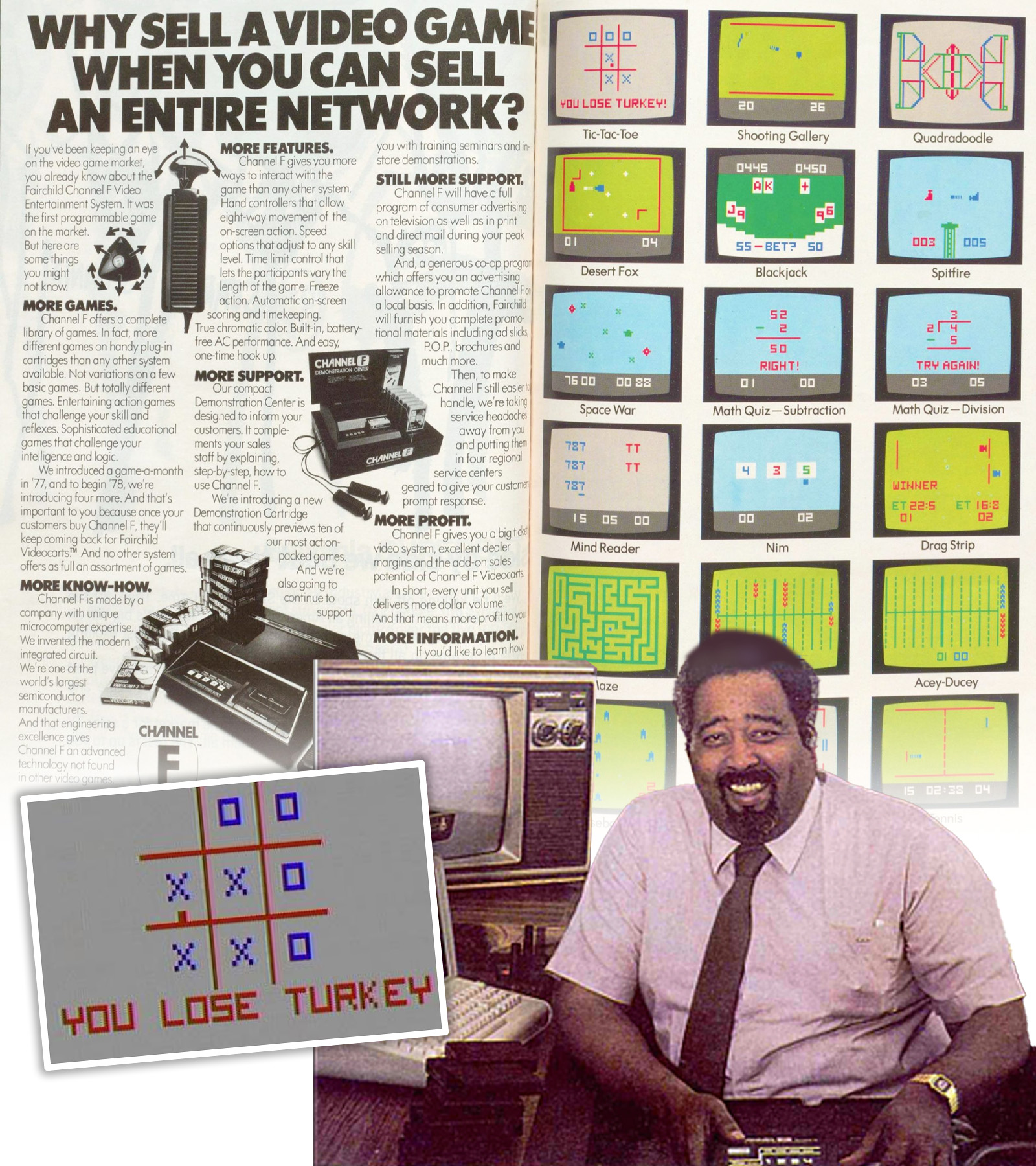
Lawson got the role at Fairchild, an electronics component company, to head up their skunkworks home video game console project after management discovered that Lawson had built his own arcade video game machine on his own. Instead of getting all bent out of shape at this potential moonlighting, they gave him control of the project that would become the VES, or Video Entertainment System, later renamed to Channel F.
Lawson adapted a prototype from a company called Alpex, and he and his team refined the ideas contained in that crude start. They adapted the machine to use Fairchild’s own two-chip F8 CPU, making the Channel F the first console to use a microprocessor, also a huge deal, they refined the cartridge concept, which was something (putting computer memory chips in a plastic shell and allowing them to be plugged and unplugged over and over again) that had never been tried before, Lawson had the clunky keypad controls turned into hand controllers that incorporated joystick and paddle-like functions into one unit, and he gave the console some personality, which can be seen in details like how the early tic-tac-toe game would call you a turkey if you lost, something Lawson enjoyed calling people.

It was a big deal about the cartridge concept never really having been tested. As Lawson says in that interview:
“We were afraid — we didn’t have statistics on multiple insertion and what it would do, and how we would do it, because it wasn’t done. I mean, think about it: nobody had the capability of plugging in memory devices in mass quantity like in a consumer product. Nobody.”
There’s also a good part in the interview describing Lawson answering complaint calls from buyers of the console the day after Christmas 1976:
Yeah, I’ll tell you what happened. The first year we put out the Fairchild video game, I made the mistake of going to work the day after Christmas. The day after Christmas in the consumer business is called “Hell day.” Why it’s called “Hell day” is because that is when everything comes back to the store, and the person couldn’t use it.
So I start getting calls — there’s nobody in the factory except the guard and me. I’m there in the plant to take care of some paperwork. He starts transferring calls to me. They had one guy call me, and he wanted to know where the batteries go. I said, “There is no batteries.” He took the thing apart looking for a battery in there!
One guy called up and said, “Dog urine hurt the game.” The dog lifted his leg and peed on it!
And one of the things that really cracked me up is that I was starting to get really jaded by answering the phone, right? One woman called up, really irate, and she said, “My game hums! Do you know why?” And I said, “‘Cause it doesn’t know the words, lady.”
Good to know about that dog urine.
Anyway, let’s get to the automotive part, here the 1977 Videocart #9 game, Drag Race.

As you can see on the label, Fairchild was careful to include a diagram of a standard H-pattern 4-speed shifter, so even kids would know how to select gears. There’s no clutch, as such, but you do shift with the controller. You rotate the controller knob as the sort of throttle, and that affects your tachometer. You can blow the engine or stall if you don’t shift at the right time, too.
So, the way it works is that you watch the “Christmas tree” lights in the center to count down from red, to blue to green, then again, red, blue, green. The Channel F had no yellow, so blue stands in. When the second green hits, you shift into first, give it throttle, and take off, being careful to upshift before you blow your engine.
Here’s a pretty good video of the game in action:
Simple? Absolutely. Fun? Ehhh, kinda? By 1977 standards? Sure! We were all high on lead from gasoline then, anyway. Really, the whole game is manual transmission shifting! That’s the core of it all! Watch the tach, listen to the engine noises, and shift at the right time. Do it better than your opponent, and you win!
Good times, right? Really, this may be the most manual-shifting-focused game ever. Well, minus the clutch part, but still. I wonder how many Gen X kids got their first taste of manual transmissions from this game?


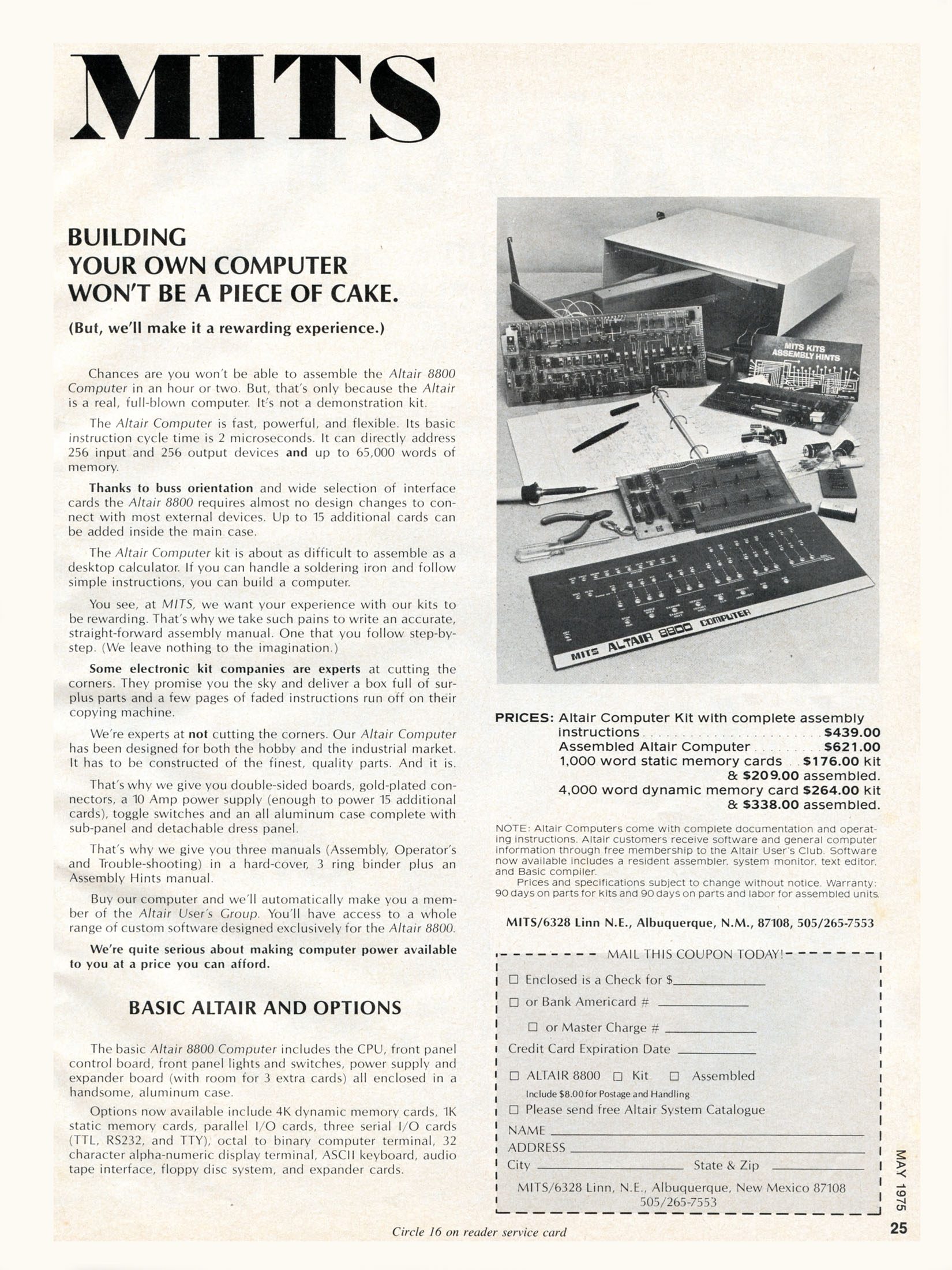
The Fairchild computer company has an interesting history. Founded by 8 engineers from Shockley Semiconductor (the Fairchildren or the Traitorous Eight) and Sherman Fairchild, son of the first Chairman of the Board of IBM and aerial photography pioneer. https://computerhistory.org/blog/fairchild-and-the-fairchildren/
The tech is interesting. The skin color of the people involved is less interesting. Nice work Mr. Lawson!!!
In much the same vein, nobody gives a fuck about your comment, regardless of your skin colour, and even if it is your greatest contribution to society.
k
Yup, old enough to have played Fairchild console games–new game was like swapping 8track tapes, we all said.
I honestly never knew of this game/console until now – but arcade games were my first experience with manual transmissions. I don’t remember the game…maybe it was “super shifter” or something like that, but it was a 70’s electro-mechanical game, and was pretty amazing for the day. You’d sit in it, there would be a small Corvette shaped car on the display, and a christmas tree drag racing light. You had three pedals, speed was simulated by a strobe light effect from the cabinet, and you had to keep the thing straight while going through the gears. The mechanics of the shifter were very heavy, and you had to get the timing right or you’d get the “blown engine” light. I don’t know recall any other racing games- even in the later video era – that made you use a clutch as a key element of the game. As a kid, I had no idea how any of that worked, so I’d blow the engine all the time – only figured out how it worked by watching older kids or teens do it (my parents had automatics – I truly had never seen a manual in operation). My next experience with an H-pattern shifter in arcade gaming was “night driver”, but that one didn’t have a clutch.
That sounds like a really cool piece of gaming history. I’m always intrigued by those 70s era mechanical vintage games, but I’ve never seen one like that.
The only arcade machine with a functioning clutch pedal from my childhood was the early 90s Ridge Racer. It also brought advanced 3d graphics and force feedback. Very groundbreaking for the time.
This reminds me of things I’ve read about the constraints that programmers for the Apollo program were dealing with and the systems they built to allow astronauts control their crafts and land them safely.
Which makes sense, since this was sold less than a decade after the first moon landing. It’s incredibly primative by today’s standards, but it’s impressive how much of an advance it represented.
The technology had advanced far enough to be customizable to this extent, and was cheap enough to be sold to everday consumers. And it still works!
Ah, the old “humming because it doesn’t know the words” gag.
What do video game consoles, transformers, and hummingbirds have in common?
None of them know the words!
I have been reading car magazines, on and off, since 1961 and I don’t remember reading about this game, or its inventor.
Torch, if you have any more topics like this, please don’t wait for a holiday to write them up.
As an 80s kid I LOVED the arcade version of Hard Drivin’. It had everything – force feedback steering, a real four speed with clutch pedal, and even an ignition key you had to turn. I seriously think I learned to drive stick because of that game.
If I could have just one video arcade game at home, it would be the sit down version of that.
There was one in the student center when I was in college, ’88 – ’92. My friends and I played the shit out of this thing, even though most of us had actual cars with actual manual transmissions.
I wouldn’t be a 50 year old video game nerd with out the work of Jerry Lawson. I never owned the Fairchild Channel F though. My first console was their competitor Atari 2600. Been hooked ever since.
’66 NewYorker, Type 1, Type 2, Type 1, ’66 98, Type 3…
You lose, Turkey!
Decades ahead of the Honda, Hyundai, Porsche and other efforts at fake shifts and noises. Bravo!
Am I the only one that first read that headline as “stimulating a manual transmission”? Perhaps I don’t belong here. Or maybe I do…
Thanks Torch, I was already thinking today of the times when personal computing was creeping along before largely killing main frames and centralized computing.
What got that all going today was thinking of how local AI can kill the monster data centers and burst the bubble. Maybe hardware will become affordable again at some point, when the trillionaires quit hogging it..
Happy Juneteenth.
If people just could stop giving a flying eff about how much pigmentation another human being’s (or actually, their own) skin has, that would be great. Thank you.
It doesn’t mean anything. Well, beyond visual appearance.
This is exactly the sort of comment that someone makes when they themselves have never dealt with the generational effects of someone else “giving a flying eff” about their skin color. The fact that it doesn’t mean anything to you is wholly irrelevant.
Anyway, regardless of your feelings about race and/or Juneteenth, I think we can agree that this is super-fascinating article about a really interesting and talented engineer. Content like this is why I continue to subscribe!
“Race” within humanity is a social concept. The genetic differences within what racists call “races” are much more significant than the differences between them.
I am not sure what to make of your comment. It sounds deeply racist, but somehow I doubt that this is what you were trying to say.
Whatever the imagined justification, oppression based on bad / irrelevant ‘science’ was / is real.
I’m meeting you more than half way in assuming your post is in good faith.
Again, you are not wrong. This is the whole point, even – racism is so dumb that the very concept is meaningless, but people still kill in the name of skin colour to this day (and it doesn’t look like it will end anytime soon)
Okay? I’ll direct you instead to @Pappa P’s response above, which communicates the idea I was trying to convey from a much more authoritative position.
I presume you are coming from a good place (you are an Autopian after all, and we’re awesome!), so I’ll respond with that in mind.
You are technically correct that colour SHOULDN’T matter, but keep in mind non white people have been subject of exploitation and all sort of awful things for ages in the Western world. Celebrating black people’s achievements is an attempt to undo that, and make life better to non whites today – since, you know, things are still awful for us. I won’t comment or judge where you fall on the “race” gamut, but speaking for myself, I can stay under the “race radar” most of the time (I look like a middle Eastern mantilla envelope), but I can tell with certainty that things suck the more “different” from the “norm” you look, everywhere in the world. This is why people take um rage when “white” passing people minimize racism in any way, perceived or real.
Saying things like your comment in this world, right now, sounds like all that suffering is “solved”, which very much isn’t. It is like saying hydration is important to a drowning victim, or that “blue lives matter” after a black guy dies from police brutality – you are not wrong, but timing matters a lot.
Like many other POC, I came into this world thinking that we were all just people, like they taught us in church.
It’s you motherfuckers (by “you” I mean ignorant white folks and racists) that pointed out to us and then violently insisted that we are not the same as you because of our skin colour.
For you, it’s a blissful ideology. For us, it’s a messy reality that for which we bear real scars.
I grew up in the era of the 2nd gen consoles. Never had a Fairchild, but I collect the more common contemporaries. I really like reading about innovators like Jerry Lawson. I love stories about how they worked around the limitations they ran into.
Jerry Lawson sounds awesome. Really, most of those early computer guys were cool nerds.
Oh, for sure! I bet he had some really amazing stories.
The tech industry in the last 10+ years went from being people who really wanted to change the world in a positive way to just pure greed.
Things we take for granted now on processing power.
I had a student for a summer working for me who worked at a call center for a large pizza chain; he admitted that it heavily influenced his ability to handle difficult people.
Good article on what is indeed a fascinating man and game. Thanks for sharing, even with the shameless beetle addition. Never change, Torch.
Ah, DEC PDPs. Around 1998 I was visiting a plant for an inspection that would result in a quote for services by my company. Part of that was obtaining the drawings for the original, existing mechanical, electrical and controls systems.
I’m given a stack of photocopies of D and E size drawings about 6” high. Those are 22” x 34” and 34” x 44”, and I really didn’t want to have to wrangle them back on the plane, so I asked if I could just get the files on disks. Guy said that would be really difficult, and brought me to a back room, with a closet, and in the closet was PDP-<number> the size of a kitchen stove. “The drawings are on this. There might be one guy in the company who knows how to fire it up and pull up the drawings, and he’s hard to get hold of, and we probably can’t get the floppies it takes. That’s why I had someone spend hours photocopying those drawings for you.”
I was more interested in the Fairchild parking lot. 4 VW’s, something on the left end I can’t make out on my small laptop monitor, and a gigantic battleship; I believe it is an Oldsmobile ninety-eight. If I’m wrong, the sharp eyed Autopians will surely let me know it.
Definitely an Olds 98. The one on the left is a ’66 Chrysler Newport, I believe.
I was going to comment on the parking lot of Fairchild Semiconductor. Four out of six vehicles is a VW of some sort. The engineers there had good taste in automobiles.
Great article! Drag Race sounds like a technically more sophisticated game that older nerds, um, computer enthusiasts of the ’70s might enjoy. Different than push a button and go on the Atari.
Wondering if this game could work on my G29 and H-pattern shifter…
I bet the board in your H-pattern shifter could probably run the entire game.