

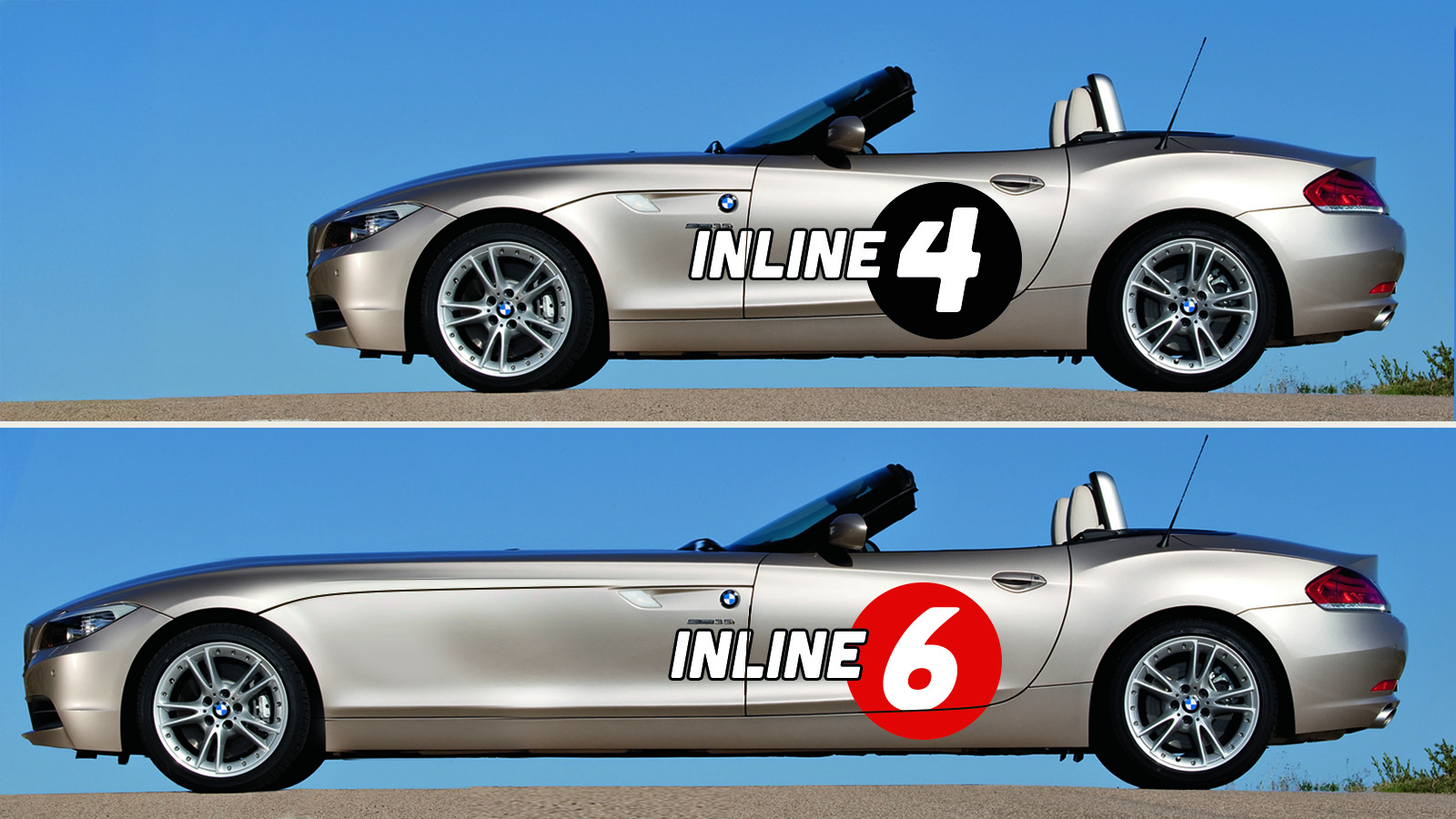
A straight-six is two cylinders longer than an inline-four, right? I mean nice try at confusing the issue with the whole “straight” vs “in-line” thing, but it’s not hard maths. I used to own an E86 BMW Z4 with a 3.0 six, and my brother-in-law had an E85 (same car but without a roof) Z4 2.0 four, and it was pretty clearly a couple of 500cc cylinders different under that long, long, looong bonnet. But what if you want to keep the capacity the same, for tax reasons, or because science demands you only change one variable at a time, or if you’ve been asked to design yet another interchangeable 2.0 litre engine and you are hoping to bankrupt some poor unsuspecting OEM because they omitted cylinder count in the product definition document?
Let’s assume our benchmark is a 2.0 litre four with a bore and stroke of 86mm. It’s a common engine capacity — so common in fact that all three cars parked on my drive right now are 2.0, and both my GT86 and Lotus Europa have the exact same 86mm bore and stroke. This makes for an actual capacity of 1998cc, but that’s close enough.


[I’m Dave Larkman, former Lead Engineer of Powertrain Design at Lotus Cars. I spent 25 years doing extremely confidential work at Lotus for other OEMs, like GM and Nissan, and working on every Lotus product from the S2 Exige to the Emira. I also worked in Powertrain Research, where I got to engineer ingenious engines with 40:1 compression ratios or foot long titanium pistons. [Ed Note: Read Dave’s other pieces here. -DT] ]
Please excuse the crudity of this model; I no longer have the resources of a multinational automotive engineering consultancy to command at my whim. This entire article had a CAD budget of 10 hours, so no complaining that it doesn’t have core plugs/oil drains/oil drillings/breathers/engine mounts/casting datums/coolant connections/ribs or, you know, all the stuff that makes a real model of a block take three months.
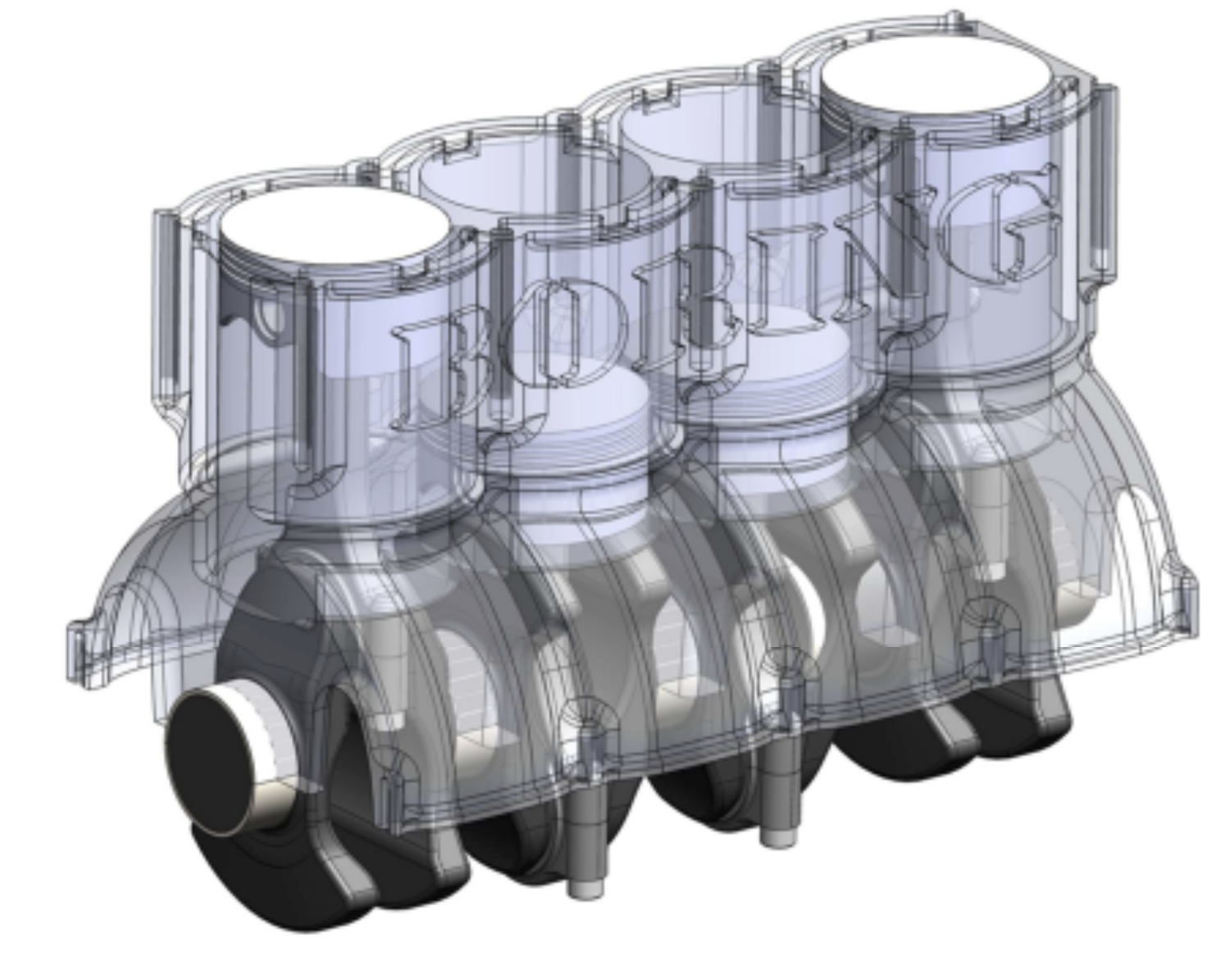
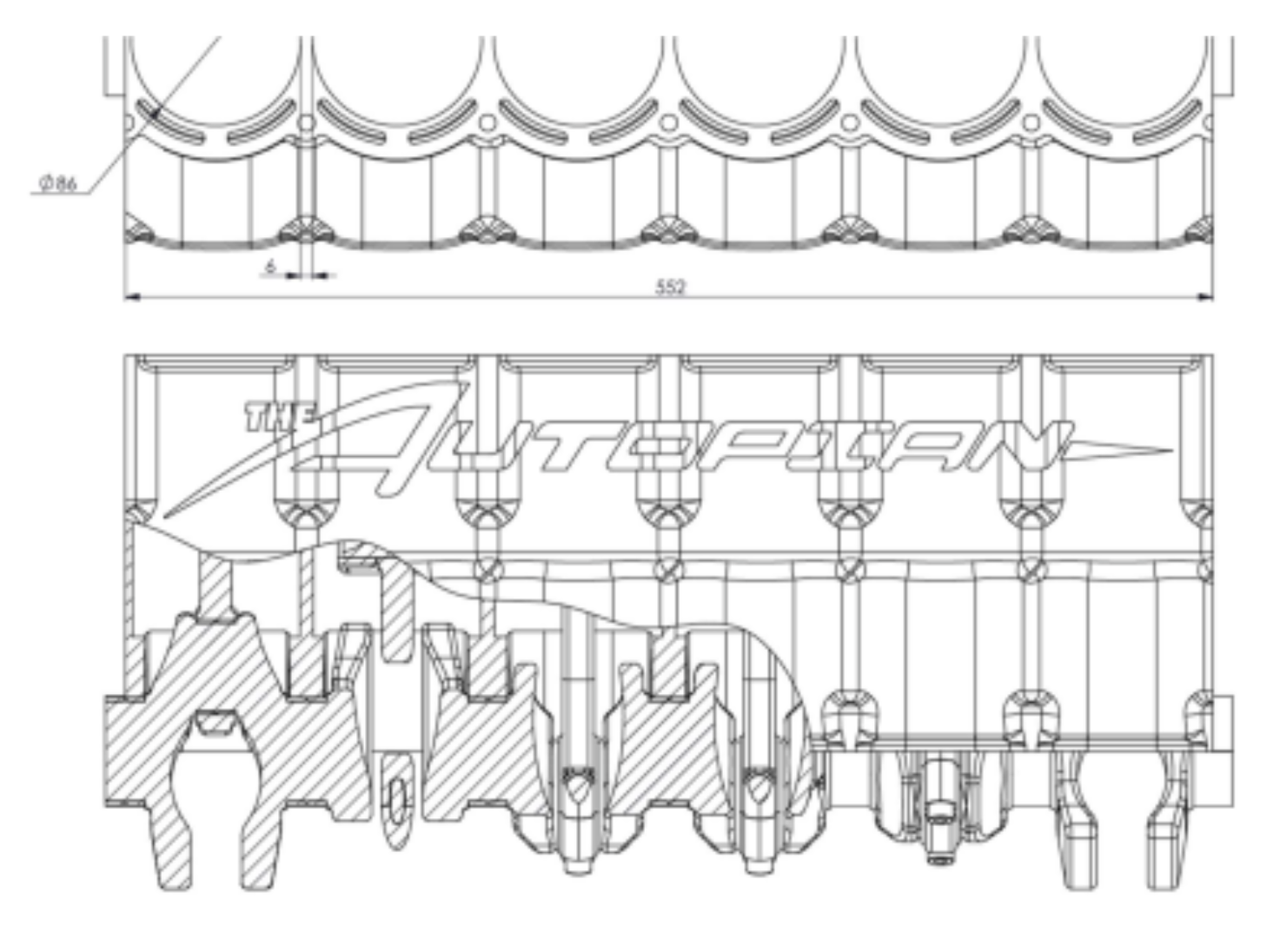
Simply pressing the do-a-drawing button on the CAD gives us a clear view of what we mean by bore and stroke: the cylinder bore is the diameter of the hole in the block, and the stroke is how far the piston moves from top to bottom. Multiply this volume by the number of cylinders to get the engine capacity. (4.0-liters, 2.0 liters, 3.5 liters, etc.)
Why would you want a 2.0 straight six instead of a 2.0 inline-4? [Ed Note: Isn’t it strange that folks call it a straight-six but not a straight-4? -DT]. Well, the inline six is the smallest engine layout with perfect balance, and as a result, the basis of quite a bit of engine snobbery. Plus they sound glorious. Most of the basic engine architecture of a family of inline engines can be shared, so the cam drive (chain, or I guess belt if DT doesn’t have a say, or gears if you want to do it properly), front case, front end accessory drive system, any rear end accessory drive, gearbox bell housing geometry, etc. If you already need a 1.0 triple or a 1.3 four in your smaller cars then a 2.0 six starts to make sense from a parts-sharing standpoint.
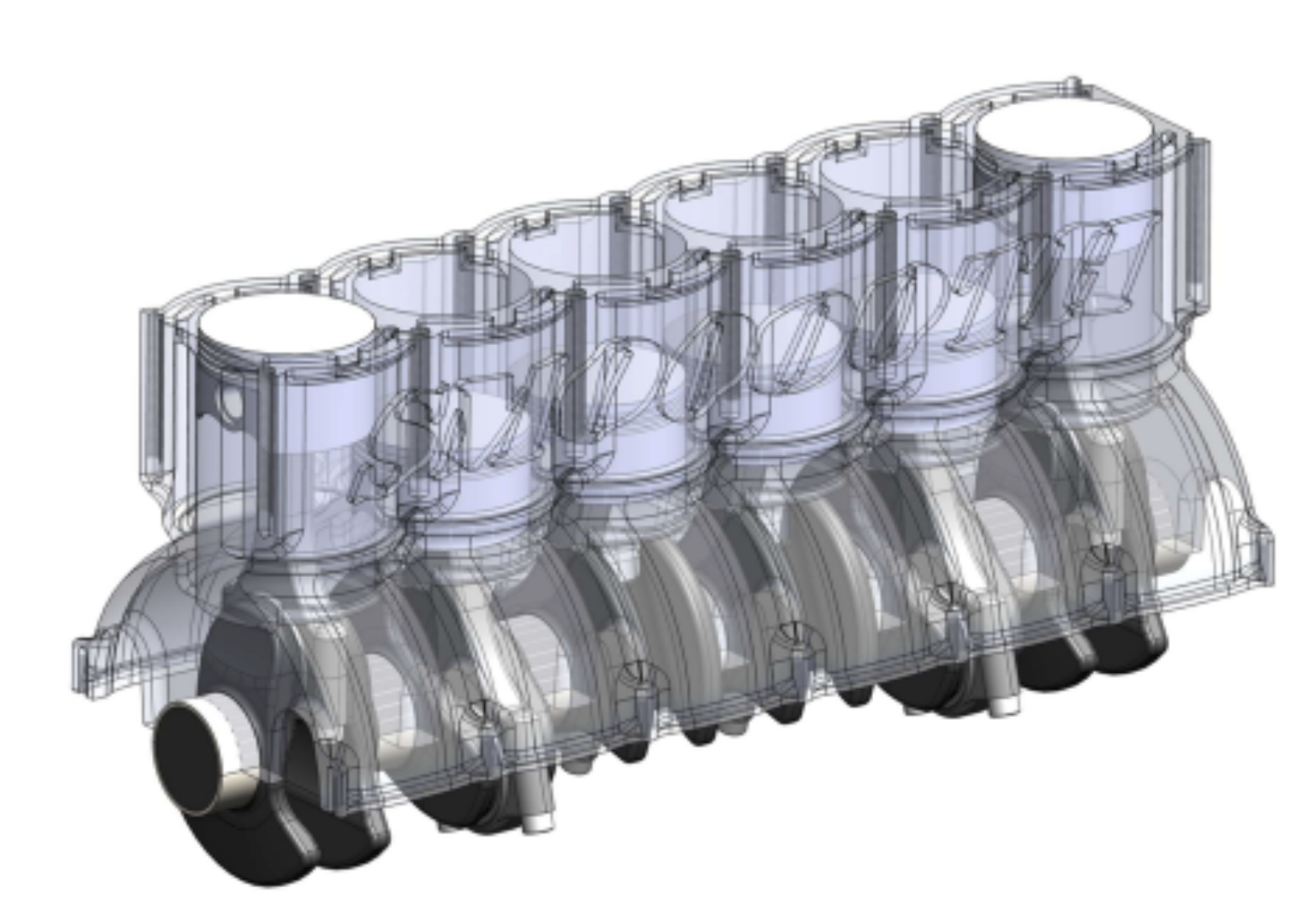
Keeping a square bore-to-stroke ratio gives us 75.1mm for both in our glorious 2.0 straight six. That gives a swept capacity of 1997cc, which is as near as dammit the same as the straight four. To calculate our increase in engine length we just need the space between the cylinders, which I’ve assumed is 6mm (I’ll be honest here and say that most of the cylinder blocks I’ve designed have been for single cylinder engines, and often very weird single cylinder engines, but 6mm seems sensible for head gasket sealing).
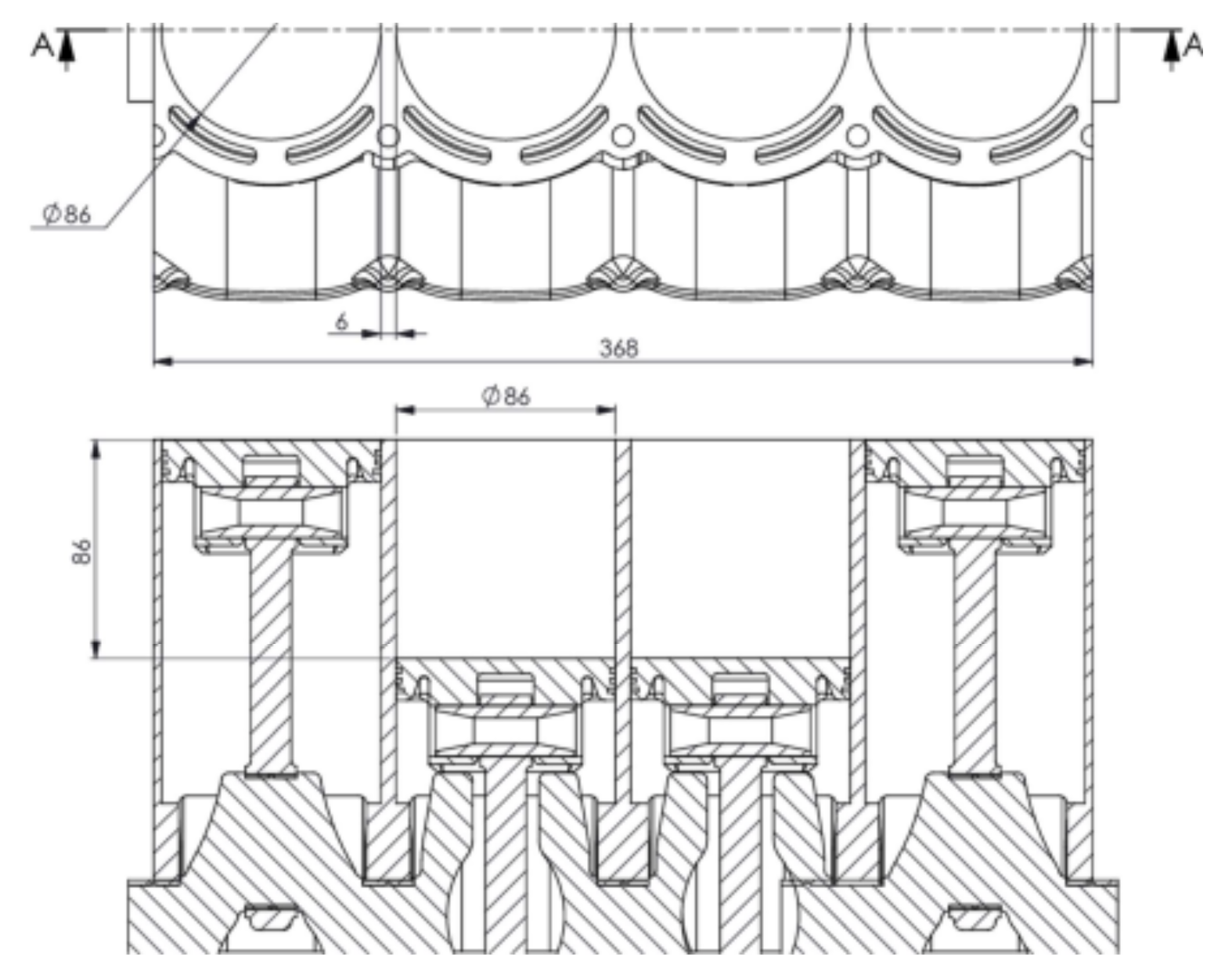
That makes the block length (ignoring all the tedious front case flanges and gearbox mounting at each end that you’d need for any engine regardless of cylinder count) just 368mm long (14.5 metric inches [Ed Note: What the actual ef is a metric-inch? Huh? -DT]) on our benchmark four cylinder, and 486.6mm (19.1“) for the six cylinder. That’s a disappointingly difficult 118.6mm or 4.7” of extra engine length to fit in a car. I once had to redesign an exhaust manifold because it stuck out of the front of the engine by 0.01mm more than the OEM’s current engine, to give you an idea of how critical engine size is for OEMs.
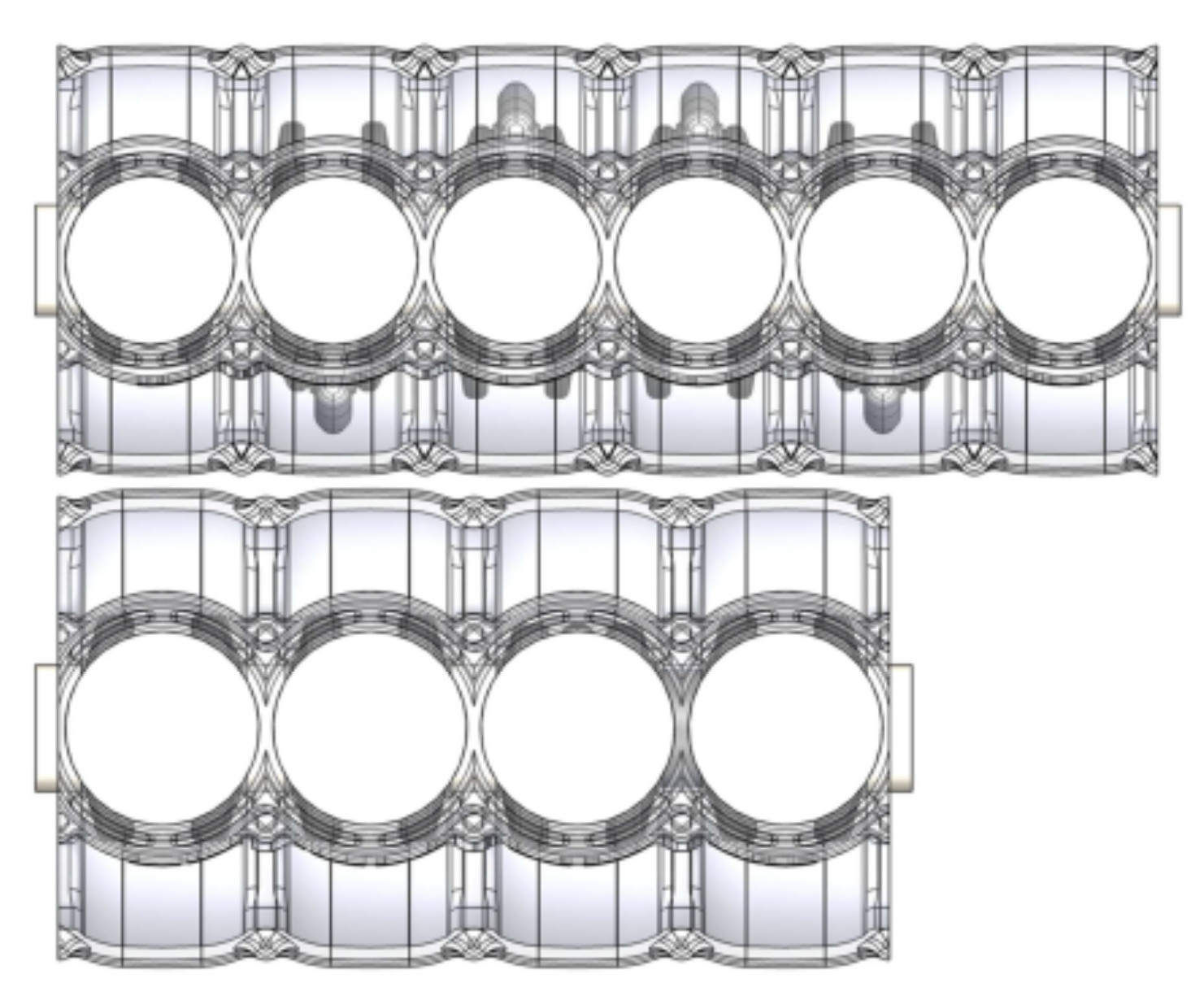
Wow. When I started this I kind of expected this to be a much less obvious difference in length. I guess that’s why we model this stuff up rather than relying on some engineer’s ad hoc reckoning. I have a follow-up thing planned using bits of this model, and I’m a bit worried it’s not going to be a dinky as I thought it would.
Back to our surprisingly long 2.0 six: As well as your improved smoothness and noise you’ll get more revs from the shorter stroke, meaning more power. You’ll also get an increase in total valve flow area, despite having smaller valves in smaller cylinders, so again more power. How much more power? Well, after all the extra bearings and cam drive friction maybe only a few percent based on some rough calcs, but anything at all is nice given that you’re really doing this to get a smoother engine and nicer noise, because it’s the experience that counts, not the numbers.
Although that saying about there being no replacement for displacement/no substitute for cubes? Slightly smaller engine capacity, same level of technology, but more power.
Why then does no one make 2.0 straight sixes anymore? Cost is a big one; small pistons cost nearly as much as bigger ones, and take the same grief to assemble. Cranks, block, head and cams will be 50% more expensive. But the big issues are packaging, that extra 4.7” of engine length, and worse emissions from the extra internal friction. It’s hard to justify when most customers just won’t notice the difference in the engine.
However, for just a tiny additional two and a half inches of engine length on top of that, you can get 50% more power by ignoring the total capacity, saving a bunch on money on common pistons, rods, valves, springs, and just have an even more glorious 3.0 six instead.
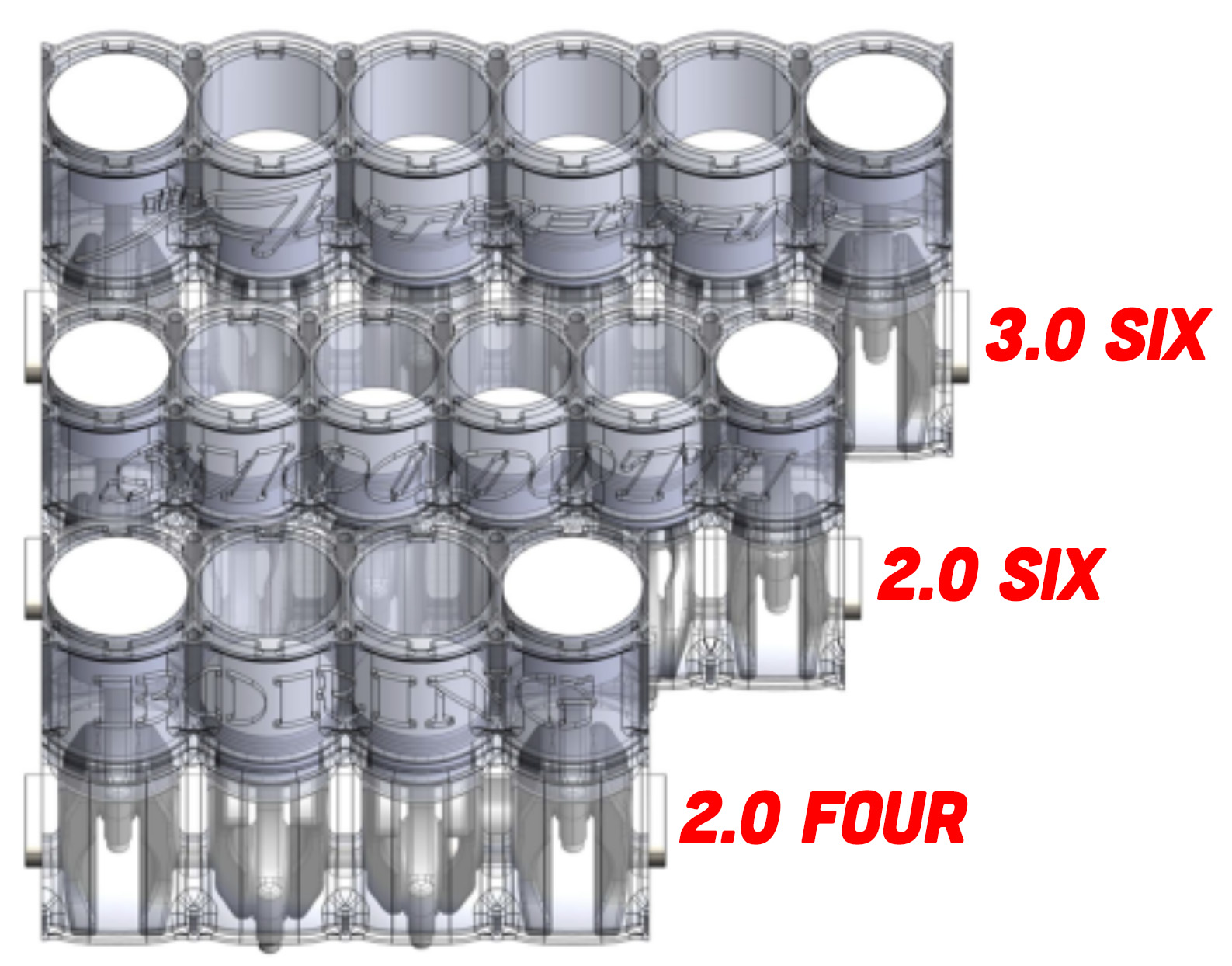
Why would anyone want a 2.0 straight six when 3.0 six is just 13% longer?
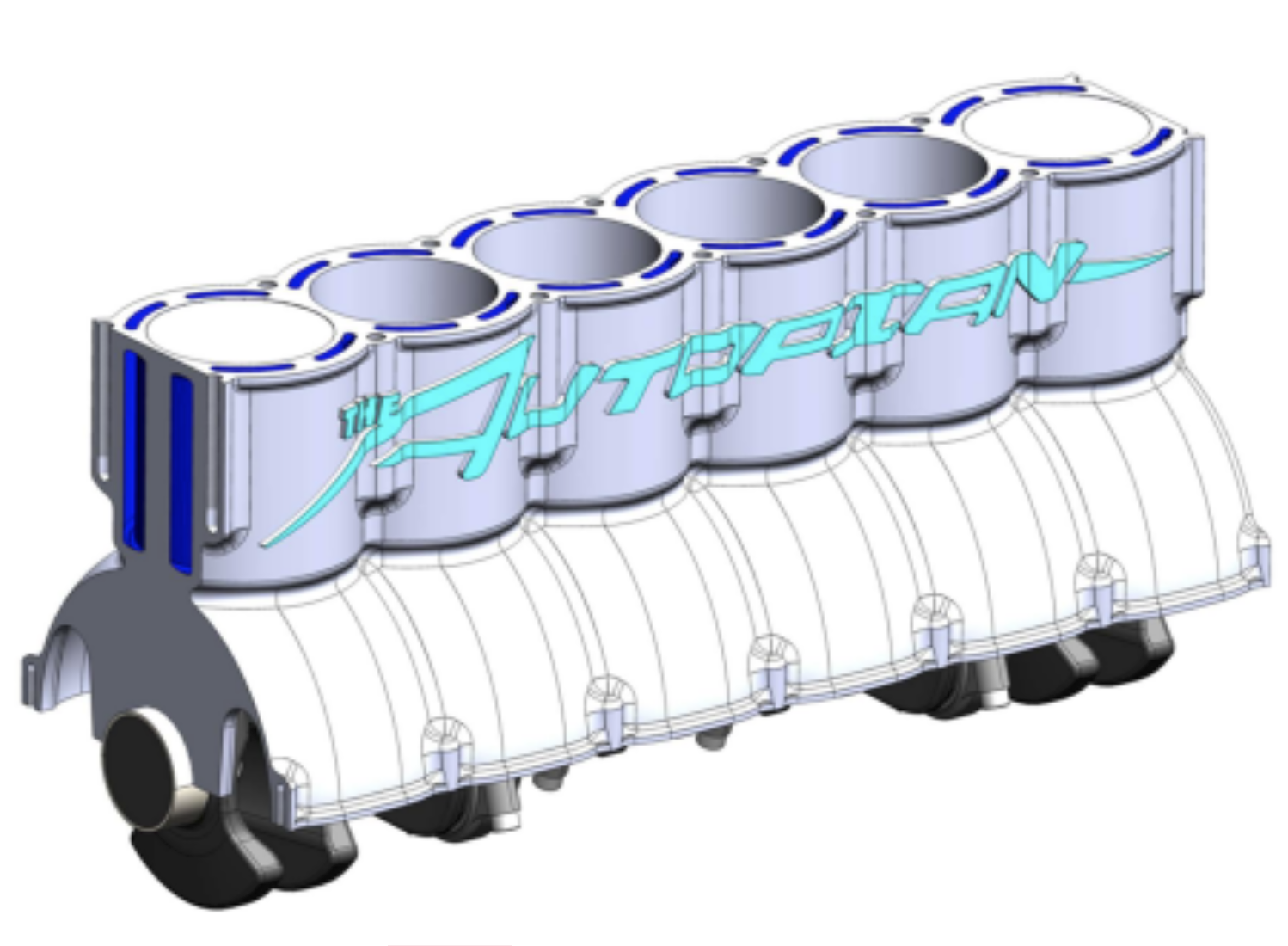
Just so you know: the “The Autopian” logo on the side of that block took longer to model than converting the base 3.0 six assembly to either the 2.0 six or the 2.0 four. Worth it though.
Huge thanks to Jack for the CAD access, without which this would just be some maths and maybe some crudely drawn circles in MS Paint.
All Images: Author


Now draw up a 2.0L thumper…
Always a pleasure to read your articles. I didn’t know I’d be learning about online 6s this morning.
Cheers!
Bring back the straight 8!
“The Autopian” logo on the side of that block took longer to model…”
I felt the need to mess around and if you offset the outer surface and then use that to trim the logo it can be done with like 2 or 3 operations (depending on CAD software). A little more work than just changing your linear pattern from 4 to 6.
It’s not the operations (I did it in 2) it’s the sketching around an image of the logo that takes the time.
I had to do a new crank for the 4, but that was way easier than changing the bore and stroke on the six and finding out how good I am at planing a parametric model’s constraints. The block made some really weird shapes until I fixed it.
Ah the memories of doing incremental changes to a parametric CATIA model because if you tried to do it in one fell swoop, the model collapsed. Might only be a 5% change in one dimension, but you had to do it a little bit at a time, and you could never predict which dimension was going to cause it to fall over.
Then to export it as an IGS file, open it in FreeCAD, make no changes, save and close, all to get Abaqus to be able to open it properly. You’d think with both being Dassault products, Abaqus could handle a native CATIA file, but nooooooooo.
There are websites out there that will convert an image or logo (bitmap) into a DXF (vector) which you can then import. Some image editing software can do that for you as well. They’ve saved my ass many of times when I had a complicated logo I needed to extrude into a model.
I really enjoy my ’73 TR6 with the 2.5L straight six. Even with a basically stock exhaust, it sounds great, runs great, and takes away any need for a sound system in the car, whether the top is up or down.
I’ve got the 2.0L version in my GT6. it’s a good thing those engines sound so good since the electrical system will only allow a radio to function about 10% of the time. 🙂
The only thing I miss after converting my GT6 to an EV is the noise. Boy do I miss that exhaust note…
That would keep me from changing it also. Though it would be nice…
Upgrade that 2L engine from carburetion to a lean-mapped EFI and you might be able to double the fuel economy, in addition to a significant horsepower increase.
The wiring harnesses are old. It’s a simple system, and not too bad to replace. I did the whole thing in my MGB, but it comes in sections, so you don’t have to tackle the whole thing at one time.
I know, I’m just goofin. As much grief as we give those systems, they are dead simple to fix. Once you find the problem, anyway. I rewired mine, too, with a real fusebox and relays and everything.
Would it be technically correct to refer to a one-cylinder engine as an “Inline-1”? I mean, it’s in a single line, but then again it’s not in a line. Or do you call it a “Straight 1”, but then again, who’s our arbiter of “straight here?” You can’t tell where that thing is leaning. If you somehow made a V-1, that would create a whole slew of engineering problems none of us are prepared for.
Germany made a V-1 during the 1940s.
I do not think people in London appreciated its engineering.
If you park that single-cylinder car on a hill, you’ll have a Slant-1
Benz’s first car had a H-1, with a one armed boxer setup with a horizontal piston.
A one cylinder engine is a Dot-1.
“Or do you call it a “Straight 1””
Gay 1.
LOL
If a single cylinder engine is a point rather than a line, does that make an inline engine a vector or a scalar?
I’ve had a 2.8 liter I6 (84mm bore and stroke) M52 E36 and a 3.0 liter I6 (85mm bore and 88mm stroke) N52 E82
Have been a big straight 6 fan since my 71 TR-6 and its 2.5L. Have 3 in the fleet right now: 58 Austin Healey 2.7L, 92 F-250 300-6, and 99 XJ 4.0L. The packaging problems are apparent in the XJ. Things are pretty tight there up front.
My straight six experience has been with Land Cruisers. They were glorious, under- stressed tractor engines that could probably run on crude oil. Fun fact: because a straight six has such a (relatively) long crankshaft, their early crankshafts would do funny twisting and oscillating antics at certain higher rpms leading to excessive wear or early bottom end failure. This was fixed by adding extra webbing to the engine case to support 7 main bearings instead of the original 4.
Also, I will now refer to four cylinders as straight fours just for the looks.
Yeah, straight six cranks are not creat for torsional stiffness.
FOUR main bearings – Yikes! No wonder it had issues. Funny enough, the new 3.4TT V6 that’s been having issues only has 4 as well, and I think they’re fairly small as well.
I have experience with the 4.5L I6 in the FZJ80, my buddy in SoCal lent me his for two weeks while I was visiting. I fell in love with it – not a lot of HP, but sufficient. Good low end tq – he warned me it’d be slow, but it felt comparable, if not a little better, than my 4.0 5th gen 4Runner in normal driving. Tractor is right – it had a nice rumble and shake at startup, though it ran quite smooth when driving. Main con is it goes through fuel like there’s a hole in the tank. I see in LC groups that people LS swap them to double the HP AND improve mileage.
Yep. I loved my FZJ80. It just wasn’t worth an engine swap (or a turbo addition!) to me when it could go to someone else who could enjoy it as they see fit, and it feels a little icky pulling a reliable Toyota engine to install something else. I’ve got V8 Toyota power now, and it came with a whole vehicle wrapped around it, including heated seats and better interior noise management.
I wonder why SAAB didn’t jump up to six cylinders when they drew up the 1980s H-motors that replaced the 1970s B-motors (which they had inherited from Triumph, who were perfectly happy with 4 cylinders.) They sure had enough room up there under those bassackwards hoods.
Where was Saab gonna realistically get a 6 cylinder from? I guess the other Type 4 cars, but the engine was one of the biggest differentiators between them, so I’m not so sure Lancia/Alfa/Fiat would have been so excited to share them. There is a reason Saab didn’t stuff more cyilnders under the hood until they had been under GMs ownership for a while and threw one in the 9000 in the mid 90s.
Triumph, same place they got the 4 banger!
And that would fit in a FWD chassis?
An engine hanging way out in front of the front axle never stopped Saab. Audi seems (seemed?) to have no problem with it if it meant bigger engines.
Most everyone who stuffed big engines in FWD cars had the budget to specifically design that. Saab didn’t have that budget. Reusing someone elses engine originally designed for RWD use means you still have crazy costs to reengineer and redesign that engine and transaxle to fit up front.
Volvo turned it sideways and made it fit as early as 1998. It was a packaging nightmare, but it definitely was in there.
Just give the car a nose like the 1974 AMC Matador sedan had and it’ll fit. LOL
https://www.streetsideclassics.com/vehicles/5391-atl/1974-amc-matador
Sure! The 4 cylinder fit in there with all its pistons arranged in a neat little line from front to back, right on top of the transaxle. Why not a six at a mere 25% longer? Hell, Kawasaki fit a 1.3 liter 6 into a motorcycle.
I’ve had this question for YEARS! Great article! Now I know why small displacement 6+ cylinder engines are not mass market
That’s my car!! That’s my car!! (In the first paragraph , the one pictured is newer) I’m so excited to have the intake solenoid coming in the mail. I really hope that puts it back into service for real
I sold my E86 Z4 because the running costs for a Lotus were going to be much lower.
Great car though.
Too true. I’m working on a friend’s Ranger to prepare it for sale. After giving the Z4 a big do-up last summer, I’m endlessly caught off guard at how damn cheap everything is. A whole front end rebuild kit for the Ranger costs as much as my tie rods. Yikes.
Me going into this article: Why doesn’t anyone make small displacement 6’s anymore. They sound fun!
After the article: Oh 🙁
Very interesting writeup, thanks.
Those are some insurmountable drawbacks in a world where people are less and less in tune with the mechanical feel and personality of their cars and efficiency/emissions requirements are more stringent.
We will get the cheapest and most compliant way of producing the required amount of power.
Having passed up a plethora of ubiquitous but more efficient 2.0-turbos for a 3.5-liter V6 of similar power but far nicer NVH characteristics, I feel some things are worth paying a little bit more.
Doesn’t help that engines are all-around complex enough that balance shafts are relatively cheap/easy to implement, so straight-4’s are smoother than ever on average.
Add to that increasing hood heights that make it easy to package long-rod designs that mitigate secondary imbalance, metallurgy that allows long-stroke engines to reciprocate at higher speeds than normal crankshaft profiles and turbocharger geometries can support, and the fact that engines are simply more efficient at lower speeds, and you really don’t gain much from high-revving engines with small cylinders in cars anymore.
We own a BMW E34 with the M20B20 2.0L engine. It’s a tank of an engine but slower than erosion.
Imagine my sorrow to find that this article is merely about a displacement level, for an engine layout that not only still exists, but is recently thriving.
Meanwhile, an actually beloved configuration with perhaps less perfect balance but a lot of heart and character has vanished from the marketplace entirely. Some of us still mourn it.
10 fingers, 10 cylinders. Five on each side!
It’s so logical!
Listen, if it’s the base of our entire counting system, it’s good enough for a couple sports cars.
A number of cultures used base 12, easily divisible by an assortment of numbers, and countable on one hand by finger segments. V12 is obviously the way to go.
The original title was “so how much longer is a straight six than an in-line four?”
+1
I remember the first gen Z4 had a 2L 6 cylinder in line engine. Pretty awesome.
4 cylinders feel like little tractors to me
I know there was a 2.5L, was there a smaller euro-spec engine?
The Z3 had a 2.0L straight 6 which is kinda the first gen Z4
Maybe it’s the Z3, it was so long ago. Still, it’s a cool idea.
I’ve no direct experience with one, but Mazda does have that newish 3.3 liter inline 6 sky active engine for the CX 90 and CX70. May the autoGODs move them to put one into an iconic style sports GT.
If they would sacrifice the Wankel, a new RX with the straight six would get my attention.
It does seem a wicked shame to have built a motor with such potential and shackled it only to a large SUV. Even just putting it into the long rumored new 6 sedan would be great! Ideally with no hybrid, a stick, and RWD, but one can only hope for so many miracles at once…
I shall make my standard refrain.
PUT IT IN A NEW MAZDA6 YOU COWARDS
Talking about 2.0l straight sixes immediately brought the Toyota 1G to mind. It was available in just about every Japanese-market large car they made from the 70s all the way through the early 2000s.
It was born out of Japan’s vehicle classification system, which had a separate bracket for cars under certain dimensions with engines smaller than 2 liters. Toyota must have done the math and realized the premium they could charge for a smooth straight-six outweighed the development cost.
The sound they make isn’t quite what you’d expect from a big sedan either-
https://youtu.be/M9WcPDzqmiE
Is that an inline six or are you just glad to see me?
“Well, it’s certainly not a straight. Or even a six.”
I remember as a grade school youngster reading a car magazine and they had a shootout for modified pony cars in the 90s. One point raised for the Camaro was due to the body design it was easier to route one single exhaust pipe after the Y pipe. It also reduced weight, which was a bonus.
But what really blew me away was the factoid that a single 3 inch exhaust was less restrictive then dual 2 inch pipess. I just ran the numbers again because old me still has trouble with it but the math still maths.
This is functionally the same issue. Easier to do fewer, bigger tubes (pistons) and take up less space and weight.
One of the “infinite money, time, and space” projects I’ve always dreamed of is to put the BMW K1600 six into a lotus 7 clone. I do wonder how that motor lines up with these models just for kicks.
The bore of the K1600 is 72mm, making it just 18mm shorter than the 2.0 six modelled. That’s still much longer than a tedious 2.0 four.
Nobody told me there’d be math.
Hey, I did ten hours of pretty intense CAD so there would be pictures instead of math.
My comic book brain thanks you.
No discussion about a 2.5L inline 5 like the VAG EA885?
Or the Volvo 2.5T’s!
Why settle for a 3.0l straight six when, in the same length, you could have a 6.0l V12?
Right?
This is the way.
A V12 will be about half a bore longer than a straight six.
But twice as cool.
Fork and blade cranks “fix” that.
So, you’re saying a smaller capacity V12 is the way.
Owning a V12 is on my bucket list.