

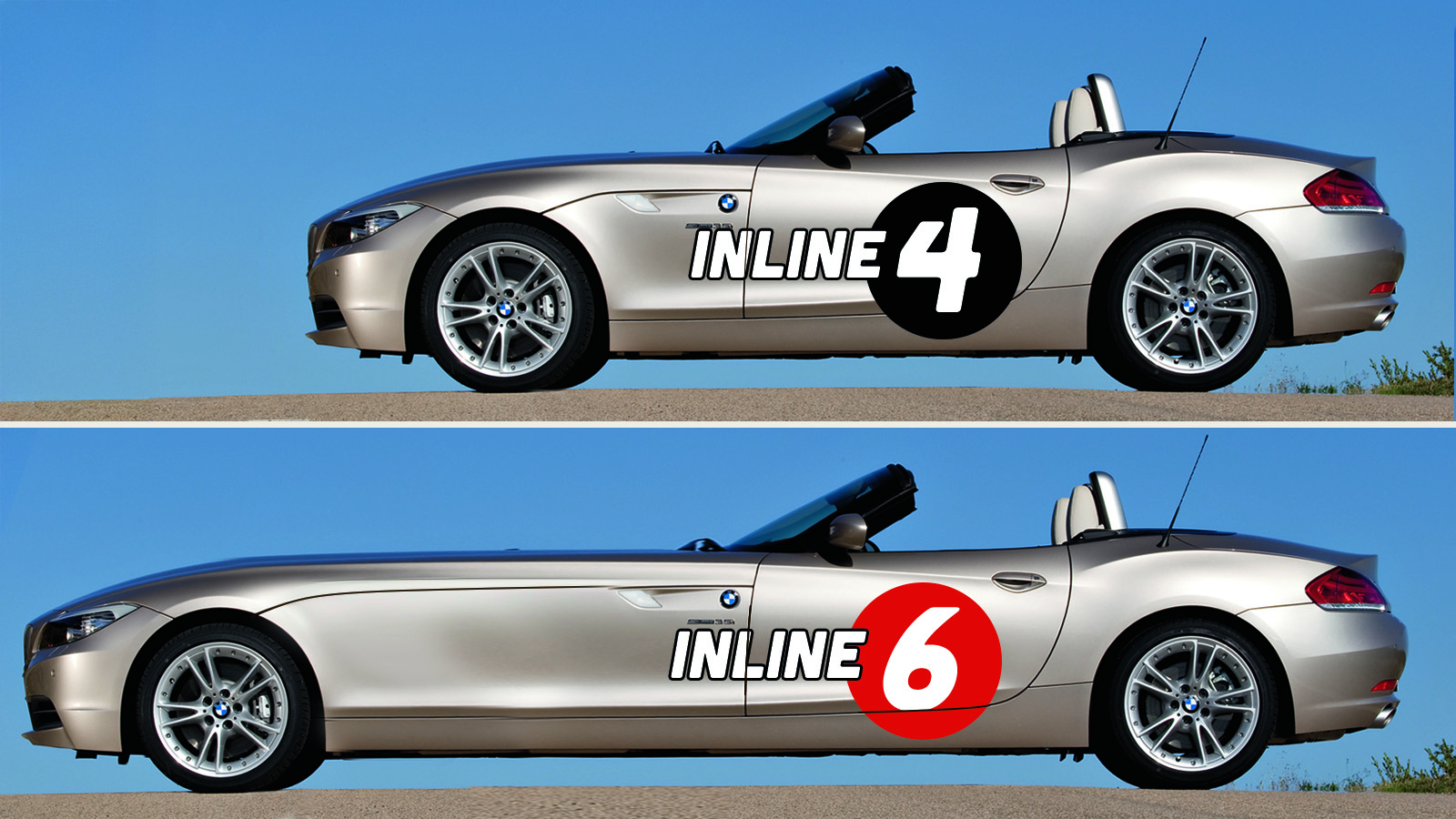
A straight-six is two cylinders longer than an inline-four, right? I mean nice try at confusing the issue with the whole “straight” vs “in-line” thing, but it’s not hard maths. I used to own an E86 BMW Z4 with a 3.0 six, and my brother-in-law had an E85 (same car but without a roof) Z4 2.0 four, and it was pretty clearly a couple of 500cc cylinders different under that long, long, looong bonnet. But what if you want to keep the capacity the same, for tax reasons, or because science demands you only change one variable at a time, or if you’ve been asked to design yet another interchangeable 2.0 litre engine and you are hoping to bankrupt some poor unsuspecting OEM because they omitted cylinder count in the product definition document?
Let’s assume our benchmark is a 2.0 litre four with a bore and stroke of 86mm. It’s a common engine capacity — so common in fact that all three cars parked on my drive right now are 2.0, and both my GT86 and Lotus Europa have the exact same 86mm bore and stroke. This makes for an actual capacity of 1998cc, but that’s close enough.


[I’m Dave Larkman, former Lead Engineer of Powertrain Design at Lotus Cars. I spent 25 years doing extremely confidential work at Lotus for other OEMs, like GM and Nissan, and working on every Lotus product from the S2 Exige to the Emira. I also worked in Powertrain Research, where I got to engineer ingenious engines with 40:1 compression ratios or foot long titanium pistons. [Ed Note: Read Dave’s other pieces here. -DT] ]
Please excuse the crudity of this model; I no longer have the resources of a multinational automotive engineering consultancy to command at my whim. This entire article had a CAD budget of 10 hours, so no complaining that it doesn’t have core plugs/oil drains/oil drillings/breathers/engine mounts/casting datums/coolant connections/ribs or, you know, all the stuff that makes a real model of a block take three months.
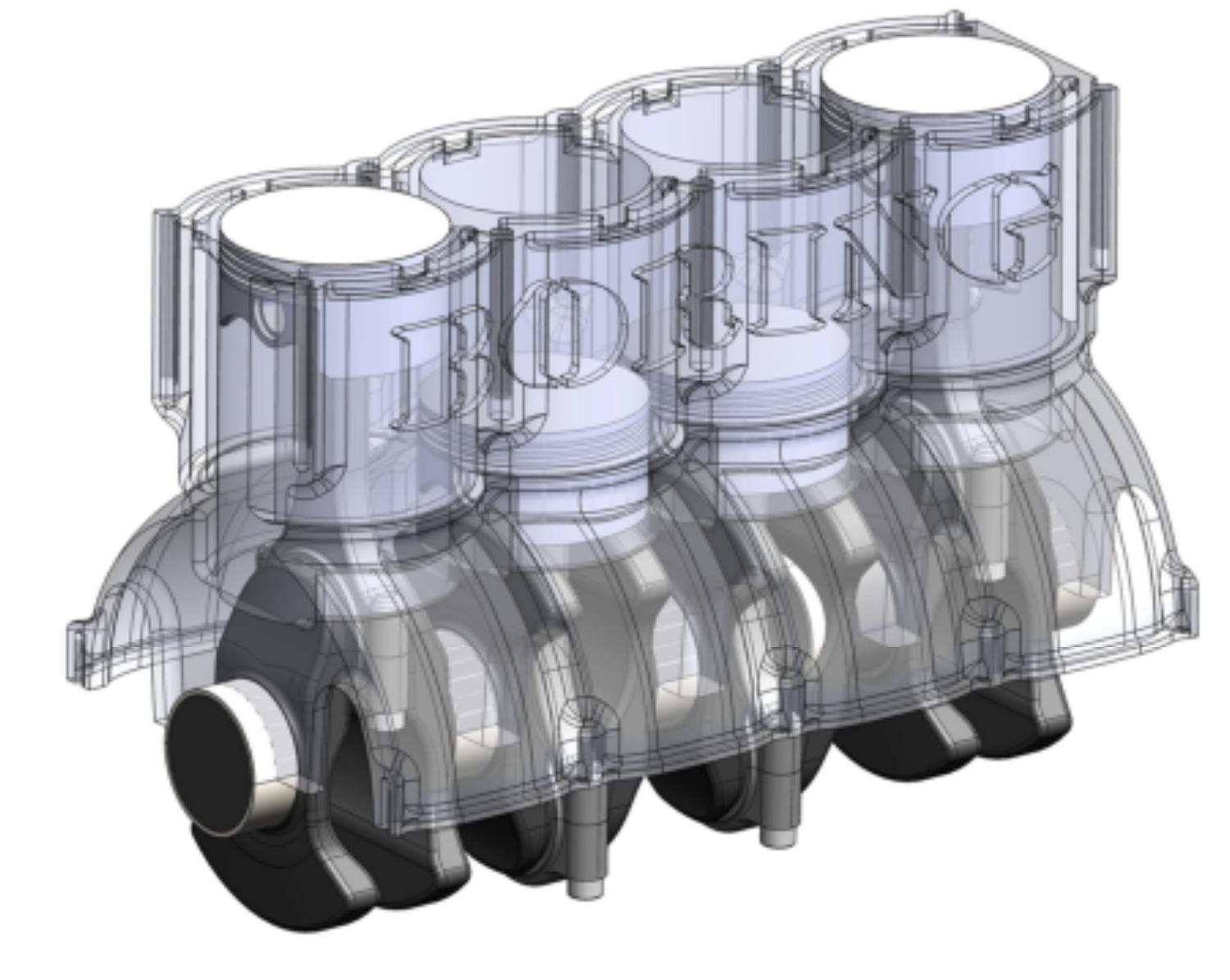
Simply pressing the do-a-drawing button on the CAD gives us a clear view of what we mean by bore and stroke: the cylinder bore is the diameter of the hole in the block, and the stroke is how far the piston moves from top to bottom. Multiply this volume by the number of cylinders to get the engine capacity. (4.0-liters, 2.0 liters, 3.5 liters, etc.)
Why would you want a 2.0 straight six instead of a 2.0 inline-4? [Ed Note: Isn’t it strange that folks call it a straight-six but not a straight-4? -DT]. Well, the inline six is the smallest engine layout with perfect balance, and as a result, the basis of quite a bit of engine snobbery. Plus they sound glorious. Most of the basic engine architecture of a family of inline engines can be shared, so the cam drive (chain, or I guess belt if DT doesn’t have a say, or gears if you want to do it properly), front case, front end accessory drive system, any rear end accessory drive, gearbox bell housing geometry, etc. If you already need a 1.0 triple or a 1.3 four in your smaller cars then a 2.0 six starts to make sense from a parts-sharing standpoint.
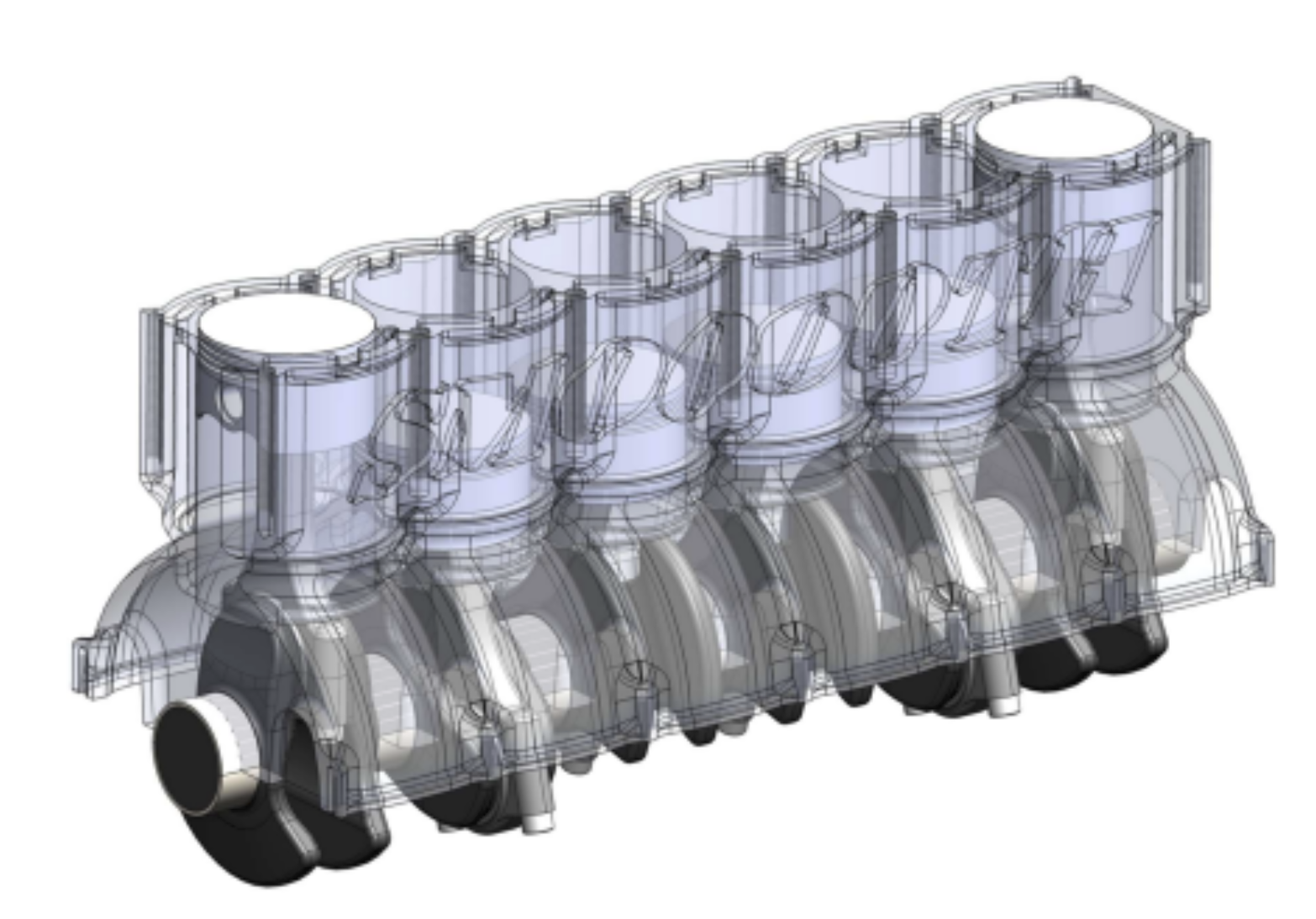
Keeping a square bore-to-stroke ratio gives us 75.1mm for both in our glorious 2.0 straight six. That gives a swept capacity of 1997cc, which is as near as dammit the same as the straight four. To calculate our increase in engine length we just need the space between the cylinders, which I’ve assumed is 6mm (I’ll be honest here and say that most of the cylinder blocks I’ve designed have been for single cylinder engines, and often very weird single cylinder engines, but 6mm seems sensible for head gasket sealing).
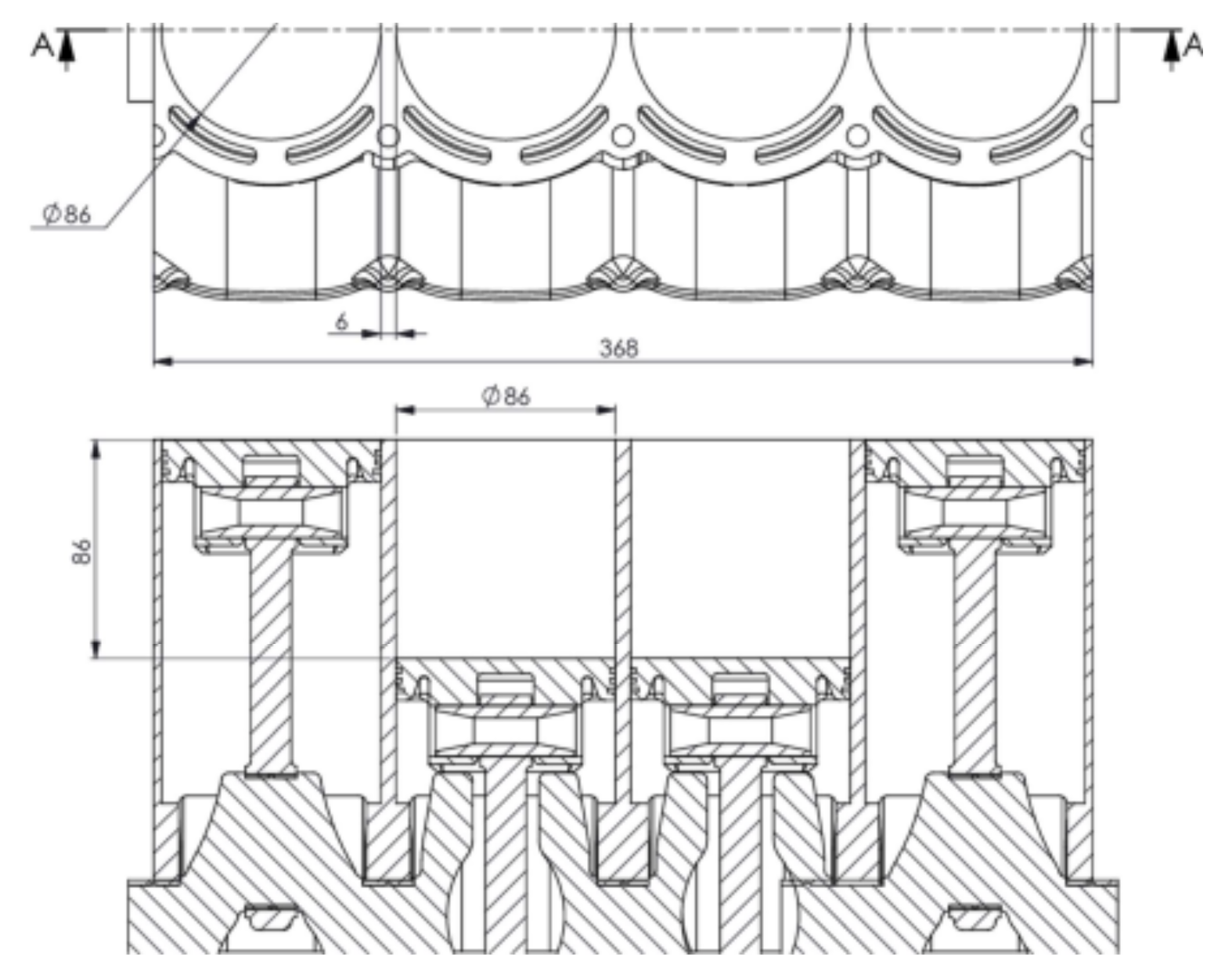
That makes the block length (ignoring all the tedious front case flanges and gearbox mounting at each end that you’d need for any engine regardless of cylinder count) just 368mm long (14.5 metric inches [Ed Note: What the actual ef is a metric-inch? Huh? -DT]) on our benchmark four cylinder, and 486.6mm (19.1“) for the six cylinder. That’s a disappointingly difficult 118.6mm or 4.7” of extra engine length to fit in a car. I once had to redesign an exhaust manifold because it stuck out of the front of the engine by 0.01mm more than the OEM’s current engine, to give you an idea of how critical engine size is for OEMs.
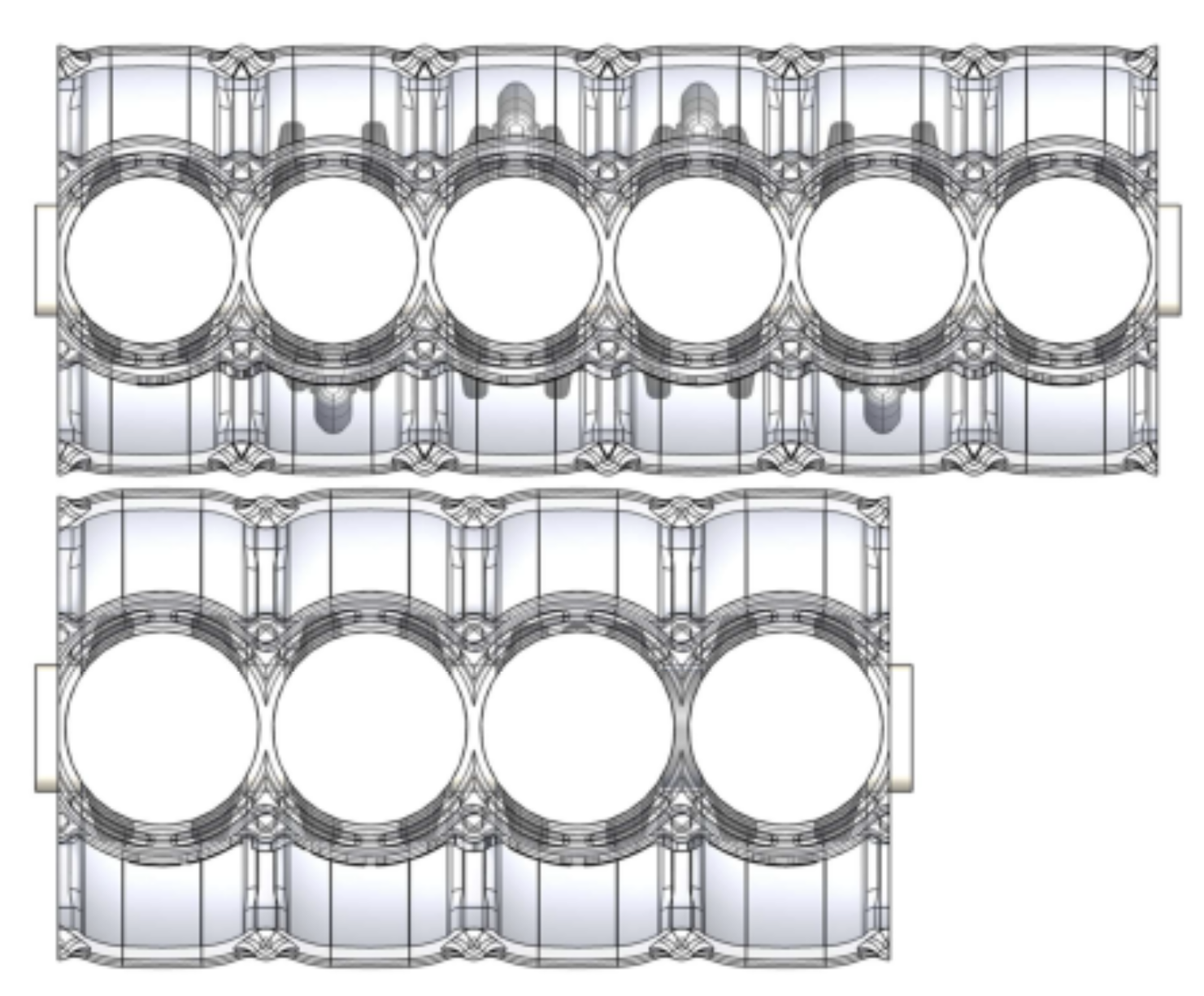
Wow. When I started this I kind of expected this to be a much less obvious difference in length. I guess that’s why we model this stuff up rather than relying on some engineer’s ad hoc reckoning. I have a follow-up thing planned using bits of this model, and I’m a bit worried it’s not going to be a dinky as I thought it would.
Back to our surprisingly long 2.0 six: As well as your improved smoothness and noise you’ll get more revs from the shorter stroke, meaning more power. You’ll also get an increase in total valve flow area, despite having smaller valves in smaller cylinders, so again more power. How much more power? Well, after all the extra bearings and cam drive friction maybe only a few percent based on some rough calcs, but anything at all is nice given that you’re really doing this to get a smoother engine and nicer noise, because it’s the experience that counts, not the numbers.
Although that saying about there being no replacement for displacement/no substitute for cubes? Slightly smaller engine capacity, same level of technology, but more power.
Why then does no one make 2.0 straight sixes anymore? Cost is a big one; small pistons cost nearly as much as bigger ones, and take the same grief to assemble. Cranks, block, head and cams will be 50% more expensive. But the big issues are packaging, that extra 4.7” of engine length, and worse emissions from the extra internal friction. It’s hard to justify when most customers just won’t notice the difference in the engine.
However, for just a tiny additional two and a half inches of engine length on top of that, you can get 50% more power by ignoring the total capacity, saving a bunch on money on common pistons, rods, valves, springs, and just have an even more glorious 3.0 six instead.
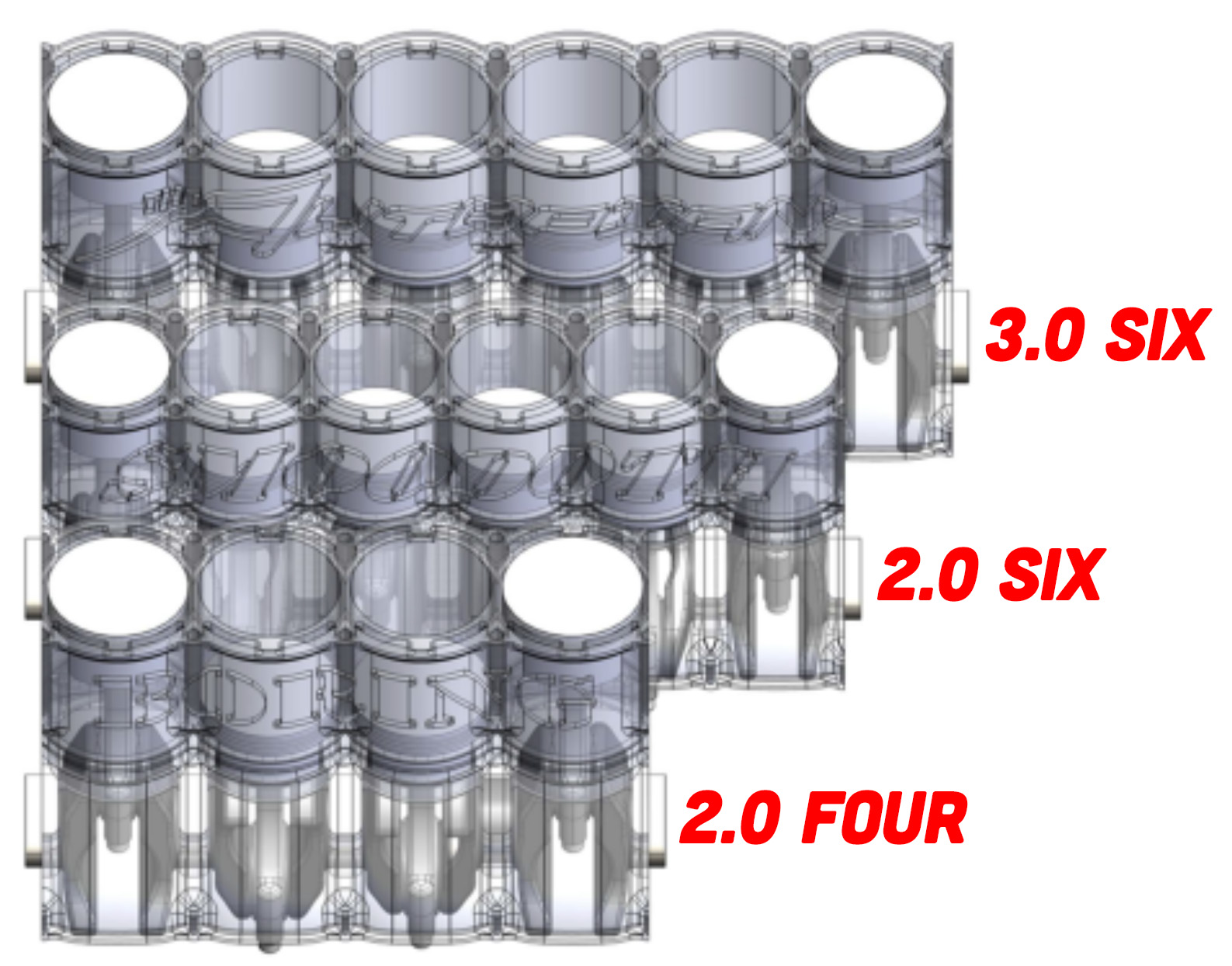
Why would anyone want a 2.0 straight six when 3.0 six is just 13% longer?
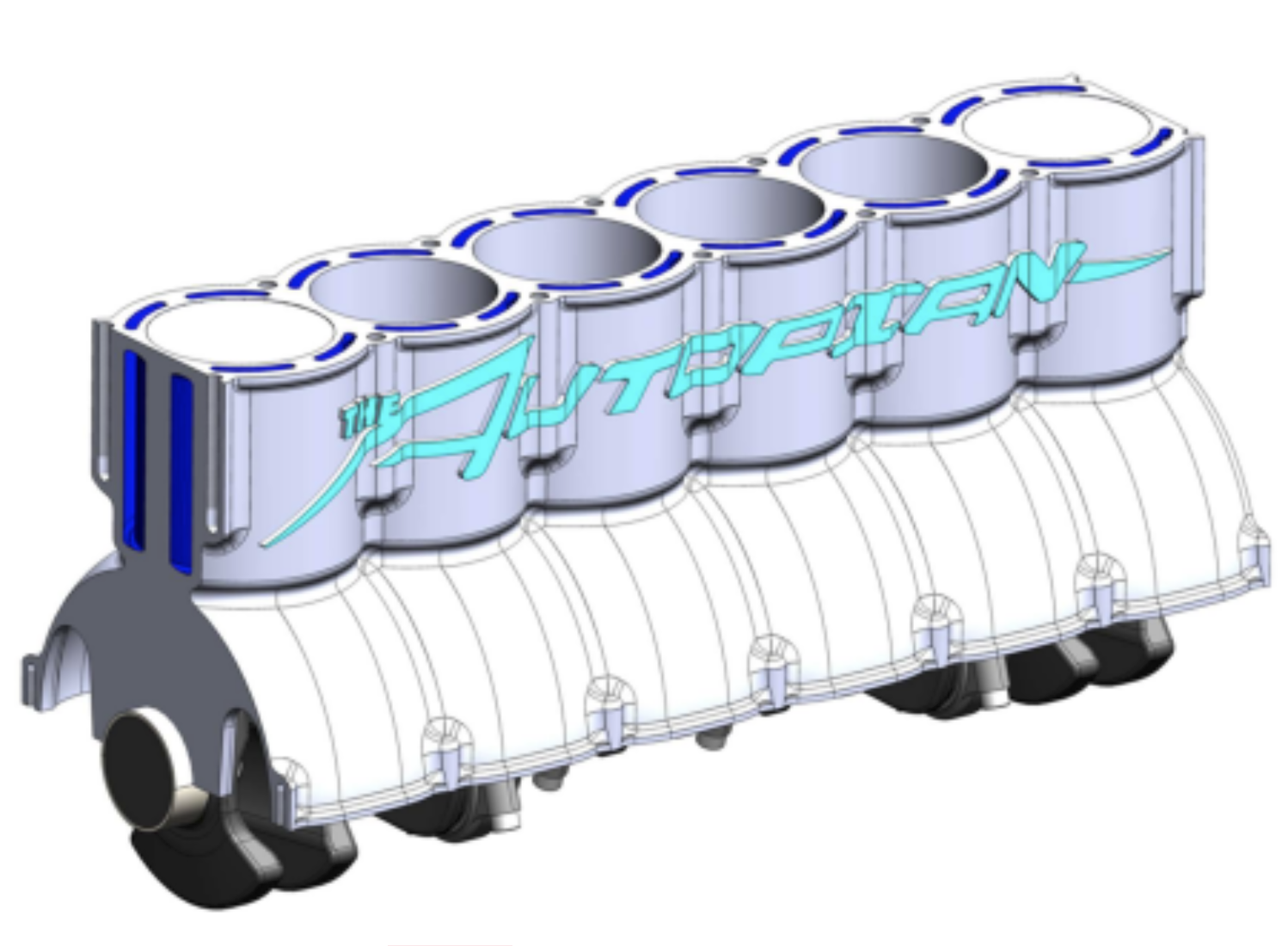
Just so you know: the “The Autopian” logo on the side of that block took longer to model than converting the base 3.0 six assembly to either the 2.0 six or the 2.0 four. Worth it though.
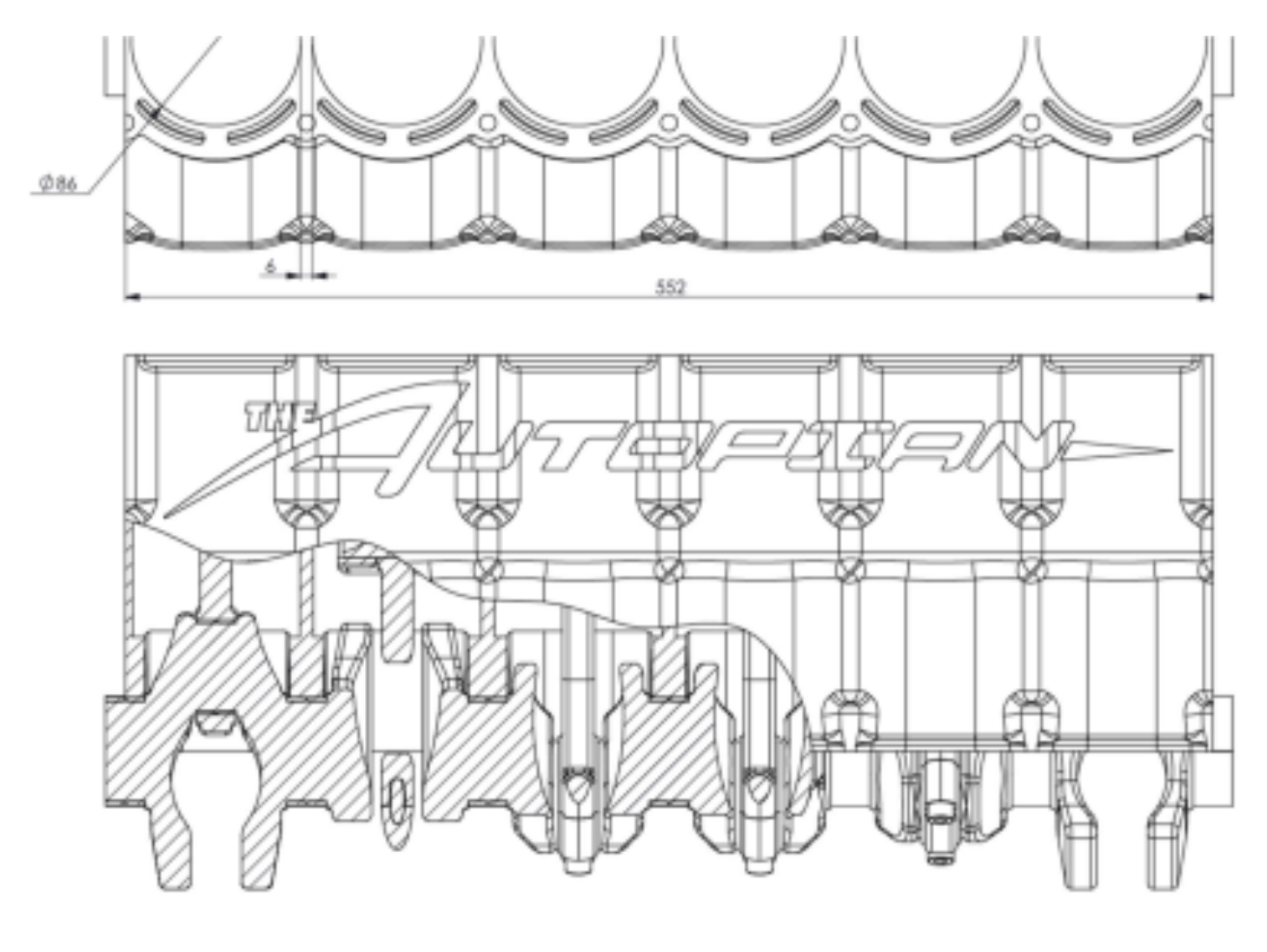
Huge thanks to Jack for the CAD access, without which this would just be some maths and maybe some crudely drawn circles in MS Paint.
All Images: Author


Biggest argument against the smaller cylinders will probably be efficiency loss due to higher heat transfer. That whole surface area to volume ratio heat transfer thing really kills you with the smaller cylinders. This is the main reason that the largest engines in the world happen to also be the most thermally efficient engines in the world.
But if the goal is fun and noise then please disregard my previous comment.
I stopped reading after the author’s claim of having to “…redesign an exhaust manifold because it stuck out of the front of the engine by 0.01mm more than the OEM’s current engine.” There’s no way that 0.01mm (0.00039 inches) is of any significance in the space-claim requirements of an exhaust manifold.
Of course not, that’s a silly number. 0.01mm is tiny.
The actual stuff-up clearance required for the assembly of that engine into the vehicle was 25mm. The manifold I designed provided 24.99mm of stuff-up clearance to the chassis.
You know what isn’t bigger than 25mm? 24.99mm.
Does it make a practical difference? No.
Did it meet the technical obligations of a multi-million pound contract? Sadly also no. Hence the redesign.
I’m taking the manager who made that call out to dinner on Friday, because it was his birthday. Hi Digs! He’s already pointed out that this article doesn’t mention the mass penalty of going for a straight six, which is fair.
On the terminology, DT missed that a 2 cylinder is called a parallel twin. So you have parallel, inline, and straight for the same layout. Gotta love language.
Straight six works because we’re suckers for alliteration. Or at least I am.
Alliteration? You mean start syllables sounding similar?
All flat engines have cylinders that are parallel but not in a straight line. I can also design a parallel but non-straight engine with three or more cylinders.
We can call those opposed-parallel engines, or oppa! for short.
Sometimes you don’t need much of a practical reason to push the limits of inline engines:
https://engineswapdepot.com/?p=21361
I think that inline 5 cylinders are the most underrated engine design, and there should be more of them.
As a previous owner of cars with smaller capacity sixes, 2L V6 and 2.5L I6, while I understand the pragmatic nature of the 2L I4, I mourn those lost in the quest for rationality.
Start reading due to my enjoyment of Dave’s writing and technical knowledge.
Stay reading for the continuously varying interchange of straight and inline terminology.
I’m just glad someone noticed that I’m wildly inconsistent.
I took it as true commitment to the bit established in the opening of the article.
Much like, to this day thanks to a previous boss, when writing a response where I’m adding comments to the email sent to me, I will write something like “see comments below in red” but then write them in a different colour.
I’m a rebel.
Well if a 2.0L four is better for cost and packaging compared to a 2.0L six, then a 2.0L TWO cyl should be even better than the 2.0L four.
Right? RIGHT???
And then if you ever want to make a big, Cummins 6BT-style inline 6, just stick 3 of them together and you’ll have a 6L inline 6.
And if a 3L inline 6 is better than a 2L inline 6, then a 6L inline 6 should be GLORIOUS!!!
Y’know what, let’s go for it, grab a Triumph Rocket engine and slap it into the engine bay of a TR6. Or we can commit some heresies with a BMW R18 boxer-twin in the engine bay of a 911. I wonder if a BRZ’s engine bay can swallow a Lycoming?
You just keep enbiggening until your piston is so vast that the speed of the flame front limits the engine to 5rpm.
I will offer a counterpoint to your sizing argument: the Mazda CX 70/90. Which have two engine options- a 3.3L turbo inline 6 with a mild 48v hybrid, or a 2.5L NA inline 4 with a high voltage hybrid drive. If I’ve done my homework correctly, the 2023 debut of the I6 version makes it the newest I6 engine in the NA market. It is also incredibly loooooonnggg, taking up virtually all of the CX’s very large engine bay.
The engine bay has the same outside envelope, which means if you have the PHEV version with the 2.5 NA engine, you get an absolutely comical amount of room in the engine bay, like something out of a 1950’s Packard. You could stand in there and work on the engine. You could fit a camp chair and sit in there. I don’t know that official numbers exist, but it seems like the I6 is a full two feet longer than the I4, it’s a real puzzler.
Your comments about the size of the I4 engine vs I6 of the same capacity is interesting, especially in light of the Mazda 1.8L V6 article from a week ago. (Thanks, Andrew.)
When I went down the Mazda V6 rabbit hole in response to the article, I was surprised to discover that their 2.5L V6 takes up nearly the same amount of space under the hood as the 1.8L version. In this case, enlarging the V6 was very space efficient!
I do love the sound of my 2.5L six, but there are lots of lovely-sounding fours out there.
The issue with 2.0L straight-4’s is that we have very few of those made for dedicated small car platforms anymore, they’re designed to power entire product ranges and end up being mediocre at every application as a result.
The main problem with 4-cylinder performance-ish cars today is that, with few exceptions, they’re fitted to cars that have 6- or 8-cylinder options, with all the extra length, width and structure that the larger powerplants require.
Native 4-cylinder sports cars are still awesome, that’s the Miata, the GR86 and the A110. Note that the Miata has a 1.5L option that’s considered the “right” one, the GR86 was upgraded to a 2.4 at the refresh, and the A110 runs a 1.8L. The A110 is the black sheep of the set, sporting a turbocharger and an automatic transmission like the now-dead Alfa 4C.
Save for these 3, almost every other fast 2-door is just not made with the 4-cylinder option in mind: The Z4/Supra, 718 and Emira are all worse with the 4-cylinder option, not because those are bad engines, but because they’re in the wrong car.
There exists a world, a better world, where BMW makes a baby Z4 with a shorter wheelbase and a lighter body that only gets a straight-4.
You make an interesting point. Although it’s trickier to maintain a packed engine bay, it does make for a more efficient shape and front to rear balance most of the time.
“The main problem with 4-cylinder performance-ish cars today is that, with few exceptions, they’re fitted to cars that have 6- or 8-cylinder options, “
We can fix that by cancelling those 6 and 8 cylinder options!!!
Easy peasy!!!
I’m honestly ok with that for some cars. If BMW replaced the 2-series with a 4-cylinder-only 4-seater that weighs as much as the porky 911, it could actually reignite my respect for “the ultimate driving machine”, even better if they made a 4-door version that can compete in weight/size with a Civic Si sedan.
I appreciate what was communicated here, but I missed the “why the I6 has disappeared” part. In fact, I6’s have been making a pretty significant come-back! Mercedes switched over and Mazda has created one, too. I think there are efficiencies over V6’s from parts reductions that might be driving it, but I’d be interested in a deep dive on that.
As far as 2.0L I4 to 3.0L I6, it’s pretty simple that most of the the engine architecture can be carried over between the two, reducing complexity and cost.
It works well in family/luxury cars because they already need long hoods to accommodate a longer and more effective crumple zone anyway
I always thought it was charming how Jaguar used to label at least some of their V-12s as a “double-six”).
When ECUs were more rudimentary, some V12’s really were ran as double-sixes
My Touareg V10 TDI sees itself as double-fives. 🙂
I have owned a s52 powered MCoupe and currently have the Elise.
Both with longer stroke than bore.
Lotus 2ZZ-GE
82 × 85 mm
BMW S52
86.4 × 89.6 mm
At the track driving the Elise your feet are doing a dance to keep it on the boil. The MCoupe is happy to grind around in 3rd gear (PIR Portland).
For pure sound six cylinders rule. The Elise is challenging because there are a lot of inputs going on all the time.
I miss that BMW because it pulled like a tractor from any above idle.
For a GT cruiser straight six every time.
Now let’s talk forced induction…….
One of the many things I love about the M52TUB25 in Gertie is that I don’t have to keep the engine RPMs way up to get good torque. I can keep the gearing a little taller and still have great pull through the tach, which I find helpful as a novice racer.
Of course no OEM would cast their logo into the block like that, it’s going on a decal on the valve cover if they want to be old-school or the thing that looks like Bender the robot’s toilet lid if not.
I was Lead Powertrain Design Engineer on the Lotus Evora 400 project. The top of that engine is the huge intercooled supercharger, and the top of that is aluminium with “LOTUS” cast in to it, then painted (sometimes red), then machined so the logo really stands out.
When you can see the engine though the back window, you put a bit more effort in.
I remember in the late 80s or early 90s, I think it was Ford that was experimenting with bringing back not just a straight six – they were still screwing the 300 into trucks at the time – but a straight eight. If I remember, it was called T-drive.
I just looked it up – and I commented on it at The Old Site in 2020 it was from 1991. I reckon the easiest way to look at it is as two straight-fours coming to a common takeoff in the middle of a yard-long crankshaft.
Packaging would be tough. Having an ultra-long inline placement has its ups and downs, but dang.
A transverse mounted I8 at that
https://www.hagerty.com/media/automotive-history/when-fords-t-drive-missed-a-beat-others-picked-up-the-tempo/
Somewhere, I have pictures I took of the Contour concept car with this engine at the NAIAS in ’91. It’s a shame that later on I believed the hype and bought the actual Contour, with a V6, in ’97. Or, as we called it, the Craptour.
I have been wondering what the reason for the recent Lotus models are opting forced induction since Evora 400 as standard.
Wouldn’t purists who may consider a Lotus rather see a high rev NA engine even if it means less power in the end?
Which high-reving, reasonably-priced donor engines are you thinking of?
Then you have to filter out the companies who unwilling to supply engines to Lotus.
Then you have to filter out the engines that’ll not fit in the chassis.
Then you have the nearly-all-turbo engine options of the 911, which makes hard to prove there’s a demand.
You guys get 3 months to do an engine block? Must be nice. I’d have so much time for activities with that kind of timeline.
-Former EV drive unit housing designer
That’s three months of some git continually changing the bore and stroke, moving all the fasteners and multiple iterations of cooling CFD.
Plus the internet won’t surf itself.
Yeah, 3 months of changing the assembly that requires casting changes is standard procedure then. Don’t get me started on CFD adjustments.
Crash safety.
When you crash a car with an inline six you get impaled by a long spear of a block. When you crash car with a V6 you get squished by the cube of metal. Everyone knows being impaled is far worse than squished. As for an inline four, it harmlessly bounces off you because it’s small and cute
When you crash an inline four it’s usually mounted transversely, so it’s the boundary between the crumple zone and the safety cage.
(I’m picturing a V4 engine bouncing harmlessly off of someone’s head.)
No, my straight six forms the ‘Great Wall of Wales’ between me and whatever I’m hitting #BridgendSI6 #transverseI6 #volvolovespackagingnightmares
If mounted longitudinally, it’s a “straight four”. If mounted transversely, it’s an “in-line four”.
Problem solved.
If an in-line six is mounted transversely, it’s called a “wide-ass car!”.
Mount it rear midships, width isn’t as much of an issue when you don’t have to make room for steering geometries too.
Would that make mounting the transmission more difficult? (Why am I designing a rear-engined, inline 6 cylinder, transversely mounted engine automobile in my head? Don’t I have better things to do???))
Volvo (well, Ricardo) did a very neat transverse I6. I often fantasize about cramming that engine into the middle of my Europa to replace the original Vauxhall Zafira lump.
Given that engines should be straight sixes, and that cars should have the engine in the middle, it’s of continual bafflement to me that there is only one mid-engined car with a straight six, that I know of.
That’s the BMW M1, which is longitudinal, as god intended. It’s also begging to be a V12 as there is definitely room back there for another bank. I guess that’s why no one makes mid-engined straight six cars.
I think you pretty much nailed the reason nobody makes longitudinal midship I6’s. Most mid-engined applications are hurting for length but have width to spare, and since stretching a mid-engined chassis at the engine bay pushes the whole cabin forward and doesn’t help weight distribution very much, it’s only worth it for a very special or very powerful/heavy engine like a V10 or V12.
Unlike a front-engined car, where a wide V or boxer engine can compromise suspension packaging or steering angle, a longitudinal mid-mounted engine sits largely in front of the strut towers and doesn’t have to deal with steering, so there’s a way to achieve almost any desired suspension geometry with any engine width.
And unlike a front-engined car, where you can push the seats all the way back until the occupants have their backs against the axle before you start having to stretch the wheelbase, you can’t push the driver forward too much or else they end up squeezed in by the wheel wells, a trade-off that’s considered worthwhile for a v12, but not a straight 6, especially for a chassis that can effortlessly house a boxer engine that’s just as balanced and just as vocal as the inline version.
Now, I do have to say, Lamborghini’s old transmission packaging is the coolest thing, having the whole trans in front of the engine with a driveshaft going back to the rear-mounted differential yields slick shifts from short linkages, better weight distribution with the mass of the trans up front, and a shorter body without the transmission hanging out the rear. It’s genius, even if it means every V12 Lamborghini ever has had its engine offset to the left by a few inches.
Drop the tranny wherever. Connect it with a big chain like a Toronado.
Take a peek at the Miura. Mid engined transverse V12, so it’s close…
That never occurred to me! Looking up a Miura engine bay now…
Wow! There it is! It is a 3.9L v12, so that fits with the idea that 2.0/2.5L sizes fit the best.
Another great article, Mr. Larkman. You made a complex subject simple enough that even this dumb accountant could understand.
Why not the Platonic ideal 5-cylinder. Nearly balanced. And it make a beautiful symphony when revved with slim muffling. I’ve owned four 5-cylinder cars in my life. I’m not a hater on the straight-6. I’ve owned five. But the V-8s are where my heart will always sleep. Glorious sound, tiny bit longer than a four.
I’ve always had trouble with the idea of an odd number engine. Just doesn’t sound “right”. Unless it’s big, round and has a prop on the front.
Triumph triples are some of the best sounding motorcycle engines…
Sorry, I should have used “feel” instead of “sound”. I’m not commenting on the noise they make, just that it seems, well ODD to have an odd cylinder count.
I had a Laverda 1000 triple for a long time, I can still hear it.
Mine was the later engine with crank pins evenly placed at 120 degrees, but the early ones were literally a parallel twin with another cylinder pasted on and had two pistons up with one piston down; now that was a distinctive sound.
What about the single cylinder engine your lawnmower likely has?
OK, I’ll concede that one! But, my (main) lawnmower is a twin! 🙂
I’ll amend my statement to “odd cylinder counts more than one”!
What about the Audi 5 cylinder? Like this Audi 4000 5+5:
https://www.caranddriver.com/photos/g61018425/1981-audi-4000-5-5-archive-test-gallery/
Nearly balanced, almost single, slightly dead.
Some states of being are absolute.
I do like a five though. Hell, I’ll even like a triple if it’s fun.
Kinda pregnant.
No, it’s just that this shirt is a bit tight.
Barely married, occasionally faithful, slightly born.
Mostly dead.
I would love V8 engines more if the people driving them didn’t feel the need to share the unmuffled noise by revving it every 100 feet down the road.
Good luck obtaining your heart’s desire. (Please don’t share it with everyone.)
I gotta live with ’em too. Call my mufflers tastefully lightened. No droning allowed.
I’d love to make a baby NA inline-6 suitable for Kei cars. It would end up around 659cc, and be tuned to 63 horsepower using electronic limiters to meet Japan’s agreement. With such a short stroke and modern technology, and having such perfect balance, I think a 13k RPM redline is a possibility.
Remove the Japan-spec electronic limiters and tune the engine to make as much power as it reliably can, and you’d have something capable of outputting 200 horsepower per liter, and would be able to increase that engine to 130+ horsepower with some simple ECU tuning. It would be a lighter engine than a standard 1.5L inline-3, so then you could use it in motorcycles, economy cars, small sports cars, whatever. Imagine a lighter Miata/Fiata with such a little firecracker in it.
With a large enough production volume spread over hundreds of thousands of vehicles, it could be cheap enough, and it would also be reliable, efficient, high revving, and have quite an exhaust note.
Want even more power? Time for an aftermarket baby supercharger kit, and push that thing to 200 horsepower, and beyond…
My CBR600RR makes 200bhp/litre and does 15,000rpm. A straight six version of that in 659cc would be even better.
Can it still last 500,000+ miles with regular scheduled oil changes, air filter replacements, and no rebuilds? Because I’d still have that in mind, just coupled with getting as much peak power out of it as possible within that context. I think 13k RPM and 200 bhp/L would be a reasonable guess as to what could be extracted within that context.
Elsewise, the tuner crowd would be free to go hog wild and maybe extract double the horsepower, at perhaps 1/4 the engine life.
Seems reasonable then.
Given that I’m waiting for Honda, actual Honda, to announce the fix for the chronic oil consumption on the 600 I’m not sure it would last 500,000 miles.
Get 1990’s Honda to make it.
If British Leyland could stuff a 2.0L straight six under the bonnet of a Spitfire (with a slight bonnet modification), there’s no excuse for anyone else not to.
Damned straight.
*inserts drum sting gif*
Hi-Yo!
“ What the actual ef is a metric-inch? ”
Oh, since 1933 the US stopped using the old inch and replaced it with one defined as 25.4mm, using the metric mm as the base standard for the length of an inch.
This is the real pearl hidden within this article’s oyster.
I thought it was a passive aggressive British thing like their pints and metric miles and gas marks.
That’s not passive aggressive, that’s just us being utterly useless. We’re metric, apart from distances over a metre, some volumes of drinks, and fuel economy which is measured in gallons (but different to US gallons, because obviously) when fuel is sold in litres.
It’s maddening.
I like to measure my fuel economy using imperial gallons. It’s about 20% better than using US gallons.
I will concede that British pints are superior, but that’s partly because ordering 50CL in a pub sounds so dorky.