


Every August, speed junkies, engineers, and legends roll out to the Bonneville Salt Flats to take the world’s fastest cars, motorcycles, and even RVs to their limits. Bonneville Speed Week is the home of land speed records both incredible and weird. This week, I’ll be there watching JCB, the British heavy equipment manufacturer, hopefully set a new hydrogen speed record with a wild car powered by two tweaked engines that normally power construction equipment. What do you want to know?
Racers have been giving it their best on the salt for over a century. The Bonneville Salt Flats, which are located about 110 driving miles west from Salt Lake City in the northwest corner of Utah, consist of desert encrusted in a hard, white salt. The area, which spans some 30,000 acres or about 12 miles by five miles, are what’s left of Lake Bonneville, which covered over a third of Utah some 10,000 to 32,000 years ago.


The salt flats have been used for a little bit of everything from science to filming, and people have been racing motor vehicles on the flats since 1912. It’s been a popular venue for land speed records since 1935. For those seeking to set speed records, Bonneville is a sort of Mecca.

For British heavy equipment manufacturer JCB and retired Royal Air Force Wing Commander Andrew Duncan Green OBE, the flats might just be the place to set a unique speed record. This week, 1,600 horses of hydrogen power will hopefully blow past 350 mph.
Where Legends Are Made

Red Bull gives a primer on what makes Bonneville a great place to test out a vehicle:
Its long, thick stretches of salt-encrusted earth are perfect for driving at high speed. The area was formed during the last Ice Age, when a huge lake dried up, leaving behind mineral deposits. Every summer the flats’ salt crust hardens again after the winter rains, leaving a perfect speedway. Torrential rain and cooler temperatures have led to the cancellation of events there in recent years, and the US Geological Survey estimates that the crust has thinned by nearly half a metre.
The first outright land speed record at Bonneville was scored by Malcolm Campbell and his famous Bluebird in 1935. They notched the first-ever 480kph (300mph) pass. After 104 years of racing and record-breaking there, the place will forever be a motorsport utopia.
[…]
The last outright record to be set at Bonneville Salt Flats was on October 23, 1970, when Gary Gabelich’s rocket-powered Blue Flame peaked at 1,014.656kph [630.478 mph], making him the first to exceed 1,000kph [621.371 mph].

Bonneville has been home to some weird record runs. In 1948, car and motorcycle racer Roland “Rollie” Robert Free took a Vincent Black Shadow onto the flats, managing to hit 148.6 mph in one mile. Determined to hit 150 mph, Rollie stripped out of his motorcycle leathers, leaving him in only swimming trunks, sneakers, and a shower cap. Rollie then laid prone on his Vincent, dangerously close to the abrasive salt just below, and managed to eke out the extra 1 mph. He completed the mile in 23.9 seconds at 150.313 mph, breaking an 11-year-old record and cementing Rollie into the history books.
The run produced perhaps the most iconic image in motorcycle racing history. The photo perfectly sums up the madness of the flats without a single word. Today’s speed runs have greater care for safety, making Rollie’s stunt a thing of the past, but the vehicles and their drivers are plenty crazy.

Many land speed vehicles have been massaged out of the portable drop fuel tanks that hung from World War II aircraft like the Lockheed P-38 Lightning, North American P51 Mustang, and others. In aviation use, these tanks would be used up and then released from aircraft, lightening the load and helping the aircraft maintain a combative edge.
After the war, thousands of these tanks sat around as surplus. Hot rodders realized that these tanks’ streamlined shapes made them the perfect donor for racers. Builders took the tanks, slapped some wheels and a drivetrain on them, slammed them to the ground, then took them racing.

There have also been other sorts of fun and weird land speed vehicles, like three-wheelers, motorhomes, and even a big diesel truck pulling a camper trailer.
Maybe The World’s Fastest Hydrogen Vehicle?

This year, JCB has a weirdo of its own. Meet the JCB Hydromax.
I will be writing about this vehicle in depth later. For now, I’ll hand the microphone to JCB:
20 years on from the JCB Dieselmax breaking the world diesel land speed record at an incredible 350.092mph, we’ve got our sights set on an ambitious new target: a new land speed attempt, powered by hydrogen. We’ll be returning to Bonneville Salt Flats for the annual SpeedWeek this August to set a new record, ahead of opening our new $500million, one million sq. ft, 400-acre factory in San Antonio, Texas.
[…]
The JCB Hydromax will once again use two revolutionary production engines at its core, each tuned to an astonishing 800hp. In an attempt to become the fastest hydrogen-powered car, the hydrogen internal combustion engines will drive all four wheels through a twin-transmission and clutch system – a display of real engineering prowess and a drastic step forward from the JCB Dieselmax project.
As for the other learnings in the two decades since our last world record, we’ve studied aerodynamic developments and engineered the body of the hydrogen engine car to cut through the air more efficiently, while also enabling a more stable drive. Every part of the car has been stress and simulation-tested, with suspension components, traction control settings, aerodynamics and camera placement all being critical to get exactly right before the attempt.
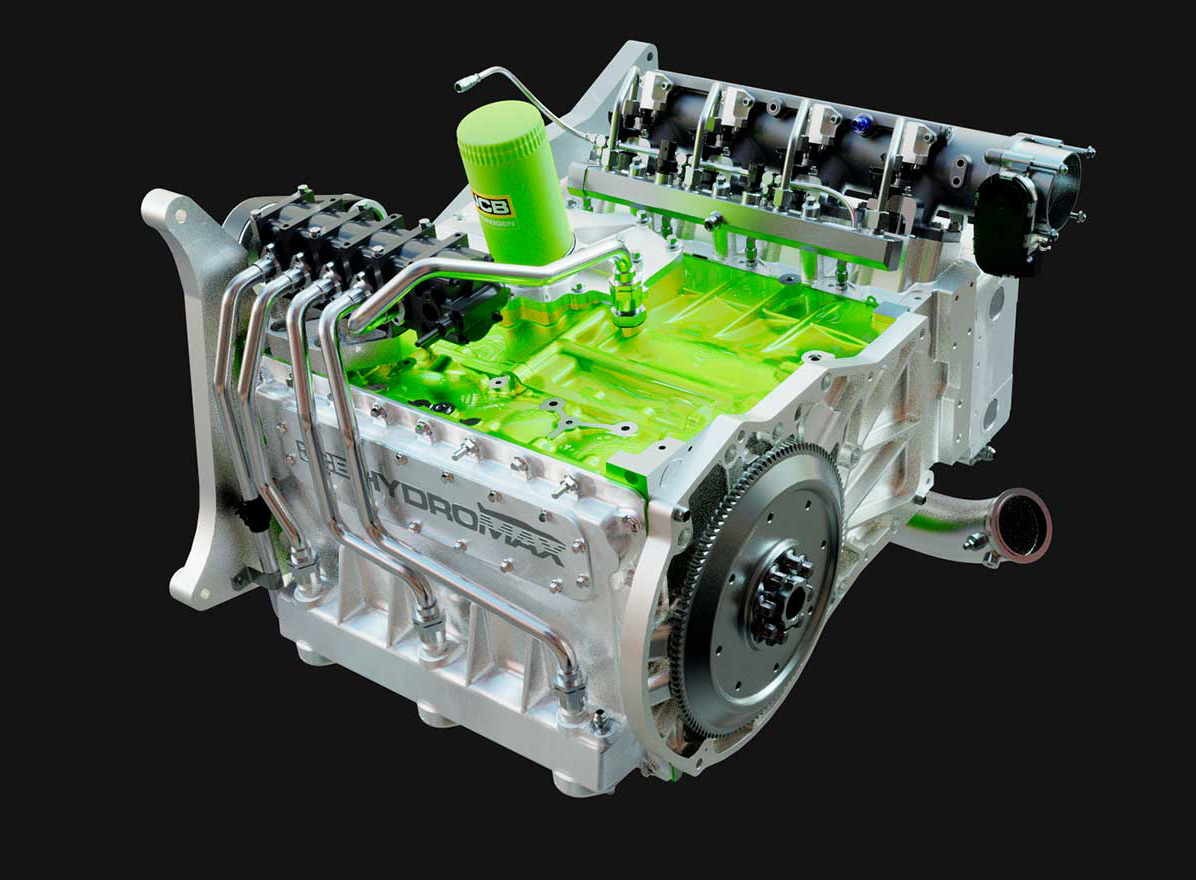

JCB says that the team involved in the Hydromax project consists largely of JCB’s own engineers, many of whom worked on the Dieselmax land speed vehicle. Prodrive helped build the car, Ricardo helped tune the twin engines, and gearing from Xtrac.

More on the engine from JCB:
One engine is mounted behind the driver and the other is mounted in front. These engines are based on JCB’s existing 4.8L inline four-cylinder spark ignition with port injection hydrogen engine. The JCB Hydromax also has a sophisticated induction system, with a single-stage motorsport turbocharger to help deal with the high altitude of the Bonneville Salt Flats.
During the development of the production engine, JCB turned to the motorsport industry for inspiration. The initial 448 prototype hydrogen engine was fitted with spark plugs designed for a Le Mans 24 hour engine. Even though the engine is built on production hardware, the JCB Hydromax engines were extensively rebuilt to suit the demands of breaking the speed record. The figures at the exhaust are striking. On the full record run, JCB Hydromax will consume just over 2kg of hydrogen – and produce 18L of water.
Behind the controls will be a living legend. Andy Green OBE served the Royal Air Force for 39 years, commanding such aircraft as the McDonnell Douglas F-4 Phantom and the Panavia Tornado F3 in regions including Afghanistan, Bosnia, Iraq, and West Germany. When he wasn’t tearing across the sky and being a Wing Commander, he was setting records on the ground.
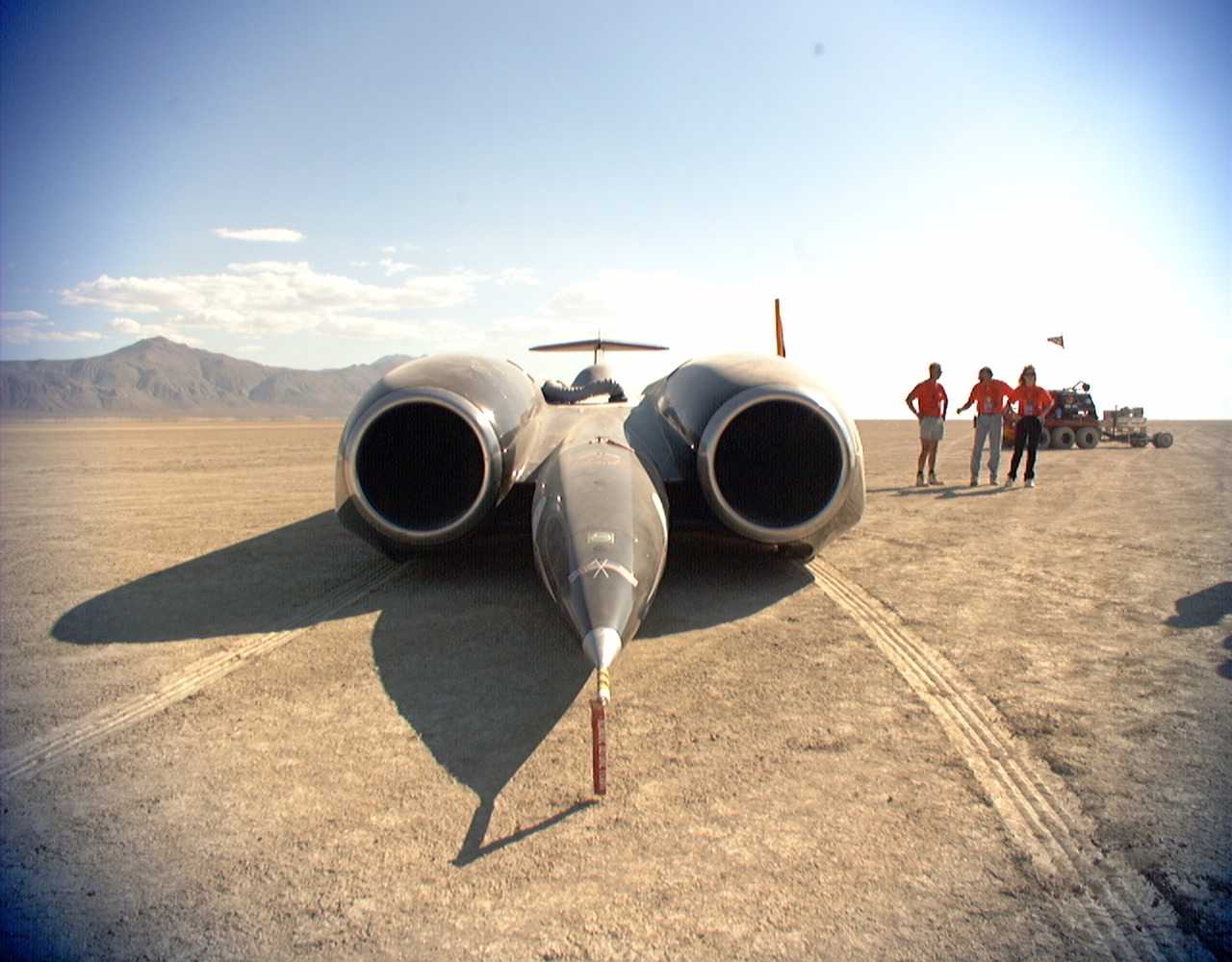
Andy’s most famous land speed achievement happened in 1997, when he took the ThrustSSC twin turbofan-powered car to 763.035 mph. He wasn’t just the first and still only man to break the sound barrier on land, but he remains the fastest guy on the ground.
Andy was JCB’s pick to take the Dieselmax to its historic record, which still hasn’t been beaten. Now, Andy might take home a record in a vehicle powered by something completely different.

I’ll be on the ground the moment that happens. I’ll also be here in Bonneville to check out what other fun land speed vehicles are racing down the salt. Word is that there are some 50cc bikes here!
Of course, this is my first time ever at Bonneville and definitely a bucket list item, so you’ll get to read all about that experience. As I ready myself for a couple of blazing hot days in the desert, what do you want to know about Bonneville, the JCB run, or anything else?
Top graphic image: JCB





That header image with the giant Mercedes head looming over the salt flats racer is giving Rat Fink energy. Someone get this woman an 8-ball shifter and some flamethrowing exhaust pipes.
Sorry, what? “He wasn’t just the first and still only man to break the sound barrier on land, but he remains the fastest guy on the ground.”
So, he does still hold the land record?
Could you cook a steak on it? Because all that salt outta make for a perfect crust.
This is a really bad idea, isn’t it.
The guy who redid my trail 90 went there a bunch of years ago to break a 50cc record in honor of his friend Fiddy. If I remember correctly he did. I donated some $$)’s for petrol as he was schlepping the bike in an old Dodge van with optional 1970’s shag carpeting still intact. Milwaukee to Salt Flats at maybe 8 mpg equals a lot of money.
“what do you want to know about Bonneville, the JCB run, or anything else?”
Well since you asked…
“Its long, thick stretches of salt-encrusted earth are perfect for driving at high speed. The area was formed during the last Ice Age, when a huge lake dried up, leaving behind mineral deposits. Every summer the flats’ salt crust hardens again after the winter rains, leaving a perfect speedway. Torrential rain and cooler temperatures have led to the cancellation of events there in recent years, and the US Geological Survey estimates that the crust has thinned by nearly half a metre.”
Where’s the salt going? It’s not evaporating. Is it blowing away? And why now?
The prevailing theory is nearby salt and potash mines, and general groundwater removal, have been lowering the surrounding ground salinity and overall water table, so there’s now a net outflow of water and salt from the flats washing away into the surrounding geology. So it’s not the rain that causes the thinning, it’s more directly human-caused. Though you still can’t race if it’s too wet or too thin, so both are problems.
Well even so it may not be long until the Bonneville flats are replaced by the Great Salt flats where the lake used to be. And when that happens the racing will be even closer to the world class decadent nightlife and flesh pots of Salt Lake City.
So problem solved.
[Kermit noodle arms] YAYYY MERCEDES IS GOING TO BONNEVILLE!!!
LSRs are interesting partially because the game is finding some corner-case category like “Piston engine hydrogen fuel forced-induction” that hasn’t been contended in a while, so you can bring newer technology to the problem. A few years ago a buddy of mine was building up a Buell Blast with a MegaSquirt for pushrod single-cylinder forced induction motorcycle, but someone else beat him to the punch.
edit: pushrod
Also partly why nobody has beaten Burt Munro’s famous record. We certainly could, easily. But it’s in a relatively niche category and everyone still loves Burt so much it would be sacrilege to even try. So everyone just runs in all the adjacent categories instead.
I assume they are storing the H2 cryogenically, so what methods are they using to prevent overheating of the storage in that hot environment which would result in loss of H2 as safety valves release excess pressure? How, specifically, are they testing the H2 line for leaks? H2 is invisible, and H2 burning is also invisible. Back when I was working around H2, one method was to walk with a lighted torch (usually a broom) on fire. If the torch flame increases, you found the leak. As long as the flame is coming -out- all is good as long as it is not burning something else, so the rest of the system is safe to be around. People with the proper know how can take their time to assess and turn things off in the proper sequence. However, if the flame gets sucked back -into- the feed line RUN!
Just a note that H2 is much lighter than air, so there is no risk of it pooling on the ground. If they are storing it inside a cooled tent, what are they using to alert if a leak occurs and pools at the top of the tent?
They’re taking the engines from an existing hydrogen-powered JCB*. If they can build a hydrogen powertrain that can stand up to the abuse of a typical building site, the salt flats are practically a benign environment by comparison.
*(I think the US translation is ‘backhoe’, but in the UK we call all of them ‘a jcb’ regardless of manufacturer)
I genuinely thought the UK term was “digger,” which is extremely charming.
Mercedes I’m curious about the stats, especially, the times. Does everybody bring their own traps? Is there a single timing equipment provider? Who verifies times, what are the rules? Who gets to say whats what?
https://scta-bni.org/bonneville-general-info
Arrive early, bring a helmet, and they might let you take your rental car out on the salt for a timing run.
Fun way to find out the limited top speed of the rental car. 🙂
Also, I worked with JCB diesel engines for the final three years before I retired. They were great when they ran, but they did not like sitting even for a weekend when it got below zero outside.
While most motorsport no longer interests me, I love Bonneville for the incredible variety, the streamlining, and the original and creative ideas on display.
I don’t envy anyone out near Wendover in this heat cap. But I know where some amazing Tacos are if you want to know.
I love some good tacos! 🙂 And yeah, it’s been oppressively hot already. Good news is that we have an air-conditioned tent, so it’s not so bad for the JCB people and guests.
sent you an oppochat
I’m not going to be there but who knows, I may be near Wendover someday. As might be other taco loving Autopans
So where are these amazing tacos?
Rolbertos. looks like any other joint of its type. Best ever.
Thanks!
A bit smokey at the moment too.
Why there?
I mean, because it’s flat, or because it’s salt, or because it is salt flats? Or because it is long and all those things?
flat. giant, naturally flat terrain with safe runoffs for miles. Think of salt flats like natures self leveling concrete. Between the natural flatness and dragging sleds to smooth the surface, you can hardly do better.
A very low supply of trees.
The most incredible part of actually being there is feeling the sound waves come across the salt flats as one of the streamliners run the 5 miles course. Its amazing.
Is that fuel consumption city or highway mileage?
Hilarious yesterday Torch goes on a tirade about forcing ads and today we have a constant running streak of ads so annoying you can’t concentrate on the story and it covers the Autopian logo that takes you back to the main page to select another column. I think this is probably more annoying than BMW
I’m a member and just today saw the pop-up video in the lower right corner of my screen. I hate it on The Old Site and really don’t want it here.
New video player/provider, weirdness expected, see today’s member email from Matt for details.
If it’s Autopian videos running down there, small in the lower right hand corner, I find that easy enough to either ignore or expand if I want to. Ads, yeah, don’t want that.
No idea if flavor of browser matters. Also, I only look at this site on a desktop, not a smartphone, so YMMV.
Looks to be all Autopian content, yes. On a laptop/desktop machine as well.
I remain frustrated that they only ever test in production.
1978fiatspiderfan, this is COTD. Wanted to rage more but just saw my email from Matt so as long as its a mistake we can all laugh about it…tomorrow I hope.
The crazy thing at least on my browser is that I can’t even watch the Autopian ad. It is tiny and has no way to increase the size to make it watchable. There is button to maximize the ad but when my curser goes over it the option disappear. So extra annoying.
Chrome on a Macbook.
I thought I’d accidentally signed out again, it’s too easy to do on mobile with all the controls on the top right corner of the screen, and hard enough to sign back in that there really should be an “Are you sure you want to sign out?” popup.
Me, a uBlock Origin Lite user: What ads?
The ones behind the paywall.
The same ads I don’t see since I set my private DNS to dns.adguard-dns.com
That sounds like a blast! Look forward to the full article.
At the hydroplane races Saturday, we were talking about airplane engines powering earth movers, and this headline is basically the inverse. What a neat twist of a coincidence!
I watched the unlimited hydropower races on the Detroit River in the 60’s. What glorious sound they made.
Rollie more ballie than I would be. Those ‘Greatest Generation’ types were nuts. Guess when you’ve already faced down Death and spat in his face…
When cars aren’t racing at the Salt Flats, enjoy the overwhelming silence that surrounds you. It’s a silence you can feel, and there aren’t many places left where you can experience this sensation.
Hydromax will consume just over 2kg of hydrogen – and produce 18L of water. Wow! Even I remember enough chemistry to understand this calculation. Maybe my 21 years in school had some value after all.
you get all the fun travel assignments lately! don’t forget your sunscreen and stay hydrated/covered.
this reminds me of the movie Rat Race, where Whoopi Goldberg’s and Lane Chapman’s characters stole a “rocket car”.
their line afterwards of “we came on the rocket car” always makes me laugh for how silly it all was.
Can’t wait for the follow up! Curiously the 50cc record and the top speed of a Smart ForTwo (Brabus) are both about the same (about 103mph). Which will you be piloting next year? Speed record Smart sounds like a good Autopian project!
Cool! For you Mercedes, I understand a modified Buell Blast holds the 500cc motorcycle land speed record…
I’d be interested in if there’s any special, specific to land speed racing gear the drivers wear/use.
Take sunscreen.
Don’t forget under your chin.
will consume just over 2kg of hydrogen – and produce 18L of water.
Are oxygen atoms really 16 times heavier than hydrogen atoms?
Looks it up-Hydrogen has an atomic weight of about 1.008 g/mol and Oxygen has an atomic weight of about 15.999 g/mol. With “just over”
so that’s close enough
Highschool was so long ago
And water, plus some electrolytes. It’s a dry heat… find shade.
Dry heat still allows you to get 2nd degree burns just by touching exposed metal
I know, spent a week backpacking in New Mexico in ’92. 102 may feel more bearable than 90 with 80% humidity in the Midwest, but is maybe more dangerous. The biggest thing is staying hydrated and fed.
Low humidity allows a cooling vest soaked in water to cool you.
Doesn’t work here.
You can cool a tent by pouring water around.
Or just go to Speedweek when they hold it in September, like I did.
It was comfortable.
Yes, Hugh! Sixteen! I don’t know why I enjoyed that so much.
Oxygen has on average 8 neutrons along with the 8 protons that define the atom as “oxygen”. Since electrons weigh much much less than either protons or neutrons the protons and neutrons make up the vast majority of the weight of the atom. So yes, an average oxygen atom is 16x heavier than an average hydrogen atom.
Now if the hydrogen atom was a deuterium or tritium isotope the average oxygen atom would *only* be 8x or 5.3333x respectively.
AKA heavy water.
Maybe. Only D2O is classified as “heavy” water. HDO would be semi heavy water, T2O super heavy water and (presumably) THO semi super heavy water. I have no idea what TDO would be called, maybe demi semi heavy water?
Any time I open a Mercedes post, I know I will be entertained. As a preview and not the actual run article, this was a delight.