


The 1990s Škoda Octavia is one of the great success stories when it comes to rebooting car brands. The Octavia wasn’t the first model from Škoda’s Volkswagen era, but it was the first one developed completely under Volkswagen’s corporate umbrella. 30 years later, the current Octavia is going strong. Globally, it’s Škoda’s top seller, and while it’s widely remembered to have spawned from the mid-1990s introduction, Škoda did use the Octavia name on a small sedan in the 1960s, at a time when it actually exported cars to the United States.
For the Octavia to succeed, it had to sever its ties with the old rear-engined Škodas. While they weren’t as terrible as they’re often claimed to be, they were slow and handled weirdly, and the new, solid, Volkswagen Golf-based car couldn’t have any other connection to that apart from the brand and logo. Yet, a couple of years after the Octavia’s launch, Skoda went ahead and put the actual engine from one of those old rear-engine Skodas directly into the new car.


The Czech automaker was Volkswagen’s second acquisition in relatively quick succession, and the brand was secured to create cheaper or more affordable versions of Volkswagen cars using long-standing brands from other countries. First, the Volkswagen Group acquired SEAT from the Spanish government in 1986, and gave the company keys to the Golf Mk2 kingdom. With Volkswagen’s help, SEAT launched the first-generation Toledo in 1991.
Let’s Build Bigger Cars Based On The Volkswagen Golf

Much like Hyundais of the time, the SEAT Toledo was also a Giugiaro design based on older tech, and its rear section hid a large tailgate despite a distinctly four-door-sedan-looking profile: the same trick as the Plymouth Sundance/Dodge Shadow used.
The initial Toledo designs had been based on the Passat B3 platform from 1988, but possibly fearing that SEAT would steal sales from the Passat, Volkswagen decreed that the Toledo would be based on the smaller Golf/Jetta instead. The Mk3 Golf (1991) and the associated Vento/Jetta (1992/1993) were deemed strong enough not to suffer from the Toledo’s introduction too much, and they would also include a station wagon version unlike the Toledo.

As the first Toledos rolled out of the Martorelli factory in Spain, Volkswagen had already been setting up another deal for even cheaper cars. The old Škoda brand, founded all the way back in 1896 (130 years ago!) was approaching the West with the engines finally front-mounted.
Skoda had introduced the new Favorit in 1987, after years of development, and while it still had to use the same old pushrod engine that dated back to 1964, the company had been able to fit it in the front of their new front-drive, Bertone-designed hatchback.
All Of The Frunk Space
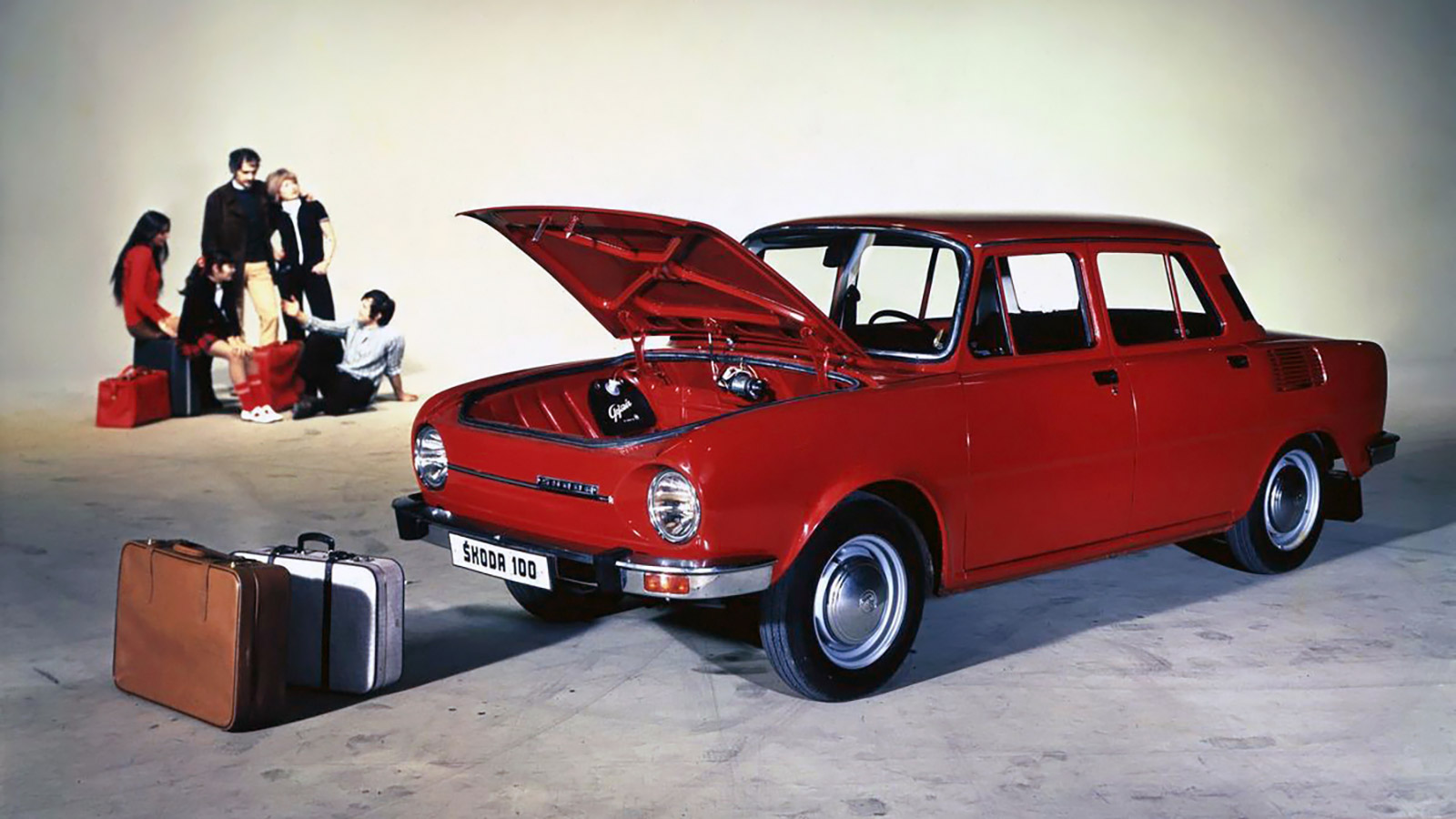
For ages, Škoda had been building the old rear-engined sedans, which were initially designed to be front-engined and front-wheel drive, but the powers that controlled the Eastern Bloc had prohibited it. They had Moskviches to sell, and a front-engined FWD Škoda would have seemed far more modern than those.
By the time the Favorit was being developed, the Soviets no longer cared to the same extent, despite the Lada Samara being engineered at the same time to be launched in the mid-1980s.

Having acquired Škoda in March 1991, VW gave the Czech company the funds to polish the Favorit for its new facelift. During the early 1990s, Favorit assembly quality got better, and Bosch fuel injection improved both fuel economy and reliability. The real update, however, was a big 1994 facelift from Favorit to Felicia: the car was still based on the same bones, but the ‘80s styling was softened inside and out, and customers later got a Volkswagen steering wheel to hold.
Importantly, the engine palette now included Volkswagen engines, both gasoline and diesel, to supplement the old Škoda gasoline engine. The Felicia station wagon, developed from the Favorit’s Forman wagon, was in diesel form a frugal workhorse, and the pickup version was good enough to be rebranded as a Volkswagen Caddy, to replace the old Golf/Rabbit based pickup. The yellow Felicia Fun pickup is unforgettable once you’ve learned about it.
Bring On The Octavia
All of this development rolled towards one goal: to give Škoda its own Toledo equivalent. The Mk3 Volkswagen Golf had been built since 1991, and the Mk4 generation was looming on the horizon for a 1997 launch. Both SEAT and Škoda would get their share: SEAT would get to build a beautifully designed, swoopy new four-door Toledo based on the Golf, as well as a shorter hatchback called the Leon.
The first car from the PQ34 platform would be the new Audi A3, announced in 1995 and sold from September 1996, but the big news was the new Škoda Octavia, sold from November 1996 on, manufactured at a new plant opened by President Václav Havel in September ’96. It fast-forwarded Škoda to the front row of European family car makers, as if it had started out from there. Naturally, for some time, buyers were skeptical of such a turnaround, but the product was the proof.

Designed by Luc Donckerwolke, who would go on to work on 2000s Lamborghinis and Bentleys, the Octavia was a handsome-looking, modern car that offered a similarly large trunk as the Toledo had, but also included a station wagon version.

Sure, the wheelbase was still Golf-sized, meaning rear legroom was tight, but Volkswagen was also about to launch the new B5-generation Passat, which needed to stand shoulders above the Octavia, estate or not.
The Octavia was introduced with the base 1.6-liter, the 20-valve 1.8-liter and the 1.9-liter TDI, with the palette expanded further with engines as hot as the 180-horsepower 1.8T. The Laurin & Klement trim, named after Škoda’s founders, gave the Octavia full cognac leather, and you could also buy an AWD version of the Octavia station wagon. The engine choices were also expanded … downwards.
How Does 60 Horsepower Sound?

Remember the old pushrod engine from 1964? The one that started its life mounted in the back of the old 100-series Škodas? The one modernized for the Favorit and further updated for the Felicia? For so long, it had formed the backbone of the company. It was a Czech engine, light and stout (the crankcase was aluminum). Škoda gave it one more chance at the top and actually fit it in the new Octavia: not at launch, because the launch specification engines were carefully selected, but as a new bare-bones variant for 1999, the Octavia 1.4 LX.
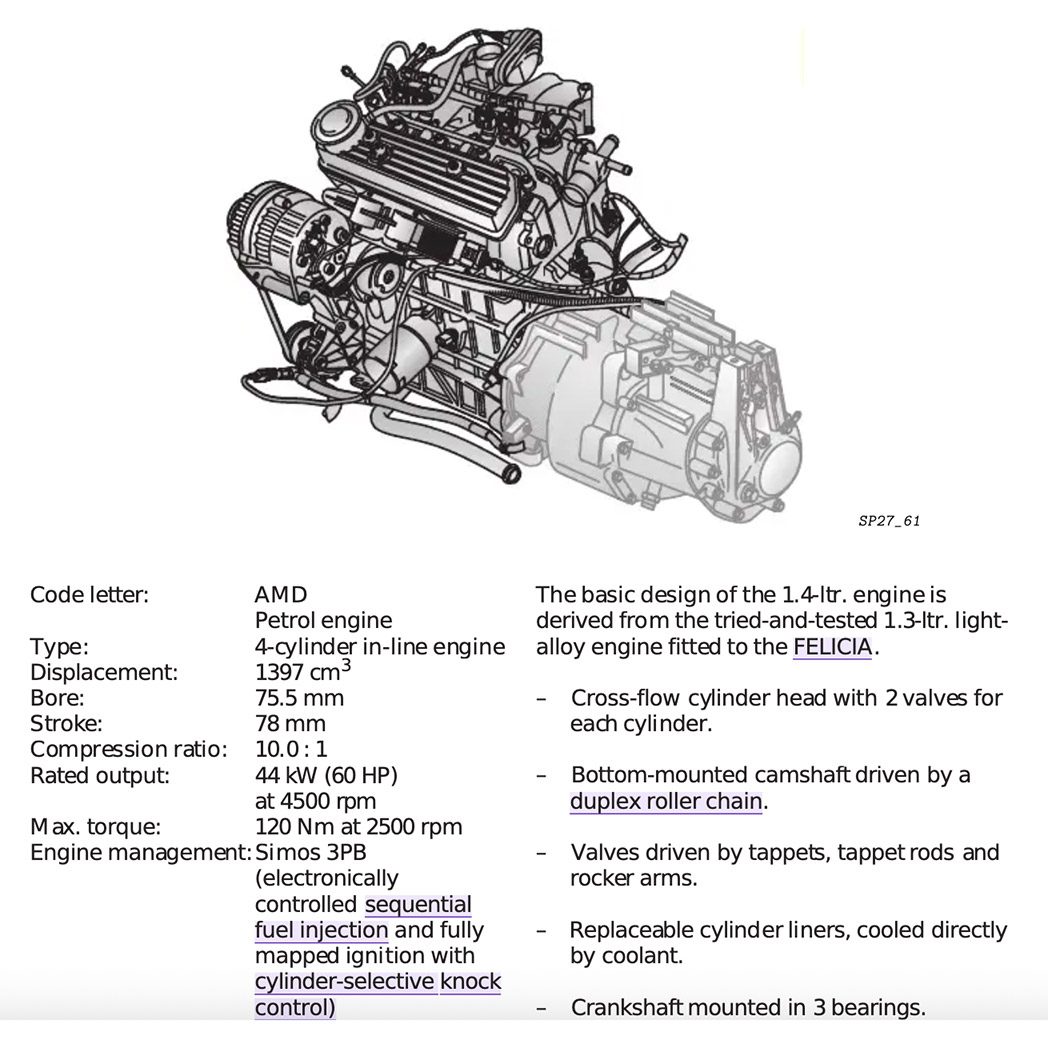
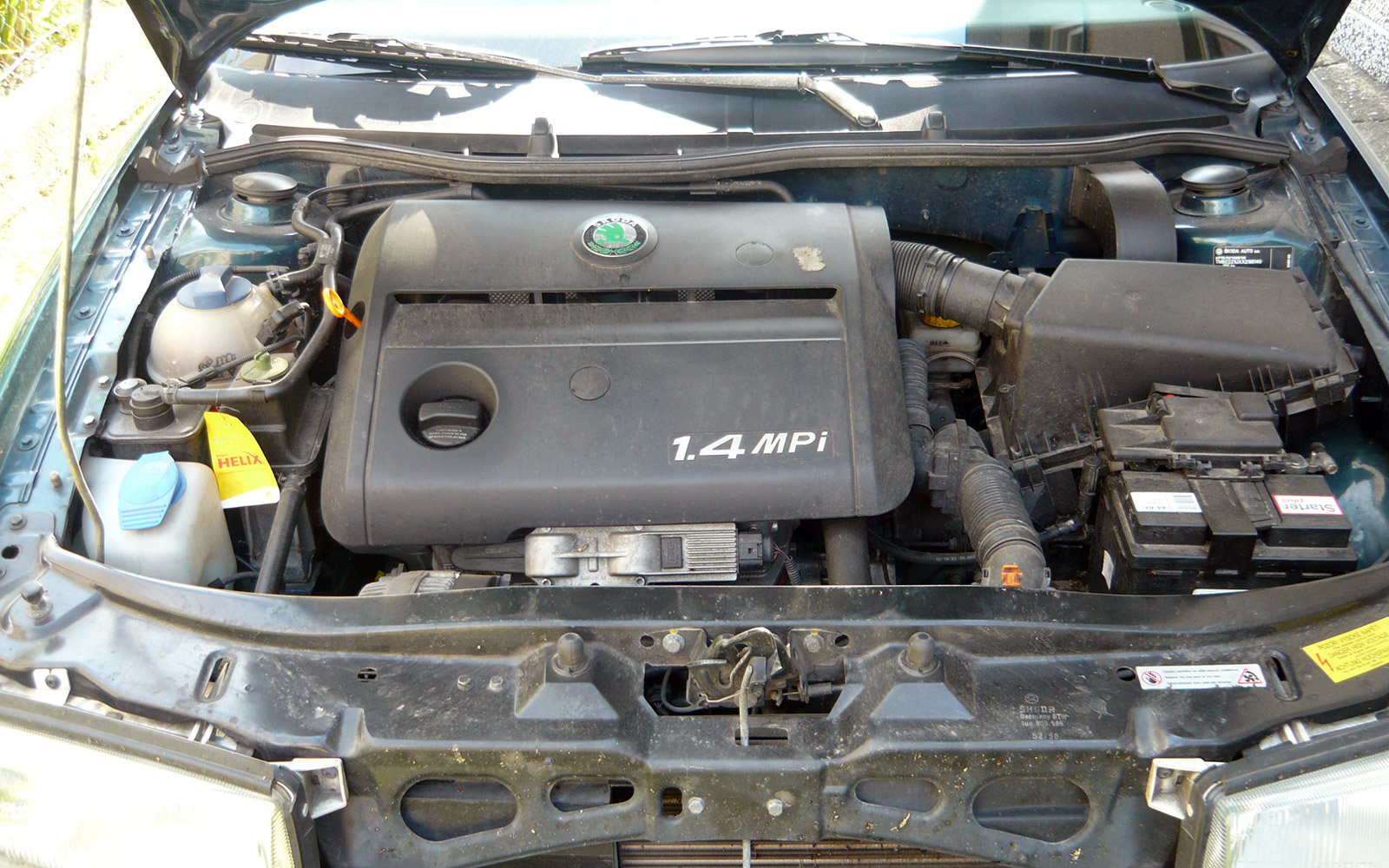
Škoda had to put in the work to make the engine fit the Octavia, too. It wasn’t bolt-on, and the engineers chose a variant that had been updated further to power the SEAT Arosa and Volkswagen Lupo, a pair of city cars that were essentially cut-up Polos. The engine, called AMD in Volkswagen’s internal engine code speak, now had lighter pistons, Simos fuel injection, hydraulic lifters to reduce valve gear noise, and increased displacement thanks to a longer stroke. The new plastic cover obscured much of the engine, but it seems to have had a similar valve cover to the one it wore in the 1960s.
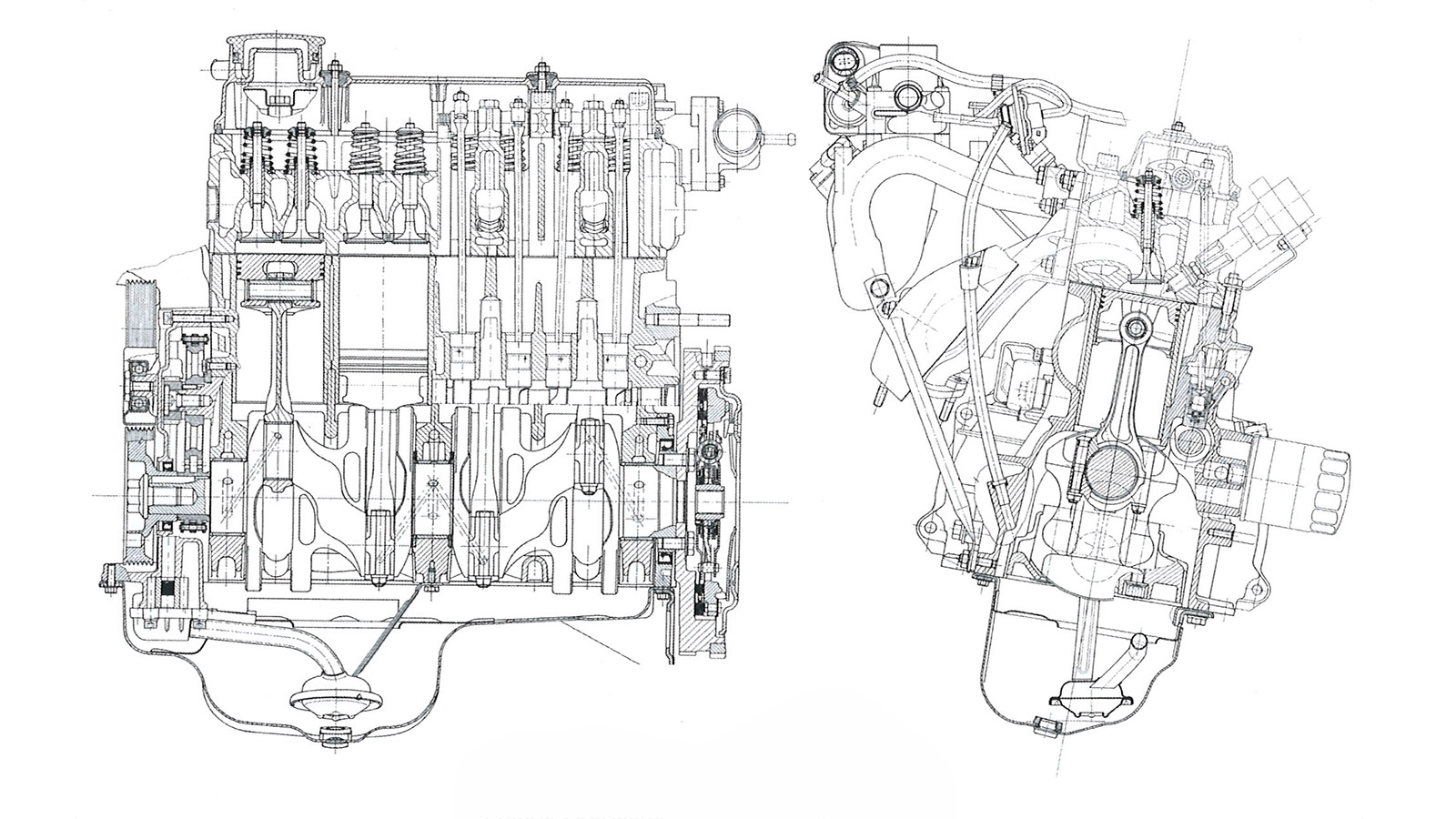
As well as fine-tuning the engine to improve lower-end torque and power delivery, Škoda engineers also tailored the Felicia’s gearbox to suit the heavier Octavia. The transmission was given shorter ratios to help acceleration, rod-operated linkages were replaced with cables, and the entire unit was shortened to properly fit in the engine bay.
All of this work – for a car that would have 60 horsepower. 60!
With the now-1.4-liter engine, the Octavia LX weighed 1160 kg or over 2550 lbs, meaning 0-60 mph took nearly 19 seconds. It couldn’t break 100 mph, as the car’s top speed was mentioned to be 155 km/h (96 mph).
The old, yet modernized engine meant a cheaper price tag, but customers simply weren’t interested and the car soon became a curiosity. Škoda only offered the 60-horsepower Octavia 1.4 LX for two years and phased it out at the 2000 facelift. The pushrod unit was replaced with Volkswagen’s usual 75-horsepower 1.4-liter, also seen in the Golf, and that was that. It’s likely that Škoda had only sold the OHV-engined Octavia in its home market, and it’s incredibly difficult to find surviving examples today. They can be identified by their lack of protective door trim.

At its heart, if you could negotiate the incredible slowness, the engine was at least frugal and reliable. A Czech Škoda driver defended the engine in a comment section:
I was the proud owner of this rarity, I have countless photos, but seriously, I had it for about 10 years, I drove about 250,000 km, to my complete satisfaction. The consumption of about 5.5 l was great. Yes, it is true that it took a little longer to get up to highway speed.
Plus, you didn’t have to worry about timing belt changes. Another owner, who got a nice, low-mileage example from his uncle, comments that the engine pulls fine in the lower RPMs.
The engine work wasn’t useless, either. Škoda ended up using the improved OHV in the Felicia’s replacement – the new Volkswagen Polo-based Fabia hatchback – both in one-liter and 1.4-liter sizes, up until 2003. The engine retired at 40 years of age, as Škoda replaced it with a far more modern three-cylinder unit.
Attempting to use such an old engine in a relatively large car, the Octavia, was a rare misstep that Škoda hasn’t often taken in its Volkswagen era. Or as Martin Chlupáč explains in his book “Historie Motorů,”
Unfortunately, (the OHV engine) played no part in making the Octavia the brand’s commercially most successful car over the years. In the 1.4 l/60 hp version, the engine was simply too weak for a relatively large and heavy car. In the beginning, it was a generally good idea to offer a large car for the price of a small one, but in 1999, when Škoda introduced the version with the 1.4 MPI engine, almost no one was interested anymore; customers wanted more powerful cars, and especially better-equipped ones. The poor equipment level of the cheapest model was likely the main reason for the lack of interest.
We’re talking bare-bones. Crank windows front and rear, no central locking (let alone remote), no locking glovebox, no split-fold rear seat (it still folded, but not in 60/40 configuration), no locking fuel filler cap, and importantly, no folding cup holders.
To write this article, I contacted Škoda directly. They were more than happy to help, but there simply wasn’t that much material available in the Škoda archives regarding the 44kW/60-horsepower Octavia with the OHV engine, other than technical details and a brief mention in the company’s engine history. In the marketing material of the time, the base model is just featured in the price lists, and the photo of the red car above sans door trims is one of the few manufacturer photos of the car. That’s why the forum post from 2010 that yielded the engine bay shot is so important; it has good shots of an incredibly rare car, together with some driving impressions. Keep forums alive!
Top graphic images: Skoda


“It still folded, but not in 60/40 configuration.” Here’s looking at you 2021 Honda Accord LX. And my guess is any trim level of Skoda offers better seats than the miserable ones in the Honda.
I’m a little surprised by the equipment levels. My 1984 Jetta GL felt decently equipped, despite crank windows and manual locks because it did have ai conditioning and a cassette player. It also had about 70hp from a 1.7 liter engine. The 95 Escort was actually more luxurious with power windows locks and mirrors, it was less powerful with a 1.9 CVH and an automatic
The Volkswagen type one from 1936 was still powering new (old) Beetles in Mexico until 2003. I don’t know if it had 60 horsepower by then but probably not. The SBC from 1955 and Rolls-Royce/Bentley L-Series V8 from 1959) were also in active production they both had a wee bit more power, seemed adequate by RR. Wasn’t the Ford Kent engine still in automotive use then in 2000 as well?
I looked it up and the final form of the Kent was the Endura E used in the Ford Ka until 2002. The 1.3 had 59hp and the 998 had only 53hp. Fortunately it only had to move a small car.
I visited the Czech Republic a couple times per year in the early and mid 00’s and rented one of those 75 HP Octavias a few times. They were SLOW even with the manual.
I was so happy when our company started allowing us to rent cars with a GPS and I jumped up to diesel E-Class wagons.
Would drive it. Can’t stop seeing a Jetta when looking at the doors. Same as I see Saab 9000s when I look at Alfa 164 doors (https://en.wikipedia.org/wiki/Fiat_Tipo_Quattro_platform)
So; was the tiny engine simply a nod to the classic bargain-seekers, or was it a tax thing?
I am thinking both, and also a way to make more profit from long-amortized production tools and designs. Perhaps they had additional production capacity to use up as well?
I love underpowered cars, and stripped down specials, and anachronisms – this one checks all those boxes. Mission creep makes for the most interesting and bizarre solutions.
All of this chat about the Octavia’s base engine, and no mention of the four years it occupied the basement of the WRC rankings???
Also worth mentioning that this car’s ONLY WRC podium was the ’01 Safari Rally. The retirement list from that brutal event includes Burns, McRae, Sainz, Gronholm, and Solberg.
Armin Schwarz and Tony Gardemeister are sad that we have forgotten.
Gardemeister’s dad used to sell Saabs in the town where I grew up. Not forgotten!
I saw a newer Golf that some genius swapped an air-cooled VW engine into. Into the rear even. This is only slightly better.