


The 1990s Škoda Octavia is one of the great success stories when it comes to rebooting car brands. The Octavia wasn’t the first model from Škoda’s Volkswagen era, but it was the first one developed completely under Volkswagen’s corporate umbrella. 30 years later, the current Octavia is going strong. Globally, it’s Škoda’s top seller, and while it’s widely remembered to have spawned from the mid-1990s introduction, Škoda did use the Octavia name on a small sedan in the 1960s, at a time when it actually exported cars to the United States.
For the Octavia to succeed, it had to sever its ties with the old rear-engined Škodas. While they weren’t as terrible as they’re often claimed to be, they were slow and handled weirdly, and the new, solid, Volkswagen Golf-based car couldn’t have any other connection to that apart from the brand and logo. Yet, a couple of years after the Octavia’s launch, Skoda went ahead and put the actual engine from one of those old rear-engine Skodas directly into the new car.


The Czech automaker was Volkswagen’s second acquisition in relatively quick succession, and the brand was secured to create cheaper or more affordable versions of Volkswagen cars using long-standing brands from other countries. First, the Volkswagen Group acquired SEAT from the Spanish government in 1986, and gave the company keys to the Golf Mk2 kingdom. With Volkswagen’s help, SEAT launched the first-generation Toledo in 1991.
Let’s Build Bigger Cars Based On The Volkswagen Golf

Much like Hyundais of the time, the SEAT Toledo was also a Giugiaro design based on older tech, and its rear section hid a large tailgate despite a distinctly four-door-sedan-looking profile: the same trick as the Plymouth Sundance/Dodge Shadow used.
The initial Toledo designs had been based on the Passat B3 platform from 1988, but possibly fearing that SEAT would steal sales from the Passat, Volkswagen decreed that the Toledo would be based on the smaller Golf/Jetta instead. The Mk3 Golf (1991) and the associated Vento/Jetta (1992/1993) were deemed strong enough not to suffer from the Toledo’s introduction too much, and they would also include a station wagon version unlike the Toledo.

As the first Toledos rolled out of the Martorelli factory in Spain, Volkswagen had already been setting up another deal for even cheaper cars. The old Škoda brand, founded all the way back in 1896 (130 years ago!) was approaching the West with the engines finally front-mounted.
Skoda had introduced the new Favorit in 1987, after years of development, and while it still had to use the same old pushrod engine that dated back to 1964, the company had been able to fit it in the front of their new front-drive, Bertone-designed hatchback.
All Of The Frunk Space
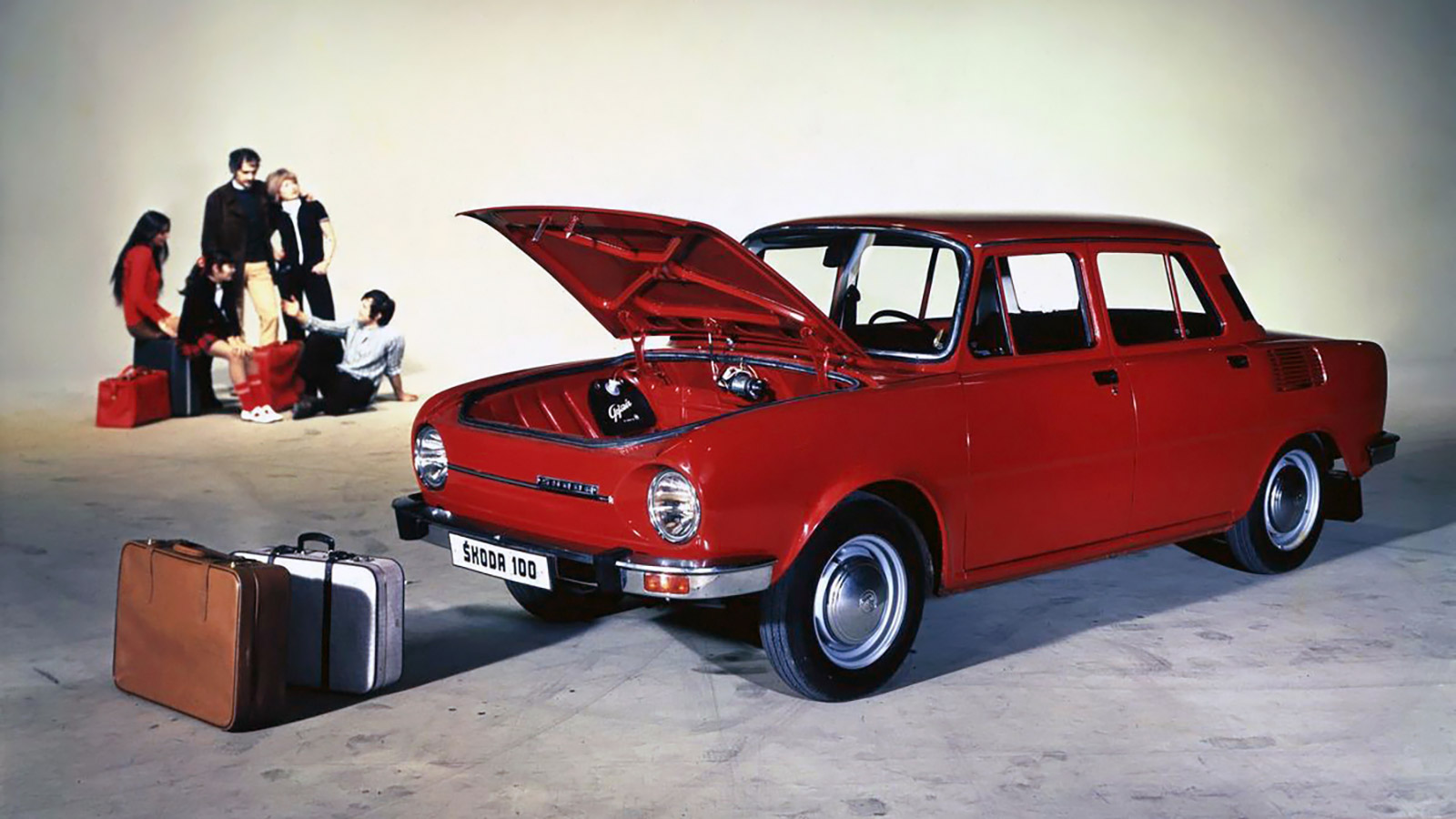
For ages, Škoda had been building the old rear-engined sedans, which were initially designed to be front-engined and front-wheel drive, but the powers that controlled the Eastern Bloc had prohibited it. They had Moskviches to sell, and a front-engined FWD Škoda would have seemed far more modern than those.
By the time the Favorit was being developed, the Soviets no longer cared to the same extent, despite the Lada Samara being engineered at the same time to be launched in the mid-1980s.

Having acquired Škoda in March 1991, VW gave the Czech company the funds to polish the Favorit for its new facelift. During the early 1990s, Favorit assembly quality got better, and Bosch fuel injection improved both fuel economy and reliability. The real update, however, was a big 1994 facelift from Favorit to Felicia: the car was still based on the same bones, but the ‘80s styling was softened inside and out, and customers later got a Volkswagen steering wheel to hold.
Importantly, the engine palette now included Volkswagen engines, both gasoline and diesel, to supplement the old Škoda gasoline engine. The Felicia station wagon, developed from the Favorit’s Forman wagon, was in diesel form a frugal workhorse, and the pickup version was good enough to be rebranded as a Volkswagen Caddy, to replace the old Golf/Rabbit based pickup. The yellow Felicia Fun pickup is unforgettable once you’ve learned about it.
Bring On The Octavia
All of this development rolled towards one goal: to give Škoda its own Toledo equivalent. The Mk3 Volkswagen Golf had been built since 1991, and the Mk4 generation was looming on the horizon for a 1997 launch. Both SEAT and Škoda would get their share: SEAT would get to build a beautifully designed, swoopy new four-door Toledo based on the Golf, as well as a shorter hatchback called the Leon.
The first car from the PQ34 platform would be the new Audi A3, announced in 1995 and sold from September 1996, but the big news was the new Škoda Octavia, sold from November 1996 on, manufactured at a new plant opened by President Václav Havel in September ’96. It fast-forwarded Škoda to the front row of European family car makers, as if it had started out from there. Naturally, for some time, buyers were skeptical of such a turnaround, but the product was the proof.

Designed by Luc Donckerwolke, who would go on to work on 2000s Lamborghinis and Bentleys, the Octavia was a handsome-looking, modern car that offered a similarly large trunk as the Toledo had, but also included a station wagon version.

Sure, the wheelbase was still Golf-sized, meaning rear legroom was tight, but Volkswagen was also about to launch the new B5-generation Passat, which needed to stand shoulders above the Octavia, estate or not.
The Octavia was introduced with the base 1.6-liter, the 20-valve 1.8-liter and the 1.9-liter TDI, with the palette expanded further with engines as hot as the 180-horsepower 1.8T. The Laurin & Klement trim, named after Škoda’s founders, gave the Octavia full cognac leather, and you could also buy an AWD version of the Octavia station wagon. The engine choices were also expanded … downwards.
How Does 60 Horsepower Sound?

Remember the old pushrod engine from 1964? The one that started its life mounted in the back of the old 100-series Škodas? The one modernized for the Favorit and further updated for the Felicia? For so long, it had formed the backbone of the company. It was a Czech engine, light and stout (the crankcase was aluminum). Škoda gave it one more chance at the top and actually fit it in the new Octavia: not at launch, because the launch specification engines were carefully selected, but as a new bare-bones variant for 1999, the Octavia 1.4 LX.
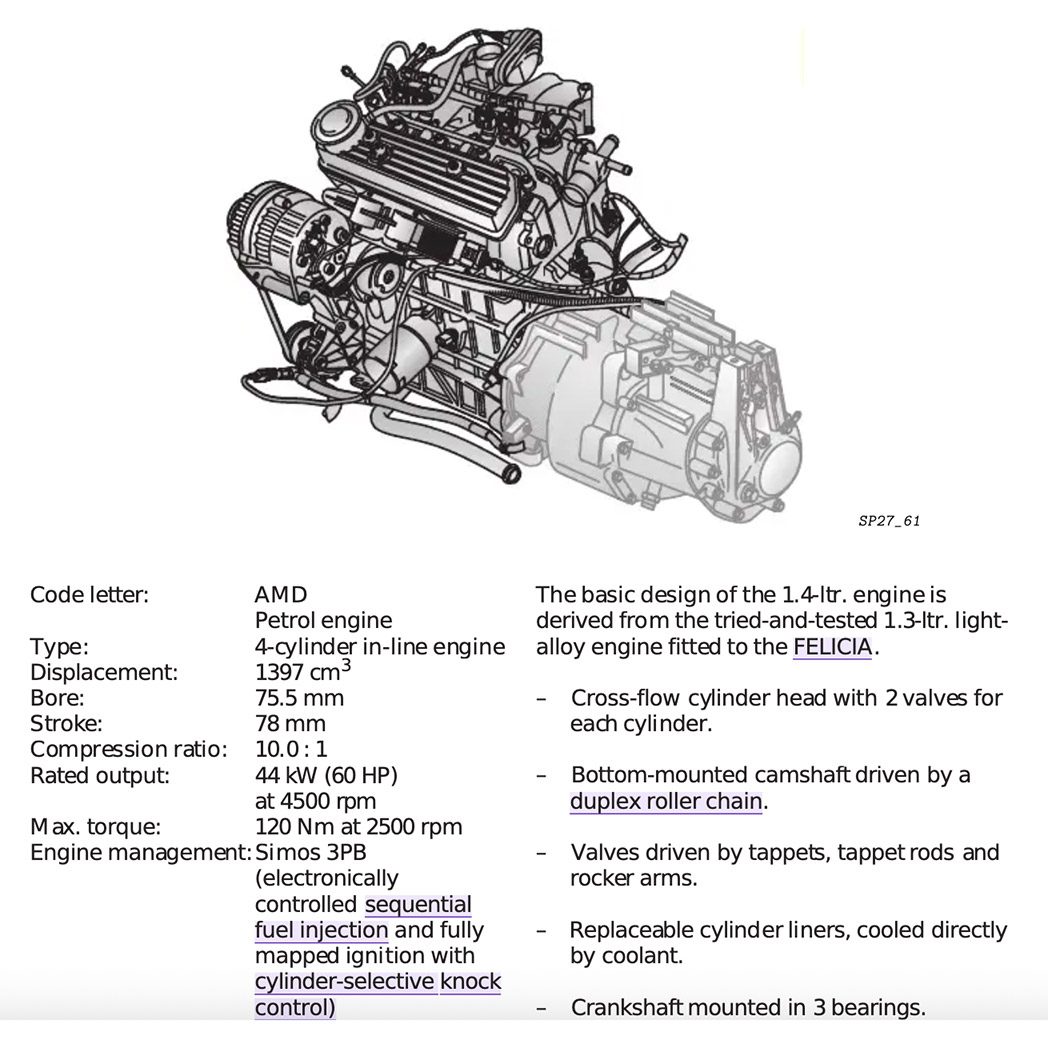
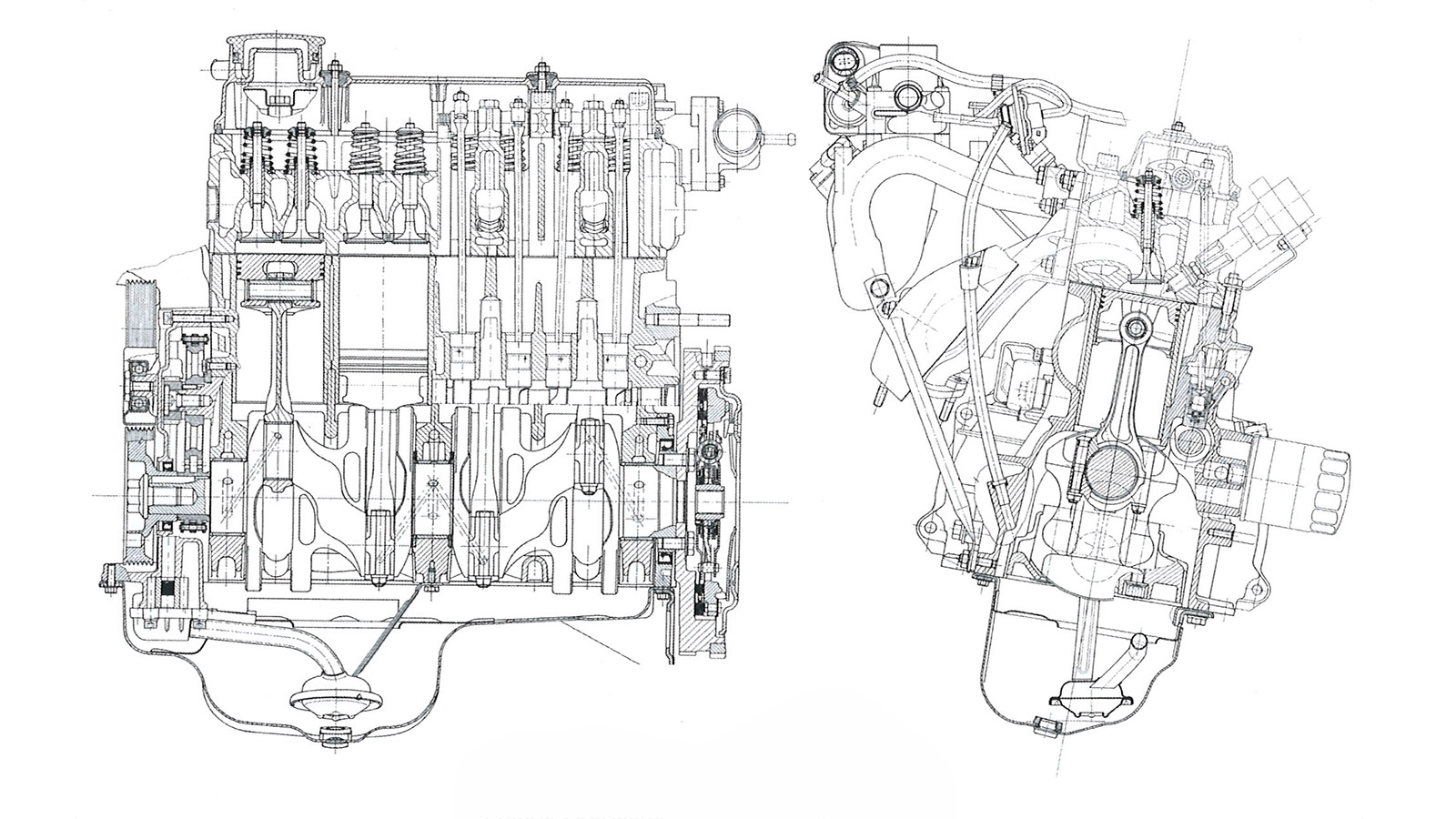
Škoda had to put in the work to make the engine fit the Octavia, too. It wasn’t bolt-on, and the engineers chose a variant that had been updated further to power the SEAT Arosa and Volkswagen Lupo, a pair of city cars that were essentially cut-up Polos. The engine, called AMD in Volkswagen’s internal engine code speak, now had lighter pistons, Simos fuel injection, hydraulic lifters to reduce valve gear noise, and increased displacement thanks to a longer stroke. The new plastic cover obscured much of the engine, but it seems to have had a similar valve cover to the one it wore in the 1960s.
As well as fine-tuning the engine to improve lower-end torque and power delivery, Škoda engineers also tailored the Felicia’s gearbox to suit the heavier Octavia. The transmission was given shorter ratios to help acceleration, rod-operated linkages were replaced with cables, and the entire unit was shortened to properly fit in the engine bay.
All of this work – for a car that would have 60 horsepower. 60!
With the now-1.4-liter engine, the Octavia LX weighed 1160 kg or over 2550 lbs, meaning 0-60 mph took nearly 19 seconds. It couldn’t break 100 mph, as the car’s top speed was mentioned to be 155 km/h (96 mph).
The old, yet modernized engine meant a cheaper price tag, but customers simply weren’t interested and the car soon became a curiosity. Škoda only offered the 60-horsepower Octavia 1.4 LX for two years and phased it out at the 2000 facelift. The pushrod unit was replaced with Volkswagen’s usual 75-horsepower 1.4-liter, also seen in the Golf, and that was that. It’s likely that Škoda had only sold the OHV-engined Octavia in its home market, and it’s incredibly difficult to find surviving examples today. They can be identified by their lack of protective door trim.

At its heart, if you could negotiate the incredible slowness, the engine was at least frugal and reliable. A Czech Škoda driver defended the engine in a comment section:
I was the proud owner of this rarity, I have countless photos, but seriously, I had it for about 10 years, I drove about 250,000 km, to my complete satisfaction. The consumption of about 5.5 l was great. Yes, it is true that it took a little longer to get up to highway speed.
Plus, you didn’t have to worry about timing belt changes. Another owner, who got a nice, low-mileage example from his uncle, comments that the engine pulls fine in the lower RPMs.
The engine work wasn’t useless, either. Škoda ended up using the improved OHV in the Felicia’s replacement – the new Volkswagen Polo-based Fabia hatchback – both in one-liter and 1.4-liter sizes, up until 2003. The engine retired at 40 years of age, as Škoda replaced it with a far more modern three-cylinder unit.
Attempting to use such an old engine in a relatively large car, the Octavia, was a rare misstep that Škoda hasn’t often taken in its Volkswagen era. Or as Martin Chlupáč explains in his book “Historie Motorů,”
Unfortunately, (the OHV engine) played no part in making the Octavia the brand’s commercially most successful car over the years. In the 1.4 l/60 hp version, the engine was simply too weak for a relatively large and heavy car. In the beginning, it was a generally good idea to offer a large car for the price of a small one, but in 1999, when Škoda introduced the version with the 1.4 MPI engine, almost no one was interested anymore; customers wanted more powerful cars, and especially better-equipped ones. The poor equipment level of the cheapest model was likely the main reason for the lack of interest.
We’re talking bare-bones. Crank windows front and rear, no central locking (let alone remote), no locking glovebox, no split-fold rear seat (it still folded, but not in 60/40 configuration), no locking fuel filler cap, and importantly, no folding cup holders.
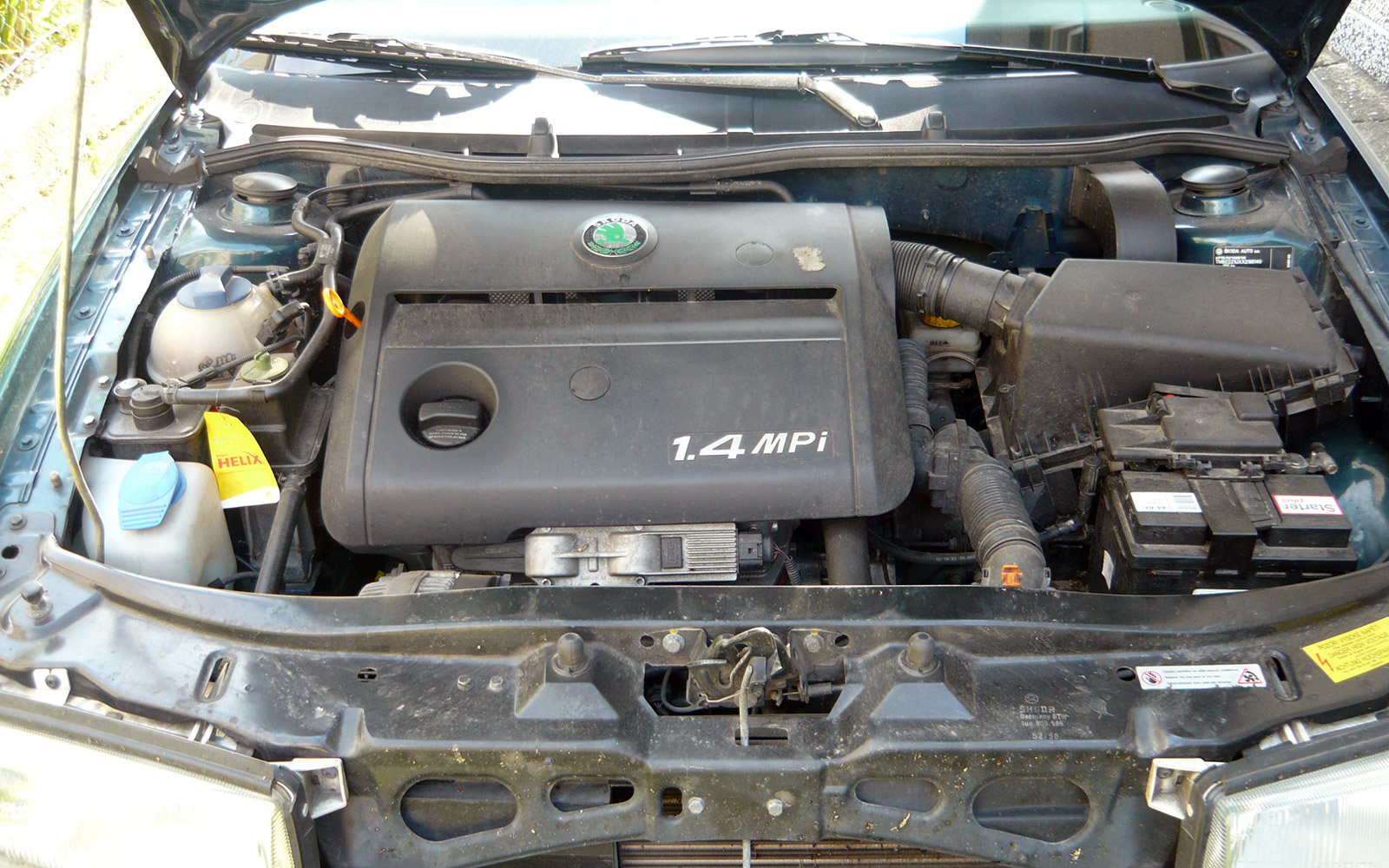
To write this article, I contacted Škoda directly. They were more than happy to help, but there simply wasn’t that much material available in the Škoda archives regarding the 44kW/60-horsepower Octavia with the OHV engine, other than technical details and a brief mention in the company’s engine history. In the marketing material of the time, the base model is just featured in the price lists, and the photo of the red car above sans door trims is one of the few manufacturer photos of the car. That’s why the forum post from 2010 that yielded the engine bay shot is so important; it has good shots of an incredibly rare car, together with some driving impressions. Keep forums alive!
Top graphic images: Skoda


“The initial Toledo designs had been based on the Passat B3 platform from 1988, but possibly fearing that SEAT would steal sales from the Passat…”
That didn’t stop Škoda from borrowing Passat platform, namely the stretched Shanghai-Volkswagen B5 LWB, for its Superb. Yet, Volkswagen and Audi held their Passat Variant and A4 Avant very close to their chests and denied Škoda the estate version of Superb.
On a hp per liter basis, this engine outperformed all but the most powerful versions of the Iron Duke. True story.
So cute that they gave the old geezer a new hat.
Skoda is owned by Volkswagen, who used effectively the same engine from 1939-2003, so…
Wow, I haven’t seen a three main bearing I4 in quite a while, much less in a car sold in the 21st century.
Most cars sold in the USA from 1975-1985 couldn’t hit 100 mph. Having 85 mph speedo’s kept most folks from exploring the limit, which probably took a minute or more.
BMW sold the M10, M20 and M30 engines well into the 90’s. Those engines are designs from the 60’s, gradually upgraded with fuel injection and other electronic bits, but at their core they remained 60’s designs.
We have a 1990 E34 520i with the M20B20 engine. It’s slow as molasses, lazy to rev up and an absolute tank of an engine.
Neat oddity. Reminds me of when VW downgraded with the Mk6 Jetta and gave it the ancient 2.0L NA engine.
Low power just means you have to focus on driving. I drive an LLV every day. It had 90bhp about 40 years ago. When new, it did 0-60 in 17 seconds, while empty. Now, I suspect, for the typical LLV, it’s well over 30 seconds, if it can even reach 60. I’m sure this Skoda would feel like a rocket by comparison.
I hope you get the NGDV soon!
I spent a lot of time in the UK in the 2000s and someone told me a Skoda joke.
“Why do Skodas have rear window defrosters”
“To keep your hands warm.”
I needed him to explain to me that your hands would be on the rear glass pushing the disabled vehicle. I assume they got better.
The only other one I remember is:
Those jokes were pretty common in the 80’s, but by 2000 Skoda had been owned by VW for long enough for most of the negative perceptions to have been forgotten. By, say, 2005, it was totally socially acceptable to own a Skoda.
My family has mostly owned VWs, but several Skodas have joined the family over the last decade or so; (My parents currently have a Yeti and a Roomster)
A top speed of 96 mph is fine in a family car, since it means it can still cruise fine at legal highway speeds, which are basically all less than that.
I’d also guess that 19 seconds 0-60 is maybe more liveable than it sounds, as long as you pay attention at red lights instead of playing with your phone, I mean, I regularly drive a car in traffic that’s only a couple of seconds quicker than that, and its completely fine, since most drivers seem to need 30 seconds to notice the light is green and then another 10 to remember which pedal is the velocitator anyway
One should remember that Mercedes-Benz offered the 240D with it’s 64-71hp engine in a 3000lb+ car – which accelerated to about 90 on a good day, and reached 60 in around 24 seconds.
However in other markets Mercedes offered a 200D – with just 54hp, and a 220D with 59hp. Acceleration to 60 was closer to half a minute or more.
So that little 1.4 Octavia was Rapid in comparison.
Superb, even.
Epiq comment, Dude.
I see what you did there
Top speed of 96 likely means the car is screaming for dear life at 80, which is the cruising speed of most American and European highways.
That sounds awful.
When I was stationed in Monterey, I went to a friend’s parents house in the Sierras for Xmas. The Volvo 164E we drove up in decided not to proceed the morning we were to return to base so his Dad packed us and his Mom up in the new final-year W123 300D Turbodiesel sedan to drive us back to Monterey. We were clipping along swiftly – 75 or so – but he had to keep the motor on the boil the entire time – and that car had 125hp.
I think it depends what you’re used to. For a big American V8 5000 RPM is valve-float territory, for a little inline-4 in a hatchback, that’s peak power. For a motorbike that’s practically tickover.
Fiat made the TwinAir with just 2 cylinders until last year, and the non-turbo version made 60 hp in cars likely heavier than that Octavia due to modern safety shit.
Europe had vans with 60 hp or less and were designed to carry heavier loads than the red sedan pictured.
The upcoming BYD Racco will only have 25 hp, and this is for a highway-legal vehicle in a first-world country!
Racco is supposed have a maximum output 47kw motor about 63hp the same as most keis. It does have a rated output of 25kw or about 33 hp.
https://www.byd.com/material/__CN/byd-site/jp/lineup/racco/catalog/catalog_202607_v2.pdf
In 2000, you could still get a Chevy (formerly GEO) Metro with a 55-hp 3-cyl. The base model had manual locks and all models had hand-crank windows. It did, however, have a timing belt with a recommended 60,000 mile change interval.
But it was a much smaller car at 1,984 lbs. for the 4-door sedan.
The Czech auto industry is amazing.
In April of 1990 my mother decided that it was an excellent time to visit Eastern Europe, with my sister my wife and myself, what with the Berlin Wall being turned into souvenir rubble and general party time. Especially in Prague. I have no idea how they metabolized that much ethanol, we would unexpectedly get drunk at breakfast on waffles soaked in rum of something. As we were driving out of Czechoslovakia we realized that we had a massive amount of soon to be worthless currency, so I stopped at a bookstore and proceeded to spend all the money we had on beautiful Czech books. Among other things I bought every book in the automobile history section, along with some atlases of the world insects biographies of cosmonauts, and a histories of the Czech glass, ceramics, textile, and chair industries. I’m pretty sure the proprietors thought we were nuts, but when we had bought everything that was even a little interesting, we gave the staff the rest of our money and they all came out and clapped.
Pthis was at the time that president Václav Havel named Frank Zappa a special cultural ambassador and insisted that all diplomatic relations should go through Zappa. The United States balked at Zappa and insisted on Shirley Temple instead. Weird and fun times.
Anyway I have a three volume set of every Czech car whether production, prototype or just something someone at Tatra made in their spare time, and apparently they lots of spare time. Also the same treatment of Czech race cars and airplanes. Really amazing stuff. Best shopping spree ever.
I’m a sucker for that sort of thing. My son gave me the second volume of a photographic survey of Soviet bus stops that has me on the lookout for the first.
I got many volumes of the travels of Zikmund and Hanselka. Did the Autopian cover this already?
I loved the time I spent in Prague, great city.
I’d move there in a heartbeat.
I just had to Google “Soviet bus stops”. I’m glad I did!
https://www.thisiscolossal.com/2017/12/soviet-era-bus-stops-photographed-by-christopher-herwig/
Yes, that’s the book he gave me, isn’t it amazing?
Of course whenever someone asks what I want my cake to look like, I always answer “ like Tatlinʼs Monument to the Third International of course” so I guess it was the obviously the perfect gift.
Have you watched the documentary? It’s great! https://www.sovietbusstops.com/
This is fucking awesome.
I spent four weeks in Russia, from Moscow to Lake Baikal and down to Tbilisi and Sevastopol in 1986. I’d forgotten about the bus stops until you guys brought them up. The underground stations in Moscow were breath-taking.
I was in Prague in the fall of 1990 and it was magical. I too bought a ton of books, not really smart when you’re backpacking from Denmark. Many were art “coffee table” books of major artists works in Soviet and east block museums. Unfortunately these, plus a beloved Calvin Klein jean jacket and some tchotchkes got lost in shipping from DK to US. 🙁
My only experience of groups of people wandering the streets singing night after night was in Prague in 1990.
Czech printing is amazing. I have a couple of books that have 12 color printing, and an atlas that has 24.
There are two volumes? My daughter bought me the one; I had no idea there was a another!
We are blessed with children of impeccable taste.
Finding the sweet spot between power, economy, reliability and cost is all about Czechs and balances.
Czechs and Avalanches?
Post 1990 you see a lot more Czechs in Balenciaga
And I thought 138 hp from a turbo 1.4 wasn’t a lot for a 3000 lb car. Less than half the ponies in a car that weighed 500 lbs less seems like a recipe for a miserable time to this American.
Personally, I’d love to buy a Skoda in the US; I’ve heard they have a little better reliability than VWs. They seem to occupy a market that Volvo did before they went upmarket.
Umpteen taxi drivers can’t be wrong. If you get a cab in the UK and it’s not a Corolla, it’s an Octavia for sure.
Most of them are Prius’s round here, but we have a ULEZ.
At one time I had a car with just 63 horsepower, but that car also weighed only 1500 pounds. Saddling so little power with another half-ton sounds like a lot of work at every stop light.
I have a diesel vanagon westphalia. packing 36-38 hp and weighing 3600 lbs unladen. And around 4700 when I take it on trips. It’s an 82 model so it only has the 4 gears. 1 st tops out around 7 mph but there’s really only two more gear changes after that…
It’s a lot of waiting instead of a lot of work.
*shift* and floor it and
wait for it
wait for it
hang on
almost
nearly there
aaaaaaand
*shift* and floor it and
oops little bit of a hill here might have to
hmmm
you gonna make it?
#diesellifeyo
#HammerheadEaglei-thrust
I think I can I think I can
wait for it
aaaaaaaaand
damn red light.
<sigh>
Pretty accurate.
The worst is when you rush the 2-3 shift and it falls off the power band and you start losing speed. Usually drop back to 22 mph downshift to 2nd and try again. Wait until you overshoot the torque “peak” and shift on the over rev.
3rd and 4th are closer atleast.
Hopefully the up! and Octavia had better gear spread
I never had a diesel Vanagon – ain’t nobody got time for that – but I had a (US) first-gen Hyundai Excel and in hilly East Tennessee did I find out about rushing the shift? Oh yes. Get it right and you’re lugging up the hill in 4th at 45mph; get it wrong and you’re winding the hell out of it and shifting like Shirley Muldowney to try to get on top of the torque curve. That, or just sit back and wait for it to end, whining at the redline at 35 as every gigantic pickup towers impatiently over your rear bumper.
I think my Rapide had 52hp but weighed nothing
…and at last, everyone could say, “Bye, Felicia!”
First, that wagon looks great. Second, I came here wondering if it could compete with the AMC straight six that Jeep was still using (albeit with updates) until 2006. The answer was yes, this engine use puts Jeep to shame. That did a bunch of work but none of it on the engine itself in order to increase power or efficiency?! That’s a heck of a choice. No wonder there are few survivors; who would want to save one of these abominations?
are you stating that the 232 amc six was not updated to increase power and efficiency? You know to make the 4.0 HO? or even the 4.2?
Was right there in my comment, so no, I explicitly said it did get updates, but it was the same basic block for like six decades. But this Skoda is more impressive because it didn’t get updates.
ahh, that was why I needed clarification.
Wait. Replaceable cylinder sleeves? I’ve never seen this outside of diesel engines. Seems over-engineered for such a low-feature engine.
Those old Skodas would run forever because they were engineered for simple durability – something VW could have learned from.
I don’t know about durability., but VW was about as simple as it could possible get. Easy to rebuild, and the parts it didn’t have would go forever.
I’m pretty sure ‘60s Renaults had replaceable cylinder sleeves.
It’s kind of the holy grail for engine rebuilders though.
Triumph engines were wet sleeve designs, and I think some Volvos were too. Of course it was shared with Ferguson tractors. Peugeot used removable wet liners in engines like the 203/403.
I once had a chart of what engines had what sleeves, interchanging was a cheap way of making a big bore engine without any actual boring.
It certainly made rebuilding an engine with only hand tools fairly straightforward,
The Triumph standard engine had replaceable liners.
I think this was the station wagon in the beginning of Black Mirror: Metalhead. No wonder she couldn’t outrun the dog.
Oh yeah, that’s an Octavia wagon!
So I’m thinking that’s like 43 mpg, assuming he means 5.5 liters per 100 km?
Pretty good, but had to be better options that offered similar fuel economy in Europe…
For comparison sake:
The Ford Festiva / Kia Pride / Mazda 121 with it’s 1.3L engine was a blistering 63hp weighing in at 1713lb/777kg
That’s 3 more hp for a car that’s ~2/3 the weight.
It, also, couldn’t break 150km/h or 95mph either (unless you drove it off a clip, or launched it via trebuchet)
I had a ’88 with the carbureted engine that made a bit less power (58hp? ), and with the 4 speed. 85mph was terminal velocity (or was at least as far as the speedometer went). At that point the door window frames started to flutter if I had the fresh air vents open, unless I cracked open a rear window for the air to escape. Such a great little honest car though.
I mean no slight to it, it’s an absolute blast to drive. 10/10 would drive one again.
The giggles of both screaming across an intersection at full-tilt slamming through each gear and being in 5th by the time you’ve made it across and, yet, still not exceeding the posted limit, or burying the needle into the bottom of the display and still not fast enough for the passing lane.
LOL. I had similar shenanigans in mine. One of my favorite memories: My boss in his new 1994 Mustang GT was lined up next to me in my Festiva at a red light in midtown Atlanta. We revved our engines, the light turned green. We both dumped our clutches, wheels spun, and he took off, while I remained stationary spinning my front right tire.
My first car was a VW Polo with a 1047cc engine which made about 40HP when it was new. I once got it up to 100mph, but that took about two minutes of foot-on-the-floor ‘acceleration’. Probably a similar power to weight ratio as the Skoda.