


For Toyota to come up with the sort of technological innovations that are an essential part of its storied history, it has to have fostered curiosity and creativity in its engineers. It shows: Toyota’s oldest in-house volunteer organization, the Toyota Engineering Society, which was founded in 1947, has come up with offbeat mobility solutions and concepts over the years, including hydrogen powered autonomous soccer robots, four-legged running scooters and augmented reality go-karts that combine physical kart racing with video game graphics.
The society has nearly 30,000 members, which makes it a powerful think tank: consider it a sensible output for all the weird minds that are normally tasked with things such as hybrid technology. TES encourages its members to tackle unconventional projects in their spare time, and over the years, TES has organized numerous Toyota Idea Olympics to showcase these ideas in public, from the 1970s to the 2000s.


Some of Toyota’s production cars are super serious, but that’s offset by the weird, weird stuff that has only been possible through absolute commitment to the bit.
Sometimes these concepts are designed to answer a real-world issue in an out-of-the-box way. A case in point is this spectacularly strange folding Toyota MR2 AW11, which posed as a solution for Tokyo’s tight parking spaces.

The Tokyo metropolitan area has over 30 million people, and the population was around the same size in 1988, when this concept was designed. Traditionally, Japanese urban traffic favors kei cars, which are easier to park thanks to their shrunken dimensions. These days, for a car to fit into the kei regulations, and benefit from lower road tax and insurance costs, it can be 3400mm long (134 inches), 1480mm wide (58.3 inches), maximum two meters tall (78.7 inches) and have a 660cc engine at most. Engine power is only capped by a “gentlemen’s agreement” to 64 horsepower.
These rules used to be tighter, as originally a kei car could only be three meters long and a meter wide (1000 mm), but gradually they were relaxed. ‘80s kei cars were allowed a 3.2-meter length and a 1.4-meter width. Toyota didn’t even make kei cars in the ’80s, as it had Daihatsu cover that part of the market.
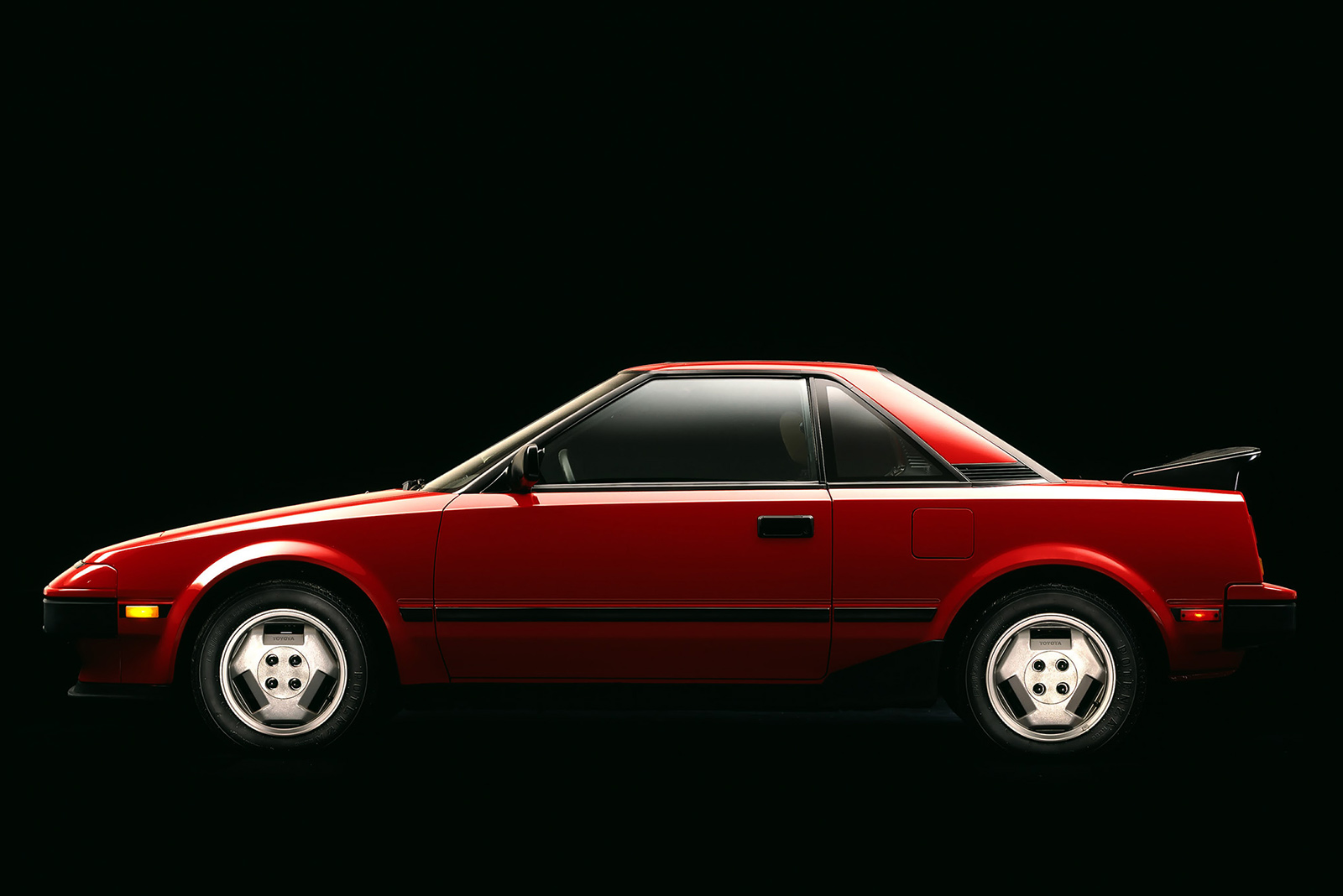
How do you fit a Toyota MR2 into these dimensions? Well, you don’t. The AW11 is 1665mm wide, so the width restriction trips you up – unless the side mirrors are small enough to let you in.
But an MR2 is nearly four meters long at 3925mm, or 154,5 inches. It would need to be such short wheelbase that you can’t fit the driver in there, or you’d have to chop the ends off the car.
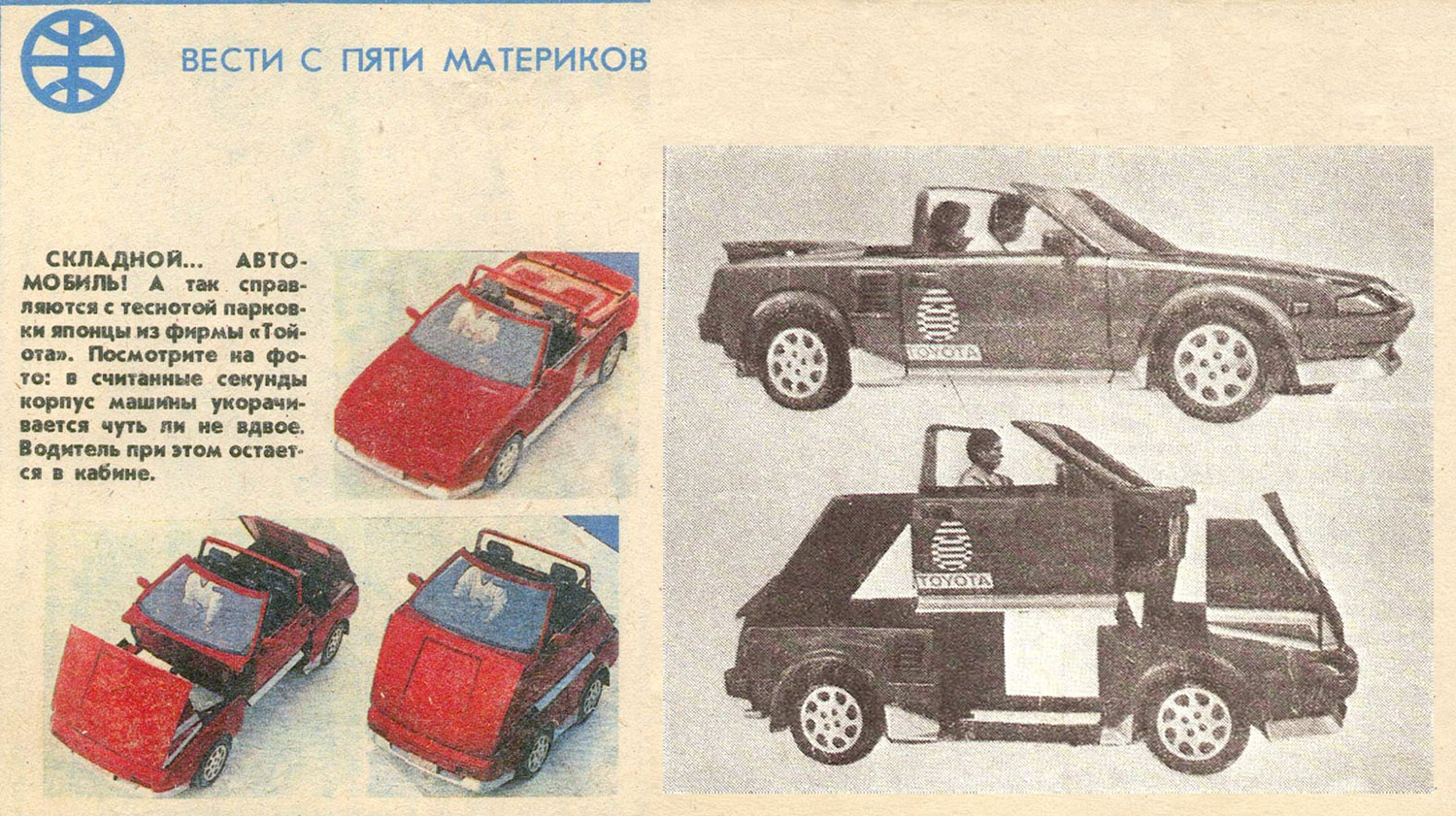
This folding 1988 concept answers this perfectly. The unnamed Toyota engineer simply rigged up a setup that folds the AW11 into even more compact size, without the driver having to step out of the car. Just by flicking a switch, the frunk panel and the engine cover rise up, the passenger compartment lifts up, and the car packs itself into a shorter form.
Supposedly, a tiny cargo area also opens up underneath the driver and passenger, but I’d be wary about leaving anything there that cannot be crushed. The above caption in an unnamed Soviet newspaper says:
A FOLDING … AUTOMOBILE! This is how the Japanese company Toyota copes with tight parking spaces. Look at the photo: in a matter of seconds, the car’s body shortens by almost half. The driver remains in the cabin.
No video has survived about this concept except for some screenshots, so we’re reliant on some grainy newspaper images and captions that may have a bit of a “broken telephone” effect to them, thanks to merely interpreting the photos.
As some of the folding MR2’s original incentive has been lost in translation already back in 1988, Western newspapers called it a sportscar that turns into a van by flicking a switch. However, it’s more likely to be about packing it up for parking’s sake.
How did they do it? Hydraulic rams and telescopic structures, most likely, while still retaining drive for the midship power package and steering to park it. Judging by one image, the pedal box stays connected. The car itself has been chopped up in various ways for it to be able to fold up, which has turned the originally T-topped MR2 into a fully open convertible, or likely more of a roadster without any sort of roof. It’s very difficult to say how much of the car’s original chassis rigidity or overall driveability survived the project, but those can surely be sacrificed in favor of theatrics like these.
その昔、本当に変形するAWが実在したことはあまり知られていない… https://t.co/Ven9Azxp2V pic.twitter.com/38FB6pWmJc
— s15skyline (@s15skyline) June 15, 2026
As this was a rogue engineer’s passion project, it may have been shelved and stored for the decades after it debuted at the 1988 Toyota Idea Olympics. Even if it still exists in boxes somewhere in Japan, no information has appeared since.
This wasn’t the last time an MR2 appeared in the Idea Olympics, as in 2010, someone set up an electric-converted MR-S to be driven remotely via iPad remote control.
A separate folding EV idea was last touted in the 2010s, originally as a project by the Massachusetts institute of Technology and then by a Spanish start-up, but the car never progressed from concept stage.
Top graphic image: Toyota/Samochody Świata


“The above caption in an unnamed Soviet newspaper”
How many Soviet newspapers could there have been?
True 😉
Thanks for this Jason! I fwd’d it to my buddy who’s on his third AW11.
Looks a little bit like Inspector Gadget’s car when it folds up into a van
Reminds me of David Letterman’s Hyundai Accordion.
Bubble economy Toyota would have been wild imagine the office canteen chat in 1988.
Toyota Engineers: We’ve succeeded in reusing the 1970’s KE70 Corolla live rear axle and rear end for the new for 1988 Corolla AE95 alltrac wagon to save $20 per unit even though the track is 50mm narrower – we absolutely can’t alter it.
Also Toyota Engineers: We’ve made a bespoke sports car that folds up and is still drivable but as a weird open van.
I say we have a new leader in discovery of unique automobile history. Very enjoyable but I would have rolled in a better option and that being the Jetsons car that allows passengers to be separated in a vehicle from the main vehicle.
Think seperate personal even mobility vehicles that can hook up and share battery power but as you reach each parties destination their individual pod seperates and proceeds and charges. Then upon pickup they all reconnect and use the recharged power to get home. Also would work for singles in a car pool.
Has anyone but me thought of this? If not proof and contact me for the design authorization. I need the money.
No wonder we got Transformers around this time.
“Jane! You left the car unfolded again!”
“Oh George – You always get so upset at the littlest things….”
*Jane pushes button – car folds into a briefcase*
“There – Better now, Dear?”
“Yes, Dear – Better now.”
*George returns to reading his newspaper and sipping his Venutian Martini*
Hint the olives were Venetian gonads from operations to keep from having kids. The average Venution has a breed of 110 kids.
Things we need to know.
*Spit takes and angrily smashes Venutian martini on the floor*
Things we did NOT need to know!
*calms down a bit*
Maybe that’s on me. I should have guessed what the nuts in a VeNUTian martini were….
The folded up MR2 looks like the chibi style cars in Choro Q, of which there was an MR2! https://static.wikia.nocookie.net/roadtripadventure/images/c/ce/CQ2-43.jpg
we could have had folded up car racing!
Autobots! Transform and roll out!
…how do you get out once you’re parked? Or in? Do they provide a rope ladder for this purpose?
Toyota should have kept researching this technology. We’d have George Jetson’s car by now!
I actually love that diminutive look. I would definitely daily this if it were in my garage.
How did someone let this article about a transforming ’80s sports car get published without referencing Inspector Gadget?
This is the first thing I thought of when I read the title too. Inspiration can come from the oddest places.
Haha, good call!
Or, you know, Transformers. 🙂
All sports cars are folding sports cars. What we have here is an un-folding sports car.
+1 came here for this
I’m betting chassis rigidity is great.
Does this mean this is not a sportscar anymore?
Go Go Gadget Parking Mode.
Dr. Claw: I’ll get you next time, Gadget! NEXT TIME!!