

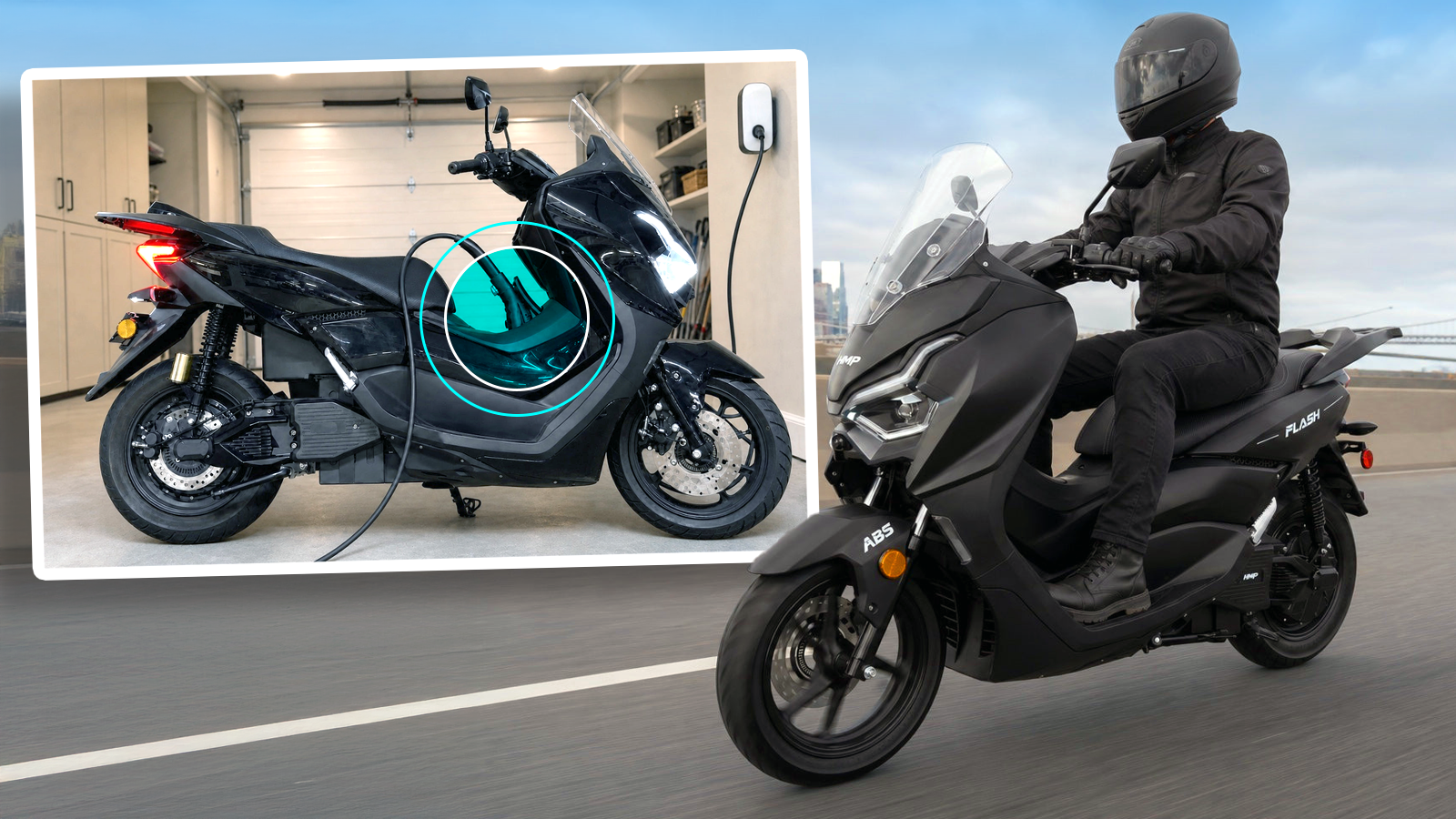
One of the greatest challenges in electric motorcycles is hitting just the right balance of performance, range, and price. There are so many bikes out there that are great, but just cost way too much for what you get. One company thinks it has found a decent formula. This is the HMP Flash, an electric maxi-scooter that you can buy right now from a company in California that has over 70 miles of real-world range, a top speed of 75 mph, and a price that’s around $6,000 for the better version.
Motorcycle companies that sell electric wares in America have found our market tough to crack. The limitations with present-day lithium battery technology mean that electric motorcycles that have the kind of range that recreational riders are looking for tend to cost over $10,000. My favorite electric motorcycle, the Zero DSR/X, is currently going for $20,495. Even my second-favorite electric, the LiveWire One, is $16,499. That’s a discount, too, because in the past, its price was nearly twice that. It’s no surprise that some electric motorcycle brands in America struggle to move inventory.


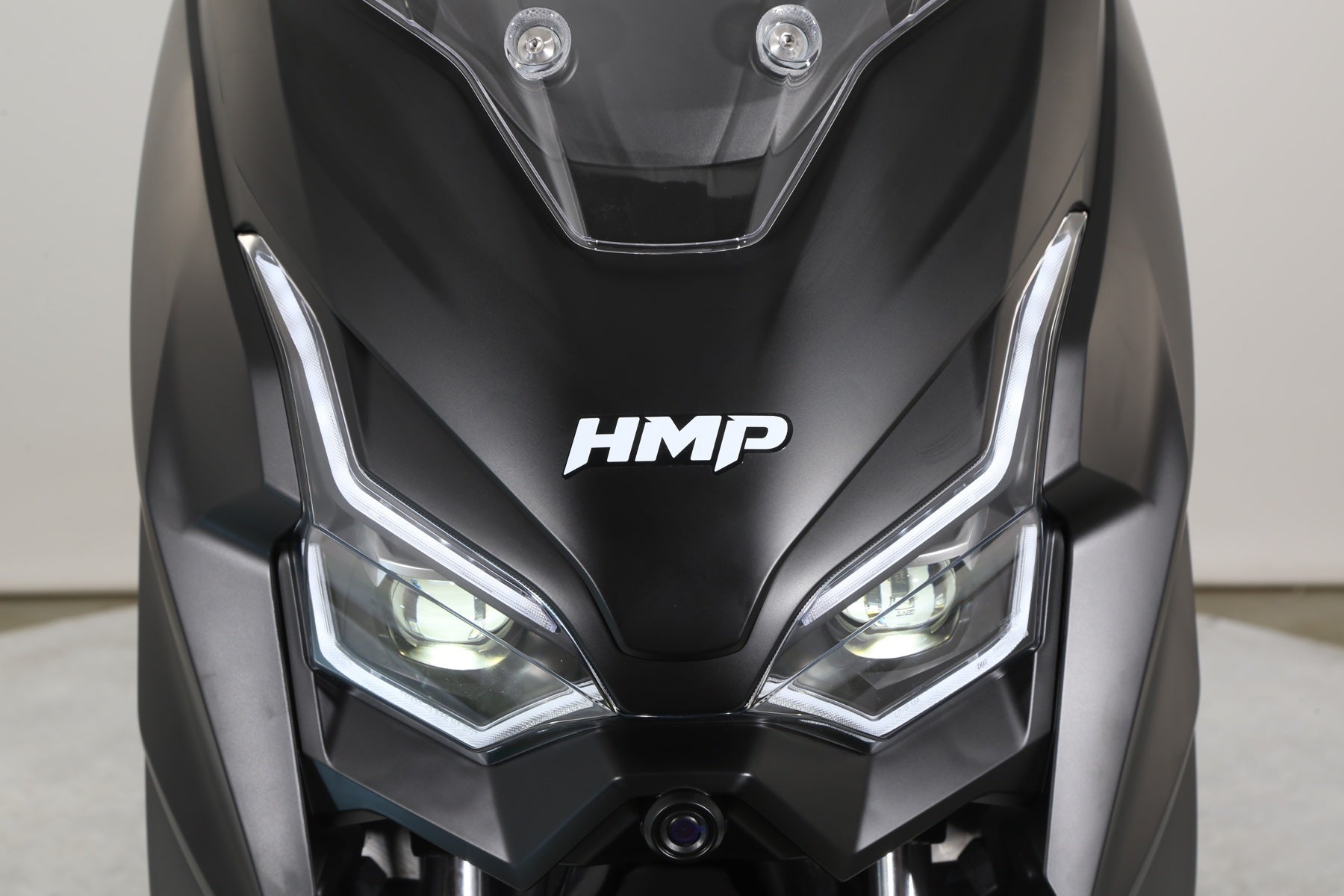
HMP Bikes of San Francisco, California, normally trades in low-speed electric bicycles and purely urban electric scooters that focus on last-mile mobility. But this month, it’s expanding into a new field. The HMP Flash is a genuine maxi-scooter with a large body and a top speed of 75 mph. But instead of piling batteries into this scooter and trying to market it to recreational riders, this scooter wants to be the ultimate urban machine. At $4,799 for the cheapest version, it seems attractive on paper, too.
A Startup You’ve Probably Never Heard Of
If you’re not a resident of San Francisco, you’ve probably never heard of HMP Bikes before. Even I had to do some research on this company. HMP Bikes was founded in Davis, California, in 2022 by mechanical engineer Peter Chu. This is Chu’s second business after he founded Muncho, a provider of self-service restaurant kiosks.
According to the Davis Enterprise, Chu started HMP Bikes after seeing a need for an affordable moped that could help people reduce their dependence on a car for short trips around towns that don’t have good public transit. HMP’s debut bike was a Class 2 e-bike with a lead-acid battery, a 20 mph top speed, and was built in China by Luyuan. While legally an e-bike, the machine is more of a moped with larger tires and a more substantial body.
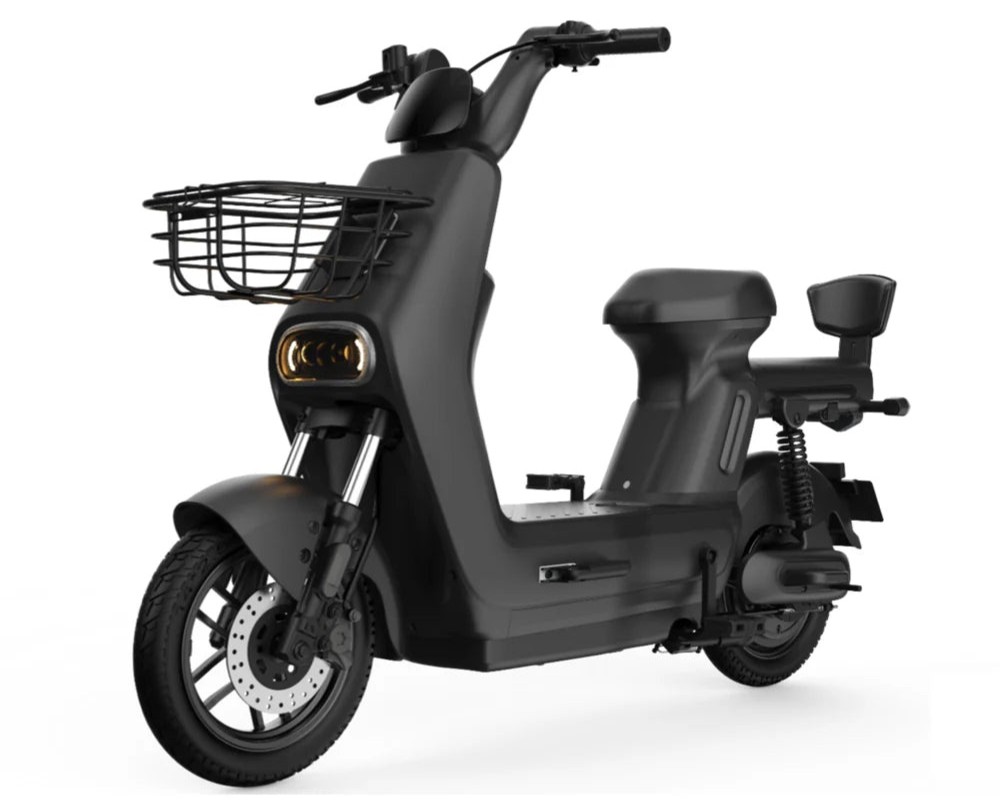
Today, HMP sells these moped-style e-bikes as the Liva 7 and the Inno-A. Both of which go up to 20 mph, have lithium batteries, and have quoted range figures of 50 miles and 60 miles, respectively. Both mopeds are similar, but the Inno-A is marketed to people who ride scooters for delivery work.
Until now, the hottest scooter in the HMP lineup was the Lightning, which had a top speed of 56 mph and a range of up to 62 miles. The Flash is a step forward and is HMP’s first product that could be treated like a motorcycle or maxi-scooter.
In A Flash

HMP says that, when designing the Flash, it benchmarked the Honda PCX scooter. The little Honda was HMP’s target because, per HMP, it’s one of the best-selling scooters in America. It’s also a proven platform by the biggest name in motorcycling. So, HMP says it wanted to make a scooter that beat the PCX.
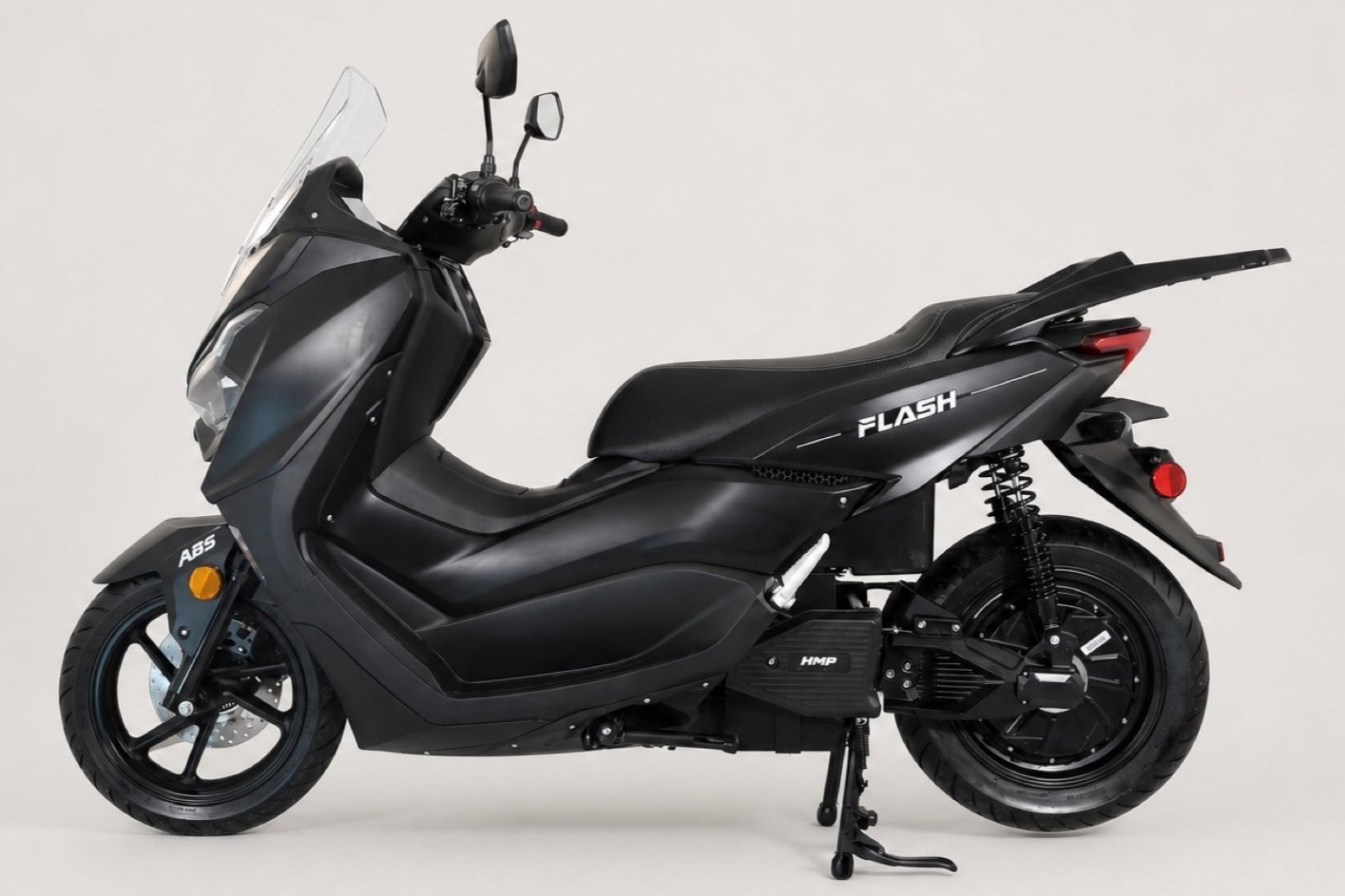
HMP is light on details such as the Flash’s structure, brakes, and suspension, but does say that the scooter sports a rear brushless DC hub motor that punches out 20 peak horsepower when the scooter is equipped with two batteries, or half that when equipped with one battery. Nominal output is eight horsepower. That motor is able to get you to 60 mph in the model with a single battery and a GPS-verified 75 mph in the two-battery version.
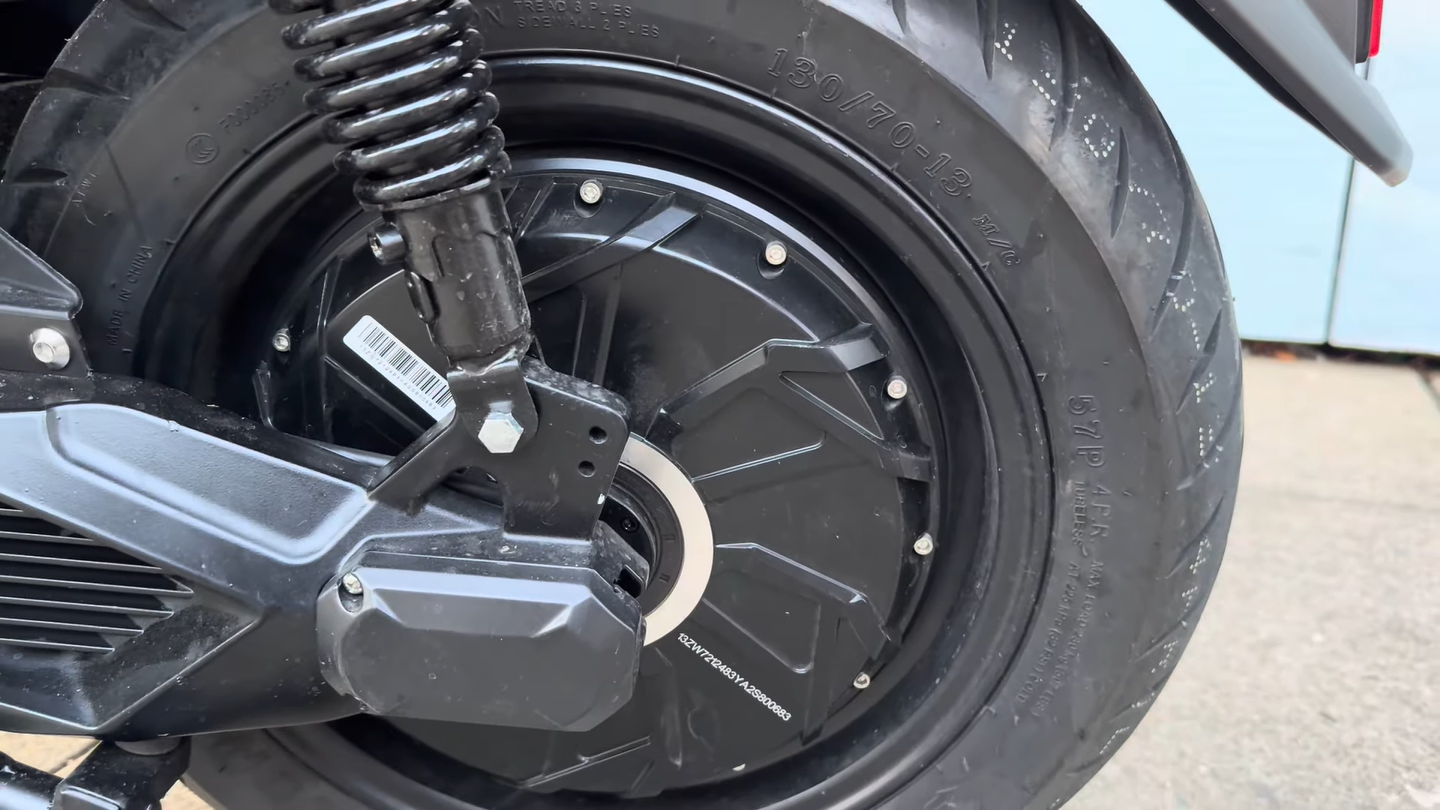
If you’re wondering why HMP chose a hub motor, which adds unnecessary unsprung weight, it was supposedly done for maintenance reasons. The hub motor means no drive belt or chain to maintain.
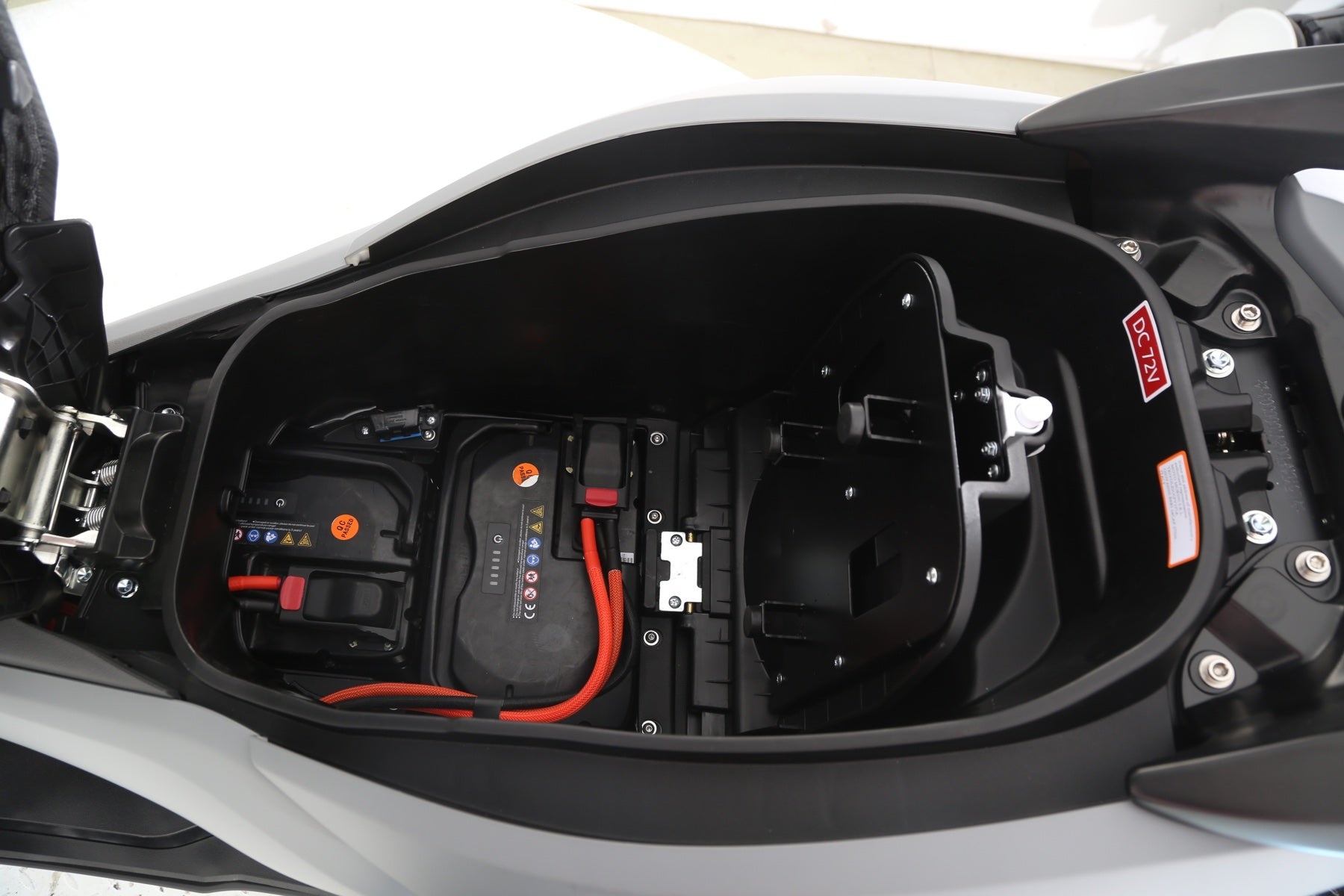
One highlight feature of the Flash is that, under the plastic, sits one removable 3.33 kWh lithium battery or, optionally, two removable batteries. These batteries weigh 40 pounds each and are designed to be hauled into an apartment for charging. The scooter can run on one battery, or use both at the same time. Meaning, if both are installed, both drain at the same time. HMP says that the batteries should go more than 60,000 miles without issues.
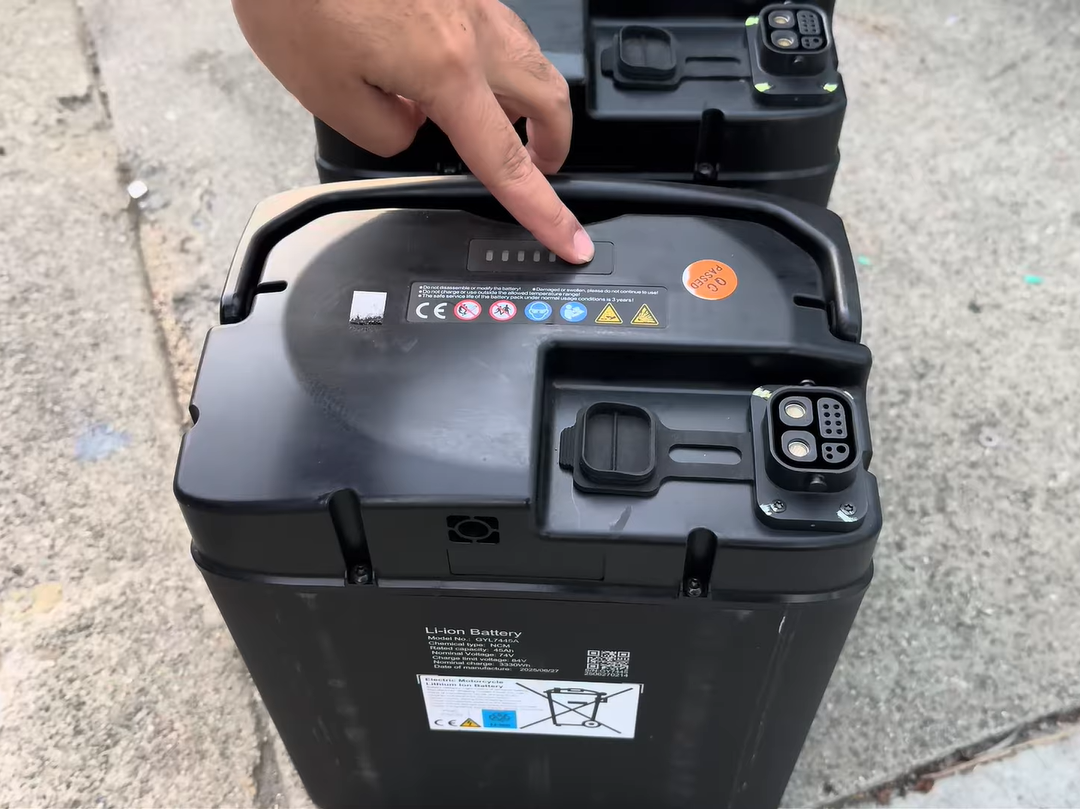
These batteries get their power from your choice of charger. The standard charger is an 840 W portable unit that plugs into any 110V outlet. That one takes four-and-a-half hours to charge a pack. Two packs would take nine hours. If you upgrade to the 2kW onboard charger, you get a J1772 plug and the scooter can charge from 20 percent to 80 percent in one hour with one battery or two hours with two batteries.
In terms of range, HMP says that you can expect to get 56 miles out of a single pack at a constant 37 mph, or 106 miles at the same speed with two packs. This range figure also assumes a 145-pound rider. HMP has done some real-world range testing around San Francisco and found that, with a single pack, the scooter should get around 40 miles of range and anywhere between 70 miles and 85 miles with two packs. HMP’s range testing was done with a 200-pound rider who spent 80 percent of the ride in the city and 20 percent on the highway.

The scoot is also tech-laden, and features a built-in dashcam, keyless operation, ABS, traction control, a large infotainment screen, Apple CarPlay, Android Auto, reverse gear, regenerative braking, optional heated grips, and a center stand. Apparently, this scooter was designed primarily for California delivery riders first, and as such, it has a rear platform ready for a storage box. If you’re not a delivery rider, HMP says you can put a child seat on there. I think I’ll pass on that last one.
All of this comes in at 299 pounds with a 31-inch seat height and a 377-pound weight carrying capacity. Storage on the scooter is minimal if you don’t use a rear box. You get 20 liters of space over the batteries, which isn’t enough to store a single full-face helmet.
HMP claims that it was successful in beating the Honda, given the Flash’s slightly higher top speed, ability to hit 60 in 3.69 seconds, claimed greater stability, and lack of need for engine maintenance. However, it should be noted that a Honda PCX can easily go twice as far on a tank of fuel and won’t need two hours to replenish that range. Honda also has a robust nationwide dealer network, while HMP is only in San Francisco. At least, HMP does say that if your scooter needs repairs and only HMP can fix it, they can send a tech to where you live.
HMP has published an unlisted video (embedded below, or click here) on YouTube where one of its representatives spends a lot of time comparing the Flash to the PCX. What’s interesting to me is that, to my eyes, the Flash looks Honda-ish, but it looks like the distant cousin of an ADV160.
Something that’s been curiously missing in HMP’s marketing blitz is who actually builds it. Previously, HMP has said that its mopeds and scooters came from the Luyuan Group, a Chinese company that’s been around since 1997. HMP has a whole blog post about how Luyuan spent nearly a decade developing the liquid-cooled hub motor that HMP uses in its other scooters. Notably, HMP says that Luyuan is “our manufacturer.”
Luyuan does not sell any scooter like this one, but does market itself as an “OEM Partner” that can manufacture vehicles for another company. I’m not really concerned about that. As I have written many times before, China has made strides in its motorcycle and scooter manufacturing sector. Luyuan’s scoots look even cooler than the HMP Flash does! But I do wish that HMP was a little more detailed about the production side of the Flash. The way the marketing materials are written, you’d think that the scooter was made in America. A writer at New Atlas already made that assumption in their coverage of this scooter.
One annoying part about HMP’s advertising is that the website has a section of “Real Photography” that shows “Real riders, real streets.” However, every image URL says “ChatGPT” on it, and the images do trigger AI detectors. The people in these images do seem real enough, so maybe ChatGPT was used to edit them?
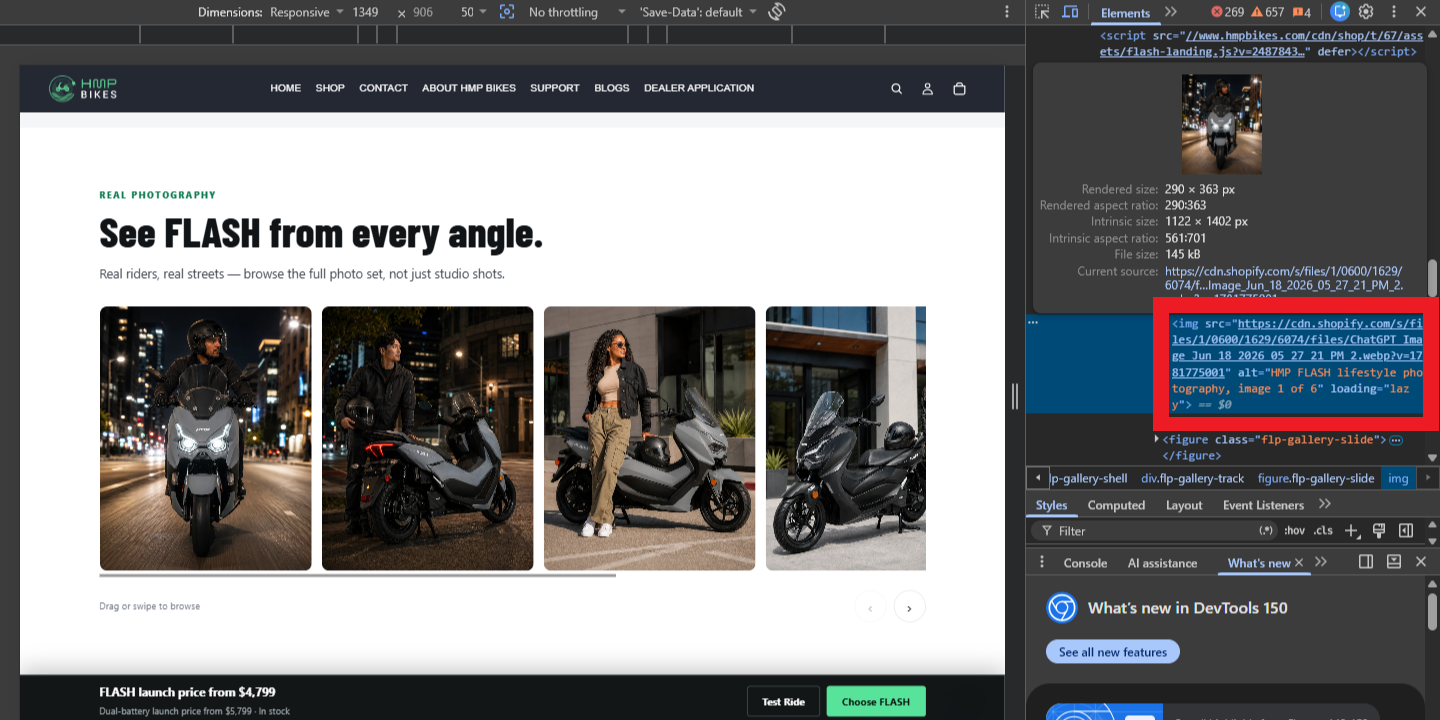
Certainly, the image of the Flash near the Golden Gate Bridge (below) is AI-generated or at least has AI-generated elements. In the image, the Golden Gate Bridge’s cables are seen extending off-screen. In real life, the cables connect to the concrete anchors, which were ignored entirely by whatever AI generated this image. I also could not find a road like the one pictured. Finally, the scooter is pictured moving, but the wheels are still.
What’s baffling is that HMP has sold many real Flash scooters to the public, units have been reviewed by YouTubers, and it has even produced videos showing the thing. Why resort to AI? Through a lot more research than should be required, I have at least confirmed that the other images here should be real.

About That Pricing
The scooter’s biggest selling point is its price. A Flash with a single battery and the super-slow charger will run you $4,799. This is a launch price, and HMP suggests that the price could later be $5,199. If you want it with two batteries and the 75 mph top speed, that will run you $5,799. The version that has both batteries and the 2kW charger will run you $5,999. HMP claims that the non-introductory price for these scooters is $6,699 and $6,999, respectively. But the company gives no indication of whether or when the introductory price will end.
HMP even claims that its scooter is cheaper than a Honda PCX. Apparently, the company called around and found out that the out-the-door price for a new PCX in San Francisco can be around $6,500 after Honda’s required destination fee plus setup fee and other dealer fees. To HMP’s credit, it doesn’t load you down with fees. If you get the top-spec Flash, you pay $5,999 before tax and registration, but no hidden fees.
However, HMP’s claim that its scooter is cheaper is only true if you don’t have it shipped and you buy during the promotional period. The company charges $400 to ship within California or $600 to ship nationwide. Likewise, unlike buying a scooter from a dealer, you can’t negotiate with HMP. So, is this truly cheaper than a PCX? As my lawyer would say, “it depends.”
There is not a large market of electric maxi-scooters in America. There’s the CSC E-RT3, which is made in China and claims a top speed of 85 mph or a range of 124 miles for a price of $7,295. However, you cannot buy that new anymore because CSC Motorcycles recently closed up shop.
There’s also the BMW CE 04, which is faster than the HMP Flash and has roughly similar range, but costs an eye-watering $12,195. I suppose you could also draw a comparison to the Ryvid Anthem, which is faster than the Flash, charges much faster, and has roughly similar range, but runs $7,995. That one also has a motorcycle form factor.
Could Be A Barrel Of Fun In A City
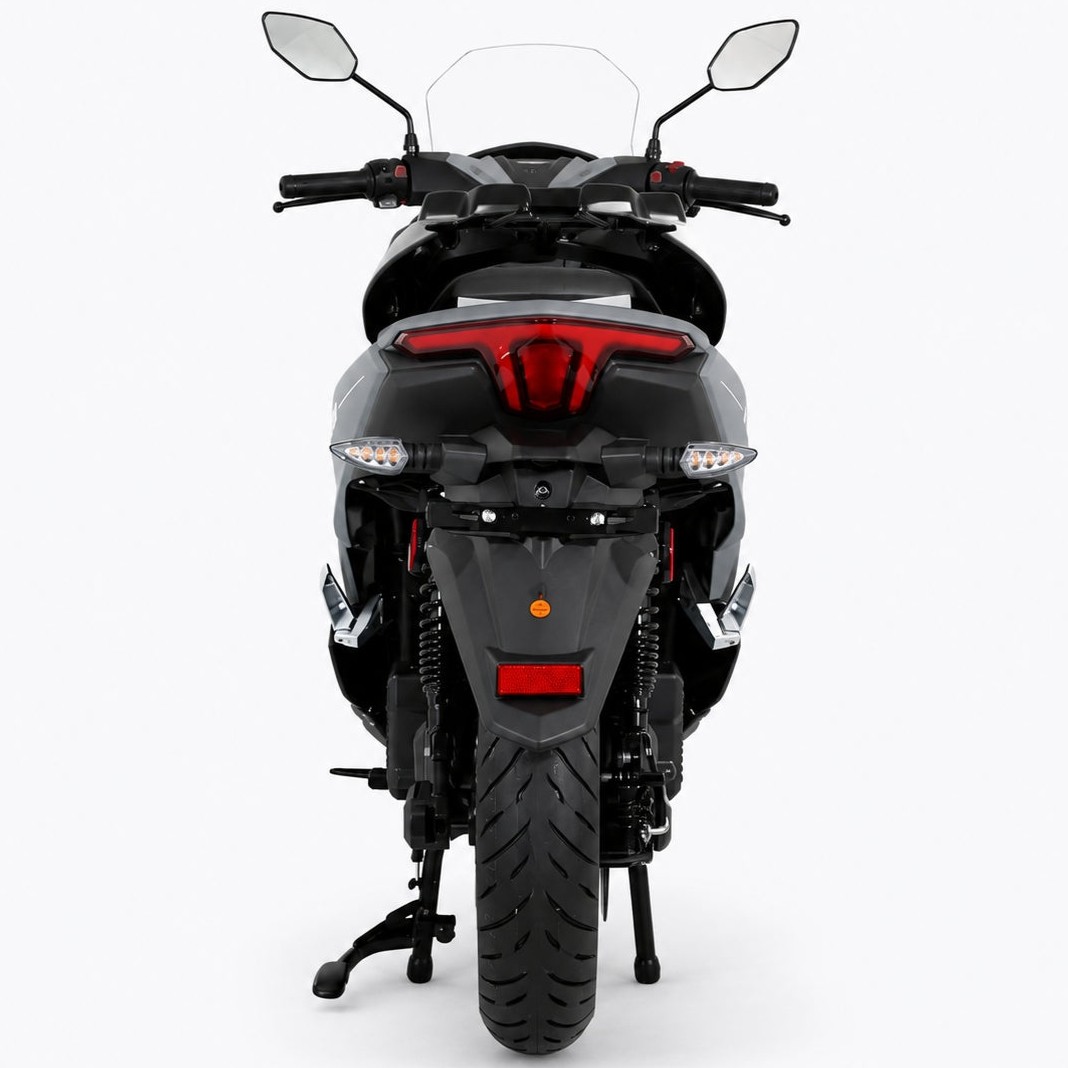
I think, then, that the HMP Flash’s price isn’t that offensive. Yes, like many electric bikes, you don’t get a lot of range for your money, and this one can’t even be charged quickly. But if you’re in the market for something like a brand-new Honda PCX, it is theoretically possible that it’ll cost the same as a Flash. The keyword there is new, because the second you hit the used market, the Flash loses its edge. Used scooters often have low miles and cost half the price that the Flash does.
Still, challenges aside, I like what’s going on here. If you’re a purely urban rider, and you’re likely to be one on a scooter like this, I think both the performance and range are more than usable. Yet, it also has just enough speed to scoot down a highway for a mile or two as you skip through traffic. Apparently, HMP had more than 100 delivery riders test the Flash out in the months before announcing it, and the riders loved it. So, I guess if you’re in San Francisco and you do DoorDash on a scooter, this might be a good idea.
Personally, what I love the most here is the fact that there are companies out there trying to bring down electric motorcycle prices. Sure, the specs of this scooter won’t blow anything out of the water, but this is affordable enough that, so far as I’ve been able to tell, HMP has actually sold many of these to happy riders already. I wonder if the future of electric motorcycles in America is not $30,000 bikes with donut hole wheels and yet-to-be-seen solid-state batteries, but urban motos with price tags well below $10,000. I’m not sure, but I like this trend. But I do hope to see less AI slop.
Top graphic image: HMP Bikes



I really wish they’d do range estimates at a few different weights and speeds to give people a more thorough picture of what is going on. As someone 80 pounds heavier, I would expect a decrease in range, but how much? And it can go double the speed, but for how long? If I get on this and get it to 70 mph, am I limited to 25 miles with 2 packs? 20 minute ride, then a couple hours of charging.
I am pretty sure that an electric motorcycle/scooter isn’t really in the cards for me, but it would be nice to see the numbers to verify that. It’s also hard to justify any electric motorcycle when Royal Enfield makes a compelling product at such a great price, of course.
“Muncho, a provider of self-service restaurant kiosks.”
It’s hard to tell from their website, is this just a weaksauce Automat?
Damn I miss Automats.
Hurts to see a scooter that doesn’t have the standard pet carrier that’ll fit, at least, a full-face helmet.
As an urban/suburban runabout, the lack of storage would limit its practicality and a topbox becomes mandatory.
Makes me miss the Honda PC800 a little bit, or a nice set of coordinated hard bags on a VFR750/800.
While price parity is improving on electric scooters and motorcycles compared to their ICE counterparts, they are still will behind cars. This seems like a nice offering, but I’d way rather have the PCX at the lower price end. At the higher end, I’d rather spring for a SR GT 400 or Xmax.
Things are improving, but we just aren’t there yet unless you meet the somewhat narrow use case where the electric version of a scooter is a huge advantage to you.
Exactly. In this case, the use case is purely urban riders, or, supposedly, delivery riders.
Which even then isn’t a slam dunk. For urban deliveries, something like a PCX is getting through the work day on a single tank of fuel.
And even if you burn through the PCX’s tank, you aren’t sidelined for two hours.
I wonder if your best strategy would be to have one battery inside charging, running a single, and then swapping them once the one in the scoot dies. Seems like a viable strategy for the delivery driver. Not viable for the urban commuter unless you want three batteries (one at home, on in the scoot, and one at work). But that’s a pricey proposition.
The most viable use case for this to me seems like the commuter that can make the entire round trip on a single battery (or can charge at work). That keeps the upfront costs down the lowest.