

I generally attribute this predilection to something related to the appeal of the exotic, the innate human desire to always want what you can’t have, which is why I think I’ve always been more drawn to strange little cars from other countries instead of the big American iron I grew up surrounded by. The American cars that made up the background layer of the automotive quilt I was wrapped up in throughout my formative years may have had plenty of appeal, but for a long time I was blind to them.
But I’m older now, not smarter by any stretch, but something between more experienced and just simply worn down. Whatever it is, I now find myself able to appreciate some big American land yachts in ways that I just never felt before.


Maybe it’s because I finally have a fleet of tiny weird cars at my disposal, including a Nissan Pao, VW Beetle, and, most recently, a Citroën 2CV, so perhaps with those urges (temporarily) sated, I can feel free to appreciate things outside my usual circle of obsessions. Things like the first-generation (1973 to 1975) Pontiac Grand Am.
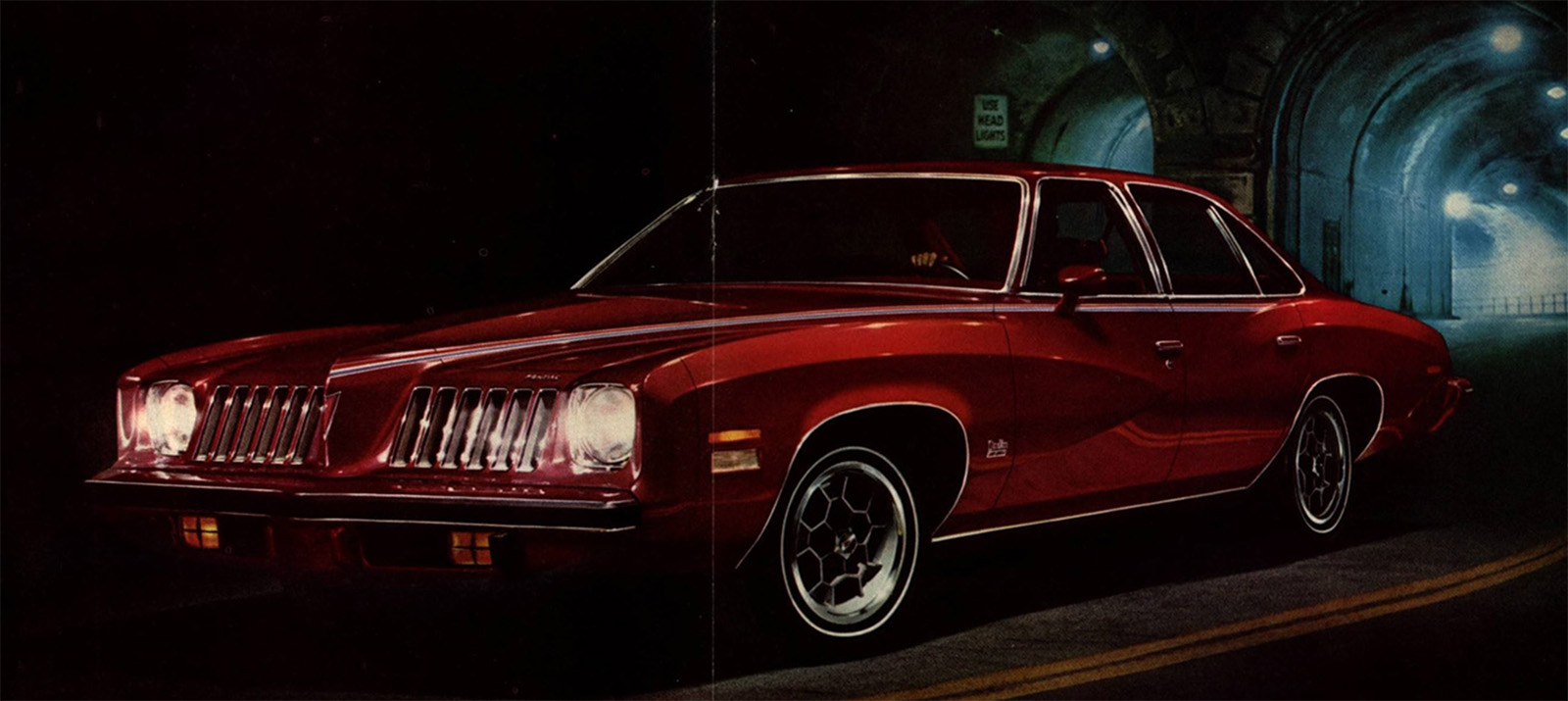
How many times have I seen these cars in my life? Plenty. Plenty plenty. And ridden in them and parked next to them and jump started/been jump started by them, all so many times. As a child of the 70s and 80s myself, the prime Malaise-era barges were pretty much everywhere.
And I feel like I never really looked at them, because if I had, I think I would have appreciated them a lot more. Look at these things! They’re downright exuberant! Those exaggerated, curving fenders, front and rear, the flowing lines, that bold beak-like nose, flanked by all those grille slats, the delicate use of thin chrome trim, the crosshair turn indicators, the airy greenhouse with those thin pillars, the whole damn thing! It feels very Syd Meade, a design from a future where drama beat out rationality, and we were all having a pretty good time as a result.
Also, note the cornering lamps below the side markers. I always like those.
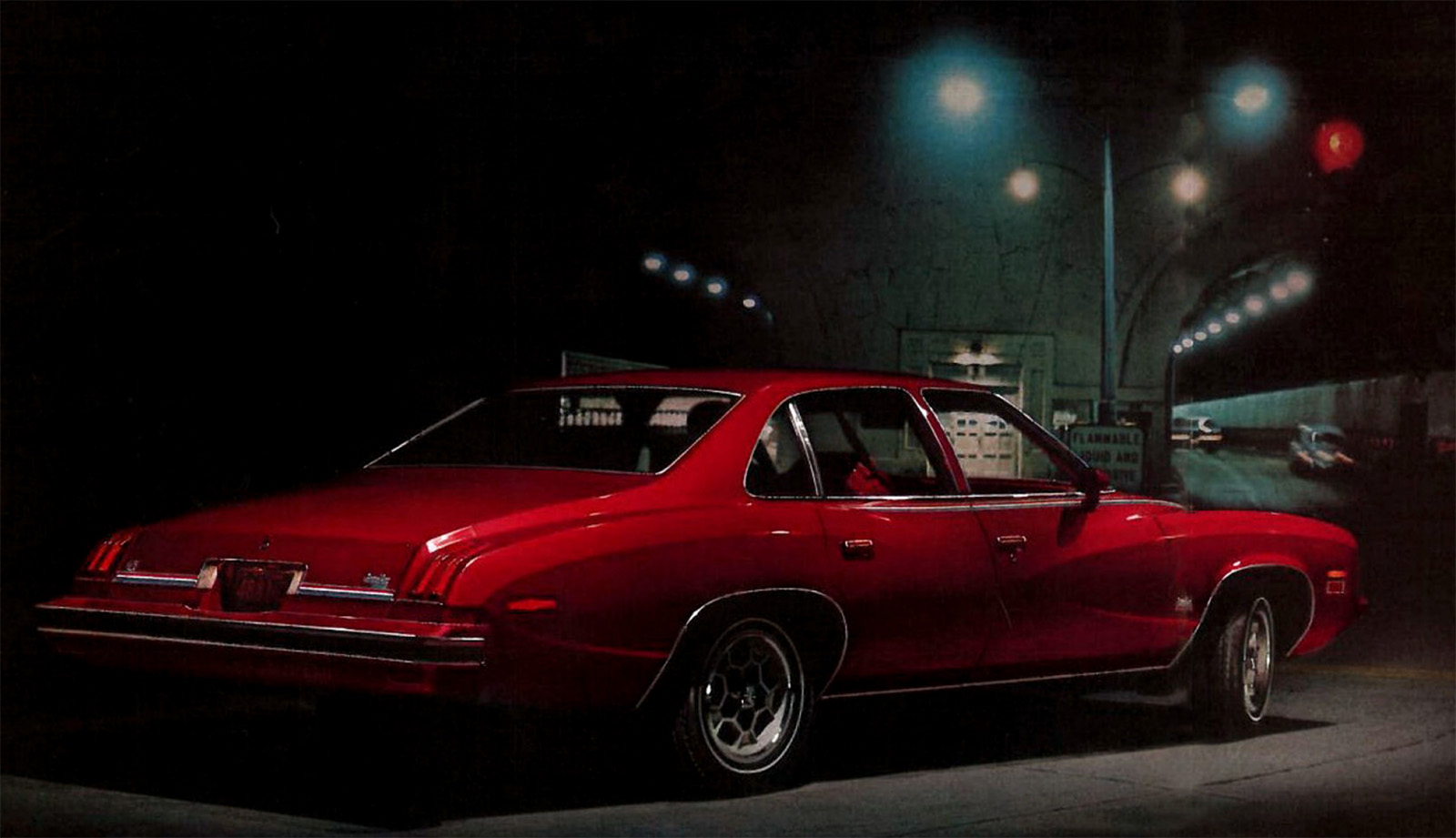
I do kind of wonder why Pontaic seemed to only be able to shoot these cars at night at the same spot in a tunnel, but maybe they were doing the photography off the books and had to keep it quiet.
Still, look how flowy and elegant these damn things were! And that’s just the sedan; the coupé was, arguably, even more so, of everything:
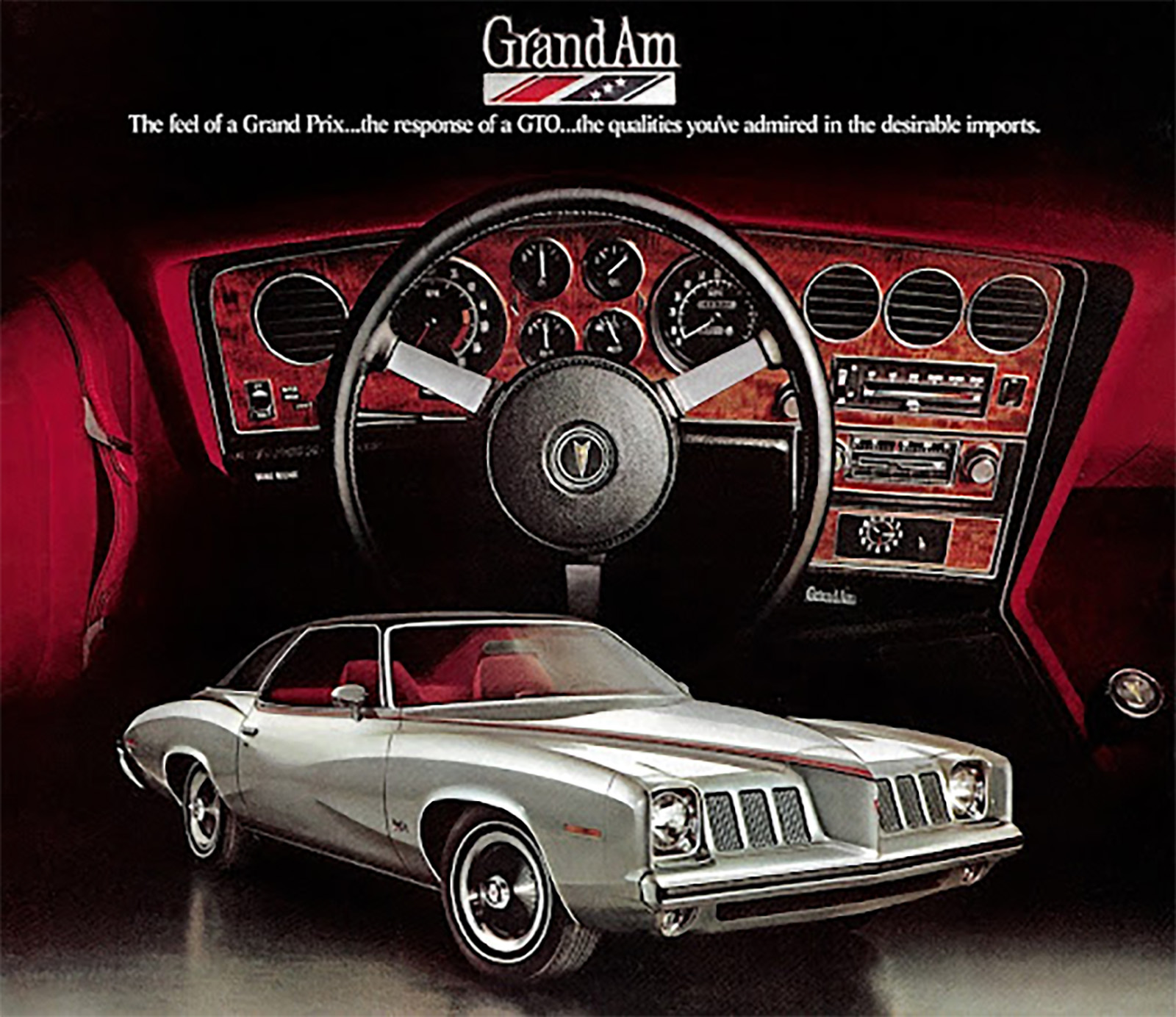
The whole point of the Grand Am can be sussed out from its name: Pontiac took the “Grand” from the luxurious Grand Prix and the “Am” from the sportier Trans Am, creating what they hoped would be a sort of unholy, or, hell, maybe even holy hybrid of luxury and sportiness.
I’m not sure just how sporty these things really were – sure, they had massive 6.6-liter and gargantuan 7.5-liter V8s, but thanks to Malaise Era emissions magic, those engines made a meager 170 and 200 hp (250 hp with a really big carb) and they handled like a bar of soap escaping the tub.
But, who cares, just look at these exuberant things! On the coupé, they even came up with a name for opera windows I haven’t heard before:
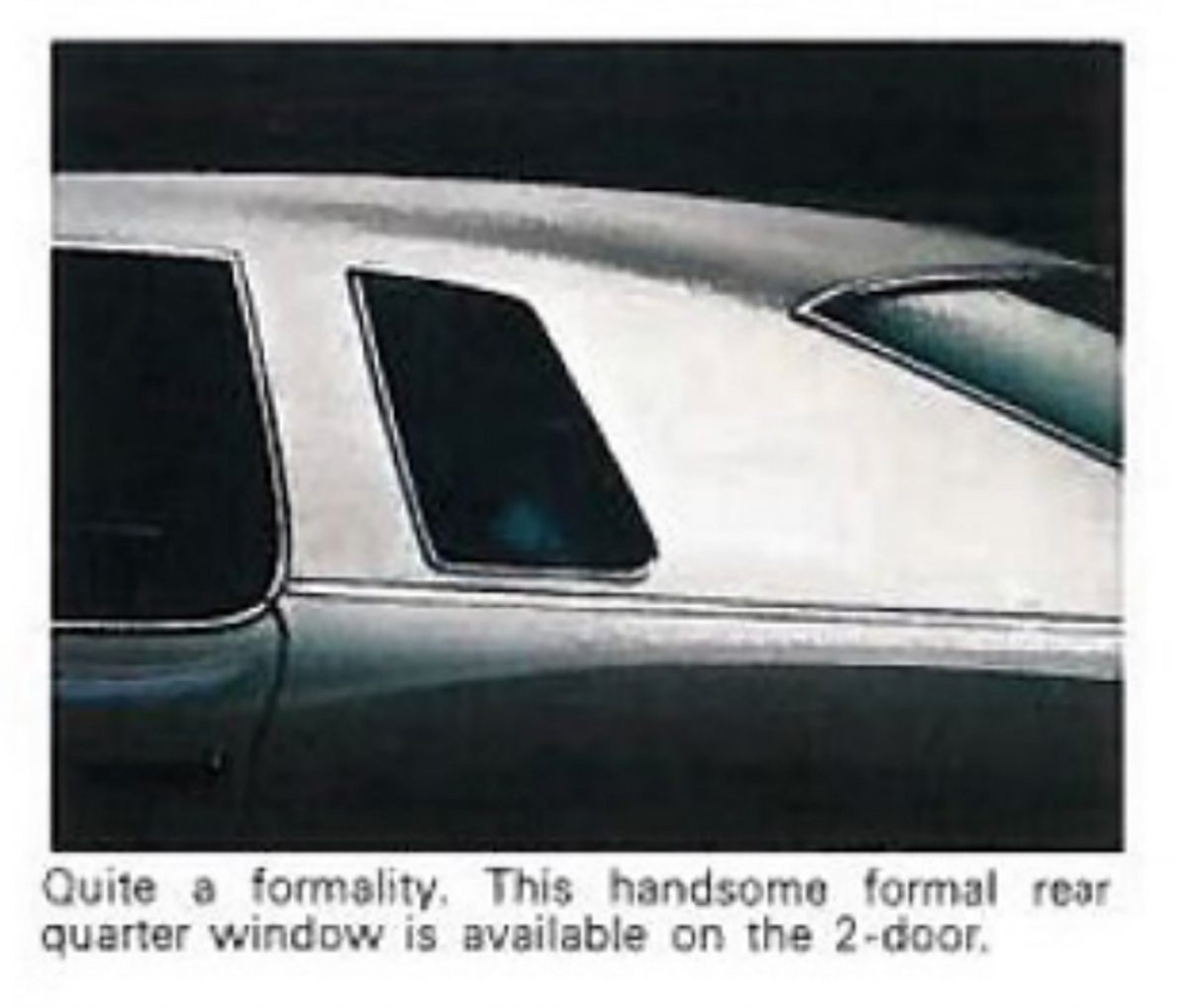
Ooh, a “formal” rear quarter window! Classy!
Pontiac really wanted people to see these as an American take on GT cars, of a sort:
That commercial also show off one of my favorite features of GMs of this era: the “Endura” deformable plastic bumpers and front ends that you could squish with impunity:

Look at that! You can just scrunch that thing up, back away, and it pops back into shape! I’m not sure how many times you could really do this, but still, pretty cool. Also, I have to donate some props to the copywriter here, because the “pressing your nose against a window pane” analogy is spot-on and gives every nose-bearing mammal an instant and visceral understanding of what’s going on here.
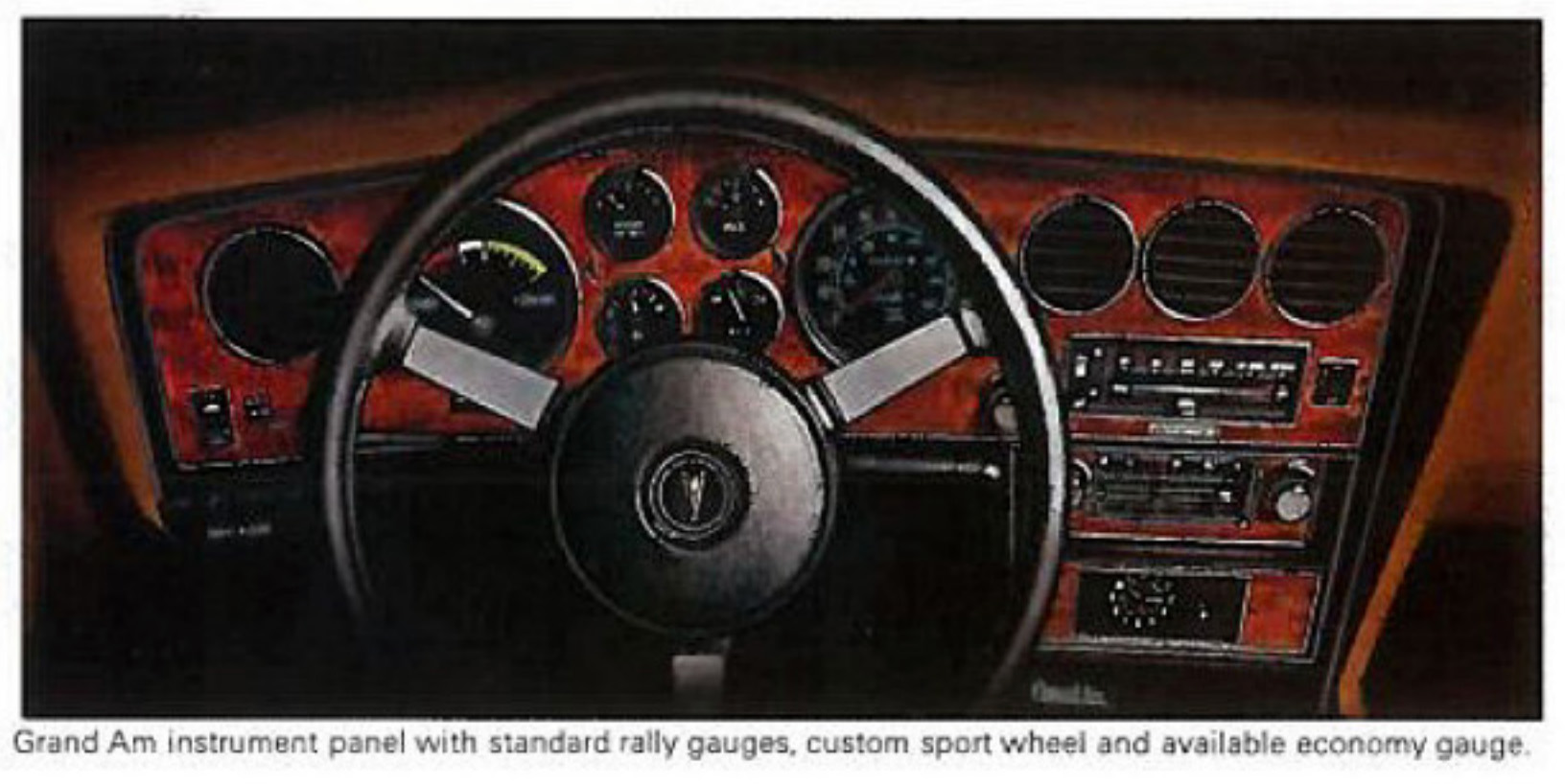
The dashboards in these cars had a novel feel, too, with a bent shape and lots of round gauges. Those gauges could include an “economy gauge,” which, with those 6.6 and 7.5-liter V8s, was really more of a gauge designed to most effectively quantify your dissapointment.
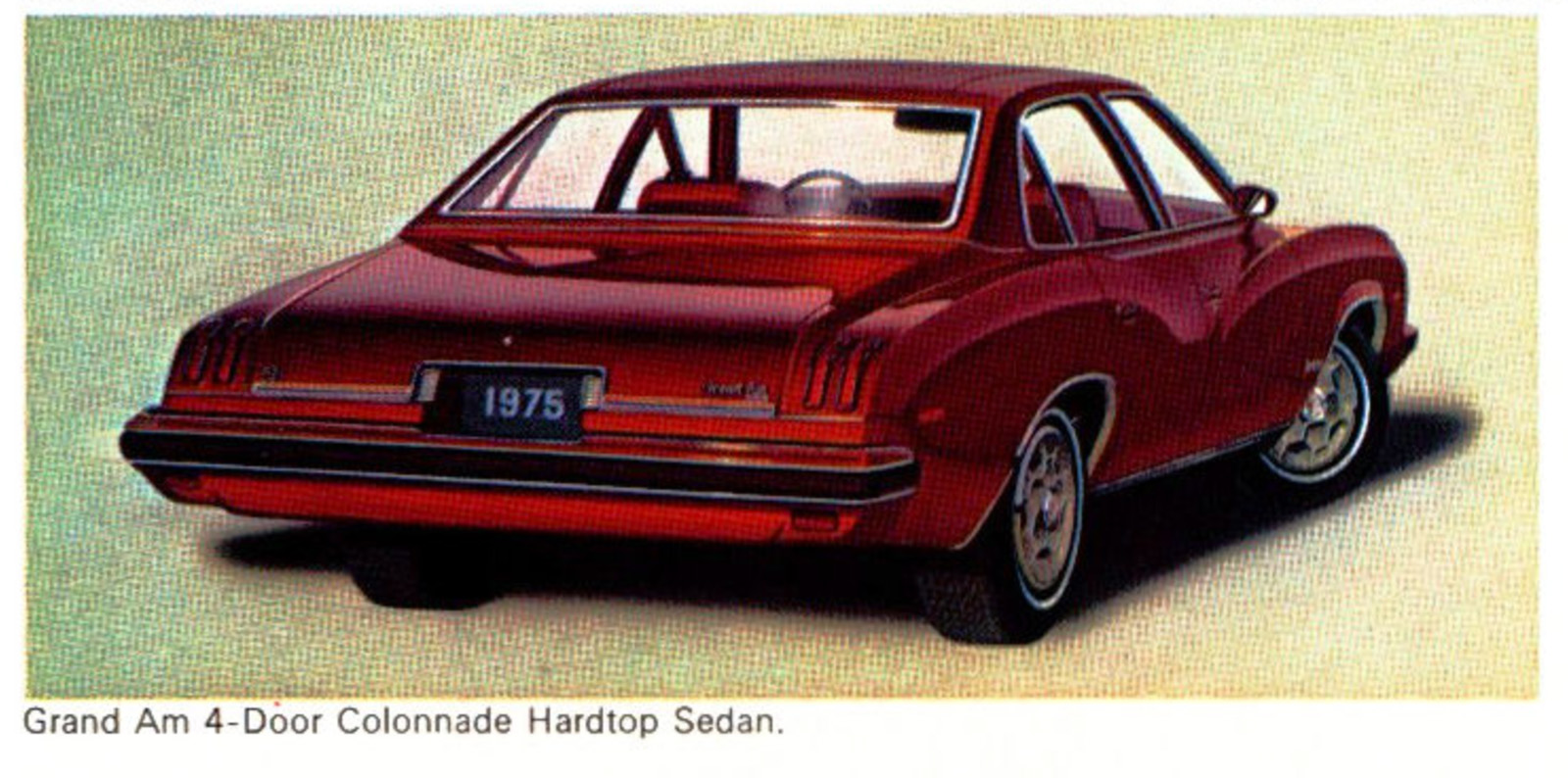
Still, who was buying these things for economy? Look at that thing. It’s so swoopy and substantial and, well, seventies, in the best way possible. I just wish I appreciated them more when they were all around me.





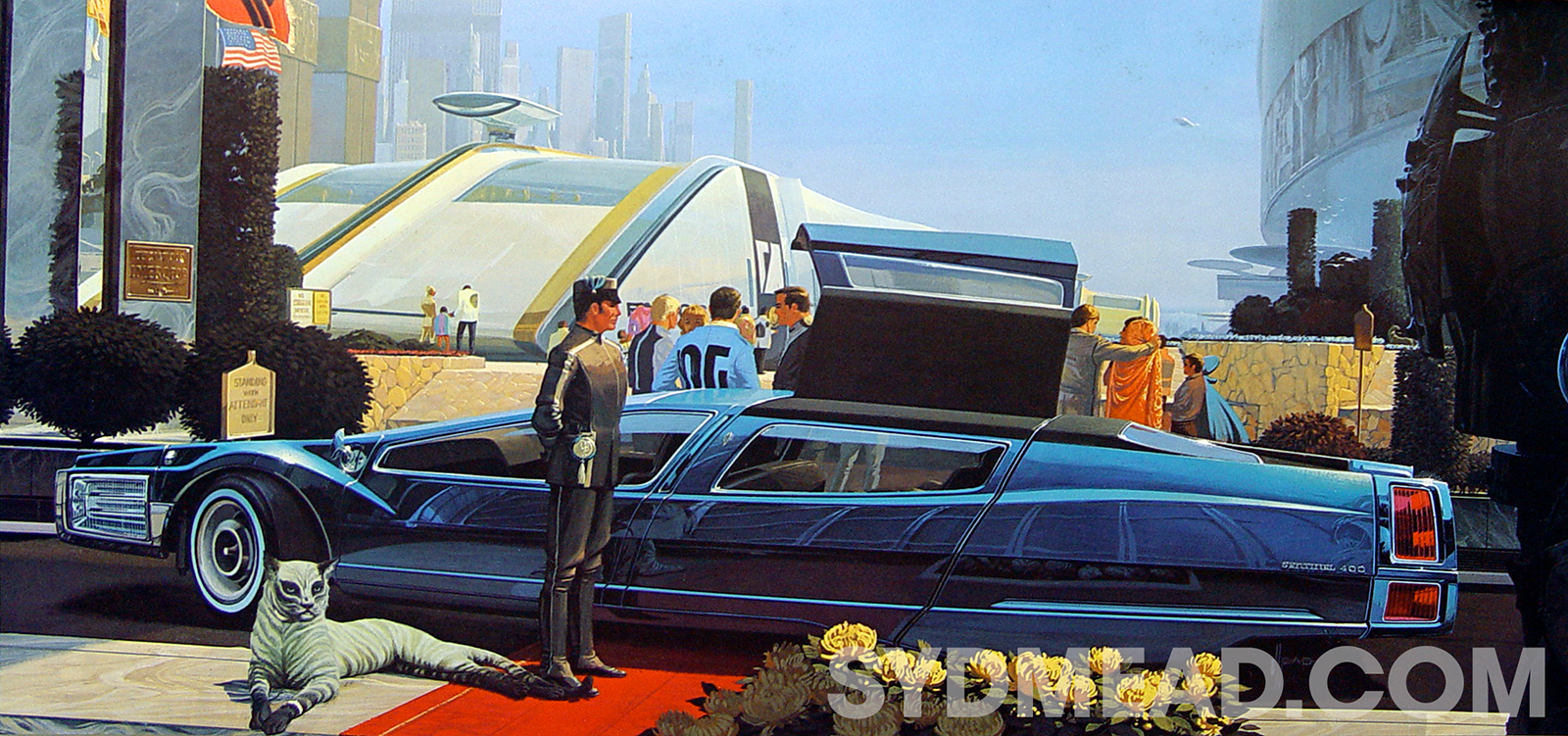
Ha! That’s hilarious, I’ve also come to that same conclusion about this car. I really love the torpedo or rocket/airplane shaped fenders. This car has so much swagger. A restrained restomod on this would be awesome.
the 4 door is peak.
“Also, I have to donate some props to the copywriter here, because the “pressing your nose against a window pane” analogy is spot-on and gives every nose-bearing mammal an instant and visceral understanding of what’s going on here.”
One wonders if Charlie Schmidt ever had one of those Grand Ams
https://youtu.be/S-AclyA32Co?si=jCImuJXycdRBHru9
Glad to see these 73-77 A-bodies getting some love. My first car was a 77 Grand LeMans. Similar profile, but quad rectangular headlamps and horizontal tail lamps.
If only these cars escaped the big bumper regulations, they would have been so fantastic.
Its funny that you mention Big American Iron when talking about this car. I was a kid during this era and I remember them being known as a “mid-size” car. My dad had a 76 Grand Prix that to me was the most awesome car ever (two-tone red exterior and red velour interior), but he told everyone he was downsizing. For reference his previous cars were Caprices and the like, and at the time my mom’s car was a 74 Coupe DeVille.
Yes, the Grand Am was designed as a size or two down from big American iron. These were 13-17 inches shorter than the “full size” Bonneville and Catalina; 19-23 inches shorter than your Coupe DeVille.
Good looker !
My memories of these only start when they were already depreciated used cars. Not terribly old, in the scheme of things, but they just seemed to age very quickly. By 8-10 years old, the paint was faded to a dull matte, all hubcaps missing, rust around the rear arches, at least one bumper held up with straps, and the driver’s door would have to be lifted upward a few inches before it could be pulled closed (by the new interior handle improvised out of rope and hardware store fittings, because the original broke off some time earlier). Also, owners seemed to love leaving chunky, re-treaded snow tires on the back all year round
The only thing missed was the explanation for not getting a door handle from a junk yard: they were all broken, too.
That was basically all cars back then. Even my first Volvo (’76 242), which was barely a dozen years old when I bought it, was a rusting, pretty much used-up heap. And they lasted a LOT longer than the average Malaisey Ameri-Barge in salty New England.
Though that said – my stepfather had a ’77 Grand Prix SJ (loaded, white on lipstick red leather) that he had for seemingly forever. Though looking back through time, it didn’t make it even 15 years, as it was replaced by a GoooLE (he was definitely a Pontiac man, the Grand Prix replaced a Bonneville, and I think a Grand Am came after that after they divorced). But he did manage to put something like 300K on the thing, having a LONG commute from our house in Maine to his job as the Postmaster of Portsmouth, NH.
That Grand Prix was the car that my mother managed to drive through the back of the garage when it was a few months old, while pregnant with my baby brother. A large tree prevented her from comprehensively redecorating the neighbor’s kitchen. Possibly explains a lot about my brother.
Volvo got the rust proofing figured out for the 700/900 models, but they still made the interiors out of materials that turned to dust in sunlight
No worse than most cars of the era. The newest of them are 31 years old now after all.
Color very much mattered. The black and gray lasted pretty good, at least until they updated the glues to be “greener” in 94-95 – 95s are REALLY bad for things coming apart- but that was an across the industry issue. Red was awful for disintegrating, tan was somewhere in-between. It also didn’t help that they were very, very much designed to be easier and cheaper to assemble than the 240 was, so it was mostly all held together with plastic clips and tabs, very few screws.
There are few cars as mechanically stout.
Back in the later 70’s I helped a friend install an Accel turbo kit on a SBC 73 lemans. It wasn’t a Grand Am, just a boring brown with tan roof and bench seats coupe. With the turbo it was a monster compared to most anything on the road at the time. Heaps of shenanigans were committed in that car.
“Rubber baby buggy bumpers”
Yeah, land yachts are awesome!
I’ve always thought Pontiac pulled otf the colonnade era GM cars the best by a long shot, and the Grand Am and following Can Am are the best of those for sure. Still also not a big car guy either but I can appreciate these.
I fell off the hood of one of these.
My best friend’s dad was working on a midget and wanted to start it.
He no longer had a truck with a push board on it.
The gran AM had the lowest bumper of the cars in the driveway.
It was close to slipping over the top of the push bar so i volunteered to set on the bumper to watch / hold the front of the car down.
One rule, no hitting the brakes, I could not reach over the long ass hood to grip the back.
The midget kicked sidways, the brakes were hit and I was off the hood.
I managed to direct myself off the side as to not get run over, did a tuck and roll, somehow, only barely skinned up.
The neighbor saw this and asked why were trying to kill me.
First and last time for that trick.
I’d like to point out the under-bumper indicators that were clearly designed to mimic the fog lights that were commonly seen on European cars of the era.
“You want European? We’ll give you European (sorta)”
These cars are great in your dreams. The 1/4 inch plus gap between doors and body or hood trunk to the fenders. Plus a new car door would drop 1/8 inch when opening this would always increase with time, until you had to lift it to close. I remember these cars well. Please don’t let the romantic filter of memory delude you into rescuing something that would make an excellent bundle of emt for a data center. After they have been recycled.
The good old days really weren’t all that good at all – especially when it came to American cars.
Hey! I think you just identified why I started preferring sedans in the 1980’s since the coupes had those saggy doors, and sedan doors were shorter by the 1980’s! (Also the doors were too long for parking lots if someone got too close)
Edit: Much of my door experience came from a Mustang II, so not even one of the largest doors.
I always liked the Colonnade sedans although Chevy Chevelle Malibus were by far the most common. IMO the coupes look best with the non-formal triangular rear windows you couldn’t get on a Grand Am at all.
I think the Grand Am might’ve sold better if the minimum buy-in wasn’t a 400 V8 just before the gas crunch – if they’d offered even a 350 (let alone a 305 or Chevy six) they probably would’ve sold enough more to make it worthwhile.