

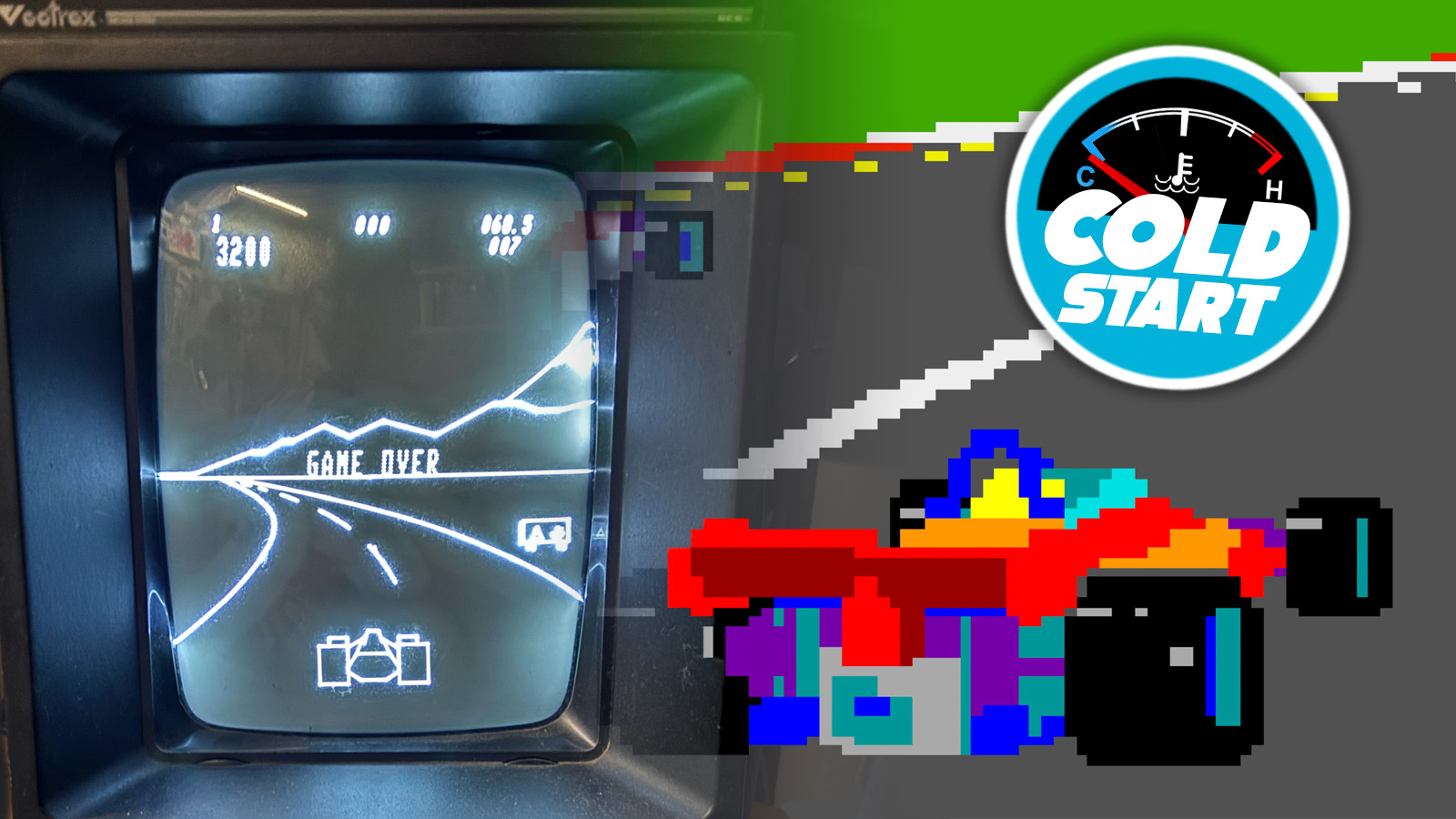
I’m not sure exactly what made me think about this, but the concept of translation was on my mind this morning. Not necessarily linguistic translations, though that is a whole interesting subject of its own, but more transitions of things between types of media and technologies, and how challenging that can be. And, because my default settings tend to revert to things that, you know, don’t really matter, the example that popped into my head had to do with cars and obsolete technologies.
Specifically, I was thinking about the design challenge that arose when the iconic Namco/Atari arcade racing game Pole Position had to be translated for use on the Vectrex, the only home video game console designed to use vector-style graphics as opposed to the far more common raster.


Are you familiar with the Vectrex? I did a whole video about it for the Old Site a few years ago:
The way the Vectrex produced graphics wasn’t just a stylistic difference, it was a fundamental technological difference, with different hardware. That’s why it was the only somewhat-major home console that couldn’t just be connected to your television; it had its own built-in CRT, which was needed because it worked differently than a television CRT. Where a normal raster CRT’s electron gun scans side to side and illuminates discrete pixels to form an image, a vector scan display draws images point to point, creating perfectly straight lines between points. None of that diagonal line stair-stepping effect, just lines that look like they were drawn with a protractor.
There were a number of video games of the era that used this approach, like Asteroids and Tempest, and I think there were some CAD systems back in the day that used this method. Here’s an illustration, if that helps:

See the difference there? Dots vs. lines, basically. And while vector scan was great for some kinds of images, especially precision wireframe sorts of things, there was lots it just couldn’t do, like big filled-in areas of color. That’s why I was thinking that the translation of a game like Pole Position, known for its rich, colorful, realistic (for the era) graphics, would have been such a challenge for the Vectrex.
Here, let’s compare the arcade Pole Position with the Vectrex version:
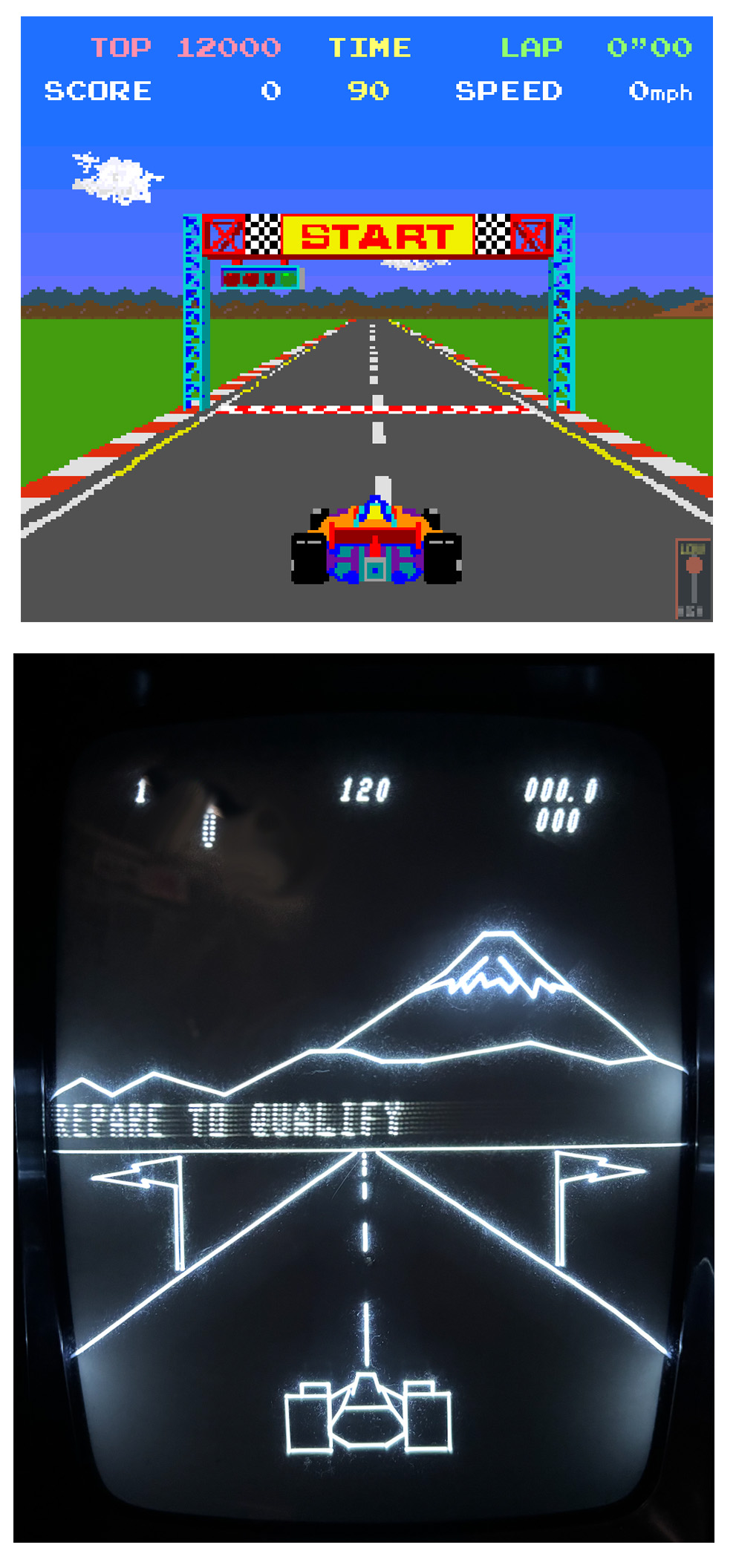
It’s very different, but I think it works remarkably well. All of the key elements are there, and it still feels like the original game, even if it looks significantly different, owing to the very different display technologies. The programmer of the Vectrex conversion of Pole Position wasn’t widely known until 2024, when an Easter Egg in the original code was found that just displayed the words “THE KID.” The Kid himself eventually came forward and told the world his actual name: Joel Hassel.
I especially like how Hassel translated the quite detailed player’s car for the Vectrex version, which was a pretty tricky task. Not only could the Vectrex only produce straight lines, but the number of lines wasn’t unlimited. The limitations of speed and memory meant that the number of line segments needed to be kept fairly low, and I think Hassel did a great job of that, with the whole car being a mere 25 line segments in its central position.
Let’s look in detail at how the car was translated from raster to vector:
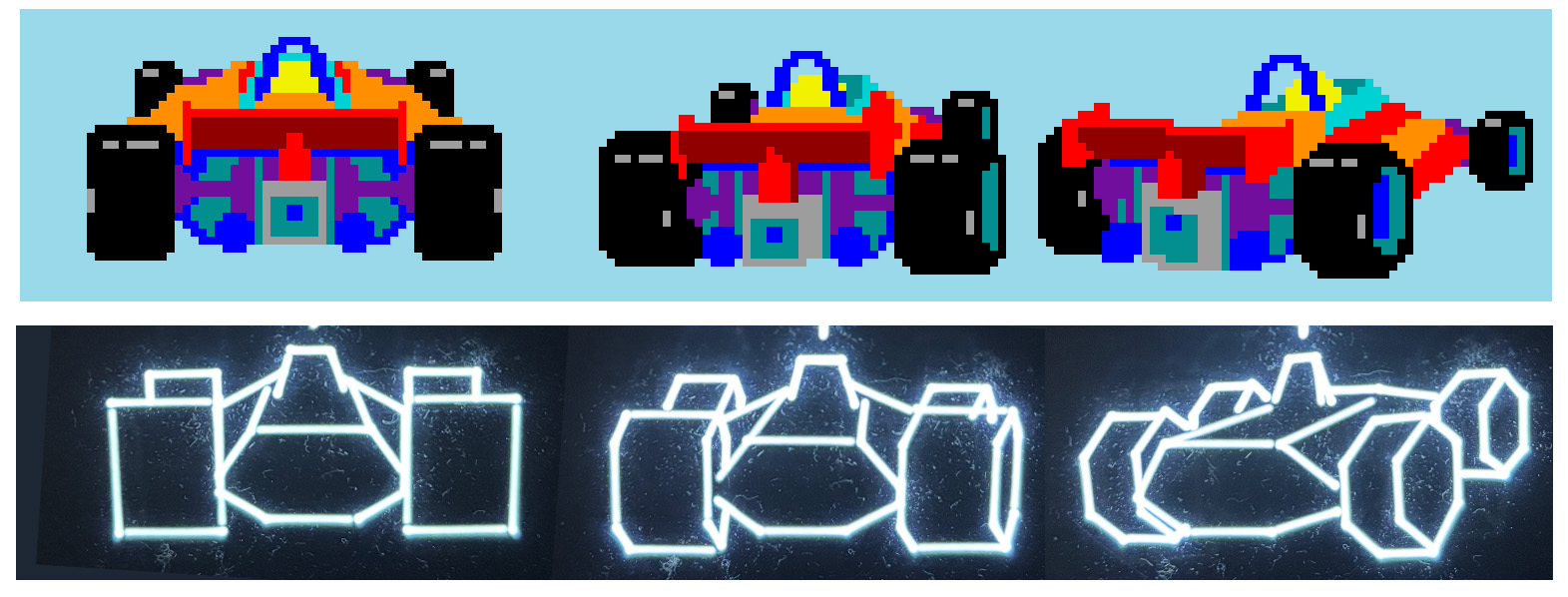
I don’t know exactly why I find this so satisfying, but I have a weird fetish for restrictions and how they force creativity, and I think this is just a really compelling visual example of that. The visual tools here are so divergent, but you have to admire how Hassel captured the look of that car. The widened hexagonal rear section fits well, the two angled lines from the upper corners of the rear hexagon define the body and give it visual, foreshortened length, the wheels feel like chunky F1 tires even if they’re essentially extruded hexagons, too.
Am I fixating too much on these details? Maybe. Probably. But I love seeing a design challenge met, and I think the Vectrex version of Pole Position is absolutely that. Maybe if you have some difficult hurdle facing you, you can look at this 40+ year old video game and find some kind of inspiration in it. I know I do.


In the last illustration the Vectrex version of these cars appears to have rear-wheel steering. At least to my eyes.
This all reminds me of back when Postscript-capable laser printers became available in the mid-80s. A quick read of the Wikipedia article about PostScript points out the original Apple LaserWriter was priced at $6,995 (1985 USD). That inflates to $21,000+ 2026 dollars!
Being an early adopter is not for the faint of wallet.
I am familiar with Vectrex from Homestar Runner references.
YOUR HEAD A SPLODE
https://youtube.com/watch?v=BS33WI-1FNc
Vector fans, check out the Rebirth section on the Vectrex wiki:
https://en.wikipedia.org/wiki/Vectrex
Could it be true?! Truly: No way!
The Vectrex was for the longest time my white whale of my retro game collection. I got one about 3 years ago. It’s a great console. They did some clever graphics. I lack overlays for most of the games, but still fun.
This era of video game programming is amazing to me. The things they could accomplish within the constraints and the magic they could work with simple graphics were incredible.
Games now can be well over 100 GB, need patches to work correctly, and often feel like reskins of other games. A single skin in a modern game can take as much disk space as hundreds of NES games.
LOOKING AT YOU FORTNITE….
Whole games were in the kb size range! And a lot of them were more fun than modern stuff. As a kid, I dreamed of the technology that could allow the kind of games we have today, but now that they exist, I find them too serious.
Yeah, the entire NES library is something like 250 MB for like 800+ games. And I’d rather play many of those than a lot of brand new games.
I designed a stand up arcade cabinet (complete with artwork for a fictional game) with changeable control panels for different types of games for that reason—a simple thumb drive would give me all the games. Ultimately, I didn’t have a good place for it and I don’t think it would get enough use, but I love the idea.
The technology that allows it is too expensive, so they only get made by big-budget teams beholden to investors who demand safe returns. Indie games, on the other hand, are largely made by/for hardcore gamers.
Most games are either a 5,000lb BMW M5 or an Ariel Atom, everything in between is a rare find.
It’s all because the pixel graphics share similar traits as vector graphics where math/code generates instead of creating a bitmap and applying it to something.
Now these days even pixel based games are really just using bitmaps.
That’s true. It’s funny to see the pixel games playing at being retro when they didn’t have to do any of the optimization behind the scenes or use any tricks to make the pixels work. Every asset gets to be its own thing.
Old man voice: “Back in my day, we had one bush cloud. It was white in the sky or green on the ground, and we were having too much fun stomping goombas to notice.”
I’m curious what the next major shift will be.
Since the transition to 3D we haven’t really seen a fundamental change in the architecture of how games are built. Even most if not all “2D” games are really just running in a 3D engine with the appearance of being 2D.
Tool sets have definitely evolved and we’ve added the complexity of client/server but at it’s core things haven’t changed a ton in the last 30 to 35 years, at least since Quake (considering Doom and Wolfenstein are really pseudo 3D games).
I’m not sure if we’ll ever see another big swing. I honestly don’t think there will be any more paradigm shifts in how the game is perceived.
If anything, we’ll get more realism/immersion features, like more advanced physics-based animations (i.e. characters walk by actually shifting simulated weight on simulated feet), or procedurally-generated NPC dialogue with some LLM that enables the player to sell their personal information to the developers in real time.
Once the 3D thing is pretty much perfected, I imagine we’ll see lots of universal-use and even some crowd-sourced engines coming out where folks can relatively cheaply make games, and then we’ll see a lot of fun titles, as well as a lot of slop. Sifting through them will reveal the diamonds in the rough.
Being a retro game collector myself, I’ve done a fair amount of reading books about the older systems. The accounts of the folks making games in the era and the tricks they used to get the results were impressive.
Honestly never saw one in the flesh, but I would have totally fawned over it if I had. Many of my favorite arcade games in my youth were vector-based – Lunar lander, Tempest, Asteroids (and deluxe), the OG Space War, Star Wars, Battlezone, and my all time favorite, Star Trek. If your arcade had the sit-down version of Trek, you were living. Here’s an incredibly geeky confession – my local haunt had it, and I’d go in and play it while listening to “the wrath of Khan” soundtrack on my walkman. I can admit to this because I know I’m among friends.
Sweet, a Vectrex story! And do I have a Vectrex story for YOU!
I found my Vectrex in a junkyard. Yes, you read that right.
About 17 years ago now, I was perusing the selection of older vehicles at a local yard with a few buddies, and while investigating a blue 1966 Rambler Classic 660, my buddy commented, “Hey, check out this weird little TV!” My eyes bugged out of my head!
After I explained what it was and marveled at the overall condition of the unit, he handed it to me and said that it was mine. I brought it to the counter, and they said I could have it for free, otherwise they would have to pay someone to recycle it. Unreal!
I still have it, and it still works. Although I haven’t picked up a copy of Pole Position for it (it’s one of the more expensive games), I do have a copy of Hyper Chase, which is nearly as good. It’s more like Sega’s Turbo arcade game or Enduro on the 2600 than Pole Position, though. Don’t forget the overlays!
Also, they ported a few non-Vector games to this thing. Another good example is Konami’s Scramble. They did a pretty great job with that one as well.
Holy crap, a free Vectrex in a junkyard! Amazing!
I still can’t believe it! All that was wrong with it was that it was missing the little cap on the thumbstick, which was a $5 purchase on Ebay. Still works, too!
Strangely, that was not the 1st time we found gaming items in the junkyard. We once found a NES and about 30 games in a Chevy conversion van (buddy kept those, and still uses it regularly), and I found a rare AA battery pack for a Sega Nomad (portable Genesis) in a Subaru XT6, which in my head, makes complete and total sense.
Somewhat related, I found an Armor Attack arcade game in the junkyard! I had to rebuild the monitor board, replace a few components here and there, and clean it up (a lot), but it works great! I have it in my office on campus alongside a Q*Bert cabinet so I can explain the difference between vector and raster data structures to students.
I also have a Vectrex and a CIB copy of Armor Attack at home, they weigh significantly less than the arcade cabinet lol
That is amazing! I mean, how does that even end up there? Incredible.
I also have Armor Attack on the Vectrex. That’s a good one.
JT: I’m assuming you’re subscribed to Technology Connections on Youtube. If not, it’s a channel that goes insanely in depth on things just like this. Check it out.
I love Alec’s videos. He’s got some great ones that delve into the topics of EV’s. Plus he’s overvolted electric kettles in another. Great stuff.
Also LGR (Lazy Game Reviews) and Techmoan if you love weird old tech. LGR mostly focuses on PC stuff and oddities, Techmoan is fascinated with dead formats.
Love those guys… Also, The 8-bit Guy has some great stuff on his channel. He developed the game PETSCII Robots and has some awesome C64 content as well. Did I mention that he also owns and operates an arcade in Texas?
What i want to know is how it handled the curved edges of the track. Straight lines are easy, but drawing a curved line would be mathematically intensive or require what I would expect to be a prohibitive number of individual line segments.
It looks like segments, but just barely; the curved road lines are surprisingly, good!
I like how the Vectrex version (it’s hard to call something like that a “port”) basically backdated a 1980s themed game into a ’60s themed one, de-winging the car and turning it into a flying kazoo. But only because of the limitations of graphics that were arguably more ’80s in vibes.
When I think of vector games, the first one I think about is the cool Star Wars game that was in arcades for a while. Also Battlezone is one I spent a lot of time with. I never thought about it before, but that used vector graphics also. Something about vector graphics made the games seem cooler, but I’m not sure why..
The sit-down Star Wars vector game is still my all-time favorite video game from the 80s. I always look for it when I find a vintage-themed restaurant or arcade with old games.
Battlezone was on my list as well. Vector graphics just worked for the 80s.
Speaking of translation, I’ve often wondered how your word play, plays out when translated to other languages. Have you had interesting feedback?
If the translators use AI- “Oh it’s Jason, forgetaboutit”
Honestly, when comparing CRT tech to LCD, I’m amazed that CRT was first. We as a society were REALLY good at coming up with complicated designs that are both elegant and durable before microchips gave us an easy button.
I’m also a big fan of the portrait style CRT on the Vector.
This gives me renewed motivation to go pick up that 32″ CRT from my dad’s place and set up my retro gaming station. I’m not looking forward to hauling that behemoth up the stairs. Wild to think my parents paid $900 in Maple Money for that thing back around 2000.
Yeah, had a 32″ Panasonic back in the day. Thing was a monster.
I remember my parents upgrading from a 22″ CRT to a 27″ CRT, and it was just massive! It didn’t even fit in the “entertainment center” any more. The doors had to be removed from it so it would fit.
When they eventually switched to a LCD (or was it a plasma?) that was the final nail in the coffin for the entertainment center.
The first TV I remember us having was like a Mid Century stereo with shittier style. It was a major piece of furniture about 5′ or 6′ long and over 2′ high and deep for something like an 18-20″ B&W screen.
I used to sell TV’s in the 90s for a major big box electronics store. Having to lift a bunch of these large CRT’s in even bigger boxes completely sucked. The worst was when we stocked a 39″ Toshiba for a time.
In the mid 90s I did desktop PC deployments for ITT Automotive (anyone remember them?) and each shiny new Pentium came with a shiny new 17″ SVGA Display. I could do 4-6 a day depending on how much data the particular person had on the old machine, each morning was spent digging out a stack of monitors and desktops onto my flat cart to haul from the loading dock to my staging cubicle.
I did manage to snag a 21″ Nokia CRT, that thing weighed as much as I did.
Ha, that’s not a TV, this is a TV: Sony actually made some…43-inch Trinitrons!!
Just posted a comment in this thread with a link to a really good YouTube video about those 440-pound leviathans.
Yep…. someone on YouTube sourced one from Japan and had it shipped to the USA where he reconditioned it. What a freaking beast!
Yeah, this is the link that I mentioned as having posted in another comment: https://youtu.be/JfZxOuc9Qwk?si=SixB7TOxxKZyyvjg
The YouTuber is ShankMods and the video went briefly viral in 2022. Well worth the watch!
My uncle had a 60″ around ’90. If you looked at it at more than a 20* angle from head on, the picture disappeared due to the fresnel lens. I don’t remember the exact price (my jealous father made sure we knew and what a waste it was, but we all knew he was coping), but even ignoring inflation, it would be big money today. My BiL bought a 84″ a few years ago for a lot less in today’s money. Physically, the 84″ isn’t even that much bigger and hangs on a wall instead of probably weighing as much as a large gun safe.
This is a really good video about the 43-inch (!!) and 440-pound (!!) Sony Trinitron PVM-4300, the largest CRT TV ever produced and sold to the public, and the discovery of one (just one or two are known to still exist) in Japan and its relocation to the USA: https://youtu.be/JfZxOuc9Qwk?si=SixB7TOxxKZyyvjg
I didn’t realize they made Pole Position for the Vectrex. It’s a stretch, but does look good. Unfortunately, the reverse ideas didn’t go so well: Tempest is an awesome vector game that did not translate to the Atari 2600’s capabilities.
A lot of existing games didn’t translate well to the 2600’s capabilities. Ref. overbite Pac-Man.
I chalk the bad Pac-Man port up to the fact that it was done by a single developer with a 4 month window and was forced to use the 4K cart size despite other larger sizes being available.
There have since been recent ports done in the past decade that look much better, some of them are even 4k in size.
As a Coleco owner at the time, I just kept thinking what could have been. They had some of the best home versions of popular arcade titles.
Coleco had this racing game called Turbo that came with wheels and a pedal. The first time I had a chance to play that at a relative’s place blew my freaking mind that it felt pretty similar to arcade racers of the day.
Also played way too much of the Smurfs game as it was one of the better pre-mario platformers of the day.
At Blair Alley Vintage Arcade in Oregon they used to have a vectrex racing game and a tank destroyer game. I was blown away by the 1970s “3d” graphics while drunk. They retired them after they expanded and most of their old arcades are pinball machines at this point, but what a marvelous technology!
Did any car screens ever use vectrex? Likely no, but if one ever did I would think the Aston Martin Lagonda would’ve been a good fit.
If near Pittsburgh, Pins Mechanical Co. and Coop DeVille both have vintage arcade machines, pinball and duckpins. Pretty sure Pins has a Tempest machine.
If in Pittsburgh, Pins Mechanical Co and Coop Deville still have vintage arcade machines. Pretty sure Pins has a Tempest machine.
The Vectrex version makes me feel like I am watching Automan. Cursor, car.
I’m hopeful that Tubi will eventually get that show b/c that’s exactly the kind of forgotten but cool show it would pick up. I’ve been happily watching Stingray, another car adjacent show I loved back when but had totally forgotten about.
CRT’s don’t have pixels at all. Like you said, they are lines. I believe it’s the aperture grill (or sometimes a shadow mask) that along with the gun bandwidth determines the “length” of the illuminated area that you are calling a pixel.
They do and they don’t. They have RGB phosphors illuminated by the electron beam, clustered together to make hues and luminance in discrete quanta, i.e. pixels. They have pixels in the same way an LCD or OLED has pixels: they don’t physically, but they do practically. It’s more of a logical unit of an image than a physical object.
At risk of “telling you what you’re saying” – which is extremely annoying and not my intention at all – are you thinking of scan fields/scan lines? At 240/30i these are horizonal fields redrawn (by illuminating phosphors) every other field each second, so in a 240i (interlaced) picture you redraw 120 fields 15 times in a second, alternating with the other 120 fields (30 total redraws), capitalizing on the residual glow from the phosphors for image persistence.
I’d argue it’s not discrete quanta, because CRT’s aren’t able to control them to such
precessionprecision. They can’t illuminate just a single “pixel”. The beam size is too large, mask aperture too large, and gun bandwidth too broad.CRT’s illuminate groups phosphors, and it’s “fuzzy” where exactly that illumination starts and stops.
So no, they don’t have pixels in the same as as LCDs or OLEDs do, at all. Saying that they do is like saying film grains are the same as pixels; they aren’t. I guess if you want some big overly simplified way to explain to people, treating them the “same” isn’t bad. But when you discuss how they actually work and what’s going on, no they aren’t the same at all.
This is one of those perfect examples of ‘Yes, but also no.’
Growing up poor, I’d have murdered someone for a Vectrex console.
Preferably an oligarch.
You’re welcome to live out that dream for a current gen console. I doubt anyone will complain.
I volunteer… Elon Musk.
A wild Neo Geo AES enters the chat.
Torch—so does the vectrex car get rendered as a finite number of sprites? Or are they doing transformations? It seems like it *just* might be possible to do the car turning mathematically since all the vectors are probably stored in an array. That is, if you happen to know…
The car seems to be a finite number of sprites, or whatever the vector equivalent is. I think for simpler things, like an overhead rotation of an Asteroids-style ship, it can be done mathematically, but I think for a movable object as complex as the car, the 6809 CPU is just too slow
The vector display simply draws line. The electron beam is steered in arbitrary directions. The raster “conversion” occurs when the beam strikes the phosphors.
So it’s basically a laser light show that splats on a screen?
Yes, exactly, Instead of a laser steered by mirrors it’s an electron beam steered by magnets.
this is such a perfect description!
Looking at the screen shots, I think the real trick was figuring out occluded lines. It’s pretty easy to move 3D points around in 3-space using matrix math with a second operation to map to 2-space. The thing to remember is these points represent polygons and the fill area is opaque. I wonder if that was done in software or hardware.
I don’t think the Vectrex was capable of the idea of a “filled” area; they were all just lines. You can look at the middle car on the Vectrex/raster comparison image and see where a pair of lines overlap into what should be an “occluded” area