

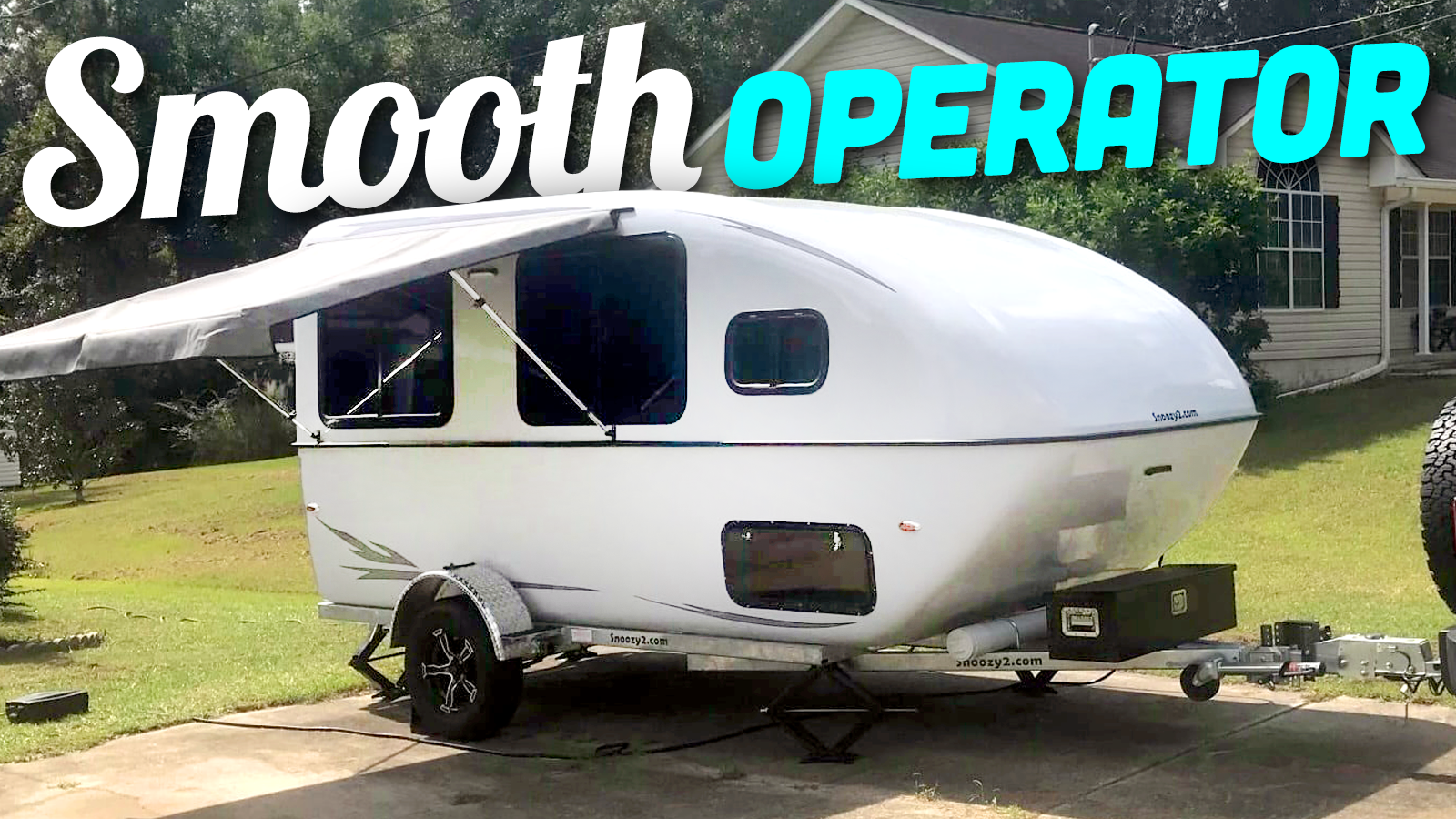
Spring is here, which means camping season has begun for so many Americans. Unfortunately, this season’s high gas prices might turn some people away from buying a new camper. But if you’re in the market for a new camper and might want to save a little gas, I found an interesting alternative to the typical travel trailer. This is the Snoozy, and it’s a well-equipped fiberglass camper trailer by a boat designer that was tested in a wind tunnel. But there’s a big, infuriating catch.
The poor aerodynamics of a typical camper trailer are a large part of why your tow vehicle guzzles fuel or sucks down its battery while towing. Most campers are shaped like bricks. If you’re lucky, the RV manufacturer slaps on a rounded front cap, but your tow vehicle is still forced to yank what’s more or less a building through the air at over 60 mph. This kills your range.


Last year, Robert Dunn of Aging Wheels perfectly demonstrated this by making his Chevrolet Silverado EV haul loads with different aerodynamic shapes and weights. He found that weight alone made a negligible change to fuel economy. Yet, when you tow something that has the aerodynamics of a brick, it’ll destroy your fuel economy or electric range, even if the trailer doesn’t weigh a lot. For example, Dunn used his Silverado EV to haul his Polestar 2 on an open trailer, scoring 1.09 mi/kWh efficiency. When he built a wall on the front of the trailer, simulating an enclosed trailer, efficiency fell to 0.94 mi/kWh. Click here to read about the test.
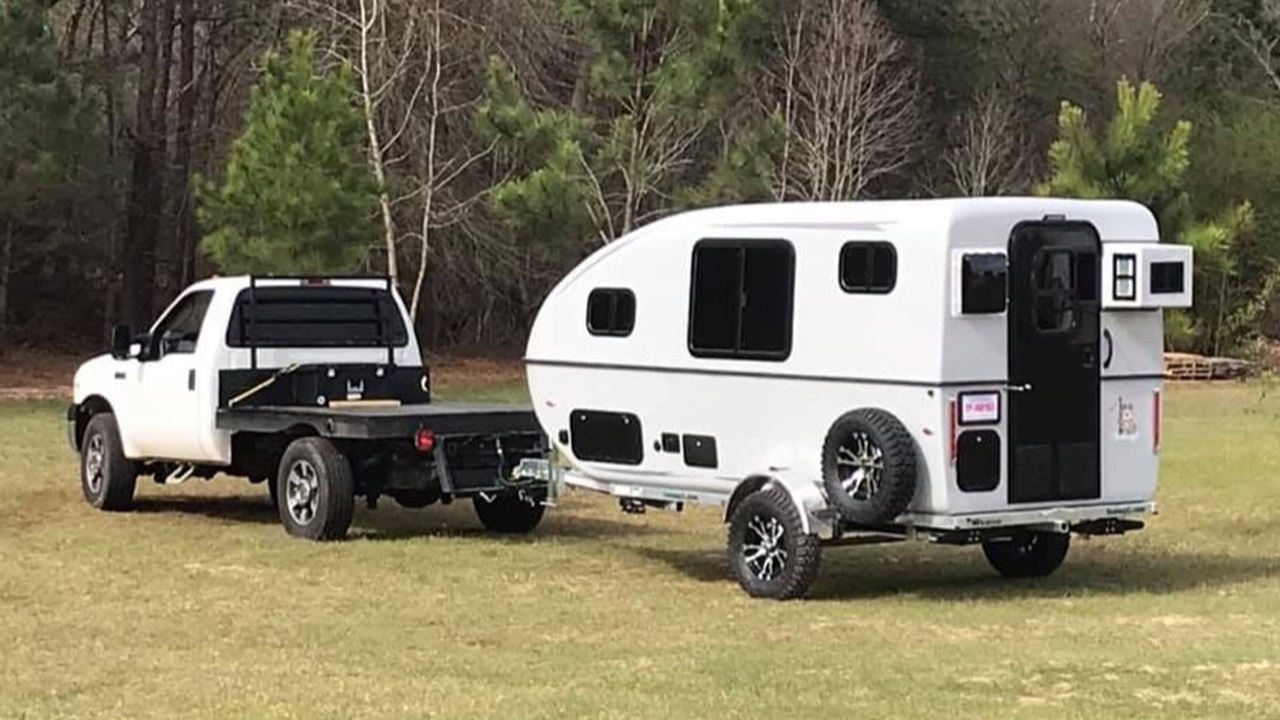
This same logic applies to vehicles powered by internal combustion, too. A lightweight camper trailer will likely cause greater fuel burn than a trailer that’s built to be aerodynamic. Of course, an RV might be the second-largest purchase you make in your whole life, and RVs often require a lot of money just to store, maintain, and operate. So, the cost of fuel to tow or drive your RV probably won’t even be the greatest expense.
Yet, some people do care about not blowing a ton of cash on RV trips. It’s a factor of why some people prefer aerodynamic teardrop campers over traditional travel trailers. But what if you could have both? The Snoozy is shaped a little bit like a teardrop, but is also large enough to spread out in. Unfortunately, you might not want to buy one new.
From Pools, Planes, And Boats To An RV

If you think the Snoozy looks like it was inspired by a boat or plane, you wouldn’t be far off. The camper was the brainchild of Robert Alan Smoak.
Smoak was an entrepreneur, a pilot, and an engineer who was known as the creator of Eagle Boats and Alaglass Pools. He specialized in creating objects out of fiberglass, and here’s what South Carolina’s The Times and Democrat said of Smoak’s business ventures:
Alan Smoak, who owned Alaglas Pools from 1989 to 2000, has opened up a fiberglass camper trailer business Smoakin Concepts Composites. Smoak owns and operates the business with his son, Nicholas. The business, located at 191 Sweet Bay Road next to Alaglas Pools, is open Monday through Friday from 8 a.m. to 5 p.m. and will be open by appointment on Saturday and Sunday. Smoak decided to sell Alaglass with plans to retire but was inspired to pursue a new business venture about two years ago.
“The smaller ones (campers) were in tin boxes,” said Smoak, in relating his experiences traveling the country at various camper trade shows. “They were cheaply made of a cheap quality.” His dissatisfaction with the state of the small camper industry propelled Smoak to design a new concept – a fiberglass trailer. “We have made a classy little small camper,” he said. The 14.5-foot long “Lil Snoozy” trailer (excluding the tongue) is fiberglass-insulated with foam layered between fiberglass. “Our inset is like an igloo cooler except we use fiberglass and not plastic,” Smoak said. “Frames are galvanized.” Under 2,000 pounds, the camper can be pulled by a car and provides 6-foot, 3-inch headroom and “can fit in a one-car garage.”
“It is aerodynamic,” said Smoak, who also is a pilot. “It looks like the front of an airplane.”Smoak said the market for the lightweight trailers is great especially with near record high gasoline prices.”Everybody is getting away from the large campers and getting to the smaller campers,” he said.
Check out one of the original Lil Snoozys:
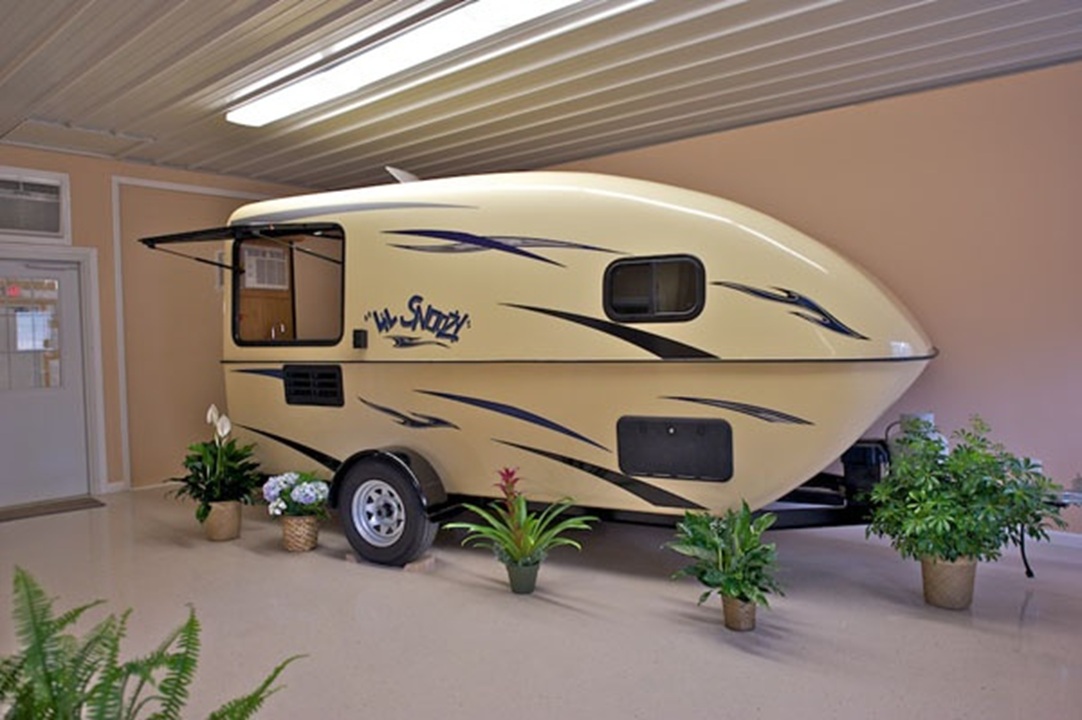
Lil Snoozy trailers was founded in 2009 under Smoak’s then-new company, Smoakin Concepts Composites. By 2011, RVTravel reported, Smoak planned on building two to three campers a week, later ramping up to six units per week. In 2013, Smoak sold the firm to Richard Mickle, who kept production going under a company called Lil Snoozy LLC.
Sadly, Smoak passed away in December 2024 at the age of 74, leaving behind a legacy of creative uses for fiberglass.
Lil Snoozy LLC. ran the trailer company a little differently, demanding a $10,000 deposit before the $15,000 campers were built. Unfortunately, this model meant that when Lil Snoozy LLC filed for Chapter 7 Bankruptcy in 2019, every waiting customer became an unsecured creditor who either wanted their trailer or their money back. Reportedly, when Lil Snoozy LLC shuttered, it was in such a bad shape that there was no inventory, partially-completed trailers, or equipment that could have been seized to pay creditors. Apparently, even the molds used to create the fiberglass bodies were in bad shape.
Thankfully, there was good news. In 2019, a completely different company, Wesco Trailers, a maker of boat trailers from South Carolina, picked up the scraps from the Lil Snoozy bankruptcy.
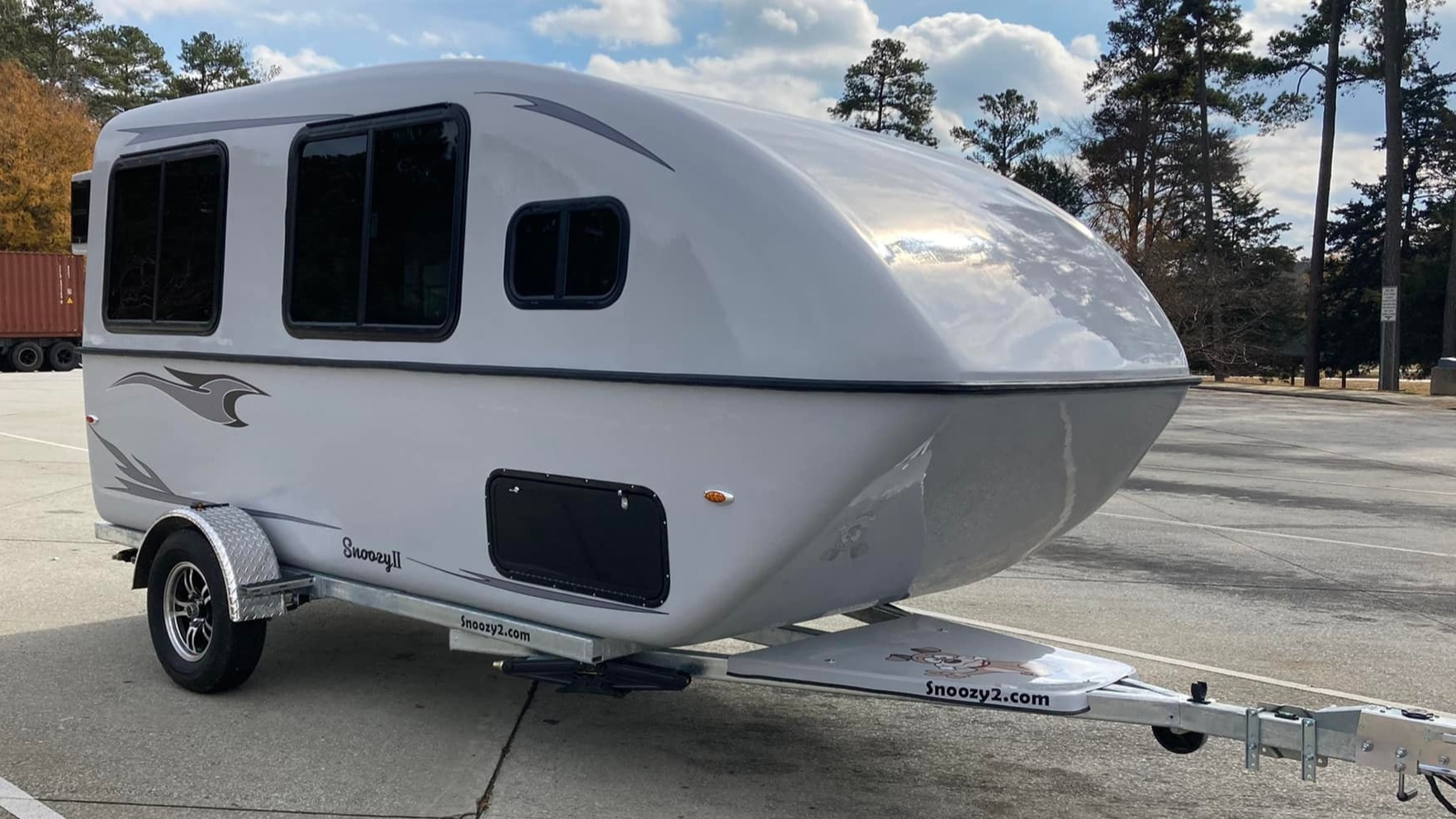
Wesco wanted to use its resources to improve on Smoak’s design. The Snoozy II, as Wesco called it, would get an optimized design from the frame up. This went as far as putting the body into a wind tunnel and letting engineering students from the University of South Carolina reshape the camper’s fiberglass shell to maximize aerodynamics.
Apparently, Wesco also tried to clean up the mess left behind by Lil Snoozy LLC by hiring the workers who had been let go after the operation’s failure. Wesco also gave the customers stiffed by Lil Snoozy LLC first dibs on the Snoozy IIs. Unfortunately, in creating the Snoozy II, Wesco would almost double the price of the camper, but also still require a deposit of $10,000.
Today, the Snoozy II is now just known as “The Snoozy.” Confusingly, the camper division of Wesco is also called The Snoozy. So, what do you get when you buy one of these?
Boat Trailer Bones
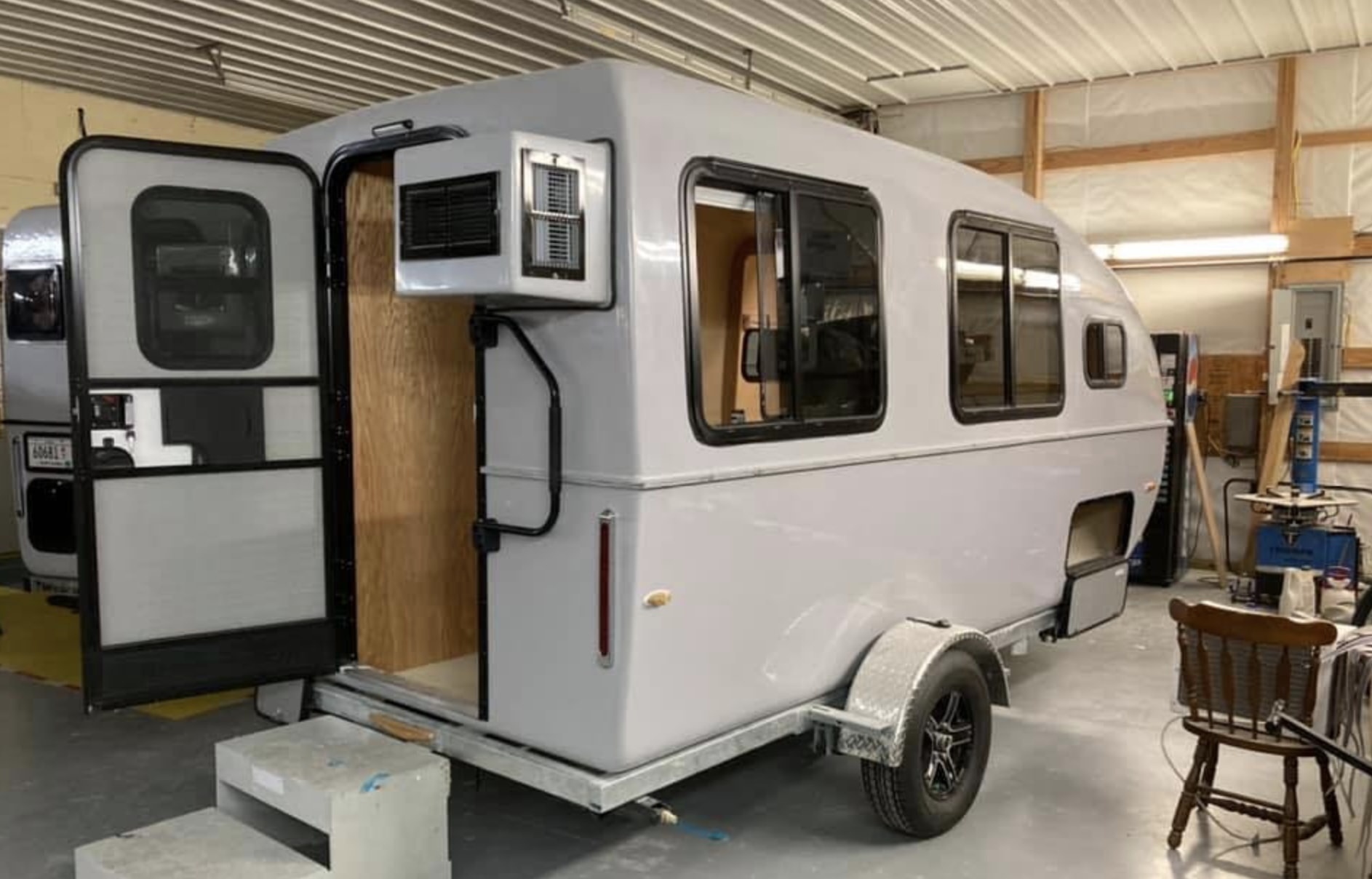
The new Snoozy’s design rides on a galvanized Wesco Marine chassis with a 3,500-pound axle and a spring suspension. Since this frame was originally designed for the carrying, launching, and retrieval of boats, it has optional surge brakes.
A surge braking system is self-contained, requires no modification to the tow vehicle, and requires no brake controller. The tongue of a trailer with surge brakes has a primary cylinder. When you apply your tow vehicle’s brakes, the tongue of the trailer pushes a rod into the primary cylinder, activating the brakes.

Boat trailers use surge brakes because they’re simple, reliable, and remain effective even after immersion in water. But they have quirks. Some surge brake designs apply the trailer’s brakes when you’re reversing, and surge brakes cannot be manually triggered or adjusted on the fly. Campers, which don’t need to reverse down boat ramps, tend to have electric brakes.
On top of this chassis is a double-hull fiberglass body. The Snoozy isn’t doing anything new in this regard. The fiberglass tubs meet a central point where they’re bonded into a single piece of fiberglass. This is the industry standard for fiberglass and has been proven to create rigs that can last for decades.
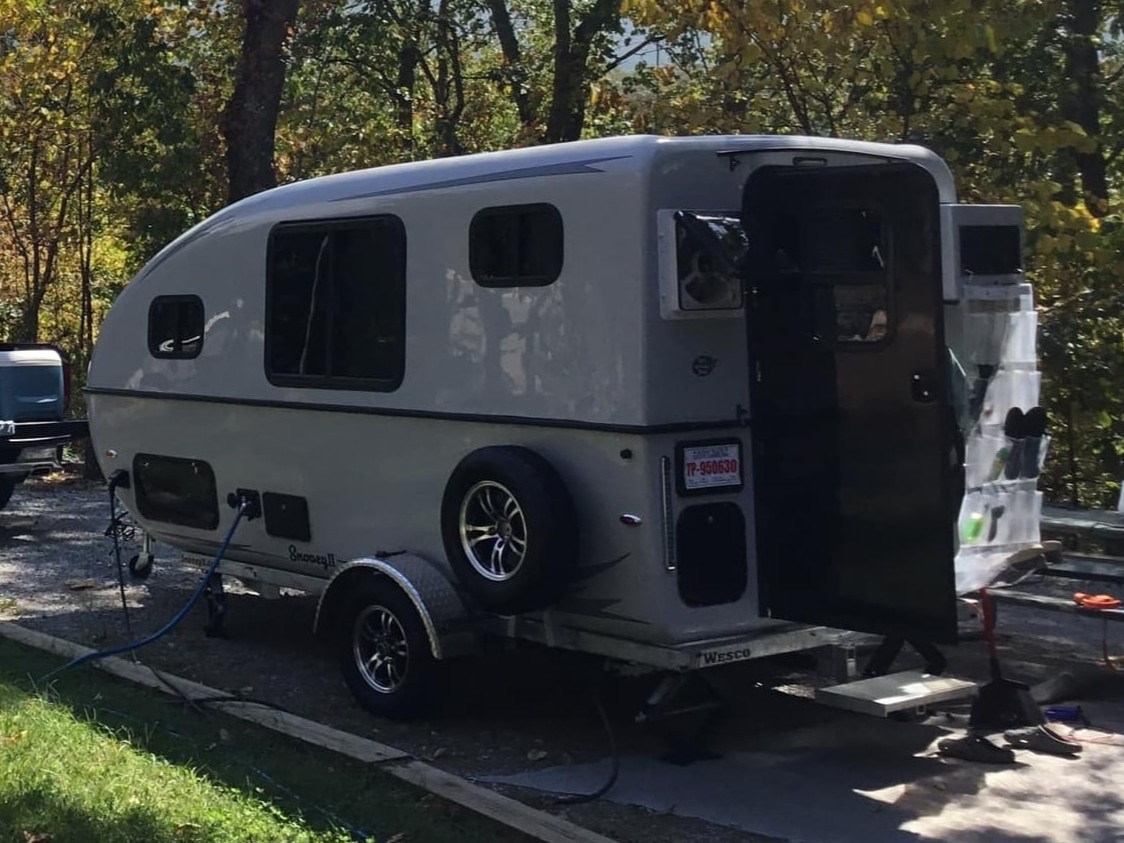
A neat quirk that I like about the Snoozy design is its lack of any holes in the roof. Not only does the Snoozy not have wood that can rot out, but it doesn’t even have a hole in its roof for water to get into. I like that. The camper shell is also covered in gel coat.
Entry to the trailer is gained through the rear, where you’ll find the door and an air-conditioner poking out of the back wall. Inside, there’s a cozy interior featuring your choice of red oak or maple cabinetry. Wilsonart laminates are used for countertops with textured stone or wood-look finishes. Congoleum ArmorCore felt-sheet flooring with one of four different wood-look finishes is used down below.
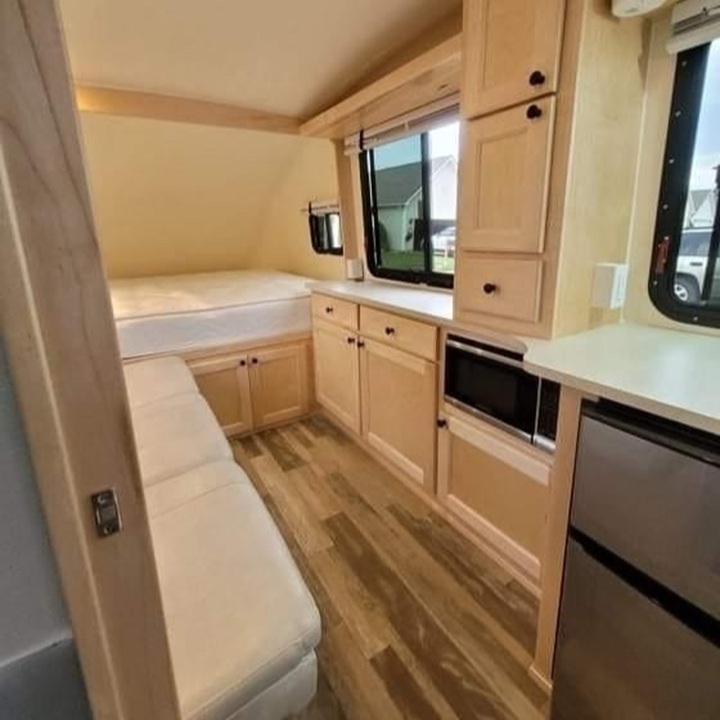
There are two versions of the Snoozy available, one with a queen bed and one with a twin bed. Going with the twin version saves 200 pounds, which we’ll get to in a moment. Regardless of the version you buy, the standard features list is both nice and a little weird. You get an 8000 BTU air-conditioner, a stainless steel sink, a 700-watt microwave, a water heater, a refrigerator, and a wet bath with a shower and a cassette toilet. There’s also a sofa that can be slept on. That’s all pretty great.
But then you notice that there isn’t a stove, and your room heater is a 350-watt Handy Heater, which is more of a personal heater that you sit next to at home and not an RV heater. These limitations seem to be because the Snoozy does not carry any propane, but there looks to be enough space in there for an electric cooktop and a slightly bigger heater.
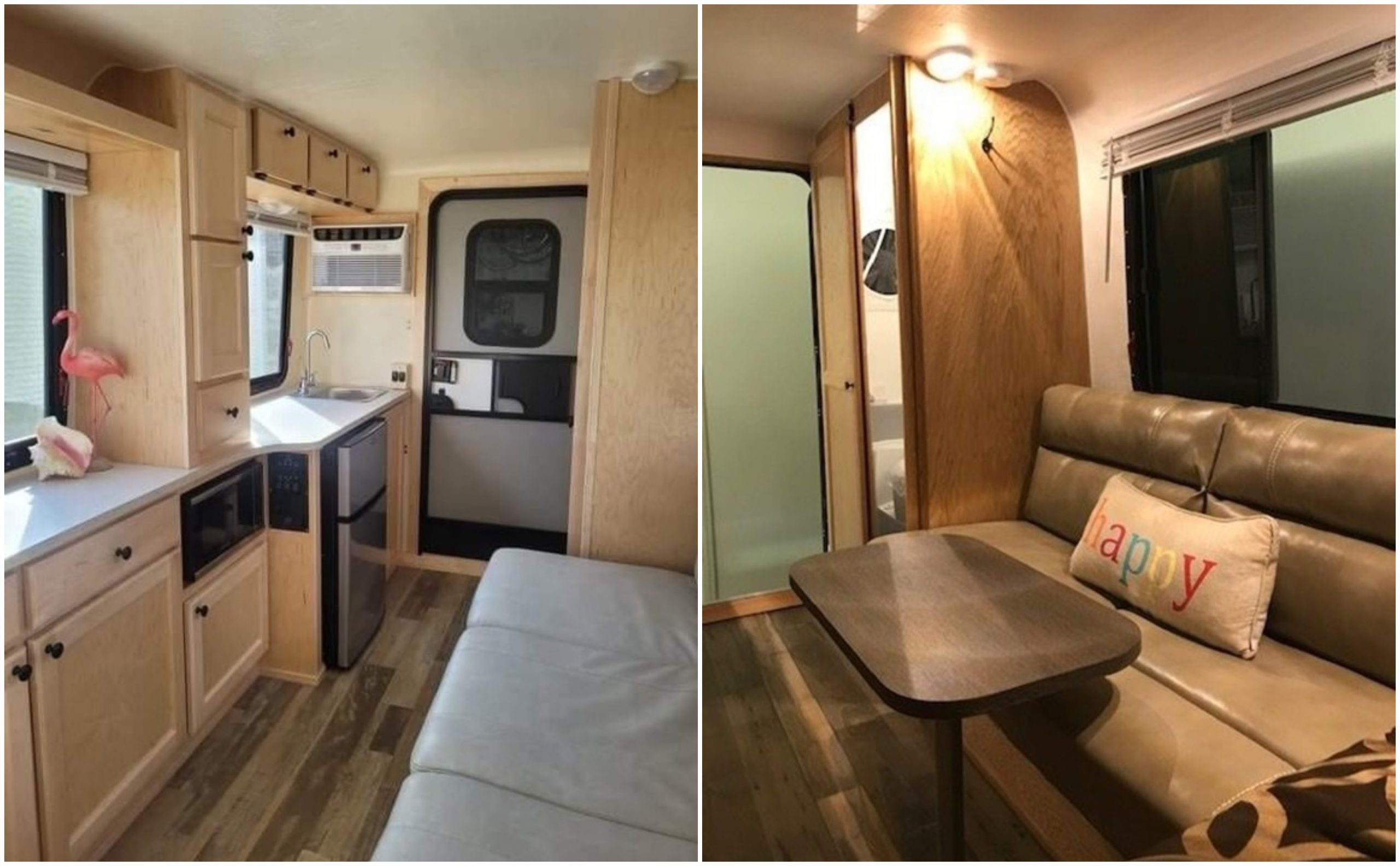
Upgrades for these items also aren’t available in the options list. Instead, the options include an awning, gas shocks for the windows, extra lights, a cable TV connection, an outdoor shower, a spare tire, and other small bits.
The Snoozy measures 15 feet long, 7.75 feet tall, and weighs 2,500 pounds empty with a queen mattress or 2,300 pounds with two twin-size beds. The twin bed version of the Snoozy is also a foot shorter and a few inches taller, but comes with the same features. Both trailers have a gross weight of 3,500 pounds. In terms of stores, you’re looking at 27 gallons for fresh water, 27 gallons for gray water, and 4.5 gallons in the cassette toilet.
Why You Should Probably Buy One Used

The price for all of this is $36,900 for the Snoozy Queen or $38,900 for the smaller Snoozy Twin. Yes, both of these campers are more than twice as expensive as they were in the past. That makes a Snoozy nearly $10,000 more expensive than an equivalent Casita Patriot and still thousands more expensive than a well-equipped Scamp 13.
The bigger concern, at least to me, anyway, is that some Snoozy customers say they paid the company a $10,000 deposit and then never received their camper. The latest complaint accusing Snoozy of not delivering was published only two days ago. One person claims they sued the Snoozy company for their deposit back, and is still waiting for the refund. Currently, Snoozy’s site says that the lead time for a new camper is 90 days. However, the owner of Snoozy now says the wait is actually roughly seven months.
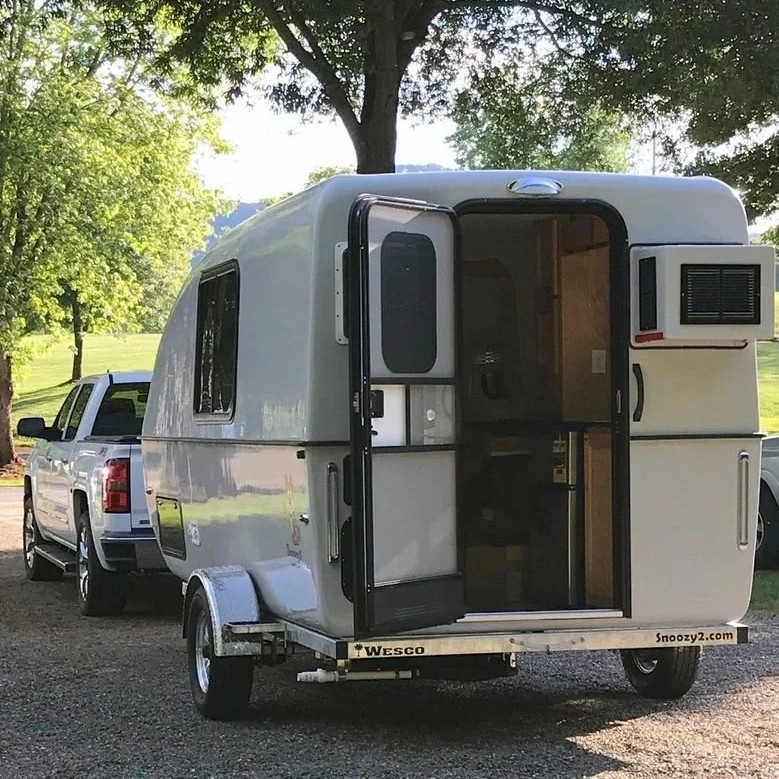
So, the big catch here is that if you buy one new, you have no idea when you’ll get it. Thus, my recommendation matches that of some Snoozy owners in that if you want one, you probably shouldn’t buy one of these new. I reached out to Snoozy for clarity on the situations mentioned above and will update if I hear back.
That said, those who have received their Snoozy campers do seem to love them, so not all owners recommend buying one used. Anecdotes that I have found online suggest that the camper’s aero does work. One person with a Ford Maverick claims to average 17 mpg or 18 mpg with a Snoozy on the back. Snoozy campers do show up from time to time and tend to be thousands cheaper than new.
So, with the caveat that some people suggest you don’t buy a new one, it sounds like a Snoozy is a cool little rig. The Snoozy is different, a little weird, and should last a long time. There are a lot of folks out there who want to tow a camper with their crossovers, and a Snoozy seems to be great for that desire. It’s just a shame that so many people have had problems when buying them new over the years.
Top graphic image: Wesco Trailers




Have you ever reviewed Aerotabs?
when i turned 13, we got a 14-foot jon boat on a Wesco trailer. we paid $400, mostly for the trailer. the boat is long gone, the Wesco is still worth about $400…
$38,900?
I vote CP today.
Don’t buy any camper new. Let the first owner take the huge depreciation hit and fix all the stuff the factory couldn’t be bothered to assemble correctly.
Well definately don’t but new from these guys.
But I think *in general* I could be convinced to go new on a fiberglass camper. The Casitas, Escapes, and Scamps hold their value very well, so you aren’t getting crushed with deprecation and also aren’t finding many deals on used ones unless you go older. They are basically the Camry of travel trailers – when you’re staring down a 2 year old example for basically the price of new, it’s a tougher decision.
If you have the time and patience to search out a used fiberglass camper, it’s still the way to go. But since they are hard to find for sale, I can see why people would just bite the bullet on new.
My understanding from other aerodynamic trailer designs is that the shape is far less important than the frontal area. You can lower the Cd as much as you want, but if the A part of CdA is large then you still have a giant sail behind you. This does appear to be smaller than your average travel trailer, but it makes me very dubious this would meaningfully outperform any other similar-sized trailer.
Additionally, it seems like there is a pretty real possibility that the company just absconds with your money and you’re left with a big empty space where your trailer should go. I think I’ll pass.
Also, cassette toilet. Blech.
It’s a direct multiplication, so if you can halve your Cd your drag is exactly half. And considering a flat front trailer might have a Cd of 0.8 or so and this might be as low as 0.4 or lower, this is going to make a significant difference.
Frontal area is driven more by how large you want the camper to be – i.e. can you stand in it. Or you can reduce it by folding the camper down, but that has its own tradeoffs.
For aerodynamics, I still think that A-Liner has the best idea (cut the trailer’s height in half).
I can vouch for that, I owned the smallest one they made, an Alite (no longer in production), still averaged 50+ mpg with it behind a Hyundai Ioniq, car pulled like it wasn’t even there. Was also light enough to pick up the tongue and pull and maneuver it around by hand, only weighed 500 lbs or so all in
I really like this design. Feels very cozy.
Thankfully, the odds of me buying ANY trailer new are pretty low, so I’ll keep an eye out.
Yeah, the interior looks quite attractive and comfortable, and I prefer a rear vs side entrance, especially in a small trailer, gives more flexibility in how you can park it in a site
I’ve never been one to complain about entering from the rear either. It definitely opens up options for positioning.
I don’t have a wind tunnel, but my layman’s understanding of aerodynamics leads me to question the claims here. Looking “like the front of an airplane” may not be so important. You might get better aero if you mounted this trailer backward on its frame so it looks like the BACK of an airplane. That’s because air is fairly easy to compress, but, as the old saying goes, Nature abhors a vacuum. The flat back of this design will create plenty of turbulence behind, creating a zone of suck that holds back forward progress. All those postwar teardrop trailer builders weren’t wrong.
But what about the wind tunnel testing? It matters much what tow vehicle was used in front of it. That open-bed pickup truck depicted would favor the shape of this camper. The truck doesn’t do a good job of punching a hole through the static air for the truck to follow. Plenty of folks tow this way, but a small lightweight trailer like this really belongs behind a midsize SUV/CUV. With its long roof and probably a cargo box on top, those vehicles deflect a trailer-sized hole through the air, and that makes the trailer’s frontal streamlining less important.
The proof is in the towing, and at the pump. If the maker of the Snoozy claims 18 mpg on the highway, I can believe that. That’s the approximate average MPG I’ve gotten with a 16′ Scamp behind each of three tow vehicles: an underpowered Subaru Forester, a VW Tiguan and now a brawny Mercedes GLK. No breakthroughs there. But, hey, it looks streamlined, doesn’t it? I’m reminded of the hilarious scene in Sacha baron Cohen’s film The Dictator, when the exalted ruler demands his new nuclear ICBM be redesigned with a pointy nose, so it “looks scary.”
Yeah, I’m really curious how it behaves when towed. Clearly mpg is going to be better than the typical brick, but it looks way too wing-like to me. I feels like it’ll generate lift and the center of pressure is well forward of the axle, so I can’t help but wonder if the tongue weight gets quite a bit lighter than it already is with that giant lever arm and it wants to wander around rather than tracking straight.
The lift would vary greatly according to tongue angle. Hitch this to a lifted truck and watch it fly!
Can you do a used camper buying guide, like what is everything we should be looking for when buying used, where does one even buy used, when to buy. Or maybe a shitbox showdown camper edition.
I would find that really interesting, and I’m not at all into campers.
These are great ideas. I want to live camper life vicariously through The Autopian
Def. With a chart showing typical towing capacity ranges across types of vehicles!
There are so many systems in an RV that need checking….plumbing, propane gas, electrical, etc. Not to mention roof seals that need to be gone over VERY carefully. The only real way to do this is to be on the roof…..
For most folks, it is worth it to pay for a 3rd Party inspection unless you are very meticulous and have a good understanding of all RV systems to do a through inspection. Lots of folks even recommend such an inspection for new units.
We just took delivery of a special ordered 2026 model. (I understand buying used to save depreciation, but we got a very good price and older models have an older suspension system. It was worth it for us to go new for the more robust suspension.)
We “camped” at the dealer overnight so we had plenty of time to test all systems thoroughly. And yes, I climbed up on the roof while there and spent about 30 minutes inspecting everything.
How did you get on the roof? Did you bring a ladder, or maybe park your truck next to it and hop up?
RV has a ladder at the rear built in.
For that money, I’ll go with an Escape and not worry about losing my deposit. They are also a more established, and apparently reputable, manufacturer. I can pay for a lot of slightly lower MPG with a lost $10k deposit.