

In an effort to mix things up and feature as many different types of cheap vehicles as possible, we move from yesterday’s land yachts to a couple of tiny two-seaters that were originally marketed as economy cars, but weren’t fooling anyone. One of them is, however, also a Pontiac. Maybe I can make that the theme for the week: every matchup is a Pontiac versus something else.
Yesterday’s Pontiac choice went over like a lead balloon, I’m afraid. Its smog-era carburetor and lack of an overdrive gear counted against it, but I think its main flaw was that its competitor was a woody wagon. I tried to find a Roadmaster Estate or something to put up against that Colony Park, but came up empty-handed in the time I had to look. Maybe I’ll try to make that matchup happen someday soon.


I’m of two minds about this one. I like the Catalina a lot better, but the Mercury wagon would be a lot easier to live with. I guess I’ll take the wagon as well. But in reality, I’d go for a Chrysler Newport, sedan or wagon, over either of them.

For those of you who prefer zippy, good-handling little cars with manual transmissions, yesterday’s vote was a tough one, I know. Maybe you’ll prefer one of these two. Let’s check them out.
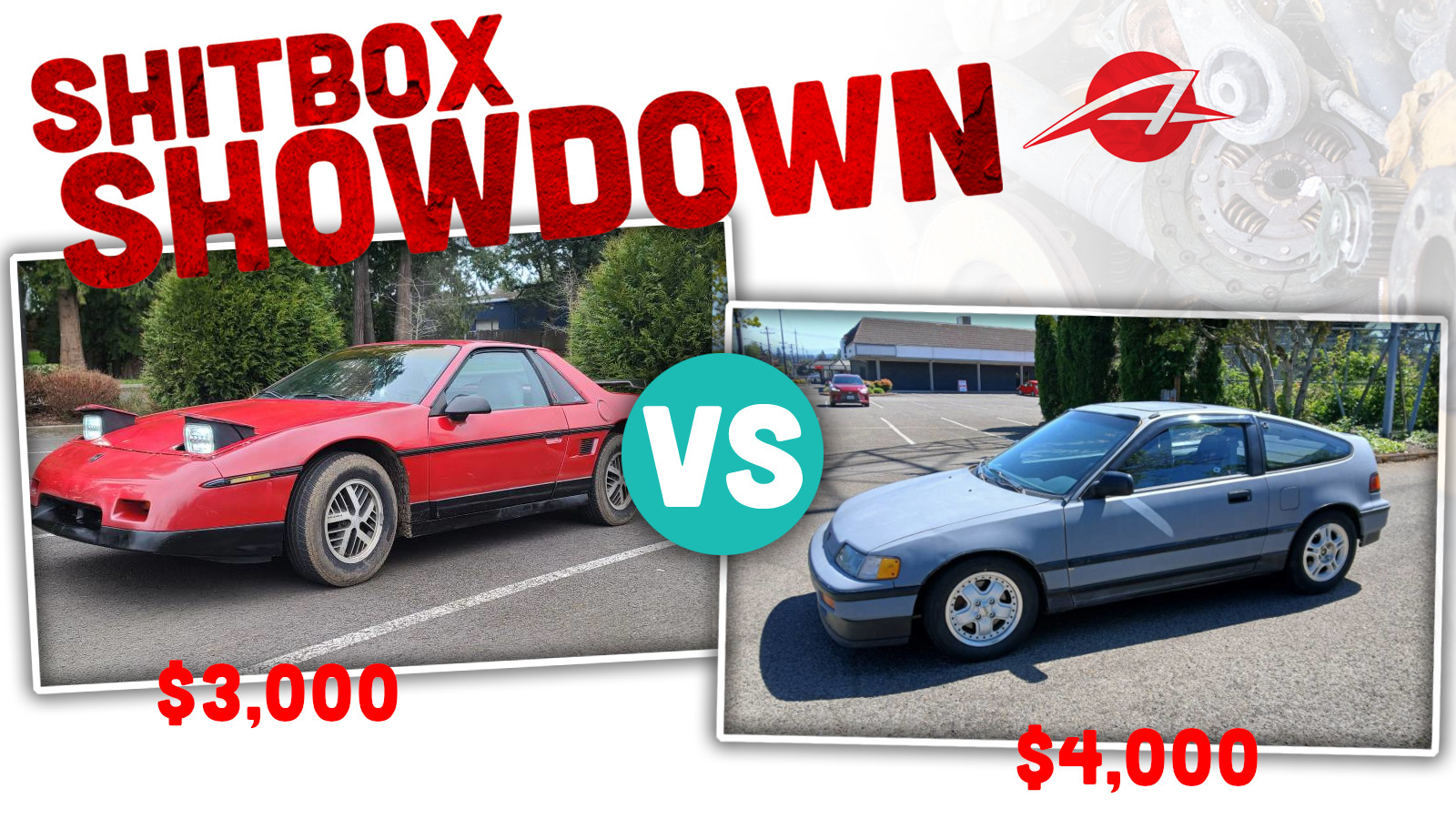
1986 Pontiac Fiero SE – $3,000

Engine/drivetrain: 2.8-liter OHV V6, four-speed manual, RWD
Location: Oregon City, OR
Odometer reading: 105,000 miles
Operational status: Runs and drives well
By now, you know the story: Pontiac sold the Fiero concept to the GM brass as an economy car that just happened to be mid-engined and wedge-shaped. It was cobbled together from GM’s parts bin, sold just well enough, and showed just enough promise to warrant some improvements, then was unceremoniously killed off just as Pontiac finally started to get it right. This SE model, from smack-dab in the middle of the production run, has some noticeable improvements over the original, but doesn’t command the high price of the coveted 1988 models.

The standard Fiero engine was Pontiac’s low-revving Iron Duke four-cylinder, which was a respectable enough engine for a family car, but had no business being in a sports coupe. It seemed to realize that, and had a tendency to protest being shoved into the Fiero’s cramped engine bay by catching fire. The later optional 2.8 liter V6, which this car has, is more powerful and less prone to self-immolation, making it a logical choice. Halfway through the 1986 model year, V6 Fieros switched from a four-speed manual to a five-speed; this one is an earlier car with the four-speed. Hey, at least it’s a stickshift. The seller says it runs great, and has a smattering of new parts.

The interior needs a little help: the upholstery is torn up on both seats, the carpet is a mess, and it looks like the headliner might be falling down. I’ve seen a lot worse, though. The seller is tight-lipped about the condition of things in here, but I would expect a few electrical items not to work, and I’m certain that the dash rattles over bumps. They all do.

1986 was the first year that the Fiero GT received the new rear body style, with the long flying buttresses alongside the engine cover. Base models, and SEs like this one, kept the original rear styling, which personally I like better. This one is in good shape, and if it has been an Oregon car all along, it’s unlikely to have any worrisome rust under the plastic body panels.
1989 Honda CRX Si – $4,000

Engine/drivetrain: 1.8-liter DOHC inline 4 (swapped), five-speed manual, FWD
Location: Oregon City, OR
Odometer reading: 93,000 miles
Operational status: Runs and drives well
Like the Fiero, the Honda Civic CRX was meant as a commuter car, especially the frugal HF model. But the go-kart handling and easy modifiability of the second generation in particular made it a favorite among enthusiasts. The side effect of that, of course, is that it’s now hard to find a stock CRX for any sort of reasonable price. The price of this one is reasonable, but it is by no means a stock CRX.

The CRX Si originally came with a 1.6-liter engine making 108 horsepower, plenty to toss around such a lightweight car, but this one has something considerably more potent: a 1.8-liter B18C1 from an Integra. The seller says it’s “fully built,” which could mean a lot of things, but hopefully it means it was overhauled by someone who knows what they’re doing. It reportedly runs and drives very well. I’m not against engine swaps in general, but one thing I cannot abide is repainting a car that was originally yellow in primer gray. What were they thinking?

I have to be honest: When I first clicked on this ad, I expected the interior of this car to be a lot worse than it is. I mean, yeah, there’s a huge gaudy subwoofer in the back, and some non-hidden wires running to it, but it’s mostly intact inside. The driver’s seat looks pretty worn, which makes me question the odometer reading; I have a feeling that the gauge cluster may have been changed out at some point and that it has more miles on it than are being reported. Still, for a car like this, it’s pretty nice inside. Clean it up a bit, and you could conceivably take this car on a date, which is a good benchmark for interior condition.

Apart from the fact that it’s no longer that glorious Honda yellow, it looks decent outside. It has been lowered, but that’s no surprise. The seller says it comes with “racing slicks,” by which I hope they don’t just mean bald front tires. Regardless, you should probably count on putting some decent rolling stock on it if you intend to drive it regularly.
So we have a stock Fiero in okay condition and better-than-it-could-be specification, and a CRX that has been, I won’t say ruined, but significantly altered. They both run and drive great, if the sellers are to be believed, and neither one of them seems like an outrageous price. Which way are you leaning?


Gotta go with the CRX, even though I probably can’t fit in it. Even a scruffy Honda’s gonna be better than an ’80s GM product.
A B-swapped CRX is one of my dream cars. I can fix whatever else is wrong with it.
If it wasn’t literally about as far away from me as it could be in the continental US, I would buy the CRX literally today.
CRX is a steal. the B18C alone is worth $4k.
Well going by the new rules of voting here I have to say I like the looks of the Fiero but it was a year before Pontiac got it right but a Honda is pretty nearly indestructible unless a prior owner replace s all the indestructible parts but when all is said and done I guess I’ll find me another Jensen Healey.
That is okay right Mark?
I owned an ’89 CRX Si when I was in high school and college, so my choice here is clear. It’s an absolute gem of a car, and even though this one isn’t stock, it just means that I would have no guilt about modifying it further. For a project car, that’s not a bad way to go.
If it were mine, I’d repaint it back to yellow, clean up everything, put some smart suspension and brake upgrades on, and just have a blast. The engine swap is fine, assuming it was done competently.
I’m leery of that engine swap, simply because I loved the original (’88) Si I once owned. And those wheels are to puke for.
Still I cast a reluctant vote for it since I imagine that Fiero wouldn’t be much fun to live with.