

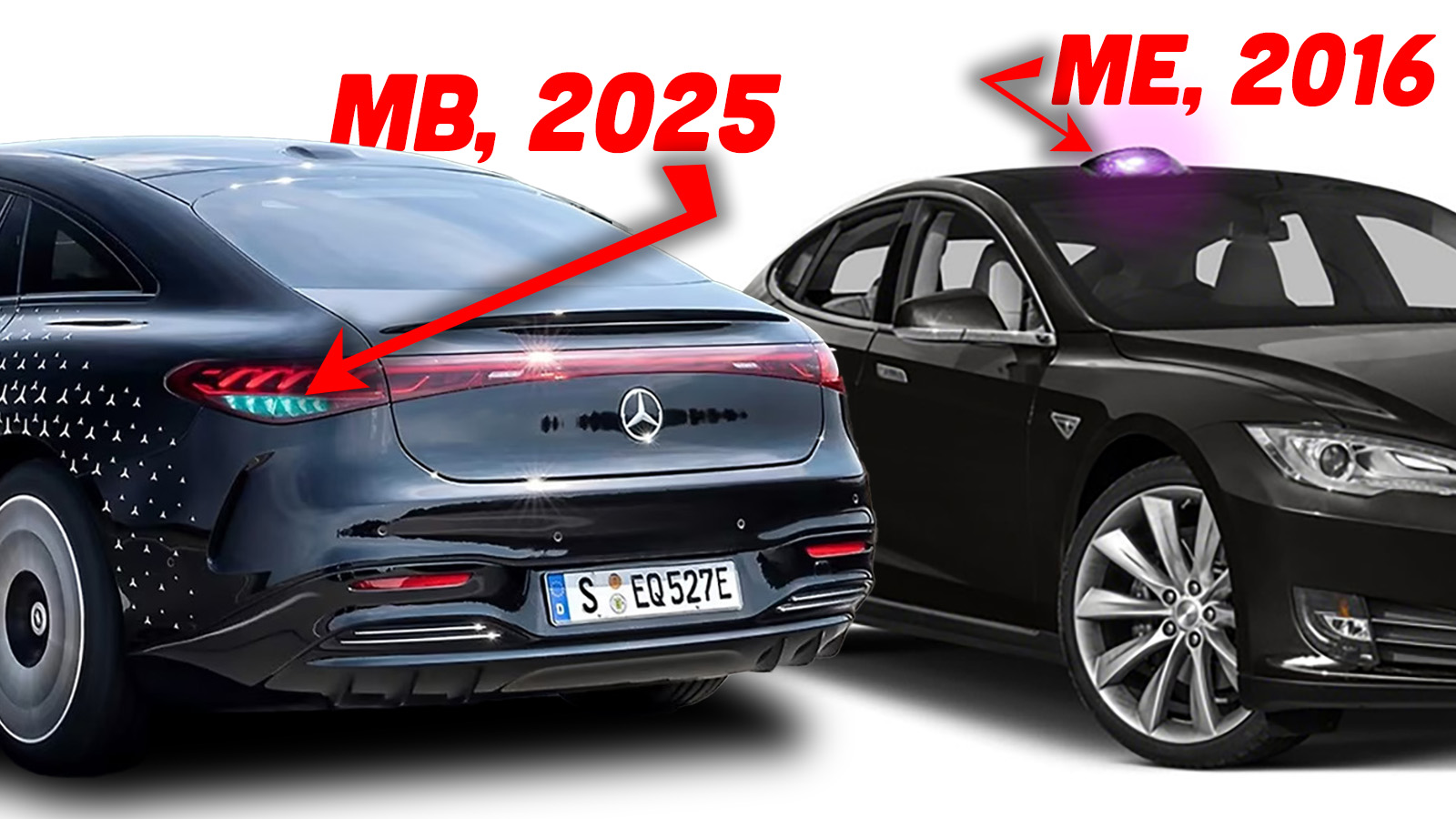
Okay, sure, I’ll admit I’m late to this news, as Mercedes-Benz’ press release about this was, let’s see, over a year ago. But, in my defense, the concept behind their press release is about the exact same thing that I proposed over a decade ago, way back in January of 2016.
How did I miss this when it was first announced? Maybe it’s not really surprising, considering the spectrum of things I miss is vast and widely varied, but considering that, again, I had this same idea myself, so you would think perhaps I’d be a little more aware. Well, I’m not.


Enough preamble: the idea is a fundamentally good one, and I’m happy to see it being implemented. The idea is simple: a warning light that illuminates when a given car is under autonomous control, instead of human control. Here’s how Mercedes-Benz describes the light and its reasoning:
“The exterior lighting now permitted by special exemption indicates to other road users whether the conditionally automated driving function is activated. This also allows traffic authorities and police to recognize the system status more easily and determine whether the driver is allowed to engage in other activities during conditionally automated driving. The special marker lights are integrated into the front and rear lights as well as the side indicators in the exterior mirrors.”

…and here’s how I described essentially the same concept back in 2016:
“Here’s what I’m thinking: any car that has some level of autonomous capability – let’s say at the level of a Tesla Model S or better – would be required to have a roof-mounted light. This light should be visible from 360° around the car…
It would be a gesture of openness, almost a respectful gesture to people who still drive their own cars. In the early stages of development, when autonomous cars really have yet to prove themselves en masse, I think drivers will be more open and willing to allow them to share the roads if they make their presence clear.
This can also help on the opposite side of things, too. For those who do genuinely believe in the safety of autonomous cars, and, even, their superiority over human drivers, those purple lights could be a beacon of perceived safety for some drivers.”
So, this light would be a way for other drivers, traffic monitors, emergency vehicle drivers, law enforcement, and so on to be able to easily tell which cars are being operated by humans or machines, and adjust their expectations and behavior accordingly. I think this type of warning/indicator lamp will prove to be very useful, and I’m happy to see it actually happening in reality.
I’m just not crazy about the way it’s being implemented, really. And I may be too late to complain about that, because there is already an SAE standard for these lights, SAE J3134:
The SAE standard, which I think so far is only being implemented by Mercedes-Benz for their cars that are equipped with their Level 3 automated driving system, mandates that the color of these lamps be a sort of blue-green or turquiose.
Mercedes has also implemented these lamps into existing headlight and taillight housings, as well as on the door mirrors, where the turn indicator repeaters usually are.
Personally, I think neither of these choices is ideal; blue-green lights I think are too easy to confuse for green lights, which already have a very specific and important meaning: go.
Then there’s the fact that police use blue lights, and the possibility for a car with blue-green lights to be confused with a police vehicle is a very real possibility, too.
In poor lighting conditions, the possible confusion of green street lights or police lights with autonomous vehicle lights just seems like a can of worms not worth opening, or a hornet’s nest not worth kicking, whichever annelid/insectiod metaphor you prefer. I think purple is a better color because it would be hard to confuse for pretty much any standard light color currently used.
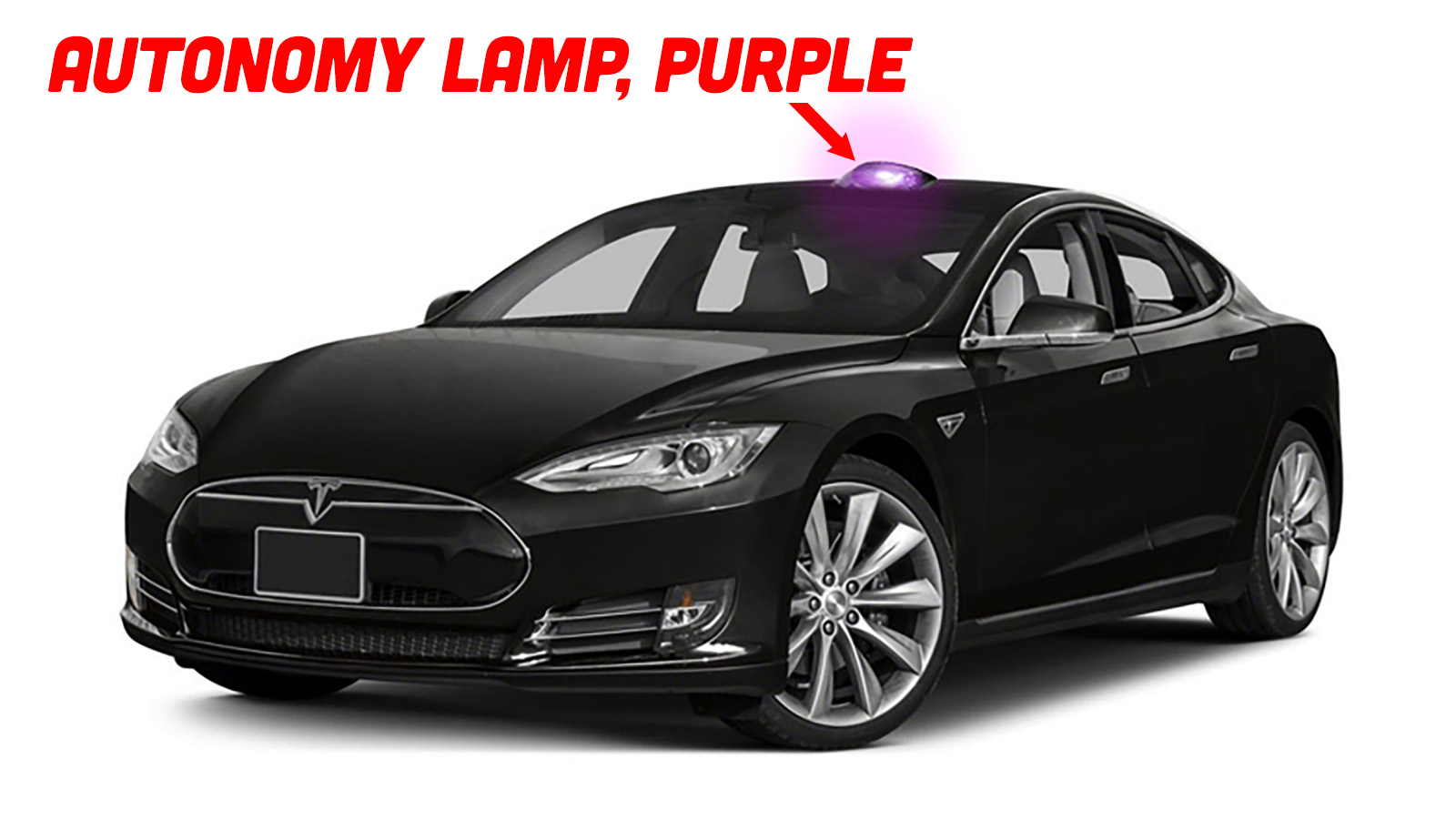
Plus, I think a roof-mounted light makes more sense than one in lighting units that are already crowded with features. Why cram these into the taillight assemblies, which already have to do so much communication as it is?
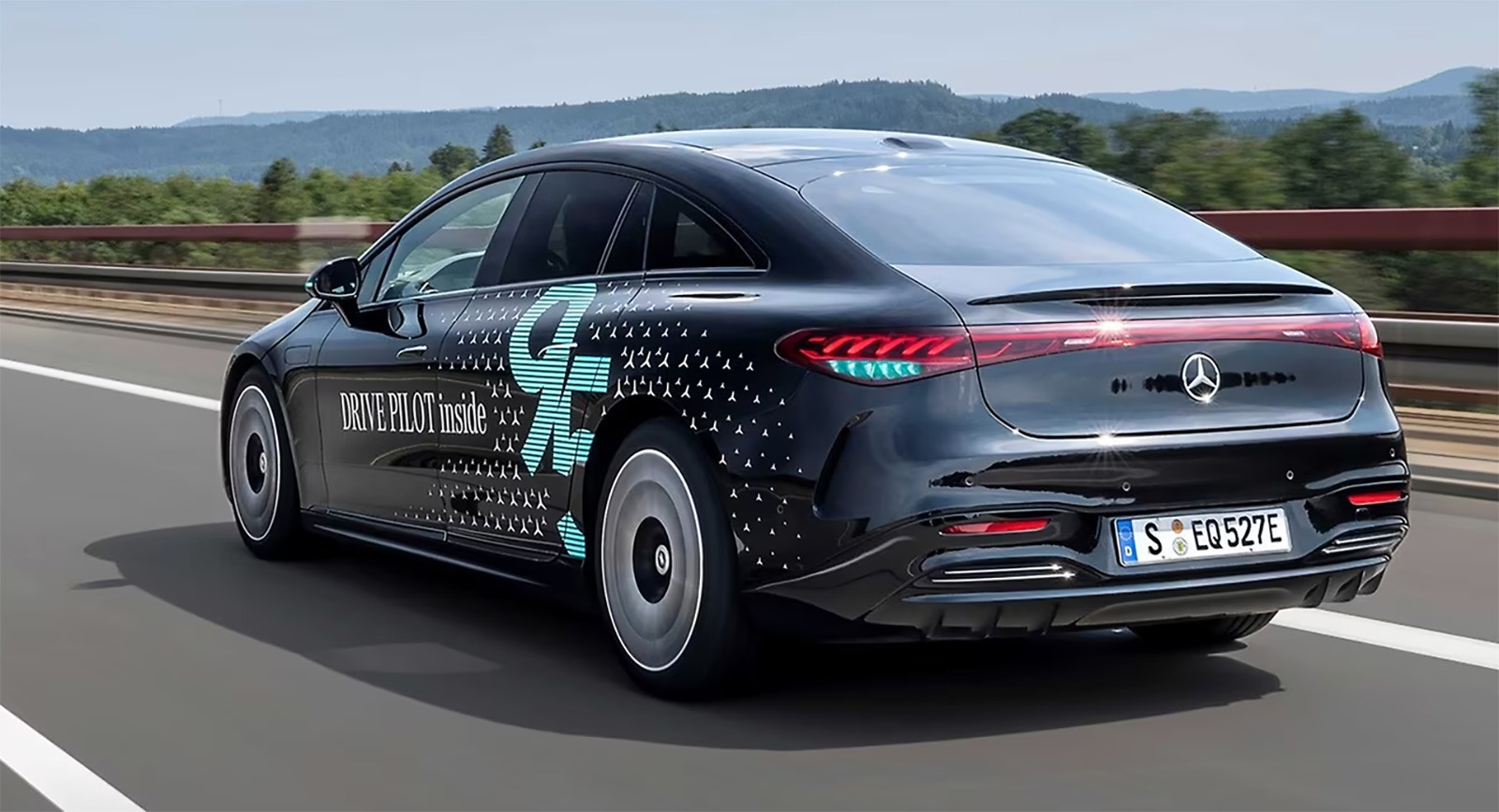
Plus, a roof-mounted lamp will just be more visible in close, dense traffic, and be, ideally, visible from even several cars away, even in denser urban traffic situations. Plus, it’ll give car designers a fun new component to work with.
Was I the first to talk about the idea of an autonomy indicator lamp? Maybe in the sense of talking about it publicly, though I have found a reference to the SAE beginning the drafting process on this standard as early as 2015. But I think I was the first to address this in the press. It even made it into my book in 2019:

I wonder if this standard will actually catch on; if so, I suspect the current SAE standard will be the one to be implemented, as I don’t think carmakers are eager to add roof-mounted light pods to their cars. And, the standard already has a foothold, at least a little bit.
Really, I’ll be happy to see these lights become standard equipment for AVs; but I still think they should consider purple over blue-green. SAE, you know how to get ahold of me.
Top graphic images: Mercedes-Benz; Tesla


I agree with you that purple would be a better color choice. Purple, like high-viz yellow, is just one of those colors that catch your eye. Where they’re located is not as big of a deal to me as it is to you, but I can’t fault your logic.
Mercedes wasn’t actually the first to implement this either (I mean when have they ever been first?). Aside from all the Chinese cars, Honda was doing this all the way back in 2021, and that’s where I first discovered it: https://www.motor1.com/news/492415/honda-level-3-autonomous-driving-japan/
A better idea – a light that is illuminated when the driver has their eyes on the screen on their phone. Oh wait, this is indicated by the car sitting still after the traffic light turns green.
Presumably true, but that spectrum usually doesn’t include tail light-related things. 😛
The roof-mounted thing will never fly because of aerodynamics, but I’m with you on the color, mostly because I hate teal.
For the past year or maybe longer I’ve been wondering (and becoming increasingly annoyed) about why Teslas are so slow to go when a light turns green. To be clear, I’m behind a Tesla and maybe a couple of cars are in front of the Tesla and we’re all waiting for the light. The light turns green and the two cars in front get going tout suite and the Tesla sits there on its ass for three to five seconds before it starts to go. Too often the Tesla gets through the light and of course I’m stuck on the red. This happens regularly. I’m thinking, what is with these Tesla drivers? They’re looking at their stupid phones!
Finally I figured out the “driver” isn’t driving at all. What the driver is doing I have no idea, but it’s the car that’s doing the driving, and the car is sooo lazy about getting going. It’s making me crazy. I would love a light that indicates autonomous driving so I can make sure I’m in the other lane.
If this was only confined to Tesla drivers. Many drivers perform this way without having to spend money on autonomous driving cars.
LEDs can be made to emit all kinds of colors. Not sure why anything needs to be added to the roof (raising drag coefficient). Some LED in the rear light display, some new code, and voila.
I do hope that my new car, when automatically slowing down due to the slower car in front of it, displays the brake lights in the back. I wouldn’t know, as I am asleep while driving, with “eye” patches over my eyes to fool the car.
Yeah I think I prefer this implementation. Turquoise is sorta close to green but it’s at eye level, more or less, not above the roadway; roof mounting it puts it up higher and, if there’s a stark difference in vehicle height (Ram 3500, Honda CR-Z), it might be a bit difficult to see if it’s low-profile. And it’d have to be low-profile for aero reasons, which is probably another reason it’s put into the signaling assemblies already present. (That and being able to more easily swap lighting assemblies for different markets rather than the roof sheetmetal.) Finally, if turquoise can be confused with blue or green, purple, especially if mounted higher, could be confused with stop lights.
Still, credit where it’s due for seeing the necessity of such a decade ago.