

While consumer taste is the greatest driver of demand when it comes to how new cars are conceived and developed, ultimately, it’s up to government regulations to decide what can and cannot be sold to buyers. Usually, these regulations evolve slowly over time through incremental changes and come with years of warning before they’re actually implemented.
Lately, though, that hasn’t really been the case for the United States. A swath of deregulatory actions by the Environmental Protection Agency (EPA) over the past year has seen many longstanding emissions-related rules and benefits lessened or lifted entirely. Earlier this year, the agency eliminated its 2009 Greenhouse Gas endangerment finding, as well as all emissions standards for vehicles built in 2012 and beyond.


The EPA also killed the regulatory benefits granted to automakers for including stop-start technology in their cars, and decided it would no longer criminally charge people who delete complex diesel emissions systems from their vehicles. Some in Congress are pushing for diesel emissions system deletes to be fully legal. Just last month, the agency announced plans to “revamp” its funding of electric school buses and potentially revoke funding.
All of these longstanding rules are now either disappearing or changing drastically, catching automakers off guard and forcing them to rethink years-long product pipelines. That’s not good for anyone involved, according to an Infiniti executive I spoke to at the New York Auto Show.
Flip-Flopping On Policy Only Adds Stress

While chatting with Eric Ledieu, vice president of Infiniti in the Americas, at the Nissan booth at the show, I brought up the challenges automakers have recently had to face with regard to all these huge, sudden swings in policy. Unsurprisingly, he wasn’t exactly a fan.
[It’s] absolutely not beneficial for brands, for any brand,” Ledieu told me. “What the industry needs and likes, when you think about all of our lead times here in this hall, you’re talking about years, right?
“So, predictability is a good thing, right? And having things change that dynamically, that quickly, I think, has disrupted a lot of people,” he added. ”You see the headlines on how much money has been spent on R&D at every company, whether those monies ended up being brought to market or not, it’s different by company, but I think we’re always navigating that. I think everyone, if we could choose, we would choose a path—whatever the path is—to have it be stable.”

New cars don’t just appear out of nowhere—they take years of planning and foresight. A lot of that planning is based on customer demands, obviously, but just as much stems from making sure the cars adhere to that region’s regulations, whether that means passing local emissions tests or crash safety rules.
If Nissan were to, for example, spend a few million dollars to develop a new engine to achieve a certain mpg rating, only to discover that it didn’t need to do that because the regulations changed, that’s a bunch of wasted money that could’ve been spent elsewhere on the car to make it more competitive. The company loses out, and the consumers lose out too, since they’re getting a product that isn’t as good as it could’ve been.
Despite this regulatory flip-flopping, Ledieu remains confident in Nissan’s and Infiniti’s ability to make decisions on the fly.
One of Nissan’s core values is our ability to just react,” he told me. “It’s actually some of the best [work] in the industry for us because of our agility and our ability to pivot and our ability to turn left, turn right, whichever way we want to go. So, actually, I’d call us a large company. So when you think about it, a large company that still has the ability to be agile, it’s a fun place to be. It’s always dynamic. And we’re always challenging ourselves to do what we think is gonna not only be needed today, but also in the future.”
e-Power Is The Way
What is the future for Nissan and Infiniti, then? The company was arguably way ahead of the curve when it came to the softening of EV demand, when it canceled plans to build two electric sedans in the United States back in April 2025 (versus other brands like Honda, which canceled America-made EVs of its own only just last month).
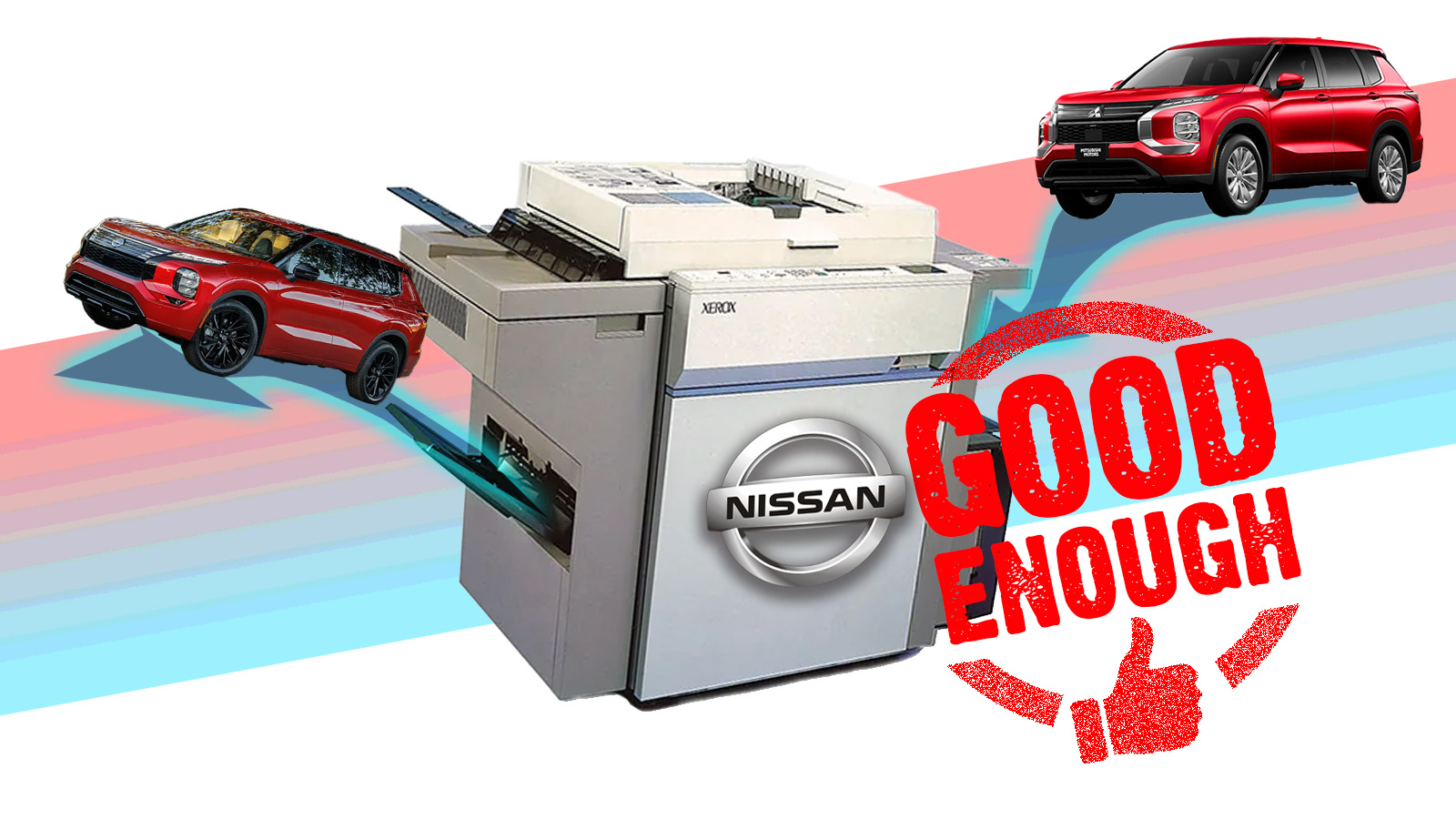
Instead, Nissan is focusing on hybrids in the near-term. Its first push into the space came in November with the new Rogue Plug-In Hybrid, which, to anyone with eyes and even a passing knowledge of plug-in hybrids, will know that it’s just a lightly reskinned Mitsubishi Outlander (not that that’s a bad thing).
As of the Auto Show, Nissan is getting serious with its hybrid offerings in America. The company announced yesterday it’s finally bringing its e-Power hybrid system—a series-type hybrid powertrain that’s been on sale overseas for a decade now—to the U.S. with the next-generation Rogue.
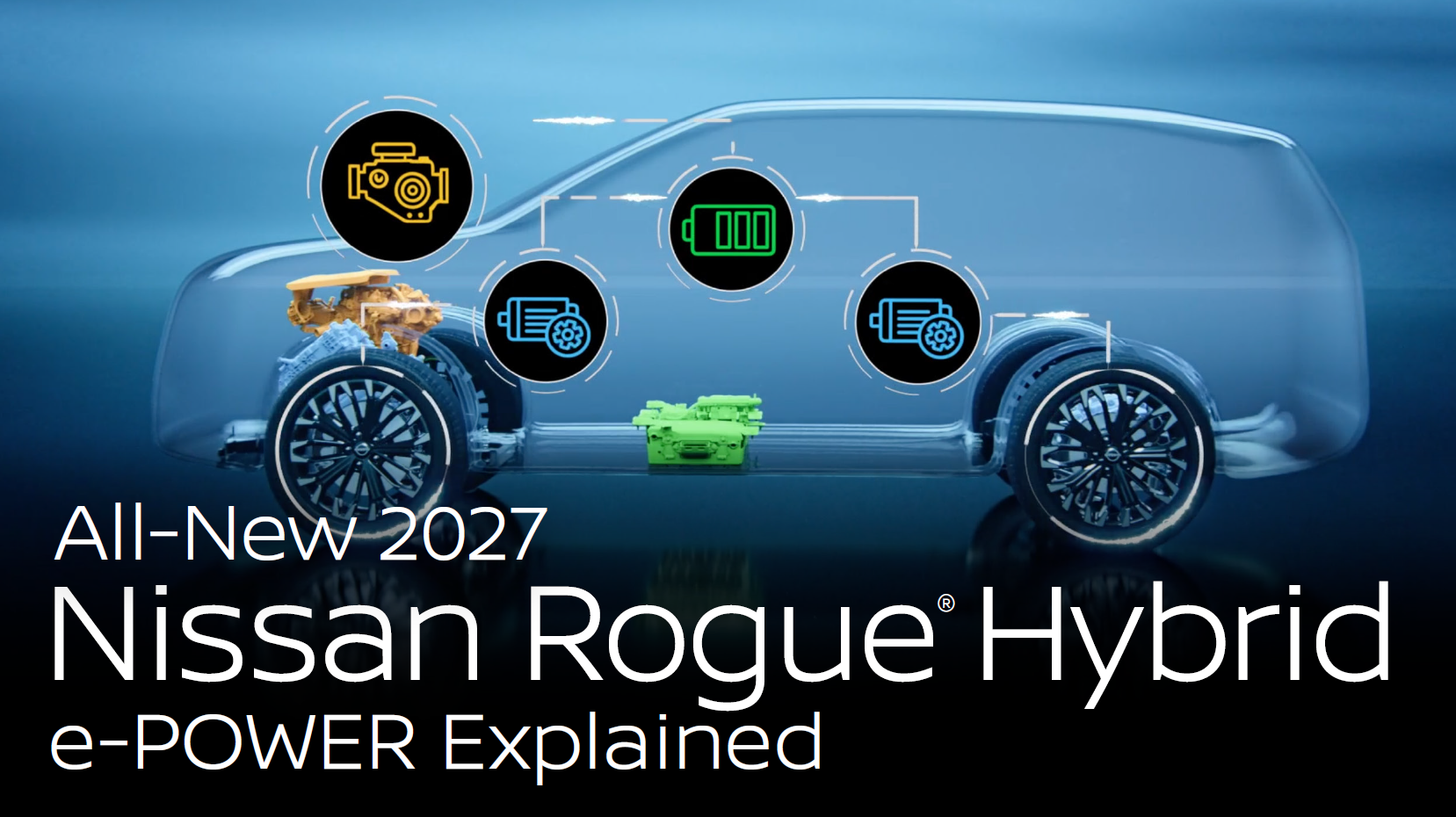
On paper, series hybrids offer the best of all worlds, according to Nissan, delivering the efficiency of a hybrid, the convenience of a gas-powered car, and the instant power of an EV. The engine has no physical connection to the wheels; it acts only as a generator for the onboard lithium-ion battery, which in turn powers the two electric motors (one at the front and another at the back). As a result, there’s no traditional transmission. For e-Power hybrids, there’s no plug involved, either—the only way to fill up is through the gas tank, simplifying things for owners. This is the path forward for Nissan in America, says Ledieu.
“We’ve been very much concentrated as of late, especially since North America is such a big part of our success, globally, to come up with power trains that the U.S. consumer would want,” he told me. “And so internal combustion is still very much a real alternative for many buyers. Next step would be hybrid, right? We talk about electrification in a lot of different ways. e-Power hybrid will absolutely be the way we execute our hybrid here in North America for the foreseeable future.”

Nissan isn’t saying which engine will be paired to its latest e-Power system in the upcoming Rogue, though I hope it uses the 1.5-liter turbocharged three-cylinder that, last year, it deemed the most thermally efficient production engine ever made. That setup is used in Europe for smaller cars like the Qashqai, so who knows if Nissan will deem it worthy enough for the bigger Rogue. Either way, the car should be pretty damn efficient.
Top graphic image: Nissan




Um maybe the government should do a little less deciding what can and cannot be sold to buyers.
That’s what got us into this mess.
Unfortunately very few consumers prioritize safety. I’d guess almost no one outside of weirdos like us knows pedestrian safety standards even exist, let alone care about them. And the average consumer is not going to care if a certain tech makes the care 1% more efficient. But, over the nationwide fleet, 1% is a massive gain.
Point is: regulations are good and in my opinion necessary. Happy to concede there are plenty that are silly or outdated and contribute nothing of value to anyone.
I think I mostly agree with you I never said no refulations. I just think there is a point where some regulations either go too far or have unintended consequences which outweigh the benefits .
Like the stop start systems, is a 1% gain in efficiency worth it if it causes a car to become mechanically totaled 2% faster? I would argue it’s not. Especially when we consider it costs money to install too.
Maybe start stop was a bad example since yeah, I don’t know if that one actually pans out for the reasons you said. I was just trying to think of something that delivers a minuscule savings/benefit per vehicle.
Government deciding what can and cannot be sold to buyers resulted in safety and emissions standards for all passenger vehicles, rather than the handful of brands that cared (such as Volvo and Saab for the former, Honda as one example for the latter). The average customer doesn’t know or care enough about these things, they’re just going to buy the thing they like most out of what’s on sale.
I never said there should be no regulations at all, but a little less.
I wholeheartedly disagree with the upcoming ADAS requirements. Will it save lives? Maybe but it might cost more than it saves. And if we think that one is bad the “drunk driver lock” is even worse because it has no benefit to people who don’t drink and drive but it does cost you in cost and errors/repairs.
Unfortunately they have to cater to the lowest common denominator. Until there are stricter laws regulating who is allowed to drive and higher standards imposed for operating a motor vehicle, cars will have to put in measures to ensure idiots don’t kill themselves or other people.
Or, they could focus their efforts on more stable regions, and just leave America to rot in the past.
Eh. They’ll keep doing what they’re doing so long as Americans keep buying what they’re selling. Give it a few years until our economy completely collapses and no one can afford to buy a car. That’s when they’ll move on.
Fine. If automakers don’t like the regulatory flip-flopping, they can take the moral and right path forward. Do what’s right for society, it’ll pay long term. If you have to ask what that is, then you can see where that moral problem extends to.
Sounds great in theory, but probably does not work. While you’re investing R&D in “doing the right thing”, you’re sacrificing your margins and ability to compete in the future to other automakers that are less “morally righteous”.
If the regulations don’t catch up on time, you might be out-competed and end up out of business.
No automaker would ever be foolish enough to build something for a set of regulations they think might be in force in the future, purely based on moral vibes.
Isn’t that what happened when convertable cars were no longer being developed and sold some years ago? Automakers expected regulations to change that would essentially not allow convertables?
That was the case in the late 1970s, yeah. Expectations for rollover standards that ended up never happening. The more recent disappearance of mass-market convertibles is more to do with people just not buying them anymore. Luxury brands still offer them.
One, maintaining margins and the myth of constant growth is part of what got us from there to here. Look at the EV market. Everyone went high priced premium, thinking everyone out there is rich. Let’s just sell a handful of cars instead of mass producing and making it up in volume, to the masses screaming for affordable cars. As for morals, where do you place the backtracking on emissions with respect to its damaging effects on society? It’s now suddenly Ok to pollute by executive decree? No, that’s immoral. I’m beginning to think the US doesn’t have an ideological problem, it has a moral problem.
Plus even if you’re trying to be moral, good luck determining the “moral” hood deformation amount needed for pedestrian safety (etc). You need a government that can do the grim cost/benefit analysis to create the regulation with the greatest utilitarian benefit.
Predictably is an issue but so is speed. Maybe the real answer is get faster. I doubt they will but it’s starting to get silly. Vehicle’s coming out with 5 year old tech because they started designing it 5 years ago. Japanese used to design a car in about 2 years and they are still on the road. Now they Chinese are on a cycle that keeps getting shorter and shorter some of them are months now.
If there is no modern American standard being enforced use a modern European one that meets whatever standard is being enforced. Then when the next guy gets in global standard is already here so just rubber stamp it. They can build in exemptions for whatever if a manufacturer thinks there is a market let them go for it. American Pick-up trucks are alway looking for a loop hole so I’m sure they could carve one out for them.
But maybe just maybe we can shrink pickups back to pickup sizes and leave these monstrosities to medium duty trucks.
There is a limit to how quickly you can validate a new vehicle, due to how long the testing takes and seasonal climate extremes that are required for those tests. The only way to release vehicles more quickly is to double up on your employees to run the replacement project 18 months behind the initial project. Halving the cycle time doubles the cost, and still takes you three years, it’s just the consumer sees a new product sooner. You also lose economy of scale on parts, so it costs more.
In summary: rapidly changing products costs the consumer more and still can’t keep up with rapidly changing regulations.
Sure, that is the traditional view. But if you look at it more like a tech product like the Chinese have done. You take the tech model, continue producing the older version decreasing the cost if possible as the design pays off. Offer the latest at whatever full retail is or market is. And continue the cycle. Doing refreshes like the Chinese are doing as tech improves maybe not as full tech company as Tesla with arbitrary changes so it’s hard to keep up. Automotive was the high tech industry for years as was aero space. Design cycles in both were measured months now is half decades. Close to universal packaging might be their best bet they keep trying but few seem to succeed.
With combustion cars the tech hasn’t mattered as much so long design cycles work. Where we are now and cars going back to somewhat disposable (like we see tech now) as they were for maybe 60 years in the 20th century it probably doesn’t.
Calling it “tech” doesn’t change the fact that skipping summer testing in Death Valley means potentially millions of dollars in dashboard replacement warranty costs, or battery overheating issues, and skipping winter testing in the Arctic could means you miss finding an issue that will set all your Canadian market cars on fire.
Cars have a much harder life than consumer electronics, and much more serious consequences when they fail.
China is still doing hot and cold weather testing in their shortened development windows. Do the sim testing then find suitable environments for both. It doesn’t all have to be the UP and death valley. It’s just what’s been established. It can be done in a few months without changing hemispheres.
I’ve seen the compromises caused by reducing a four year vehicle project to three years. Development phases cancelled, going straight to production tooling on long lead time items, and the mad rush of fire-fighting towards the end as a result.
You have to go conservative on everything because there is no time to redesign, retool and revalidate without delaying production. That means everything is a bit heavier and more expensive than it could be. If I could have had another week of simulation I could have knocked 20k off the airbox tooling and 200g off the airbox, but there wasn’t time.
I don’t think there is a spare year in there to remove, unless you’re just face-lifting a current vehicle that was already package protected for new features.
I’d love to see the project plan of a clean-sheet new vehicle in just two years.
Spead up project vs a speedy project would be different for sure. They are heavy into all sorts of sims live by cad and are getting more and more into ai. It’s a bit worrying considering there are assumptions in the software but it must get close enough.
And as long as they aren’t designing aircraft in the same method, fine but I fear they are. Hopefully they are more conservative validating all the outputs for aerospace.
They also aren’t necessarily shipping precived perfection at first. Typically are relying heavy on suppliers or existing platforms so there is that too. BYD in particular has been known to over build some aspects of vehicles especially in the first iteration some of that has been postulated as a result of less time to optimize.
I look at China fast as they are calling it the same as JIT it’s Americans ideas from maybe some radical engineers exported, deployed , and validated. Where the conservative engineers don’t want to believe it’s true or working. I believe the su7 delivered the lexas moment to Detroit and Germany from the Chinese.
I will agree that series hybrids are probably the best way for most people. I know the comments section on any article about EV vs hybrid vs ICE devolves into the same arguments, but I believe you have to design to the habits people actually have. And if all they have to do is fill up at the pump like normal and still get a large boost in mileage, I’m all for it.
A series hybrid is less efficient than a series / parallel hybrid. There is a reason that no serial hybrids are for sale in the USA today and only 1 has ever been sold.
Oh true, Honda’s system has the lockup clutch for the engine to drive the wheels directly at highway speed. So I believe the engine is designed to be optimal power at that speed.
I’m curious to see the numbers in practice. I know there is a (significant) loss for converting mechanical energy into battery energy and back to mechanical. There’s also a gain for being able to run the engine at a constant and ideal RPM.
Also the public is fickle. I can see a future where people prefer to hear an engine rev up and down vs always be at a steady drone. And then some OEM will design an engine that can simulate such behavior…
Honda already did that with their new 2-motor hybrid. From Car & Driver’s 2025 Civic review:
“With no conventional transmission onboard, the Honda’s direct-drive gearbox attempts to trick you into thinking it has the world’s slickest automatic by modulating engine rpm to rise and then fall as if taking a pause during an upshift. Because the four-cylinder is acting only as a generator when you’re not cruising at highway pace, these climbs and dips mean only that the engine briefly steps away from its most efficient speed. It’s effective, and we didn’t experience any clunky transitions or the droning that is all too common with continuously variable automatic transmissions.”
As to fuel economy – the Nissan X-Trail e-Power is already for sale in other parts of the world. Multiple Australian sites have reviewed it vs the RAV4 hybrid and it isn’t really close. From WhichCar:
“Nissan claims 6.1L/100km for the X-Trail E-Power on the combined cycle and Toyota’s equivalent figures are 4.7L/100km for the RAV4 hybrid 2WD and 4.8L/100km for the AWD.”
We don’t lose out from more efficiency and less air pollution.
The “need to react”, either by Nissan or any other legacy carmaker you can name, ultimately stems from one of two things. It’s either (A) the worry that other automakers will be racing to the bottom to deliver a cheaper–but ultimately less efficient or more polluting product–because the regulatory environment is suddenly more lax, or (B) that the current administration will actively order/threaten them to do something (as was the case for recently eliminating limp mode for diesels vehicles that run out of DEF, for example).
Putting the second one aside for now (since that’s sadly out of everyone’s control until at least November), the problem with the “race to the bottom” mentality is that shareholders will likely demand that automakers do it to chase growth rather than “doing the right thing” and adhering to the previous regulations.
I do wish there was some sort of legal mechanism to make companies act according to an obligation to our society and environment (and I would gladly vote to enshrine something like this into law), but we have a long ways to go before we can convince enough people that this would be good policy.
We do, because the lesson here would be that automakers producing efficient and clean cars aren’t as successful and profitable as ones who don’t.
That only incentivizes automakers to build worse products.
This is why a stable and logical regulatory environment is so important, to keep everyone on a level playing field.
Most US car buyers are unwilling to pay more upfront for better fuel economy.
The number of people willing to pay more for less air pollution approaches zero.
What about the number of people willing to require the other guy to pay more for less air pollution?
I don’t think so.
I’d also add this is the rational choice for the consumer: the world is no worse off if I drive a car 5% less efficient than it could be. Even if I care about that, do I really care about it more than all the other considerations that go into choosing a vehicle?
It’s a tragedy of the commons situation. The only way out of it is for some entity to enforce standards for everyone.
No, it is not a rational choice to avoid paying a bit more in purchase price when that extra cost is returned 3x over the life of the vehicle on fuel savings alone.
In a logical world almost nobody would buy a 34 mpg Corolla LE for $23,125 when the 50 mpg Corolla LE Hybrid is $24,975. With fuel at $3 a gallon that extra $1,850 pays back in 66,500 miles.
No, we don’t. It’s all a long term win-win, if we could get people to stop thinking quarterly.
Companies think about profits. If you could get people to actually car about fuel economy and be willing to pay more upfront to get it then companies would compete on fuel economy.
It is crazy that only 20% of Corolla’s sold in the USA are the hybrid. There is almost no logical economic reason for someone to buy the base ICE over the hybrid but they do every day.
“… though I hope it uses the 1.5-liter turbocharged three-cylinder…”
I’m no engineer and am honestly asking this to know; is there a value in adding a turbo to an engine that’s working solely as a generator? Would that not require additional packaging complications to feed additional air to the turbo and complicate things?
I’m guessing that the engine most likely operates within a pretty narrow RPM range (once the warm-up period is complete), and the turbo’s geometry is probably such that it provides more torque at lower rpm’s. That constant low-end torque is what is required to drive generator of the charging system. All of this being further dictated by whatever charging voltage is required.
Without the turbo, the engine would struggle to keep the battery charged without running it at high RPM’s constantly. No one would want to put up with the higher noise and engine wear for a car sold as an appliance and not like Bob Lazar’s “sports model”. Me and ol’ Bob go way back as they say.
I was thinking along the same lines. A narrow RPM band means you could run your naturally aspirated engine at WOT all the time, minimizing pumping inefficiencies. Sure a turbo is going to be more efficient but at the cost of packaging and heat and, well, cost. But no one wants the NVH of a generator cranking away at 6500rpm whenever it’s on.
yes … many fixed-rpm engines run turbos … I’m thinking industrial fixed generators, wood chippers, etc. I think keeping it at a steady, fairly low, RPM under mild boost would be a great thing for efficiency, quiet ops, etc.
but also yes to more complexity is more fail points
Excellent, I learned something new today. Now I can call it a day!
It should be possible to get higher thermal efficiency through higher peak cylinder pressures from boosting, and cooling, the intake air, and collecting a little energy in the exhaust. Certainly would add some complexity though.
Operating in the US regulatory environment is like playing a game of monopoly where the person who is winning gets to change the rules every few turns, which roughly explains how we got where we are.
I like to think of it as a big game of Who’s Line Is It, Anyway?
The rules are made up, and the points don’t matter.
Maybe they can eliminate crash standards too and then I can buy a Toyota Hilux Champ!
One can dream.
They could just ignore policy changes in the US. Rather, they should ignore policy changes in the US (as much as possible). Build to a broader global standard and be in a better position to compete for a larger pool of customers.
They won’t though.
The USA doesn’t use global auto standards or regulations and has no plan to do so.
A problem stemming from extreme flag waving and thoughts of exceptionalism in regards to the rest of the people we share this rock with. It’s time for that backwards thinking to end.
Good luck getting that done. As a manufacturing engineer for an automaker I would love to see it happen. I’m tired of making 5-6 versions of the same thing.
All the more reason to ignore them.
It is illegal to ignore US regulations. You either follow them or you exit the US market.
Seems like a good opportunity!
Yes, exactly this. Ditch the US and focus on the rest of the world.
A chaotic government is bad for business? I never would have guessed that…
Don’t worry. While this seems like advice everyone is ignoring now, as soon as the administration changes, this will be the most important thing ever. Kind of like the national debt.
“We can’t maintain this kind of deficit!” – people who only care about the deficit when someone brings up social services
Heaven forbid none white folk ever get any benefits from the government.
And/or the other guys are in power.
Long term everyone will continue to plan products as they would have before.
Short term there’s certainly some winners and losers. Companies that have been behind on hybrids and EVs certainly get a benefit from regs being rolled back – especially if they were paying out the ass for carbon offset credits. Even if the Dodge/Ram/Jeep strategy of “hemis for all” looks suddenly pretty dumb when gas prices doubled in the last month, they are still ahead of where they would be if they also had to offset those thirsty V8s.
They can focus their energy on getting their portfolio back on track and catching up to the industry for when the regulations and fines abruptly come back. They won’t, but they can.
There’s no benefit from companies left behind or those that have voluntarily slowed down efforts to innovate. They will find themselves further and further behind the competition, with their hands out, asking for yet another government bailout.
“Duh” says anyone with half a brain.
…which includes nobody at 1600 Penn Ave – despite them being the ones making the decisions which affect all of us.
You’re picking up what I’m laying down.
You’re assuming they don’t know this, rather than they do and just don’t care. Because it gets them votes from people with less than half a brain. And pockets lined by oil and gas companies.
I’m not convinced that the guy who bankrupted casinos is playing 3D chess.
You’re right, that guy doesn’t even know where he is or what he’s doing there. But the people whispering in his ear keep repeating “tell everyone they are coming for your trucks and gas engines” so they can keep getting paid by Big Oil.
It’s easier now too- Bush had to hide and suppress the data. Cheeto can waive data around and just lie about it and the MAGAtts eat that shit up.
“But the people whispering in his ear keep…”
…doing insider trading.
People voting against their own interests, and too stupid to see that?