

A few weeks back, I wrote about how General Motors sold some of the most American of cars ever on the other side of the globe when it offered Pontiacs in bubble-era Japan. They didn’t find many takers in Asia, but that didn’t stop General Motors from trying to push “Pontiac Excitement” onto other parts of the international stage.
As unforgiving as the Japanese market was, would places like France and even Germany really be any better? I wouldn’t think so, but that didn’t stop GM from making a marketing effort with some Pontiac cars in the early 1990s, including some that seemed to make no sense at all. Some of these weren’t even cars, and in a few cases they technically weren’t even Pontiacs. I can explain.

Das Ist Ein Sehr Schnelles Auto, Ja?
Imagine sitting at an outdoor café in a small German town, enjoying some strudel with cathedral bells ringing down the alleyways around you. You hear an odd rumble that shakes your dainty coffee cup. Soon the entire street next to your table is filled with bright-red painted sheet metal, covering the width of the cobblestone thoroughfare. What is this?
Or let’s say you’re making a run on the autobahn, and suddenly your rear view mirror is filled with lights and the low shape of a sports car, raising its headlights and flashing them to suggest you make way immediately. Is it an exotic? Well, sort of; I mean, you couldn’t get more exotic than a Pontiac in Deutschland.

I saw the above brochure online but couldn’t find much evidence that any mainstream Pontiac sedans and coupes like the Grand Prix were offered for sale across the pond; the unchanged lighting sort of proves that out. Honestly, you could find a dozen German cars that offered what those front-drivers had (and did it better), but there’s one car that really had no equivalent from Stuttgart, Munich, or even GM’s own Opel in Russelsheim: the Pontiac Firebird.
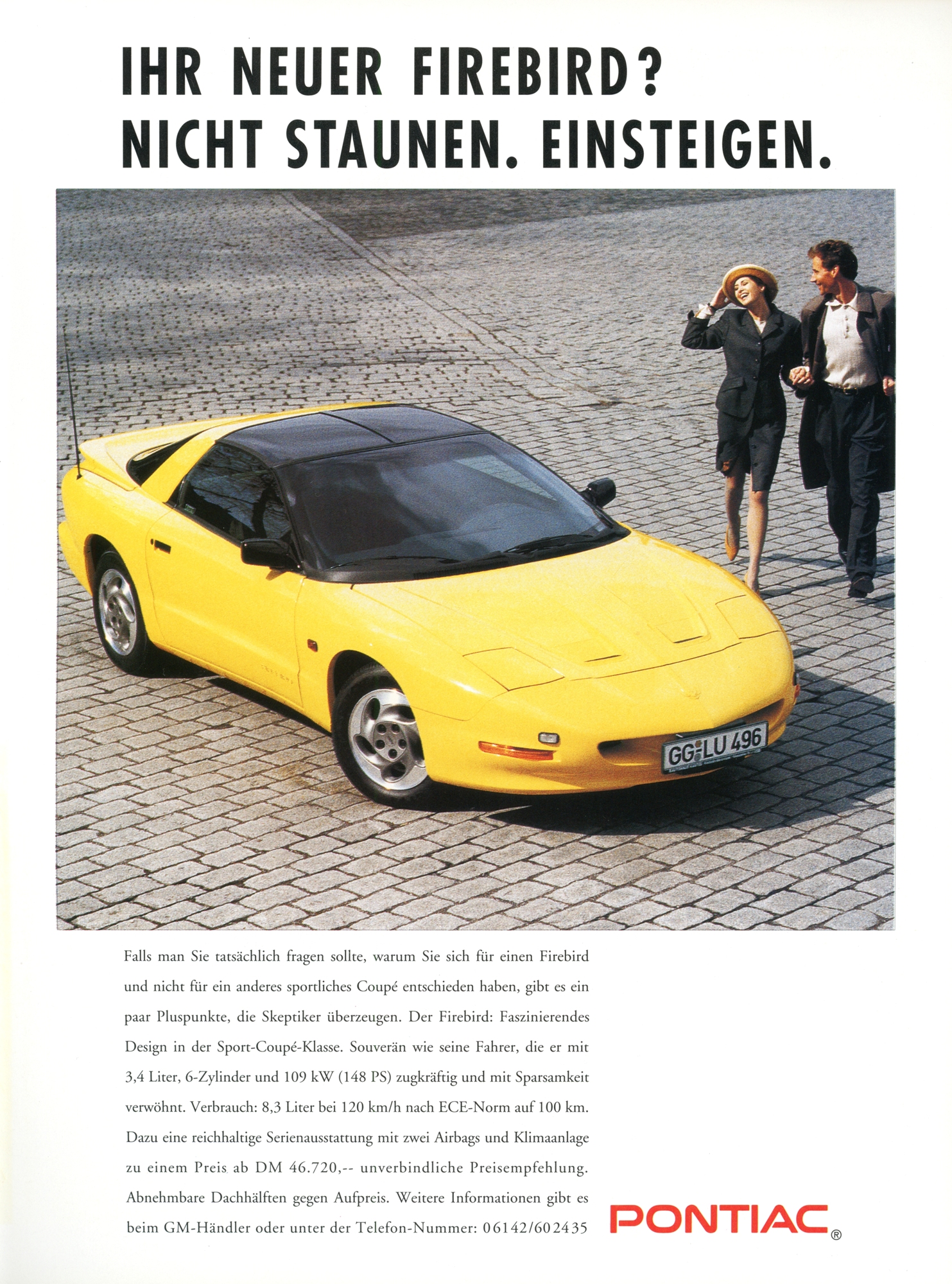
Besides the mandatory flip-away mirrors, the most jarring thing about the Firebird in the ad above is the lighting. There must have been (or still is) some German law that requires white parking lights at the front of the car, requiring someone at the factory in America to run out to the nearest Pep Boys and load up on these cheap white lamps. Hey, I know that this was the early nineties and we all thought that Cindy Crawford’s prominent mole was beautiful, but this doesn’t work here:
It looks like the Trans Am version with the “knight’s helmet” nose was also marketed, but lacking the standard driving lights, leaving open “eye sockets.”

In back, some red reflectors (or fog lights?) were stuck into recesses below the taillights, modified with amber signals at the ends.

This thing looks so odd on narrow European roads. Again, this one has the Trans Am nose with fog lights missing – were there cooling issues at Autobahn speeds? If you know, please share.

Based on the back of the brochure, it looks like you could get a V6 or a V8, and that power figure translates to roughly 268 horsepower with the bigger engine.

I don’t remember any palm trees in the Black Forest, but a green Firebird drop top would absolutely get you as much attention as you’d be able to stand on the streets of Freiburg.

For better or worse, the Firebird was like a Big Mac at Oktoberfest: something that you couldn’t get anything quite like in Germany. The same could also be said about another vehicle that GM modified for Europeans around the same time.
Was Ist Ein “Dustbuster?”
I have an odd feeling that in the early nineties some GM marketing people looked at the new Pontiac Trans Sport “dustbuster” minivans and scratched their heads. “This thing is weird,” one would quip, “like something we’d only be able to sell in France.” At that moment the idea popped into their heads to do just that. That’s just my read on what might have happened, but I’m probably not far off.
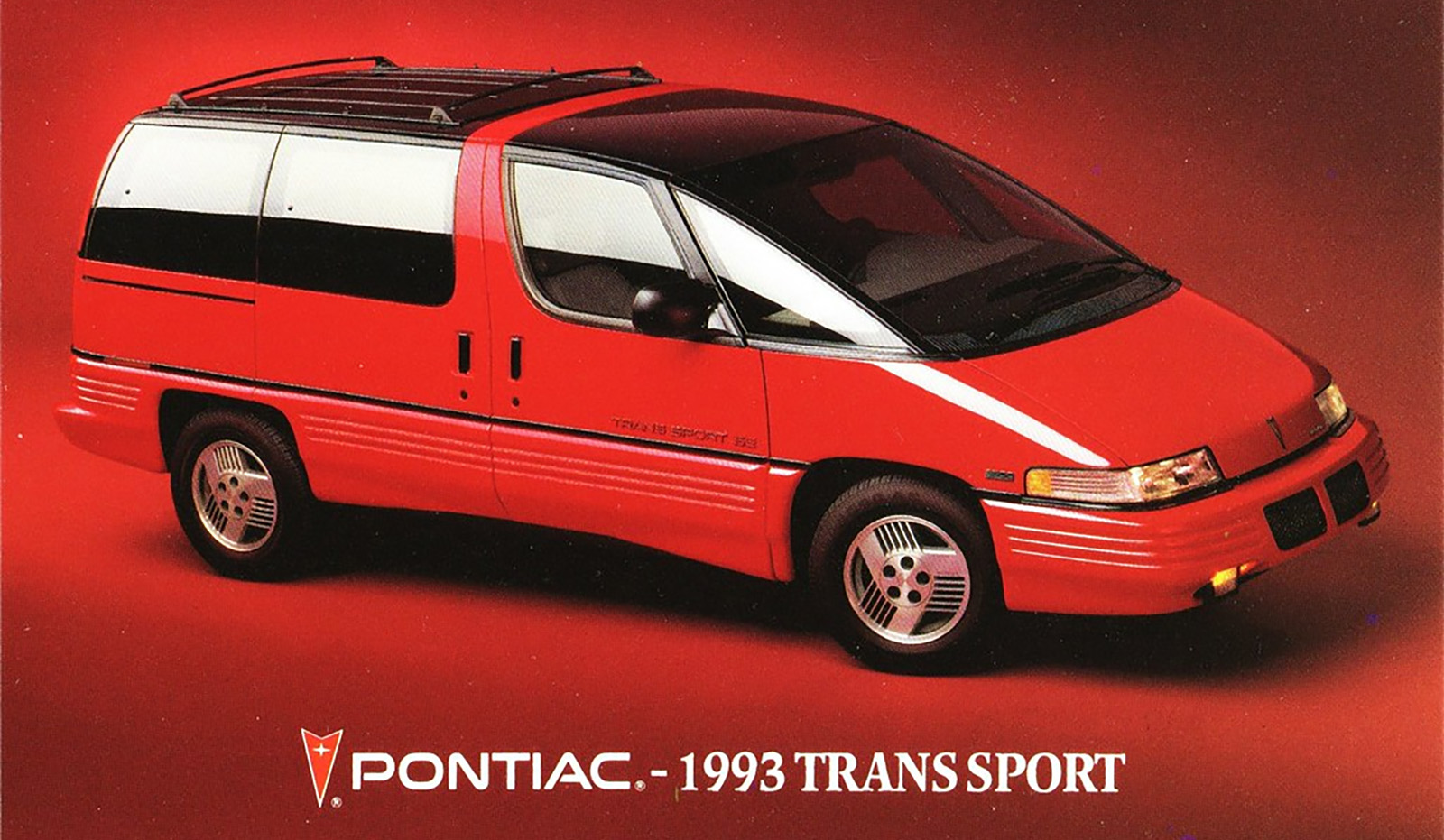
Unlike the Firebird, it appears that Pontiac put some actual effort into making their new minivan Euro-ready, such as some bizarre things to meet European lighting regulations. Early examples from 1990 had rectangular lights in place of the flush composite units.

These were just GM truck parts bolted in place with high-output yellow bulbs:

In the back, amber signals were put in the bumper reflector holes.

For 1992, Pontiac was somehow able to install legal flush lamps, and amber signals replaced the American version’s under-bumper front foglights.

Things got strange for 1994. The American market got a mid-cycle facelift with a slightly longer hood, ostensibly to “normalize” the looks (it didn’t work):

There was no way GM was going to make a Euro version of this nose. Their answer was to go to another division and raid their parts bin, in this case, Oldsmobile’s:

GM essentially took the entire front clip from the Oldsmobile Silhouette version of these controversial vans and just stuck a Pontiac logo on it. In fact, all of the lower- body cladding was now from the Olds to the point that little actual Pontiac identity remained.

They sure got tricky with the lights in back, featuring amber signals and rear fog lights on the tailgate.

Even more strange, under the sort-of hood (really the ultra-long dashboard), GM made the “Quad 4” twin cam engine and hooked it up to five-speed manual as a standard powertrain. Our David Tracy uncovered one a while back and was understandably obsessing over it.

In case you’re wondering, absolutely zero row-your-own-gears Pontiac Trans Sports were sold in America. The 3800 V6 with an automatic was available in Europe as well, but considering the price of fuel on the Continent and the fact that the six only generated a few more horsepower more than the Quad-4, that stick shift drivetrain might have been a better option.

After 1996, the new boxier and more normalized body style Trans Sport was rebadged as a Chevrolet and sold as a version called the Opel Sintra as well, marking the end for this, uh, “Pontiac.” I really do want to send away for the VHS cassette below.

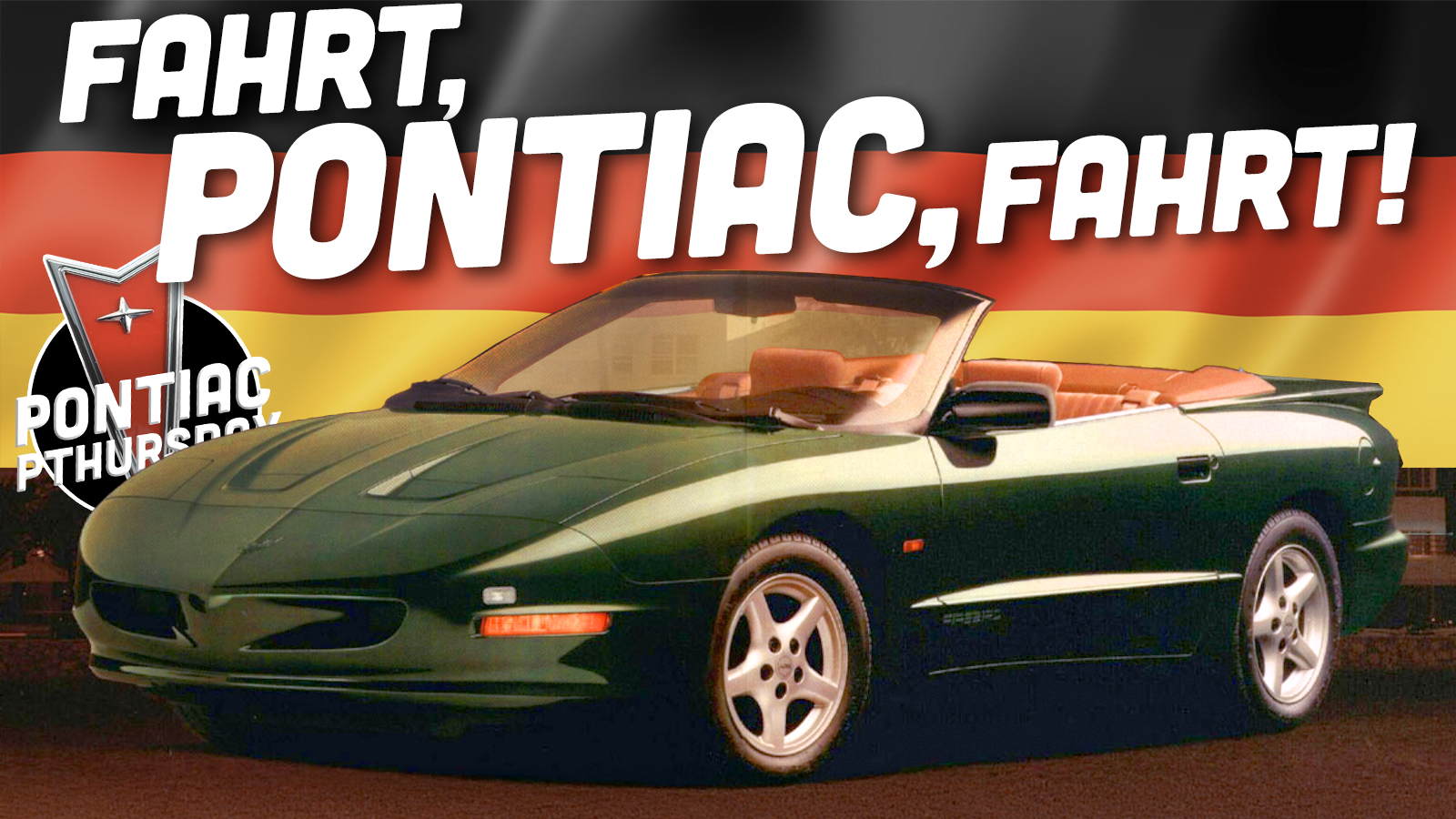
Fahr Pontiac, Fahr!
Did the European experiment work? The numbers are very hard to find, but they would suggest a solid “no.”
My research found that very, very few Firebirds were sold, but Pontiac did reportedly find homes for several thousand of their funky vans over the total number of years they offered it. Interestingly, around 30 are still listed as actively operating in Denmark, and over 300 in Sweden.
Maybe my fictional General Motors marketing reps were right: weird really does sell better overseas.
Pontiac Points (Euro Trans Sport): 59/100
Verdict: Sure, a funky van with a five-speed and twin-cam four is cool, but they put it in an Oldsmobile disguise!
Top graphic image: GM





Based on what I learned from my research when I was converting my Corvette to export taillights, what I suspect is the case with those goiters foisted on the front of the Firebird is that the long, skinny, low and somewhat recessed turn signals on the LT1-era Firebirds didn’t pass muster for visibility from the front.
Edit: Though perhaps not, since the turn signals themselves are also different items from the US market ones and different in a way that suggests that it was specifically to increase forward visibility. I guess those white ones are just side marker lights after all.
Not that there was much Pontiac identity… I have looked at both versions and apart from the logo, the ribbing in the lower panels and the two nostral openings in the front bumper I could not identify anything specific. I would say we got the better version with the Olsmobile front, the updated US Pontiac front looks like a pig’s nose on a otherwise elegant design.
I don’t have any numbers either, but the Trans Sport sold well enough in Austria to not cause any double-takes when you saw one in the wild. This despite the fact that one well-known Austrian industrial designer whose name escapes me called the design “irresponsible”, because the handle in the middle invited you to grab the thing and throw it out.
Pontiac sold Bonneville SSEi in Europe with export headlamps and rear bumpers redesigned to accomodate wider numberplates and rear fog lamps. Ironically, the same Bonneville headlamps would fit the facelifted Trans Sport. So, Pontiac shouldn’t have issue with recertifying the facelifted Trans Sport for Europe.
Now, the burning question: fog lamps. Why weren’t they fitted to the Trans Am? ECE regulations stipulate the certain distance from the outermost side edge. The Trans Am and Bonneville fog lamps are too far from the edge. This regulation explains why Mercedes-Benz W116 S-Class appears to be “cross-eyed” with fog lamps on the outer side while the headlamps are positioned closer to the cooling grille.
The rectangular headlamp capsules and bezels fitted to the first year Trans Sport were taken from Chevrolet Corsica, which was sold in some European countries.
Actually, I have never seen 1988-1993 Grand Prix in Europe despite the German-language advertisement. The secondhand car classifieds sometimes show the Grand Prix that wasn’t fully modified other than the headlamps like this one. The Dutch importers often replaced the composite headlamps with headlamp capsules like this Mercury Grand Marquis while leaving the rest unmodified to meet ECE regulations.
By the way, Germans usually say “oder”, not “ja” at end of the question. It does sound strange to hear “…., ja?”
I love these automotive oddities.
These are yet again evidence that amber lights ruin all kinds of designs. The all red Firebird taillights are iconic, they are an absolute mess on the Euro car here.
Didn’t you notice how many “all red” taillamps actually have the amber turn signal indicators, either hidden behind the red lens or in the clear lens? They don’t ruin the look and do enhance the collision avoidance.
Yes, modern day LEDs have largely solved this problem.
I absolutely love that they offered the dustbuster with a manual and a quad 4… I had a similar vintage Beretta GTZ with one in college and it was a really fun car. I’m sure all of that fun was zapped in mini van format but at least it would sound good when you wound it up.
GM needed a 4 cylinder to make their people mover competitive in markets where road taxes are based on engine displacement – so the Quad 4 being the most powerful 4 cylinder GM had at the time was a necessary move.
I am sure the 3800 caused fiscal apocalypse in more than one European market…
I think most people buying a Pontiac Firebird in Europe ultimately got the idea while watching Knight Rider.
This is exactly right.
My buddy from Germany bought an old TA when he immigrated to the US because of Knight Rider – then later bought a DeLorean, for obvious reasons.
You’d think that a continent that had room for the Fiat Multipla would be able to make use of the Dustbusters. The first time I saw a Dustbuster, I thought it was custom-made to compete against the second-gen Renault Espace.
gm in rolling out these half baked wart mobiles makes me think that really had zero idea what they were doing.
Too bad we didn’t get those folding mirrors and amber turn signals over here 🙁
RE: cooling, I had a 3rd gen trans am that had a grill-less nose and it was sub par at cooling in low speeds where the duct opening from the undertray didn’t suck much air up into the radiator. Don’t recall it having cooling problems at highway speeds but would not shock me if the removal of the driving lights was to let more air in for better cooling at Autobahn speeds. Or maybe pie plate sized driving lights didn’t meet German lighting reqs? But then you’d think they’d at least put some block off plates to more elegantly cover the holes. Of course seeing their marker light solution, in typical GM fashion they were clearly trying to get away with the bare minimum here.
Of course now that I typed the above, some quick googling seems to show some versions of the car in the USA had a front bumper cover with sculpted in ducting instead of the driving lights…
Damn, those dustbuster vans have aged well design-wise in my eyes, minus the lovely pontiac cladding of course. I wonder what Adrian would have to say about them?
I must say, “4hp cassette stereo” is more powerful than most at that time.
That’s what I was wondering – was audio electrical power output of stereos really rated in horsepower rather than watts in France? That’s not some kind of reference to the frequency bands of the radio?
I saw one of the dustbusters in France – those produce a double take here in the US, especially so overseas.
It’s up there on the weird list with the Ford Excursion I saw in a small town in Bretagne.
That topshot makes my inner ten year old roll around crying in laughter. Just like when my German teacher mentioned that the German version of scouts were called “Fahrtfinders”
Wanna know what a speed bump is in Swedish? Farthinder!
I had a project in Germany for a bit over a year and found some amusing false friends.
Such bürger being citizen, not the thing you eat in a McDonalds.
Or my absolute favourite: ausgang means exit, notausgang doesn’t mean “not the exit” but rather emergency exit. But if you don’t know you might as well perish in an innocuous building fire.
I had (still have) a Majorette die cast Pontiac Trans Sport, so I knew they were sold in Europe, but even as a kid that struck me as odd.
I had the chance to travel a few times to Belgium / France to visit family when I was a kid and the American car that stuck out to me the most, as in the model I would see more than once, was a Corsica, of all things. There really weren’t that many, but enough that 9 and 10 year old me noticed it was out of place. Didn’t spot any screaming chickens though (well, of the Pontiac variety that is)
The Euro Pontiac that wasn’t a Pontiac, the Opel GT that was a Solstice.
The Opel and Daewoo versions were directly rebadged from the Saturn Sky, which had a lot of sheet metal differences from the Solstice
When I was younger, I recall that there were decent markets for American cars in European countries that did not generally have their own large protected auto industries. In Austria and Switzerland, the The Pontiac Tran Sport variants were pretty popular. There were also a fair amount of Chrysler products of all varieties – Voyagers (which were assembled in Austria), Lebarons, Sebrings, and Neons.
I think only Chrysler really cracked the European market in the 90s (and even then probably lagging significantly behind established players).
LeBarons and Saratogas were moderately popular throughout Europe. Here in Spain they were a somewhat common sight.
And of course the Chrysler Voyager. The most popular of all.
GM’s offerings, by comparison, were oddities.
There used to be a GM plant in Switzerland until the 1970s or so. But in Austria U.S. cars were very niche until the minivan boom really got going. If you saw a U.S. passenger car the standard assumption was that the owner was either a diplomat or a pimp.
There’s a joke in there somewhere but it is eluding me at the moment 🙁
Those lights look so tackey and the missing fog lights make it even goofier. Also the 93-97 birds are really the only years of bird I just do not like 98-02 are awesome. 93 to 97 I just don’t care for the styling.
The end of the line Trans Am is on my short list for a summer car
For me it is a 6speed Formula with T-tops as cloth didn’t come in the Trans Am’s if I am not mistaken.
I’m friends with a pair of Spanish siblings that were into F-bodies, out of the 3 or 4 they had, two came from the german market IIRC they had dual cats under the passanger seat instead of a single one. some time in the early 10’s or probably late 00’s I used to buy regular maintenace parts, think the odd oil pressure sensor, some gasket, brake parts, stuff like that and send it over to them from Mexico, using regular mexican post. It was way cheaper for them, and since they used them mostly as show cars, they didn’t mind the wait time.
After a while, word got out and I was sending autozone parts to Spain regularly to other american car enthusiasts from that side of the world.
Biggest thing I shipped was a set of mexican made subframe connectors along with some lower control arms.
The Hermione meme but:
“It’s pronounced TranSss Sport”
Love the article and these weird EDM Americanised cars. Buicks of a similar vintage suffered an equal fate:
https://live.staticflickr.com/955/40784074125_f4758044a5_b.jpg
Also those red things under the taillights of Firebird were reflectors. The fog lights were integrated into the main units.
Hahaha wow, a Buick! Definitely not a vehicle with European driving in mind during development.
The Dutch are known to have a thing for American cars though
Yeah, the fog lights are the ones where the reverse lamps on the US market taillights originally were.
Those Buick units and their visible chrome dividers also make it look like a car from the 1970s.
It’s such bullscheiße that rear amber turn signals aren’t mandated in the US.
Not only that, but your taillight, brake light, and blinker can all be a single bulb.
With pretty much all car makers being global I really dont know why countries cant get together and standardize some of this stuff. Its a waste of resources
In essence they have. Outside of North America, most countries now follow the UNECE rules.
https://en.wikipedia.org/wiki/World_Forum_for_Harmonization_of_Vehicle_Regulations
As with many other things the US is an outlier in this respect.
For all the talk about “Fair trade”, it’s all about protectionism.
Make specifications slightly different so that it costs foreign manufacturers extra money to develop and install those meaningless changes for the US market – and it makes imported cars cost more to US buyers.
Of course it also makes US cars more expensive than they would be for buyers in non-US markets – because of the need to make little meaningless changes to sell them abroad – but that’s something certain people can use as one-sided talking points to get voters riled up about how unfair other countries are to the US…
How ’bout them tariffs?
Don’t worry we don’t want them either 😛
Not “most countries”. About 60 out of 197 countries. Over 100 countries don’t have vehicular safety regulations.
Japan incorporated many of UN-ECE WP.29 regulations in its JASIC. Same for Australia and its ADR.
You forgot about Canada that bases its CMVSS almost word for word on US FMVSS. México is basing its NOM194-SCFI-2015 on FMVSS and has indicated that the country would switch to UN-ECE WP.29 at undetermined date despite the USMCA.
I think these are actually perfect examples of how amber can totally ruin a design.
I get that these are afterthoughts and could have been better integrated – but the American lighting is so much cleaner on these cars.
