

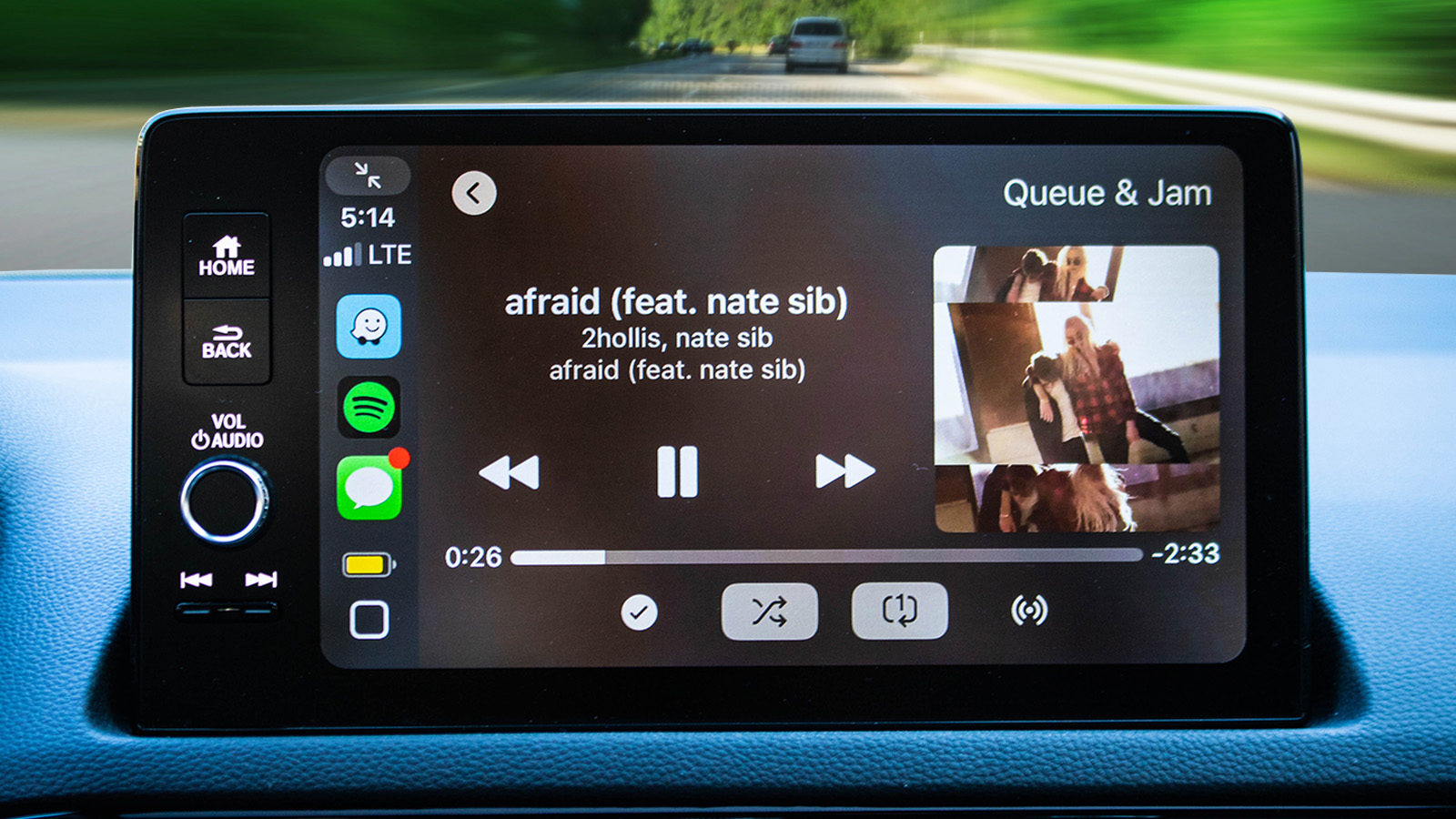
Since the first Motorola car radio launched in 1930, listening to music in cars has become ubiquitous. From mono radio to Dolby Atmos integration, the technology has changed a lot, but some methods of soundtracking your drive are likely safer than others. A team at Harvard has found a possible link between major album releases on streaming services and road fatalities, and it’s the nuances of this study that might be the most interesting.
So how’d we get here? Let’s have a look at the study. Researchers first compiled the ten albums released between 2017 and 2022 with the most single-day Spotify streams. Unsurprisingly, there’s a lot of Taylor Swift and Drake on that list. They then plugged those albums’ release dates into NHTSA’s Fatality Analysis Reporting System (FARS), and compared fatalities to the 10 days before and after each release, adjusted for day-of-week, whether the release fell on a federal holiday, and what week of the year an album was released on, then broke things out based on existing FARS categories such as blood alcohol presence, number of vehicle occupants, driving conditions, and so forth. After checking their work using random dates, random Fridays, and the closest weekdays of other years, a pattern emerged: on big album release days, traffic fatalities went up.


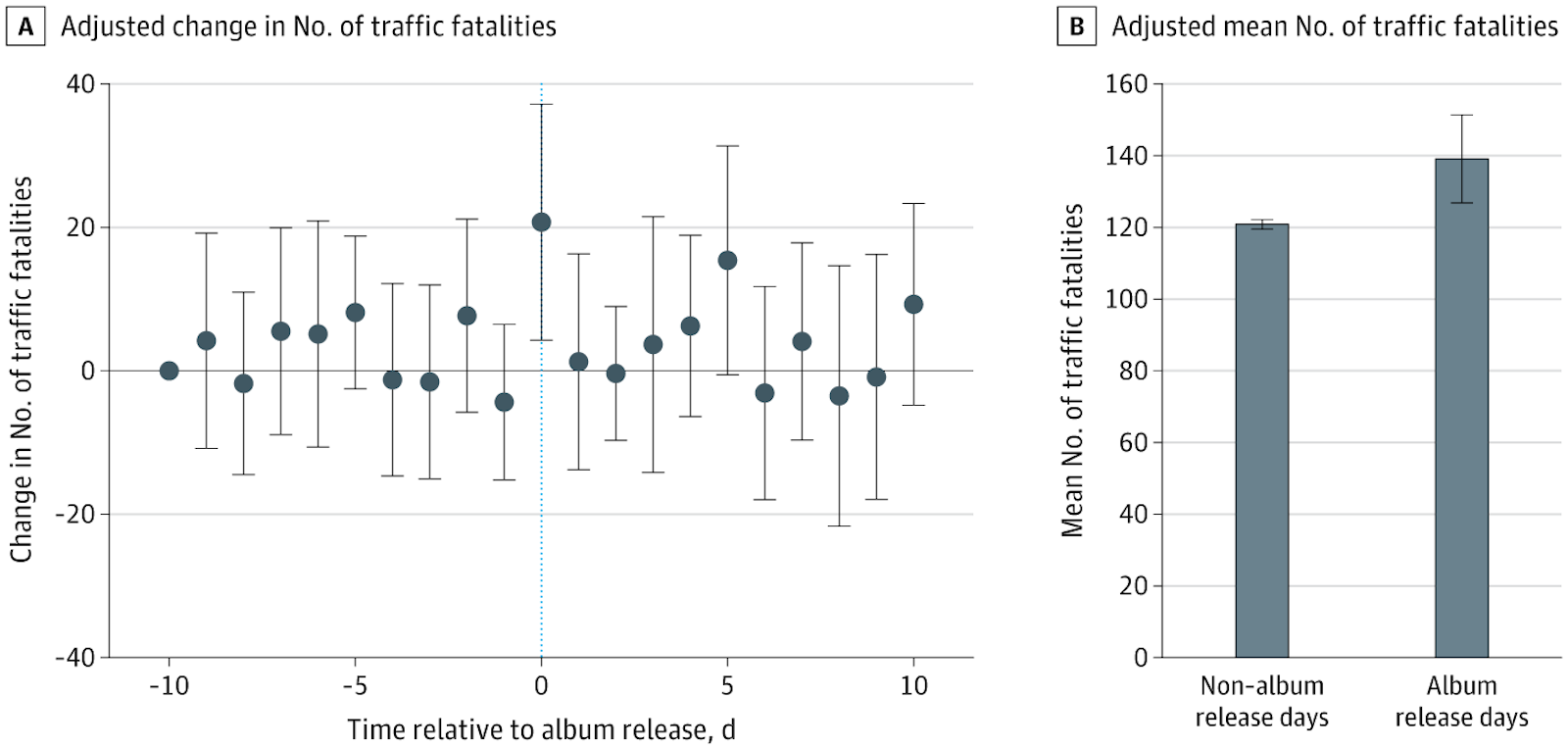
According to the study, “The adjusted number of US traffic fatalities was 139.1 (95% CI, 126.8-151.4) on album release days compared with 120.9 (95% CI, 119.6-122.2) on the 10 days before and after the release, corresponding to an absolute increase of 18.2 fatalities (95% CI, 4.8-31.7 fatalities; P = .01) or a relative increase of 15.1% on album release days.” On paper, that works out to an additional 182 road deaths on the release days of these ten most-first-day-streamed albums.
What’s really interesting here is the conditions under which most of these additional deaths occurred. The data shows a disproportionate increase in fatalities among sober drivers crashing in clear weather conditions. A riskier time-of-day is too close to firmly call between day and night based on increased fatalities alone, although more deadly collisions happened in urban environments than in rural environments. That’s the only data point where driving conditions seem to be a factor, and part of that could just be that urban roads are more heavily travelled than rural ones because this data point isn’t normalized per-capita for miles driven.
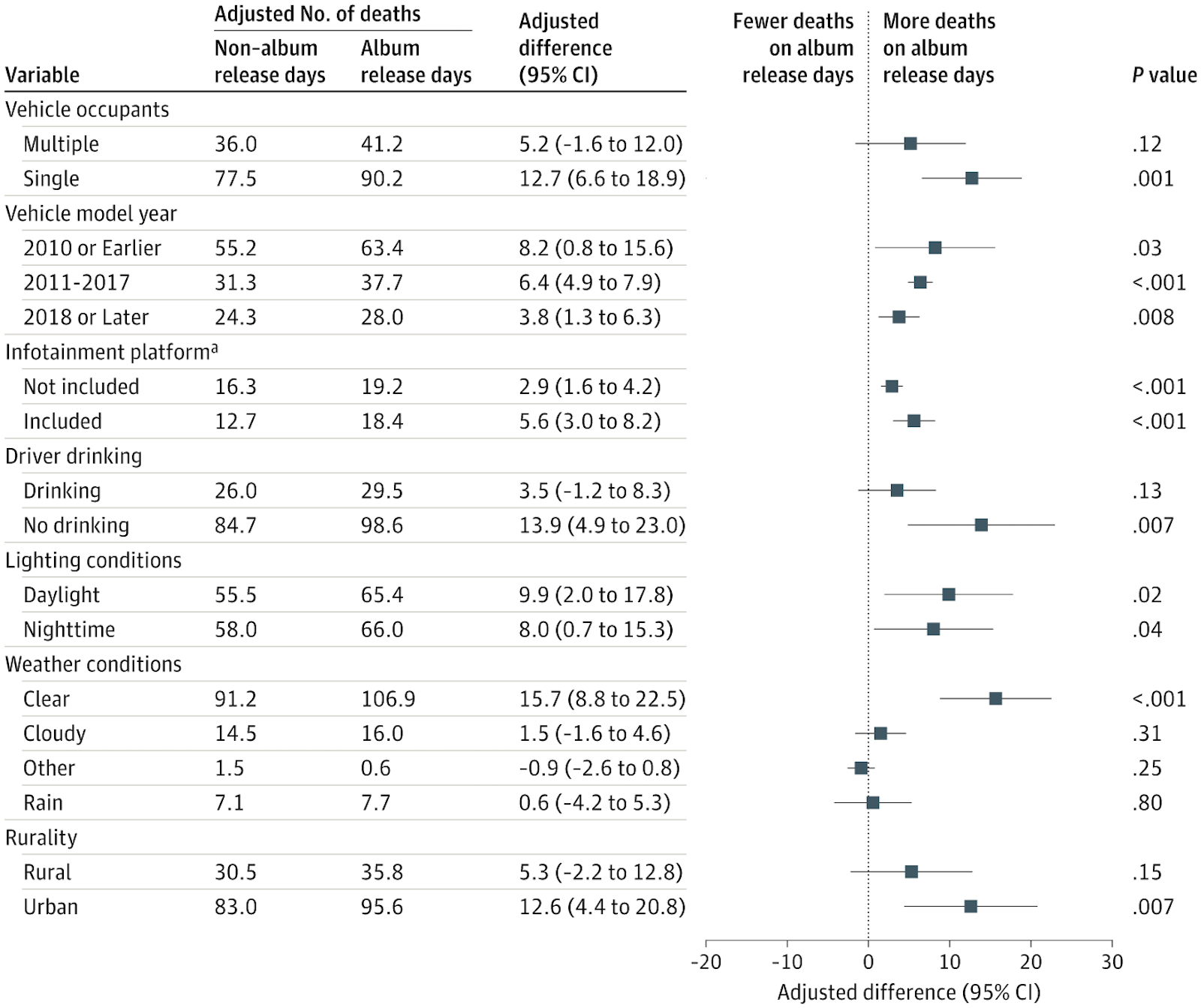
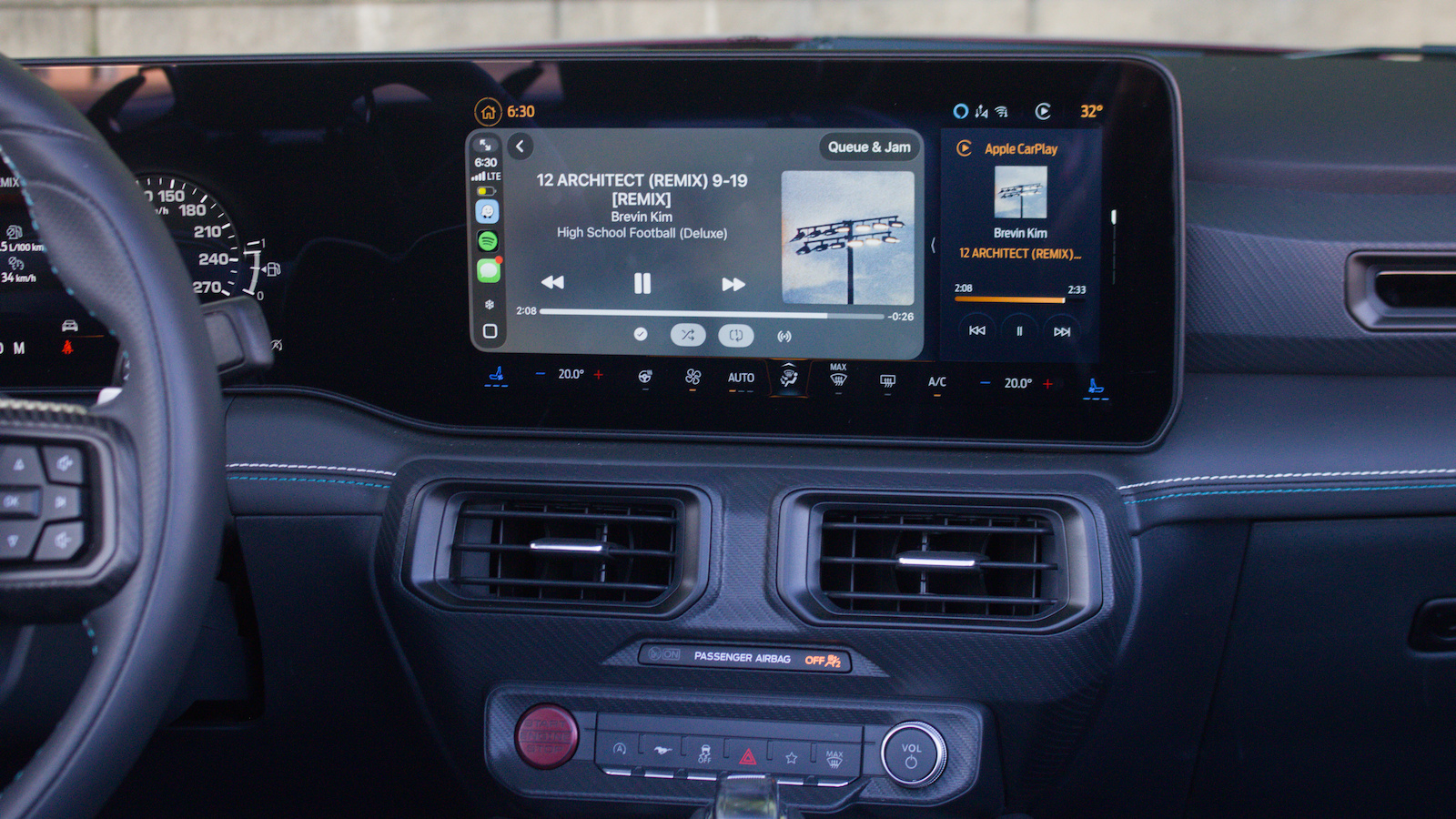
In short, these general conditions do seem to point towards distraction as a likely factor, and there’s another interesting piece of data here that raised an eyebrow. The researchers also wanted to know if infotainment might play a role, so they set 2016 as a cut-off date. Why 2016? Officially, it’s “when many new cars began to come preinstalled with [infotainment].” While certainly not every 2016 model year car featured a standard infotainment system, 100 different 2016 models were available with Apple CarPlay thanks to Volkswagen, GM, Honda, Hyundai, Mercedes-Benz, Mitsubishi, Volvo, and Ferrari all having joined the party. Unsurprisingly, 2016 also marked a year when a number of GM, Honda, Hyundai, Kia, Mercedes-Benz, Volkswagen, and Volvo all supported the feature on select 2016 models. This gave drivers a way to interact with their streaming apps on a built-in screen.
As you’d probably expect, the study’s selection of pre-2016 vehicles saw higher fatality rates on non-album-release days than the selection of cars with infotainment. Generally, the cars without infotainment are older and may lack some of the safety advances of modern machinery. Proper small-overlap impact protection, automatic emergency braking, that sort of stuff. However, on album release days, fatalities of drivers in vehicles from the infotainment era spiked 44.9 percent compared to 17.8 percent for vehicles prior to 2016. The resulting figures stood fewer than one adjusted number of deaths apart, notable shrinkage from a non-album-release-day delta of 3.6. That’s a fascinating result, and it does beg the question: What behaviors could influence this?

See, normally, albums are meant to be listened to all the way through. If people are indeed doing just that, is there really a need to poke at a screen beyond cueing up an album before you set off? It’s not like Spotify or Apple Music for Apple CarPlay or Android Auto display lyrics whilst you drive so you can channel your inner James Corden. Likewise, if it’s just a case of people playing music extremely loudly to the point of distraction, why would a car being newer than 2015 have a disproportionate effect on fatality rates coinciding with big album releases?
In some ways, that’s the beauty of science, in that the overwhelming majority of it involves uncovering more information rather than solving something. There are likely more studies to be done here on how drivers interact with audio streaming services, how loudly they’re playing music, and what effect actively listening to previously unheard music has on driving performance. Also, have things grown better with new technology? Hitting three or four virtual tiles in Spotify for Apple CarPlay to start a newly-released saved album is likely less distracting than swapping CDs, but by how much? Also, is it more distracting or conversely more reliable than using voice commands? Furthermore, how do native apps perform on cars that don’t support Apple CarPlay or Android Auto?
For now, the study concludes that streaming “sharply increases by 43% on dates of major music album releases, while US traffic fatalities increase by approximately 15% on those same days.” Certainly not all of those streams are happening in vehicles, and more research is needed to figure out why fatalities go up, but maybe do that first listen at home instead of on the road.
Top graphic image: Thomas Hundal; DepositPhotos.com




I’d like to see the comparison of the rate of fatalities while drinking v. number of fatalities while drinking and having “Roadhouse Blues” blaring on the stereo.
It’d be very hard to correct for it, but there’s the possibility that people using CarPlay/Android Auto are significantly more likely to be listening to the new album.
Good thing the newest song that played on my drive home this evening was from 1994.
But seeing how many people these days are actively more interested in their phone than piloting the 4000 lb object going 65 down the road, I can’t say I’m surprised that they put “driving” aside to check out song lyrics or something.
Heard this on the news the other day too. Why am I so attuned to happenings that’ll wind up in these pages?
I think one reporter referred to it as ‘cognitive distration’ …the act of listening to new music very attentively while doing something else simultaneously, such as driving a car. At freeway speeds. At night.
For quite a while now, I don’t even listen to my usual stations in the car: KCSN and KXLU. I just keep the factory stereo (which Volvo called ‘high performance sound’ 22 years ago, but to me, it mostly sounds like an average peformance) on the local classical station KUSC, with the air conditioning on low. There’s SO much traffic, and the sun is SO bright and hazy, and there are SO many people not paying any attention at all to their driving.
It makes me just want to get home as soon as possible.
Surprise, Surprise, that the “Paradox of Choice” and FOMO, brought on by bringing the internet to our cars could lead to higher fatalities.
My initial kneejerk reaction is I hate the idea of blaming music for a driver’s subpar driving skills.
It also bums me out, knowing I’ll never again have the experience of listening to a new Rush album in the car. Maybe Tool will release one more album before my demise…
So, I’ll give credit where it’s due: this study actually seemed to control for a reasonable number of variables.
But then I’m going to take away some of that credit: We got vehicle model year. We got rurality.
What did we not get? In broad strokes, demographics of fatalities: Is the uptick among women? Among men? Were the individuals actually listening to these albums or evidence desire to listen to them (fun trivia: Netflix, Spotify, Pandora, and all other platforms track what you listened to and when and will release this to law enforcement).
Like, this is an interesting study, but it’s not normalized for mileage-traveled-per-day or even age of fatalities. If it comes out that lots of artists like to release their albums at the beginning of summer (when there are, strictly speaking, more people driving tired on the road), then it’s correlation, not causation.
I miss the days of creative brand names. Motorola is a perfect example, being a port manteau of “motor” and “Victorola.”
Refrigerators under the brands of Frigidaire and Kelvinator come to mind. There are nearly countless others.
I did not know this tidbit about Motorola and for whatever reason, it just makes me smile thinking about them coming up with that name back in the day
It makes me smile just to remember that for years we had a Hotpoint refrigerator and a Frigidaire stove.
That’s funny!
> What behaviors could influence this?
https://giphy.com/embed/PqwqtOLfG19Ti
I guess it’s time to ban music, or at least new albums. new albums cause more deaths than lawn darts, fireworks and cheetahs combined.
“NHTSA’s Fatality Analysis Reporting System (FARS),”
I thin you mean, NHTSA’s Fatality Analysis Reporting Tracking System (FARTS).
I can believe it especially if it’s a top 40 artist album. I accidentally discovered certain cities have music that they seem to dive to. If you get into the same flow as that it’s easier to deal with their driving. Results seem to be better if listening to satellite radio.
Nashville and most of Tennessee on 40 unsurprisingly country top 40. Parts of Texas and Dallas classic country. That also seems to work in most of Oklahoma, Utah, and good part of Kansas plus the rest of the box states sans large parts of Colorado and New Mexico. I’ve been told Celtic rock for Boston but I’m not convinced. Top 40 had a better result if you can stand it. I’ve also been told 90s for 00s punk rock for Baltimore I’m not to sure on that one either.Parts of Colorado soft rock various edm seem to work well. Top 40 seems work in most cities. Especially along the coasts.
theguyfromblink182WTF dot gif.
Great episode on Freakonomics ep. 668 on this very study, with more in depth commentary from the author.
95% of people who die just saw a doctor. Correlation does not mean causation
THIS!
Don’t most albums come out on Fridays? I wonder if that might have anything to do with it…
Pat McAfee album dropped. Does that mean the roads are exponentially more safe this week?
Maybe it will help cancel out the crying and crashing from the new Phoebe Bridgers album.
Safer than if it was John McAfee.
This… makes very little sense to me. When I put on an album in the car that’s basically 45 minutes of not having to fart around with the infotainment system while I just listen. Are they trying to read lyrics on their phone screens while driving?
Oh crap, that’s it, isn’t it?
From the actual study:
“Key Points:
Question Is the use of smartphones to stream music associated with increases in traffic fatalities?
Findings In this cross-sectional study of 233 809 US traffic fatalities from 2017 through 2022, the adjusted number of traffic fatalities was significantly higher on major music album release days than on the 10 days before and after, a 15.1% relative increase, when daily online music streaming increased by approximately 43%.
Meaning These findings suggest that online music streaming through smartphones is associated with distracted driving and traffic fatalities.”
This Autopian article mentions nothing about drivers being distracted from using their smartphones. The actual conclusion from the study was this:
“Conclusions and Relevance In this cross-sectional study of US traffic fatalities, major music album releases, accompanied by increased online streaming, were associated with a significant increase in traffic fatalities, suggesting that online music streaming through smartphones may significantly contribute to distracted driving and traffic fatalities.”
So people are more likely to be playing with their phones when new albums are released. People who play with their phones while driving are more likely to die in an automobile accident. If people would just put their phones away while they were driving, they’d be less likely to kill themselves or other people.
Seems like a non-story to me.
Yes- people being on their phones leads to fatal accidents is a non-story. But, how are/why are people on their phone while listening to music? Its a perplexing phenom, though I am inclined to agree with another commenter here that its people on their phone reading lyrics.
I listen to music while driving either from an iPod, USB drive, CD/MP3 disc, or just plain FM radio. I could never imagine looking up lyrics on a screen while I was driving.
I learned most of the lyrics to the 600 or so CDs I own by reading them in the liner notes included with the CD.
The wife recently put some type of music video with lyrics on our TV via You-Tube and we both laughed at how it must have been A.I. trying to interpret the lyrics due to the hilarious mistakes we were seeing.
AI lyrics totally suck the big one.
They are feeling their “needs” are worth more than a possible accident or injury-death of another.
We have state law here that prohibits hand held use of the phone while driving. It has made no effect on behavior, but that’s probably because of almost no enforcement at all.
Which really sucks.
Best car I ever owned was destroyed in 2014 by an idiot on his phone.
Also destroyed my back, knees, and neck.
It’s a shame that thoughtless behavior exceeds common sense and concern for others. YMMV.
I have two thoughts about this:
“And yet, the number of traffic deaths declined on the release date of Men Without Hats’s ‘Rhythm of Youth’ in 1982. Further study is required to suss out the exact reason why.”
I’d like to see the breakdown of male vs female drivers in this study.
See?! I’m not listening to only 80s-90s metal because I’m “stuck in the past”, I’m doing this for SAFETY!!!
Metalica is keeping you safe
Nothing else matters
Just make sure to keep the Whiskey in the Jar whilst driving.
It helps that they haven’t released new music since August 1991.
I listened to “The Very Beast of Dio” on my way home today. I made it home safely, now I know why.
Jeez, Taylor Swift and Beyoncé must’ve killed millions. Millions!
New hazard warning in Waze: “Hey y’all, Tay-Tay just dropped a new album, be safe out there!”
I’m pretty sure the DOT digital signs they use for safety messages in my area have referenced Taylor Swift at least once. I could totally see this showing up on one of them.