

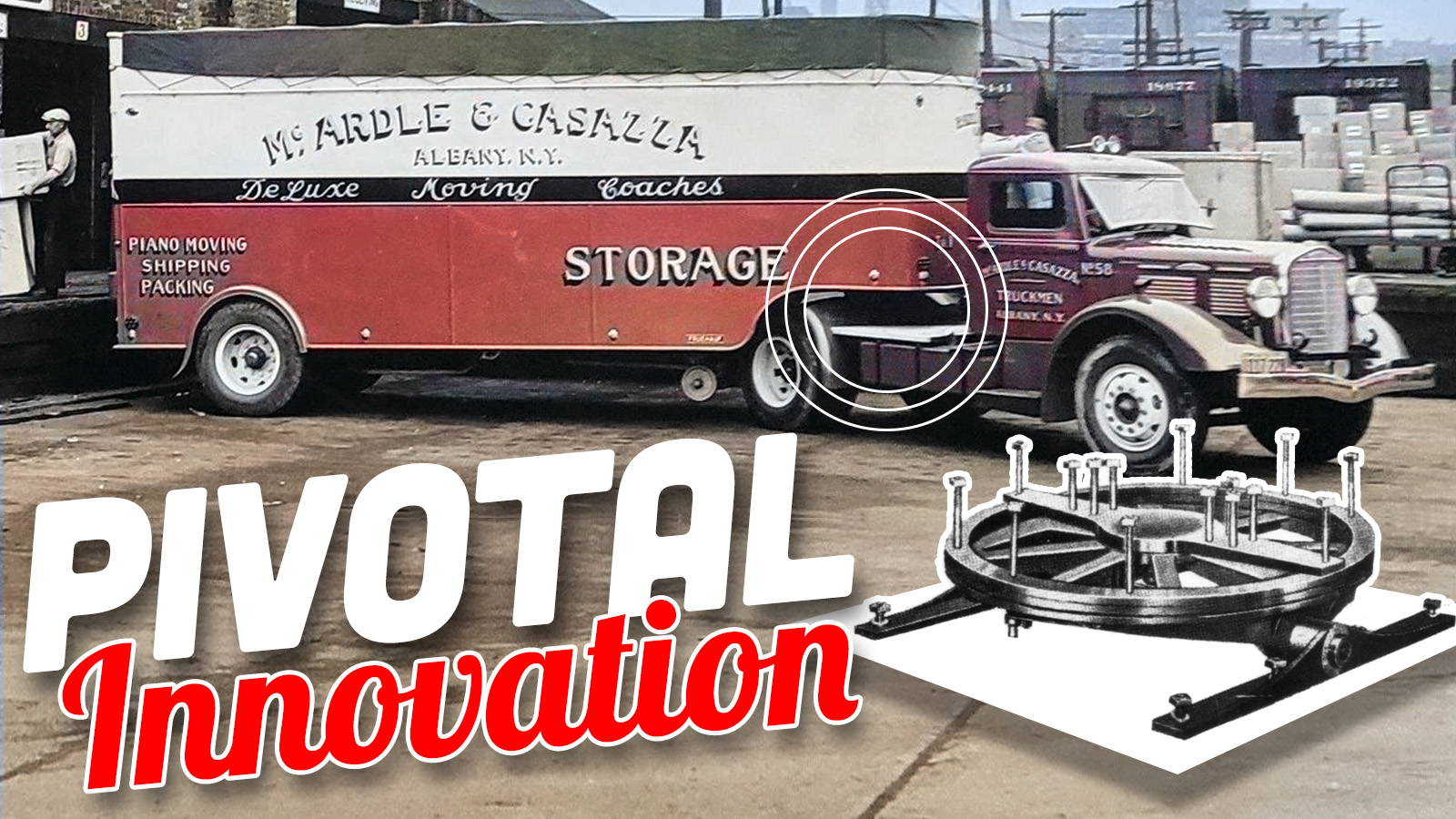
The semi-tractor has been around for nearly as long as the truck and the automobile have been. The core idea of having a truck pull a trailer hasn’t changed much in over a century, but a long road of inventions and technological development has gotten us to where we are today. One of the biggest inventions in trucking history is the modern articulating fifth wheel. This device, which can be found on the back of every modern semi-truck, allows the trailer and truck to articulate without coming into conflict with each other’s structure. The modern fifth wheel traces back to the 1915 invention of one man and its popularity to one iconic trailer manufacturer.
The earliest semi-tractors were simple machines. These trucks, built in the mid- to late-1890s, largely resembled horse-drawn wagons, but with engines instead of horses. These vehicles featured open cabs, solid wood and iron wheels, a long open bed, and steering that was perhaps closer to a tiller than anything in use today. Daimler Truck says that it built the world’s first truck in 1896 when Gottlieb Daimler converted a horse-drawn wagon into a truck (below).


[Editor’s Note: As usual with Diamler-Benz, this isn’t close to true. The first truck was also the first automobile, as Cugnot’s 1769 Steam Drag was a machine designed to haul artillery, very much the duty of a truck. And after that there were plenty of other motorized trucks, like the Thompson Road Steamers from 1869, which were used to haul cargo around. Again, like a truck. Diamler didn’t make the first trucks. – JT]
It wasn’t long before automotive pioneers began toying with the idea of having a truck tow a trailer that carried goods. In 1898, Scottish immigrant Alexander Winton was growing the automobile business that he founded only a year prior. Winton built his cars by hand with some nice features for the era, like a painted body, a padded seat, a leather roof, gas lamps, and B.F. Goodrich tires. In 1903, one of his cars was the first to drive across the United States from San Francisco to New York City, long before the country even had a proper road network. Later, Winton would become one of America’s experts in diesel power.

Anyway, in 1898, Winton was faced with a challenge. Orders were rolling in, and he was building cars, but his method of transporting them to their new owners had a critical flaw. Like some other early automakers, he simply drove each completed car to the buyer’s location. Not only was this inefficient, but it meant the car wasn’t truly new by the time it reached the customer. Worse, if something on the car broke during transit, Winton would have to fix it at his cost, reducing how much money he made on the car. There had to be a way to get the car to the customer without actually driving it.
Winton’s solution was to take one of his touring cars and install a platform on its back, above the car’s rear-mounted engine. He also built a cart, onto which a new vehicle would be wheeled onto and strapped down. The modified touring car would then be brought to the cart, and the cart’s tongue hooked into the touring car’s platform. Winton’s contraption is the earliest known example of the semi-trailer, and it’s also the earliest known example of the modern car hauler. By making a touring car haul touring cars, Winton was now able to deliver his cars in actually new condition.

Despite being one of trucking history’s most important figures, Winton’s invention was merely his solution to deliver his cars. He’d leave truck and trailer design to the pioneers who were making their own strides.
I have told Winton’s story before, but I haven’t explained how those early trailers worked. They weren’t really as flexible, as capable, or as convenient as today’s trailers. One invention would help spark the development of the modern semi-trailer, changing trucking history.
From Horses To Trucks
The original fifth wheels were an invention for horse-drawn carriages.
In centuries past, turning a carriage varied in difficulty depending on its design. The front wheels didn’t turn as the cars of today do. Instead, they were attached to a solid axle and, to facilitate turning, the entire axle itself pivoted around a pin or bolt. This is how wagons worked for centuries. However, this had the drawback of reduced stability, as the wagon body connected to the axle through that pin. Later, inventors figured out that stability could be improved if the pin was surrounded by a plate or two to take the weight and motions between the axle and the wagon bed. In 1758, Erasmus Darwin, the grandfather of Charles Darwin, came up with the idea of an axle that didn’t move, and instead, the front wheels moved independently as the wagon turned.
There were other difficulties, too. If all four wheels were large enough to reach the body, for example, front wheels that were allowed to turn would impact the box of the carriage. There were different methods to improve turning. A cut-under wagon had the box raised above the wheels so that the entire front wheels could pivot without impacting the box. Smaller front wheels also helped with clearance.

A cut-under wagon had greater maneuverability than wagons of previous designs, but presented another limitation. In wagon designs that had a reach – a central beam that connects the front and rear axle assemblies – the front wheels could pivot only so far before they made an impact with the reach. Sometimes, that was around 60 degrees or so. There was a risk of the wagon tipping over if a wheel caught while the horse(s) were turning the wagon.
The fifth wheel was a step forward in wagon design. Invented sometime in the first half of the 19th century, the idea was essentially an evolution of the plate system. On a wagon, a fifth wheel consisted of a circular or semi-circular ring that looked like a wheel and was mounted atop the front axle’s structure. Another plate was on the bottom of the wagon. Together, these plates formed a load-bearing structure that not only provided stability but also turning. A fifth wheel enabled a wagon’s wheels to turn about 90 degrees, or sometimes more, depending on the design.

It’s unclear who invented the fifth wheel. Some 10,000 patent drawings and around 7,000 patent models were destroyed in the U.S. Patent Office fire of 1836. The fire was devastating for American pioneers. Anyone who patented something from 1790 to 1836 completely lost the official record of their invention. Only 2,845 patents from that period were restored because their inventors were able to resubmit patent drawings. In other words, if someone invented a fifth wheel before 1836, the record probably went up in flames.
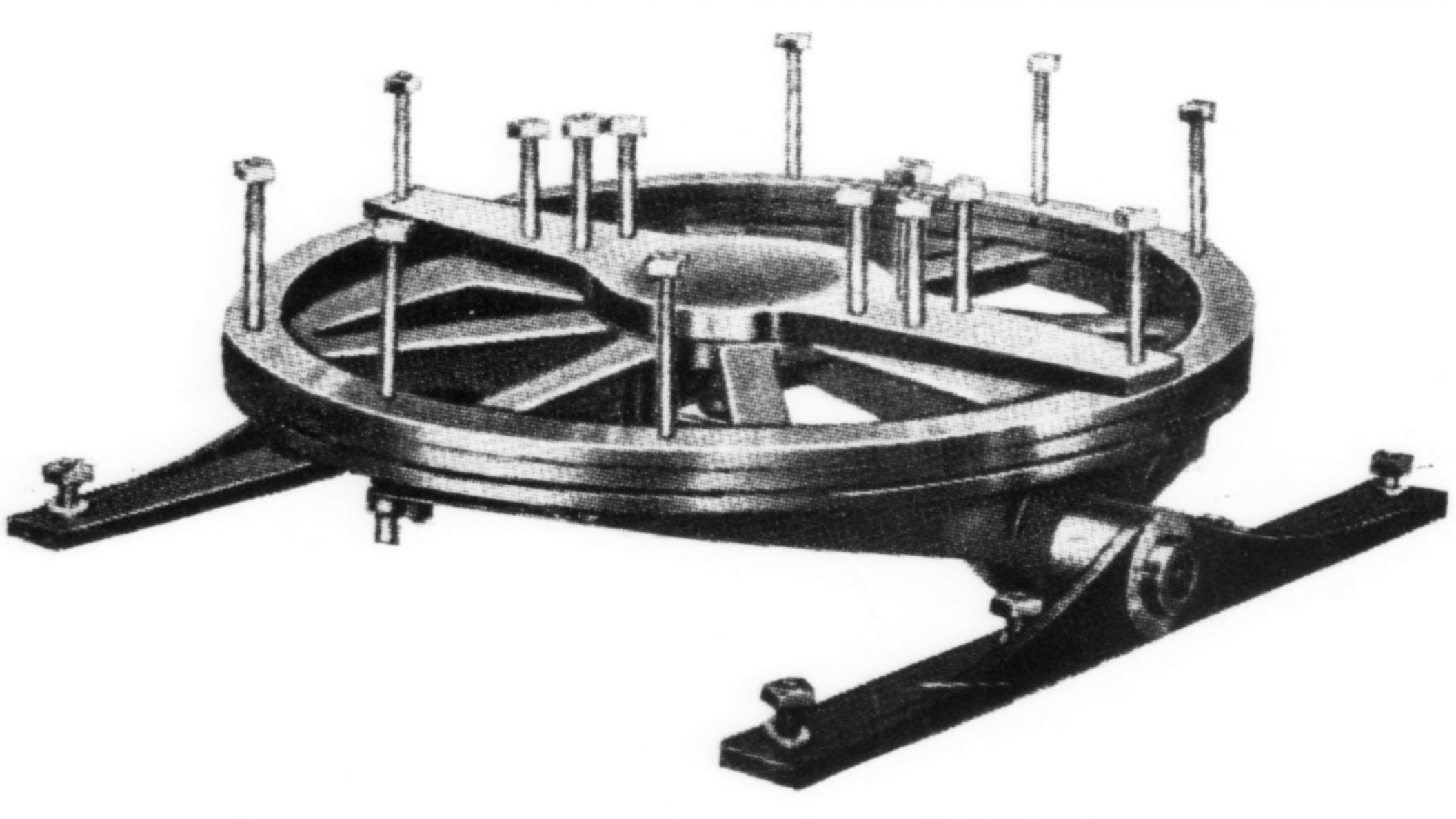
The earliest fifth wheel record that I could find was from Samuel C. Brown and Levi J. Hicks of Macedon, New York, who filed for a patent on a “Fifth Wheel” (above) on July 17, 1837. Historians also point to the fifth wheel invented in 1850 by Edward and Charles Everett of Quincy, Illinois. From this point forward, inventors would continue to improve fifth wheel designs until the truck and automobile took the place of the horse-drawn carriage.
Fixing A Problem With Early Semi-Trucks

When the earliest semi-tractors started hitting the road, many early American trailer coupler designs were based on the horse-drawn carriage fifth wheels of old. But this presented a problem. While these couplers transferred some trailer weight to the truck for better distribution and allowed for horizontal pivoting, they did little for vertical movement.
This wasn’t a problem with horse-drawn carriages because, given their four wheels, they could traverse rough terrain independently. Semi-trailers often featured only a set of rear wheels, and thus, the truck supported the front of the trailer. But since the coupler did not allow for much vertical movement, essentially the entire truck and trailer had to react to America’s rough, rudimentary road network. This beat up the truck, trailer, driver, and cargo.

There was more. Fifth-wheel designs in that era often required the truck and trailer kingpin or kingbolt to be in near-perfect alignment. The trailer also had to be lifted and lowered into place and then manually secured to the fifth wheel. This process usually involved a support structure to hold the weight of the trailer and sometimes a team of men. This meant that it was not quick to swap trailers, limiting the flexibility of the truck.
Dozens of inventors all tried tackling these issues. Some inventors added hinges to allow for vertical movement, some added springs to improve handling, some tried reducing friction between tractor and trailer, some tried to reduce turning radius, and others figured out ways to automatically slide the trailer into a locking coupler. This is to say that, technically, the modern semi-tractor fifth wheel doesn’t really have a single inventor, but many. Each of those inventors, and sometimes trucking companies, sought to solve a specific issue with the rudimentary fifth wheels of the 1910s.

Some historians point to a 1915 patent from inventor Herman G. Farr and assigned to Charles H. Martin as the beginning of the modern semi-tractor fifth wheel. Trucking publication The Trucker gives some background on Charles Martin:
Born in 1867 in Findlay, Ohio, Martin got his start in the business world as a traveling salesman, first selling groceries for a wholesale company. He later went to work for the W.J. White Chewing Gum Co. This position took him to Europe where he was sent to market the company’s product. In 1899, he reached a turning point in his career. He developed an interest in a recent invention back in the U.S. — the motorized automobile. Martin’s obsession with America’s newfound source of transportation took him to Springfield, Massachusetts. There, together with Honsdale Smith, he purchased the Knox Motor Co. Martin is credited with carrying the company name to Puerto Rico, where he introduced the island to automobiles. But it was his later work — as a mechanical engineer — that brought about his source of fame in the motor vehicle world.

Martin moved from Knox to the Morgan Truck Co. It was there he designed a three-wheeled road tractor. Coincidentally, he sold the tractor to Knox Motor Co., and it became widely known as the “Knox Motor Tractor.” In the meantime, Herman Farr, a former colleague of Martin’s at Knox, developed a fifth-wheel design. However, Farr’s invention received little fanfare in its early years. By 1915 Martin and Farr had teamed up to form the Martin Rocking Fifth Wheel Co., which was among the first businesses to specialize in the fifth wheel. Martin patented Farr’s invention — for which Farr was credited by being named secretary of the company.
Farr’s invention wasn’t so much something that was entirely new. Instead, his fifth wheel had combined the ideas presented by other inventors into a single package. Farr’s fifth wheel effectively distributed weight to the tractor, allowed the truck and trailer to articulate on their own, granted a tighter turning radius, added lubrication points, and improved ride quality. Charles Martin claimed that, with the fifth wheel installed, a truck could tow up to three times the weight it could just by itself.

1. Tractor and trailer connecting apparatus, comprising, a circular member having parallel box portions along opposite sides thereof, a diametrically arranged rock shaft, shaft supporting members .for the shaft slidably arranged in the boxes, springs between the sides of the supporting members and the ends of the boxes to normally hold the former in central position, and means fixed to the shaft to connect it to a vehicle.
2. Tractor and trailer connecting apparatus, comprising, a member adapted for permanent connection to one vehicle and having a king pin portion, a cooperating member having means to receive said ‘portion to pivotally connect the members and on each side thereof box portions, sildably mounted shaft supporting members one in each box and provided with central projections on each side parallel to the boxes, springs loosely wound around the projections and bearing against the ends of the boxes and the sides of the supporting members, a transversely arranged rock shaft mounted in the supporting members to move therewith against the force of the springs and means to connect the shaft and the other vehicle.3. Tractor and trailer connecting apparatus comprising a circular fifth wheel member having a transversely arranged member with a centrally positioned king pin portion all adapted to be connected to one vehicle and a cooperating circular fifth wheel member adapted to be connected to the other vehicle and having spoked thereto a central portion to receive the king pin portion. a pair of parallel bearing boxes, one fixed adjacent the circumference on opposite sides of the central portion, shaft supporting members slidably arranged one in each box. a transversely arranged rock shaft mounted in the supporting members and extending beyond the boxes, projections on the sides of each supporting member extending along the boxes, springs loosely mounted over the projections and abutting against the sides of the supporting members and the ends of the boxes to normally hold the shaft in .central position, and parallel plates one fixed to each end of the shaft to attach the shaft for movement with the vehicle.
4. Tractor and trailer connecting apparatus, comprising relatively pivoted fifth wheel portions, one of which is provided with a pair of spring boxes, shaft supporting members slidably arranged in the boxes having projections thereon to abut the ends of the boxes and limit their movement therein, coiled springs loosely mounted over the projections and abutting the ends of the boxes and sides of the supporting members to normally hold the latter in central position, a transversely arranged rock shaft mounted at opposite ends in the supporting members to move therewith and adapted to connect the apparatus with one of the vehicles.

One of the biggest advantages of the Martin Rocking Fifth Wheel, as it was called, was its flexibility. If the front end of the truck hit a bump, the fifth wheel’s horizontal and vertical rocking mechanisms would allow the trailer to articulate on the fifth wheel, leaving the trailer unbothered. Likewise, if the trailer had to navigate an obstacle, a curb, for example, the fifth wheel’s rotation would allow the trailer to traverse the curb without stressing the tractor. A Martin Rocking Fifth Wheel was originally $35 ($1,157 in 2026) for four-ton trucks, $65 ($2,148 in 2026) for six-ton trucks, and $85 ($2,810 in 2026) for ten-ton trucks. Prices later increased by $30 across the board. The price got you the hardware for both the truck and the trailer.
This made rough roads easier on the truck’s driver and on the cargo in the trailer. Martin claimed that his fifth wheel’s advantages would cut the cost of hauling in half. But what really thrust the Martin Rocking Fifth Wheel into its status as an icon is what happened next. Remember, before Martin came around, Farr’s invention didn’t get traction.
A Semi-Trailer Innovator
A year before Farr and Martin applied for their patent, Detroit blacksmith and wagon builder August Fruehauf was tasked with solving a problem. From Fruehauf:
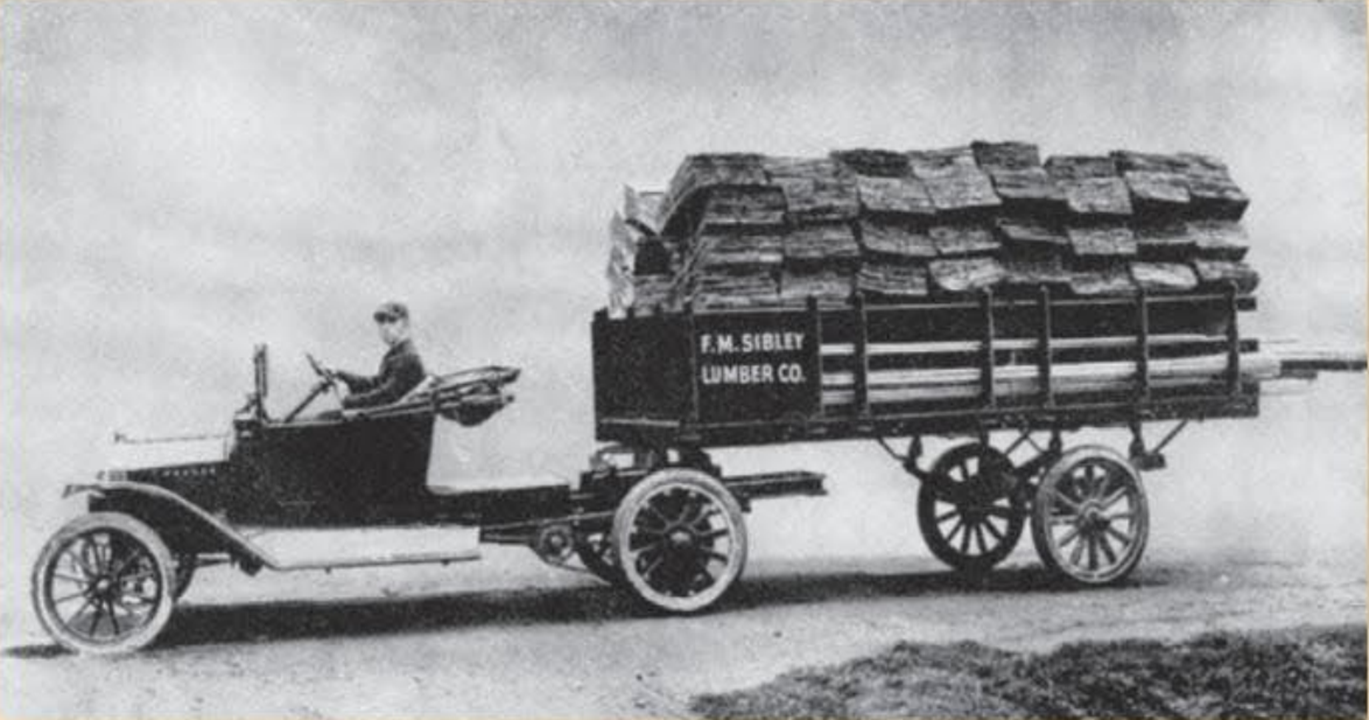
In 1914, Frederic M. Sibley, looking for a way to transport a sailboat to his vacation spot, asked August Fruehauf to fit the kit on his Model T Ford. August Fruehauf and his longtime collaborator Otto Neumann developed the initial concept, forming a tray with sides high enough to transport the sailboat and its accessories safely. At the front of the trailer they install the first special king pin, compatible with the rear of the car. For this, the rear seat of the Ford had to be disassembled.

Sibley loved this first trailer so much that he ordered more of them. Fruehauf decided to make a whole business of it, launching what would become known as the Fruehauf Trailer Company. Sibley’s competitors saw his Fruehauf trailers and loved the concept, asking for their own trailers. A Fruehauf trailer meant that the truck itself could be smaller, carry more weight, get better fuel economy, and have lower operating costs. Trucking companies also liked the idea that they could expand their cargo-carrying capabilities even further by making straight trucks tow trailers, or by linking multiple trailers behind one truck. According to Fruehauf, it also invested $28 ($925 in 2026) in an advertisement in a lumber publication, which resulted in $22,000 ($727,346 in 2026) in trailer sales.
At first, Fruehauf trailers had the same rigid kingpins that so many other trailers had in the era. In 1916, Fruehauf found a solution in the Martin Rocking Fifth Wheel. The decision to implement the Martin Rocking Fifth Wheel helped thrust both the Martin Rocking Fifth Wheel Co. and Fruehauf into a regional spotlight. Now, not only were Fruehauf’s trailers a cut above the competition, but they were innovative, too. Soon enough, Fruehauf was the Martin Rocking Fifth Wheel Co.’s largest customer and Midwestern distributor.

This arrangement benefited both companies tremendously. Yet, as the Fruehauf Trailer Historical Society claims, in 1916, Charles Martin concocted an idea to try to beat Fruehauf at its own game by building Martin trailers with the Rocking Fifth Wheel included. By November of that year, Martin proclaimed that his company had built some 400 semi-trailers and 800 fifth wheels. This, allegedly, caught the attention of Fruehauf, which demanded that Martin stay in its own lane rather than try to copy Fruehauf. Reportedly, not wanting to lose its biggest customer, Martin backed down.
The relationship between Martin and Fruehauf would ultimately be a short one. By 1919, Fruehauf’s engineers had developed their own articulating fifth wheel and stopped using the Martin design.

The Fruehauf design also had an improvement that allowed it to automatically lock to the trailer. Fruehauf engineers also replaced the ungainly support structures of the past with a built-in jack to support the front of the trailer when it’s not connected to the truck. Today, we know of these legs as “landing gear” on semi-trailers.
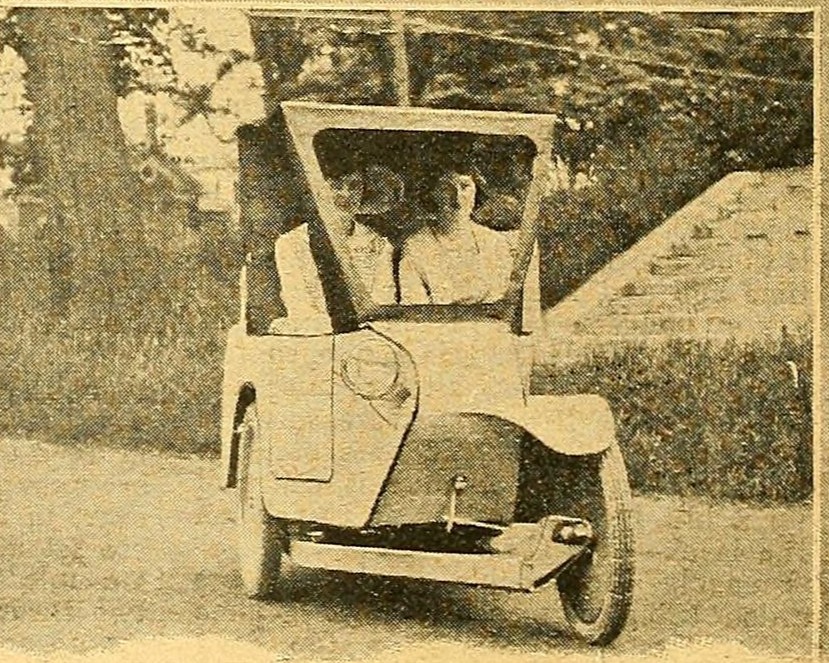
Martin would eventually get back into the business of building trailers. In 1921, the company would also try to solve urban parking and garaging problems by designing the Scootamobile, a 150-pound three-wheel car with a top speed of 30 mph and 75 mpg fuel economy. While it appears some examples were made, this concept was short-lived.
A Concept Still Used By The Trucking Industry Today
In 1926, Fruehauf engineers created what would become one of the trucking industry’s greatest advancements. The automatic coupler used the motion of the semi-tractor to hitch up to and release the trailer with no more than minor inputs from one person.
As I noted earlier, in the past, jacking up a trailer to lower it onto a truck often took multiple people and a lot of space. The Fruehauf “Automatics,” as the devices were marketed, linked the landing gear to the front of the trailer. When the truck reversed into the trailer, a locking bar or pin would release the landing gear. A linkage in the front of the trailer then used the continued motion of the reversing truck to automatically retract and stow the landing gear. Then, the automatic coupler would lock the trailer into place.
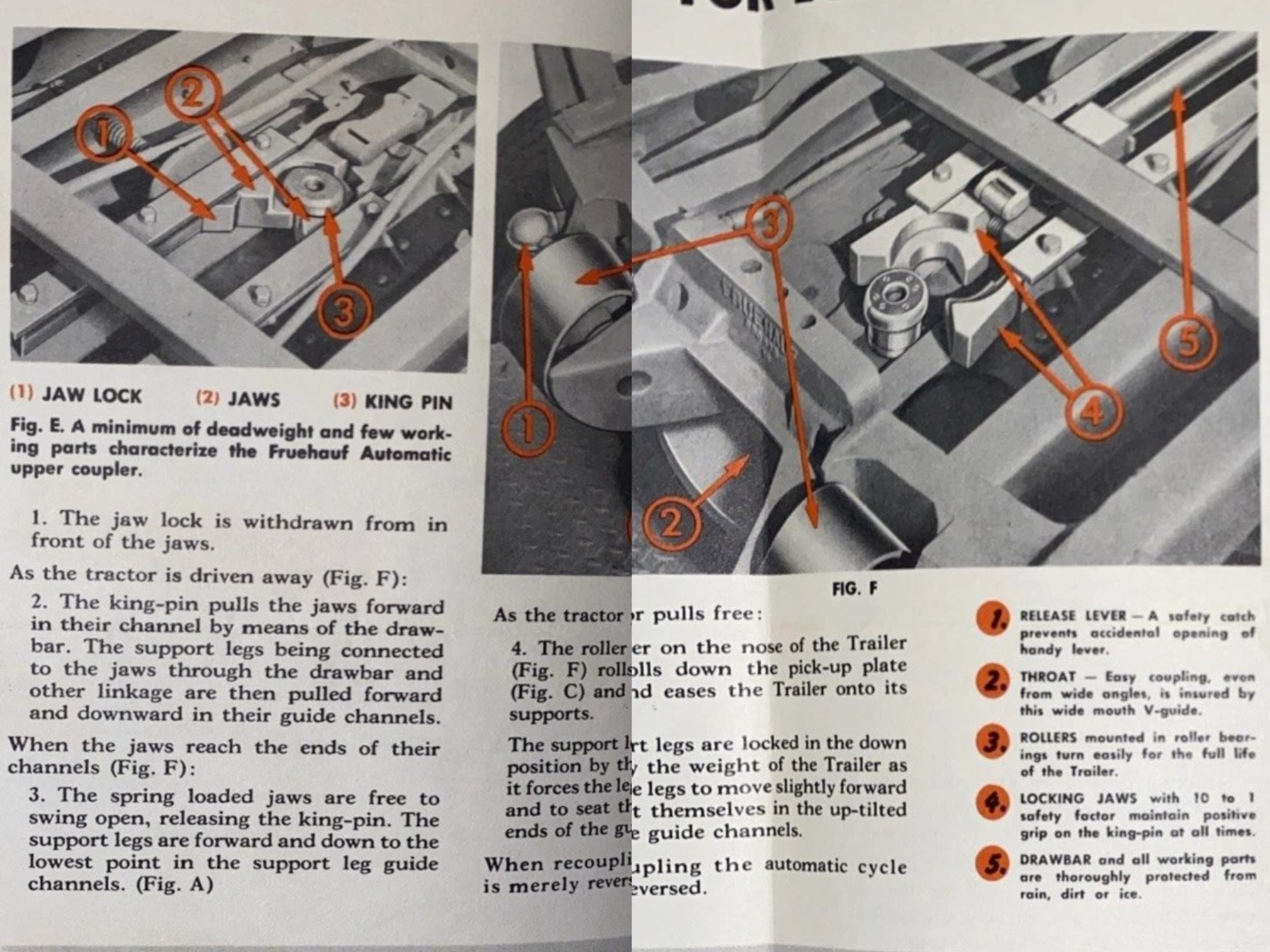
The coupler was also capable of doing the reverse, where the trucker would get out of the truck, unlock the coupler, set the brakes, and then drive away. As the truck drove away, the same linkages would deploy and then lock the landing gear automatically. Later, Fruehauf added the option to add two levers into the truck cab. One would unlock the coupler; the other would set the trailer brakes. This way, the trucker could drop their trailer without ever leaving the cab.

The Fruehauf automatic coupler was a leap forward. In the past, the truck had to sit around at the dock during loading and unloading because it was too difficult and took too long to decouple the trailer from the truck. This was wasted time as the truck and the driver sat idle. Now, the driver could drop the trailer off at a dock, at a yard, or somewhere else and immediately drive to a loaded trailer that needs to be transported.
This is still how semi-tractors work today. Drivers can easily hitch up to or drop their trailers by themselves to move on to the next load.
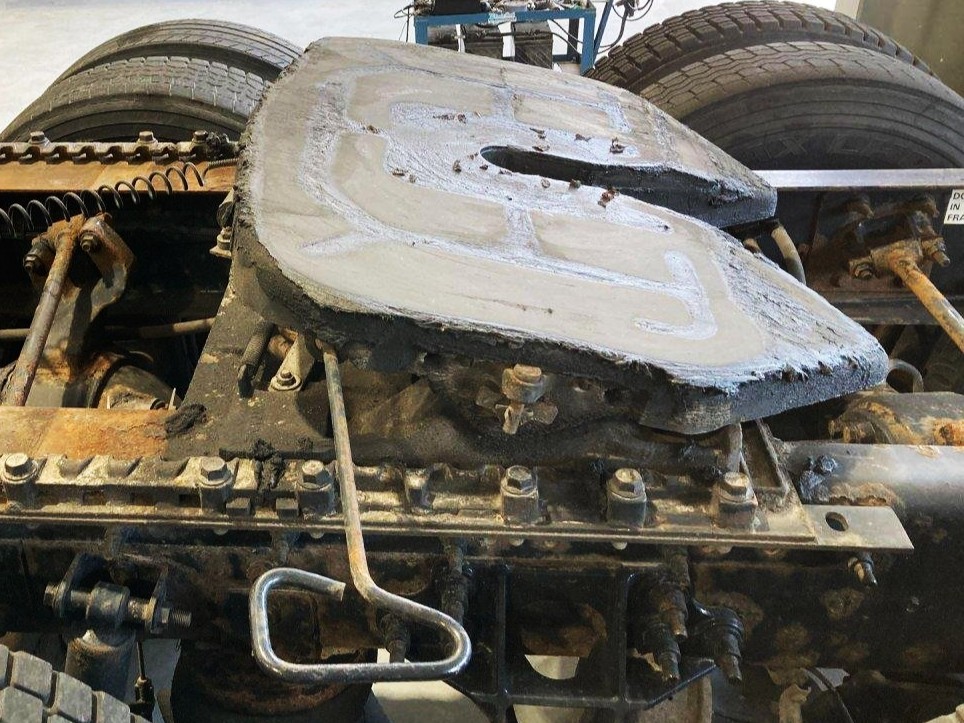
Together, the articulating fifth wheel and the automatic coupler revolutionized trucking. None of what today’s trucking companies do would be possible if they had to work with fifth wheels that couldn’t articulate and trailers that could not be easily removed from tractors. Today, the fifth wheel is something that most drivers take for granted. The fifth wheel has been perfected enough that, so long as it’s greased and maintained, it usually just works without anyone having to think about it too much.
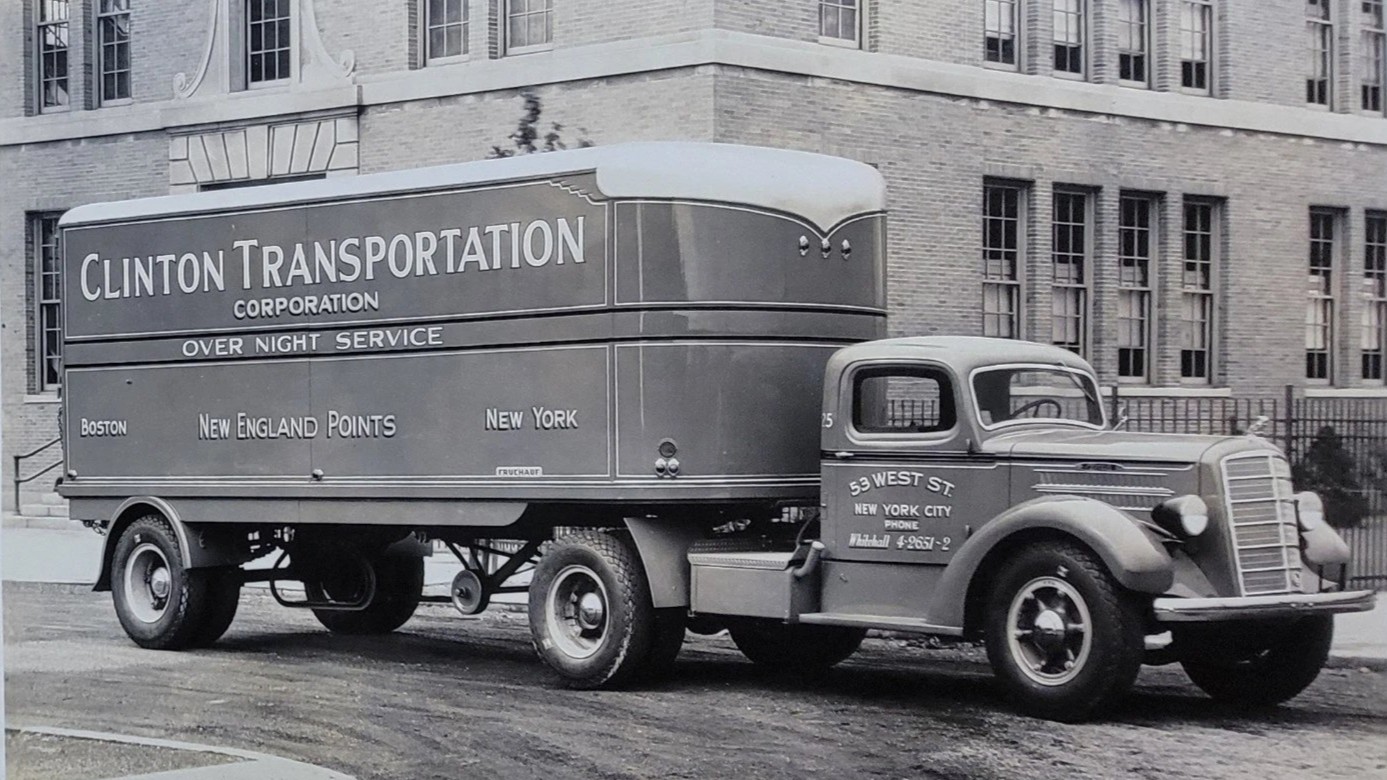
Sometimes, it’s easy to point to one person as being the father of an idea, but not here. In this case, the fifth wheel took centuries to get to where it is today. Charles Martin and Herman Farr could not have created the Martin Rocking Fifth Wheel without the hundreds of inventors that came before them. Likewise, Fruehauf might not have arrived at the automatic coupler without its early exploits with the Rocking Fifth Wheel. It’s always fascinating when history seems to work that way.
So, the next time you see a semi-tractor rolling around without a trailer, take a look at its fifth wheel. That giant lump of metal is the result of incredible engineering through hundreds of years, and it’s right there, hiding in plain sight. Sometimes, the trucks and the drivers get all of the glory, but their parts are also worth remembering, too.
Top graphic image: eBay/Martin Rocking Fifth Wheel Co.



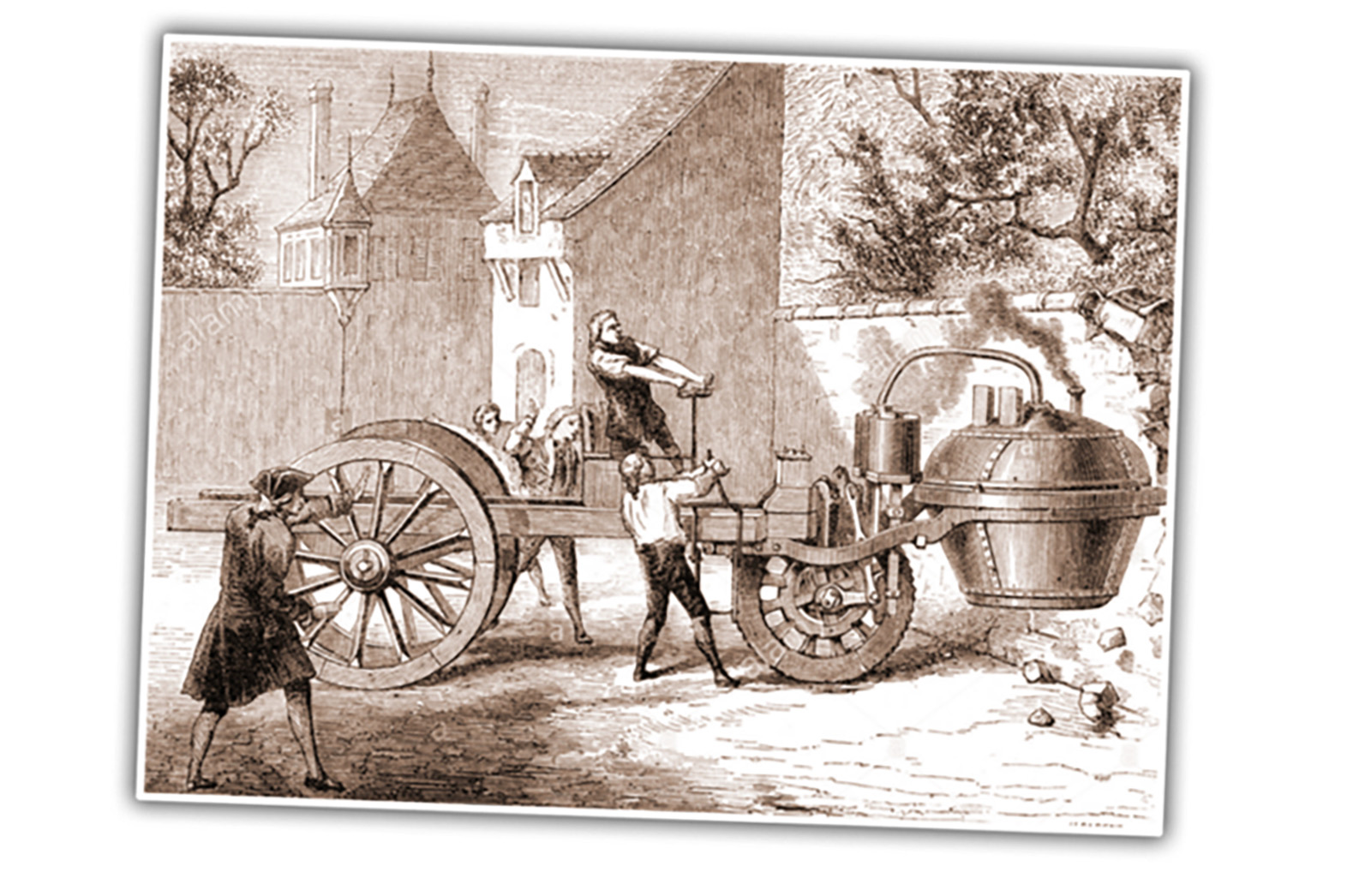
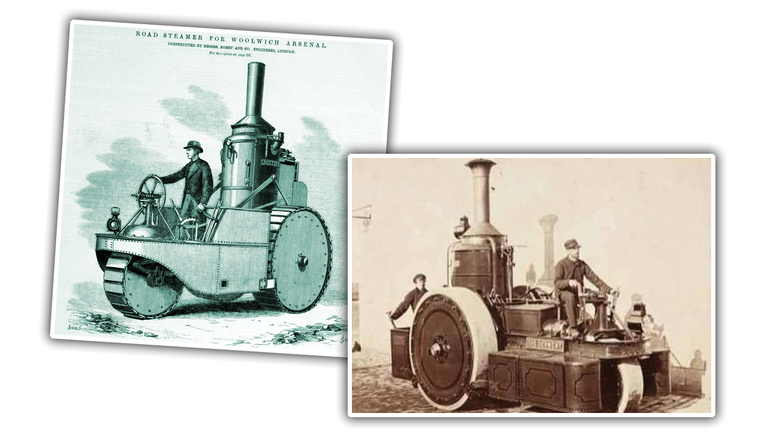
As usual with Diamler-Benz, this isn’t close to true. The first truck was also the first automobile, as Cugnot’s 1769 Steam Drag was a machine designed to haul artillery, very much the duty of a truck. And after that there were plenty of other motorized trucks, like the Thompson Road Steamers from 1869, which were used to haul cargo around. Again, like a truck. Diamler didn’t make the first trucks. – JT
Jason, you’re conflating an earlier road-going steam hauler with the first automotive truck: Daimler’s 1896 Motor-Lastwagen was purpose-built from a goods wagon, petrol-powered, four-wheeled, steerable, braked, capable of carrying a defined payload, offered as part of a truck range, and actually sold commercially.
Your definition of “truck” is doing an awful lot of work here. Cugnot’s steam tractor and the Thompson Road Steamers were road locomotives—steam-powered machines designed to haul loads, often by pulling trailers or wagons—not four-wheeled motor trucks in the modern automotive sense. Daimler’s 1896 Motor-Lastwagen was fundamentally different: a purpose-built, four-wheeled, petrol-powered goods vehicle with its engine, drivetrain, steering and load-carrying body integrated into one machine, and it was actually offered for commercial sale.
You can certainly call the earlier steamers ancestors of the truck, but if the question is who produced the first practical, commercially offered automobile that we would recognize as a modern truck, Daimler has a remarkably strong claim.
As usual, Jason is experiencing the Benz Derangement Syndrome® (BDS) again.
Some of those early developments look like the 2 wheel tractor configurations that are super popular in SE asia. 2 wheel tractor with a motor, hitch, and tiller for steering. The driver sits on the trailer. Huge variety of uses and can easily be repurposed for either towing or field work.
Note on the editor’s note: Who the hell is Diamler? Never heard of this company. Obviously they are being untruthful, though, as Daimler built the first practical truck that one could drive without running into a wall like that French steam truck.
I never understood why it was called a fifth wheel until today… Thanks for the lesson Mercedes!
As someone who cut his teeth working on semi trucks, I’ve done more 5th wheel pins and jaw kits than Carter has liver pills.
Maybe the drivers don’t think about ’em, but the techs think about them plenty. I don’t need a 50,000lb trailer dropping on the local interstate.
I’m old enough to remember when most trailers were Fruehauf.
As you can tell by my profile picture, I was a little kid during the trucker/CB craze of the 1970s, always keeping my eyes peeled on the highway for the Snowman or the Rubber Duck, and I hardly knew there was any other brand of box trailer. For all I knew as a little kid, “Fruehauf” could have been a catch-all eponym for “trailer,” like how all disposable tissues are a Kleenex, all adhesive bandages are a Band-Aid, and so forth
This is a great tracking of the convergence of ideas that led to something largely taken for granted. Like the fifth wheel, almost all ideas draw from what came before and it’s almost impossible for it not to where the inventor has access to any bank of knowledge or source of prior work as inspiration. It’s a major reason those ancient advanced technology conspiracies don’t work unless the conspiracy allows for thousands of years of prior development to get to that point including long term and widely available sharing of information.
We can thank the patent office whose records enable that sharing of information.
Yeah, it’s to the point where I don’t think I’d bother to patent something without the money to actively defend it.
Thank you Mercedes for the detail in this and all other articles you write for the Autopian. My working background is in engineering and technical writing. I appreciate your in depth knowledge of the subject matter about which you write, and the way you present technical detail so that readers can readily comprehend the details in articles you publish.
I have complimented Mercedes before on how so many of her articles go into depth about a common everyday motoring item, that I never considered too deeply until I saw her article – “Hey, yeah, why IS that thing made that way, and how did it come to be?” Some of my favorite informational pieces are explanations of things I never even knew I wanted to know that much about until I saw the headline.
And hey, Father, I knew that you were the longtime gossip columnist for the Vatican Enquirer, but I had no idea that you had a background in technical writing. You are quite the renaissance man.
Bless you my son. I never did consider myself a gossip columnist. On my best days I reported on scandals, slander and hearsay, considered by many to be high level technical writing. I also presented the Vatican weather report during the reign of Pope John Paul 1 which lasted from his election on August 26, 1978 until his death 33 days later, effectively ending my career as a meteorologist.
Father, fancy seeing you here! I rather miss your weekend insights—will, in fact, tonite watch the episode you shared with Ms Garr back in the mists of time 😉
Thank you, I’m glad you noticed my new residence in the commentary section of the Autopian! It has been a long unpaved road from that SNL episode featuring the lovely Terri Garr, and all other SNL episodes I participated in, to my present position. No more weather reports or news about the new FIAT Popemobile, I am now the Vatican corespondent covering the awesome Autopian. As well, I cover all automotive tabloids now containing sloppy copy, such as Jalopnik.
Hope you can see through the mist to enjoy the SNL episode featuring Me and the beautiful Ms. Garr!
A great and very interesting article!!
Excellent article on an interesting subject. You have become the Autopian’s most valuable historical researcher / writer on staff and your articles are always a pleasure to read. Just sayin’.
I’d say most valuable transport researcher/writer on the internet. Aside from digging through primary sources, I have no idea where else you’d find this sort of content.