

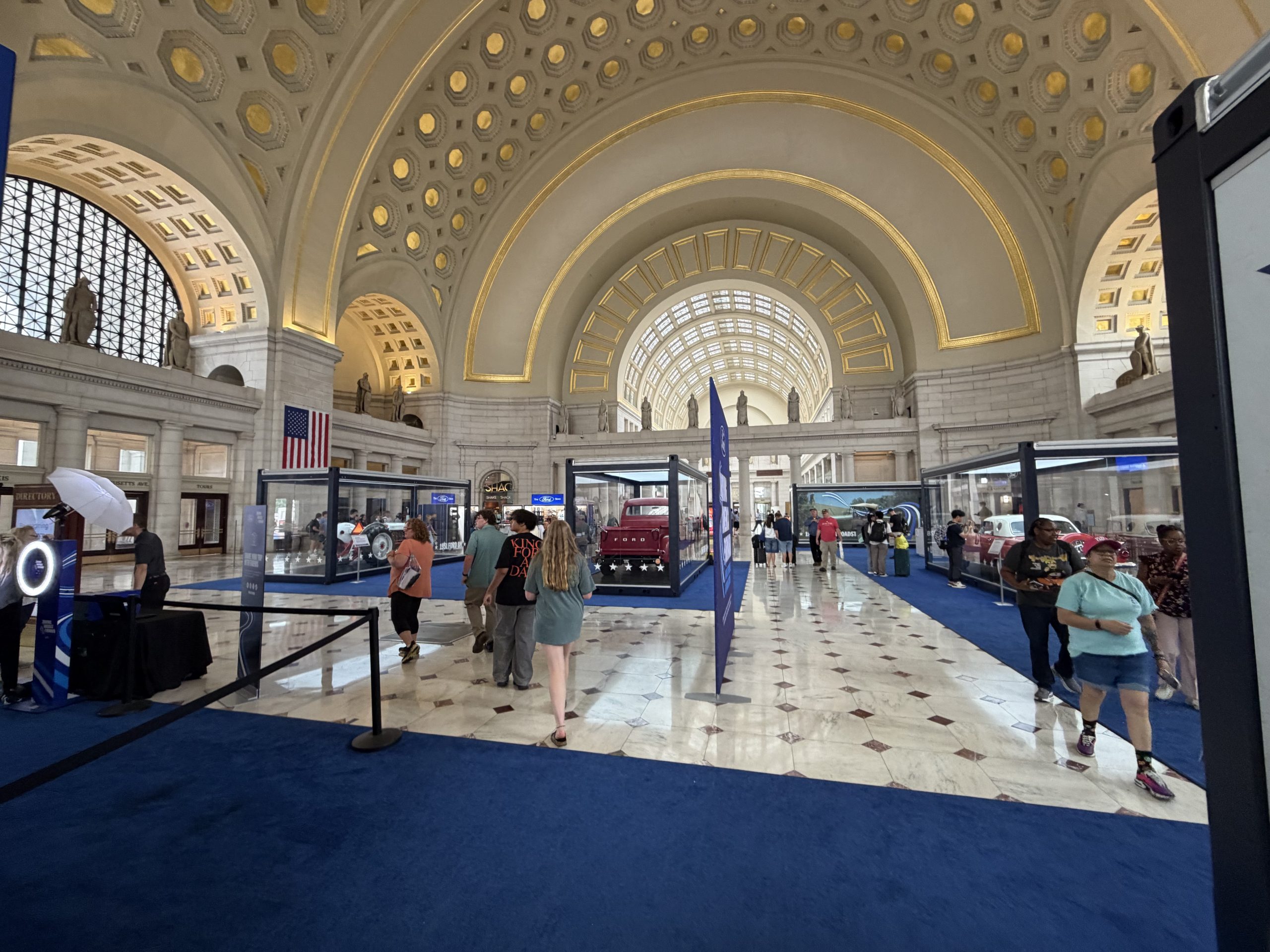
Washington DC’s Union Station is a big place – a big, confusing place full of people, trains, shops, restaurants, more people, and, for now, historic vehicles. Starting on July 2, the Hagerty Driver’s Foundation marked the induction of a unique 1965 Ford Mustang convertible into the National Historic Vehicle Register as part of Ford’s “Driving America Forward” exhibit at Union Station featuring historic Ford vehicles.
[A quick word of introduction: I’m Sid Bridge, Autopian member, PR guy by day, comedian and bass player by night, and frequent flyer in our comments section. Matt asked me to stop in D.C. on the way back from the 1rd Annual Autopian Track Day and accept Hagerty’s gracious invitation for a tour of the exhibit. Matt had a lot of faith in me after seeing my 1989 Subaru GL at Lime Rock. He actually trusted it would get me to D.C. for the appointment, and the Subi didn’t disappoint. Hagerty didn’t provide free shrimp, but the tour and the conversation with their team were fun and interesting.]


The National Historic Vehicle Register was created by Hagerty’s nonprofit, The Hagerty Driver’s Foundation, in partnership with the U.S. Department of the Interior. It functions like the National Film Registry in that a team of people evaluates specific vehicles for their role in United States history. It must be a specific vehicle with a VIN number, not just a general model type.

The Register started in 2013 with the induction of the Ford-powered 1964 Shelby Cobra Daytona you see above.

Inductees aren’t just supercars or movie cars – any vehicle that played a role in automotive history can be up for induction (Yes, I did ask about OJ’s Bronco and the answer was a definitive no). Other inductees worth mentioning include the 1964 Meyers Manx “Old Red” dune buggy seen above:

A 1947 Tucker prototype.

And an unrestored 1984 Plymouth Voyager – the first Chrysler minivan in its full wood-paneled glory.

The latest vehicle is a 1965 Ford Mustang Convertible. And it is very special.
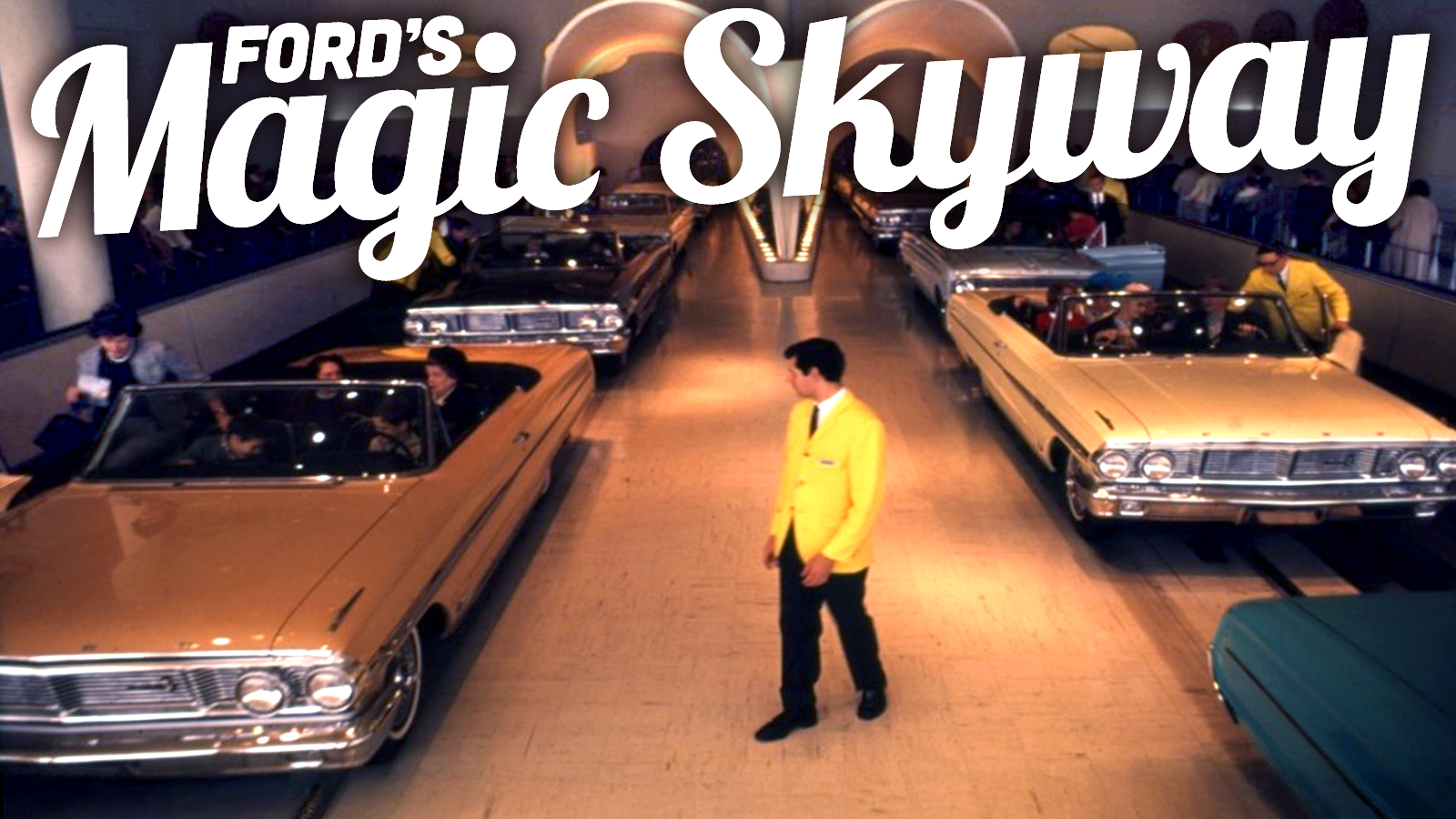
Three of Four Disney Rides From The 1964 New York World’s Fair Became Icons. Here’s A Look At The Fourth, ‘Ford’s Magic Skyway’

Ford produced more than 30,000 Mustang convertibles in 1965, so I was hoping Hagerty would have a good story for me on this one, and they did. Let’s start with some of the obvious features. The Mustang, VIN number 5FT383386, has been fully restored to its original Wimbledon white with red interior. It’s powered by a 200 ci inline-six with a three-speed automatic transmission. Somewhat rare for a Mustang, it has a bench seat – a move I’ve always found gutsy for any car with a floor-mounted shifter.
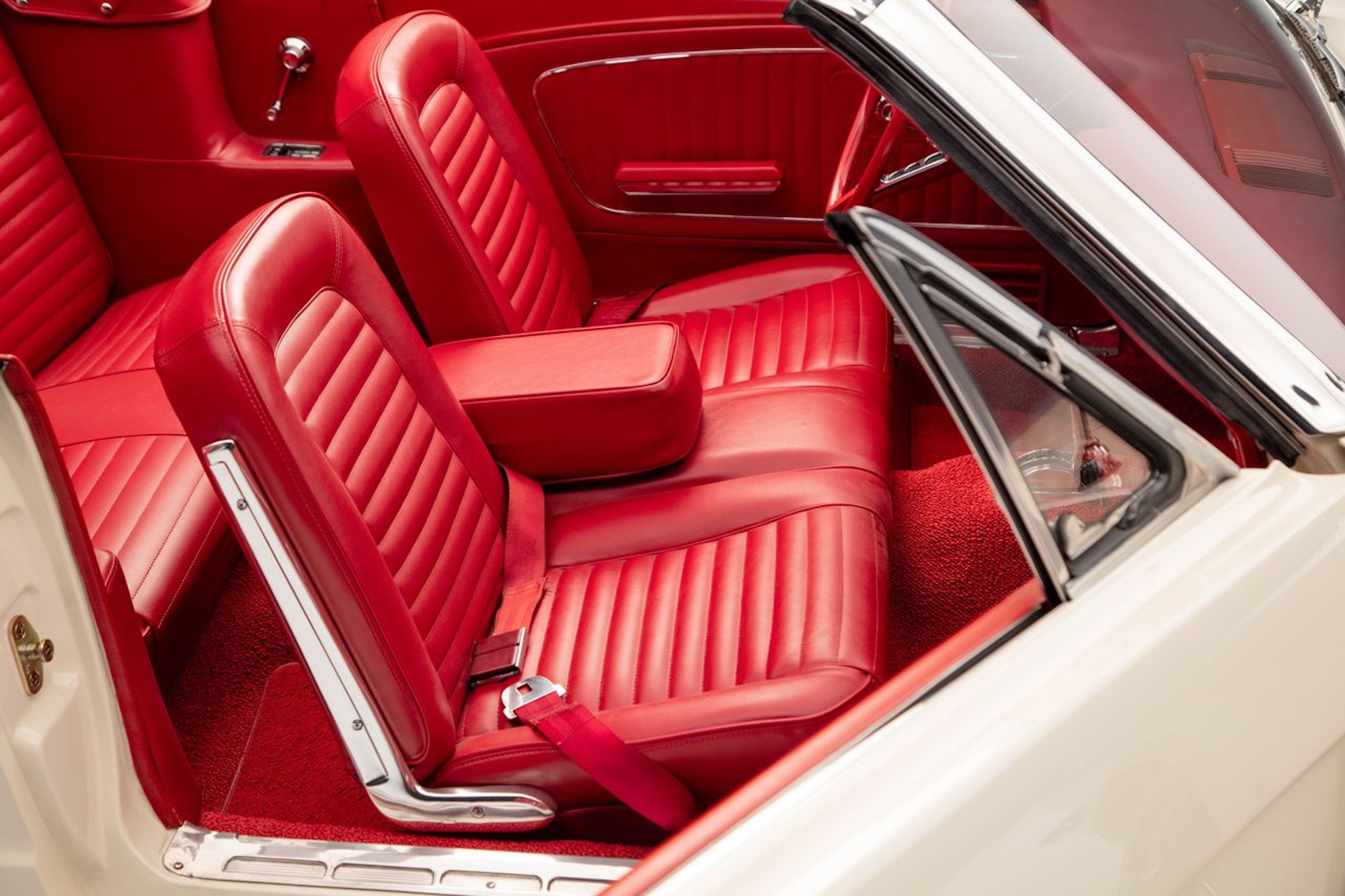
Also, did you know that driver’s side view mirrors were optional? This car came without one. (They didn’t become mandatory until 1968):
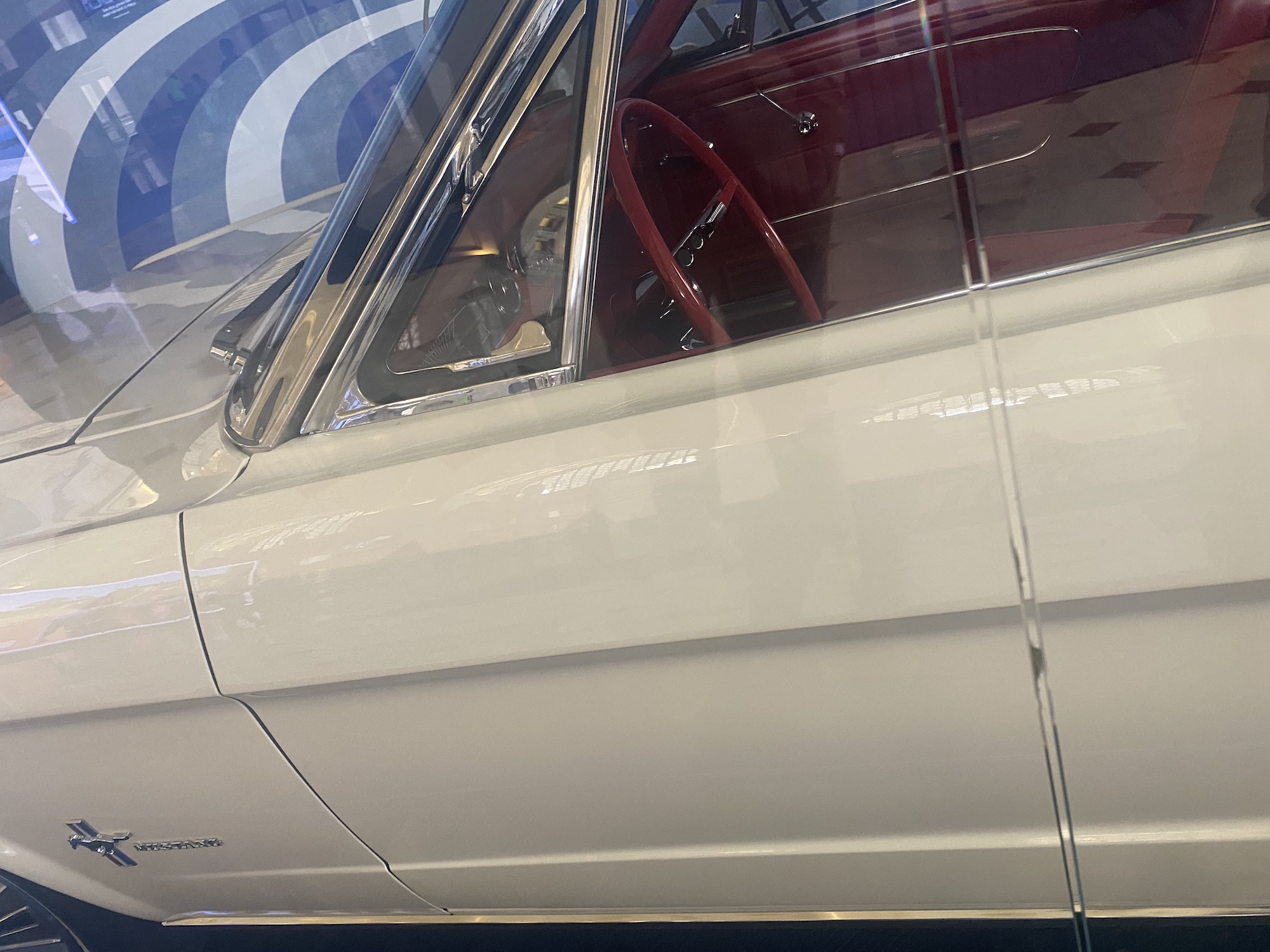
This Mustang’s claim to fame should be exciting to Disney fans. In 1964 and 1965, the New York World’s Fair (where the Mustang debuted in 1964 to huge fanfare) featured four rides created by Walt Disney. Three of the rides – It’s a Small World, Great Moments with Mr. Lincoln, and the Carousel of Progress (originally part of General Motors’ exhibit) – were relocated to Disney parks, where you can still ride them. (I rode the Carousel of Progress and It’s a Small World on my last visit to Disney World. The theme songs are still stuck in my head).
The fourth ride, part of Ford’s massive exhibit, was the Magic Skyway. To reach the ride, attendees snaked through a long line where they were bombarded with elaborate displays of Ford’s history before finally getting to the main attraction – a journey through history where your tram car was a real Ford convertible. The ride debuted in 1964, but in 1965 eleven Mustang convertibles were added to the lineup thanks to the car’s popularity. Want to see it in action?
According to Ford, a young Jay Leno insisted his parents take him to the fair and let several other people go ahead of him in line because he wanted to ride in one of the Mustangs. After the fair, the ride was dismantled. It kind of got a second life as many of the parts, including the dinosaurs and the mammoth, went on to be used in other Disney rides.
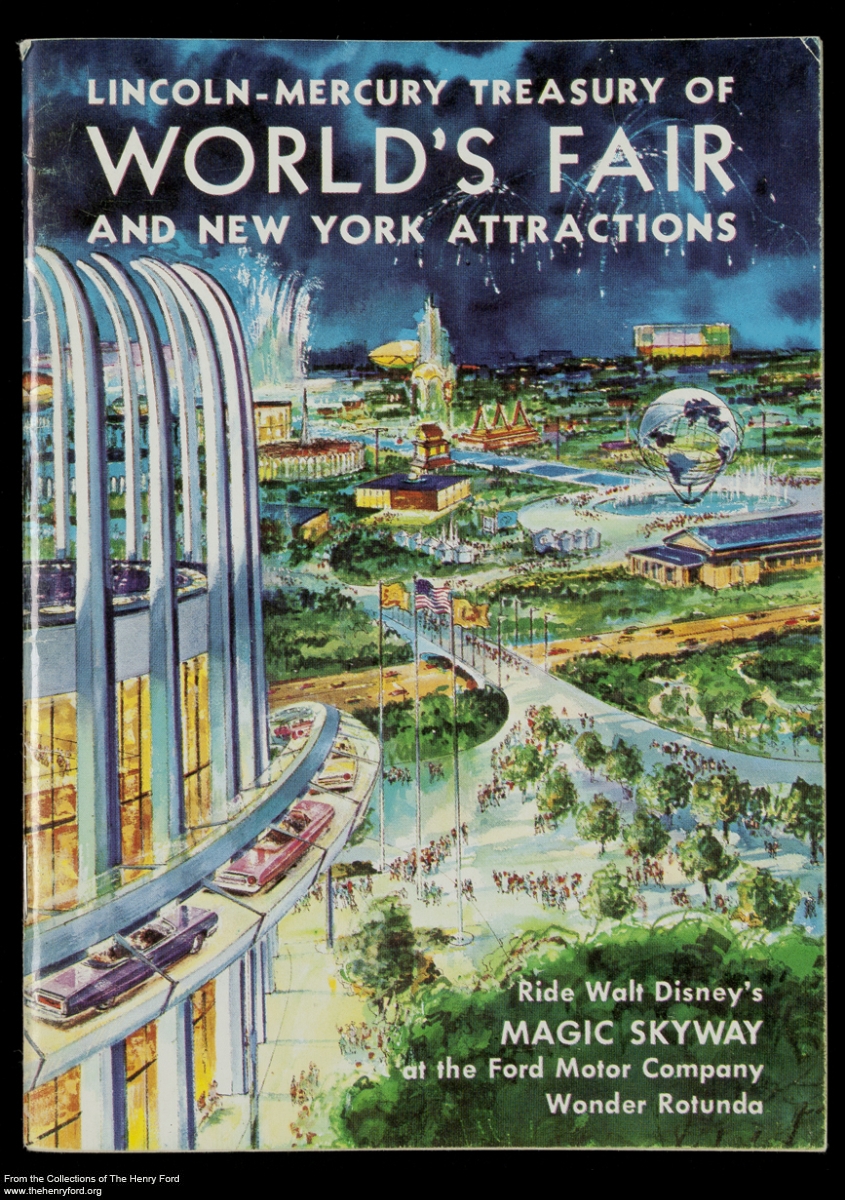
The 1964 New York World’s Far itself was already an exciting affair covering 646 acres with the Unisphere – a stainless steel globe – at the center, and Ford’s enormous “Wonder Rotunda” as the largest above-ground structure.
The sprawling campus included all types of exhibits, rides, food and more; exhibited by anyone who could afford to buy a spot. Ford Motor Company was on board, looking to sell cars and promote innovation. As one of four exhibitors partnering with Disney to create rides, Ford decided to go a little overboard in an attempt to outshine its competition. While Ford wanted to sell cars, Walt Disney was looking to capitalize on the success of Disneyland. Disney’s goal was to use the fair as a proving ground for new technology while seeing if he could replicated his success in Anaheim on the east coast.

According to the Walt Disney Museum the relationship between Ford and Disney was a rocky one, as Disney wasn’t into making compromises and Henry Ford II wasn’t happy that it went over budget. Disney won the battle in terms of ride quality (mostly) – the Ford exhibit was an epic affair that was full of insane detail. Ford kept the budget in check – partly by not paying any licensing to get Disney’s name attached to the exhibit.

The line leading up to the ride was a feature in and of itself. From TheHenryFord.org:
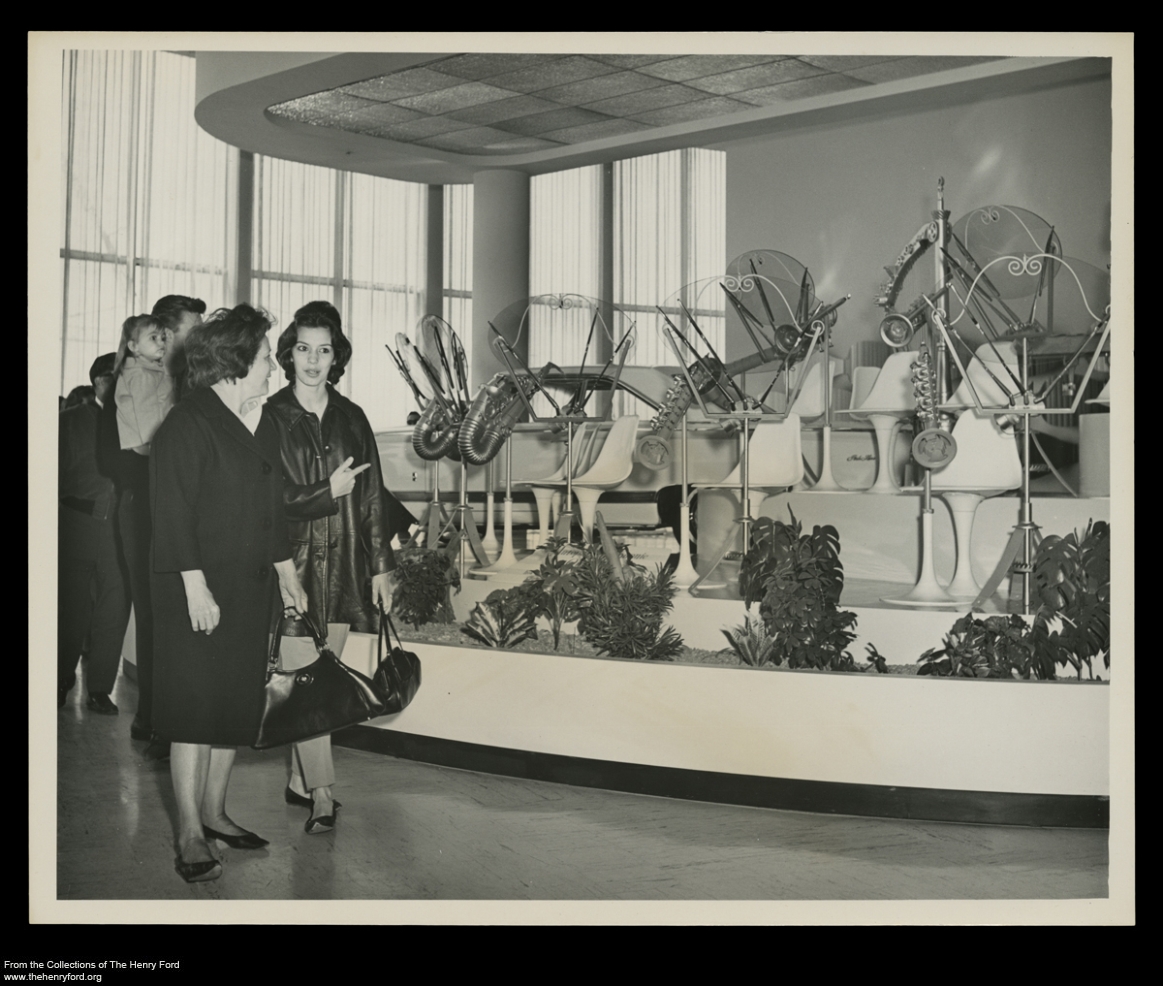
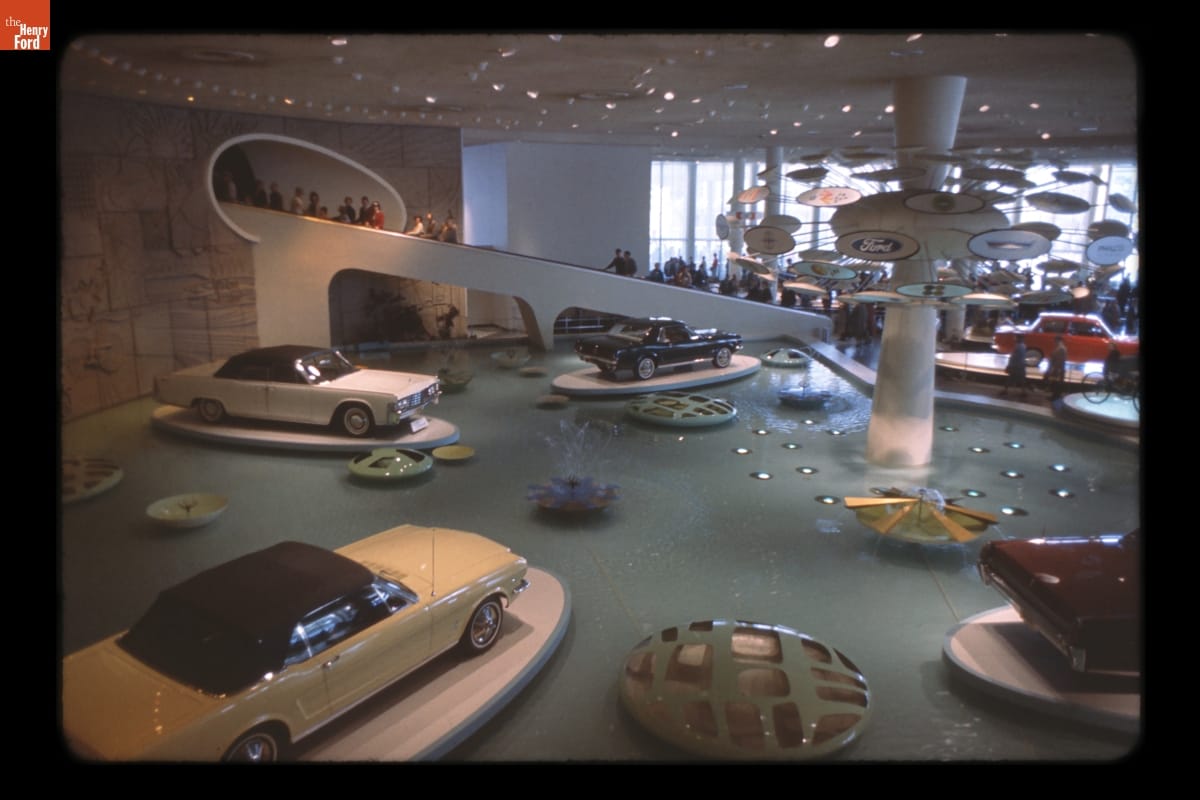
As guests entered the Ford pavilion through the monumental Rotunda building, they encountered a series of colorful exhibits focusing on Ford’s history, global influence, and current products. The topics were Ford-related, but the treatment of virtually every element had the unique Disney touch. For example, the miniature villages of the International Gardens display were reminiscent of the miniscule settings at the Storybook Land Canal Boats attraction in Disneyland. Great moments in Ford Motor Company history were represented by several humorous, Disney-designed dioramas as guests took moving “speed ramps” to the upper level for the Magic Skyway ride. Near the ride queue, a Disney-created “animated orchestra” was comprised of ingeniously rigged Ford automobile parts.
Here’s the orchestra:
And here’s the Ford Theme Pool:
After meandering through the opening act, which probably made the long line for the ride a lot more palatable for attendees, the “magic” of the Magic Skyway finally began. Riders were ushered into either of two parallel lines of new Ford convertibles. Convertibles were used for obvious reasons: They were easy to climb into and gave everyone the best possible view, and bench seats made space for more riders. The cars continued moving along while riders boarded them from moving platforms that matched speed. Vehicle choices included Falcons, Comets, Continentals, Thunderbirds, and Mustangs.

The cars, whose radios played music and narration for the ride, ushered the riders into a glass tunnel, giving them a nice view of the fairgrounds.

From there, strobe lights and sound effects kicked in (probably not as scary as Willy Wonka’s boat ride) to give the impression of time travel, leading to this:
Emerging from this time tunnel, guests found themselves in “a dim primeval place of strange sounds and sights.” Their cars moved past several gatherings of “prehistoric monsters”—some engaged in mortal combat, others combing the rugged and swampy terrain for food. But, within moments, climate and plant life shifted and Man made his appearance. Groups of cavemen could be seen discovering fire, painting on cave walls, fighting off vicious beasts, using stone as a tool, and—in a final vignette—using the wheel.

The animatronic dinosaurs would be considered impressive today and were cutting edge at the time. After surviving the dinosaur display, another time tunnel dropped riders into the future, complete with at futuristic “Highway in the Sky,” followed by “Space City,” which showed Disney’s idea of the city of tomorrow.
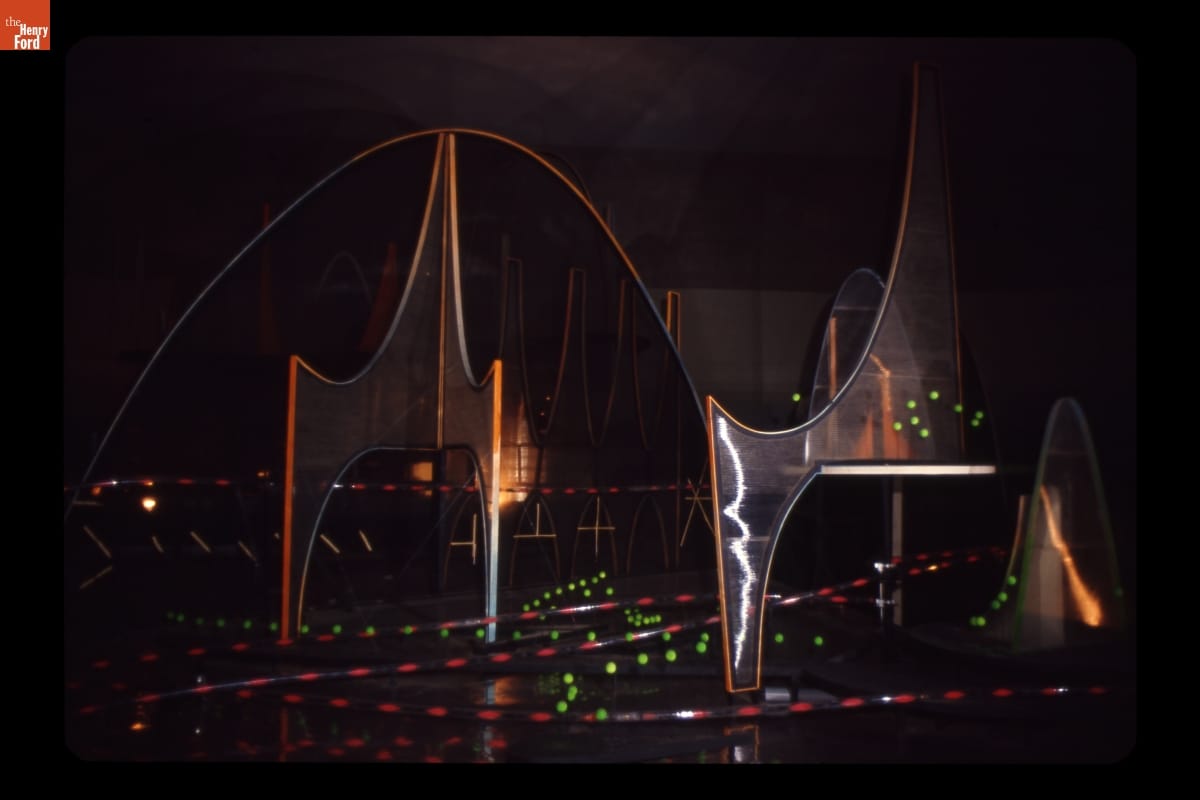
This is where the ride concluded – but with plenty of Ford’s new technology displays to view on the way out.
The Cars Were Sold And The Props Repurposed For Use At Disney
Disney did propose a version of the Ford pavilion at Disneyland, but Ford declined. The dinosaurs of the skyway found new life along Disneyland’s railroad.
The fate of the cars is a bit more interesting. Disney’s team created an elaborate system to guide the cars along a track. It’s hard to find exact details on how the system worked, but the technology went on to become part of the People Mover at Disney parks. Henry Ford II hoped that using real cars as ride cars would sell more Fords, and the ride ended up being quite popular with long lines, even though it had two separate tracks and nearly 200 cars. Here’s information on the system from the Walt Disney Family Museum:
In Ford’s Magic Skyway, guests sat in the shells of Ford cars, propelled by a “WEDWay Transit System” through vignettes from the age of dinosaurs to the invention of the wheel, all narrated by Walt himself. WED Imagineers and Disney Legends Roger Broggie and Bob Gurr led the effort to create this pioneering ride system for the attraction—notable because it required no moving parts in the ride vehicle. The “WEDWay Transit System” would provide the basis for the PeopleMover attraction that opened at Disneyland following the World’s Fair and eventually would be ported over to Walt Disney World Resort’s Disneyland-style park—Magic Kingdom Park.
The museum’s description seems to contradict a few details that are clear in the video – first of all, while it required “no moving parts in the ride vehicle,” the wheels are clearly rolling in the video. According to Ford archivist Ted Ryan, the Hagerty Mustang’s 35,656-mile odometer reading does not include the roughly 5,000 miles it traveled carrying an estimated 40,000 people through the ride circuit. I’m guessing that means the vehicle’s driveshafts were removed for the exhibit, but I have yet to confirm that. Also, these were not “shells” of cars – it was an entire car. The Mustang’s bench seat starts to make sense when you consider it allowed more passengers to squeeze in for the ride.
Key modifications included welded brackets, suspension tie-downs, and guide pins. After the fair concluded, the cars used on the ride received fresh paint and refurbished interiors. The welded-on brackets were cut away. The featured Mustang still has the remains of the welded plate underneath.

Approximately 200 Ford and Mercury convertibles were used in the ride, then sold to private owners like a regular car. A few of the Mustangs are accounted for, including the one inducted at Union Station and one at the Gilmore Car Museum in Michigan.
The Display At Union Station Is Super Cool
The exhibit itself features an impressive collection of Ford vehicles, all sealed away in glass cases like those expensive toy cars your parents wouldn’t let you play with. Ford’s goal was to celebrate American history on the country’s 250th birthday by showing how the automobile played a role in the second half of that 250.
Here are some details on other noteworthy cars at the exhibit.
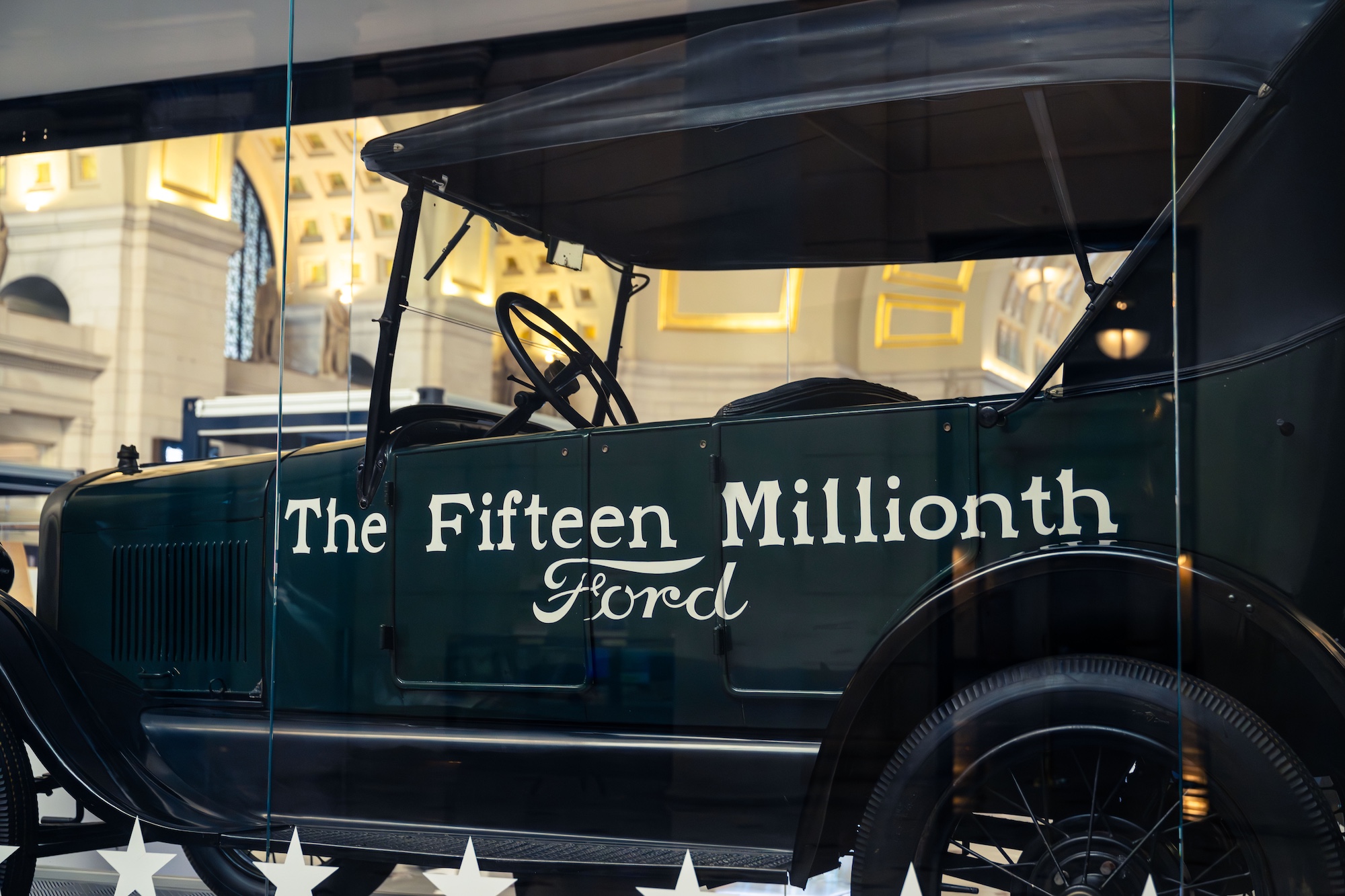
1927 Ford Model T
This Model T was designated by Ford as the “last” Model T and the 15 millionth car produced by Ford. While that number can’t be 100% confirmed, the car itself is a perfectly preserved time capsule from the day it was produced, with “The 15 Millionth Ford” hand-painted on the side and a VIN number where each digit was hand-etched by a Ford executive. Also, notice the color? It’s green. The insistence on nothing but black is a bit of a myth. According to Hagerty, early Model T’s came in a variety of colors, but color choices were scaled down to black as a cost-savings measure. Later in the Model T’s run, more colors were added so the car could remain competitive.
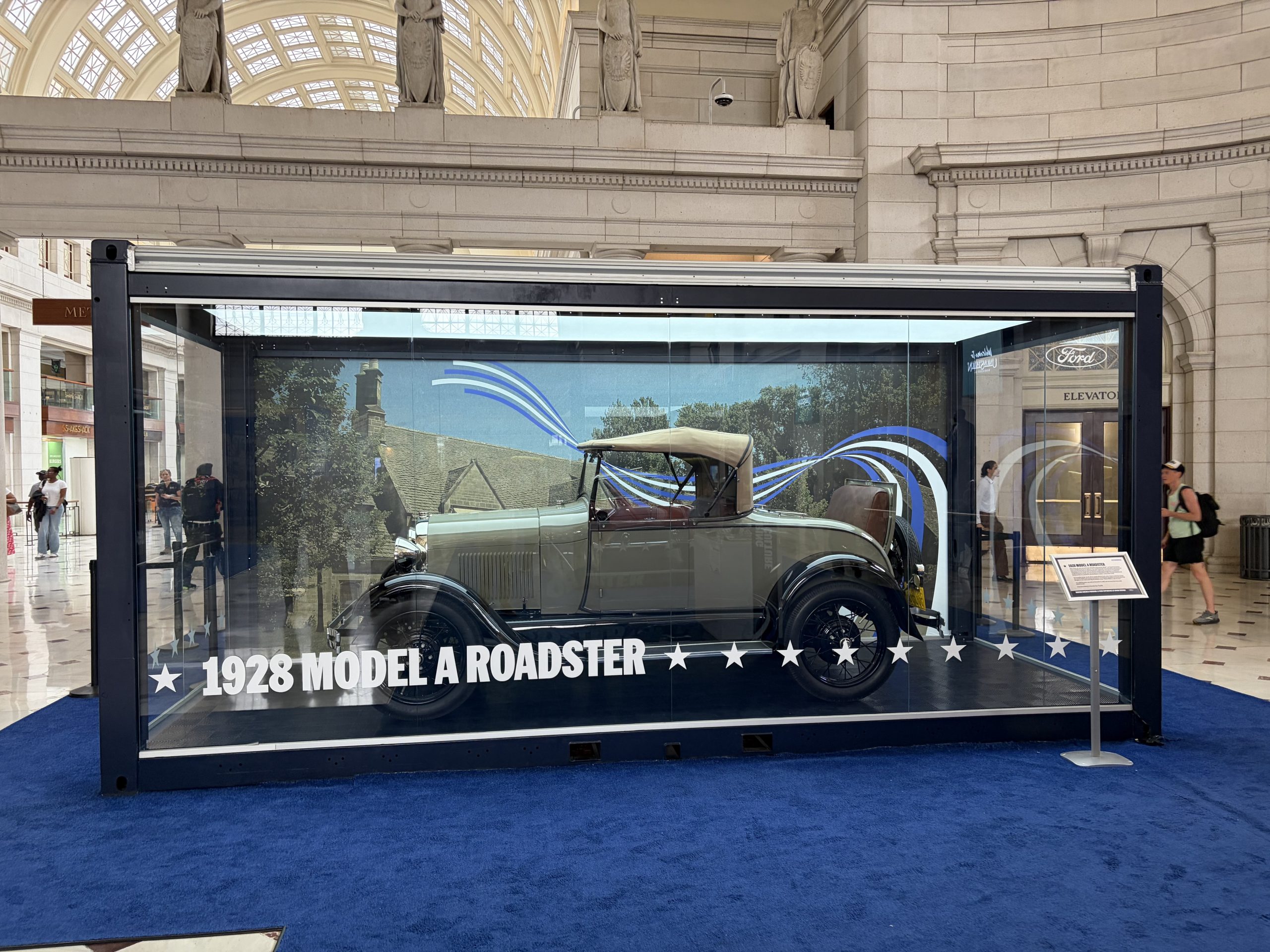
1928 Model A Roadster
The example on display is one of the first 1,500 Model A’s built. The Model A is noteworthy as a successor to the Model T, which featured the driving controls we’re used to today – gas, brake, and clutch on the floor.
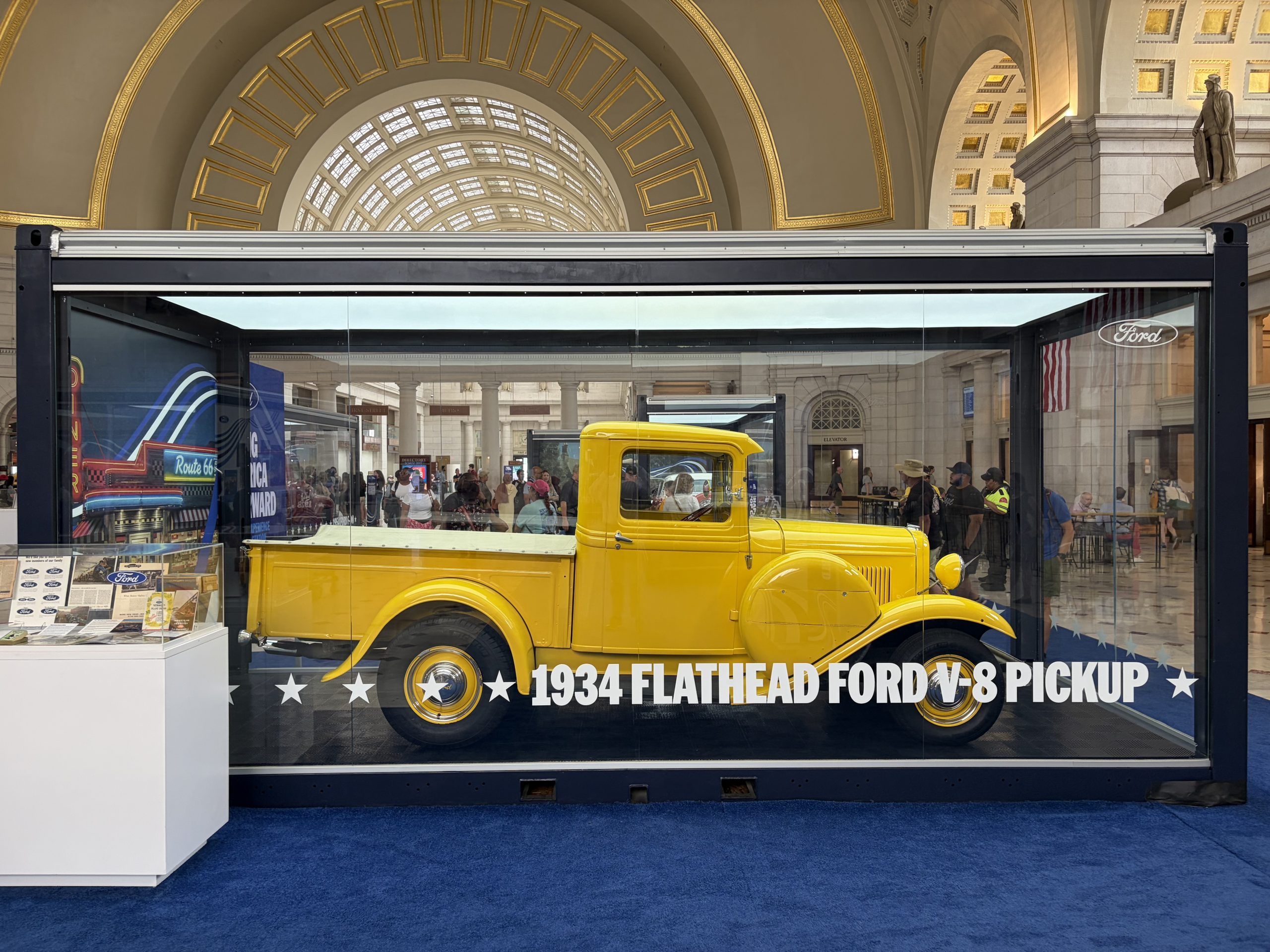
1934 Ford Pickup
This pickup is on loan from Jay Leno’s collection. His first car was a 1934 Ford Pickup. He bought this one and restored it ten years ago because of its similarity. (I can relate after buying a Subaru GL similar to my first car – you never forget your first…)
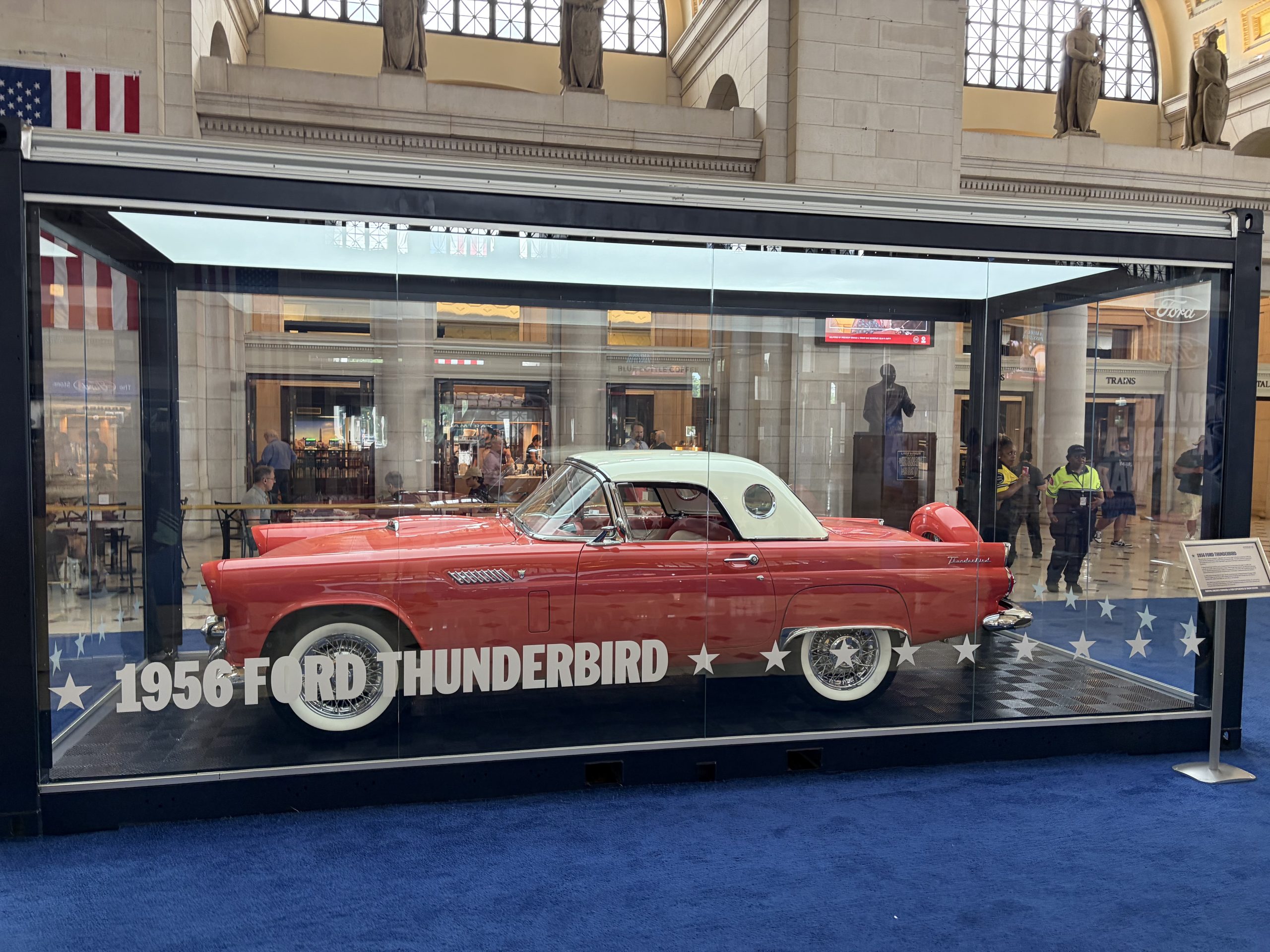
1956 Ford Thunderbird
This Thunderbird was chosen for the exhibit because of its similarity to the Thunderbird featured in American Graffiti.
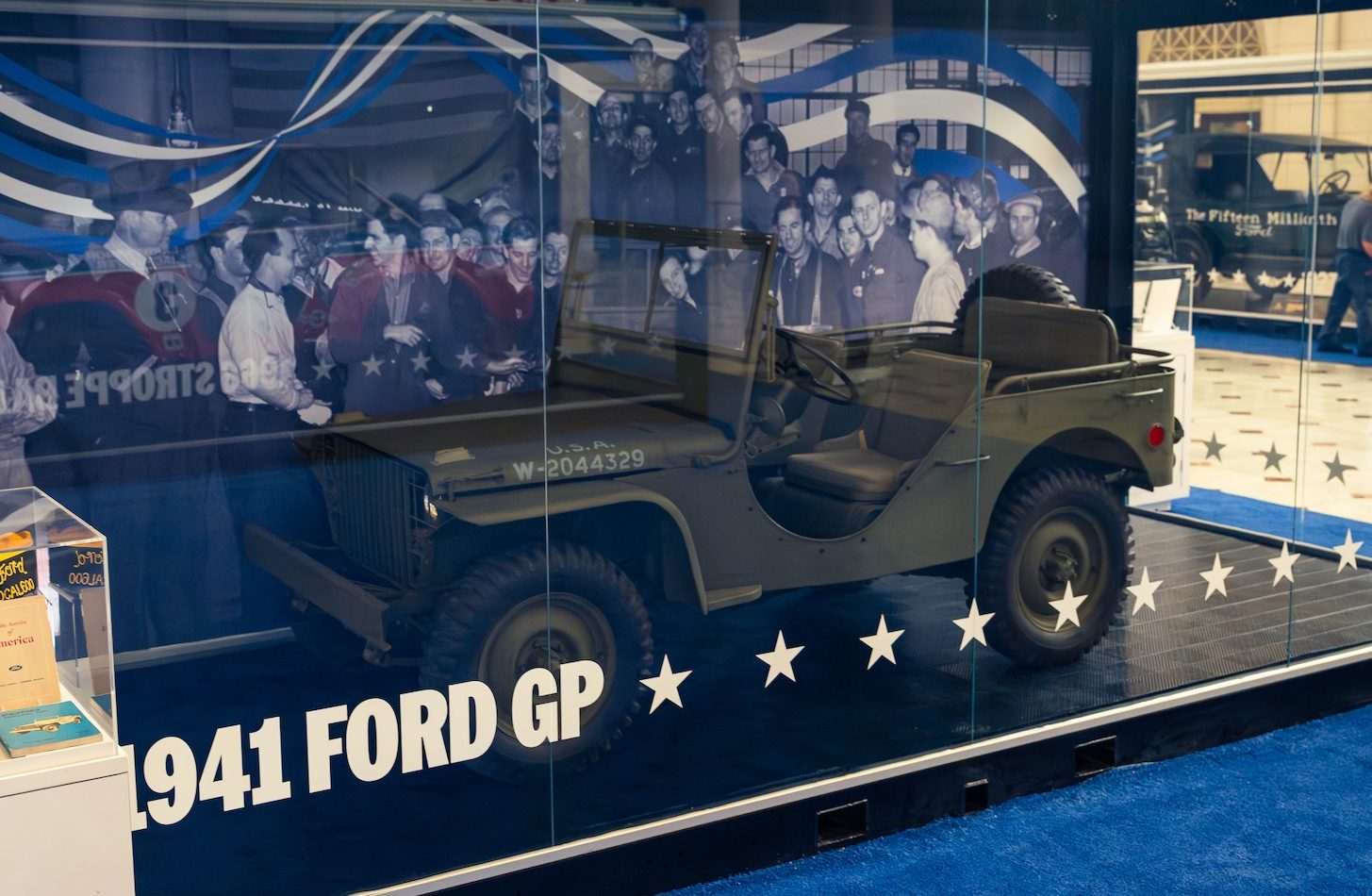
1941 Ford GP
Several automakers participated in the creation of the Jeep, with its key role in World War II. This example is an early production GP, noteworthy for its grille, which predates the iconic stamped Jeep grill which Ford would soon innovate (I believe David wrote in detail about this because of course he did).
1951 Ford 8N Tractor
The 8N was produced from 1947 until 1952 and was the top-selling tractor of its time. This one is definitely a tractor.
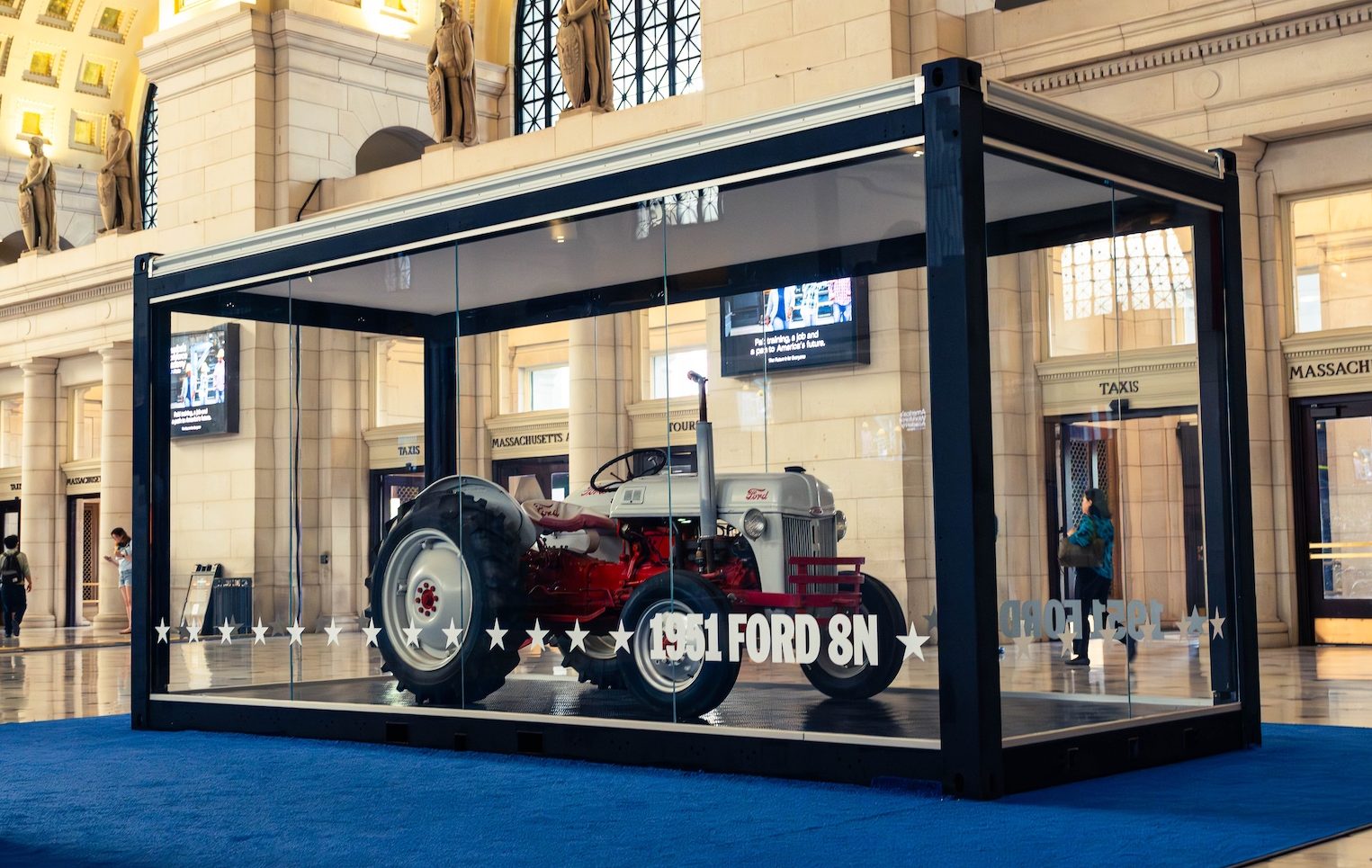
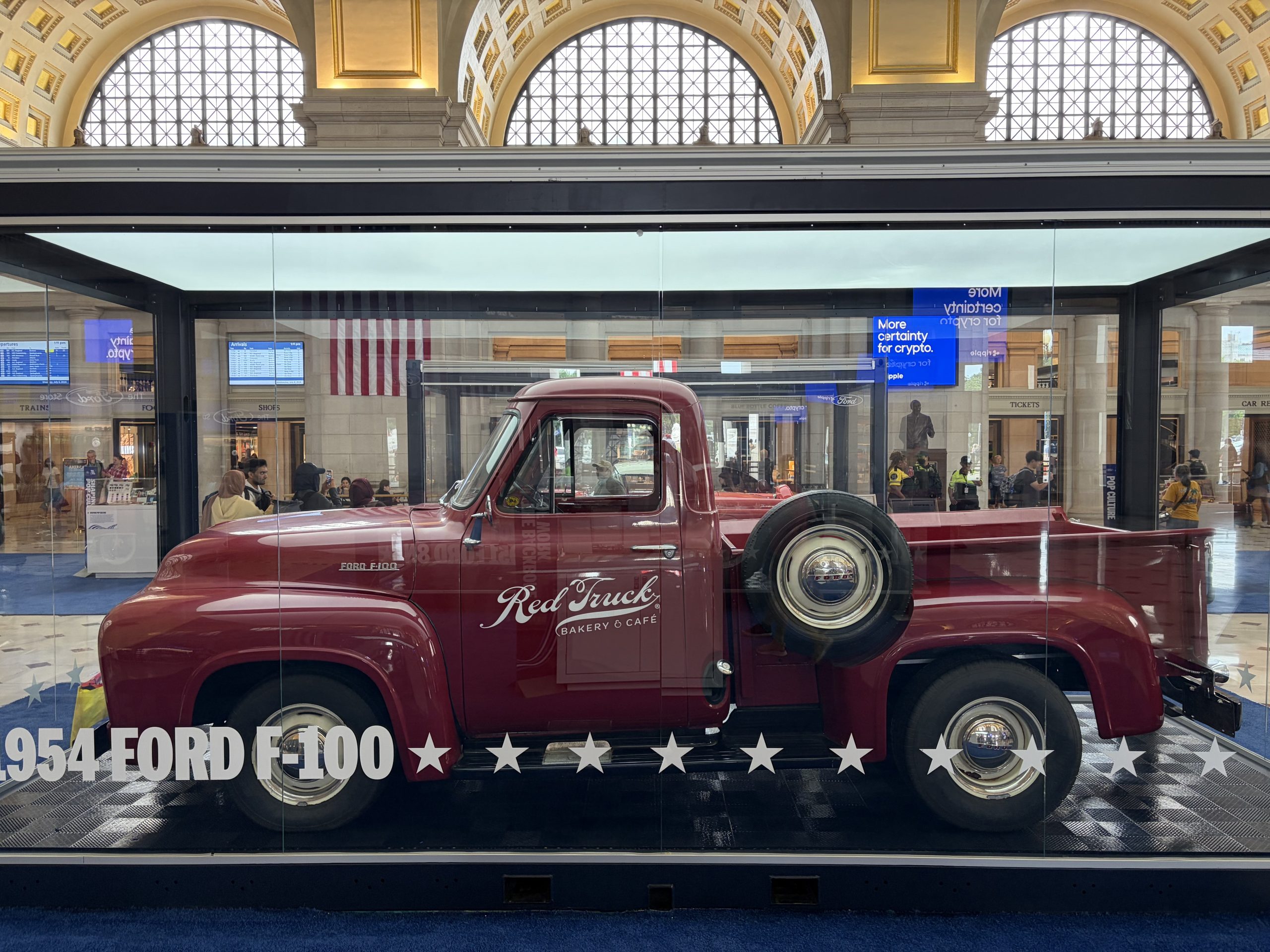
1954 Ford F-100, Red Truck Bakery
This specific truck was previously owned by fashion designer Tommy Hilfiger and purchased to deliver backed goods across rural Virginia. It was added to the exhibit because it’s somewhat of a local celebrity as the bakery still exists.
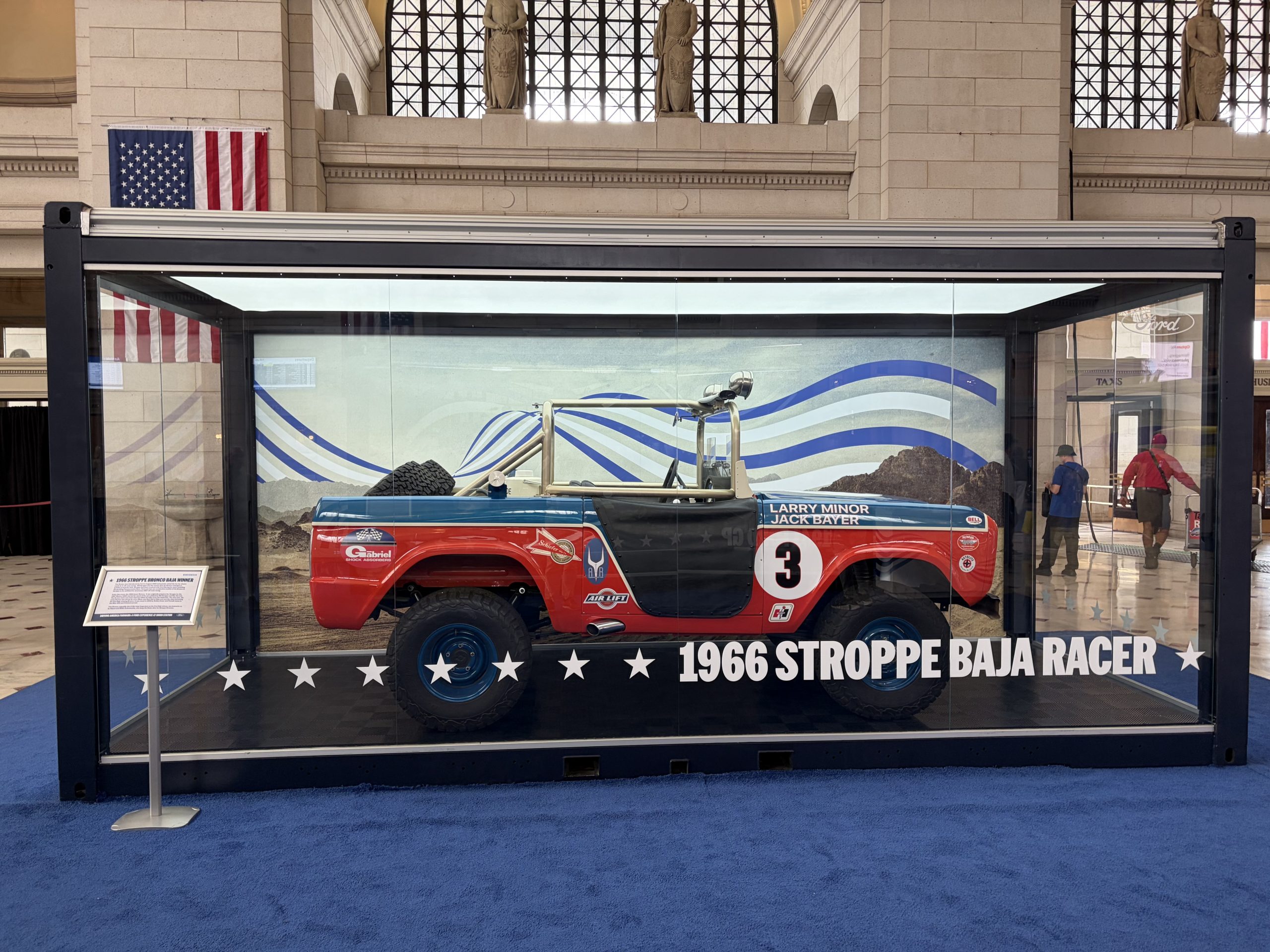
1966 Stoppe Bronco
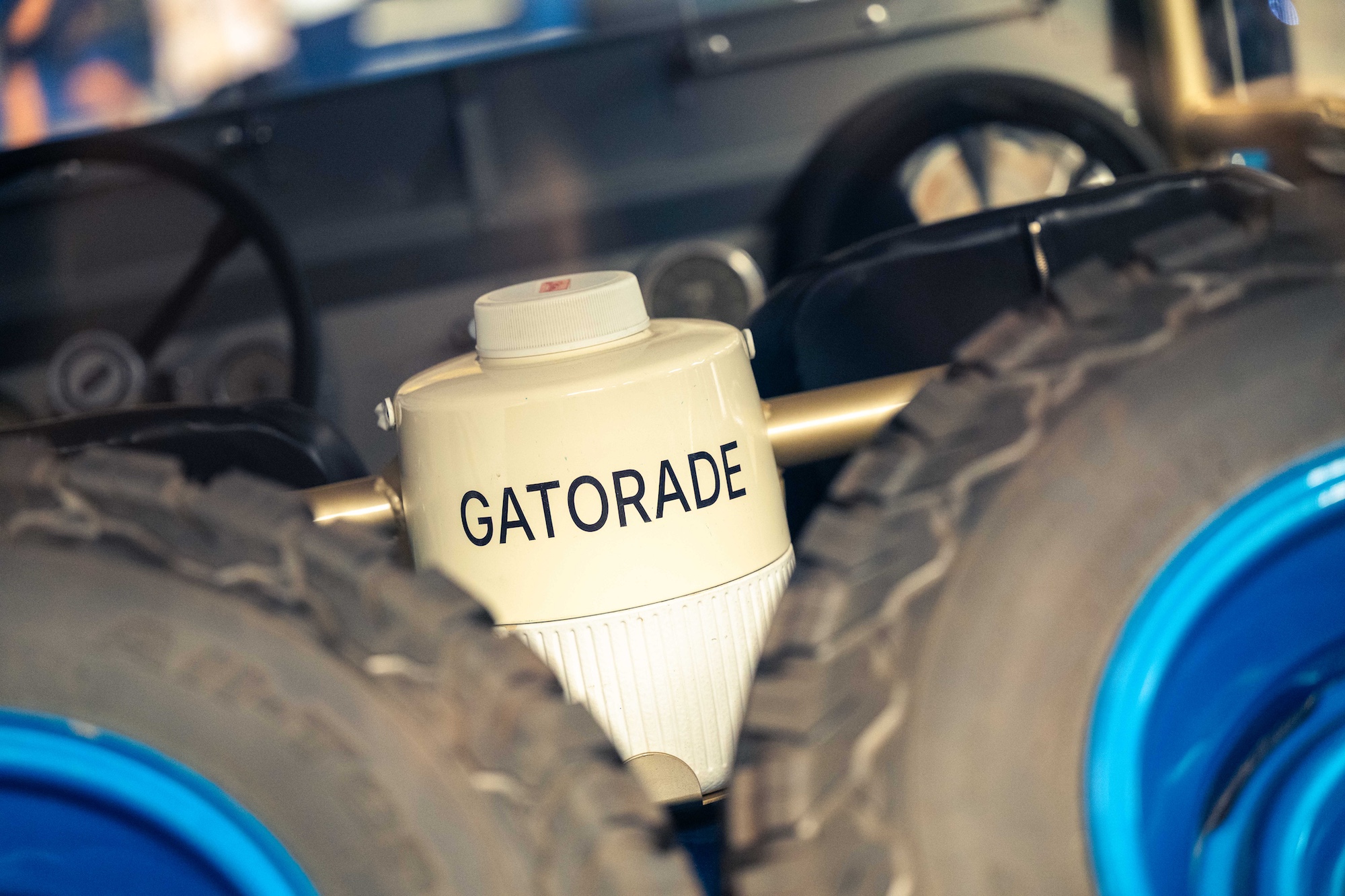
This is the legendary Bronco that had a two-hour lead in the 1967 Mexico 1000 (driven by Bill Stroppe and Ray Harvick), but failed 10 miles from the finish line. It came back next year (driven by Larry Minor and Rod Hall) and became the first Baja-winning Bronco. Actor James Garner had a role in its creation. A few things caught my eye seeing this truck up close for the first time: The air cleaner is where you would expect to see a glove box in the dashboard. That’s a pretty creative way to keep the dirt out! Also, it has a built-in Gatorade tank behind the console area. It was pretty hot in Union Station, so 60-year-old Gatorade started to look really tempting.
It had not arrived yet when I viewed the exhibit, but the 2026 Oracle Red Bull Racing RB22 Formula One car will be added to the display as well.
You Have Six Days
The exhibit is going on right now until July 14 in the Main Hall of Union Station and it’s free to the public. Union Station is a stop for the D.C. Metro and an Amtrak station so getting there is beyond easy, even if you’re driving a vintage Subaru.


The Voyager van brought back memories. We bought the first one to arrive in Southern Illinois the day after it was delivered in the exact trim pictured!!
At 13 years old I remember the Ford pavilion at the New York Worlds Fair. I don’t remember which car I rode in but I do remember the glass tunnel, the dinosaurs and the future city.
I also remember the Century of Progress and the Great Moments With Abraham Lincoln both at the fair and later at Disneyland.
Does all this make me old?
Nice article Sid! As a DC resident, I can’t believe this fell off my radar. It is one of the few feel-good things happening in the city at the moment.
Huh?
Great article Sid. And it’s interesting that cars without driver’s side mirrors were legal to sell prior to 1968.
Makes me think of my first car.. a 1990 Festiva which didn’t come with a passenger side door mirror. I added an aftermarket one immediately after buying that car.
We complain about being nickeled and dimed these days, but Ford made a side mirror an option on the mustang. Wow
Today most cars offer a limited number of packages. This was a different era. What Ford was doing was doing with that lefthand was mirror standard industry practice, not unusual at all. Individual options at extra cost included AM radio, day/night rearview mirror, two-speed electric windshield wipers, tinted windshield, and of course a righthand mirror. Buyers were free to pick and choose from more than 70 Mustang options.
I did a documentary on the fair several years ago, including an interview with the guy restoring one of the Mustangs from the fair. I think this is it because I think there was only one white one known to exist. If you want to learn more jump to 40:38 if the link doesn’t take you there: https://youtu.be/g-x7nFxHkCg?t=2438
This is great! Just watched the segment and – wow – real footage of two of the Mustangs?! Plus some great ride footage I didn’t see in my research! Way to land some awesome interviews, too. I still like to think there are some Ford convertibles out there with plates welded to the bottom and people just don’t know.
My mom raved many times about how she rode in a Mustang at the NYWF on a high school senior trip. Until today I was unaware a bench seat was an option. I really wasn’t much into 64/65 Mustangs, but I’ve recently seen a few original, unmolested ones in simple trims and options and I can now understand why they were so popular.
Enjoyed the read, Sid. Maybe I’ll make time to get down there this week.
I would have tried to get the Sanford and Son truck instead of the bakery truck.
Congrats Sid! Was cool meeting you at Lime Rock. Hope to see more of your excellent writing here!
The World’s Fair would have been lost on me. I would have just kept looping around on the Ford Magic Skyway. The first Mustang I rode in had the bench seat. A young woman in our neighborhood bought one and bunch of us (young and old) lined up waiting our turn for a ride. She was gracious and beaming with pride. Ten year old me rode the hump which meant I got to sit next to her. I fell in love.
No mention was made of the IBM exhibit, which had a grand stand that raised up into an IBM selectric typewriter ball. There was a movie shown, but the only part I remember was of a ride down a mountain road on something akin to a go cart, or a wheeled device the rider nearly laid down in. The camera was mounted near the front, and watching it go around sharp curves had everyone in the audience leaning into the curves. It was almost nauseating.
You have an 89GL? Awesome. Also my first (new) car (actually was an 87). Loved that car and would love to have one again for nostalgia. Totally believe it is still running (mine made it to 200K until it was crushed in a barn collapse)
I work right down the street from Union Station; I avoided the city around the holiday for obvious reasons, but was pleasantly surprised to see the Ford exhibit here. Hagerty’s registry has been really interesting to see in person over the years; back in 2018 they put the Bullitt Mustang in a glass case out on the Mall, like a life-size Revell model.
I remember they did something similar with a BTTF Delorean maybe a handfull of years ago. It was kind of cool seeing that glass case from afar in the middle of the national mall.
Given the number of spectators expected, it seems Ford was prudent to equip this Mustang with only an inline 6 and a three speed slushbox.
Great article! I might have to go check this out. I work just a few Metro stops away and it would make a cool lunch break.
Good article, but It should be noted early in the article that this is the Washington DC Union station. There are Union Stations all over the country.
The ride may not have survived in its original form, but the elements of it are in a bunch of current rides. The People Mover is mentioned in the article, but it also sounds like it has some Spaceship Earth and Test Track (amusingly sponsored by GM now) in it.
So of the four, this Disney exhibit did not become an iconic ride. Is it true to say it was…
“All alone at the sixty-four World’s Fair…” ?
Were there…
“Eighty dolls yelling ‘small girl after all’…” ?
Who was at the Dupont Pavilion?
Why was the bench still warm?
Who had been there?
Ana Ng.
I don’t want the world. I just want your half.
Great job , Sid!
What are you going to do to get COTD on your own article?
I would like to nominate this for COTD.
Jay Leno also worked as a lot porter at their local Ford dealership when he was a teenager, he got fired when he bumped into the used car manager and dropped a pile of hubcaps he was carrying. He wrote a letter to Henry Ford II asking for help in getting his job back, which apparently did make it to the Deuce’s office in the Glass House, and he called the dealer owner to get him rehired
Now I need a Gatorade cooler.
Congrats on the article Sid! Lots to dig into here.
Thanks!
Dang. Now I have to find a Karman Ghia convertible to relive my first car. Hopefully not the rust bucket 39hp of my 1968 self. But the fun and memories of that car….