

I often go to bed confused about why I’m a car guy. Why are we spending thousands of dollars at a time on something that’s just going to lose value in the long term? Every time I turn on the Corvette and log more miles on it, I do it knowing that each additional mile is another dollar off the resale value for my one-of-one built on a Monday in that color chariot, and yet I do it anyway.
Beyond daily usage, what if I get in a crash? Or have a brake failure? Is that something I want to deal with — that risk of potentially irreversible debt hanging over my head every time I hit the city streets? Any small hiccup that comes along the way is something that could harm your financial future for who knows how long, and yet we do it anyway. And that’s before we even think about something like modifying our cars.


I was at the Petersen Automotive Museum a few weeks ago checking out their new exhibit called A Fast & Furious Legacy and, per usual, I loved it, because the Petersen just doesn’t miss. That being said, as much as I was enjoying the exhibit, I couldn’t help but keep myself from thinking about just how irresponsible Dominic Toretto and his friends are with their money.
The Family Man Who Needs an Accountant

It’s probably very safe to assume that any car person in the world has seen at least the first Fast and Furious film, but if you haven’t, let me be the one to tell you that it’s nothing short of a JDM fan’s dream. Obviously it’s not all JDM, as there are secondary characters with gambling problems named Jesse who’s whipping a rather clean VW Jetta, but it’s still tuned to hell and back in a way that’s very in line with the trends you’d see pop out of Japan.
Outside of that, though? The first car we see Dom in is a Mazda RX7, Brian is rocking an Eclipse (before it gets nuked and he picks up a Supra), and there are just sooo many Civics on highways filled with semi-trucks that are just begging to be released of their coveted VHS machines that I’m sure have appreciated in value today.

The beauty of JDM tuner culture has, at least to me, been that the cars could often offer bargain performance for the right person, which makes sense for someone like Dom, whose day job is running a little market in Echo Park. The 1993 RX7 had a base MSRP of $32,5000, which was in line with some cars like a BMW 3 series or C4 Corvette of the same era, but is also significantly cheaper than a 911 or Viper, which both started around $50,000.
That being said… the main form of income I can decipher for Dom is the family market, Toretto’s, that he runs with his sister, Mia. I’m assuming that working at a corner store where nobody likes the tuna would pay closer to minimum wage, which would’ve been $5.75 in California at the time, but let’s be generous and say they’re making $8/hour. At that rate, Dom would have to work 4,062.5 hours, or 169.27 days, to afford the RX7, and that’s before taxes and without consideration of his day-to-day expenses, rent, etc. And this is before we consider the fact that he had it heavily modified.

Now it is worth noting that Dom is a guy who can undoubtedly wrench the hell out of his car, which would save him plenty of bucks in terms of labor, and we do also see a shop he owns called D•T Precision Auto Shop, so he has the space to work on the car as well. It’s very possible that his shop is public-facing; however, the only people we ever see in the shop are Dom’s friends family, so we don’t know for certain if there’s positive cash flow in the shop or if it’s just a front for something else.
Nevertheless, there are no ifs, ands, or buts that a build is a build is a build. They’re expensive, and I just don’t know if his minimum-wage-adjacent job would do it for him. Maybe he had some money leftover from his dad’s racing days (who maybe wasn’t the best driver), or maybe he’s just really good at budgeting, but half a year’s salary on a car for its base sticker price seems pretty inconceivable to me. But there is one way he could get all that money, and it’s with a life of CRIME.
They Don’t Exactly Treat These Cars Very Well, Either
In the case of the RX-7, it seems to have survived in its physical form, as it is seen in the background of several shots later in the film. The rest of the runtime, though, is a bloodbath of cars, lost to the world of crime.

Brian’s Eclipse got friggin’ esploded by the very evil Johnny Tran and his snake-skin pants-wearing team in the mean streets of Little Tokyo, and Brian’s boss, Special Agent Bilkins, complained about the $80,000 price tag they’re now levied with.
In the climactic semi-truck robbery that sees Vince stuck on the hood and dodging shotgun blasts, the Mad Max-ian truck driver was able to successfully disable Letty and Dom’s cars. Those Civics were $12,400 new in 1993, and doing some calculations based on the spec sheet listed on the almighty resource that is The Fast and Furious Wiki for the car, it had (adjusted for 2000’s money) roughly $4,712 in parts thrown at it (assuming they had Spoon engines, like Hector). Present day, that’s over nine grand in parts, and the Civic would be $24,618 (which tracks with the actual modern Civic’s MSRP of $24,695), meaning they wrecked multiple builds that came in at over 30 bands. They’re gone now. Bye bye!

And I don’t even want to know what the repair bill was on the Supra and Charger after they yeeted it clear over a train track and bottomed out the suspension and probably everything else when they landed on the other side. The gambling friend, Jesse, quipped that the Supra would cost at least $15,000 in repairs, and the Charger is one of those cars that’ll probably always be worth a pretty penny, and it rocked a nasty supercharger on top of nitrous oxide, custom wheels, a cage, and more. All those notes are before we even account for the fact that those cars are most certainly more expensive now than they were then, although in the Supra’s case, that’s largely because of these films, so that’s kind of a whole time paradox situation.

As the movies go on, the crew becomes more involved in the world of international crime and heisting, which makes a bit more sense as to why they have gobs of money to blow, but even with all the money in the world, I think the team owes it to themselves to not be so reckless with their machinery. Let’s take the C2 Grandsport, for example.

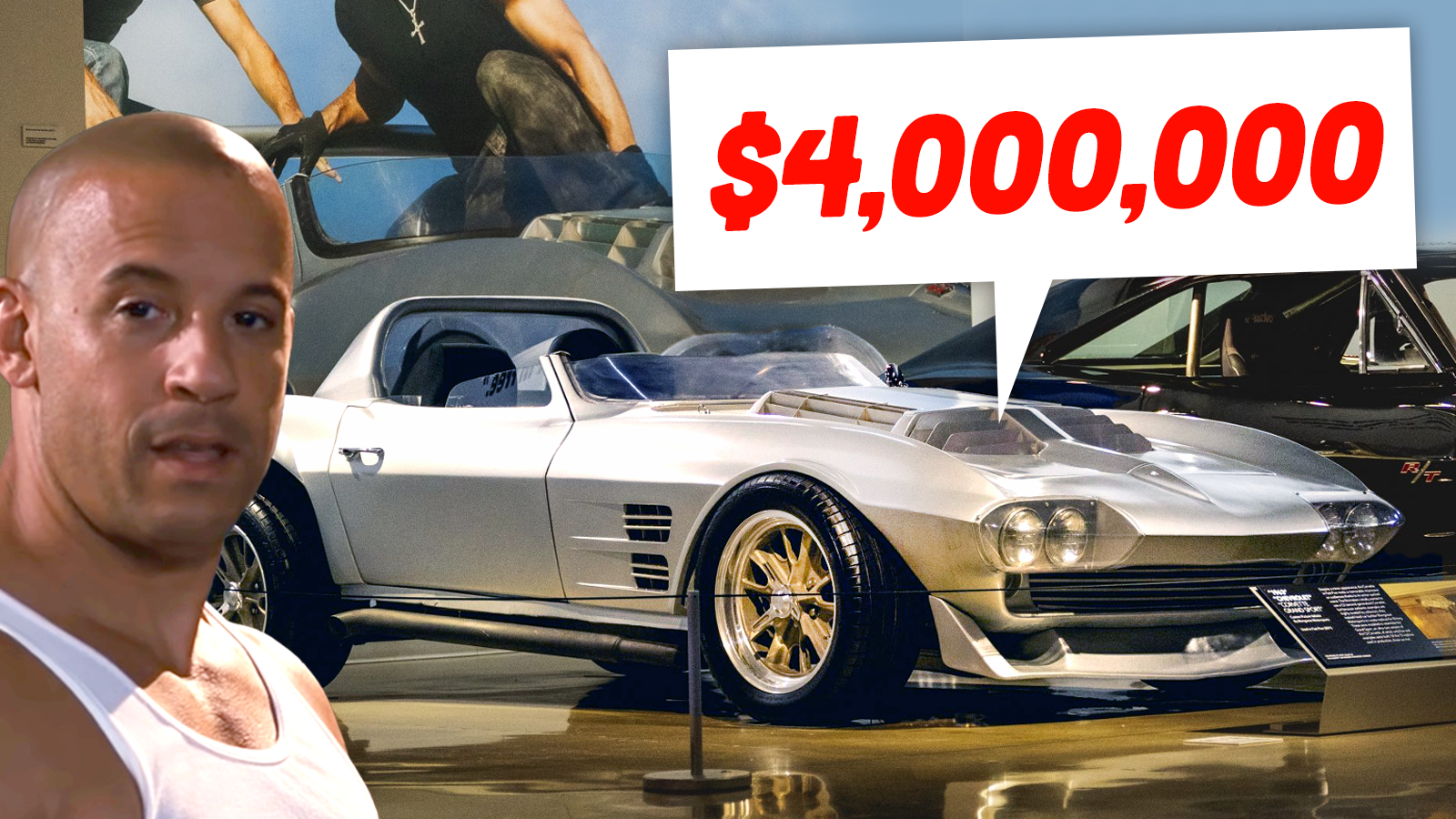
Apparently, the one used on screen is not at all a real Grand Sport and is instead a production-built car that just looks very Corvette-like. The reason they built one instead of using a real one is that, apparently, there are only five that were ever built, which has made them some exceptionally rare and expensive cars to get your hands on. Within the FatF universe, Dom and Brian simply steal the Corvette, so no cost there. And then what happens?
Exactly how much Corvette cash went into the drink? Chassis #001 went for $4.2 million in 2002, and #002 is estimated to be between $4 and $5 million.
And since we’re talking about classics, I wanna talk about the Mustang Anvil, as seen in Fast & Furious 6.

The Anvil is an insane ’69 Mustang built by the Cali-based Anvil group for SEMA to show off all the goodies you can get for your Mustang. Financial group GOBankingRates actually wrote a piece specifically focused on taking loans out on each car, and they estimate the price of the car being $193,000. From their reporting:
“Since this is not a production model car, it’s hard to value it in dollars. However, since it contains a Boss engine, let’s price it off a 1969 Boss 429. According to Hagerty, a mint-condition ’69 Boss’ll run you six figures at $193,000.”


I’m gonna go out on a limb and say that’s a very conservative estimate, because this car also features an insane, hyper-tuned, naturally aspirated 805 horsepower and features a flashy inboard push-rod suspension setup not too dissimilar from that of the Mustang GTD. Oh yeah, and it has a body covered in carbon fiber cladding.
Now, I’m already curious about how exactly Tyrese Gibson’s character Roman Pearce convinced Anvil to give their showcar away after it became so popular at the Vegas trade show, and maybe it was just a good ole-fashioned swipe of the credit card that brought the ride into his possession. Regardless of how he got it, I know one thing he should’ve never done with it, is drive it into the tracks of a fuckin’ TANK.

Even if he stole that car, brother, that thing is worth so much money in parts alone, and you were content letting it become dinner for the humble hangry Abrams tank. Bad judgment, brother.
The Bad Guys, Too!
At least with the series’ antagonists, you can rationalize their money as being entirely shady and ill-gotten. Maybe Johnny Tran and his family had something legitimate on the side, but I don’t know anything about all that. Cole Hauser in 2F2F is a straight-up drug lord; DK in Tokyo Drift is a Yakuza member’s nephew; there are cartel members and drug dealers for multiple films, all of which I’m confident pay quite handsomely. In the most recent iterations, though, it’s plenty of multinational crime syndicates.
Still, there’s no way it’s cost-effective to build a bespoke reinforced F1-style car designed to flip all the cars it encounters in traffic. I’m sorry, Deckard Shaw, both for the loss of your brother and his original ramp car, but building an insanely tuned-up homage to the Tyrrell P34 is just ill-advised. Four-axle steering and a 700HP V8 (an LSX engine making 627 HP is almost 20 grand, for the record) making buckets of downforce with all that aero? Just buy a bomb or something, man; I promise it’ll cause more damage than a flip car ever could.


I’m as much of a fan of (most) of the Fast and Furious films as the next guy, but it’s truly not until I’ve seen so many of the film’s most popular cars in person that I realize just how foolish our leading foolish family is and how horrible the economics of their world are. I’ll never go and police another adult’s spending, let alone one who can effortlessly end my life both inside and outside of a vehicle, but I beg, no, implore Dom Toretto to find a good wealth manager. Or at least a therapist. Something to teach him the value of a dollar and a hard day’s work.

If y’all are curious what the grand total is for all the destruction the main Fast and Furious franchise characters have caused, there is an answer – at least through Furious 7. As CarScoops reported in 2017 (which was the same year Charlize Theron as the baddie Cipher hucked a bunch of cars out of a parking garage to hit bystanders below), insurance company Insure The Gap estimated that there’s been over $500 million worth of damage across the first seven films (that’s not just cars, that covers all damages). From Carscoops:
[Insure The Gap] says that 169 ‘regular’ cars were damaged and 142 were a total loss. What’s more, 37 ‘special’ vehicles were obliterated, the most expensive of which would be the Lykan Hypersport by W Motors, valued at around $3.4 million.
Interestingly, most of the damage has been caused by heroes during the films, amounting to 261 million pounds (~$325 million), while the remainder comes as a result of the villains.
To quote the Flex Seal man: that’s a lot of damage.
You can see these cars and more at the Petersen Automotive Museum. A Fast and Furious Legacy: 25 Years of Automotive Icons will be exhibited through April 4, 2027
Top graphic images: Universal Pictures; Griffin Riley



“FatF”
Ha ha ha ha ha… that’s a new one to me but so good and hilarious. I really don’t mind the movies as much and the best one is definitely the first. Great article Griffin!
The first movie, and maybe the first three (I like Tokyo Drift), are the only ones worth watching from a cultural standpoint.
Beyond that they’re scifi/action shlock.
I think their most damaging accident was casting Jason Mamoa as a villain.
SMH… no mention of the Pontiac Fiero that Tej and Roman took into space to (spoiler alert) destroy an orbiting satellite?
That was in F9 & the calculation of costs covered in this article only went up to F7; that space-going Fiero would arguably have cost more than the C2 Grandsport, lol.
The entire F&F franchise does require a massive suspension of disbelief; these films, especially the later ones, are ridiculous fun once you turn off your brain.
And the films’ overall message of family & friends really does resonate with so many people worldwide, hence the enormous popularity globally. (Not for nothing the F&F franchise is among the highest grossing original IP-based film franchises based on box office alone and not including merchandise such as video games, home media, toys, etc, etc.)
I’ve watch a few of those movies. It’s like everyone has unlimited money for cars. I also like how many movies or even TV shows have the main character driving some kind of vintage car, where they are not a car person, don’t have much money, etc., they should be driving 10 yr old Toyotas or something. In High Potential, she’s driving a late 60’s Olds Vista Cruiser, in reality she would be driving a 15 yr old mini van.
60’s Broncos..so many 60’s Broncos which are really no fun to daily in city traffic.
In fairness, think about the amount of taxpayer money MI6 has been squandering for decades on cost-no-object modifications to already very expensive cars that often get destroyed or at the very least, happily abandoned somewhere fairly inaccessible.
Maybe Q’s constant harangues were justified after all.
If Bond was a real Civil Servant, he’d have to fill out his own bodyweight in forms just to expense a train ride.
“License to kill” is actually just a special exemption from all of the paperwork that would normally be associated with such activities, it’s the real reason 00 agents seem to have superpowers.
Moneypenny: “James, you haven’t filled out your expense form for you last trip to some exotic locale. I see you spent £35,000 on rum and prosititutes, personal expense?”
Bond: “Darling,you know I can’t be bothered with that, just make it up from the petty cash fund.”
I hold the first two of FF franchise single-handedly responsible for destroying complete bloodlines of beautiful ordinary cars by contaminating them in real life from the screen, Videodrome style.
It’s like a magic TV screen in the middle of a tinder-dry Californian forest. Show any tree species on the screen, and you get a real life forest fire that will selectively burn just the species shown, to leave only unlikely single lucky survivors that automatically obtain EW (Extinct in the Wild) endangered species status.
Pretty much any ordinary car that ever appeared on these first two movies has gone through that same scheme: Appear in the movie > all specimens in the wild get butchered > the few survivors become museum meat. Even the Vento VR6 😀
This is what the gambler 500 would be if we were all billionaires. Maybe a bit less crime though.
I like that you assume the billionaires would be less crime-prone.
There’s no way you paid for all the shit under the hood of that car by doin tuneups, and selling groceries!
(Did someone quote that already?)
I believe part of the way you pay for it is by stiffing “Harry”. In FF1, I don’t believe there’s any point at which Dom settles his “tab” at Harry’s before he blows town.
Good point, but, when Dominic drives, he’s golden. Kids pour in. They want everything he has. Every performance part. They pay cash! So maybe Harry cuts him a deal.
Or they just overnight’ed everything from Japan.
I love all things cars, to a level my wife calls “obsessive”, but I could barely make it through the sixth movie and haven’t seen any of the subsequent ones.
I saw 7 in theaters since the series was so important to my childhood and that was right after Paul died. Haven’t seen any of the others or the spin offs since. IMO the series should have ended after 4. 5, 6, and 7 were just action movies.
Yeah, I was already an adult when the first movie came out and it made me giggle with how it tried to be serious with its silliness. The subsequent ones went full action but went even harder in the straight-faced silliness, and that was just too much for me. The moment they started dragging a giant bank vault behind two Chargers is the moment I checked out completely.
By about 7, 8, it was definitely self-aware. I have no idea how the series gets new fans. Its so camp that I thought everyone watching the later movies is just in on the joke.
doesn’t Brian mention that Dom couldn’t make that much money selling oil changes and groceries, or something to that effect? so I’d think yes, it’s supposed to be open to the public, but they were mostly a front.
we needed the scene of some Aunt Esther coming in to get her old metro an oil change and Jesse trying to convince her she needed NOS.
“You ol fish-eyed fool”
“Ya big dummy!”
As for how they afforded cars in the first movie, it’s explained that of course the Toretto’s grocery store isn’t where most of their income is made. It’s essentially a front, and they make most of their money by sticking up semi trucks and selling the trailers’ contents on some black market for stolen goods presumably, and by winning races at the Race Wars track. There is literally a scene where Brian, as an undercover cop, presses Dom at a restaurant to tell him where all the money is made, and Dom gives him directions to Race Wars.
Yes but the IRS doesn’t know that. They think he is just a grocery man. I demand he gets audited.
That’s true. I suppose that’s why they had an undercover cop investigating him!
I love The Accountant series of movies because the main cop is an IRS investigator who finds her leads by just reading tax forms. Hilariously true to real life.
I mean they did steal that bank vault, so I’m sure there was a whole bunch of cash for cars 4
kidsthem in thereC’mon kids – The Peterson Museum has a special exhibit on family!
This entire exercise makes me miss the old Burnout games.
Yanno, the new Star Wars Game is basically Burnout and Motorstorm rolled into one. Different but looks fun!
Does that half a billion include the submarine they blew up in the 8th movie?
Yanno, I thought about including that, but I don’t know many people who own a nuclear submarine, so I don’t think most of us could comprehend the cost of all the damage done to it. Cars though? We get it.
I get what you’re saying. However, SOMEONE has to be on the hook for it, right? I doubt Russia would go after Cipher.
(Plus, you don’t want to alienate the one or two readers who do have a decommissioned nuclear submarine….)
And the cost to pave the 28mile runway in FF6?
That runway scene is what caused me to stop watching F&F movies. It just.. kept… going….
Really? That was after Dom rescued Letty by slingshotting himself off of his car, colliding with her over the gap between bridges and, without his trajectory changing whatsoever, lands safely on the hood of another car . . . But the frickin runway lost you? 🙂
Was that in the same movie? Because that’s the last one I saw. I made it to the end, and was like yeah I’m out. These are really dumb now and they were kind of dumb before.
First one was decent, second was GOD DAMN TERRIBLE all the cars were awful 00s show cars like ZERO track cars, and Tokyo Drift was great, but other than that… yeah, no thanks.
It was the scene immediately prior to the runway. Had the tank going down the dual bridge highway and everything.
I thought four was pretty decent, that was the one when they finally figured out that they were crime movies featuring cars and not the other way around. Five was fine. After that? Yeah, they were gone.
I think a YouTuber calculated that the runway was something like 26 miles long. The runway the space shuttles landed on was a tick over three miles long when you accounted for overrun space. lol
I never got past the first one. The floor board dropping out because of danger to manifold was part of it, but I think it was more the environment I watched it in.
I was just out of high school, and watched it with a group of guys that had a sharp import domestic partisan divide. It devolved into an argument about how the Supra engine could produce way more power than a V-8 regardless of modifications.
I leaned towards classic domestic cars, and the whole discussion turned me off imports for a long time.
I recognize the silliness of it now, but I never watched another one, even though I generally enjoy ridiculous action movies.
If you ever revisit the series, start at number 5. That’s when they moved away from the cringey street racing and leaned into being action movies with cars.
Thanks for the recommendation. I’ve got international flights in a couple of weeks that I’m going to need to fill with something
I reluctantly saw the second one, as well. I’ve watched a lot of bad movies on purpose, but I’d have to be paid to watch any more of the F&F franchise.
Tokyo Drift is actually good. I swear!
I suppose I did like it more than the first one.
I thoroughly, unironically enjoy the first one, in part because of how much I watched it as a kid with my dad, but also because I just think it’s a good fun movie. Then there’s a lot of stuff in between, but then I have to second Ben about the 5th. Yeah, it’s just a straight-up action movie at that point, but it’s genuinely a very well-executed heist movie in every way that just happens to use cars at every stage of the film.
It’s always interesting how our enjoyment of something can be tied to the situation we experienced it in as much as the actual thing.
Tokyo Drift is actually an excellent movie, and arguably better than the first one. I was a domestic guy at the time, and the Supra pulling on a charger with a supercharged 426 was a bit much. Hemis can make THOUSANDS of HP in drag cars.
Gisele!