


Five years ago, Stellantis killed the SRT division responsible for so many heroic vehicles. Anything with a Hellcat engine, the Viper SRT-10, the Ram SRT-10, the Neon SRT-4, the list goes on. Midway through last year, it brought it back into a brave new era. The Dodge Charger no longer offers a V8, the Challenger doesn’t exist anymore, and at the time, you couldn’t even get a Ram 1500 with a V8. It’s all part of a larger shake-up, and now we’re seeing early results of SRT’s latest go-fast endeavors: Giving a pair of turbochargers their own electric supercharger.
When turbocharging became mainstream again in the 2000s, we ended up with vehicles that weren’t the laggy, rip-snorting, fire-breathing turbo models of old because that sort of turbocharger sizing just wasn’t going to replace the low-down torque of a larger-displacement naturally aspirated engine. Some enthusiasts think it’s cool for forced induction to finally have enough exhaust pressure at 3,000 RPM and deliver a shove in the back comparable to being rear-ended by a TGV. The average consumer doesn’t want that at all, so we got all these turbocharged cars that fall flat on their face in the upper rev range like an early fuel-injected pushrod V8.


Obviously, larger turbochargers can prevent the power band from rolling over, but then you introduce that lag the typical driver doesn’t like. While automakers have tried various solutions in the past, ranging from twin-scroll turbochargers to variable geometry turbochargers to electrified turbochargers, they all have their trade-offs. Limited efficacy or cost and complexity, usually.

While not the first of its sort, Volvo’s twincharged T6 four-cylinder engine took another variable mainstream: Parasitic drag. To combat lag, the Swedish marque decided that a belt-driven supercharger would be the best bet for feeding the engine compressed air at low RPMs, with a turbocharger doing the work higher up in the rev range and a bypass valve managing the handoff. It works, but there are some efficiency trade-offs. That supercharger takes engine power to turn, and that’s not an ideal compromise.

Genesis took things one step further by eliminating the belt. The G90 and GV80 Coupe are available with a twin-turbocharged 3.5-liter V6 that also has a 48-volt electric supercharger. Drawing from power harvested by a starter-generator and stored in a battery, the 48-volt electric supercharger compresses air to feed the intake until the turbochargers wake up. But wait, what if instead of feeding the throttle body directly, the 48-volt electric supercharger fed the turbochargers instead?

That’s exactly how Stellantis’ eBoost Air system works. It uses fresh air compressed by the electric supercharger to spool the turbochargers from their compressor sides. In essence, it’s compound-charging until the valve in the intake ducting opens once the turbochargers can take it away on their own. So what are the upsides here? Well, the system’s targeting quicker spool on larger turbochargers, it doesn’t rob any power from the crankshaft, and all of the charge cooling can be done downstream of the turbochargers.
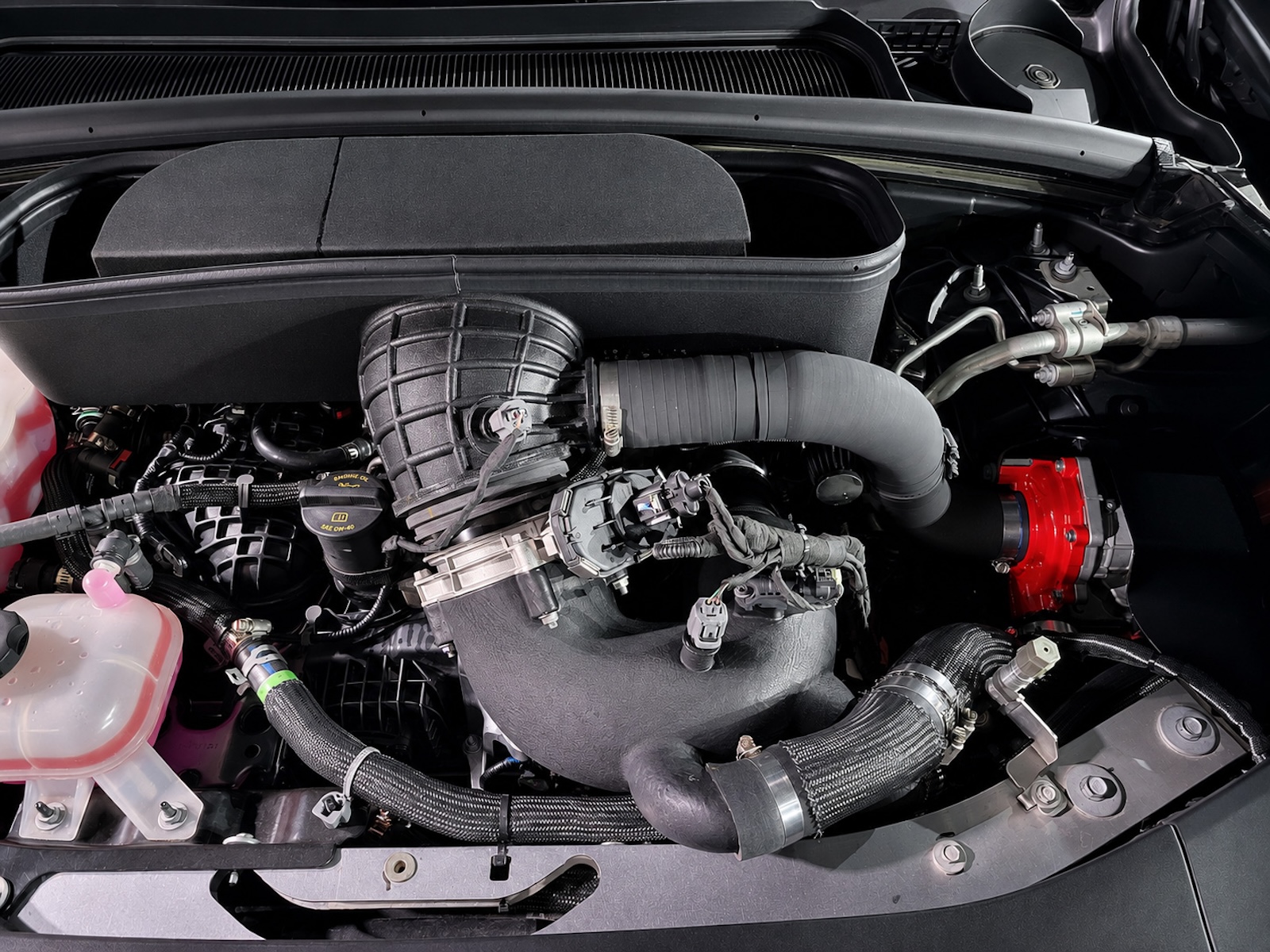
Bolted to a high-output Hurricane three-liter inline-six installed on a Jeep Grand Cherokee, Stellantis claims the eBoost Air system is capable of “virtually eliminating turbo lag.” That’s all well and good on stock turbochargers, but I’m excited to see what it could do when paired with larger units.
Still, as far as ways to combat lag go, eBoost Air has a certain simplicity to it. One electric valve like a throttle body, a few pipes, a relatively cheap 48-volt supercharger, and that’s about it. No need to draw air through a charge cooler or feed it through a second charge cooler, no need for additional water-to-air plumbing. While we don’t yet know how or if SRT actually plans on using this tech in a production car, they probably wouldn’t be showing it off if they weren’t at least considering it. Either way, it feels wild as all hell, feeding boost into turbochargers to make boost.
Top graphic images: SRT


And then they can reprogram the Fratzonic exhaust to also generate the supercharger whine. Might have to put another speaker under the hood.
I’m no engineer, but this seems like a horribly inefficient way to transfer power. Might as well go full Rube Goldberg.
So this means the Hurricane 6 fits in a Grand Cherokee?
Also I’d be more interested in this system if anyone else other than Stellantis was developing it.
Doesn’t the much-maligned 4cyl C63 do this?
I wonder if this plays into the plans reported a few weeks ago, for a 600hp Charger for the 60th anniversary. Larger turbo + this setup should make that number attainable.
*Looks at the 911 Turbo hybrid turbo system and looks at this*
I think there’s a way to cut out a lot of extra parts in the anti- turbo-lag category that SRT isn’t considering
I know this is counter-intuitive, but it was really fun the first time I drove a MazdaSpeed Miata with its little turbo that spooled up with just enough lag to disconnect the press of the foot to the feeling in your butt. Can’t help but grin wide as you got pushed back in your seat a bit. A real “I have got to get me one of these!” moment; and I did.
I later did some go-fast intake and fuel control mods to reduce the lag (thank you Flying Miata!), but that slightly delayed boost was missed, just a little, when it was gone.
Later, another Miata I had with a supercharger also didn’t come with the delayed boost, and though I knew off the line it was quick, I also missed, just a little, that kick in the pants that the delayed boost gave you.
This was announced on the day after I went on a shallow dive for engines with both a supercharger and a turbocharger, like my Detroit 8V92T. Wikipedia has a good amount of these engines under a subheading
https://en.wikipedia.org/wiki/Twincharger#Applications
All I really learned is that I would gladly trade my Wanderlodge for a Nissan Micra Superturbo.
You have a Blue Bird Wanderlodge motorhome with a big ol’ 8V92T? Does Mercedes Streeter know? Does it have a sub-10s 0-60 time?
So, the aftermarket electric turbos from ebay were actually onto something?
Yeah, but only when paired with a Fuel Shark and an intake Tornado.