

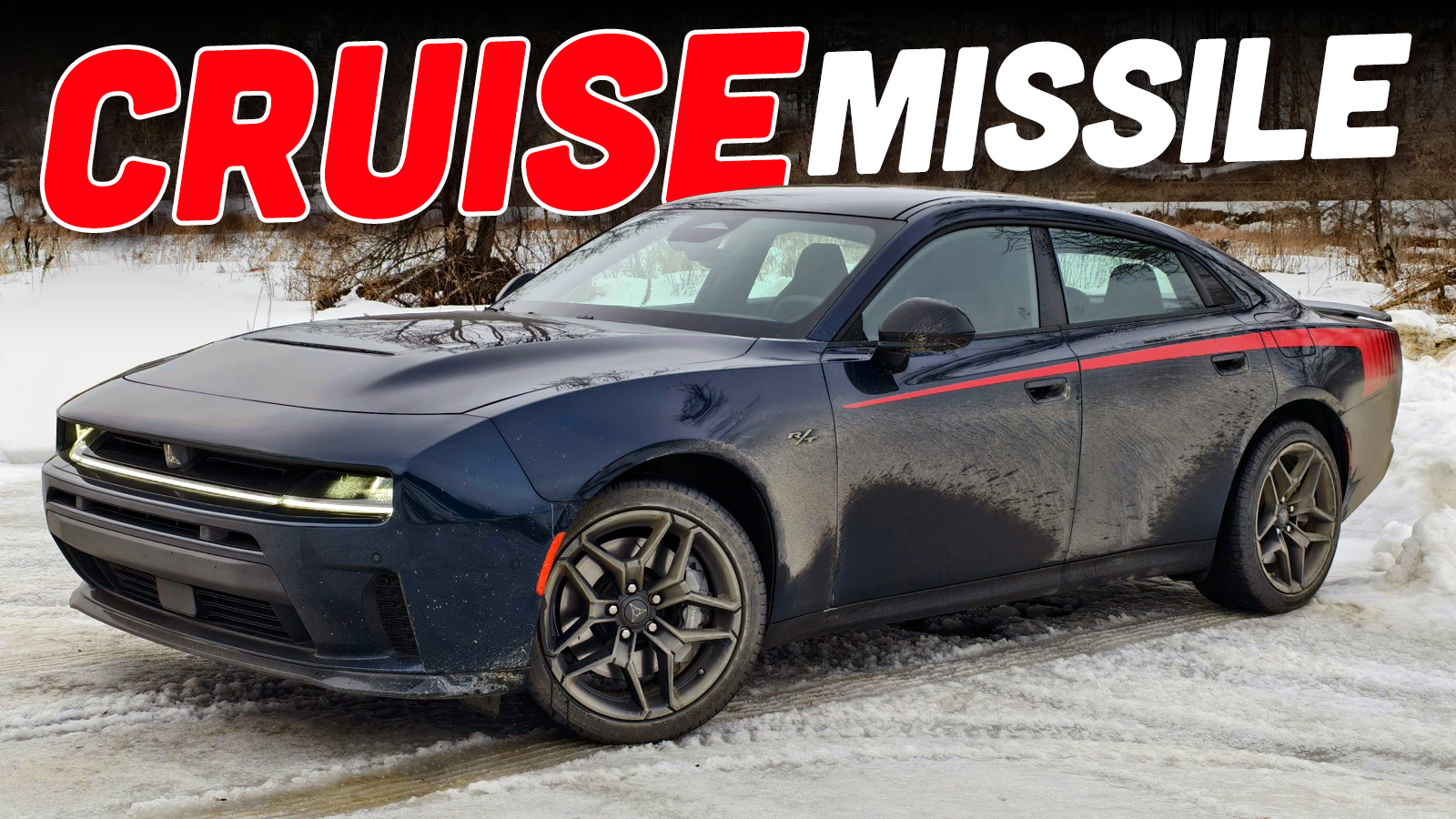
One of the greatest joys of driving is hopping into your favorite car and going for a cruise. A good cruiser is a vehicle that offers ample power, a spacious interior, a comfortable ride, and long enough legs to make any road trip feel trivial. The 2026 Dodge Charger R/T is not supposed to be a cruiser. Dodge built this 420-horsepower beast to usher in the next era in muscle cars. But in trying to make a muscle car for the modern day, Dodge might have actually built what is, low-key, one of the coolest cruisers on the road. The Charger is so comfortable and eats up so many miles with ease that it feels like a return to a type of car we haven’t seen in seemingly eons.
Last week, I had the privilege of testing Dodge’s latest Chargers in an unlikely place, New England. As I drove through northern Vermont and New Hampshire, I couldn’t help but notice that I was in a place where most people would never think to take a muscle car. The roads were crowded with all-wheel drives from Subaru and Audi to 4x4s from Chevrolet and Toyota. I can’t say, however, that I saw any Mazda Miatas, previous-generation Dodge Chargers, Ford Mustangs, or other rear-drive sporty vehicles.


That’s not entirely surprising. There was snow multiple-feet deep on both sides of most roadways, frost heaves seemingly every mile, sheets of ice on the pavement, and temperature swings so varied they’d rival the weirdest days in the Midwest. There are people who do drive rear-wheel drive vehicles in conditions like this, sure, but the all-wheel drive is king out here.

On the surface, Dodge holding the press drives for its latest muscle car in the Green Mountain State doesn’t make any sense. But the new Charger is a different kind of vehicle. For the first time in the Charger’s history, every version of the Charger, no matter if you order it in electric Daytona or gasoline Sixpack flavor, comes with all-wheel drive and only all-wheel drive. The only way to even get rear-wheel-only drive is to manually select it on the infotainment screen.
The new Charger has been around since late 2024, and the Sixpack has been around since last year. What’s new for this year is the milder R/T, and the addition of four doors. I got to test a Scat Pack and an R/T in both sedan and coupe forms. All of these vehicles are deeply weird, and yet, they actually work, but not in the way you’d expect.
(Full Disclosure: Dodge invited me out to Stowe, Vermont, to participate in the first media drives of the Dodge Charger R/T and the Dodge Charger four-door. Dodge paid for my flights, cozy lodging, and excellent meals.)
Navigating A Changing Landscape

A lot of where Dodge is today is due to its reaction to a rapidly changing world. The new Charger was a huge deal for Dodge and Stellantis as a whole. It was the launch vehicle for the STLA Large platform, a native BEV architecture that’s also flexible enough to support ICE powertrains. The Charger was also a bit of a test. Could Dodge keep the passion of V8-loving Mopar fans alive without actually having an engine at all?
Dodge gave it a valiant effort and tried to give the Daytona an identity of being the “rebellious” EV. Dodge seemingly hit that mark with speeds faster than a Hellcat and an “exhaust” speaker system that breaks sound ordinances, but it also weighs a whopping 5,838 pounds, is nearly as long as a full-size SUV, and came swinging with a $61,590 starting price. Both the media and Mopar fans seemingly weren’t feeling it. Sales have been so slow that Dodge ended up discontinuing the entry-level Charger Daytona R/T before summer 2025 even hit.

But the beauty of the STLA Large platform is that Dodge wasn’t locked into just making an electric car. At the time, both Dodge and Ram saw the Hemi bow out for the 2025 model year. Then, a change in the winds happened, and just like that, the V8 is back. Ram even made a silly ‘Symbol of Protest’ truck to celebrate it.
But the Charger has not seen the Hemi, or at least not yet. There have been reports that Dodge is working on a Hemi-powered Charger. But for the foreseeable future, if you desire to convert gasoline into burned rubber in a Charger, your only choice is a Sixpack.

This put a perhaps seemingly impossible mission on the plates of Dodge’s designers and engineers. How do you capture the essence of the muscle car into a vehicle that rides on an EV platform and has an engine more in common with a BMW? How do you get the Hemi faithful to give up their baritone V8s for raspy and nasally twin-turbo straight-sixes? Oh, and that’s not all. The Challenger is dead, too, so now the Charger has to be a sedan and a coupe.
What Dodge achieved is more than admirable. The Charger is far from a perfect car. I would even say there are parts about it that are genuinely baffling. Yet, add it up, and I’d argue that Dodge really did produce a modern muscle car. But even if you don’t buy that, I think what we could agree on is that this is an unexpectedly awesome cruiser.
The Easier, Still Powerful R/T

Here’s what I wrote regarding the Charger R/T’s bones in the first part of my review:
Dodge sells that internal combustion Charger in two main flavors. The line opens with the R/T, which sports a three-liter twin-turbo Hurricane straight-six good for 420 horsepower and 468 lb-ft of torque. The current flagship is the Scat Pack, which sports the Hurricane cranked up to 550 horsepower and 531 lb-ft of torque. Dodge calls this engine the Sixpack, and officially, the R/T dispatches 60 mph in 4.6 seconds while the Scat Pack does the same deed in 3.9 seconds. The gassers come with a ZF-designed eight-speed automatic transmission.
Dodge compares the standard output Sixpack to the outgoing 5.7 Hemi, saying that it makes 50 more horses and 73 more lb.-ft. of torque for a 60 mph time that’s half a second quicker than the old Charger. Dodge says the new gas-powered Scat Pack sedan is the most powerful sedan under $60,000.

The new Chargers look like they have a bit of an optical illusion going on. The two-door looks like it could be smaller than the sedan, but it’s not. Both versions are the same length and have the same 121-inch wheelbase. For all intents and purposes, the sedan is basically the coupe with two more doors.
The big change between the R/T and the Scat Pack is the engine. The R/T is adorned with the same twin boosted three-liter Hurricane straight-six, but now the taps are cranked down a little. From Dodge:
Twin 50mm, low-inertia turbochargers spool up rapidly for near-instant boost, and counter-rotating turbine assemblies help cut lag and balance airflow for crisp throttle response. Up to 22 psi of boost, and full peak torque by 2,500 rpm, put effortless low-end punch right under the driver’s right foot. Precision direct fuel injection at 5,075 psi (350 bar) pairs with centrally mounted injectors for clean, controlled combustion. Oil-jet-cooled, cast-aluminum pistons, with an anodized top ring and DLC-coated pins, reduce friction and enhance durability when the revs and temps climb.
Dual overhead cams and wide-range, fully independent variable-valve timing optimizes power and efficiency across the rev range. The engine-mounted, water-to-air, charge-air cooler and its own dedicated cooling circuit keeps intake temps in check through repeated acceleration runs. The plasma transfer wire arc cylinder-bore coating creates an ultra-thin, robust, low-friction surface for long-term performance.

For comparison, the Scat Pack’s turbos boost to 30 PSI. This engine, like all gas Chargers, is mated to an eight-speed transmission. AWD control is handled through a clutch-based transfer case from Magna. In snow mode, the Charger distributes power 50/50 between the axles. In normal mode, 60 percent of the power reaches the rear. In sport mode, 70 percent of the power hits the rear tires. From there, you can click the RWD button in the infotainment screen to disengage the clutch in the transfer case and go all rear wheels.
Hopelessly Pretty

The guts are cool and all, but I think what Dodge really knocked it out of the park on is the styling. It’s a perfect mix of retro and futuristic without being overwrought. The grille is a throwback to the iconic Chargers of several decades past, as are the taillights and the beltline. This Charger is a callback to the Chargers of the late 1960s, the ones that struck fear into insurance agents and unskilled drivers.
There is one piece that I found extremely confusing. The “Sixpack” plaque on the hood is oriented as if it were meant to be legible to the driver.

However, you cannot see the hood insert at all from inside the vehicle. You can see it only from the outside, and if you look at it straight on, it’s upside down. So, I guess appreciators of the Sixpack emblem are supposed to look at it from the side, or perhaps from the sky when the hood is open.

I can forgive that gaffe because the rest of the vehicle is so hopelessly pretty. It wasn’t that long ago when automakers were obsessed with jagged edges, Predator-face grilles, and designs that read like whoever penned the rear wasn’t friends with whoever drew the front. The lines of the Charger are a breath of fresh air.
One of my favorite parts of this new generation of Dodge is the return of the Fratzog logo. I feel like Dodge’s logo has been neglected ever since the famous chrome ram went to Ram trucks. Since 2011, the Dodge logo seemed like an afterthought, being just “Dodge” with two red stripes through it. The Fratzog is another callback to the 1960s of Dodge, and it’s probably one of the coolest logos in the market today.
It’s Bigger Than You’d Think

Once I got my fill of the exterior, I reached under the door handle, pressed a button, and the driver’s door popped open. I miss when door handles were physical entities. At least the button mechanism is covered under the false door handle so that ice is unlikely to get in your way, even on a cold Vermont morning.
Anyway, it was here that I really started noticing that this gas-powered muscle car was hiding electric car bones under its skin. Here’s a reminder about how huge the Charger is, from part one of this review:
The new Charger stretches 206.5 inches long. That’s a skosh more than 8 inches longer than the old Charger and nearly 9 inches longer than the old Challenger. It’s also 79.8 inches wide, or 1.5 inches wider than a Dodge Challenger Scat Pack Wide Body. At 59 inches, it’s also 1.5 inches taller than the outgoing Dodge muscle cars. To put that into perspective, the new Charger is only four inches shorter than a Chevrolet Tahoe. This is a mammoth vehicle.
It’s a heavy one, too. The electric Charger punishes the scale at 5,838 pounds, or roughly the weight of the state of Alaska. Going on the Sixpack diet helps the Charger dramatically. At roughly 4,816 pounds, the gas model weighs only about as much as the state of Virginia. For comparison, that’s about what a Ram 1500 Quad Cab with a 6’4″ bed weighs.
One thing I didn’t note in my first part of the review is that the R/T is a touch lighter than the Scat Pack at 4,741 pounds.

This meat is present everywhere. When you step into the Charger, you’ll immediately notice that the sills are thick and that the floor level sits pretty high. Dodge places a “No Step” warning on the side skirts so you don’t try entering the Charger like it’s a crossover. This high floor is a consequence of the platform being built for EVs first. The batteries would be under the floor, where there’s now some empty space and the components of the ICE powertrain. Here, it just makes you feel like you’re driving a go-kart, or a Toyota Tacoma, because your legs aren’t very deep in the tub.
I found that my optimal seating position had me rolling the seat all the way back so I could stretch my legs out, rather than down. Then, I pulled the telescoping wheel toward me. Taller people might feel a bit weird as their driving position might require them to bend their knees a bit. However, it’s all very comfortable. If anything, the go-kart seating position is fun.

This high floor is also noticeable in the rear seat. Dodge says it increased rear room in this Charger, and indeed, my 5’6″, 200-pound frame feels pretty comfortable back there. But it’s also hard to ignore that my knees are high because the floor doesn’t go very deep. The good news, at least, is that the rear room is similar in both coupe and sedan. Really, the addition of rear doors in the sedan is for practicality. Otherwise, they’re pretty much the same car.
That’s just a minor quibble because the rest of the interior is rather nice. The dashboard is another nod to the Dodge Charger of old, while also enveloping you into an environment that feels a bit like a flight deck. The dash wraps around the seats and makes you feel like you’re a central part of piloting this heavy metal muscle missile. Yet, the looks are somewhat deceptive because there’s a lot of room in the Charger. Two people can sit up front with tons of shoulder room, and adults can fit in the rear if they aren’t too tall.

The interiors feel largely the same regardless of whether your vice is a coupe or a sedan. So, pick your preferred style or level of practicality and go for it. Personally, I dig two doors over four.
The interior is a pleasant mix of soft-touch materials with some hard plastics. Those plastics don’t feel the best, especially in the door cards of the R/T. However, they aren’t nasty and, thankfully, they aren’t that piano black nonsense, either. The seats were plenty comfortable, and depending on the options you order, you can get luxurious Nappa leather, an 18-speaker Alpine Pro audio system, carbon fiber accents, suede in the seats and headliner, and a fixed panoramic roof. There’s also a 16-inch digital cluster and a head-up display.

That sound system gets so loud and puts out so much bass that your seat will shake from it. You can crank the stereo up so high that you will cause physical pain to yourself. The bass is also enough to embarrass even a Polaris Slingshot. This isn’t the best stereo I’ve used in a new car, but it might have been the most stereo. It wasn’t the clearest or the richest. But it was good. There’s just an overwhelming amount of bass if you’re crazy enough to crank the slider up. Mercedes Jam Session Approved.
The Charger is also practical, offering a hatchback rear and a cavernous trunk. If you fold the rear seats down, Dodge says the new Charger will carry a full set of its own wheels and tires. Apparently, cargo space has more than doubled in total.

The headline of the interior seems to be Dodge’s 64-color “Attitude Adjustment” RGB lighting system. It’s a great touch that adds spice to the interior and really highlights the wraparound element. I also like how the RGB lights change to orange on an open door as a safety feature.
The only real problem I had inside was the infotainment screen. Like most modern cars, Dodge funnels so much through this screen, which means that much of your experience hinges on this working correctly. I’m not just talking about your HVAC or audio, either, but you switch the vehicle into RWD mode through the screen. I accidentally discovered a quirk with the unit in the Scat Pack I drove in the morning. To keep the cars warm in the cold Vermont morning, the Dodge team put the heater on max, adding in the heated steering wheel and heated seats.

When I got in, the car was roughly as hot as it would be after being parked outside on a blazing hot summer day. The infotainment system didn’t seem to enjoy this. It was so hot that I couldn’t touch it for longer than a couple of seconds. As for the screen’s functions, everything was super delayed. It took a few minutes for the screen to boot, and every action took a couple of minutes to work. It took a good few minutes to pair my phone and several more minutes to enter the waypoints for the drive.
More frustrating was the audio. I tried to turn up my music, and nothing happened. Then, two or three minutes later, I would suddenly get blasted by full-volume audio that would take another two or three minutes to turn down. Eventually, the screen just gave up entirely and turned off. It’s startling because everything goes through this screen, so when it goes down, you have no real control over audio, HVAC, or anything else that goes through the screen. It almost felt like I was trying to force Windows Vista to run on a computer meant to work with Windows 95.

I got the screen to work by parking in the shade, opening the windows, and letting the frosty Vermont air cool it down. Once it cooled down, it became responsive and snappy. I asked Dodge’s team about this later, and was told that this wasn’t supposed to happen. It’s supposed to work in high heat. Maybe my specific unit was having a bad morning. If this happens to you, find a way to cool the screen down, and you’ll be fine.
My other complaint about the screen is that I don’t like the physical buttons below it. They have a clunky, vague engagement, and I was sometimes not quite certain when I turned down the heat or made another adjustment. I had to rely on the reaction on the screen to know I did something.
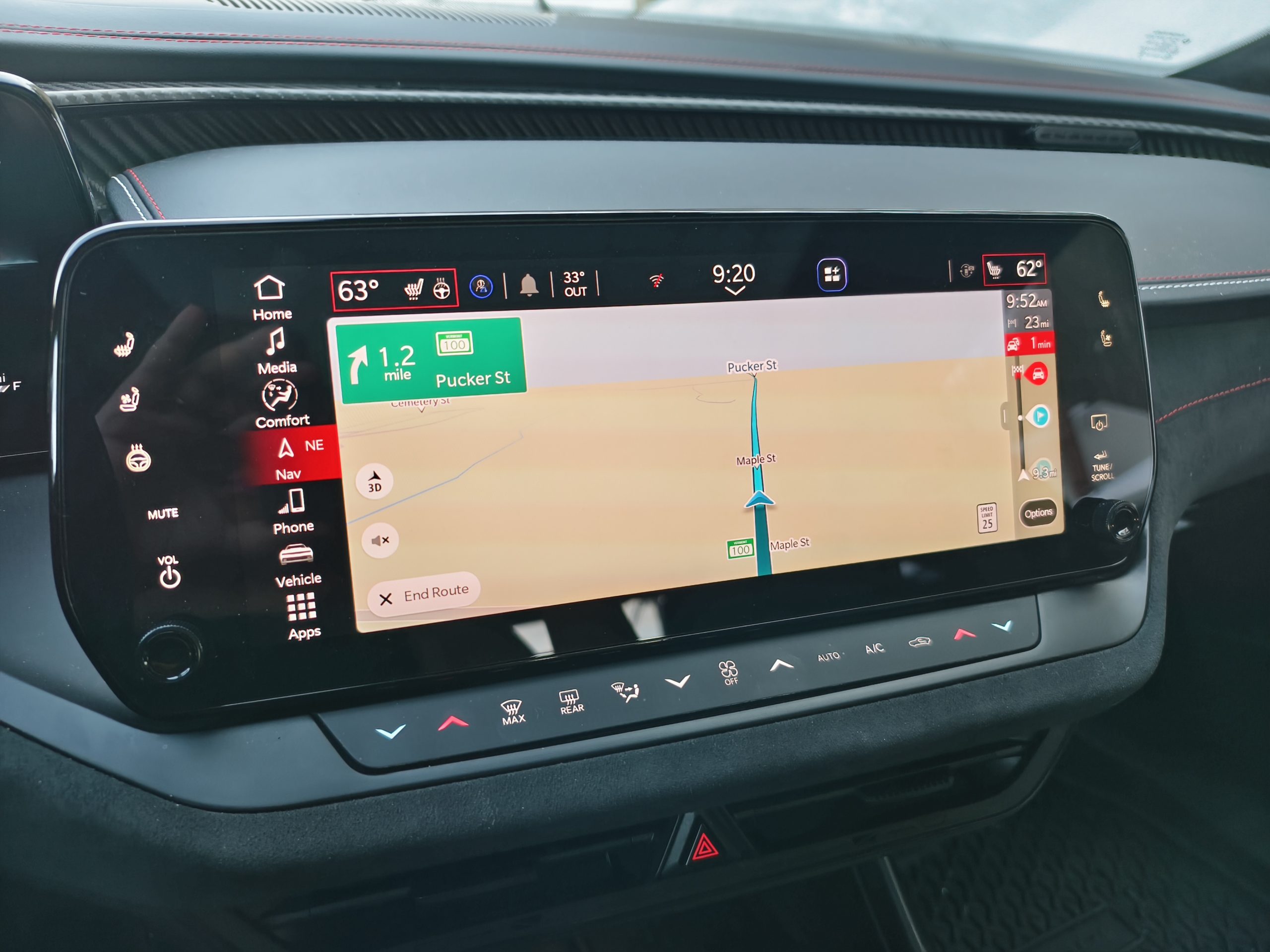
Andrew Collins of the Drive noted that his tester smelled strongly of plastic. None of the cars that I drove on that trip — which were pre-production vehicles — exhibited that behavior. Hopefully, these are just quirks and bugs of pre-production cars.
Still Has Muscle Car Charisma

Part one of my review featured my driving impressions and snow drifting at the Team O’Neil Rally School in New Hampshire. Click here to read that. Otherwise, here’s a clipping:
If you’re looking for a traditional muscle car, Dodge nailed the assignment. The new Charger has plenty of heart-skipping thrills in a straight line. If AWD launches aren’t your thing, you can even tell the AWD system to buzz off for 100 percent RWD fun, including as many burnouts, donuts, and drifts as you want. You can even tell traction control and stability control to take a hike and use your brain’s computer to keep the tires spinning and the front end in the direction you want it. There are videos out there of Dodge Badassadors doing donuts in icy parking lots in these things, and it’s just as fun as it looks.
On the road, the 550 HP of the Scat Pack hits like a sledgehammer. The power comes on hot and hard and doesn’t stop until you hit the engine’s somewhat low 6200 RPM redline. Then you get to do it all over again. I think the Scat Pack meets the oft-repeated auto journo standard of “groundswell of power.” The power is always there and always ready to rock.
The 420 HP of the R/T isn’t as dramatic and doesn’t kick your head into the seat as hard, but it is plenty healthy. If the Scat Pack feels 10/10, the R/T is closer to 7/10. But that’s not too surprising since it does take nearly a second longer to hit 60 mph. Otherwise, the experiences between the Hurricanes feel largely similar. I suspect the R/T will be fine for most people and will be the volume model, because to get the most out of the Scat Pack requires you to drive fast enough to find yourself on the wrong side of the law. The R/T is the better daily driver.

Yes, that image above shows a 28.8 mpg average! That came after a 20-mile hypermiling run where I scored 31 mpg at speeds around 50 mph in the valleys. Sadly, my average for the day was closer to 17 mpg. The EPA says that the R/T should get 26 mpg highway, 17 mpg city, and 20 mpg combined.
The sound of the Hurricane was a fascinating thing to think about. I loved the soundtrack, but then again, I’m an appreciator of straight-sixes. To my ears, the Scat Pack, and to a lesser extent, the R/T, sounded like a pissed-off BMW. Close your eyes and, really, you can’t tell it’s a Dodge thundering by.
Now, devotees of the Hemi probably won’t like that. Indeed, there’s no burble, no growl, and no crackle that the Hurricane can make that would replace the guttural sounds of a V8. But I think if you go into it with an open mind, you’ll come to love the sound of a Hurricane. Even if it isn’t a V8 soundtrack, I think the audiosmiths over at Dodge captured the feel and excitement of a muscle car, but in a high-powered straight-six.

A perhaps controversial decision is that the engine’s noise is also pumped through the speakers. Undoubtedly, someone will figure out how to turn it off. But the good news is that the noise is not super intrusive. I didn’t even know about the pumped-in sound until I read about it later on.
My biggest complaint about the experience with the engine was throttle tip-in. The turbos don’t really report for duty until about 2,000 RPM. To mask this, Dodge has calibrated the throttle tip-in to be aggressive. This is fine and dandy if you’re trying to do a stoplight drag, but it becomes goofy when you just need to go 15 mph through a town center. Give it just a tad of right foot, and it tries to leap off the line. You’ll then pull back, creating a sort of bucking oscillation motion. If you have it in sport mode with the exhaust singing, you’ll even hear the Hurricane’s revs bouncing a bit.
An Unexpectedly Great Cruiser

What surprised me was finding out that the Charger was really a low-key great cruiser. The stiff suspension does its best to limit body roll and helps the Charger keep its composure through turns. If you overcook a turn, the Charger wants to plow forward. Counter with throttle, and the rear end will want to come out. There’s a lot of weight at play here, and you never forget it. You feel the weight resisting turning in the curves. You feel the weight heave upward on bumps, and you feel it come back down with the force of gravity. It sort of feels like I’m handling a pickup truck that’s low to the ground and on a multilink suspension.
In a weird way, that’s honest to the old-school form of a muscle car. Those were cars that went really fast in a straight line, but fought drivers through corners. The new Charger will turn, but it’s not nearly as nimble as a Miata or a European sport sedan.

However, that weight comes at a massive advantage when you’re just cruising. Potholes are beaten into submission, crosswinds feel as if they don’t exist, and, as one of our readers joked, maybe truckers would have to worry about the turbulence coming off the Charger rather than the other way around. The Charger just eats up mile after mile like you would not expect any muscle car to. Add in the shockingly competent AWD system, and you have a vehicle that will go anywhere in North America and look stellar doing it. I mean, if you folded down the rear seats, you could even use the car like a pickup truck.
Yet, as I wrote in my first entry, there’s more than enough power reserves to do all of the drifts, donuts, and burnouts as you want. Just don’t leave it pegged at redline without moving for several minutes, because the engine might get hot. The rowdy character of the Charger isn’t gone.

In a weird way, the Charger almost feels like a rebirth of a kind of car we haven’t seen in a long time, and it’s the land yacht sedan. The sedans of old were lumbering beasts that were long enough to land a Cessna on and made you feel like a million bucks. The Charger does just that. The R/T even more so, because its milder, more approachable tune and lower price point make it a great daily driver. I suspect the R/T will be the Sixpack’s volume model, and it might even sell to an audience who might not have considered a Charger in the past. It’s big, it’s comfortable, and it rocks in the snow.
Honestly, if Dodge cranked up the luxury a few notches, the two-door could probably be marketed as a return of the personal luxury coupe. It fits the bill with its gargantuan size, heavy weight, and healthy power.
Affordable Power

The Dodge Charger Sixpack line opens with the R/T, which has a base price of $51,990 for two doors or $51,990 with four doors. Price includes a $1,995 destination charge. Meanwhile, the Scat Pack opens up at $57,685 after destination charge.
So, who is the Dodge Charger R/T for? I think it’s for the family person who wants an AWD car, but doesn’t want another Toyota or Subaru. It’s for the muscle car nut who is open to something that’s not a V8. It’s also for the person who wants a big and powerful sedan, but lives where the weather sucks for half of the year. I think it’s also for the kind of person who enjoys the look of an old muscle car brought into the modern day, and not overdone.
This person will have to deal with the weird quirks, like the impressively huge size and heavy weight. There’s also the high floor from the EV equipment that no longer lives in the car. But get past that, and you get a car that’ll feel at home on the American Autobahn, no matter the weather. What’s weird is that Dodge set out to create a next-generation muscle car, and it might have accidentally created one of the best modern American touring cars. I can’t wait to see what Dodge does with this platform next.
Top graphic image: Mercedes Streeter


420hp straight six sedan for $50K? Should be amazing. Then I see it has the dimensions of a garbage scow and weighs as much as a 4Runner. The high floor for a battery pack that isn’t there is a problem. And it’s a Dodge, so it comes preloaded with a bunch of man-child marketing I refuse to be associated with.
I think Throttle House tested this on track and said it corners like a block of cheese.
It’ll be interesting to see these on the road once in a while, but I’m a snot and live north of the Mason-Dixon line so I’d just save another year and get an S6 or 540i.
Check out my Charger, it’s as big as a whale and it’s about to set sail!
Sounds like they need to make a Chrysler 300 version.
For me, I can have my mind changed on the straight six, but the mandatory AWD is a bummer. I would think dropping that might get this close to the curb weight of the later hi-po Challengers.
Give me RWD and a manual transmission at 4,500 lbs and you might get a repeat customer out of me, Dodge. I’ve had my Challenger from new for 15 years and have been very happy with it.