

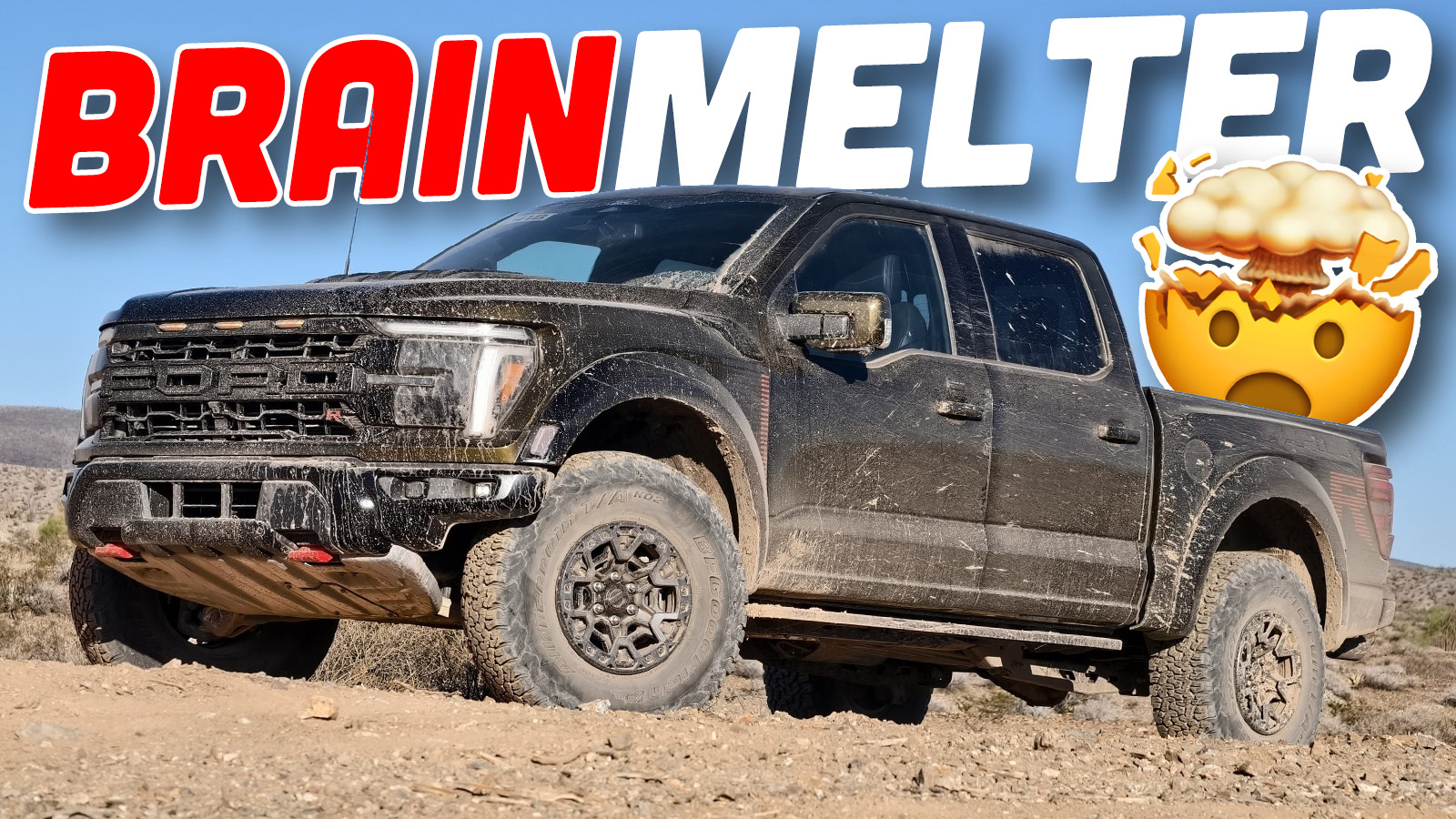
Let me describe a vehicle to you. This ride houses a 5.2-liter supercharged V8 pumping out 720 horsepower and 640 pound-feet of torque with a thunderous roar. It can hit 60 mph in as little as 3.6 seconds and can cruise at 100 mph as comfortably as most cars feel at 55 mph. This vehicle has capabilities that no regular car can dream of matching. You’re probably imagining some supercar right now. But I’m not talking about a supercar. This is the Ford F-150 Raptor R. It’s a full-size pickup truck with enough horsepower to frighten a deity, off-road chops like a racing side-by-side, and does everything with so much speed that it’s hard to comprehend how it’s possible. Somehow, you get all of that in a vehicle with a license plate.
I got to experience the 2025 Ford F-150 Raptor R, which is similar to this year’s 2026 model, during the second-ever Ford Raptor Rally. Ford tossed me the keys to the truck, which I did not lose this time, and left me to do whatever I wanted with the truck for a whole October weekend in beautiful Lake Havasu City, Arizona. More than 400 Ford F-150 Raptor, Bronco Raptor, and Ranger Raptor owners turned up to have a giant party.


When I wasn’t spending time chatting with Raptor owners, I went on my own adventures. In doing so, I proceeded to have what was probably the highest-speed and most extreme desert off-roading experience I’ve ever had behind the wheel. I even got the truck up to 100 mph in the sand, and it practically broke my brain with how well it performed.

(Full Disclosure: Ford tossed me the keys to two Ford F-150 Raptor Rs for one weekend in October 2025 to participate in the second-ever Raptor Rally. Ford paid for my travel, my admission, and most of my fuel.)
The Basics
Engine: Supercharged and intercooled dual overhead cam with variable camshaft timing 5.2-liter “Carnivore” V8.
Transmission: Ten-speed 10R80 torque converter automatic.
Drive: Part-time four-wheel drive with low-range and locking rear differential.
Output: 720 horsepower at 6,650 RPM, 640 lb.-ft. of torque at 4,250 RPM.
Required Fuel: 93-octane gasoline.
EPA Fuel Economy: 10 MPG city, 15 MPG highway, 12 MPG combined.
Base Price: $114,420, including $2,795 destination charge and $695 acquisition fee.
Price As-Tested: $116,935 (estimated for 2026).

The Ford F-150 Raptor has been hammering the trails since the 2010 model year. Back then, the F-150 SVT Raptor, as it was called, was the start of a mad trend. This was a road-legal pickup truck that offered just a sniff of trophy truck performance. It also housed some real firepower under the hood with two V8s, the bigger of which was a 6.2-liter mill with 411 eager horses at the ready.
Those early Raptors would also become meme trucks, as some of their drivers treated their Raptors like they were real trophy trucks, jumping them so high that they triggered the airbags and bent their frames upon reentry, transforming their trucks from totally awesome to just plain totalled in the process. No production truck is that tough. The Raptor went on to capture the hearts of many enthusiasts and even made it into racing video games, so that you could take your Raptor shenanigans digital.
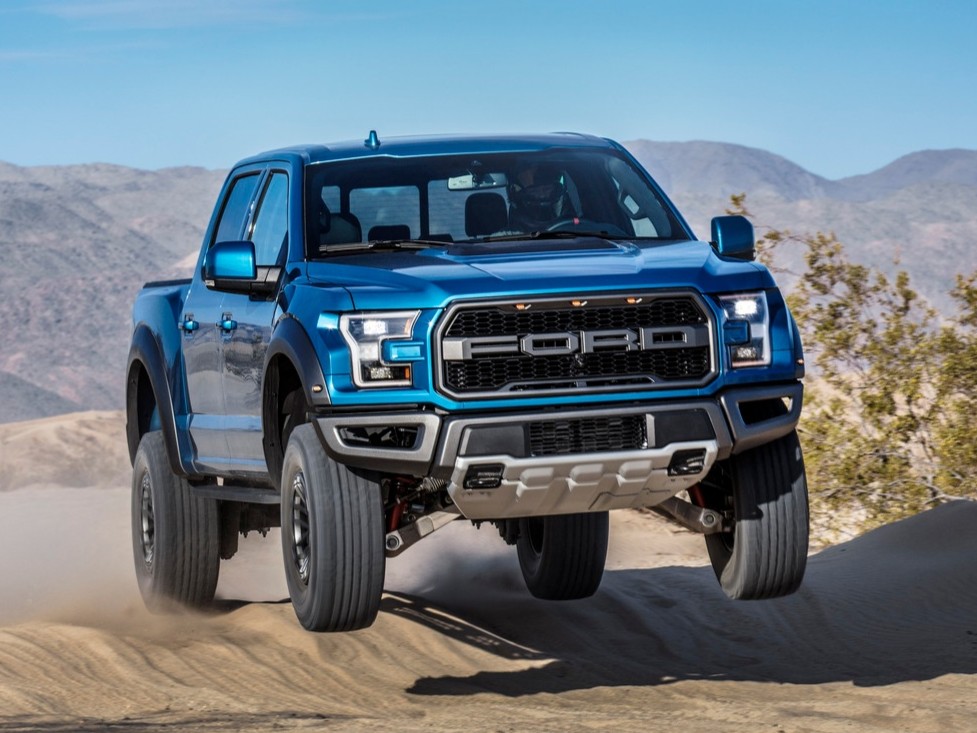
The second-generation Raptor (above), which launched in 2017, was a curiosity. Its capability was technically better than the first Raptor, but missing from the menu was any choice of V8 power. Instead, your only offering was the 3.5-liter EcoBoost V6 from the Ford GT, but detuned to 450 HP and 510 lb-ft of torque. The new truck was faster and more Raptor than before, but enthusiasts missed the rumble of V8 power.

The third-generation Raptor launched in 2021, and it was bigger and meaner than ever before. You were even able to order it from the factory with 37-inch tires. Just the tires alone were a big deal. As Road & Track reported back then, putting the Raptor on 37-inch stilts made it so tall that its factory had to be reconfigured just to fit it.
Ford also listened to enthusiasts. Sure, you can make a V6 pump out great power, but the V8 was part of the shock and awe of the original Raptor. So, the V8 came back. But Ford didn’t hold back, because what the team dropped under the hood isn’t a Coyote, but perhaps the craziest Ford V8 that could have been chosen for the job.
The Heart Of A Predator

This is actually our second time driving a Raptor R from the current generation of the Ford F-150. David Tracy did one of his characteristic deep dives on the F-150 Raptor R back in 2022. In it, he described how the heart of the Raptor R’s madness is the 5.2-liter supercharged V8 that the Raptor team stole from the Ford Mustang Shelby GT500.
As it sits in the GT500, the engine is called the Predator. Some tweaks were made to make the engine a better fit for the truck, creating the Carnivore V8.

David’s article explains further:
You may be wondering about the truck’s lower horsepower figure when compared to the GT500. This, powertrain engineer Brian Lizotte told journalists, can be attributed to the fact that the Eaton TVS R2650 blower up top features a smaller pulley diameter in order to “fill in…mid-range torque” for the truck application. You can see some of the changes Ford made to the GT500’s Predator engine for the F-150 application in the great video [click here] by Autoblog’s Zac Palmer. Lizotte talks about how, in addition to the supercharger pulley ratio change, there’s a re-tuned crankshaft damper, a new oil cooler, a deeper sump (since there’s more room on the truck than in the GT500 and since the steep grades a truck deals with off-road and while towing could benefit from a deeper sump), plus changes to the intake and exhaust system
I chatted with Lizotte over dinner, and he really did make it seem like dropping this motor into the F-150 Raptor engine was child’s-play. “You’d think that the truck duty cycle would be harder,” he told me, “It’s really not.” He went on to say that temperatures and loads tended to be higher on the track-oriented Mustang.
“The GT500 was more challenging because the on-track performance aspects of that car,” he said. “You’re literally using every bit of that engine on a track,” noting oil management challenges during high lateral (in corners) and longitudinal (during braking) acceleration events that led the team to develop active baffles. On track, he told me, you just see such high vehicle speeds, high loads. As a result of the driving conditions being less severe in many ways, plus the additional packaging space in the truck, putting the Predator into the F-150 Raptor “was a very seamless execution,” Lizotte told me.
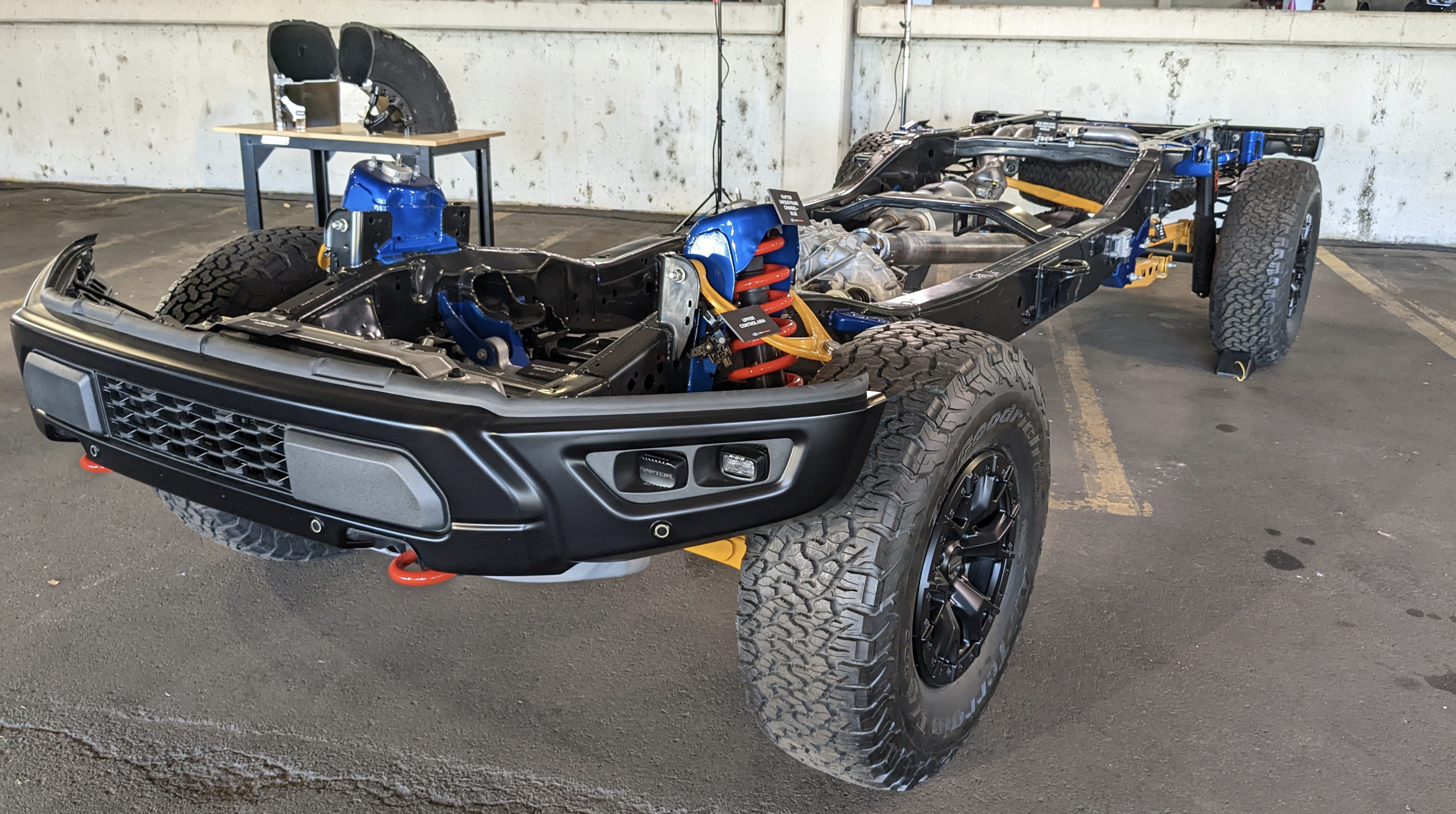
The EcoBoost remains in its home in the regular Raptor, and it still makes a very respectable 450 horsepower and 510 lb-ft of torque. The addition of the 270 horsepower brought on by the Carnivore V8 will set you back a whopping $31,925 on top of the base $79,005 price of a regular Raptor. That places the Raptor R into high-end sports car territory.
While I wanted to scoff at that price, I came to an uncomfortable realization that the Raptor R is basically a supercar, just one not meant exclusively for performance on tarmac. Where a McLaren might be designed to conquer a track at triple-digit speeds, the Raptor R is made to beat the desert into submission at the same velocity.

Everything about this truck is designed to make it better off-road at high speeds. The FOX Dual-Live Valve internal bypass shocks, for example, use electronic control to adjust damping 200 times per second with the mission of making the truck as smooth and capable as possible in the rough. with state-of-the-art electronic control technology. Apparently, the base valves of these shocks help them to provide upward of 1,000 pounds of damping per corner at high speeds.
Ford even sacrificed some towing capacity to allow the Raptor R to be an off-roading beast. You might have ridiculous power behind your foot, but the truck is so softly sprung and optimized specifically for high-speed operations that you get only 8,700 pounds to tow with. That’s still a fair amount of weight, but a decent bit less than the 13,500 pounds that a properly-equipped regular F-150 EcoBoost could tow.

The Raptor R towers 13 inches from terra firma thanks to its standard 37-inch BFGoodrich All-Terrain T/A K02 all-terrain tires, or 1.1 inches better than a regular Raptor without the 37s. Off-roading angles are also pretty decent with a 33.1-degree approach angle, 24.4-degree breakover angle, and 24.9-degree departure angle.
Alright, so enough about the nerdy stuff. What’s it like to drive?
Mind-Bending Power

Everything about the F-150 Raptor R is an adventure. It starts with a growl that bounces off every concrete wall in a 1,000-foot radius, and that Carnivore sounds like it’s ready to rip off the face of the Hyundai across the parking lot.
Once the engine settles into its idle, it can be quiet. The Raptor R rocks a Normal, Sport, Baja, Slippery, Off-Road, Rock Crawl, and Tow/Haul driving modes. Put it into Normal, and it sounds like a naturally aspirated V8 at idle. Sport gives it a little bit of a rumble, while Baja just opens up the exhaust and makes the truck sound straight-piped. Thankfully, there are sub-modes just for the exhaust: Quiet, Normal, Sport, and Baja. When you set it to quiet, you almost can’t even hear the supercharger, and the truck sounds like normal traffic.
I came for the full Raptor R experience, so I set the truck to Baja mode right out of the gate. My first move was leaving a parking lot at the Phoenix Sky Harbor International Airport, where I accidentally laid down two black marks with the snarling V8. Throttle tip-in is hilarious in the sportier modes and makes the engine react like it’s raging out after consuming way too many energy drinks. It just wants to rip a fat burnout while screaming loud enough to wake up an entire apartment block.

Once I caught my composure and stopped laughing. I set the truck to a more reasonable Sport mode and then set off. This time, I only made the rear tires chirp.
The silliness of the Raptor R was captivating. This is a truck that only barely fits in a parking space, stands 80.6 inches tall, and spreads out 87 inches wide. It has more in common with the SS United States than it does with something like a Lotus Emira. Yet, its acceleration is more brutal than most sports cars and even supercars that I’ve driven. When I punched the throttle, I simply didn’t expect this hulking 6,090-pound colossus to take off as if I commanded the USS Enterprise to go to warp. But it did, and it was hilarious.
If you have the truck in two-wheel-drive, it’ll hopelessly spin its tires against a traction control system that fights desperately to rein you in. All the while, the speedometer rises so fast it’s skipping several digits to keep up with the rapid acceleration. Eventually, the tires catch, and forward thrust continues at its relentless rate.

Launching in four-wheel drive is probably the closest I’ll get to strapping myself to a Saturn rocket. My head got tossed into the headrest, and my mission was to keep the launch under control as the world blurred around the truck. The speed at which the Raptor R can move can be incomprehensible. It goes in a straight line like a vehicle with half the weight and less than half the size. The acceleration in this truck was perhaps even more satisfying than the Ford F-150 FP700, in part because the Raptor R is so big, so ungainly, and your last thought after looking at a 37-inch off-road tire is “drag race.” I guess 720 horsepower will make darn near anything into a road missile.
The Raptor R can be made surprisingly docile after putting the drive mode into Normal and the exhaust mode into quiet. The truck will become respectable, even. Throttle tip-in becomes relaxed, pedal response lightens, and the truck’s road rage fades away. It drives almost like a normal F-150 in this mode.

My first experience with the Raptor R was on a roughly 3.5-hour, 200-mile road trip from Phoenix to Lake Havasu. Or, at least that’s what I was told. The truck must have warped time and space because I somehow beat Google’s time by 30 minutes, and I wasn’t even trying. During the Raptor Rally, I met the host of a Raptor club, and he joked that, with the power of the Raptor R, it must have taken me only 20 minutes to drive those 200 miles. It sure felt like it; the truck wants to do nothing but speed.
The highway cruise was effortlessly relaxing. The 37s quietly hummed in the background, and despite the Raptor R’s angry maw and insult to aerodynamics, wind noise was kept at a minimum. I found myself sinking into the soft Recaro seats, turning the air-conditioner on high, and getting really comfortable. For a truck that’s as shouty as a shock jock, it has no problem coddling me when I wanted it. These leather and Alcantara-trimmed thrones even had cooling and heating!

The seating position of a Raptor R is pretty fitting, too. The truck’s towering height means that you see over everything, even crossovers. Between the rabid horsepower, the height, and the sheer size of the absolute unit of a truck, I felt like I was a sort of queen. I continue to see why some folks love jacked-up trucks.
That’s all to say that, while the F-150 Raptor R was built to make its enemies tremble in fear in the desert, it’s a shockingly fun truck on the road. Things get even crazier when the pavement runs out.
Desert Express

I spent much of my time at the Raptor Rally doing Ford’s guided tours. These were great and were perfectly designed so that Raptor owners could really test out the capabilities of their trucks and SUVs. I got to participate in a rock crawl, a medium-speed jump, a hillclimb, and a side-tilting turn. None of this really challenged the truck. It handled the 19-degree climb and the 22-degree side tilt like it was cruising through a parking lot. The medium-speed jump was slightly impressive, mostly because the truck landed like some of my best touchdowns in a Cessna. It was pure butter.
The real test is what I did outside of Ford’s tours. I armed myself with a trail map and just buried the throttle. The Raptor R is no regular off-road truck. I’m convinced that our Nissan Murano CrossCabriolet could have handled that rock-crawling course. But few vehicles could tackle a desert at the sheer speed that a Raptor R can.

I found a strip of open desert where there wasn’t anyone else around, no bushes, and no giant rocks. This strip looked suspiciously similar to an airstrip, only in sand and mildly bumpy.
I lined the Raptor R up like a Boeing 747 entering a runway for takeoff. Then, just like I bury the throttle in a Cessna, I gave the Raptor R a size 11 heel. The Raptor R thundered into action like a turbofan spooling up, and the speedometer began ticking faster than the price boards at my local gas station. 10 mph, 20, 30, 40, 50, and all the way to 100 mph came staggeringly quickly, even on sand. I thought I was going to hear someone call out “V1, Rotate,” if I was crazy enough to keep going.

Instead, I brought the Raptor R down to a more reasonable 40 mph, giggled way too much, and spun the truck around for another go in the opposite direction. I had to abandon my desert strip after another run because I was getting rather addicted to my on-demand rocket launch.
Much of what made this possible was the power, yes, but it was also the suspension and the truck’s stability. 100 mph in the sand was a little bumpy, sure, but I felt confident and in control. I felt like I was driving one of those fancy high-end side-by-sides from Polaris or Can-Am, but nope, I was in a big truck with my cooled seats freezing my butt, air-conditioner on blast, and Alli Walker’s I Like Big Trucks playing from the clean and crisp B&O stereo system.

I then spent the rest of my solo time climbing over rocks, hitting a wicked jump at 60 mph, and, weirdly, even finding a random patch of mud in the desert. The truck did it all with ease, and at a speed that was mind-boggling for something that wasn’t a side-by-side or a dirt bike. At times, I couldn’t believe that the feds even allow this thing to have license plates.
The Raptor R can even put enough donuts to make you puke faster than a merry-go-round. Oh, and it doesn’t matter if those donuts are on sand or pavement; the truck doesn’t care.

The truck even has some pretty cool technology that can keep the violence in check. Its perimeter cameras are great for squeezing between two large boulders. It also has an off-road cruise control, one-pedal trail driving, a trail turn assist, and the drive modes. All of these techy settings can make even a novice look like a pro. I used them just to see if they worked as advertised, and they do. Then I immediately went back to doing things old-school with every assist turned off as much as they’d let me.
The one tech part I greatly appreciated was the navigation system’s breadcrumb feature. At one point, I got so carried away that I found myself far from a road and civilization. I was legitimately lost, and worse, my phone had no service. I was about to navigate by the sky, but then I noticed that the navigation system had drawn a line for every trail I had taken. I just followed the breadcrumbs back, and everything was fine.
Full Send-Approved

Perhaps the most impressive part about the Raptor R was that my abuses didn’t break it. It is hard for any vehicle to take repeated battering from several jumps at 60 mph, washboards at 80 mph, and slamming into hidden rocks without something breaking. Indeed, I sent the Raptor R so hard that I jacked up the alignment. The steering wheel was pretty far off when driving in a straight line. Raptor owners told me that you’ll get that when bashing dunes near triple digits, but note how nothing was actually broken. Even Ford’s people told me they could fix that in a jiffy.
If I had any complaint about the Raptor R, it’s that the fuel economy was atrocious. I averaged 11 to 12 mpg when heading back to Phoenix with cruise control on. Only once did I see 14 mpg, and it required treating the gas pedal like it was made out of lava and avoiding headwinds. I never saw above mid-single digits when off-road, even when I wasn’t doing a dozen donuts. I was able to get the 700 HP Ford F-150 FP700 to get 27 mpg. Such fuel economy was simply unavailable to the Raptor R.

I’m also not entirely sure about the use of Alcantara in a street-legal off-road vehicle. I shudder to think of accidentally bringing mud inside the truck and slathering it on the seat.
I concede that fuel economy is only a small nitpick. I cannot imagine someone spending six figures on a jacked-up 720 HP supercharged desert supercar, hoping to get decent gas mileage.
A Supercar Of A Different Kind

By the end of my drive, I was stuck on that “supercar” language. Like a supercar, the F-150 Raptor R is specialized to do one thing really well. But instead of that thing being Nürburgring lap times, it’s making the desert blur around the cab. When I look at the truck and its price as being a luxurious supercar, it makes some sense to me. I’m not going to say it’s a deal, and whether it’s worth it is entirely up to you. But I see why people will spend condo money on a pickup truck.
I also understand that a truck like the Raptor R is going to be somewhat controversial. It’s 720 horsepower at the foot of any American who can pay the price, no special licensing required. It towers so high that small children can disappear in front of the hood. Even the bed height is so high that getting things in there will suck. In a way, this truck is the poster child of what many enthusiasts hate about modern trucks.
But I can’t hate it. The Raptor R is so nonsensical and so stupid that it comes right back to being awesome again. It’ll do 100 mph anywhere, on any surface where there’s a straight enough line, and has a soundtrack ripped straight out of Jurassic Park. I’m impressed with what Ford’s engineers have pulled off, and I smiled every minute.
Top graphic image: Mercedes Streeter





My problem with trucks with performance like this one and the Cybertruck is they break the fundamental driving-like-a-jackass bargain: I want you to have skin in the game if we’re gonna let you pilot a cruise missile on public streets. The difference between this and a performance car is if you fuck up and hit me when hooning your Mustang, you’re as likely as me to get injured. If you hit me with this 3-ton brick of a truck, I’m dead and you’ve only got regrets. Add to that the lack of visibility and what I’m sure are braking distances that would’ve been underwhelming in the 80s and I just don’t love it.
A few years ago I was bicycling when a red light runner t-boned me. Luckily she was driving a Honda Fit. A brodozer like this would’ve killed me for sure. I only had to spend one night in the hospital, and only needed one surgery to put my bones back together, and 6 months of incredibly painful physical therapy to regain maybe 90% of the previous mobility.
I feel the same way. There are very few consequences for the person who screws up at speed. If you hit a fixed object like a tree or a rock, you’re probably going to have a bad day. However, if you mow down a Camry, you’d easily just hop down after and look at your own bumper. Those in the Camry would probably leave the scene in bags.
Coupled with the target buyer of this person (aka rich psychopaths), I worry that a lack of any real concern by the likely owner of one of these means bad things for the rest of the motoring public.
I doubt that these things will be flooding the streets, but I don’t much care for the whole approach of making a tall heavy thing go this fast. The dirty inside of me thinks that actually driving one would be fun, but then again, how many places on the planet can you go 100mph offroad? Maybe if you live in the desert I suppose, but for most people offroading is typically not done at speed. You’d probably be bored in 10 minutes at a typical offroad trail with this thing.
you two nailed it. And the person this appeals to is likely to be aggressive by nature and in your face every mile. Some Tesla drivers are like this. Zooming into every crack just when you were going to move into that lane after making sure all clear and using your signal.
The fuel economy is still kind of impressive when you compare it to older trucks.
My dad had a ’98 Dodge Ram ext cab 4×4 with the 318 (5.2L), he got 12-14mpg on a good day with 230hp.
I had a squarebody Chevy pickup with a mildly built 350 with a Holley 4BBL (est 325hp), that truck on 35’s got about 7mpg. I think 9 was the best I ever got with it.
Maybe its because I’m getting older, but I’m increasingly bored of these super trucks. When the Raptor first came out, I thought it was awesome to have the closest thing to a street legal trophy truck from the factory.
Now, meh.
Its been done and most of them just take up too much space in a parking lot. I might be fine with that if it weren’t for small cars all but disappearing on American roads.
I just want basic shit that works.
My problem is that these are trucks that are just driven on the road over 80% of the time with supercar gas mileage. These feel like they should be the weekend warrior type of fun vehicle, but they are positioned to also be the daily driver as well.
I just have to know; can it haul six bales of pine straw? You know, because I need this to haul pine straw to my house in my suburban McMansion.
Not a criticism, just curious: why the 7 month delay for the article?
This is infinitely more practical than a similarly priced boat. The boat will consume the same or likely more fuel. And at marina prices. At least this toy is sort of practical. But I wouldn’t want to daily drive one.
This is a toy and should be treated like one. The only business case I see for this truck is that if you have a vacation home by the beach and its parked most of the year and you only use it to have fun while on vacation.
People in the comments trying to apply a rational basis to why people buy these (and pay ~$20,000 over sticker still, 4+ years after their release) are really wasting their time.
A Lamborghini gets bad gas mileage and is an impractical daily driver too. People buy them because they go fast, sound good, and look awesome. You may not “get it”, but the exact same is true of these to their buyers.
I was going to say something similar but will just comment here.
You’re right though. Not all vehicles need to be practical and I’d argue this is much more practical than a Lamborghini. Not saying it’s a sensible family hauler but my inner 5 year old digs it. If I could afford one (and the gas for it) I’d rock it lol.
I’ve considered buying one more than once.
The mileage isn’t any worse than the truck I already have and the cab is the same size. Shorter bed is annoying, and I just hate the idea of paying over sticker for anything.
For me I just don’t get it for the rich suburbanites that live in McManisons that daily things like this. If I had that money I would have a Porsche or Ferrari if I wanted to go fast. Now if I was so rich I could beat the hell offroad in one these with out a care in the world oh hell yeah I would have one. But most times I see any of these or the T-Rexs they are just pavement princesses which I just don’t understand as that.
Like I have seen forum pages of people complain about terrible MPGs when towing with a T-Rex and the low toe rating and it is like no shit it is a purpose build truck if you wanted decent fuel economy and tow rating you should have gotten a heavy duty not a off road rig.
You can’t even buy a base 911, let alone a Ferrari, for what one of these costs. The competition is something like a Corvette or maybe a Cadillac Blackwing if you need to haul kids around.
Also, don’t underestimate the image these project to people around. I mix among both blue and white collar people for my job. Picturing the reception from some of that crowd at a job site stepping out of a Ferrari or even a Corvette vs a Raptor is comical. You simply aren’t taken seriously in the former.
Hah yeah true nowadays the prices of those are much more expensive guess I should have said a C8 guess if you look for used 911 or Ferrari.
Again to me it just seems like a weird thing to buy as a status symbol like I said to me I see these along the line as a hard core off road vehicle not an on road status symbol but others will not think the same as me which I understand and whatever floats their boats their money to burn.
Different strokes for different folks.
You can’t put kids in the back of a Ferrari or Porsche and you can’t haul rocks and crap in those either.
There is also a tax benefit for trucks owned by businesses that you can’t get with a Ferrari or Porsche.
There is also the juxtaposition of having a physics breaking truck that’s just cool.
You expect a sports car to be fast but this is an unexpected rocket.
You might not get it or want it but that doesn’t mean there isn’t a place for it.
To me I just don’t get a off road truck wanting to go fast on road. I would get if that was a lowered sport truck that was fast but a lifted offroad truck that I would want to do crawling in or hitting the dunes just to burn those all terrains/ mud tires on road is weird to me. I love off roading in my FJ and never understood the people with lifted trucks that burn away the tires on road. I have seen so many lift trucks on the road with bald mud/all terrains because they launch at every light or do burn outs in them which is not what those style tires are made for.
Also yeah so true I have seen a lot of these expensive ass trucks as company owned vehicles.
I think the C8 is the right comp to a Raptor, and a C8 Z06 stickers for $120K, or similar to the Raptor R.. What % of C8 owners go to track days? I’d bet it’s a similar % to Raptor R owners who offroad. It’s a $115K toy.
Yup so true just a toy of a vehicle. Then again that is most vehicles same can be said hellcats, top end mustangs even miatas not many peeps going to be tracking them. Like I said above whatever floats people’s people’s boats I don’t have to understand it but that is part of being a real living human being which obviously I am and not a AI alien robot lizard person or anything.
https://media.tenor.com/GextgpxYonoAAAAM/clapping-leonardo-dicaprio.gif
We need actual gifs in the comments that just collapse down and you can click for them to open up similar to your link but not as ridiculous a Bears blog I am on through SB nation has a good way of gif use with out it destroying comment sections.
I completely agree.
I agree totally. Is this a more comfortable daily than a C8? probably. I get it, but it’s not for me.
I 10/10 would rather have this than some Lambo or similar.
People think that other people who daily big, dumb trucks like this are dbags. I feel the same about people who daily McLaren’s, etc. I see a bunch of them where I live, normally driven under the speed limit by retired age guys, or bouncing off the rev limiter in first gear with a young crypto bro behind the wheel.
Most of these will be driven by people who will write them off on taxes as business expenses and driven with more confidence than wisdom and skill.
I love trucks and have had at least one in my fleet for most of my driving life. I have never understood the Raptor or its kin. Why would anyone who drives on pavement want to daily these things?
Long travel shocks make the ride downright good for something so capable.
Plus they look cool.
Who is going to buy this? It gets like 8mpg. Perfect vehicle for the economic apocalypse.
People who can afford expensive toys.
I’m going to bet the vast majority of these are not owned by eccentric millionaires. They’re owned by bros who took out a big loan and can barely afford the tires, which is why most of the ones I see have practically bald tires. $5 gas in rural America doesn’t compute
After doing the research (Google) it shows that most are business owners who buy them as a flex.
Wonder what the business is. Hauling shit super fast.
Car Wash ownership, Lots of them. 😀
Normally I see them on local contractors, like siding or roofing companies (so most likely the owner wrote it off so he could look cool) because most their normal trucks are beat to hell 2wd rust bucket trucks.
I guess I have no clue how you could write off a $100k truck. Like how much? All of it? Or just some of it? Because unless its all of it, its still a $100k truck.
Because Business! In all honesty no idea but my work just let an idiot have 50k to buy another pickup (and they still have a perfectly functional one) for work purposes and he wasted that on a 3 year old Silverado 1500 rst with 60k+ miles and it is already rusting away because salt belt.
Is this a write off? Scene from Schitt’s Creek
I’ll ask one of the like, dozen or so running around my city.
No idea where they get their money.
Maybe they go door to door selling vacuum cleaners
Leased as a business expense.
I hate that you’re right
I love that Ford makes a GT40 for the truck crowd.
You know, I think this thing actually has a far better chance of being thrashed to somewhat near it’s limits compared to most hypercars sold for multiple times this price. So that’s cool, and admirable.
On the other hand, it’s $115k for an F-150.
I do love Raptors for the engineering that has gone into the suspension and how supremely comfortable they are on road due to that. They are silly fun and the world needs more silly fun.
I’m just not a truck person so only enjoy them vicariously. I legit can’t imagine daily driving something that gets 14mpg best case. Even on Fuelly the best recorded result for one is 16mpg.