


It’s unlikely that you’ve missed the fact that it’s Monterey Car Week, and this weekend it hosts one of the most exclusive, high-society car events of all: the Pebble Beach Concours d’Elegance.
Every August, a parade of cars that each individually cost more money to buy, maintain, and restore than most of us would make in two or three lifetimes make a little trip up onto a ramp at a golf course, where the great and good of the automotive design world pick and choose which one of them is the “Best in Show.”


The spectacle, featuring traditionally high-value names like Ferrari and Bugatti as well as classics and historics that are unfamiliar to younger and less engaged car enthusiasts, has increasingly been appearing out of touch with modern society. However, it also hosts a surprisingly accessible face among the champagne-quaffing in the shape of a video game.
The Gran Turismo Connection

Among those taking in the fleet of multi-million dollar cars parked on the 18th hole’s fairway at Pebble Beach each summer is Kazunori Yamauchi, the creator of the Gran Turismo franchise. Since 2008, Yamauchi has been an honorary judge and as well as selecting his choice for the prized Best in Show category, he makes his own pick for the “Gran Turismo Trophy.”
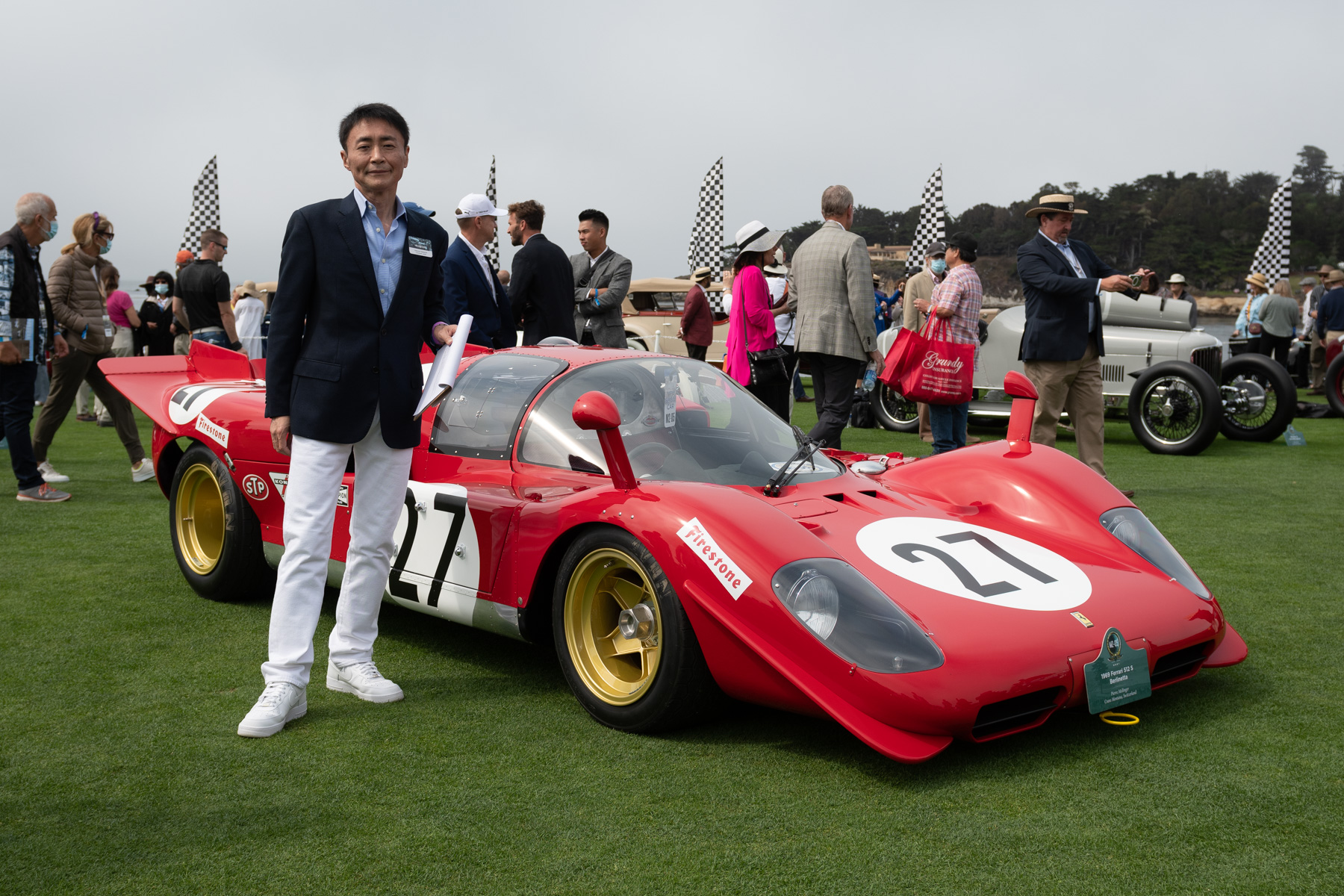
Far from just being another award on the winner’s mantle and another rosette on the car’s windscreen, this prize grants a rather different opportunity: the chance for the winning vehicle to be scanned and digitized for inclusion in a Gran Turismo game. This not only preserves the car for all time, in a form, but gives the average enthusiast the chance to experience it virtually in the comfort of their own home.
That’s precisely what has happened over the past two decades, with the game that made its name as a celebration of modern Japanese car culture (okay, there were a dozen US and British cars too) now becoming an interactive museum for vintage and historic motoring as well.

The first car to take the award back in 2008 was the prototype Lamborghini Miura P400, the oldest Miura still in existence, appearing in digital form in Gran Turismo 5 in 2010. That was followed by the Alfa Romeo Giulia TZ2 in 2009, the BAT1 Abarth 1500 concept in 2010, and Virgil Exner’s Plymouth XNR Ghia Roadster in 2011. The original Bertone Runabout won in 2022, and the new Bertone is basing the brand’s revival on a modern interpretation of it.
Bringing a classic car into a game is no simple task, however. While modern cars have CAD data that many developers rely on to create digital models, a historic car must be manually scanned. That’s a convoluted and time-intensive process involving hand-held laser scanning equipment and thousands of photographs to capture not authentic body shapes, but the different textures and colors of the components too.
View this post on Instagram
That does mean that not every owner is on board with the idea, though, and of the 17 winners of the Trophy so far, only eight have appeared in the games. All are available in Gran Turismo 7, allowing players with a PS4 or PS5 the chance to not only look at but drive on any one of the game’s tracks.

Whether the driving itself is entirely authentic is a different question, as a lot of the cars that cannot be driven hard in the real world (or at all, as with some of the virtual concept cars) are approximated to how they should drive and tweaked to suit. Given that the XNR is unlikely to be taken to 130mph around Suzuka in the real world, the simulation is at least good enough.

When coupled with the PlayStation’s virtual reality technology – PSVR2 – the whole experience is elevated, as it places you right into the car as if you were the driver and able to look around. I’ve shot a few comparisons with a helmet cam in modern machinery vs PSVR2, and it really is remarkable stuff, only short of being able to reach out and touch the buttons and switches.
Few of us could say how the 1929 Mercedes-Benz S Barker Tourer, which won the GT Award in 2017 as well as Best in Show and appears in GT7, feels in real life, but it’d be a surprise if the virtual version doesn’t get really, really close. Allied to a 6DOF (six degrees of freedom) motion rig, it’d probably be uncanny.
This notion of preserving historic vehicles and democratizing them via video games is by no means exclusive to this trophy or to Gran Turismo alone.

GT features other historic vehicles from brand museums – notably the Mercedes-Benz W196R – and previous GT games have brought the Ford Model T and even the Benz Patent Motorwagen and Daimler Motor Carriage. If you want to take to the wheel of a Bugatti Type 35, Forza Motorsport has you covered. And that’s to say nothing of game “mods,” where individuals (or groups) create their own cars compatible with titles like Assetto Corsa, sometimes at the behest of the owners.
It’s not just a case of plucking cars from the past either, but sometimes preservation for the future. When Mazda’s Furai concept was burned to ashes during a Top Gear test in 2008, players could continue to drive it in Gran Turismo 4. More recently, the Turn 10 Studios team behind Forza Motorsport recreated the car from CAD data for its 2023 title, bringing it right into the 4K era.

The reverse could also be true: an accurate enough digital recreation could help with the restoration of the original in case of disaster. A similar fate to the Furai’s befell a unique Ford Probe I Ghia concept after the Concours d’Elegance in 2024. Had it been subject to scanning for a video game, its chances of revival would increase, but it wasn’t, and it appears that it will remain lost.
This Sunday, Kazunori Yamauchi will choose the 2026 Gran Turismo Trophy winner, and we hope the owner of the winning car will allow it to be included in an upcoming edition of the game. By scanning, digitizing, and simulating these vehicles, racing games ensure that classic cars remain living, functioning things, and – more importantly – interactive for generations to come.
Top graphic images: GranTurismo.com; Sony


The fun thing about Gran Turismo 7 is that these cars are JUST as unobtainable in game as they are real life! The realism really immerses itself! (into your wallet!)
Seriously unless GT7 is your part-time job, or you’re donating the salary from your part-time job to Polyphony, you will likely never own these cars in the game. Their so high on their own farts that the obsession to realism has made its way into the earn rates and prices. A $20,000,000 Ferrari in GT7 is only mildly less absurd to afford than in real life.
The greed in both instances is palpable!
The 2026 winner is the Ferrari 250 GT/250 GTO missing link, the 250 GT Sperimentale, owned by the same guy (Bruce McCaw) who owns the 2017-winning Mercedes-Benz S Barker Tourer liberally used in my images here. A promising sign.
I wonder what would compel someone to refuse to allow the car to be scanned? I feel like if they refuse then the runner up should be given the opportunity.
snobbery.
I’ve had a few cars scanned, and it’s a remarkably quick process these days.
The thing I’ve always found a massive time suck is doing anything constructive with the point cloud data afterwards. Recreating an intake system or something in 3D still required modelling it from scratch, with knowledge of how it was made in the first place.
I designed a one-off car around a particular driver’s scanned body data once. That was fun. No one even slightly bigger than him could fit.
In certain cars, that can really happen.
The first time I tried out the seat in a formula car, I was horrified by the restriction.
You’ve probably heard this one before.
Unlimited classes reached the point of seats built around the specific driver.
One driver (not his real name) kept complaining the seat was wrong, decided it was being tampered with.
He began signing the seat, and sealing it end of day.
He went crazy when it was off again the next time.
When the dust settled, they figured out he was feeling his own body mass shifts from morning to evening!
So im all for video game scanning. I used to be a diehard iracer until I wanted to touch grass again. Im happy that a car can get scanned, but we still have the HVA that scans a lot of important cars. I know the Bullit Mustang, Back to the Future Hero Delorean, etc were scanned in Pennsylvania.
I mean rumor is Assassins Creed will help provide data to Notre Dame after the fire.
When they put the final piece in, there’ll be a random 360 drone shot and a mysterious “SYNCED” message floating in the air.
I hadn’t heard of the Mazda Furai fire so I had to look it up :
https://www.topgear.com/car-news/concept/exclusive-how-mazda-furai-burned-death
Thanks for sharing, sad though that fate be.
Gran Turismo is nice, but it’s no Grand Theft Auto 😛
No really tho, that’s cool
Since robbers started live streaming crime sprees, not sure where reality stops leaking.
And now Flock will scan your vehicle for free…
I wonder if there’ll be a point in the not too distant future where all cars are routinely 3D scanned – it could provide an interesting dataset for consumers (e.g. to track quality control and construction quality across a specific model) and also provide some feedback on how a single car changes over time (maybe even helping detect fatigue in structural elements?)
Obviously it’s cost prohibitive today, but who knows, maybe it could just become part of the routine ‘multi-point inspection’ when you get your car serviced?
It’s got to be less hassle to 3D scan the wheels for an alignment than it is strapping laser targets to them.
I’m willing to bet car manufactures would be willing to 3d scan new models if they knew they could make a profit off it. It’s not like they’re giving away secrets, once a car is launched, their competitors will have full access anyways.
That’s really cool. I really hope more owners take advantage of this.
The Furai is one of my favorite cars of all time, but I don’t understand why or how it ever existed. It’s one thing to make a cool concept car, and even better if it can move under it’s own power, but to engineer the hell out of a one-off never to be used again chassis so it can be competitive on track using an engine never meant to go into production just for the hell of it makes no sense. I’m so glad they did that and they’re one of my favorite manufacturers for doing stuff a bit out of left field.
Marketing budgets have to be used for something
I believe part of the reason the Furai performed so well was it was actually based on a leftover 767/787 Le Man’s chassis, which makes me wonder if Mazda were considering another tilt at Le Man’s with it at one point….
The Furai was based on a Courage C65 chassis that Mazda used for the American Le Man Series from 2005 to I think around 2007. It used a three rotor engine and this was around the time the RX-8 was still a new model so it was timed to market motorsports alongside the RX-8.