

The motorhome buyers of today are discovering that it’s possible to get much of the big coach experience without having to learn how to drive a truck or a bus. The Class B+ motorhome is bigger than a regular camper van, but smaller than a Class C motorhome, sitting in a spot between maneuverability and space. Six decades ago, one van build helped popularize the whole idea around the world. This is the Bluebird Highwayman, the motorhome that made motorized RVs accessible across the world thanks to its rock-bottom price. It came to America as the Sunbeam Funwagon, and despite its cute looks and massive international success, there’s a chance you didn’t even know it exists.
Every now and then, RV manufacturers and distributors try to give America a taste of that European forbidden fruit. While many American RV companies like building large and heavy units adorned with loads of firepower, European brands often try to do the most with a small footprint. The best example of that right now is Wingamm’s American lineup of motorhomes. Each Wingamm Oasi is diminutive compared to a typical American coach. Yet, as I’ve experienced, they manage to fit everything you need for a getaway on the road into that small space without that space feeling small.


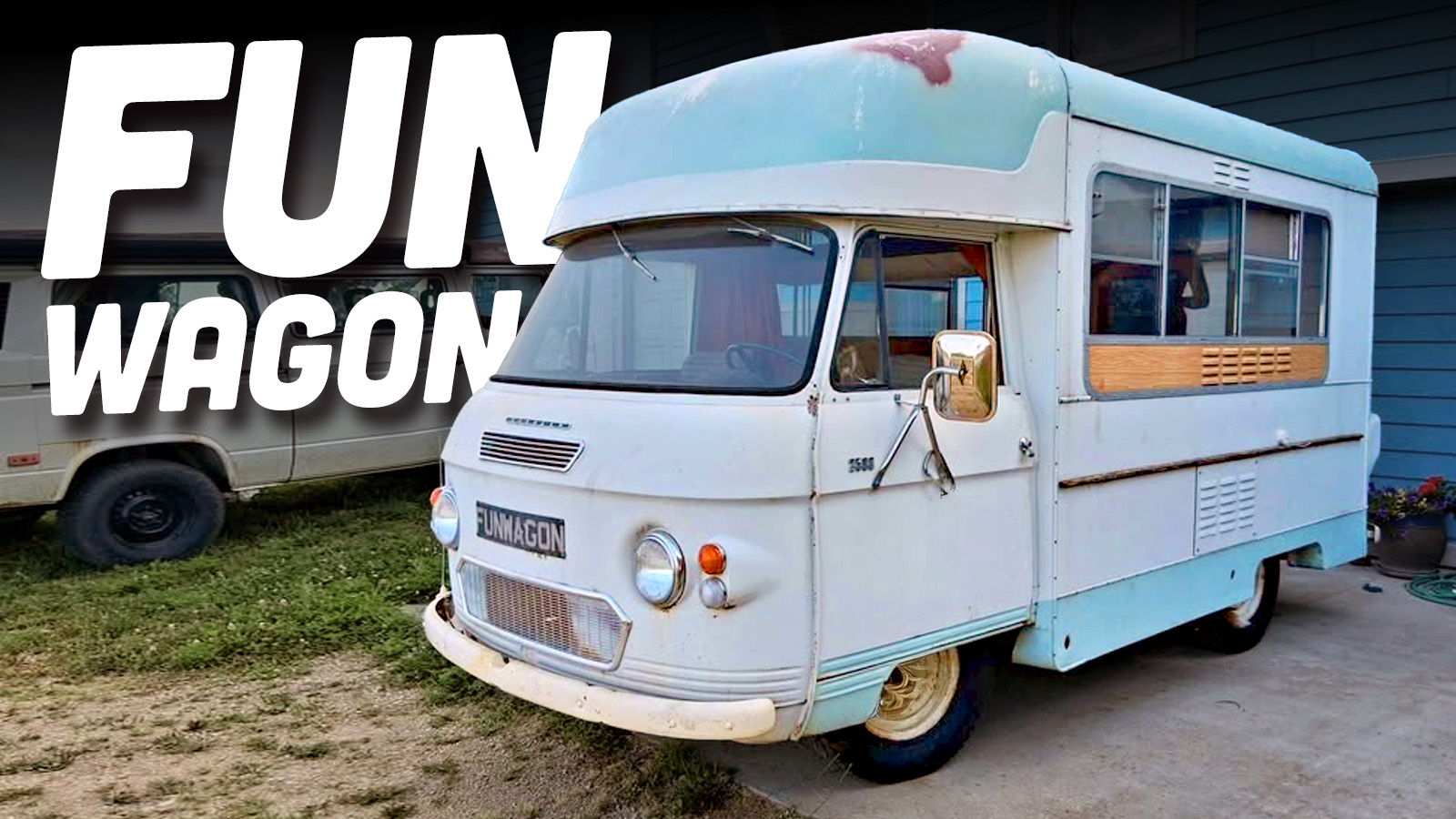
This 1967 Sunbeam Funwagon is what affordable European RVing looked like back in the 1960s. When the Bluebird Highwayman launched in 1958, it had an impossibly low price of just £870, which would be £18,253 or $24,653 in 2026. That made it the cheapest motorized thing on the road that you could sleep in. America got a taste of the action, too, with the Sunbeam name, but there might be a reason why you haven’t heard of it.

Euro Camping
As the book Motorhomes: The Illustrated History by Andrew Jenkinson writes, the English caravan (what the British call a camper) industry cratered in the aftermath of World War II. Materials were in short supply, and builders were simply unable to churn out the high numbers of units necessary to bring costs down. As a result, the UK’s RV market almost vanished. Those who stuck around, the book notes, were building pre-war designs.
Winds of change came in the early 1950s as speed limits increased, house cars would become classed as private vehicles, and new generations of sturdy, pressed-steel cargo vans were being churned out of factories. These vans were appealing because they were not much larger than a family sedan, but had a lot more room. As a bonus, these vans usually shared many of their mechanical components with those sedans, making them cheap to manufacture and straightforward to repair.

In 1951, manufacturers like Self-Drive Hire and others began turning these vans into motorhomes in the early 1950s. However, these camper vans were built slowly, one at a time. Mass-produced motorhomes proved elusive. The Volkswagen Microbus was an important step forward in this regard, as it proved to be a popular platform to build a camper from, and Volkswagen itself supported such activity. Names that we think of as icons today, like Westfalia, cut their teeth turning Volkswagen Type 2s into campers. Westfalia’s Volkswagen “Camping Box” made its debut in 1951.
While many British manufacturers loved the Volkswagen as a platform, it had some drawbacks. A Volkswagen was more expensive than a British van, and Volkswagen didn’t give a coachbuilder its blessing unless the builder could prove that its conversions were to Volkswagen’s standards. But for many, the hoops were worth it because the Microbus had good road manners, was a known good platform, and was on its way to becoming a famous vehicle in its own right.

Still, the UK would produce some homegrown favorites, too. While it would not rise to the same level of global popularity as Westfalia, for many in the UK, the name Dormobile would become synonymous with “camper van” since 1952. I’ve written about Dormobile’s delightfully dorky vans before, which you can read about by clicking here.
All sorts of camper vans would be built out of Austin, Bedford, Commer, Ford, and other vans. Meanwhile, many brands took to innovating, with some finding neat ways to add headroom and sleeping berths, and some brands finding out that building motorhomes out of cab chassis made for more room inside.
Then there was Bluebird Caravans Ltd. of Parkstone, Poole, in Dorset, and its mark was creating a van that was cranked out at a shockingly fast pace for a price that everyone could enjoy.
The ‘Ford Of Caravans’
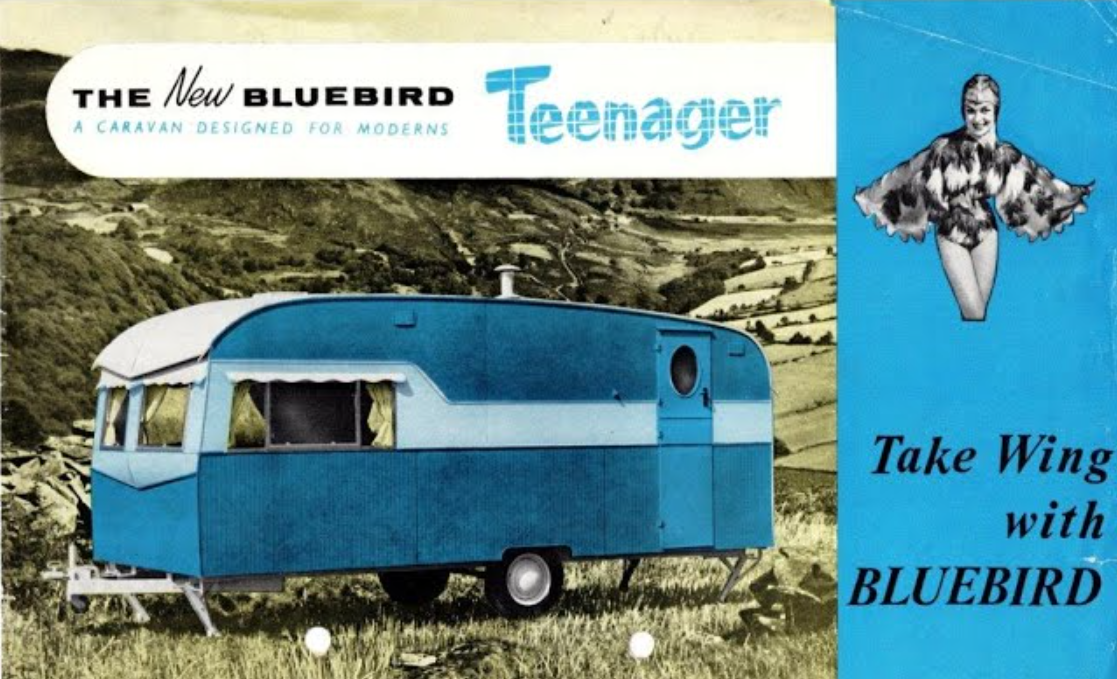
William “Bill” Knott was fascinated with caravans at a young age. He was only a teenager when he built camper trailers out of a shed in his garden in the 1920s. Amazingly, at least one of those campers has survived to the modern day. Early on, he ran the Midland Caravan company, and by 1940, he was running a private company called Bluebird Caravans. By the 1950s, Bluebird Caravans had become the UK’s leading manufacturer of mobile homes and travel trailers.
As this video from 1959 and published by British Pathé says (click here if you do not see the embed), Bluebird was pumping out 350 trailers a week, of which about 75 percent of them were mobile homes.
Bill likened himself to being the “Ford of Caravans” and company advertisements proudly proclaimed that Bluebird wasn’t just the best-selling trailer manufacturer in the UK, but in the entire world. As the video above shows, Bill also liked the finer things in life. He had a lineup of luxury cars parked at the Bluebird factory and blew off steam by golfing on the course that he also owned.
This whole empire was built from the ground up, reportedly, as Bill’s first Bluebird caravan was built from scrap materials. Ironically, in the 1950s, Bluebird’s caravans reportedly had the sort of reputation that campers from Indiana have today, in that the company built tons of caravans, but quality wasn’t always there.
Just as Bluebird turned mobile homes and caravans into everyday objects, Bill also saw a wide-open market for a truly mass-produced motorhome. From Classic & Vintage Commercials magazine:
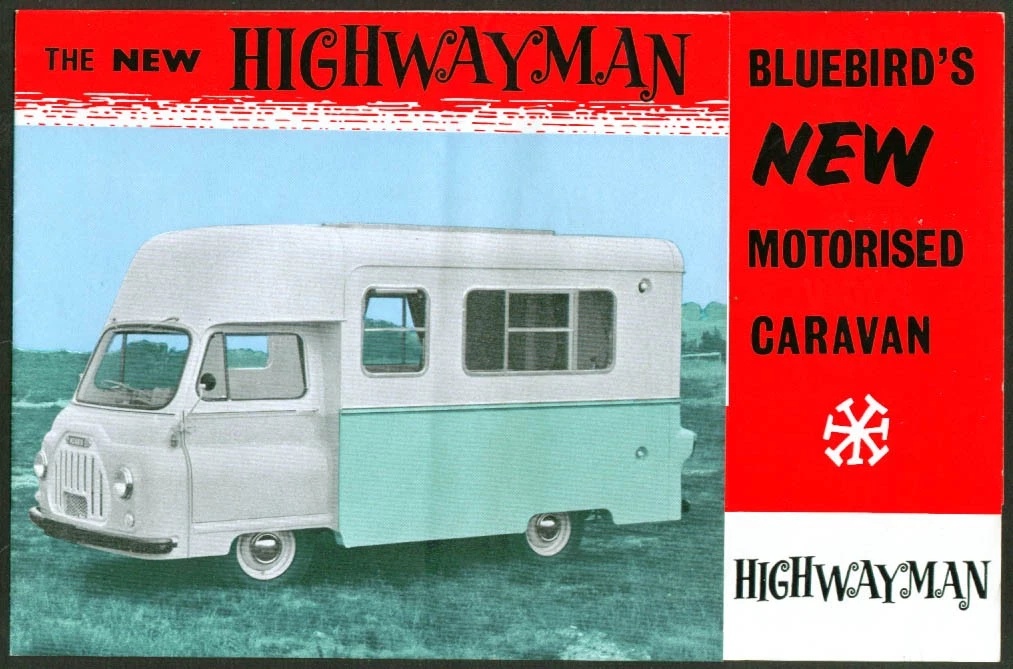
Bill recognised the potential market for motor caravans and decided to launch a mass-produced coach-built vehicle in 1958 that he named the Bluebird Highwayman. These were initially built only on the Morris J2/Austin 152 chassis and at £870 were at the time the cheapest coach-built motorhome available. For that, however, you didn’t get quite the same high quality of fittings as you did with the Paralanian coach-built BMC J2 motorhomes, which had been launched in 1957 by Central Garage Ltd of Bradford. Early Paralanians looked quite similar to the Highwayman at first glance. From 1960, the Highwayman was built on the Commer FC1500 (later PA and PB) chassis, which became a best-seller.
The sales blurb extolled the virtues of the J2/152 Highwayman being ‘as manoeuvrable as an ordinary medium sized car (and occupies no more space)’. It went on to claim, perhaps with a smidgeon of hyperbole, that it ‘has a high safe cruising speed (ideal even for continental touring). This is your own luxury hotel, to go with you wherever you go – on business or pleasure’. ‘And look at the accommodation! A double bed and two single bunks. Kitchen unit, including hotplate. Room to dine and wine’.
The interior is actually a comfortable place to be. The single rear door allowed for a full-height wardrobe and a toilet compartment fitted with a chemical loo. There was an 11-gallon water tank and 12V electrics. The boxy but practical rear body design was given some relief with a curving swage line and two-tone colour schemes. The Highwayman was sold in London through Crofton Garages, run by Peter Duff, who had a showroom on the Kings Road in Chelsea, putting it out there among swinging sixties Londoners.

As Motorhomes: The Illustrated History notes, paying that low price did mean that your Highwayman came with some quirks. During one road test, for example, a journalist reported that the cupboard handles fell off, among other teething issues. So, no worse than my family’s modern American campers, really.
That didn’t stop the Highwayman from becoming a smashing success. By the 1960s, Bluebird Caravans claimed it had control of 65 percent of the entire camper van market. In 1963, Bluebird Caravans merged with Alperson Products, becoming Caravans International. Two years later, Caravans International landed in America for the Californian Sportsman’s Show, where it put the Commer-based Highwayman on display.
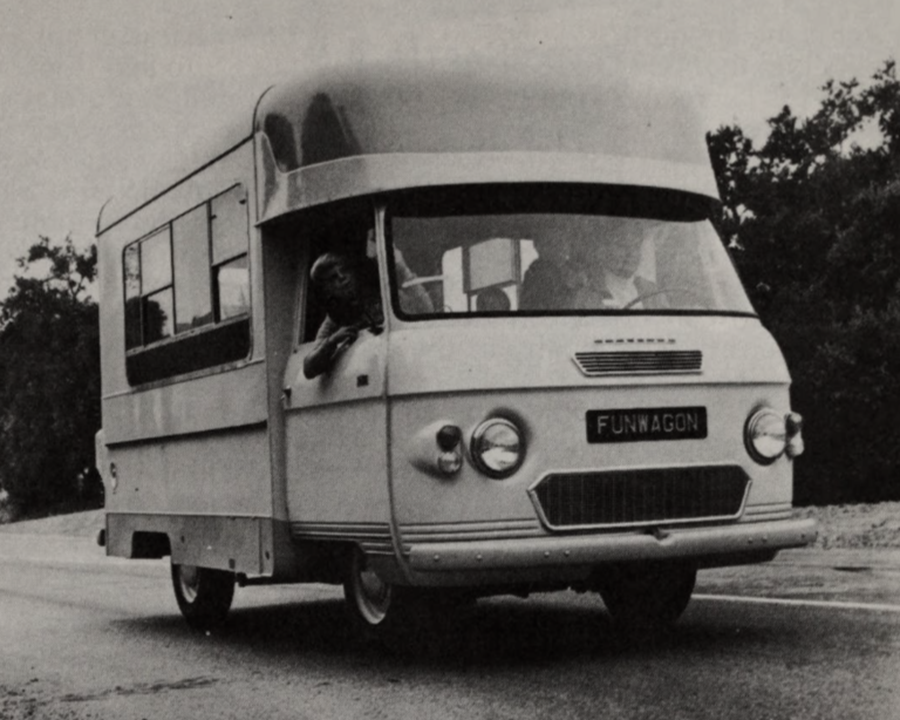
Apparently, the public response was great enough that Caravans International struck a deal with Mobile Recreation, Inc. to provide 2,800 Highwayman vans to America. The vans we got here in America were Commers, but were sold as Sunbeams. They weren’t called Highwayman anymore, either, and instead became the Funwagon. I could not find a reason behind the name change, but it could be that Sunbeam was better known in America than Commer thanks to the Sunbeam Alpine.
Along the way, this 1967 Sunbeam Funwagon was built, and it’s a rare piece of motorhome history.
Five Cars In One, Technically

The Sunbeam Funwagon has some features in common with a Class B+ motorhome of today. It rides on a commercial van chassis, has large side windows, and is built to be compact. At only 15.5 feet long, it’s shorter than every new camper van on sale today. Also weird is the wheelbase, which is only 90 inches long, or about a foot shorter than the motorhome is tall.
The Funwagon is based on a Commer FC/PB 2500 forward control van. Power comes from the 1725cc four from the Sunbeam Alpine, which was good for 93 HP and 102 lb-ft of torque, which drives the rear wheels through a four-speed manual or a three-speed automatic from Borg-Warner. Commer 2500s were sold as pickup trucks, cargo vans, minibuses, mobile storefronts, ambulances, milk floats, gown delivery vans, and, of course, camper vans. It was designed under Rootes Group, which gradually fell under Chrysler control in the mid-1960s.

The biggest advertised feature of the 2500 was its one ton of payload capacity.
The Funwagon departs from today’s norms pretty quickly. That body? It’s made out of wood framing and is draped with aluminum external panels. The brown spots you see in images are not rust, but primer showing through. Of course, riding on the forward control chassis also means that this van has a tiny wheelbase unlike most camper vans of today.

That weirdness continues inside. You probably won’t be blown away at first. Indeed, this van has some seating and a long, central aisle, just like today’s camper vans. It even has a modest six feet, two inches of standing room. But then you read the brochure. Dealerships boasted about how this van is supposed to seat nine adults for journeys and sleep six during camping. Supposedly, you were supposed to use it as the family sedan, the family station wagon, the baseball team’s bus, the Cub Scout den, or as your work truck. A brochure even went so far as to claim that it was five cars in one.
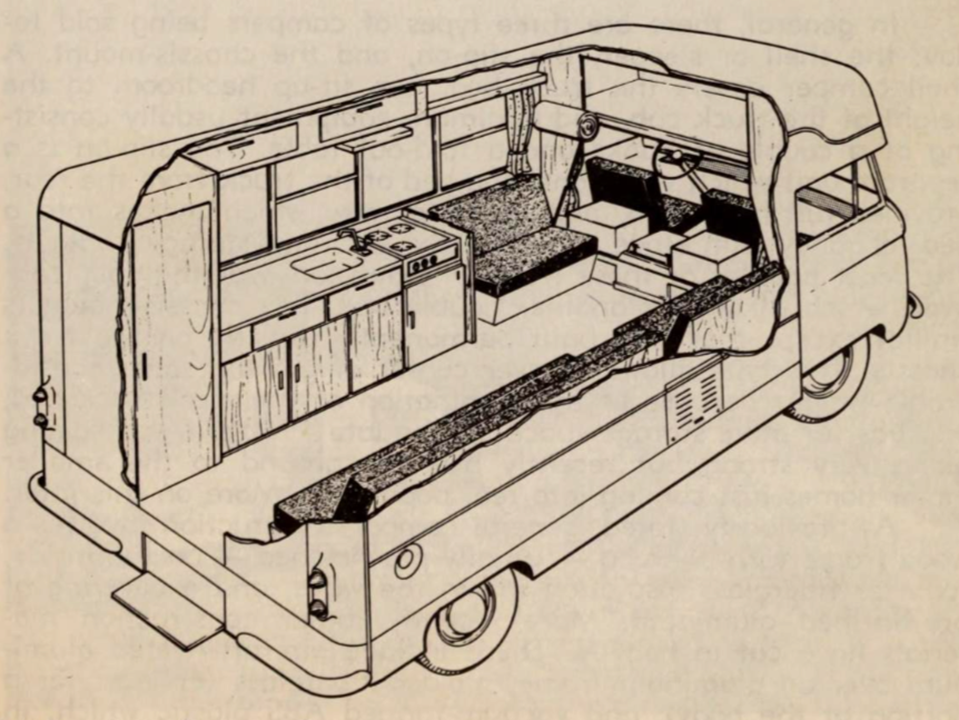
While this Funwagon now has a slightly different interior from stock, the layout is the same. The distributor for the Funwagon in America expected you to plop seven people down onto one long bench that ran most of the length of the interior, and two more small benches right behind the front seats.
The features list was pretty neat. Standard Funwagon features included safety glass, transistorized lights, a foot-pump sink, varnished hardwood, a three-burner stove, a small icebox, and a toilet. Options included a refrigerator, an upgraded toilet, a bench seat in the cab, screened windows, and other odds and ends.

In standard trim, dealers said, you’d get the Sunbeam Funwagon for $4995. In case the van wasn’t cute enough for you to pony up the cash, dealers sweetened the deal by saying it was like getting five cars for the price of one, and pointed out that the Funwagon could get up to 25 mpg. That sounds pretty good until you realize that the Funwagon had just enough horsepower for a cruising speed no faster than 65 mph.
As for this example, it’s for sale in East Dubuque, Illinois, and the seller says this about it:
18k original miles. No rust.
Based on a Commer 2500 van from the UK.
Original 1725 inline 4-cylinder gas engine. 4-speed manual transmission.
New brake hoses, master cylinder, and all 6 wheel cylinders.
New tires last week.
Interior is in decent shape but needs some renovation.
Runs, drives, and stops, but needs tinkering. I will keep messing with it until it sells, but I have too much stuff! Would make a great food/ice cream truck.

Now, the seller says that there’s “no rust,” but the video he posted on the listing absolutely shows rust on the van’s cab floor and rockers. Maybe he’s using the David Tracy measure of “rust-free” where any vehicle that doesn’t actively have rust holes isn’t rusty.
Anyway, the interior is extremely basic, with a few beds, a countertop, cabinets that are missing drawers, and some overhead storage. It looks like someone gutted this Funwagon in the past and then did not finish their renovation. That’s to say that, in terms of amenities, this Funwagon is essentially just a rolling tent with hard walls right now. The seller wants $7,500 for it, and, given the rarity, that seems reasonable.

The Sunbeam Funwagon is considered rare, with potentially only a few thousand sold between roughly 1966 and 1968. Exact start and end dates for sales have proven difficult to find, but it appears the bulk of units were from the 1967 model year. The Funwagon didn’t seem to catch on in America as its Highwayman sibling did elsewhere.
As for why it failed, one explanation is simple. Like other British cars that were here, like the Mini, the Commer van did not meet Federal Motor Vehicle Safety Standards or emissions standards for 1968. It was easier to pull out of the market than to modify the design to comply with regulations. Rootes Group vehicles ceased importation into the United States as well.

The other problem, I think, was its price. When the Highwayman launched in 1958, it was the absolute cheapest motorhome on the market. By the time it came to America as the Funwagon, it was about the same price as a much larger Winnebago F-19. As noted earlier, it wasn’t like you got a better quality RV out of the deal, either. So, you paid the same money as a Winnebago to get a smaller motorhome that rode on a platform that was soon to be orphaned in America.
The World Needs The Highwayman

But none of that really matters today. Nowadays, this van isn’t competing with any RV company or anyone else. It’s a survivor from a different era; a time capsule. Honestly, I think I’d be more excited to see a Funwagon at a vintage RV rally than a Winnebago. These were rare when new, and who knows how many have made it six decades to reach the present day?
So, I wouldn’t really buy this as a sort of practical motorhome. Instead, I see it as a really cool classic car that you can sleep in. Drive it to car shows, take it to state parks. When you get tired, kick back and relax. Even though this motorhome’s sibling might have been a best-seller, the Funwagon wasn’t. Chances are, you’ll be the only one at the show with this thing.
I’d love to see something like the Highwayman again. Some company out there should make a motorhome that everyone can afford. Forget $200,000 or even $100,000; let’s get a motorhome so crazy cheap that even people who like hotels might want to buy one. It’s time for another Highwayman.
Top graphic image: Facebook listing


built on the Commer FC150 chassis
And if you crashed one and put it on its roof, it would be an inverted Commer…
(it’s what we Brits call speech marks)
Questions:
When I approach one of these, what should I expect? Soft serve ice cream or chips?
How many times a day will it drive past my house?
What prerecorded calliope music is on the loudspeaker?
How does this compare, say, to an old stepvan with a grinder to sharpen knives? Which I can also afford.