

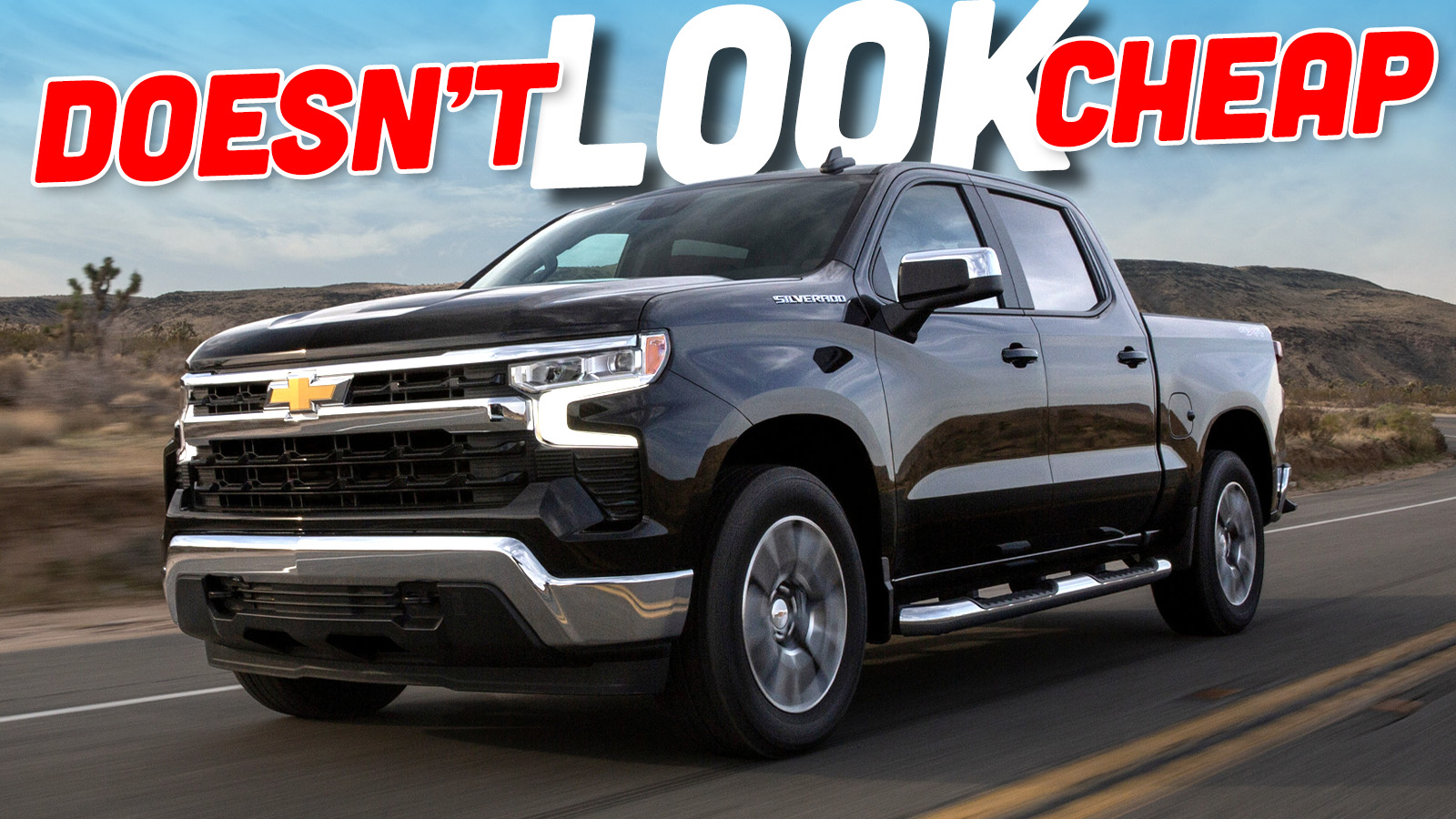
The American diesel pickup truck is an impressive workhorse. These trucks tow tens of thousands of pounds while returning respectable fuel economy and coddling their drivers in loads of luxury. But diesel trucks also tend to be heavy-duty pickup trucks that can very easily cost you over $100,000. All of America’s Big Three will sell you one of those massive heavy-duty diesel pickups, but only one automaker group will still sell you a half-ton truck with a diesel. This is the 2026 Chevrolet Silverado 1500 Duramax diesel, and you can get it for not much more than the average transaction price of a new car.
There was once a time when you were able to buy a diesel truck in America without committing to a three-quarter-ton or larger rig. From 2014 to 2023, Ram was willing to sell you a 1500 with a 3.0-liter EcoDiesel V6. Yes, that diesel engine was an infamous unit, but the option was still there. Even the Jeep Gladiator was available with that engine!


The folks at the Blue Oval had their own half-ton diesel, too. From 2018 to 2021, you were able to roll out of a Ford showroom in an F-150 with a 3.0-liter Power Stroke V6 diesel. Amazingly, even the Chevrolet Colorado and the GMC Canyon had an available 2.8-liter Duramax four-cylinder from 2018 to 2022. So did the Nissan Titan, which had a 5.0-liter Cummins V8 from 2016 to 2019.

There’s some appeal in getting a diesel in a truck that isn’t as large as a house. Modern diesel engines are known for their mountains of torque, which is great for towing and hauling. These regular diesel trucks are also known for getting pretty good fuel economy for trucks, which means great highway range. The caveat is that emissions equipment failures, fluctuating diesel prices, and diesel engine maintenance can erode away fuel economy benefits.
Sadly, if you’re a devotee of diesel and don’t want an extra-large pickup truck, your pickings are slim. Nearly every single brand has canceled their smaller diesel vehicles. That is, except for General Motors. For now, only Chevrolet and GMC sell the only half-ton diesel pickup trucks in America, and they also happen to be America’s cheapest ports of entry into diesel trucks. I was just handed the keys to a 2026 Chevrolet Silverado RST Duramax, and I cannot wait to tow a big camper with it.

This press loan has been over a year in the making. You might remember me writing about the GM half-ton diesels in February 2025. It’s seriously taken me that long to score a loaner! Granted, I usually test diesel trucks once or twice a year when I have trailers to tow, so it’s not like I was knocking on GM’s doors much. Still, each time I asked, a diesel wasn’t in the Chicago press fleet, so you can only imagine how stoked I am now.
If you want to read about the history of GM diesel, click here to read my previous story. Otherwise, I want to get to why these half-ton trucks are special in today’s world.
The Babymax

Diesel passenger vehicles were last popular in America during the 2010s. At that time, it seemed that Volkswagen had cracked the code to making desirable diesels. A Volkswagen TDI was powerful, amazingly economical, and some models didn’t even require owners to use any diesel exhaust fluid. Volkswagen pretty much normalized the modern diesel, and was selling so many of them that other automakers want a piece of the pie. Then, of course, we learned that Volkswagen cheated. In short order, the reputation of diesel was tarnished once again, just like it was in the aftermath of the infamous Oldsmobile diesel V8 of the late 1970s.
You’d think that no automaker would be crazy enough to deal in diesel again after Dieselgate, but a flurry of automakers attempted to fill the void left by Volkswagen. General Motors wanted to use Dieselgate as an opportunity to become the king of diesel, just like it was in the late 1970s. In addition to the Chevy Cruze, the GMC Terrain, and the Chevy Equinox, GM also wanted to put diesel power into the Chevy Colorado, the Chevy Express, the Silverado 1500, the Chevy Tahoe, the Chevy Suburban, and its luxury SUVs. Until 2025, you were able to buy a Cadillac Escalade 600D, which had a buttery-smooth diesel under its hood.

Core to this strategy was the aluminum 3.0-liter LM2 Duramax straight-six, which was designed by the General Motors Global Propulsion Systems Torino group in Italy. This engine is based on a scalable architecture that allowed GM to build compact diesels as small as 1.5-liter triples. Here’s what I wrote regarding its design:
Engineer John Barta started at the back of the engine where the timing system resides. It starts with the crankshaft. A chain connects the crank to the high-pressure fuel pump. From there, another chain coming off of the fuel pump leads to the camshafts. Also connected to the crank and moving down is a wet belt that drives the oil pump. A wet belt is exactly as you picture it. Wet belts are basically timing belts that are constantly drenched in engine oil.
Barta mentions that the oil pump in these engines have a variable displacement, so the pump puts out only the exact amount of oil that’s needed when it’s needed. This prevents waste and according to Barta, is more efficient. The use of a wet belt also aids efficiency. A story by our Zoe elaborates: The wet timing belt promised multiple benefits over a traditional dry timing belt. Lubrication from the engine oil was supposed to reduce wear and noise. More importantly, though, it reduced friction, which would provide an efficiency benefit, with fuel savings of around 1%.
Enthusiasts hate wet belts. Not only does using a wet belt mean that the belt that runs the oil pump is now a maintenance item, but if one of these belts fails, it can clog up the engine’s oil pickup and passages with rubber chunks, potentially killing your engine if you don’t notice it in time. Thankfully, GM says that the wet belt in the 3.0 Duramax should be replaced every 150,000 miles. That said, replacing the oil pump wet belt does require dropping the transmission, so it’s not the most DIY-friendly procedure.

Also notable is fueling. The engine drinks fuel from a twin-piston pump feeding Denso G3.5S injectors, and maximum injection pressure is 36,500 PSI.
While Stellantis and Ford went with V6 diesel designs, General Motors went with a straight-six. Why? GM says sixes are smoother and there isn’t as much friction since they didn’t have to run two banks of three cylinders. Apparently, GM was so obsessed with making diesels that feel like gas engines that the “Babymax” gets joined to centrifugal pendulum absorber torque converters for extra smoothness. [Ed note: fascinating centrifugal pendulum absorber video here – Pete]
The Duramax LM2 has a 15:1 compression ratio, which is said to help the engine lower emissions. Attached to the engine is also a variable geometry turbo with an electronic actuator. At launch, the boost cranked up to 29 psi and helped the engine hit 277 HP and 460 lb-ft of torque. Nowadays, the straight-six mill pumps out 305 HP and 495 lb-ft of torque. That comes thanks to new injectors, a new combustion bowl, and new tuning. The upgraded half-ton Duramax is now called the LZ0.

The engine’s pretty quick, too, and can move a Silverado to 60 mph in under 7 seconds. That’s great for a diesel! I accidentally lit up the rear tires during my test drive. Also neat is the fuel economy. The EPA rates the Babymax at 23 mpg city, 28 mpg highway, and 25 mpg combined. Some owners report getting over 30 mpg when they aren’t pushing the truck hard. Others report getting in the mid- to high-20s.
I do need to note that, while these trucks are diesels, it doesn’t mean greater towing capacity. Here’s what I wrote last year:
Trucks with the 3.0-liter Duramax were initially limited to 9,300 pounds for towing capacity, a far cry from the 13,400 pounds offered by the 6.2-liter V8 option. Both engines commanded a $2,495 upcharge over a 5.3-liter V8 and it seemed like the 6.2-liter mill was a better deal.
Thankfully, GM rectified this problem as of 2022. The Babymax diesels now tow up to 13,300 pounds thanks to an optional beefier rear differential and an optional heavier-duty suspension package. That’s still 100 pounds short of a properly equipped truck with a 6.2-liter V8, but at least it shouldn’t feel like going diesel nets you a penalty.
America’s Cheapest Diesel
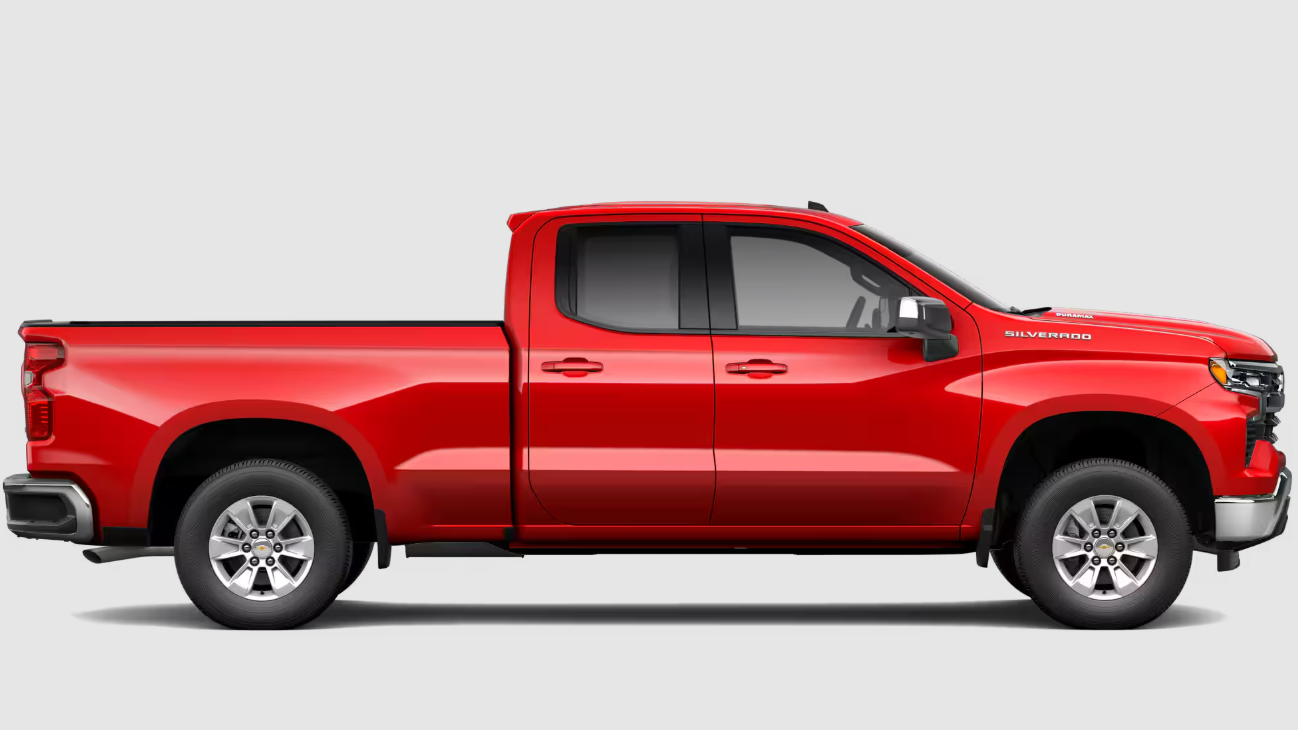
Of course, you’re probably here for the dollar amount, so let’s talk about it! Chevy still doesn’t really advertise the diesel, so you have to play around in the configurator to determine prices. In 2025, the cheapest Babymax was a 2025 Chevrolet Silverado LT with a double cab, a standard bed, and two-wheel drive. This truck was valued at $48,100, and the diesel engine moved that up to $51,145. Add in the $1,999 destination charge on top of that, and you get $53,144.
This year’s cheapest half-ton Duramax is a 2026 Chevrolet Silverado LT with a double cab, a standard bed, and two-wheel-drive. Starting price is $47,900, or technically slightly cheaper than last year. The diesel is a 2,390 upcharge, and as part of the diesel, there is a required upgrade from bench seats to bucket seats for $655. That adds up to $50,945, or still technically cheaper than last year. But then you get hit by the $2,795 destination fee, and you land at $53,740. All things considered, that’s not the worst price hike! You get a pretty spiffy-looking truck, too.
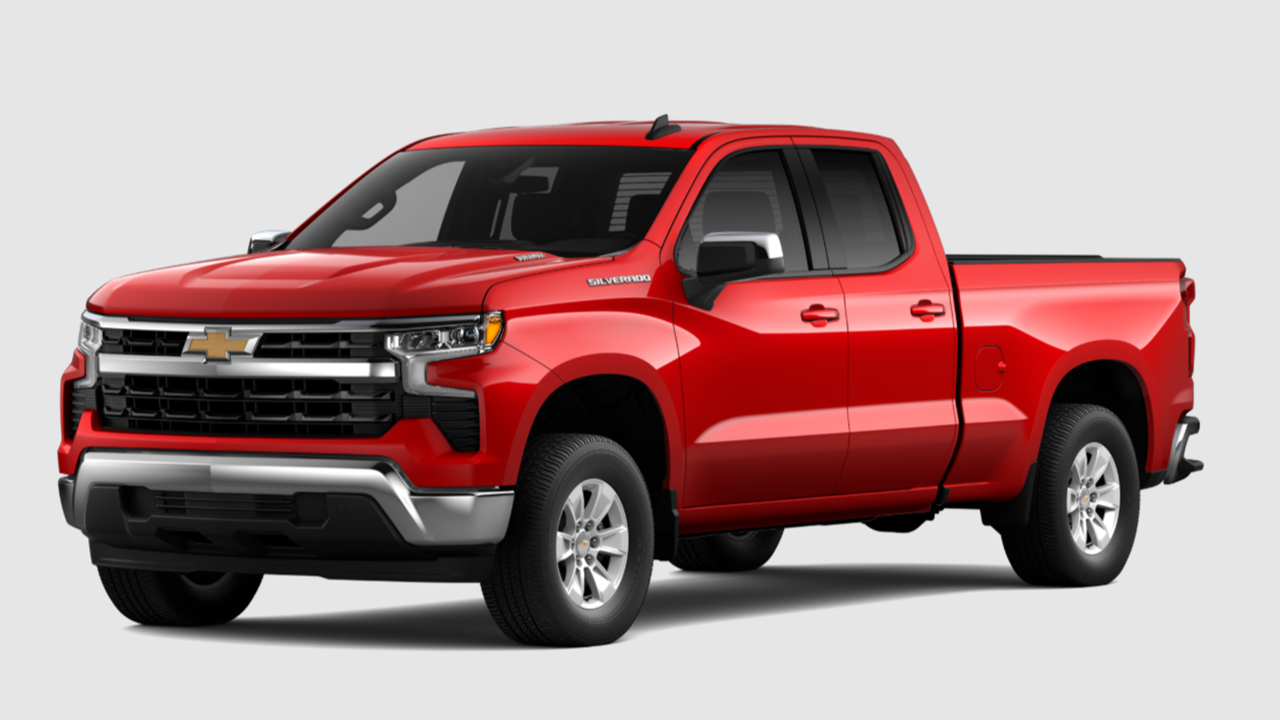
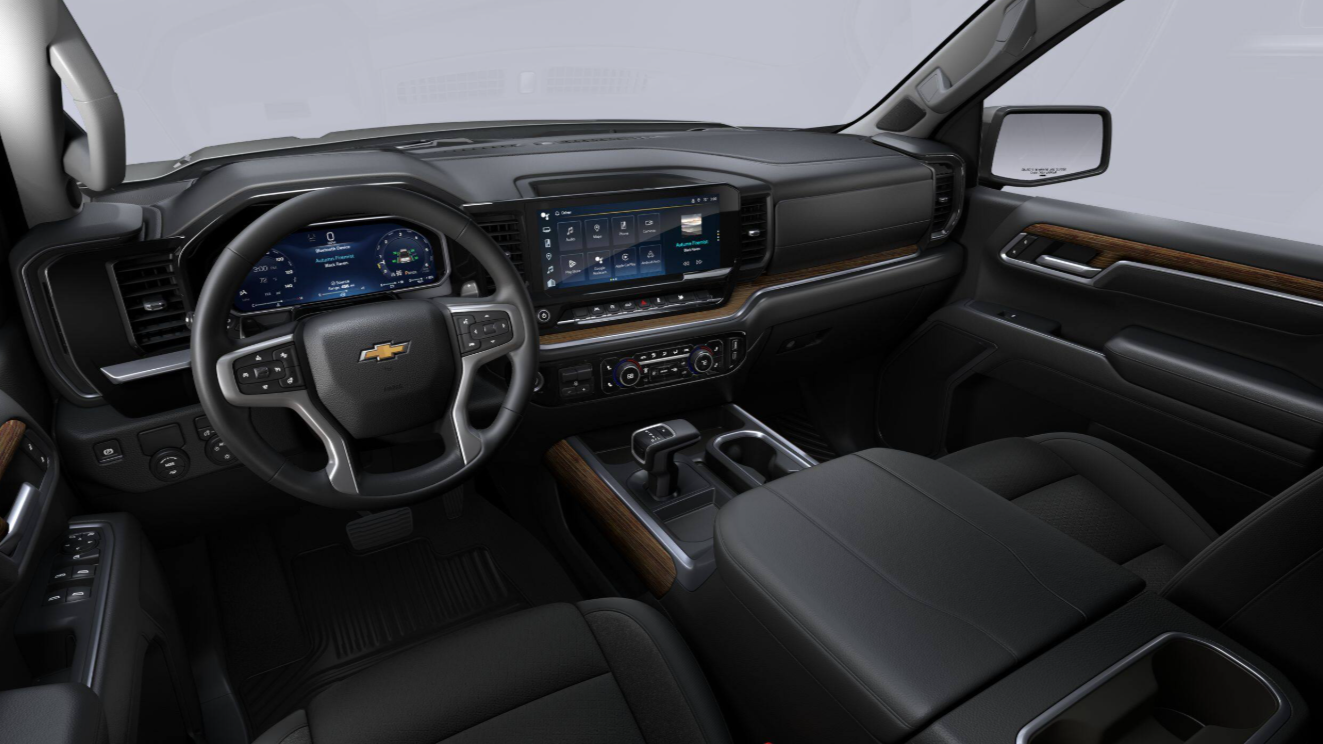
The features list isn’t too bad, either. Here’s what Chevy says you get in a base LT with a diesel:
3.0L Duramax Turbo Diesel engine.
10-speed automatic transmission with Electronic Precision shift and front bucket seats.
17″ Bright Silver painted aluminum wheels.
17″ 255/70R17 all-season, blackwall tires.
Jet Black, Cloth seat trim.
13.4″ diagonal Chevrolet Infotainment 3 Premium System with Google built-in.
12.3″ diagonal reconfigurable Driver Information Center.
Wireless Charging.
USB ports.
Engine block heater.
Electronic Transmission Range Selector.
LED reflector headlamps and signature daytime running lamps.
You also get some classy simulated wood, heated seats, and dual-zone climate. Not bad at all!
How does this compare to heavy-duty pickups? The absolute cheapest Silverado 2500 HD I was able to make was a regular cab, long bed, and two-wheel-drive WT model. It starts at $45,900, and the addition of the 6.6-liter Duramax piles $9,990 onto the price. That’s $55,890 before the $2,795 destination fee, for a total of $58,685 and an extremely basic work truck out the other end.
Maybe a Ford F-250? Sure, that one starts at $45,975 for a regular cab, long bed, and two-wheel-drive XL model. Slapping the big boy 6.7-liter High Output Power Stroke onto it (the only diesel option this year) will set you back $13,495. Throw the $2,795 destination charge on the fire, and you’re at $58,265, or slightly cheaper than the stripped-out Chevy. Ford won’t even let you have a fun color without paying for it.
Fine, how about a Ram 2500? A Ram 2500 Tradesman starts at $46,855, and that gets you a regular cab, long bed, and two-wheel-drive. Ah, but the configurator won’t let you get that one with a diesel, so you have to step up to the same Tradesman but with 4×4 to get the cheapest Ram diesel. That starts at $49,785, and you’ll have to cough up $12,995 for the 6.7-liter Cummins. You’re at $62,780 before you pay the mandatory $2,795 destination charge.
Stay Tuned For My Review

Normally, here’s where I’d blockquote what other journalists said about their drives in the Silverado, but I won’t. Finally, I get to test it out for myself, and I get to do it in the way I do best. I have a 2026 Chevy Silverado RST crew cab diesel in my hands right now, and it’s going to be my rock for the duration of EAA AirVenture Oshkosh next week. It’s going to tow a long and heavy travel trailer, a quiet generator, and all of my gear. I love using trucks as trucks, and I’m genuinely excited to see what one of America’s only new half-ton diesels is like.
If you’re curious, this one is $63,435 after destination fee. I like that Chevy didn’t give me a top-spec model with all of the fixings like automakers usually love to give to the press, but an example of a truck that you can realistically expect people to order for themselves.

My very early first impression is that I get to hear the lovely clatter of a diesel, but in a truck that can easily fit into a parking space. I mean, it’s a modern truck, so yes, it’s still quite big. But it’s not a hulking lump of metal like heavy-duty pickups are. I also like how the diesel isn’t even that loud, and I can barely feel it running there, which is exactly as GM intended. We’ll see how my impressions change after putting the Silverado to work.
I like that GM is still offering this option long after its competitors have given up. I imagine the market for a half-ton diesel isn’t terribly large, and I would not be surprised if the Sierra 1500 and Silverado 1500 diesels fill the niche. After all, much of the world is focusing on electrification right now, not going back to diesels.
But if you, like me, still hold on to your oil burners for dear life, now you know your lowest price of entry. I don’t know if I’ve just gotten used to how expensive everything feels today, but $53,740 doesn’t seem so bad. It’s cheaper than that Airstream I just wrote about! Honestly, I’m just happy to drive a truck that doesn’t have a price knocking on the door of six figures. I suppose you’ll have to wait and see if I continue to like the idea of the Silverado 1500 Duramax after I’ve lived with it.
Top graphic image: Mercedes Streeter


I want to see the Babymax installed in the competitor GM makes for the Wrangler and the Bronco.
Joking aside, I am stunned that they have just ceded that market to Jeep and now Ford for decades. They certainly have the engineering chops and library of old names to choose from. Or make a new name, whatever. Make it happen.
GM never really competed with the Bronco and Wrangler, though to your point I suppose I am sort of surprised they never tried. The closest they came was the full size removable roof K5 Blazer (and then Tahoe/Yukon) which still imo wasn’t a direct competitor as it was a full size class up.
At this point they’ve already squandered the Blazer name/heritage on an ugly crossover so they’d be having to start from basically zero on building a model identity and marketing it, but as someone who grew up in a GM family it would be cool to see a small rugged SUV with the baby diesel.
Being in the southeast truck country 53k ain’t horrible sounding. But being that I usually buy 10+ year old vehicles and my fleet is paid off..I’m not jumping into debt …but will monitor this situation from afar. Don’t lock the keys in this one.
Isn’t this the same truck that can also be had with a turbo four cylinder gas engine at some surpringly low price? The idea of getting something so big with such capacity for a (relatively) low price is appealing, but I can’t help get a sense of disposability from it, much like the Trax/Envista and so many Ford vehicles with their wet belts and plastic oil pans, etc…
Wet belt stay away
1% better fuel economy in exchange for a massive repair bill at 150k (at most) guaranteed.
Only good for the manufacturers cafe numbers not the customers. And that’s assuming it makes it to 150k…
Yeh put this elsewhere was reading a thread recently about what a maintenance nightmare a wet belt has been for the Aussie market Rangers.
I still find it funny how Americans think their giant half-ton pick-ups are small and easy to park.
A VW Saveiro is a small truck. A Ford F-150 is an aircraft carrier
It’s all about context. In the USA, outside of the major metro areas, they are reasonably sized and easy to park. In San Francisco? Not my first choice. And In Europe? Hell no. I drove a C class through a few.medival cities in Germany and it barely fit. A half ton truck would never work.
The easiest way to park these things is to back them into a spot. With a rear view camera and guide lines it’s childs play.
But if you back in you lose the fun of having people painfully smacking their shins on your protruding trailer hitch!
If you back in all the way to where the wheels hit curb, not only can put their shins in mortal danger, but you can also block half the walkway.
Way to show them who owns the walkway too!
No, it’s not relative or context-dependent. There’s a threshold where a car is objectively too big to be safe, for whoever is driving but most importantly, to other drivers and pedestrians.
Anything the size of an F-150, Silverado 1500, Ram 1500, Tundra, Cybertruck, Suburban, Expedition, etc. is just too big and I’m dying on this hill. I’m not alone either: https://www.youtube.com/watch?v=SkJXIyfJaUA
Well you go ahead and do that. I’ll be doing truck things with my truck now.
he’s right…. tall pickups* have been unequivocally shown to be far deadlier that cars SUVs and trucks of the past that were lower. You of course are free to do as you wish, the single exception of being unable to wish this reality away.
It is true that for parking purposes, size is in fact contextual, so I agree with you on that point.
* The other day I overheard a dad tell his daughter to “hop on the truck,” referring to a hybrid highlander. I think there’s some gender affirmation ideology at play that’s responsible for pickups being called “trucks” as it makes people feel more manly, and being manly is valued more than being feminine. My personal take is that no vehicle that is not prohibited from the left lane deserves that moniker.
Sadly I think you’re right when I was much younger and insecure about that stuff I remember me and my buddies calling our SUVs (admittedly truck based back in the ’00s and in some cases with lifts and big tires) “Trucks”. Granted saying “jump in the “Ess-You-Vee” is a bit cumbersome to say.
I’m not a pickup owner, but the Chevy you pictured looks svelte in comparison to the big Fords and their dazzling lights I had coming head-on in the other lane on rural Texas two-lanes at night. There were tall, bigger Chevies, GMCs and RAMs that were ugly to look at and not fun the to share the road with. Some lifted. I would flash my brights at the worst and find out that WAS their low beams.
Don’t get me wrong. Those were the all hat and no cattle guys. I respect a big truck pulling a trailer doing something hopefully good for the world. The ones running empty in the bed and not towing anything? Well, I hope you like the price of diesel (and DEF) these days.
Every car’s headlights are blinding when you are driving a lowered Miata set up for track days. Those trucks would probably crush me too if there was ever an unfortunate accident.
Normal CUVs/SUVs feel massive when driving a low slung sportscar.
I can only imagine what one of those pickups would feel like. Terrifying is probably the word.
Pretty much. I drive as if I am riding a motorcycle. Living in Maine, there are lots of big trucks all around.
And I can’t understand how the people in these huge trucks don’t think about how bright these lights are when they are tailgating you in your old sports car. No night setting on a mirror can overcome that situation. Oh wait…they probably do know how it’s affecting you…
It’s your own fault for being in the way!
I expect that most drivers these days don’t think about how their actions affect people at all. I drive accordingly. Most of them are on their phones.
The ones running empty in the bed and not towing anything? Well, I hope you like the price of diesel (and DEF) these days.
At the beginning of the current gas price spike I saw one of those lifted, empty giant pickups with a hand printed sign in the back. It said something along the lines of:
“Lower Gas Prices! I’m Not An OnlyFans Star!”
And that says all anyone needed to know about the driver of that vehicle.
Ha!
The current diesel prices make me more interested in an f150 hybrid. Lower consumables along with the lower cost of fuel, unless all I’m doing is highway towing…..
I look forward to your review Mercedes. I’d never buy one of these, but I’m interested in knowing all about it.
GM changed the wet belt interval to 15years/200k miles 3 years ago.
I considered the diesel for my 2026 Silverado after all the bad press the 6.2 has been getting but opted for the Turbomax instead. Towing north of 11000lbs with a half ton doesn’t sound like a good time even if it’s within spec.
Besides, at 310HP and 430lbs of torque it’s pretty damn capable.
Scuttlebutt seems to be that those are the most reliable too.
Not only if the welt belt fails, but as it wears normally through regular use.
You know how a timing belt gets those tiny cracks as it ages? That means tiny particles of lost material. With a dry belt that gets flung away into the engine bay. With a wet belt it goes into the oil system.
When the belt is changed, the mechanic is supposed to drop the oil sump and clear any debris from the oil pickup. Do they do this? Not every time.
Even when the belt is changed exactly according to manufacturer schedules you still get oil pathways clogged up with material, starving the engine of essential lunrication. Which that means death for your engine.
And some wet belt apologists say “well if you change the belt TWICE AS OFTEN as the manufacturer says” then it fixes the problem. It doesn’t. And it shouldn’t be necessary to do scheduled maintenance twice as often as the manufacturer says.
See the Ford 1.0 Ecoboost or the Stellantis (Peugeot/Citroen/Vauxhall/Opel/Fiat) 1.2 Puretech.
Ford actually redesigned their 1.0 Ecoboost to use a timing chain. Why would they spend that money if wet belts are as good as people claim? Because their engines were failing. They aren’t called EcoBoom for nothing. But it still has a wet belt for the oil pump, so really it’s gone from 2 wet belts to 1 wet belt.
I wouldn’t touch any vehicle with a wet belt. They are a cancer for your engine.
The Puretech problems are well known across Europe even leading to people / organisations suing Stellantis. It’s been recently replaced by a timing chain too.
But think of how much noisier that diesel would be with a chain and the slight theoretical improvement in mileage!
GM likes engines that go boom. The L87 gas ones have died with seized bearings at 30,000 miles.
They like engines that go boom after the warranty is up so they can sell you a new truck you don’t need. I do not think they’re super into having to replace tons of engines that are under warranty…
And additionally they almost universally require a very specific oil formulated to not chemically interact with that wet belt. So all it takes is a single oil change where a standard full-synthetic oil is used that drastically accelerates the wear on the belt in a completely invisible, impossible to predict manner. And we all know even dealers are not immune from slip ups, so every engine with a wet belt is a ticking time bomb regardless of service history.
I’m not in the market for a half-ton truck, gas or diesel.
What I want to know is why the destination fee went up 40% in one year? Does that include dealer prep? How much does it cost to transport a truck from wherever it’s made to the point of sale? I imagine that varies about where you’re accepting delivery and how far it is from the point of assembly.
Diesel is used to transport. It’s gone up 30%-40% since Iran War.
That will show up any time soon in stores of all kinds soon. Whether it’s stuff grown in fields (using diesel powered equipment) or hard goods coming from a port.
I saw a city work crew patching up some road faults with asphalt the other day and wondered how much that stuff has gone up in price.
It already has.
Manufacturers and dealers advertise MSRP. Destination charge is buried in the fine print so the industry trend for years has been to add to the destination to cover other increasing costs. It doesn’t cost anywhere near $2,795 to deliver a truck to the dealer.
(We just sent an update to our delivery charges to dealers)
The 40-unit condo complex I live in has an HOA that manages waste removal, maintenance, landscaping etc. By law, they have to maintain adequate reserves to cover periodic things like replacing the roof, etc. It’s prudent, I guess, that those dues have been spiraling upward.
Hopefully that increase will cover the costs when the time comes. More and more people are finding out that it doesn’t and then roof has to be fixed or the foundation fixed and people get a surprise special assessment for $20K and everyone is angry that reality caught up with them.
What level is your HOA reserve funded?
We had a $15K surpise(!) special assessment about four years ago and since then, we have insisted on an annual audit to avoid those kinds of surprises. I don’t know what level it is. And with everything going up, it might be short. But, my HOA dues have gone up pretty aggressively the last couple of years.
A bit of info from an owner. (2022 Silverado 4×4 (LM2) I tow a travel trailer at 5500 to 6000 pounds loaded.
While the tow ratings are impressive, the limitation is actually going to be payload for a half ton. A 13,000 lb trailer is going to have 1900 lbs of tongue weight, which is probably over the limit and unpleasant to tow.
So chose your trailer accordingly.
That said, the 3.0 is an excellent towing engine and does get spectacular mileage.
I get 30-33 highway, 24ish city. And anywhere from 13 to 18 mpg towing, depending on wind more than any other factor.
One final thing: don’t count on diesel clatter. This is a seriously smooth and quiet engine. Unless you mash it, you won’t notice it is a diesel.
Thanks for the first person information. How many miles on your truck? What’s your “take” on the wet oil belt?
I have about 45K on it right now. I’m not thrilled about the belt, but I may not keep the truck all the way to 150K – we’ll see. At that point, it may not be reliable enough for towing in hot and high conditions.
Also, if the transmission gets to 150K, probably best to do both at once.
As far as that goes, the transmission has already had all the shift stuff replaced under warranty – the known issues with the 10L80. It’s probably the weak link in the power train, not the oil pump belt.
Great point to bring up on towing a trailer and the reason I’m in a F250 with 3,060 payload. My 1st F150 topped out at 1,450, which was ultimately problematic.
Mine has a payload of 1800, so probably half is used by the tongue weight of my trailer. I tow a lot on mountain roads, and it rides very nicely, and handles securely. Also, at the weight I tow, the engine brake is highly effective.
A
Traditionally, in the winters, diesel is more expensive due to heating oil cutting into production.
And in the summer, middleeast country invasion has taken over as reasons for diesel prices to spike.
I don’t think too many people will see any returns on diesel premiums over, say, the 2.7turbo for regular driving.
The national average price for diesel has been more than regular since ULSD was required in the last 00’s. If I remember correctly diesel has dipped below regular 2 or 3 weeks since then.
I agree that the Turbomax will have lower TCO.
$53,000 does seem pretty bad to me. $63,000 for something apparently not all that well equipped sounds even worse, I was pretty sure it would be quite posh after seeing the price only to be knocked off my perch with your immediate refuation of that supposition! 🙂 28mpg is decent until I realize that regular gas today is around $4 a gallon and diesel is $5.50 or so, entirely negating any advantage there.
The cherry on top of course is the wet belt replacement at 150k miles, the whole point of a diesel is to rack up the miles, so 150k is well within a first owner’s purview, never mind potential issues with the emissions equipment and carrying jugs of DEF around in the cabin so nobody swipes it from the bed.
Every review I’ve ever read or seen in regard to this engine mentions the belt replacement but none have ever given any indication of what dropping a transmission and replacing the belt would cost. What would be VERY helpful in a review is if a journalist would actually call their local dealer and get a quote for replacement of that belt, it really should be considered in the purchase price. Actually GM should just include it with purchase, i.e. a coupon for a free 150k wet belt replacement, then people (ok, me) wouldn’t complain about it. Enjoy your trip and I guess stock up on the DEF!
You have yourself a deal! I wonder if my local Chevy dealer has even heard of the 1500 diesel?
Could make that into the question of the day, “how much do you think a wet belt replacement will cost?”
5 grand is my guess.
A $5000 required but pure maintenance (i.e. no discerible immediate benefit) internal wet belt replacement is something that would put this powertrin firmly in the “Hell No” category for me. I wonder what the incremental upcharge would be to replace it the transmission craps out prior to 150k and since it’s coming out anyway… kind of like doing a waterpump when replacing a timing belt…
Excellent, you will be the first as far as I know to actually look into it. This is the kind of stuff that people *should* know before buying something and also something that may be even more important for someone looking to save money and buy a used version that will still need it done.
$1500-$3000 is what others online have been quoted.
The cheapest diesel C/K in 1996 started at the equivalent of $36,400 today, with inflation. Vehicle prices have gotten ridiculous in the past few decades, pad with features nobody asked for, charge extra for them and pretend to be doing customers a favor.
My son got a job as a mechanic at a GM dealership. A coupon for a free wet belt replacement would have GM screwing the mechanics. They already get half the time/pay to do warranty work as it is. Which means that the knowledgeable experienced mechanics that are flat rate usually don’t want the warranty or “free service” jobs. They simply don’t pay well, so the hourly guys get them.
A wet belt timing belt at the back side of the motor is a terrible idea. Actually, you could do a hard stop at either “wet belt” or timing at the back of the motor. Just like some Audi cars that are notoriously expensive to service. No thanks.
No doubt, however I’m more concerned about me, the customer, getting screwed by either the manufacturer or the dealer/service department. In this case, perhaps both.
From what I have seen, GM cheaps out on the good design that works by demanding it be made cheaper. Then if there are warranty issues involving the parts, they cheap out on paying the dealer/service department and make them jump through hoops to get it covered by warranty. Some of them in turn gouge the consumer. Others push back against GM.
I avoid all of it entirely and buy well researched used cars with known issues that I can fix or have fixed by a local independent mechanic.
Save the $2400 and get the Turbomax. You will thank me when the odometer gets over 100K miles and the emission system starts failing on the regular and every mechanic visit is over $1000. (At least they is my experience with my 6.6L Duramx.
Also based on US average fuel price fueleconomy gov tells me the Turbomax is also lighter on the wallet even though it burns more fuel.
i scoffed and sneered when gm introduced a 4 banger in a full size pick up. But, i ve heard 5-6 owners say they love them.
When I first saw the specs I knew it was going to be a good engine for the Silverado. I’ve not personally had a chance to drive one but I have also heard good things from some owners.
It really makes sense in this application for those that can get over the whole “no replacement for displacement” idea.
Well now you’ve heard from 7. It’s a great motor. Pulls my 5000lb camping trailer and fully loaded up bed high up into the Sierras without ever needing to rev the piss out of it. The only thing I don’t like is how it sounds like Camry when you start it up haha.
In the configuration tool they offer’ 6″ Chrome rectangular assist steps for $775’
Why not an option to just not have the truck jacked up in the first place? At least for rwd?
Smaller diesels seem like an excellent idea, but I’ll never buy a wet belt engine. Even if the belt actually makes it 150K miles, it takes a shop over two days to replace it. Belt replacement labor cost alone cancels out much of the fuel savings.
I expect few wet belts ever to be changed, given the 150k mile interval and cost.
Mostly, it gives me pause for two reasons:
For a first owner who does a bunch of moderate-duty highway towing, this seems like a decent deal compared to more heavy-duty diesel options.
And we get a free oxymoron. 😮
Nice review, diesel pickups are great, but I’m shocked (even though I shouldn’t be) that the cheapest diesel pickup is $55K plus tax and license…
I remember when they changed extra for an all metal bed.
The original General Motors I6 Duramax is codenamed LM2. The earliest ones seem to have pretty frequent timing chain failures and rear main seal failures. The later ones, introduced in or around 2024, are codenamed LZ0 and have some revisions, including steel pistons (as opposed to the earlier engine’s forged aluminum ones), a power bump from 277 to 305 hp, and other alterations. GM has also bumped up the wet belt interval from 150K to 200K miles. Still, the LZ0 is pretty new, so it might be worth waiting another couple of years to see how people with 120K+ miles are faring.
Stoked for the review, I’ve been between this and the HD for towing my 8k camper. Everyone says to get the 2500 but the 6.2 burban tows it pretty well. Albeit going 60 to save on gas.
I want to hit 70 while getting better mpg. I’m not a speed demon with the camper but man you can feel those extra 10-15 mph on long drives.
I’m sure you’ll touch on this but how heavy/long is the camper you’re towing?
The big issue with modern diesels is that the emissions equipment (specifically the DPF) doesn’t hold up well if you don’t do longer drives (30 min or more continuously) regularly because it won’t complete a DPF ‘regen’ cycle which will lead to problems.
For anyone who does shorter individual trips, they’re better off with the gas engine.
The best use case for a diesel is for those who do a lot of highway driving… especially if they tow a trailer regularly as well.
DEF also doesn’t do well if you let it sit outside in -20ºF weather over the weekend. Do not fill the DEF tank to 100% if it’s going to get that cold.
There’s actually new fluid coming from Finland that holds up to -32C. It was in fleet use last winter and up for sale for regular folks next winter. Wether it’s available in US is different matter.
I’m retired now, but the past few years I worked for a manufacturer of specialty equipment that used new JCB diesel engines. We always had problems with them in the winters when it got cold. Especially when they sat outside over the weekend.
Eventually they would fault on the DEF system and would not let the engines rev above idle. We then had to call a technician to get them running right again.
A DEF fluid that can handle cold would be a welcome improvement.
I keep my DEF tank half filled at most through winter here in MN. I’ve had it freeze up twice, but both times it only took a short drive for the tank heater to do it’s job.
This just reminds me that noone makes a HD Gas pickup that has forced induction.
I hope Ram will put the Cummins B6.7 Octane in their HD pickups, because that seems like the easiest way to get a forced induction gas engine from the factory in a HD pickup.
“If you want to read about the history of GM diesel, click here to read my previous story. Otherwise, I want to get to why these half-ton trucks are special in today’s world”
Link appears to be missing.
Also, these two paragraphs seem mighty similar… (emphasis mine)
[Duplicated paragraph]
Barta mentions that the oil pump in these engines have a variable displacement, so the pump puts out only the exact amount of oil that’s needed when it’s needed. This prevents waste and according to Barta, is more efficient. The use of a wet belt also aids efficiency. A story by our Zoe elaborates: The wet timing belt promised multiple benefits over a traditional dry timing belt. Lubrication from the engine oil was supposed to reduce wear and noise. More importantly, though, it reduced friction, which would provide an efficiency benefit, with fuel savings of around 1%.”
Signed, your editor-for-free today. 🙂
Gosh darn it, I know exactly how that mistake happened, too. I’ve been going through our archives and changing Zoe’s name to her new one whenever I find her old name in the body of an article. I successfully updated the article I took that quote from, but the old, pre-fixed paragraph was still on my clipboard when I pasted in the updated paragraph. Then I suppose editor Pete must have missed it. All cleaned up now!
Also, because of the aforementioned mission, we edited your comment slightly to remove the name in question. Now, if only I had some sort of batch tool to more efficiently change the name across all of our articles. Thank you for the eagle eyes I apparently do not have!
Please redact that part of my comment if you can. I apologize. It’s past my editing time window.
Done! 🙂 No worries, I’m actually so happy you caught mix-up!
This is one of the reason I am happy to be part of this great community.
(The whole comment thread)
As someone who legally changed their name (though not gender) and who has something of a public internet presence, it’s annoying as hell. I feel for you and Zoe.