


In a typical year, around 140 brand new cars debut around the world. As such, it shouldn’t be surprising that some of them get totally memory-holed once they fade into obscurity. Remember the Suzuki Verona? The Hyundai XG300 falls into this category as there’s a good chance you haven’t thought of it in a while. Or perhaps even ever. However, it’s still an important milestone in automotive history because it was the first Hyundai sold in America with luxury aspirations. And guess what? It didn’t suck.
A quarter of a century ago, the Hyundai Motor Group was a very different company than it is today. It was still fairly young, still catching up to the establishment, still yet to prove that it can lure buyers out of Japanese, American, and European cars on desirability alone. In America for the year 2000, it had a lineup of four cars: The Accent, which was basically a Ryanair flight with licence plates; the Elantra, which was very much a mid-pack compact car at the time; the Sonata, which looked weirdly frumpy; and the Tiburon, which had recently undergone cosmetic surgery inspired by deep-sea fish. These were cars you purchased not necessarily because you wanted them above everything else, but because they were good enough and fit within your price range.


Then for 2001, two big additions joined the range. The first was the Santa Fe, a crossover which has since grown into one of the most compelling midsizers on the market. The second had arguably greater ambitions. It was meant to take Hyundai into the near-luxury sphere, a rival to models like the Lexus ES and Acura TL at a substantially lower price. The name? An alphanumeric almost nobody remembers: XG300.

The XG300 was an interesting one because it was based on the Korean-market third-generation Grandeur. This likely means nothing to you, but the first two generations of Grandeur were essentially reworked Mitsubishi Debonairs. The third-generation model was Hyundai’s own effort, and in U.S.-spec XG300 form, it was a fascinating collage of value.
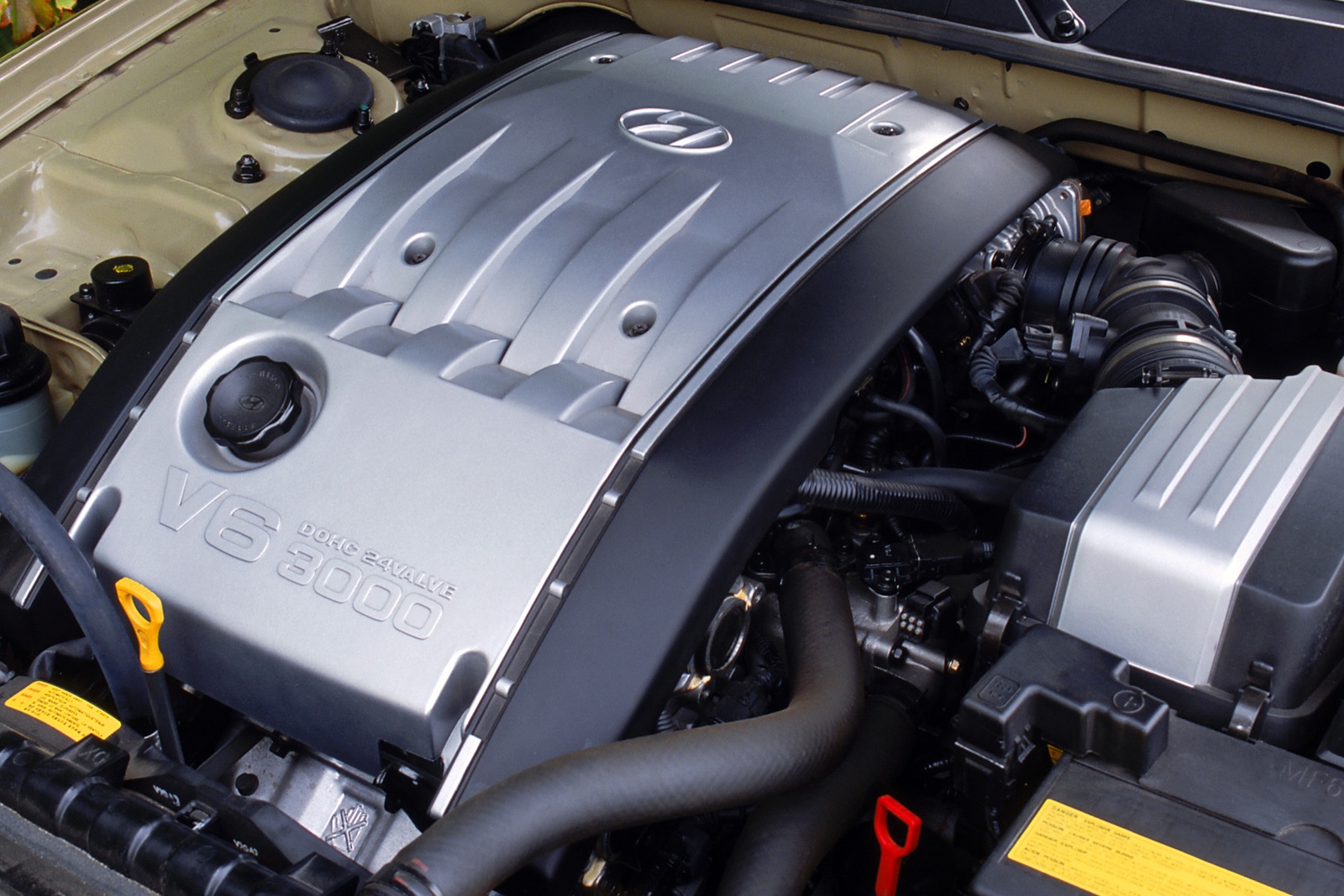
Under the hood sat a three-liter quad-cam V6 derived from the Mitusbishi Cyclone engine. Cranking out 192 horsepower and 178 lb.-ft. of torque, it came hitched exclusively to a five-speed torque converter automatic transmission and made for slow, deliberate progress. Figure a zero-to-60 mph time north of nine seconds, enough to keep up with sport utilities of the time but ultimately a league behind the near-premium competition. However, if power didn’t matter, the XG300 sure did come with a lot of standard equipment.

The standard upholstery was leather, the front seats were electrically-adjustable, the climate control was automatic, and side airbags were standard equipment. Luxury models with an “L” added to their trunk badges gained a wood-and-leather steering wheel, heated seats, memory functions, an auto-dimming rearview mirror, and a premium AM/FM/CD/Cassette system. Quaint stuff now, but this was in an era when you could get a Camry with crank windows. Oh, and the price? A mere $23,499 for the base model.

It was an interesting package, and it didn’t road-test half badly either. Car And Driver was impressed by its gadgetry, spaciousness, and interior ambience, and remarked that other than a delayed kickdown for the automatic transmission, “we see the car fulfilling most of the needs of a buyer looking for upper-middle levels of luxury and refinement.” The magazine’s summary of the car?
Anyway, the car’s sticker will invite cross-shopping from Honda Accord, Toyota Camry, Oldsmobile Intrigue, and Nissan Maxima prospects, too, broadening its potential market. Ultimately, the kicker may be the car’s looks. Not everyone will like the XG’s styling, but it is distinctive. You can’t say that about many of the cars in the target segment. Plus, the Hyundai is not without charm. There’s something quite beguiling in the direct, mechanical way it goes about its business. Besides, there’s an underdog, antihero thing going for it. We kinda like that.

In many ways, Hyundai’s first U.S.-market model with luxury aspirations simply faded into obscurity. The Azera that replaced it was a more compelling car, to say nothing of the subsequent Hyundai Genesis and the entire Genesis brand. However, the XG300 and XG350 were still reasonably compelling near-luxury cars for mainstream midsize sedan money. In retrospect, they were the first signs Hyundai’s premium aspirations would go somewhere. The XG certainly wasn’t perfect, but it was damn impressive for a first shot.
Top graphic image: Hyundai


My wife’s grandfather was a Korean War veteran who held some … ummm…. less than favorable views on Koreans yet had a XG350 that he say was the best car he had ever owned. Not sure he actually knew Hyundai is a Korean company and the family made sure to never bring it up for the rest of his life.
A guy at work has a XG350. It has almost 300K on it and and he drives it about 70 miles round trip 5-6 days a week. It’s definitely not pretty but it keeps running.
My neighbors kids first car was a Kia Amanti. Other than the hideously ugly front end it was a nice riding durable car for her. A 3/4 scale Korean Buick! It had a very nice comfy interior.
I always had a soft spot for them. I knew a banker that couldn’t resist buying one and getting the free accent the local dealer was offering for his son. He had it for years pretty trouble free. Then replaced it with a first gen Genesis. They were almost like an slightly more upscale Korean Diamante.
I think this was the best era for Korean cars. They were actually decent and reliable unlike what came before and after
I remember the early 2000s Hyundai cars having little annoying issues. Like the plastics breaking. But maybe mid 2000s? Xg350 might have been one of the first good ones. The Santa Fe wasn’t great when they first came out but were good a few years later. Same with the Sedona. Kia Sorento I think was good pretty much from the start in 02. That era of Rio are cockroachs too.
Things like the first generation Azera, 2006 Sonata etc. seemed pretty decent
Yeah I think by 05 or 06 they were doing well. Kia with the exception of the Sedona 02?
I almost bought one, but ended up with the Sonata instead.
Did you buy the Sonata because it sounded like a better deal? What was instrumental in your decision?
The exterior design was also a cheesy ripoff of the Bentley Arnage
Kia also had the “Jaguar” around this time
That was the 2002 Sonata!
(Though Kia did do something similar.)
The Amanti screamed Jaguar unlike the 02 Sonata. I’m not sure what that was trying to be
My neighbors kids first car was a Kia Amanti. Other than the hideous front end it was a comfy, dependable car. We called it her Korean Buick!