

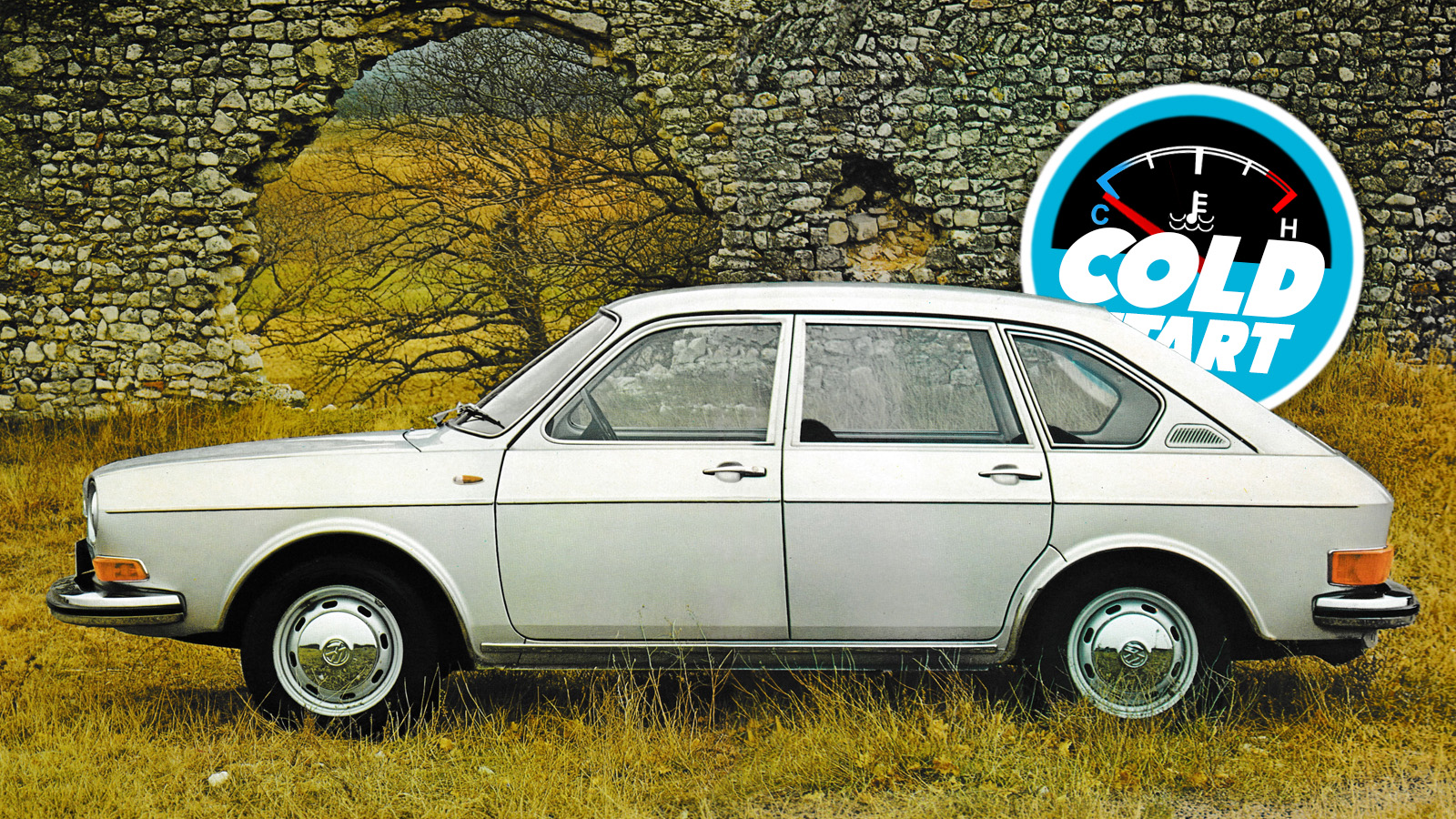
I’ve always been fascinated by the Volkswagen Type 4, because it has a sort of lost cause, last ditch effort that I find appealing, somehow. By the time the Type 4 came out in 1968, the 1930s-futuristic VW formula of a backbone chassis and rear-mounted engine were looking pretty archaic, and the transverse front engine/front wheel drive future was looming quite large. But VW wasn’t quite ready to give up the magic that made them so successful, and the Type 4 was their attempt to take these old ideas into the future. Or, maybe more accurately, present.
And, in that context, I think the Type 4 was pretty successful! VW kept a horizontally-opposed air-cooled, rear mounted engine, but this was an all-new design – not a re-working of the original like the Type 3 engine – with an aluminum block and fuel injection and stellar horsepower (for a 60s VW engine). We’re talking 85 hp! And later more!


The Type 4 was going to be Volkswagen’s upmarket car. A luxury car. Their first four-door passenger sedan! It’s this luxury context that I’m kind of fascinated with at the moment, because the elements that VW is considering luxurious or premium or whatever just seem so incredibly, um, humble by modern standards. Maybe even non-modern standards.
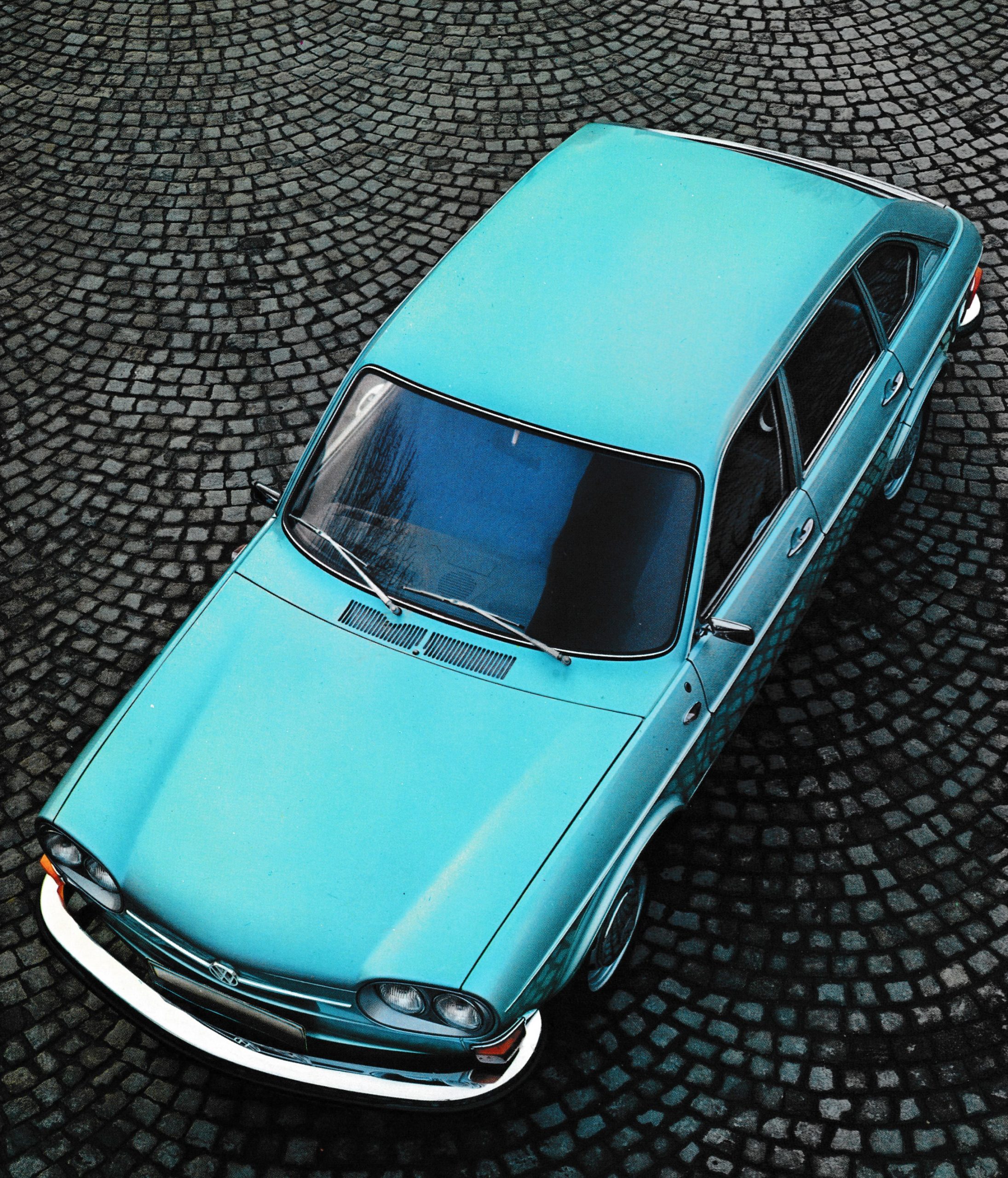
Pininfarina was said to have had a hand in the design, as the famous Italian design house was under an advisory contract with VW at the time. I personally think these cars are packaging marvels, as the MacPherson front suspension gives a ton of luggage room up front, along with a significant front overhang that looks kinda awkward, but gives plenty of more room for stuff.
The generous interior volume was a big deal to VW, and mentioned a lot in the brochures, even in the sedan version, not just the wagon. The front trunk has 14 cubic feet of luggage space, and there’s a rear luggage well with 6 cubic feet, for a total of 20 cubic feet of cargo area. Compare that to the trunk of an original VW Beetle (and some other cars):
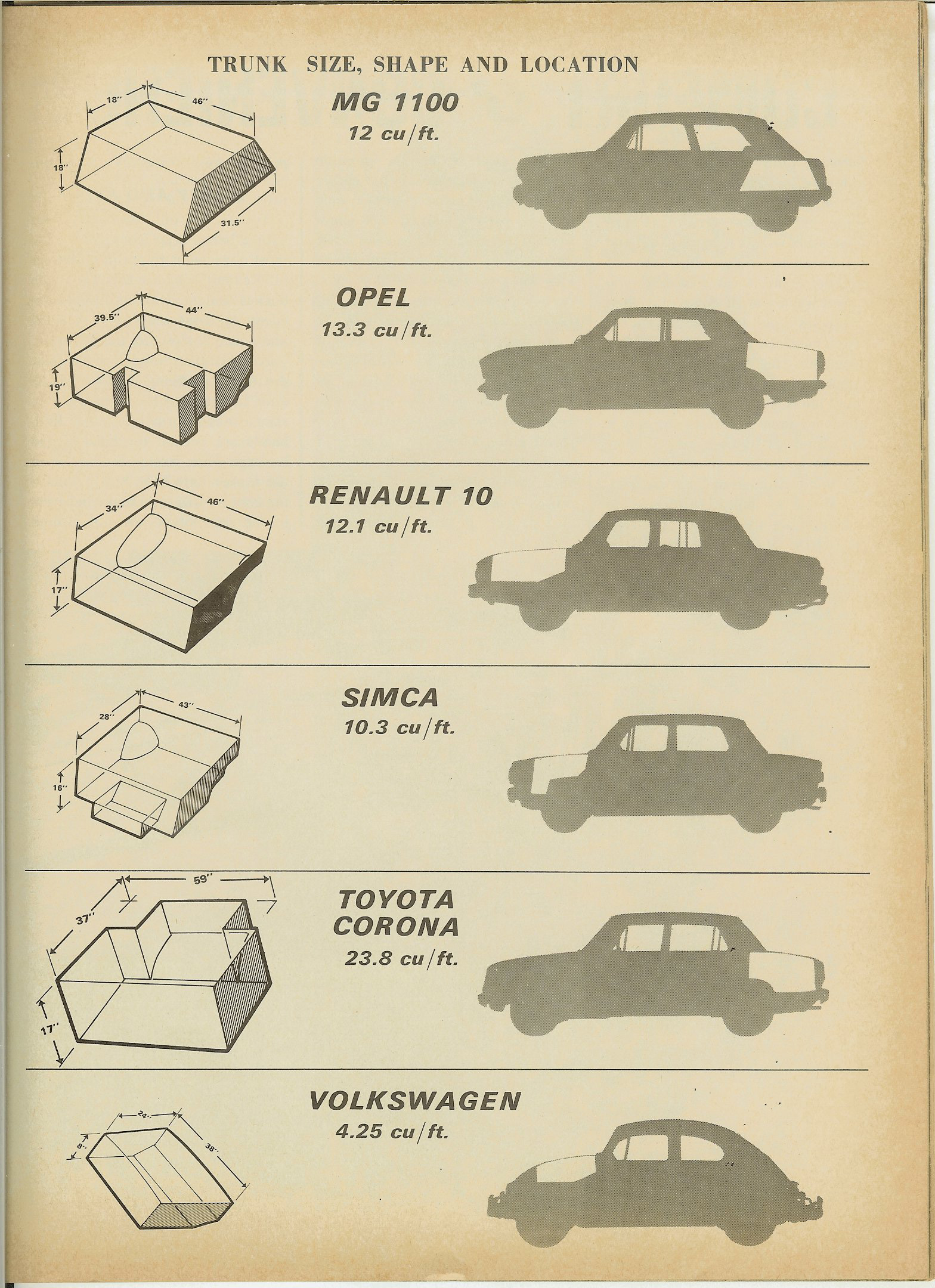
That’s a hell of a lot more space than the Beetle. A bit more than the also twin-trunked VW Type 3 (about 16.7 cubic feet for the Fastback) which was VW’s earlier upmarket attempt. VW was so proud of all this space that they introduced me to a word I never knew:
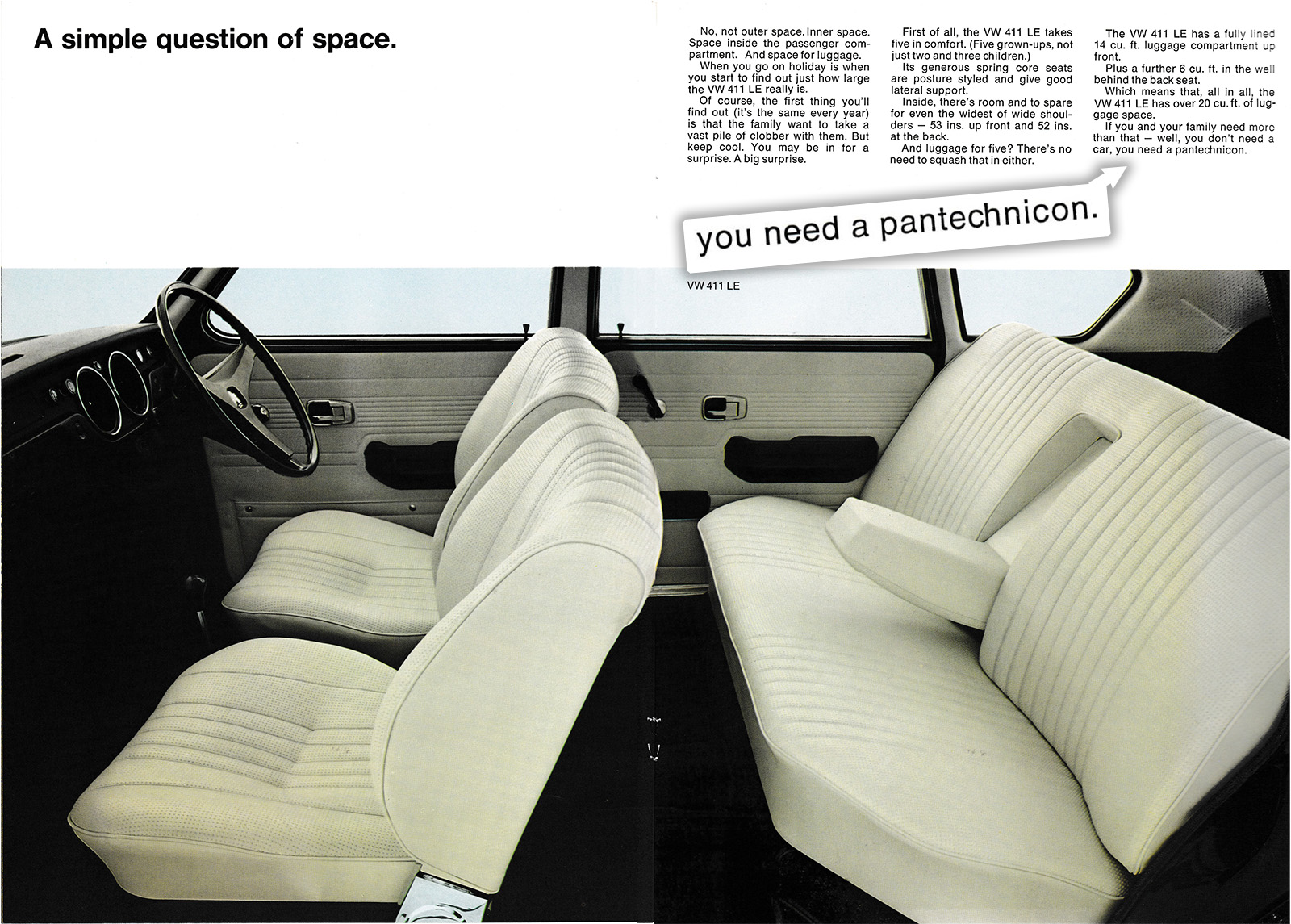
Pantechnicon? That sounds like a Victorian-era optical illusion toy you’d see in some London drawing room, or maybe a European university. But it actually means a big van, like a moving van. What an odd choice of word for a car brochure, right? Was this a commonly-used word back then?
There is a swanky fold-down armrest there, though, that’s pretty swanky. And, of course, four doors!
Weirdly – and, as I’ve discussed before – the wagon version only came in two doors, for bizarre reasons only long-gone VW product managers understand. But look at what they decide to highlight in the copy here. Sure, there’s the “impressive 62.9 cubic feet” of space with the rear seat folded (38.8 with it up) but I’m more interested in how such mundane and – you’d think – expected things like a “lockable” luggage compartment that’s carpeted and lined are pointed out specifically. Oh, and that the rear hatch “stays open automatically.” These all seem like such mundane details to call out!
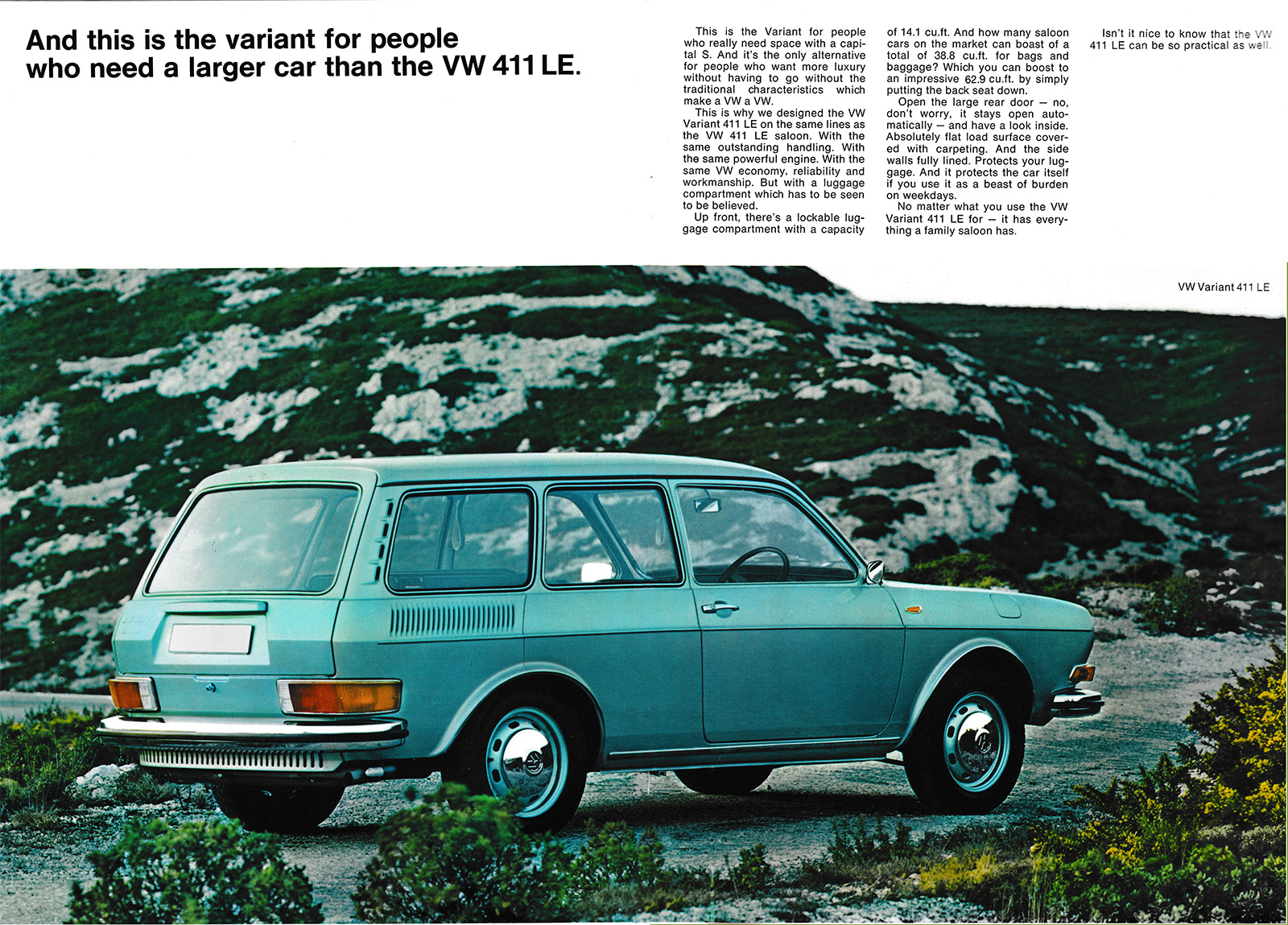
I mean, good, I’m glad the Type 4’s rear hatch doesn’t just slam down on you, that is nice. But is that what would be considered luxury?
The Type 4 was a well-appointed and built car, but it’s hardly lavish. Compared to what Americans considered luxurious, like upholstery that was certified bordello-grade and slabs of fake wood and vinyl tops and opera lights and landau bars, the Type 4 almost feels, I don’t know, not exactly spartan, but definitely sober.
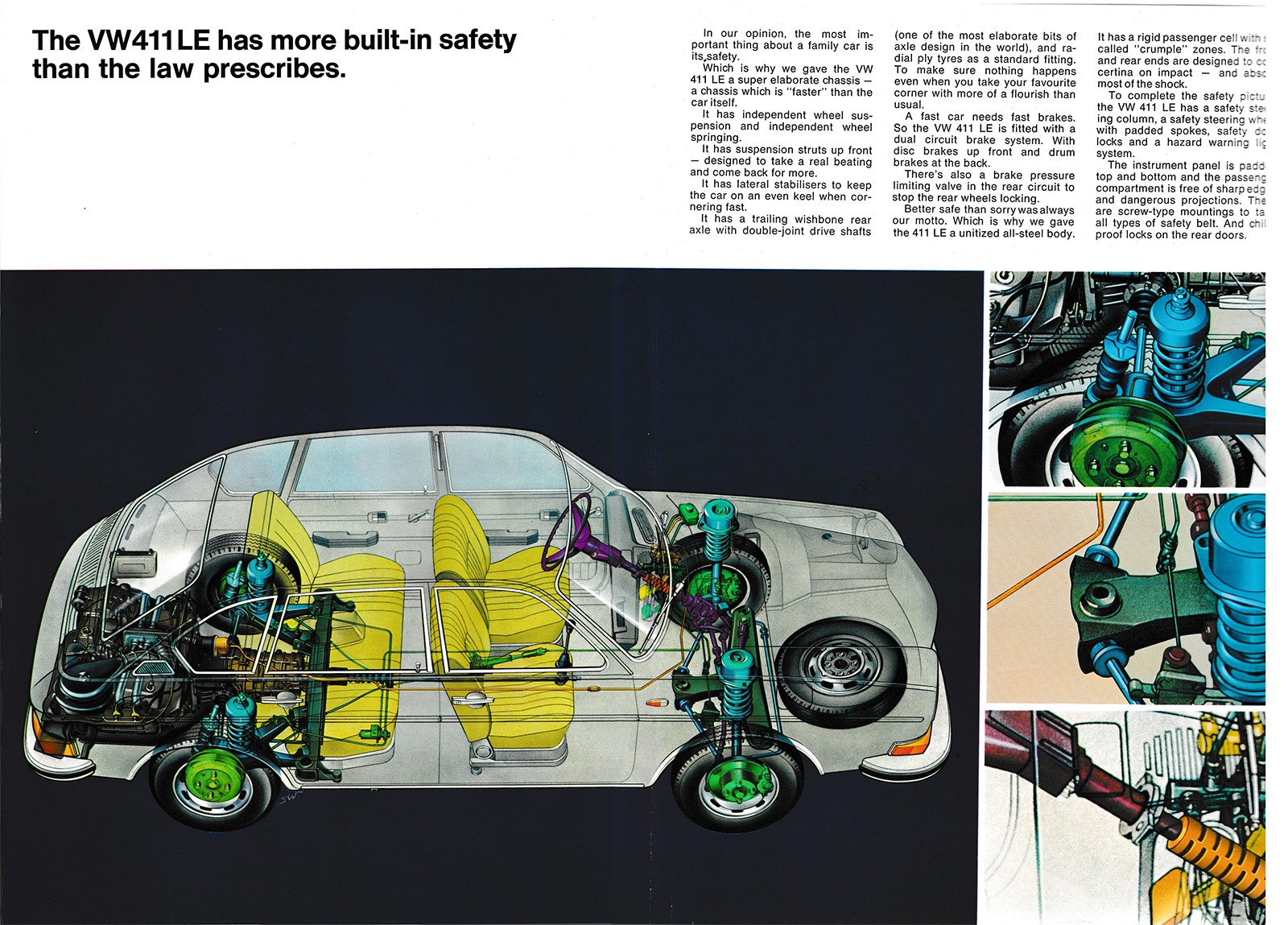
I do love this Type 4 cutaway that I’m sure I’ve shoved into articles before, but what I’m interested in here is the stuff they choose to point out, like brake pressure limiting valves and hazard warning systems. Important, sure, and there are definitely buyers who want to know the car has crumple zones and a padded dash, but the way the headline notes that it has more built-on safety features “than the law prescribes” just has a funny sort of tone.
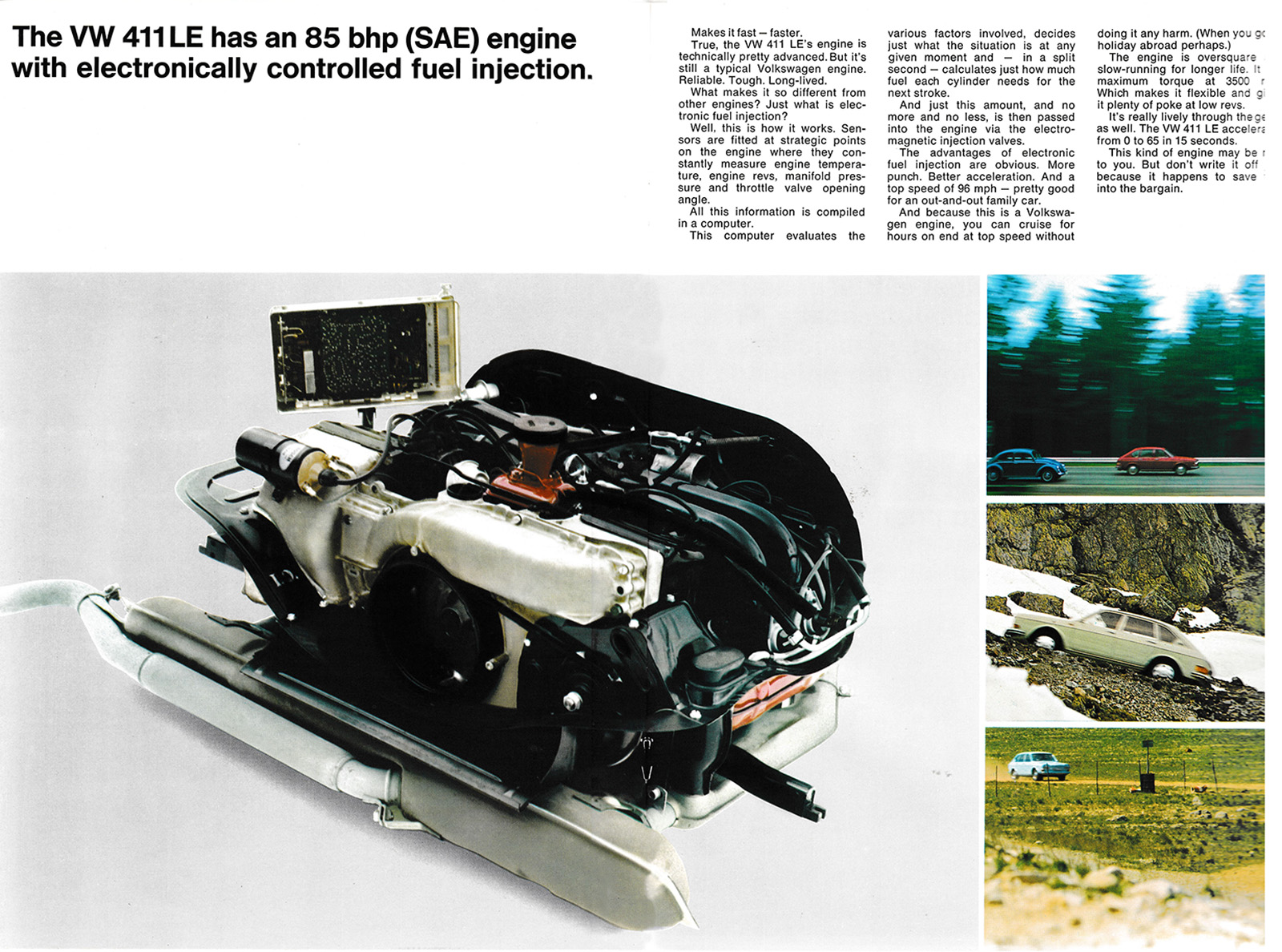
VW was sure proud of their Type 4 engine and especially its early ECU, which the copywriters delighted in calling a computer. I mean, it was, and it was a big deal, and the engine was pretty advanced. Top speed of 96 mph! 0-60 in a slow-sounding-but-really-not-bad 15 seconds! This engine made 100 hp in Porsche 914s and powere plenty of buses, too.
Really, if the Type 4 has a successful legacy, it was this engine, which was also, along with the later Porsche 993, one of the last really serious developments of an air-cooled engine for mainstream passenger car use.
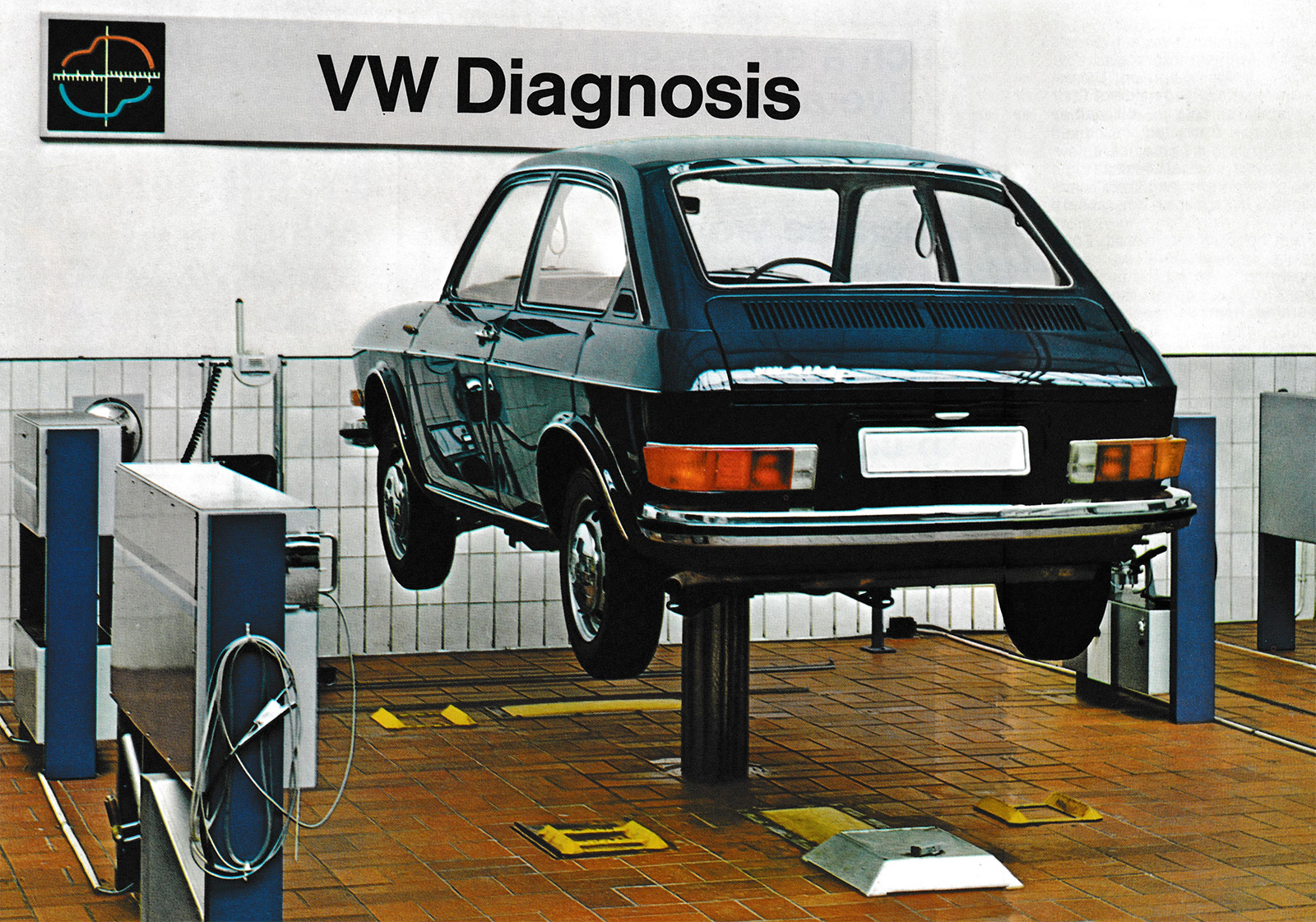
I also always liked how willing VW was to show their cars in the shop or on lifts. Also, this is the only picture in the brochure of the two-door Type 4.
These really are the most unloved of the air-cooled VWs, and I understand why, but I still think it’s kind of a shame. In hindsight it’s hard not to see these as a desperate grab at continued relevancy for the old VW formula, but at the time I think it was more about hope than desperation.
Maybe I’m reading too much into this?


Back in 2017 I was in Puerto Rico and spotted a beautifully restored Type IV wagon.This was just before hurricane Maria hit. I hope it survived.
I had a ’68 2-door 411E that sat in a field for 5 years. It was my first car, I was thrilled to have it. Until it broke down again and again from this and that. My dad (diesel engineer for industrial sized engines), spent an entire day going over the engine top to bottom. Declared success, and on the test run, this damn thing, not a mile down the road, started blowing smoke like it was one of those old fog machines spraying for mosquitoes. The look of frustration and just pissed off on his face told me he was done with it.
It was taken to a VW specialty shop and after a week (cost a fortune), I’m supposed to drive it home. Can you guess? Took off and the first traffic light I stopped at, this cloud of oil smoke caught up and blanketed the car. Even the experts gave up after another 2 weeks and it was sold off for what I can only imagine was scrap metal. It was not a car.
Did I mention that one time I was on a country road and had to dodge a wild animal? The car lurched to one side, then the steering ripped out of my hands violently spinning the other way which shifted the body weight and then went up on 2 wheels. Luckily I caught the wheel in mid-spin back the other way again, and brought it on all fours and a stop. Maybe it wasn’t the car, but there was no trust ever again.
As a kid, I was never a fan of the Beetle…not even the ’73 Super Beetle that my mom owned for a while. But I was a fan of Volkswagen. To my young eyes, the 411/412 were blessedly “modern” cars compared to the ancient Beetle, and I always thought the fastback styling was quite neat. But the only car of that series that I ever got to ride in was the Squareback belonging to my friend’s dad. Even though the styling was fuddy-duddy compared to the fastback, I still enjoyed riding in it.
(A short time later, that same friend’s aunt bought a brand new Rabbit, and then I was really off to the races with my VW appreciation. My dream car throughout most of my childhood was the 1st-gen Scirocco.)
I has a buddy delivered newspapers for a living he used a VW squareback it was ideal for space
One thing to remember is that this brochure was most likely written for British buyers, given the right-hand driving position and the reference to “tyres” and driving it on a “holiday abroad” (the only RHD settler nations where something could be driven to another country were South Africa and Rhodesia, and I don’t think that’s the phrase one would use.) And while most Britons were certainly living better than they had been before the last war and the coal strikes power cuts and Three-Day Week hadn’t yet set in, they still didn’t have a standard of attainable luxury set by a Caprice, LTD or Fury VIP. Instead, those who eschewed the leather and wood of an upscale Austin or Morris trim level had to settle for austere craftsmanship that didn’t require passengers to alert the driver to stop and reattach pieces of bodywork on the way to a seaside holiday in Torquay.
We lived in the UK in the early 80’s and going from a sadly rusting 1970 Triumph 2000 (NOD327G RIP) all leather and walnut to a base 1978 Audi 80 was a lesson in two countries different priorities.
I HAVE BEEN SUMMONED.
I really need to move my hooptie to CT already. I miss it. I am having Weird, Rare Hooptie Withdrawal and the only cure is a more obscure hooptie, which I would have trouble finding. I even get “Is that a Tatra?” from people trying to guess what it is. This means I would have to get a Tatra in lieu of my 411, and that’s a lot more expensive than simply shipping my 411.
Also, I want to chuck the stupid, poorly-matched single carburetor that some previous-owner doofus slapped on top of my engine into a volcano. BOTH ENGINES that have been in that thing—the unknown bus??? Type 4????? and the 914 1.8L—have had the same trash Pinto carb slapped on that obliterates my spark plugs with too much fuel. I want that fuel injection back. It’s luxury. I have a luxury race car. Give me luxury.
The tile floor of that VW Diagnosis shop looks like something you’d find in a fast food restaurant kitchen.
Show us a service bay of any American brand dealership with ceramic tiled floors.
Hint: They didn’t exist.
Waaaay back in my junior year of HS in San Diego I had the opportunity to ride in a 412. Granted, this was 41 years ago but what I do remember was that it was quiet, smooth and being in So Cal, rust-free. Other than that, not much else is remembered. But to say that I am probably among three or four other folks that have ever ridden in a 411 or 412 is special I guess.
The parents of my friend in high school (class of 90) owned a 412 sedan and a 69 beetle with the auto stick. I didn’t realize how odd ball these were till much later in life.
Me included. I knew that being in SoCal in the early 80’s we always seemed to have some rarer cars but the 412 really sticks out especially with all of the squarebacks and buses being all the rage.
It’s delightfully soft! I really should bring mine to work and show everyone what REAL good ride quality is.
(Ignore the bouncing.)
(Also, ignore the death wobble from the dead bushing I have to make because VW doesn’t sell it anymore. Just don’t drive over 40 mph. You’ll be fine.)
:”I also always liked how willing VW was to show their cars in the shop or on lifts.”
And not just any lift… a single center-post lift.
I’m not surprised these were a failure. My dad had a Squareback wagon. He bought it new. It was an unreliable POS. For one thing, the starter failed 2 weeks after he bought it… while on a road trip.
And the floor had rusted out after just 3 years. Even by 1960s/1970s car standards, it was bad. Even compared to the Type 1 Beetle, it was bad. Type 1 Beetles also rusted, but not THAT quickly.
And apparently that fuel injection system was also a source of problems… likely made worse by most not being familiar with how to service it back in the day.
I had a 73 fastback that went through voltage regulators like people go through Q-Tips. I never figured out why though, the rest of the car was in a race to disintegrate. Being a poor teenager, I fixed the rusted floorboards with the only sheet metal I could find: a garbage can lid. I didn’t have access to welding, so I pop-rivetted my patches over the holes. Good enough for who was driving it.
If I were to ever own an air-cooled VW, the Type-4 2-door wagon would be the only choice for me.
BTW, you missed a letter. “This engine made 100 hp in Porsche 914s and powere plenty of buses, too.“
I saw a running, driving example of a 412 last year at the aircooled/Franklin/Saab/Volvo meet at the Gilmore Museum last summer; I was absolutely shocked. It wasn’t anywhere near perfect, but it appeared to have covered multiple states to get there.
It’s this luxury context that I’m kind of fascinated with at the moment, because the elements that VW is considering luxurious or premium or whatever just seem so incredibly, um, humble by modern standards. Maybe even non-modern standards.
Did they crow about PNEUMATIC TIRES!? Or electric wipers that didn’t suck the pneumatics out of the spare? How about modern hydraulic brakes? An AM radio? A cigarette lighter?
How about the heater, any ink spent for that?
Oh, and that the rear hatch “stays open automatically.” These all seem like such mundane details to call out!
It is when the alternative is a flimsy hatch prop stick that you have to take an extra step to use or sold the hatch open with one hand while you grab the dog with the other. What a hassle!
Really neat cars, exterior reminds me slightly of Saabs somehow. Something about the proportions of overhangs and greenhouse.
One thing that bugs me about them is i prefer so much more the single oblong headlight ones, which confusingly it seems were only available for the first production year? The twin headlight treatment is kinda clumsy and dates the car compared to the smooth aero look of the ’68 ones. I find it a shame as only very few of them have that very likeable cute face.
Even in Europe they never offered covered headlights again, on a car that sold well into the 70s!
Size was itself a luxury in 1960s Europe – they were medium-large cars in that context. Power assists and air-con were practically the stuff of the Rolls/Royce Bentley/top-spec Mercedes. These were reasonably competitive in their class, if definitely a bit old-fashioned. These weren’t luxury cars, but they were definitely premium cars.
I really love these cars – if I had a hanger and lots of money I would absolutely have a Type 4 wagon in my stable.
That 2 door wagon looks sharp with those big windows and polished dog dish hubcaps.
Pantechnicon was the name of the shop which first developed wagons with ramps to load and unload furniture. The name became genericised, like Google, Photoshop or Heroin.
https://en.wikipedia.org/wiki/Pantechnicon
I own a Type 1 (Super,) and have seen all 3 Type 2s (brother’s in-laws own a Vanagon,) Type 3s, 914s, Things, and Ghias, even Kubelwagens, but never a Type 4. Even at a major ACVW event.
VW Type 4 – these things were pretty much the chosen vehicle of the archetypical English Literature professor in the ’70s
Four doors, eleven years too late. VW barely survived until the Passat/Dasher and the Golf/Rabbit saved them with more than just a little help from Audi and NSU.
The behavior of just selling the same old $(#€!$$€ over and over again seems oddly familiar today. I sincerely hope the ID.Polo and its siblings can turn things around in a similar way.
Thanks for the 4-1-1 on the Type.4.
The one option that stuck with me on the Type 4 was the clock that could be set to start the gas heater. I’m sure that was available elsewhere, or aftermarket, but the first time I ever saw it mentioned was on a Type 4. THAT’S luxury right there.
How well did these things sell? I remember seeing Beetles and Buses all over the place but even growing up in the 80s I don’t remember really ever seeing Type 3s or 4s.
About 370K units globally over seven model years (’68-’74), so definitely not a bases-loaded home run, but probably not terrible for a car of it’s fairly expensive class. By comparison, the Volvo 140 sold 4x as many over a slightly longer run (’66-’74), but Saab sold rather less than twice as many 99s over a MUCH longer run (’67-’84). But in the case of Volvo, that was their ONLY model, whereas the VW was just one of many. Saab always had at least two different cars in production in that timeframe, and three for much of it.
But interesting to think that in ’68 you could choose from three such wildly different cars in the same class for about the same price (and there were plenty of competitors too). Brings today’s boring sameness into focus…
What’s weird is I remember plenty of Volvos and Saabs and even Peugeots from that back then but I don’t remember seeing a Type3 until the late 90s. I’m sure they were on the roads back then but I somehow never noticed them even though there were plenty of VW owners amongst my family and friends.
They sold very few in the US (assuming you are in the US). Much more popular in Europe. Volvo and even Saab did quite well in the US market. Whether you saw Peugeots was *extremely* regional (so was Saab, much more so than Volvo). They were downright common in Maine/New England, but that was very aberrational compared to the country as a whole, given tiny Maine had three Peugeot dealers out of only 151 nationwide when they left the market. Probably the most per-capita in the country.
We moved around a lot but mostly in the south FL/LA/TX/CA/etc. I’m sure there were plenty of 3s and 4s on the streets but I just didn’t recognize them as anything to pay attention to. Kinda like the Mustang II, somehow I also wasn’t aware those existed until the 90s. Can’t say I was missing much with the Mustang but those Type3 Squarebacks are pretty sweet.