

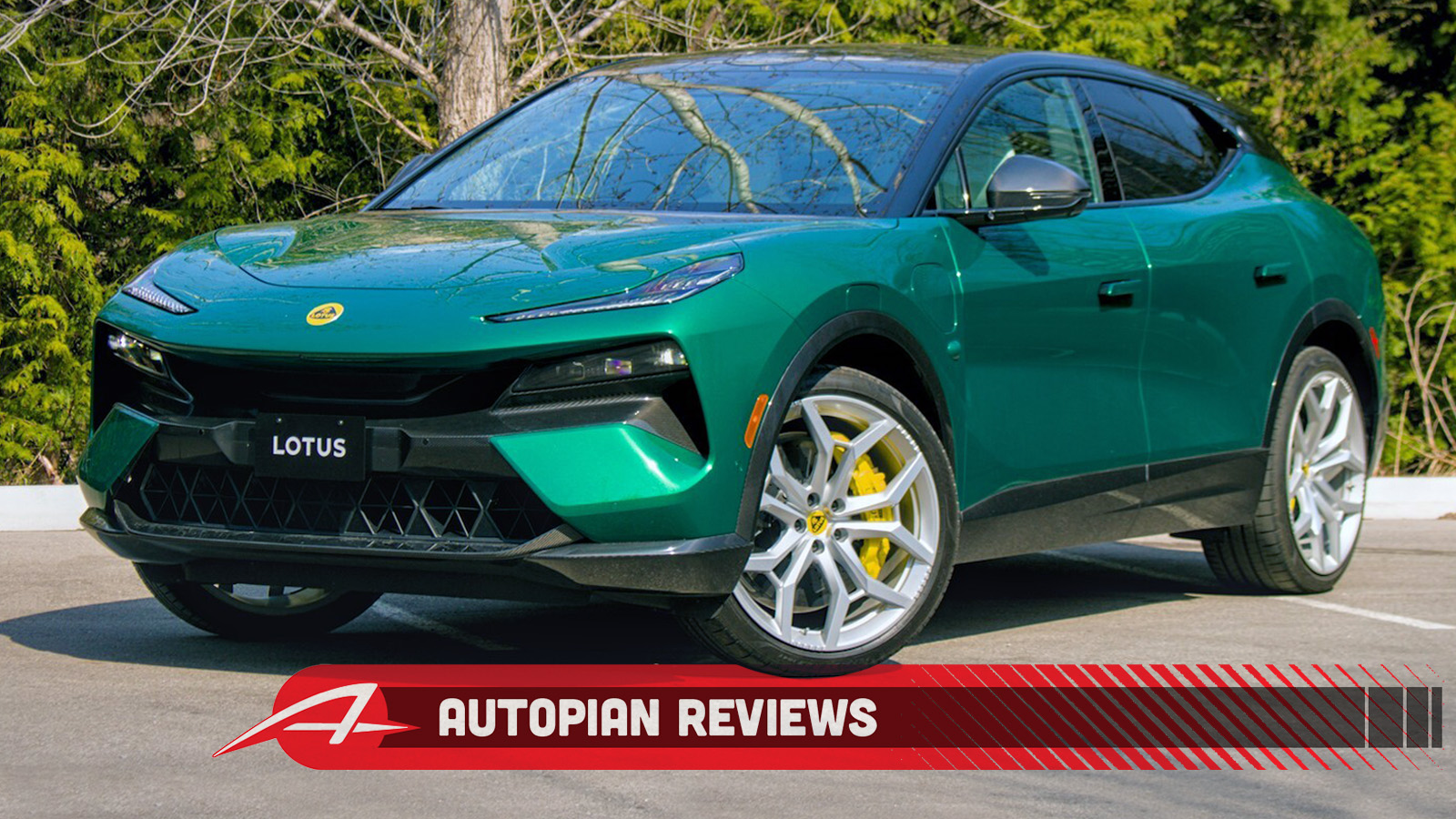
It’s amazing what can change in two years. In 2024, Canada moved quickly to match America’s 100 percent tariff rate on EVs made in China. Earlier this year, that tariff rate was relaxed under a new trading scheme. Under this quota system, as many as 49,000 Chinese-built EVs can enter the Great White North at a mere 6.1 percent tariff rate, and the first brand to take advantage of this is Lotus.
Yep, Lotus, the British sports car marque. While many North American enthusiasts will be familiar with the British-built Emira, the brand now builds a whole range of EVs in China thanks to Geely ownership. This technically isn’t the first time the Eletre SUV has been sold in North America, as it enjoyed a brief low-tariff stint before the weight of international trade concerns came barrelling down on it, but shifting tides in Canada make it a far more attractive proposition north of the border. The question is: How good is it, especially now that there’s a proper choice of posh performance-oriented electric SUVs in its price range? I spent a day in the range-topping Carbon Series to find out.


[Full disclosure: Lotus handed me the keys to an Eletre so long as I kept the shiny side up and reviewed it. They also gave an Atmos audio demonstration, followed by hosting an evening industry and client mixer for the local market relaunch. Transportation to and from was paid for by yours truly.]
The Basics
Battery Pack: 112 kWh lithium-ion.
Drive: Dual-motor all-wheel-drive.
Output: 603 horsepower, optionally 905 horsepower on the Carbon Series.
DC Fast Charging: 350 kW, CCS connector.
Range: 460 km (285 miles) base, 385 km (239 miles) on the Carbon Series.
Base Price: $124,550 Canadian.
Price As-tested: TBA
Why Does It Exist?
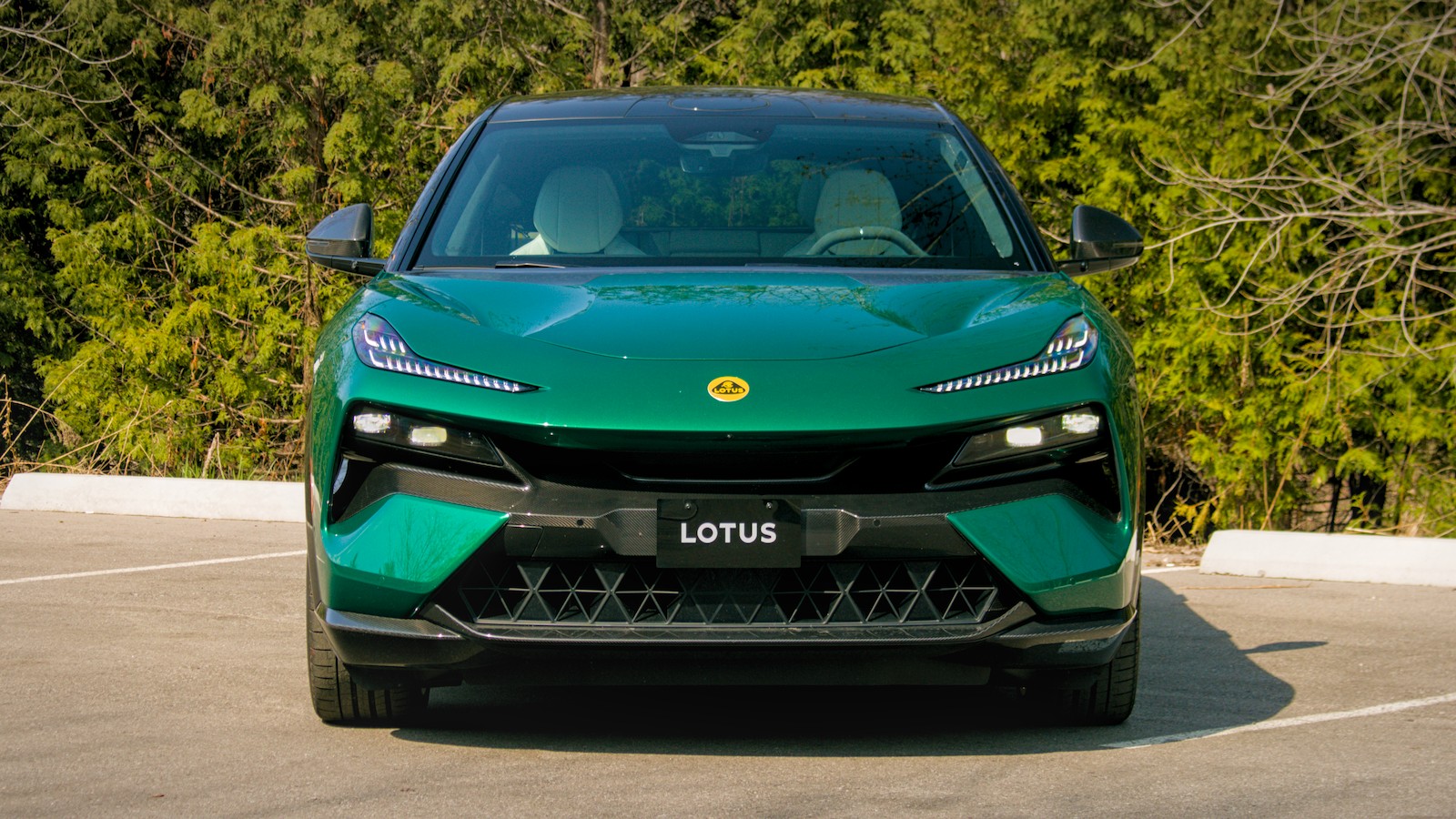
From Formula 1 innovation to delightful sports cars, Lotus has an absolutely spectacular pedigree. Unfortunately, as with many small British sports car marques, it also has a history of financial instability. After the untimely death of company founder Colin Chapman, Lotus was owned by a consortium of British investors, followed by General Motors, followed by Bugatti EB110 mastermind Romano Artioli, followed by Malaysian automaker Proton. Nearly a decade ago, Chinese automaker Geely purchased a 51-percent controlling stake in Lotus, and it’s since sought expansion. It seems like Geely is seeking to adopt the old Porsche model, and after seeing what the Cayenne did for Stuttgart’s sports car company, the Eletre SUV has been tasked with achieving the same sort of sales success.
How Does It Look?
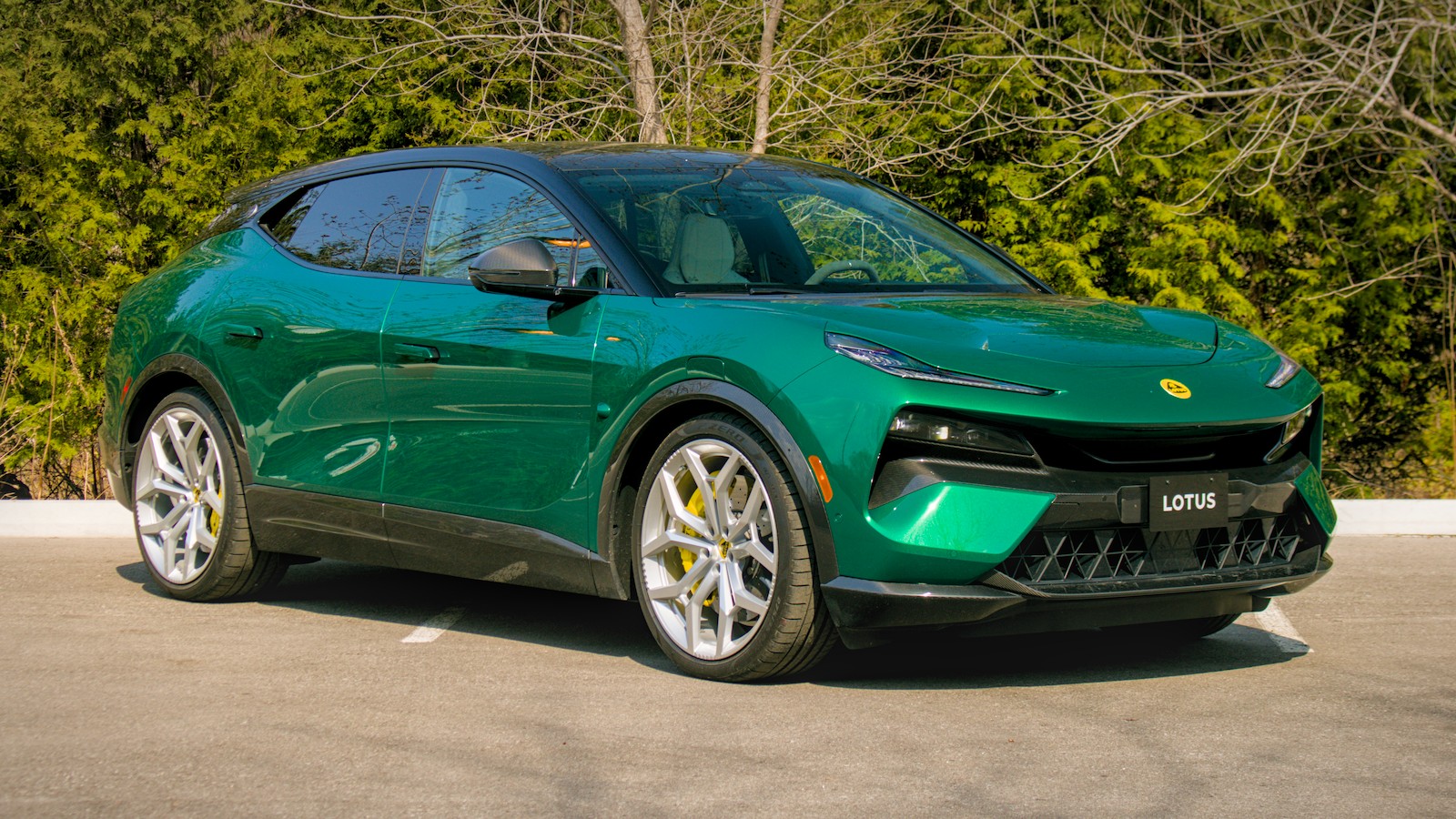
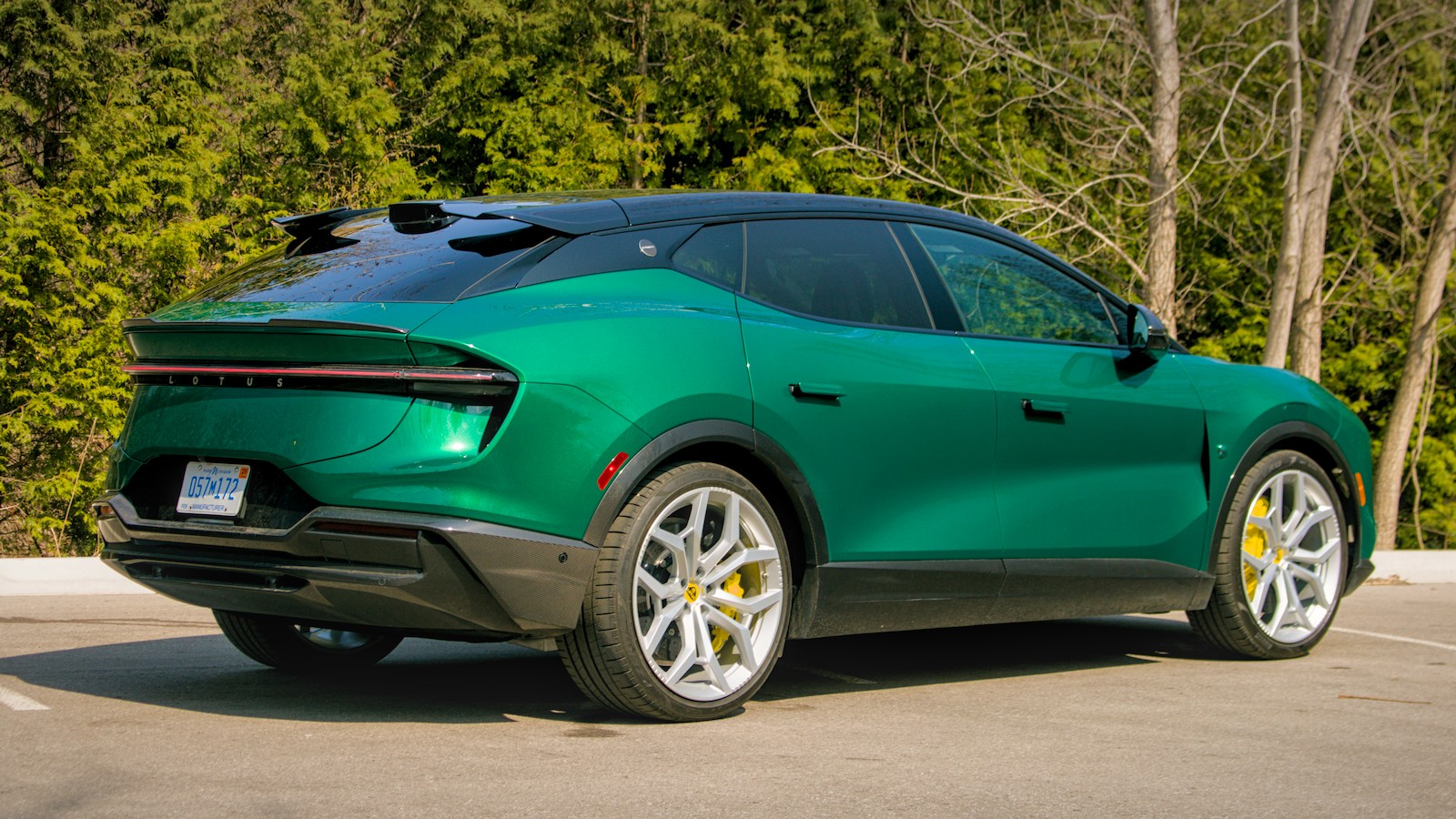
Right off the rip, the Eletre looks absolutely nothing like the sports cars of yore. How could it? We’re looking at a distinctly different form factor, although Lotus has been able to put its own twist on things. The aerodynamic channeling is wild, with large air curtains and flow-through ducts up front and huge wheel arch extractors out back that seem primed to shoot gravel should your right foot suddenly become leaden.
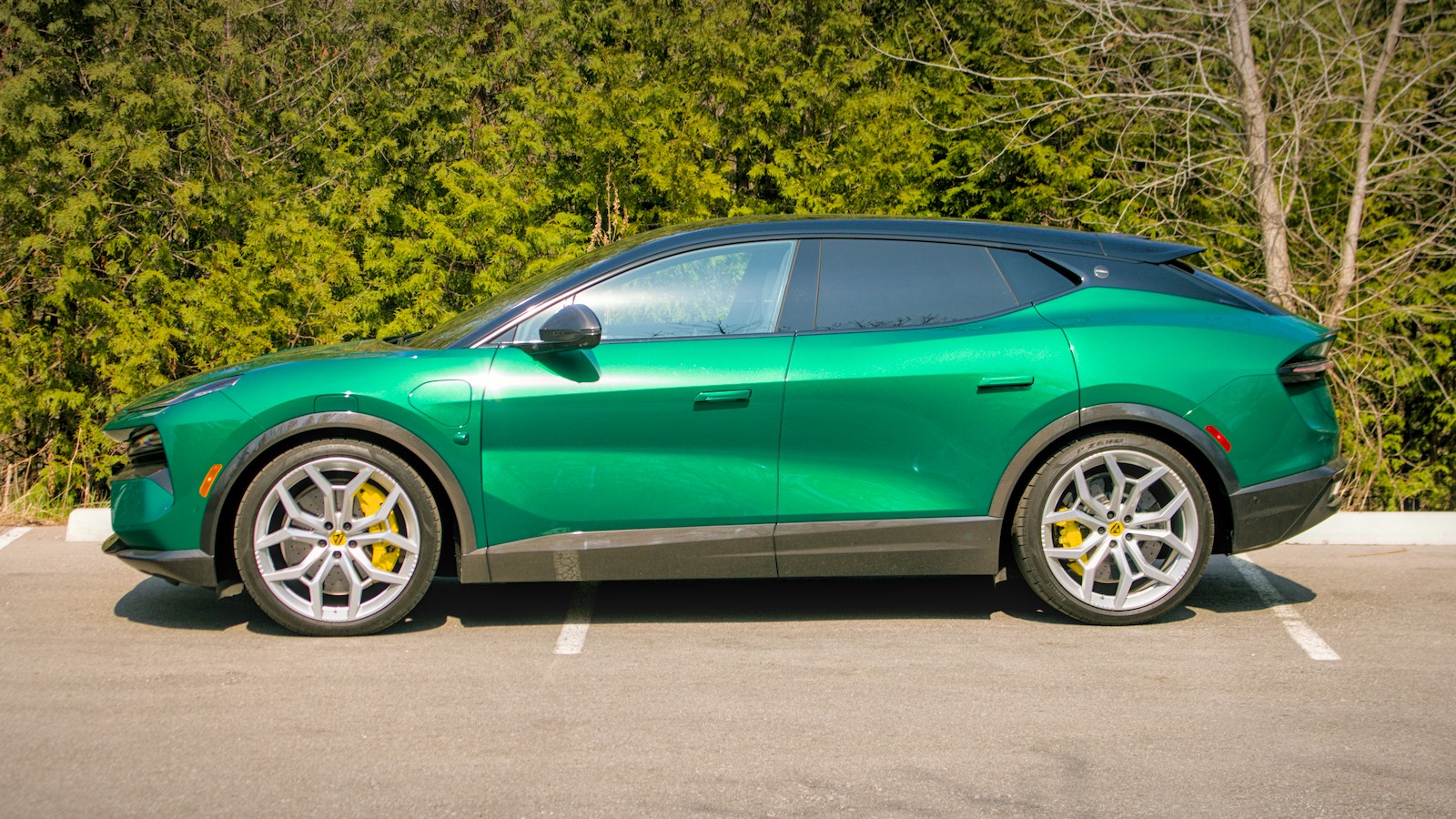
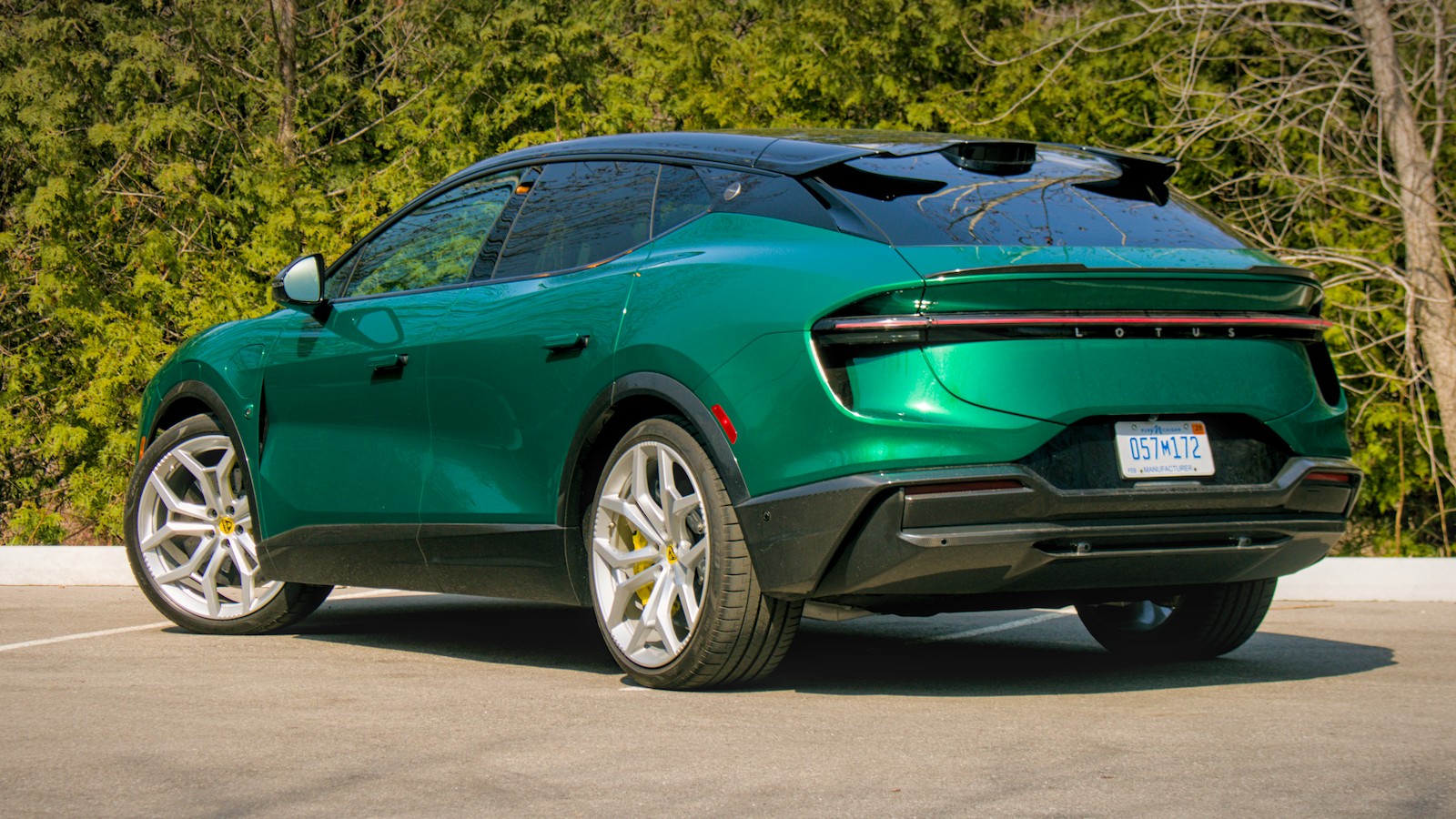
In a way, the functional ducts speak volumes about the look of the Eletre. It’s not traditionally handsome, but it’s certainly purposeful. Only time will tell if it can forge its own identity, but a few great colors certainly help. I mean, come on, just look at this green.
What About The Interior?
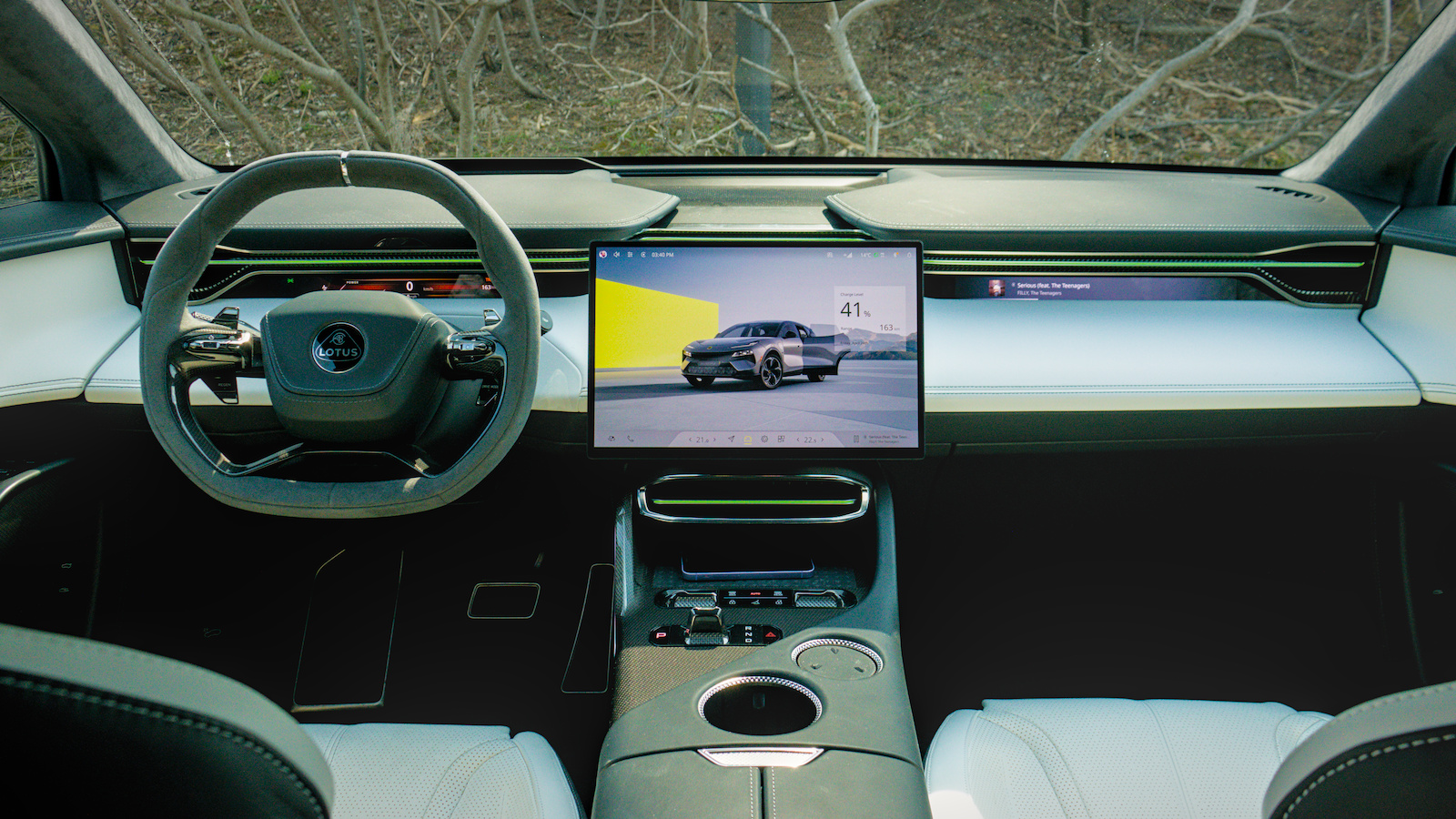
Slide behind the wheel of the Eletre, and you’ll immediately know why it commands a six-figure price tag. From the stitched dashboard to the carbon trim, the material spend feels massive. It also all feels remarkably well-screwed-together, with nary a stitch out of place. Lotus has huge luxury aspirations for this model, so it helps that pretty much none of the switchgear appears to be shared with anything else. The e-shifter moves with heft, the paddles for regenerative braking and drive mode selection offer beautiful tactility, even the recline switches for the rear seats have remarkably little shaft play. Speaking of seats, the front thrones are genuinely astonishing. The level of support is nigh-on perfect, and they’ll hug you like your favorite pair of jeans.
How Does It Drive?
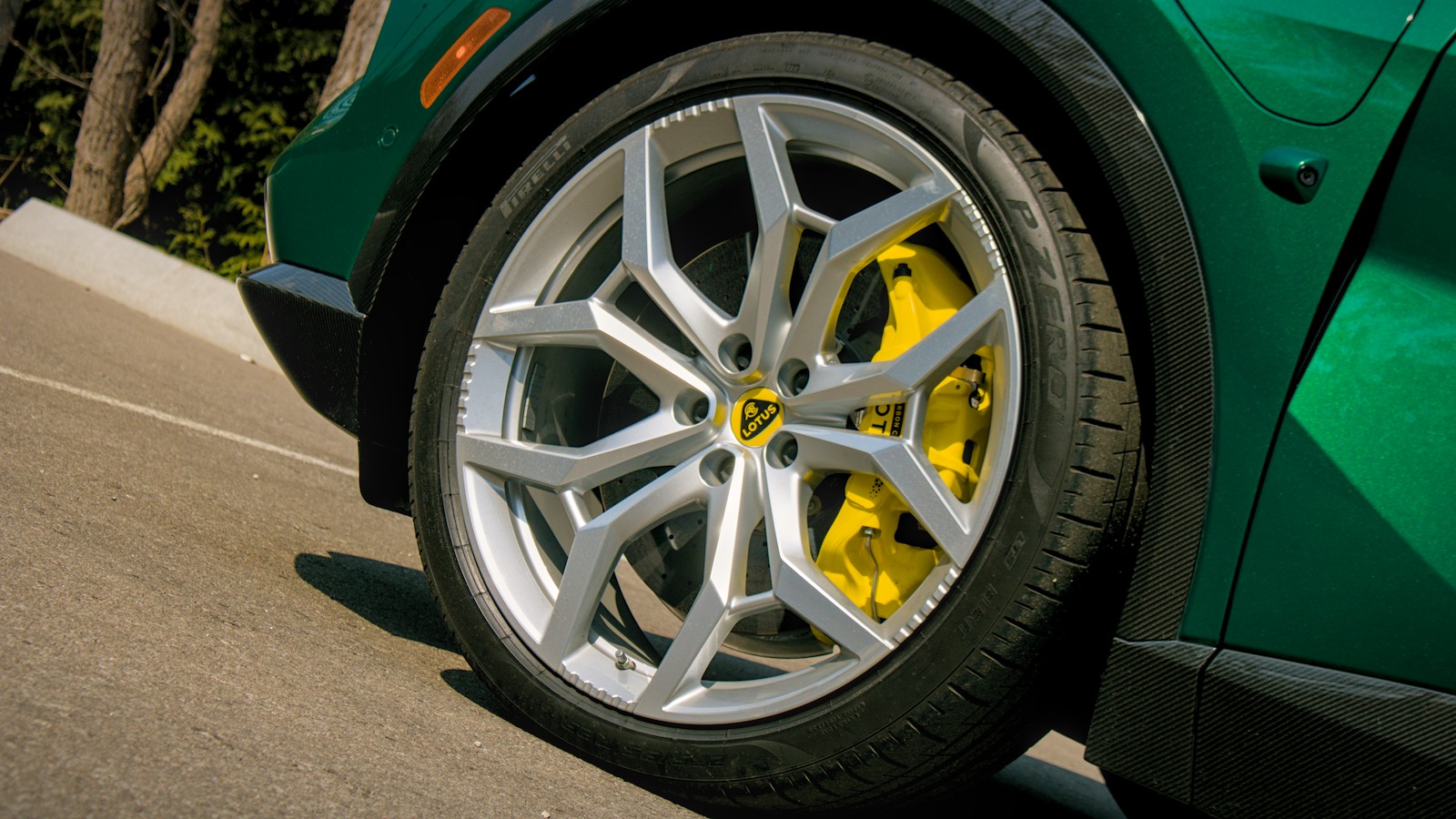
At face value, the Eletre is the antithesis of “Simplify, then add lightness.” We’re talking two-chamber air suspension, more gadgets than a Best Buy, and a base curb weight of more than 5,600 pounds. The thing is, Lotus doesn’t just make sports cars. For decades, the chassis experts in Hethel have helped dozens of marques build better-driving cars, so if anyone can make a 2.5-ton SUV go around a corner, it’s these people. Surprise surprise, the inputs are all there. I’m talking beautifully weighted steering that builds effort with load naturally, air spring pressure, and damping that’s taut but never harsh, even in the Eletre’s most aggro mode. Then there’s the way this absolute unit communicates weight transfer. Instead of trying to completely eliminate body roll, Lotus has dialed in just enough to add feedback without eroding confidence. The result is the best-driving car of this weight class that I’ve ever experienced.
It’s remarkably easy to place on the road, both on tight city streets and when you want to get a bit cheeky with the apexes. You’re aware of what the tires are doing, and instead of feeling like it’s entering a boxing match with physics, the Eletre exhibits remarkable malleability. It loads up and rotates with a surprising degree of confidence, and it’s just as eager to settle down and shut out the world with plenty of suspension travel and high-grade sound insulation. Obviously, this is not a sports car in the same way that a rhinoceros is not a greyhound, but the top-flight Eletre proudly shows traits of a car you want to actively drive. What a lovely surprise.
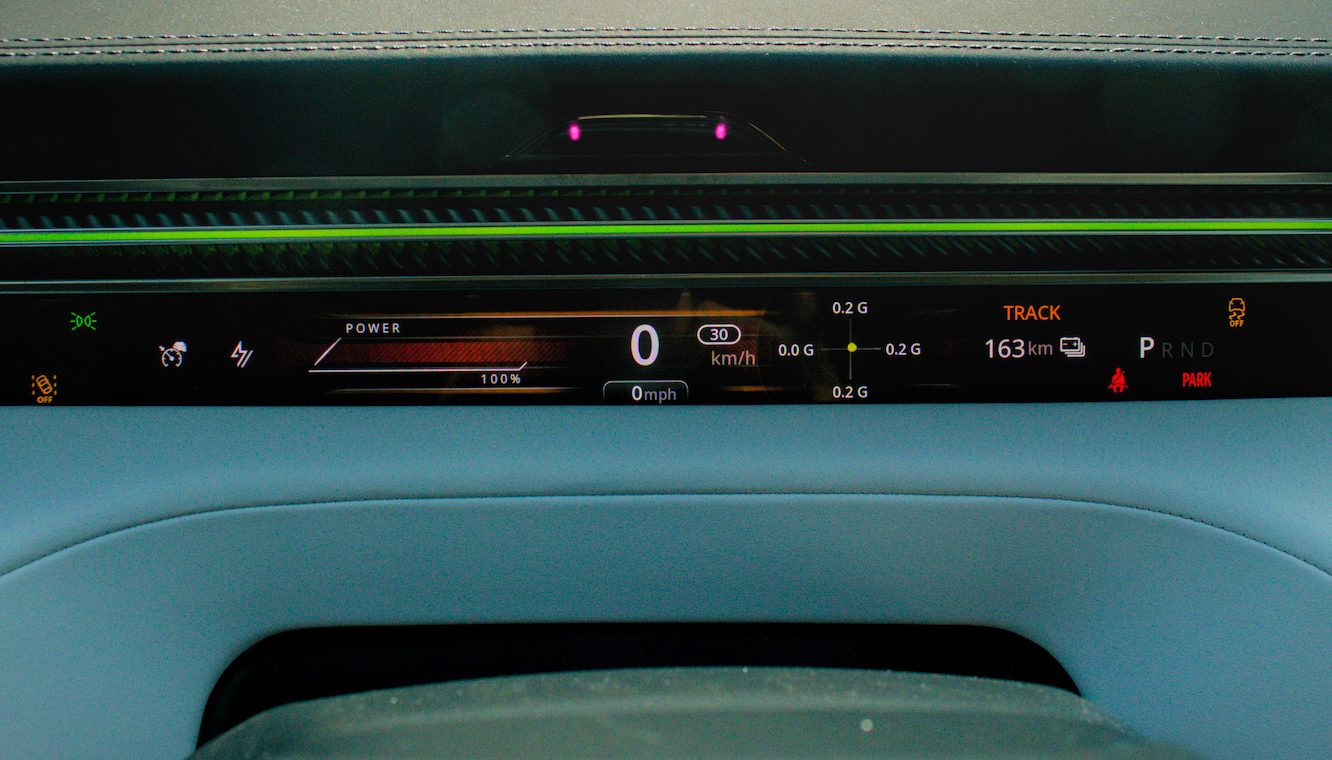
So then, what about the other stuff? Well, every Eletre can see up to 350 kW of power through the right sort of DC fast charger, although the port on the car is of the CCS variety rather than the Tesla-style NACS port. The 905-horsepower Carbon Series model I drove isn’t exactly easy on electrons (it’s rated for just 385 kilometers or 239 miles of range), but 460 kilometers (285 miles) of range from the standard 604-horsepower models is right about on par with the similarly priced BMW iX M70 and Porsche Macan Electric 4S. Oh, and it comes with a full suite of advanced driver assistance systems. Job done on that, I reckon.
Does It Have The Electronic Crap I Want?
Aside from one key thing, a loaded Eletre will get you every gizmo you could possibly want. Massaging front seats, ventilated rear seats, an electrically dimming moonroof, soft-close doors, four-zone climate control, wireless Apple CarPlay and Android Auto, the works. You know what you don’t get, though? A volume knob. Instead, you have to either use the steering wheel controls or swipe down on the top of the infotainment screen to access a virtual slider. Bah humbug.
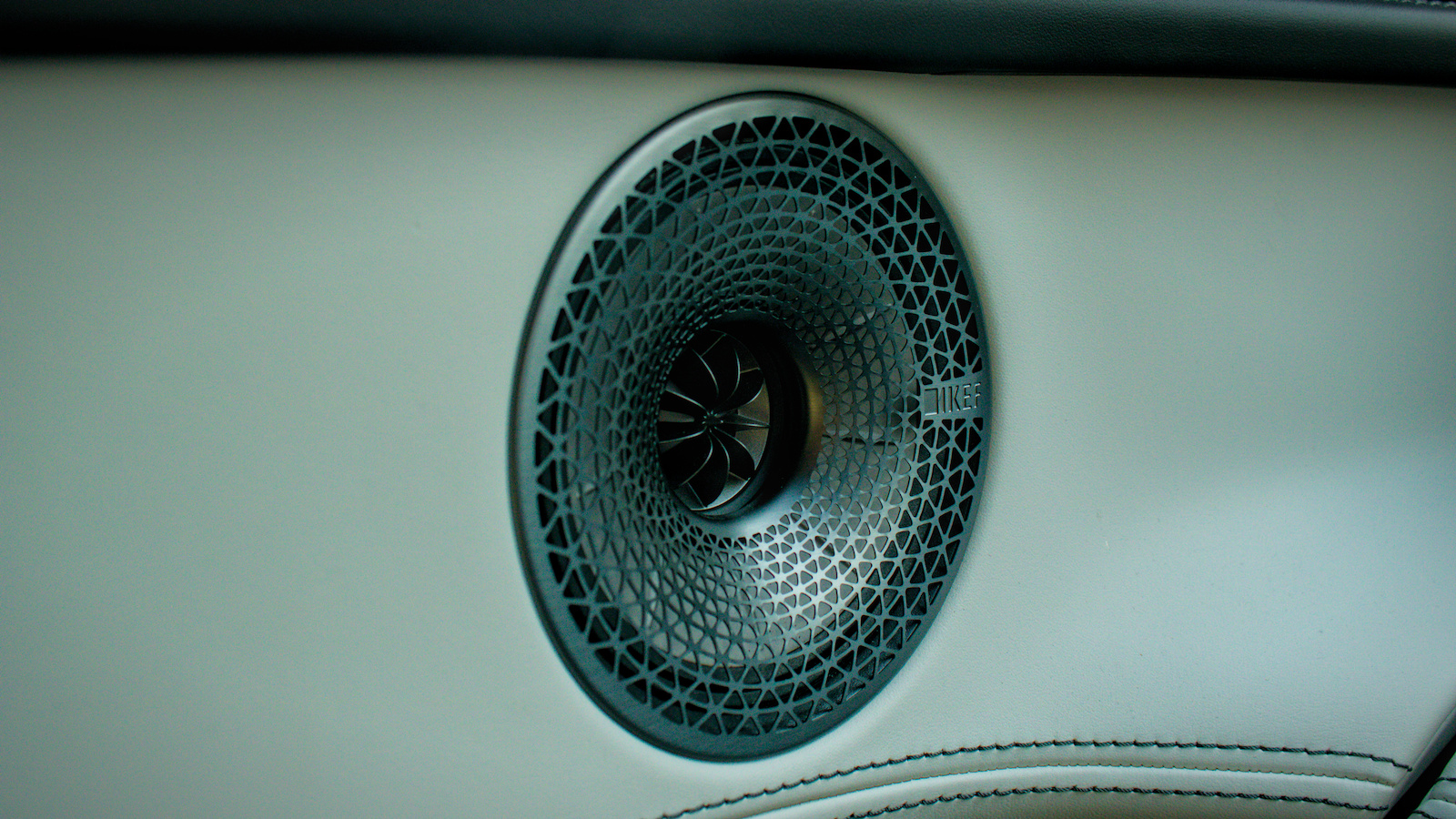
Speaking of sound, the top-shelf KEF audio system offers tremendously clean low-end extension and solid overall clarity, although Dolby Atmos support is still a bit of a gimmick for really keen audio enthusiasts. It does the immersive audio thing, but it’s currently limited to streaming, and that means you don’t get lossless quality, and the effective bitrate’s about half what you get from an old-school CD. Still, if you want to know the impact a front-mounted subwoofer has on soundstage, hop in a well-specced Eletre. It definitely warms the system up, but it also brings the action closer to you. Good stuff.
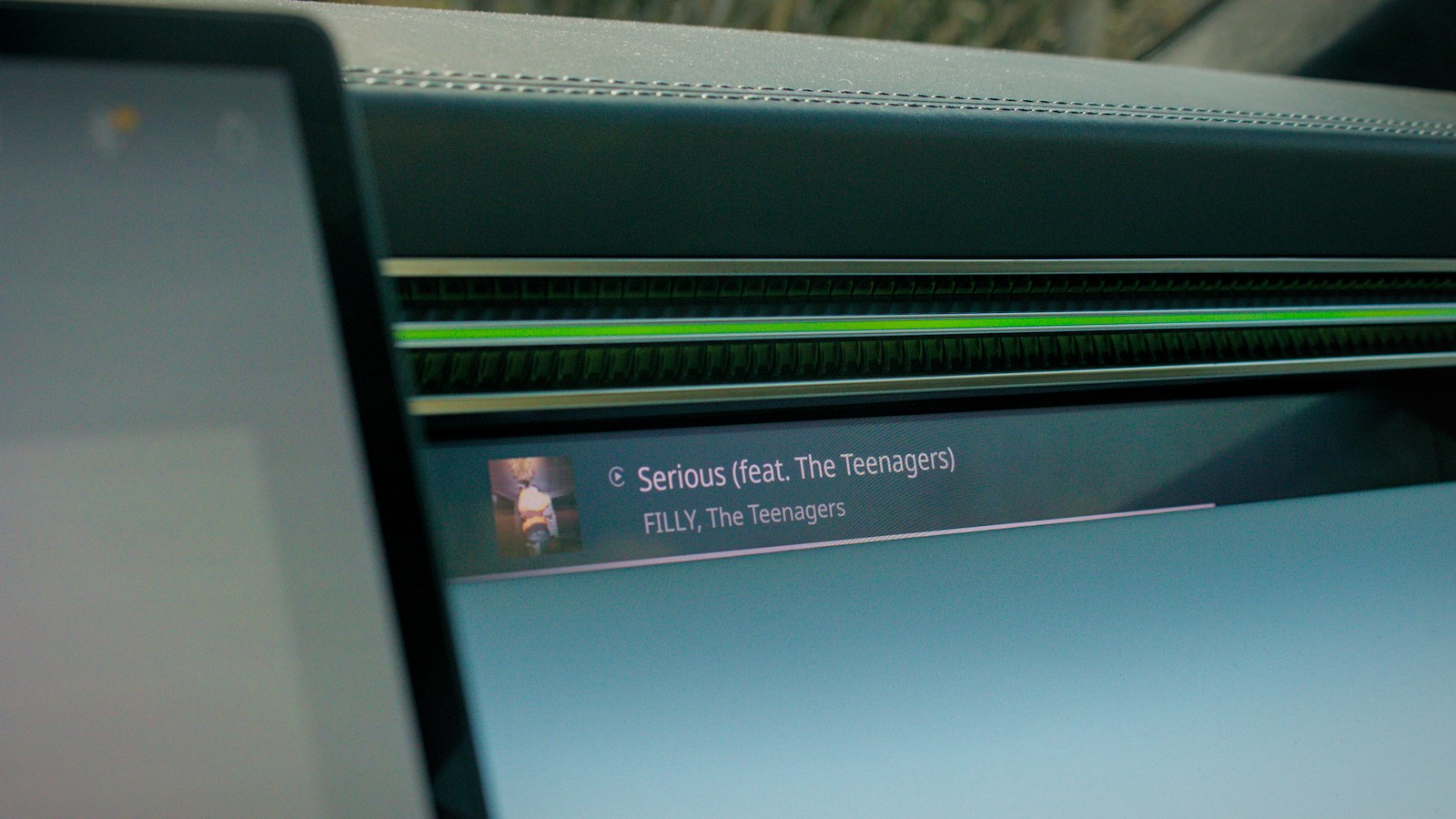
It’s also worth noting that the Eletre has the only good passenger screen I’ve ever encountered. Sure, functionality is limited to displaying relatively basic information like the time, key stats, and the current song playing, but it’s so wonderfully unobtrusive that it actually makes sense. Give whoever’s riding shotgun a little more information, but don’t bombard them with a billboard-sized fingerprint collector.
Oh, and while we’re on the subject of screens, the infotainment system is incredibly slick, with the sort of fluidity you’d expect from an iPad. It’s not perfect—Apple CarPlay integration could use a little work, and I encountered the occasional minor glitch in the native system—but it’s rather promising. We’ve come a long way from the days of aftermarket-supplied head units in Elises and Evoras.
Three Things To Know About The Lotus Eletre
- The build quality feels remarkably excellent.
- It handles better than anything weighing 2.5 tons should.
- It’s the first made-in-China EV sold in Canada under the new import cap scheme.
Does The Lotus Eletre Fulfil Its Purpose?
It depends on how you define the Eletre’s purpose. As a way of offsetting the carbon emissions of the Emira sports car in particularly sensitive markets, it goes above and beyond. Longer-range EVs exist and the dealer network is rather small, but the Eletre drives incredibly well for something weighing more than two-and-a-half tons and feels reassuringly posh.
Thanks to Canada opening up a quota program for Chinese-built EVs, the Eletre now starts at $124,550 Canadian, including a $4,650 freight charge. That’s about $8,000 Canadian less than the 650-horsepower BMW iX M70 xDrive, but about $12,000 Canadian more than the quicker Porsche Macan Electric 4S. Granted, it is much larger than the Porsche, although options do add up similarly quickly. Want soft-close doors, ventilated massaging seats, and configurable ambient lighting? Be prepared to spend an extra $10,000 Canadian on the Eletre Touring. Want the top-shelf 23-speaker audio system with the front subwoofer unit, active aero, and fancy pedals? That’s another $10,000 Canadian on top of the Eletre Touring, or $144,550 Canadian before options.
That’s still quite competitive, and while the Eletre is a European take on a Chinese-built EV, the fact that it rides on a variant of Geely’s SEA platform makes me excited for the future. Geely-owned Zeekr is actively hiring in Canada, and with BYD on Transport Canada’s approved importer list, it’s only a matter of time before I get behind the wheel of fully-Chinese EVs. If they’re anything like this, they’re going to be good.
What’s The Punctum Of The Lotus Eletre?
Regardless of where it’s made, this is one surprisingly fun luxury SUV.
Top graphic image: Thomas Hundal


Why does something like this need 600 horsepower, let alone 900?
5,600 pounds
I assume it could weigh a good bit less than that if it didn’t have a giant 100+kw battery! And it only needs a battery that large because it has 600-900hp.
Why does any car need 600 hp?
Spec sheets sell cars and people always want more. Today people complain that vehicles that go 0-60 in 6 seconds are slow.
Knowing that these were available for like 5 seconds here in the US, I jumped on Autotrader to see what was available… The cheapest one is $235k. And I thought the $144k Canadian was a lot.
I thought the promise of Chinese EVs was cheapness and high bang-for-buck (bang-for-loony?). I don’t think our neighbors to the north are going to be overly excited if all 49,000 cars turn out to be $100,000+ luxury barges.
Cheap cars rely on volume for profits. If they’re only allowed to sell 50k cars, it’s gonna be the pricey, high-margin ones.
$125k for a Chinese SUV?
I’m open to the idea of owning a Chinese car, but I am absolutely expecting a significant discount compared to a Canadian, European, or Japanese vehicle.
Everything Forest Auto Reviews has shown us from China usually has spectacular specs and features, for about half of what a comparable North American vehicle would cost.
Those are the type of products we were hoping to see with this new Chinese deal.
Everyone always says the Chinese government subsidizes prices of cars in China, so why would you think that the price of those cars when imported to Canada would be remotely similar to their local selling price? They are not selling cars in Canada to give us discounts, but to increase their profit margins. BYD Seagull sells in China for ~ $7800 US. In Canada it is going to sell for $29,000 CAD. The Canadian deal apparently mandates that 50% of those cars have to be under $35,000 CAD, but we are not going to get a car that sells for the equivalent of $35,000 in China for that $35K.
I don’t expect the prices of Chinese cars in Canada to match their domestic price.
That being said, the price needs to be significantly lower than comparable vehicles already available here, or they will have a tough time marketing these to Canadians.
China wants to sell cars in Canada so they can make money. They won’t be making any money with no sales.
I wasn’t familiar with the BYD Seagull.
With those specs and Chinese origins, I’m thinking it’s a tough sell at anything over $18k CAD.
The range is good, but EVs that have been similarly underpowered have proven to be a sales failure here 100% of the time.
I really hope they have something better up their sleeve.
A co-worker who is looking for a new car was excited when we heard Chinese EVs were coming and he’s the one who showed me the numbers on the Seagull. He’s not so excited now.
I’m confident that they have the ability to deliver something that is marketable and has great value. Hopefully that happens sooner than later.
112 kWH for 239 miles of range? Ouch! I cannot imagine in the winter…
Lucid Gravity has 123 kWH for 450 miles, much better.
All the aero work done on this thing is a death sentence for efficiency. All that channeling creates drag, not to mention the wheels aren’t even remotely aerodynamic in their shape which is likely a 40+ mile hit on it’s own. I get their attempt was to make this thing sporty, but all it did was just make it even less practical for no benefit of the people who would actually buy it.
Still very confused as to who this is for.
I don’t think there’s very many (American at least) luxury buyers who even know what Lotus is. Especially luxury crossover-pod buyers. Hell, someone like my wife would assume Lotus is a Chinese brand.
I’m sure it’s nice and drives surprisingly well but I’d hope just about any manufacturer with that goal and a price target of 125k could do the same thing.
At 5600 pounds this is roughly 5 early Elan’s which weighed in at 550 kilos! Sorry Geely, there’s nothing about this Big Mac sized badged “Lotus” that actually says Lotus to me.
The Chinese market is basically committing genocide on European luxury cars….
It’s shockingly ugly
When they launched this to staff at Hethel we were surprised, partly because so few of us had worked on it, but also because it’s utterly huge.
We were in one of the workshops in Styling, a large featureless room, and as we walked up to it for a closer look we kept stopping, thinking we were nearly there, only to realise that it was still a short walk away.
A 5,600 pound Chinese-made “Lotus” SUV. Literally everything about that is a no-go for me. May the people who buy this get exactly what they deserve. Simplify and add lightness is dead.
Exactly. The New Chinese Lotus mantra appears to be “Complicate, and add lots of weight”.
Michigan tags. Lotus. Chinese. Heavy EV.
The dealer service should be extremely wonderful. Wow.
Lotus Eletre NHRN? Ha ha
(Not Her/His Real Name)
As Colin Chapman never said: Stuplicate and add fatness.
I know you have to point out the CCS port versus NACS, but it really is as easy as ‘get an adapter’. They use the same protocol, and are pin compatible with an adapter. Not like my Leaf owning mother-in-law who bought a CHAdeMO to CCS adapter that requires its own battery to translate signals (it does work, though).
NACS is slightly slicker, but it’s not even as big of a deal as getting a diesel that can’t fit the larger pump nozzle type (my ’05 VW TDi could fit it just fine, but my ’96 HiAce cannot use a commercial filler, to my chagrin).
“Lotus is bringing their Chinese-made EV over.”
Now, there’s one sentence I wouldn’t have imagined fifteen years ago. Probably ten also. Maybe five too.
And yet 20 years ago Lotus was showing off the APX SUV, which was probably going to be made in Malaysia. In 2007 there was an EV version of that being shown off.
The ICE version had particularly well designed hydro-formed exhaust manifolds. Hideous, but well designed.
Wow, I hadn’t thought Lotus was looking at SUVs 20years ago. Time flies.
In designing the manifold, was the envelope consideration any different from what would be expected due to it being a shared platform with an EV drivetrain?
The main consideration with the exhaust manifold was that some idiot had put the steering columns in the way. The only way to avoid handed RHD/LHD engine positions was hydro-forming. Fun to design for, because to get the wacky geometry from hydro-forming you still have to design the pipe bends on traditional tooling to get the base tube in the hydro-forming tool.
Hooray for springback surprise!
I don’t know much detail on hydroforming to begin with, but I’ve always thought of it as a process for sheet. Tube must be extra special.
APX SUV’s rear glass is a…choice.
A Lotus by any other name.. wait a minute, that should be “A Geely by any other name… is still a Geely. (What the hell is a Geely anyway, an eel with lots of gills?!)
I still feel like this is just a Lotus in name only. Booooo…
Like the modern Mini and the modern MG before it, it IS just a Lotus in name only. Much the same could arguably be said for every brand in the Stellantis roster – even Jeep.
The only other alternative is that these zombie brands are permanently shuttered by legislation and then we let history do its forgetting thing.
But that’s not how capitalism works. And it’s not like the current iteration of Mini’s, MG’s and Lotus’s are demonstrably pedestrian automobiles…
The Lotus Eletre Is The First Chinese-Built EV Sold Under Canada’s Quota Program And It’s Shockingly Good
THe EV Eletre is Shockingly Good. <groan> 🙂
So a slit for a dashboard, and a big screen slapped on shelf. That interior is boring and ugly at the same time.
Hmm . . . I really like the color and uh . . . yeah, the color’s great.
It’s the new Irish State SUV
I legitimately thought that was a Urus at first glance. And second.
I see this as the next Tucker. They can make one good one and improve and fix all the mistakes but they will never build them with equal parts quality and quantity
Interesting! It makes sense that the program would launch with a car with a badge known in the West. Any idea why the car has Michigan plates on it? That doesn’t seem to make much sense for a Chinese import to Canada
Especially as it is illegal in the USA. Nice catch
It’s a manufacturer plate. Cars with those can be used for testing on the road without being certified, so you see them a lot on prototypes and non-US market vehicles for evaluation. Since these are state-issued, it might vary somewhat, but IIRC, the Fed gives a one-year use, then the manufacturer has to show proof of export or destruction of the vehicle.
Yeah, I just find it odd that they would have taken it to the US first and gotten it manufacturer-plated there, when they don’t plan on selling it there. Not that it’s anything sketchy or illegal; just (on the surface) logistically strange
Their NA HQ is in MI. It looks like Canada operates through dealer networks and doesn’t appear to have a direct manufacturer center, so that probably has something to do with it.
I had to look that up, I didn’t know that off the top of my head.
oooooooo green interior 😀
Too bad they isn’t go with a smaller battery to save weight, since it is a Lotus after all, but given their reputation, is a Chinese Lotus *really* worst than a real Lotus? LOL
Yes it is
Well, it can’t leak oil and/or fuel on the ground like a traditional old English car.
yeah, but it can still have electrical problems 😛
As someone who until recently had a job designing Electric Drive Units for EVs I can assure you that there is still plenty of oil for an EV to drip out.
A co-worker that recently bought a Tesla Model 3 told me the only fluid it has is brake fluid. He literally thought that was true.
The last EV I drove had brake fluid, wiper fluid, AC refrigerant, gearbox oil, motor/inverter oil/coolant, several different coolant circuits running at different temperatures and the tears of a former ICE designer.
I thought these were almost universally panned by international reviewers
They were. But this blog loves Chinese cars. Can’t get enough.
Well, I think that The Autopian does EV coverage with a fairly reasonable spin. There have been plenty of pieces that are not wholly in favor of full BEV adoption. The bigger problem is that the website seems to lean heavily on contrarian or higher-register takes, and this seems like the latter. “Well, it’s actually pretty good!” Said with the same tone as someone saying “I think the Giants are a playoff team”
… or, this Jeep is nearly rust free …..
Give us a hint of why or a link. Not being critical. Just curious.
one of the one’s I can recall is Harry Metcalf’s review. If you don’t watch Harry’s Garage, I recommend it thoroughly. If you check out the range and battery specs, it has deplorably efficiency
Jayemm on cars is another critical review of this ‘Lotus”.