

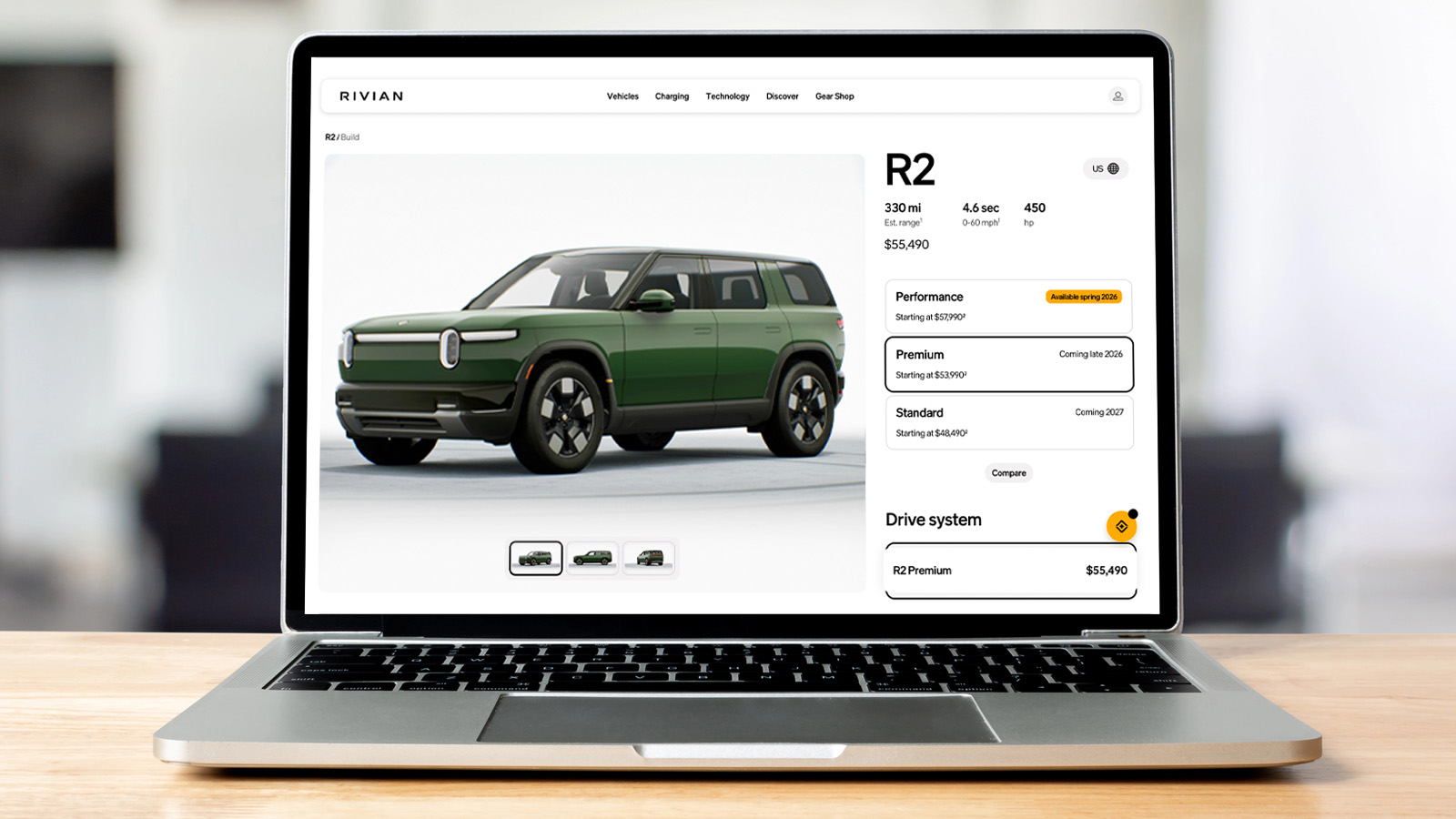
The Rivian R2 is a huge product for Rivian, an EV startup that builds excellent products (despite some reliability concerns noted by Consumer Reports). The R2 is meant to be the company’s first “affordable” machine, with a starting price of $48,490 – near America’s average vehicle transaction price and well below the $70K+ asking price of the company’s first two vehicles, the R1T and R1S. Today the R2’s configurator launched (HERE), and I discovered that the cheapest one I’d want costs $57,245.
Do you get a lot for your money at $48,490? I’ll know when I drive the car early next month, but let’s just look at the numbers and features.


This is the base R2:

At that base price, you have one color option, Esker Silver. And you have one interior option, Black Crater:

As you can see, the interior looks decent and minimalistic, with a center stack that appears to be a big screen on the dash with no physical switches. The dash vents, like on other Rivians, are operated through the screen, though mercifully, the gloveboxes (there are two!) are opened manually.
This base R2 is rear-wheel drive only, offers a decent 345 mile range, and its 350 horsepower launches the midsize SUV to 60mph in 5.9 seconds, per Rivian.

It’s a good looking vehicle that’s entering an increasingly crowded segment, but if the R2 can offer some off-road capability, it can carve out a nice niche, as there are few off-road-y midsize EVs available in the $52,000 range ($52,000 is the cheapest all-wheel drive R2).
If it were me, I’d skip the Standard trim and jump for the Premium. Yes, I’m cheap and don’t like spending money, but I hate dark interiors, and I want all-wheel drive, which comes standard on Premium models. Here’s a look at the Premium’s available ($1000) Coastal Cloud Signature cabin:

I dig that! Also awesome is the cheapest (tied with Half Moon Gray) color that isn’t silver or white, Forest Green:

If I want all-wheel drive, that nice interior, that $1500 non-white-or-silver paint, and a donut spare tire, the total is going to run me:

$57,245.
For that I get a 450 horsepower, handsome SUV with a minimalist center stack, an otherwise elegant cabin, 330 miles of range, and all-wheel drive. Not cheap, but Rivian has built a nice brand for itself, so I could see the appeal. I’m excited to drive one of these next month to see if those $57 grand would be well-spent.
Top graphic images: DepositPhotos.com; Rivian




Watched a video going over some of the differences between this and the R1 and most of the de-contenting seems totally fine to me, although I question whether some of the things they did actually save them much money on the manufacturing side.
However, as cool as the dual scroll wheels seem to be, they are not a replacement for physical controls, and in practice I’m not sure I would even like them. I don’t like the scroll wheel in my truck because it’s too easy to bump while you’re turning. These are bigger and probably worse on that front, except they control a lot more so you’re more likely to end up getting your ear drums blasted when you accidentally change the volume.
Not that I was probably in the market for an EV truck anyway (at least not anytime soon), but that interior is a dealbreaker for me.
You might as well get the performance, if that price is legit. $4k more and includes the tow package and autopilot for about what it would cost to add it to the premium. Plus you get the semi-active suspension and the more powerful motors
Comparison being the thief of joy and all that, may I present to you an absolutely generic Chinese electric SUV (Geely EX5) that looks IMO nicer inside, has similar range and is only a couple of seconds slower to 100kph – which I’m hoping doesn’t matter to people buying non-sporting SUVS. In Aus, 46k AUD whereas my spec of the R2 came to 54k USD. My point is they’ve lost the fight if ever tariffs drop. You have to make it much nicer or more interesting. The R3 looks cool in a nuggety current Honda HRV kinda way though.
Oh man, I’m really tempted by this. Sure, I’d like some physical buttons, but the steering wheel pucks do seem pretty helpful and intuitive based on what I’ve seen demonstrated so far.
I can’t wait to see what the R3x brings to the table – fingers crossed that sees the light of day in the next year or two.
Seems like a reasonable price…at least from European point of view.
I read that as “Besker Silver” and immediately said, “This is the Way”
Does it offer 4wd or just AWD?
I did some digging because I was also curious. It looks like it’s closest to what most would consider 4wd with open differentials. Because there’s a motor in each axle, it will behave as if the center differential is locked. Further traction control will likely come from electronically actuating the brakes to prevent wheelspin on tires that aren’t on the ground or are on ice.
Munro teardown: https://youtu.be/09qpEbRKelk?si=M9LtpYpc6iHacin5
Old link to Rivian testing half way down the page: https://www.rivianforums.com/forum/threads/enduro-dual-motor-electric-powertrain-to-get-locking-differentials-revealed-in-rivian-patent.10847/page-2
A motor on the each axle is a lot different than a traditional set up with a locked center.
Assuming each motor is the same size, you’d be limited to 50% of total power available on each axle. With a center locker, you can (theoretically) send 100% of power to just one of the axles.
This is why, despite some electrics having four motors (one for each wheel) there is still shortcomings in specific situations over something that has three locking differentials. Sure, they aren’t exactly common or “popular” situations, but they exist.
That being said, for daily driving, I’ll take the independent motors (two, three or four).
No, just no – I want with all my teeth the lada-niva looking R3. Everything else can suck it!
Some people will buy it. The dash with zero buttons and just two dumb screens kills it for me. You can always put colored seat covers on a car and wrap the outside, but the controls and dynamics are fixed. Hard pass. I’d buy a restored 90’s 4runner instead and use the leftover $20,000 for vacations in it.
Yup, good plan.
If your cross shopping a 1990s 4runner you are not even close to Rivians target market.
I’m definitely their target demographic in most ways, except that we owned an EV, they are transportation appliances with no soul and I don’t feel the need to do that again in the near future. Our home EV charger is collecting dust.
Am I seeing things correctly? There is no trim or option for a R2 with a roof rack for my ski box?
Crossbars are a $700 accessory.
Quick-snap designFeatures a one-handed snap-on design that securely locks into R2’s accessory ports. Telescoping capability makes it easy to quickly adjust and mount equipment and mounts.
I love Rivian as a brand and dig their Rs – although from afar. I hope this does well at this price point / features ratio!
David, my brother in Chrysler.
You JUST posted a story about your tiny child Mount St. Helens-ing you with puke.
And you desire a WHITE interior?!
I wish there were a brown one!
And does it have to be white pleather? Go for broke with white crushed velour.
I guess that’s expected pricing. 🙁 I agree with Vic: the upcharges are more than a bit insulting, cost-wise.
And I guess this means the R3/X will retail in the upper $40Ks. 🙁
It’s a giant metal Patagonia jacket.
I love it.
I know this is a $55k+ item at the end of the day, but they are really grating my “don’t nickel and dime me” nerve. The $1500-2000 for exotic paint colors like “white” and “black”, $1000 up charge to not have a black hole for an interior, and the cherry: $755 compact spare tire. That spare tire have bluetooth and Claude built in?
The overpriced spare is a fair complaint. It does come with tools, jack, and chocks, but I’m the type who would buy those separately and save some cash unless there’s something REALLY cool about their tool kit. I doubt it.
Let’s call the upcharge for those paint colors a tax on those who insist that cars should be boring. The “free” paint color should be something bold, like at least a bright blue.
The up charge for paint isn’t even within line of most of the industry (ignoring Tesla).
I really hate that dashboard.
Same. I want SOME buttons. At the very least climate control and some infotainment stuff.
I think they’re banking on folks loving the buttons/wheels that are built into the steering wheel.
Any car with this sort of user interface can bank on me not giving them any bank at all.
I LOATHE steering wheel buttons. They might be fine if there was a standard for them, but they are inevitably random and inscrutable. There is only ONE thing a steering wheel should be controlling, and it’s not the “infotainment”.
In the end, nearly no one will use the buttons. So why put them in there anyways?
HVAC can be put on Auto…no need to further use any of these buttons. And so on.
We had this topic in my company very often. We did customer studies on this…Most people don’t care about buttons. Yes in the first step, they find it a bit strange without. But as soon as they use the car, they don’t care anymore.
I have never had an HVAC system on auto that made me happy. Somehow, I feel the need to always adjust something. Temp, vent distribution, etc. I get that a lot of folks can set and forget, but something in my lizard brain need to fiddle with it now and then.
For the other stuff, I believe you. It does sound weird to only have a touch screen. My current car (23 Hyundai Santa Cruz Night)has a nice balance of touch screen for Android Auto but physical buttons for HVAC and infotainment on both the dash and steering wheel.
As someone WHO worked many years in the HVAC development and Adaption, I unfortunately have to hate you. Leave your Fingers away feom the HVAC.
Just kidding. But playing around won’t make it better. But many American Cars are not that Well Adapted…
Found the company that keeps selling manufacturers on button-less interiors, which they always backtrack on a few years later because customers hate them.
Mark me as one that never uses auto HVAC because it always seems to default to MAX AC if it is 86 or higher l. , and never do they seem to use vent even if it was colder outside . But maybe that’s changed for cars in the 2020 decade.
1. The Goal ist to reach the wanted INSIDE Temperature as soon as possible If IT IS very hot. So yes they nicht run in max Power, but should ramp down the power and blower down rather quickly. Note: the Temperature you Set ist Not the Temperature you will have. At least in Europe there is a DIN Norm for this.
2. What do you mean with vent? Central vents? They are usually Just for cold Air. You dont want to distribute warm Air towards the head or upper Body parts. Therefore usually heating is done via Windscreen defrost vent and floor vents. But many Car Makers have other solutions Here, i Just can Talk for the companies i have worked for.
I hate Manual HVAC and it really annoys me when people start playing around with HVAC settings. Usually they make Things way worse.
Vent = instead of enganging the compressor the car will bring in air from outside when it is cooler than the air inside.
There are a few scenarios where this is useful,
1) on a long trip during the day where the air is a moderate temperature 68-76F you can cool the cabin without AC at all, saving wear and tear and gas. (do modern ones do this? None of my auto do this)
2) in the desert when it is 120+ inside the car when you first start driving it is more efficient to flood the cabin with outside air that is +20° cooler before engaging the AC. I’m pretty sure none of them do this.
I’ve given in and started using auto, but it’s never a set-it-and-forget-it experience. For one thing, the temperature I want it to be changes depending on what I was doing before I got in the car. If I was on a bike ride on a hot day I want it to blast cold air until I tell it to stop. If I’m cold, the same except with hot air.
I’ve also found that on multi-hour drives I tend to have to adjust the auto temperature too. I don’t know if that’s me or the car not being consistent, but either way it’s a thing that happens.
I think this is really well priced and a somewhat unique proposition in the market. I’m really hoping it does well and lives up to the hype.
I do think the specs are just OK in a rapidly changing electric car landscape. The range is competitive but is quickly getting eclipsed, and fast charging speeds are too slow.
I’m not sure how much this will be cross shopped with the iX3, but the BMW has over 100 additional miles of range and charges twice as fast on a DC charger.
I think the range is fine, but I 100% agree about the charging speeds. It’s very weird to me that Rivian, an EV-only, tech-first company, has put this incredibly important product on aging 400v architecture.
Given that I rarely DCFC, it’s still on the list of potential replacements when my Ioniq 5’s lease is up next year, but it would be a downer having to deal with middling charging speeds when on road trips. The I5 charges insanely fast.
I don’t think the Ioniq 5 gets enough praise for being 800V, despite coming out five years ago. That’s forward looking as hell.
That being said, can’t believe there isn’t an ICCU fix yet.
The iX3 is ~$10k more in the US when both are mid specced, and there’s space for BMW to close that gap with a smaller battery and RWD that still matches or beats the R2’s range. Volvo says the EX60 should be “$60k when well specced”, and more details will come out at the NY Auto Show this week.
The Rivian is still a fairly distinct flavor of vehicle compared to the road-focused Euro luxury cars though, and hopefully for them that’ll be enough to carry them through to the R3.
Silly question: why are so many of the BEVs RWD in the base config instead of FWD? It seems like FWD is the standardfor most ICE vehicles, so why not BEVs?
FWD is not great for vehicles which approach and are over 300hp.
Well, you might have a point there, but it leads me to ask why cars (people haulers) need more than 200 to 250 hp. I get it for performance cars.
Because FWD was always a packaging compromise unique to ICE powertrains.
Going electric means we’re free to revert back to the superior configuration.
FWD electric cars are silly.
FWD performance cars are silly. For appliance vehicles they are more forgiving (understeer rather than oversteer) and tend to handle better in slippery conditions. I mean, experience and proper tires probably make a bigger difference, but FWD is easier for most* people. I agree that RWD can be lots more fun, I just think there’s a reason most cars are FWD and it doesn’t just stem from the fact that they hace ICE propulsion.
*No stats to back this up, just my experience mixed with assumptions about most people.
FWD eliminates the driveshaft to the rear wheels. That means you can have a flatter cabin floor. There may also be advantages in reduced weight (no long drivrshaft) NVH (no driveshaft or rear differential) and general packaging efficiency.
For an EV, since all you’re doing is routing HV cables out of the front or rear of the battery, rear drive is easier. Lower articulation on the half-shafts since no steering, better weight transfer for acceleration, etc.
OK, that makes some sense. I still think FWD tends to be superior in ordinary driving situations, but I can accept that there are some engineering reasons to go with RWD.
Silly? The Type R version of the 3rd gen Integra would like to have a word.
Yep, silly. Not saying that they can’t be good, but RWD is better.
Great car. Would it be better AWD or RWD? Yes.
Think of how much better it would have been with RWD. Note that the S2000 was not FWD…
FWD ICE cars handle snow better because they have 60-70% of the weight on the front wheels. That is not the case for EVs which have a heavy battery between axles and close to 50/50 axle weights front / rear and some have a rear weight bias.
Climbing steep mountain roads in a FWD EV is no fun – even with winter tires. When we head up to ski the access road it is wheel spin city and I have to be careful to keep momentum. For some driveways I’ve had to back up because there simply is not enough weight on the front wheels. (2017 Bolt EV)
Personal opinion – I don’t like FWD in snow as wheel spin means I lose steering control and the entire car will drift into oncoming traffic or off the road if that wheelspin is combined with a corner.
I dunno about that. I leased a 2017 and a 2020 Chevy Bolt – they were pretty good cars. With an RWD configuration you would still need a cooling module up front to handle A/C and heat as well as cooling for the HV battery, power electronics and motor/gearbox.
You clearly do not drive in snow.
I lived most of my life in Maine. I can drive in snow. And on the same proper tires, I much preferred my ’11 328i wagon in snow to the ’08 Saab wagon it replaced. The Saab had very marginally better ability to get going from a stop, but the BMW had vastly better ability to turn and stop.
It’s really all about the tires anyway
Yup! And the meatbag behind the wheel.
It seems like a lot of people have answered this question already, but one of my EVs is actually a rare FWD EV (2024 Kona Electric). It has only 201 hp but the torque steer is… surprisingly strong.
I keep telling people, electric horsepower is very different from ICE horsepower. You get full torque from 0 RPM and instant response. The Kona feels much more like an overpowered hot hatch when you floor it. I can’t imagine what 300+ electric HP would feel like going through just the front wheels. That would be dangerous!
I didn’t realize that was such an issue. With ICE vehicles, torque steer is pretty much a solved issue. Well, maybe not for all applications. Anyway, it seems like they could do something to modulate the torque, either electronically or with gearing (yeah, I know, complex and expensive).
Yeah, it’s interesting because the front motor in my AWD Ionq 5 makes about 95 hp, but there is 0 torque steer. Obviously, that’s not much power, but Hyundai clearly did something to completely eliminate it.
The Kona is a cheaper car on an EV-first, but not dedicated EV platform (hence why it’s FWD, as the Ioniq lineup is all RWD or AWD).
Still an utterly fantastic car, but the amount of torque steer did surprise me. Thankfully, it’s still nowhere near as bad as my P2 V70, which actively tried to kill me whenever I floored it.
Dangerous torque steer that feels like a hot hatch? Yes please!
Buy a Spark EV. 400 lbs of torque, unequal drive shaft lengths and less than 3,000 lbs. Absolutely wild levels of torque steer when the accelerator is down.
ICE vehicles use FWD primarily for its transmission & driveshaft packaging benefits that don’t exist for EVs. For an off-road flavored semi-luxury/lifestyle vehicle like this Rivian, RWD is necessary because it’s associated with both BoF/’trucky’ and luxury vehicles. Additionally, for a larger crossover, there is enough unused space in the rear axle area to place the drive unit and inverter without interfering with interior packaging like 2nd row seat placement or underfloor cargo space. Placing the primary drive motor in the rear allows for more space for the frunk.
FWD is still useful in compact & more cost focused cars like the Leaf and Bolt, where the frunk is sacrificed for cost reasons and the lower seat height means a primary drive motor would in the rear would be a tighter squeeze. Some Chinese market vehicles like the Geely Xingyuan/EX2 and Nio’s Firefly show that a compact hatch can still have RWD & a frunk with the right engineering compromises.
I think it lets you move the real wheels farther back and makes passenger seating roomier.
I remember when you were happy to have anything that ran and you couldn’t see through the floor Hollywood.
As for those light colored interiors I suggest you think back to your recent mother’s day experience and think what Delmar’s, not his real name, puking fit, his real puke, would do to such an interior.
Can’t wait to see what the R3T looks like.
Hopefully it’s better looking than GMs H3T.
It’s not mentioned directly, but looks like the R2 will come with an internal 120v outlet, as well as a “Field outlet” that converts the charge port into another 120v outlet.
This is something that really should be standard on all EVs- being able to access the stored energy in an emergency is for me a major selling point. It was one of the factors that pushed me to a Kia EV6, and something that is noticeably absent on the Lexus EV that David was looking at.
Springing extra for AWD has me wondering if Autopian will ever have a piece on why people feel they need AWD.
I hear about it all the time these days, and yeah, I’m gonna be that guy and ask “how did people manage like I did with any number of RWD cars that kinda sucked in the snow but I still managed to never hit anything so what’s the deal with it being SO VERY necessary now?”
Can I blame it on the Subes?
My guess is because they haven’t heard of winter tires, which is funny, since a 2WD with winter tires will handily beat any 4WD vehicle with all-seasons in any level of snow.
Hmm. I’ll need to ask an expert, that’d be my brother whose North Country NY State residence might have finally had its last snowfall as I type.
He went from a Volt with 2 snows to a Tacoma 4×4 (and a sedan for when the roads eventually clear). Never got stuck with the Volt AFAIK but I don’t know if it was ever all that hairy.
I run winter tires year round on my AWD. It gives it a more aggressive look and I am not garaging $1,000 of tires at any point in time.
This is true in the midwest, maybe even new england. Out west, where we have actual mountains and where EVs are very popular, you need AWD (and good tires) to get home.
I think you can blame the Subes for making it an expectation for people, they marketed it really well. I live in a snowy place. I don’t need AWD, but it sure is nice. Winter tires keep me on the road, AWD gets me out of the driveway.
In David’s case, he actually takes his 4x4s off road, so no surprise he’d go for the 4WD. But yeah, you’re spot on that winter tires are way more important than 4WD unless you’re regularly climbing icy hills.
Yeah, I guess I didn’t think David would be taking something this nice off road, hadn’t even occured to me, but sure. Why not.
He did mention the off-road-ey potential right before saying he wanted the AWD one, so it seems pretty connected to me.
Hollywood Tracy needs AWD for sunny southern California? Say it ain’t so!
How about because I am not asking for permission on how I spend my money and I wanted AWD for both commuter vehicles when we had to drive all year-round in the midwest. Did you also know that AWD and snow tires are not exclusive?
oh dearies, someone felt seen.
BTW, if you misinterpreted my inquiry as being judgemental about what people choose to spend their money on, my bad.
I literally gave a sermon on this topic five days ago. I repeated the advice I gave people when talking about their wheels: “Drive what you like, as long as it’s legal.”
I never thought I’d get an opportunity to write this, but I DO try to practice what I preach.
(no, I’m not a Reverend, just a lay speaker. Or a lame speaker, depending on your tolerance levels.)
https://www.youtube.com/live/6EH3p7Zy9Xs?si=dwx7wgi1XUEL2cln
Did you mean lay speaker?
No. Slay speaker. My story/stickin’ to it.
In all seriousness, this is my fifth sermon for my church. I might do another, but maybe I’ve plumbed the depths of my teensy intellect.
And what about mud, dirt, sand non pavement roads?
I live in a hilly town in northern Wisconsin, and I’ve never owned any vehicle with AWD. But to be honest, I have owned a handful of 4WD SUVs, from an S-10 Blazer, to a K5 Blazer, to a Tracker, to a GMC Envoy, and other than the Envoy, none of them were all that great in the snow. I have winter tires on the Envoy and it is an absolute beast in the snow, but it pays for it by only getting 10 mpg, so we only take it out when there’s 8+ inches of snow on the roads and we absolutely need to get somewhere.
My last three daily drivers have all been manual-transmission RWD regular-cab pickup trucks with all-season tires and I get by just fine…
I think the ‘need’ for AWD is borderline brainwashing and/or cult-like behavior.
My RWD GMC Canyon and the wife’s Cruze get along just fine in the winters without AWD.
Yeah well I don’t need to wear a cup when sparring in my karate class but sometimes it is just worth it.
“I have to assume that there are not roads that steep near where you live in Wisconsin.”
You would be correct. Parts of my town are a little hilly, (14-16% grade) but the main highway only has a ~7% grade hill.
With 25-30% grade, I’d call that more mountainous than hilly, and AWD or 4WD would probably come in pretty handy in the winters.
I feel the answer is a lot of people didn’t manage. They were stopped by lack of skill or lack of traction. Or they knew someone who didn’t manage and it ‘stuck’ with them to never be that person. Modern cars have so much driver assist built into them nowadays that people take for granted that AWD feels frivolous, but if it’s available, why not?
I spent a winter in Anchorage driving a RWD Mazda without snow tires. You learn how to really drive. Then, my FWD Saab with winter Pirellis was unstoppable.
Yeah, that’s fair.
Same thing with bicycle helmets for kids. We didn’t need them why do parents insist on protecting their children when they can always make another one?
Because it’s nice. Same reason you get leather or ventilated seats or any other luxuries.
It has benefits in handling, acceleration (especially with EVs with the additional motor) and traction in limited situations.
It’s entirely situation dependent though – give me a RWD BMW M3 over the AWD one any day. On a fun performance car, I want the dynamics of RWD.
In areas with chain control, AWD (or 4×4) and snow tires keeps you from having to put on chains. No, snow tires alone and your mad skillz won’t pass inspection.
*yes, there is an R3 control officially on the books, I’ve only ever seen it once. They usually will close the road at this point.
I went on a work trip to inspect some equipment in Seattle area, and the quality inspector who met me there has spent his whole life in San Diego. We went to lunch and were discussing our rentals. Had a CX-50 with AWD and he said “yeah, I got the AWD because obviously it rains here a lot.”
And man, that blew my mind. I’m never, ever gonna forget that conversation.
People gonna people [shrug].
(I did look it up and, wow, yeah, San Diego gets literally half the annual rainfall – around 10 inches – I’d expect in my old digs of MetroWichita, which got around 20, which is why “dry land” crops can still be a thing there although most seem to be irrigated.)
As what might be the last word from me in this here thread–although I might whinge to the Autopian Security Council officers about doing a separate article about this–maybe it’s all for the best. The technology advances to the point where Nervous Nellies like me stop caring if a set of wheels can be driven at four corners rather than just two.
The issue in CA is that it goes months with no rain. The first heavy rainfall after a dry period is actually very slippery, due to all the oils that build up and don’t get washed away often.
Only time I’ve ever had my semi try to jackknife on me was not on snow or ice. It was on a freshly oiled road, in Phoenix, on a 100 degree day just after a brief sprinkle.
A few times I’ve been trying to accelerate on a steep on-ramp (the kind where you often have to pull out from a stop) in rainy conditions, and I actually had some difficulty with a car right behind me. The one time this happened to me in CA, putting my truck in 4WD (it’s the old kind not to be used on dry pavement and it really helped.)
I’m not going to say it’s necessary, but I will say it’s a no brainer in an EV or a hybrid with eAWD. The R2 is a little different because they lock AWD in the middle and upper trim, but in something like a Toyota hybrid econobox, eAWD is available for $1,500-$2,000 in the base trim. If I live anywhere that gets snow, or I plan to visit some family in Minnesota in the winter, I’m spending that $2k every single time. AWD in an electrified vehicle forgoes the downsides of conventional AWD and really only gives upsides for not that much more initial investment.
Especially in an EV, AWD has some distinct advantages. You don’t need a driveshaft running between the front and rear axles for one (big packaging, cabin space win). Secondly, it’s a really easy way to add more horsepower. Assuming the battery can support the load, adding AWD gives you another motor with its HP added to the total. As such, you can keep the original RWD/FWD motor and its HP, and get bonus HP from the second driven axle.
You can see this with the 0-60 times being much, much lower on AWD EVs relative to their single driven axle counterparts. My AWD EV6 drops from a RWD 6.5 second 0-60 to 4.5, just by adding the forward motor and its 95 bonus HP. In addition, the car feels much more sure-footed with all wheels driven.
Kia also attempts to mitigate the drivetrain windage penalty by clutching the front motor out when it’s not needed. This does result in a two step acceleration when you stomp it suddenly- there’s a noticeable increase in acceleration once the front motor synchronizes, clutches in, and starts to provide torque.
Some of these configurations are quite stingy. As far as I can tell, the base model doesn’t even come with heated seats, which are basically mandatory for most of the US and come standard on cheaper competitors. The most of the paint colors being a $2,000 charge is insane considering that it’s just black, $1,500 for your average grey is crazy, and $1,000 for rental car white is lunacy. And while a 15 mile range hit is relatively low, it’d still be nice to get RWD in the Premium trim if they’re going to lock heated seats and an interior color option behind that trim.
They really should’ve gone for a tan/colorful interior option for the higher trims, something Hyundai/Kia does well. At the mid-$50Ks, it’s getting dangerously close to something like the BMW iX3, which is currently in the mid-$60Ks when optioned well but can easily drop a few Ks when they introduce the cheaper RWD trim that should still compete on range while likely charging faster.
Yeah not having heated front seats seems odd. It’s by far the most efficient way to maintain comfort without wasting too much energy/range heating the full cabin. Looks like the R2 comes standard with a heat pump at least, so cabin heating power requirements will be somewhat mitigated.
Very stingy. $755 for a donut spare!
Can we please fast forward to the R3X? Please??
Hell, I’d be happy with a plain-Jane R3.
Same. I think when I go to replace my Ioniq 5, the R3 would really be a better fit for me. The R2 is still quite large. I just hope the R3 comes out soon enough!
100% would take a single motor (rear drive) R3. I really don’t want much more.
Dad is on the list for a Launch Edition but sad that the white interior won’t be available.