

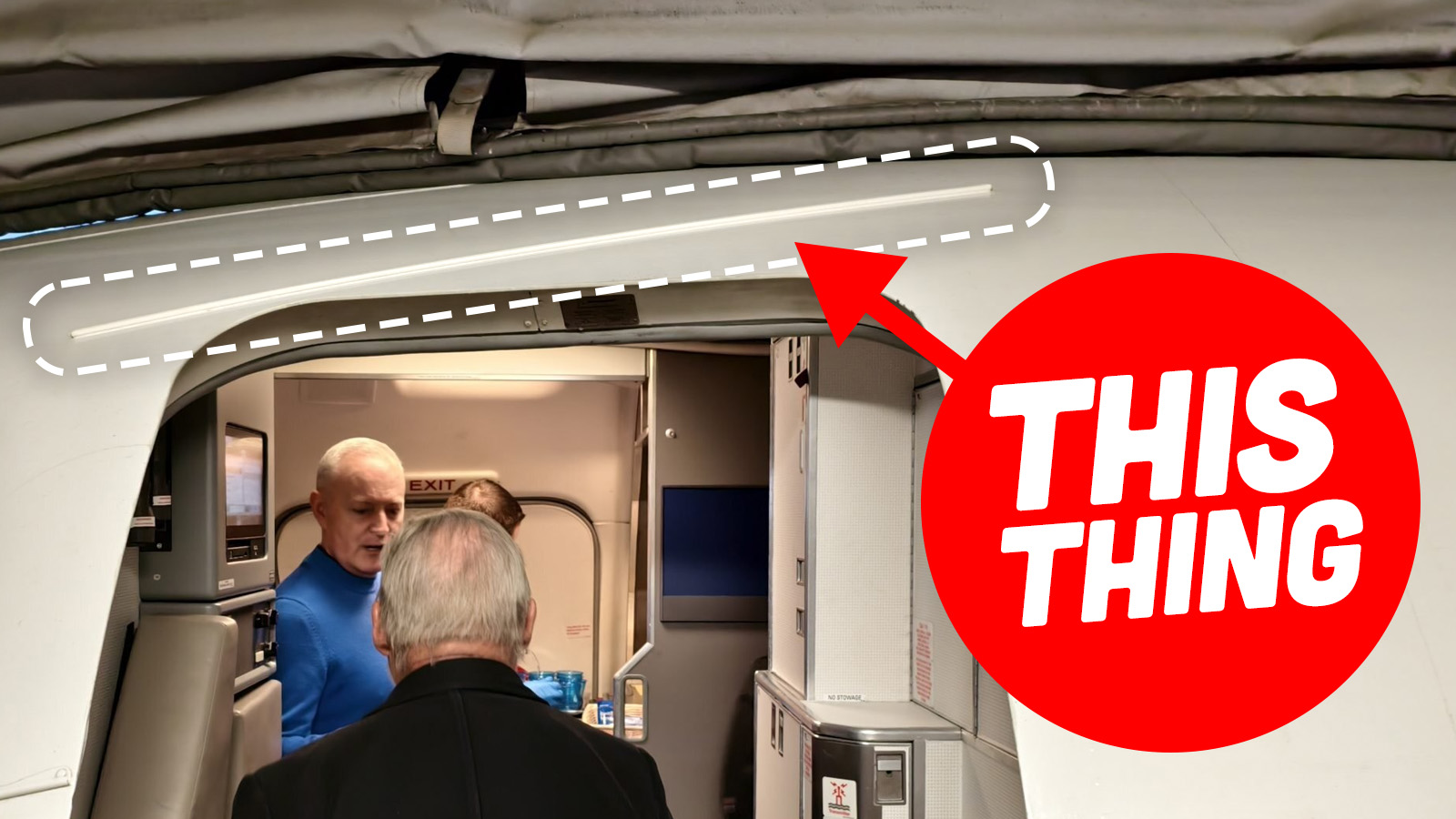
Today’s commercial aircraft are marvels of engineering designed to get millions of passengers safely to their destinations over a lifetime of tens of thousands of flight hours. Basically, every single part of an airplane serves a practical purpose, be it safety, efficiency, aerodynamics, or performance. There’s a chance that the last time you boarded a plane, you noticed a really tiny ledge above the cabin door. It looks so inconsequential that you might think its practical use is limited. That is true to a degree, but these ledges do serve a purpose in making flying a little better for both crews and passengers.
There’s a video circulating around the Internet showing an aircraft’s open cabin getting subjected to a deluge of water from a storm despite the jet bridge being attached to the aircraft. There are a few factors that led to this soggy incident. One of them was the fact that the fuselage’s built-in method to divert incoming water just couldn’t keep up with the flow.


Coincidentally, the timing of this video is rather perfect, as I’ve wanted to expand on my series of stories that explain the neat bits that make airplanes and the safety of modern aviation work. I’ve noticed that some people, including our very own Jason Torchinsky, have wondered why aircraft have tiny ledges above their doors. Upon first glance, for some, the ledges seem to be for aerodynamics. Their existence is even simpler than that, but they come with one major limitation.

How Planes Deal With Water In Flight
Flying into adverse weather conditions can come with risks. Aside from reduced visibility, you might run into heavy rain, strong thunderstorms, snow, icing, or other weather phenomena. Thankfully, pilots are trained on how to handle various weather situations. The aircraft they fly also come with clever solutions to combat the environment.
Icing is a serious subject in aviation, as ice build-up increases drag, reduces lift, and interferes with instruments. Planes can use hot air and electrical heating to help ward off ice build-up on wings, sensors, probes, engine intakes, and more. The hazards and solutions to aircraft icing have been covered in depth by the Federal Aviation Administration, the National Weather Service, the Aircraft Owners and Pilots Association, and so many others.
Rain carries its own risks. If rain accumulations freeze, for example, that can cause dangerous icing conditions. Rain can also be a bit of a headache even when there’s a low risk of icing. Pilots flying through a downpour can face reduced visibility through their windshields. Rain also brings the risks of turbulence, windshear, strong updrafts or downdrafts, microbursts, thunderstorms, and hail. On the ground, wet runways can reduce braking action. Water ingress can also damage sensitive aircraft systems.
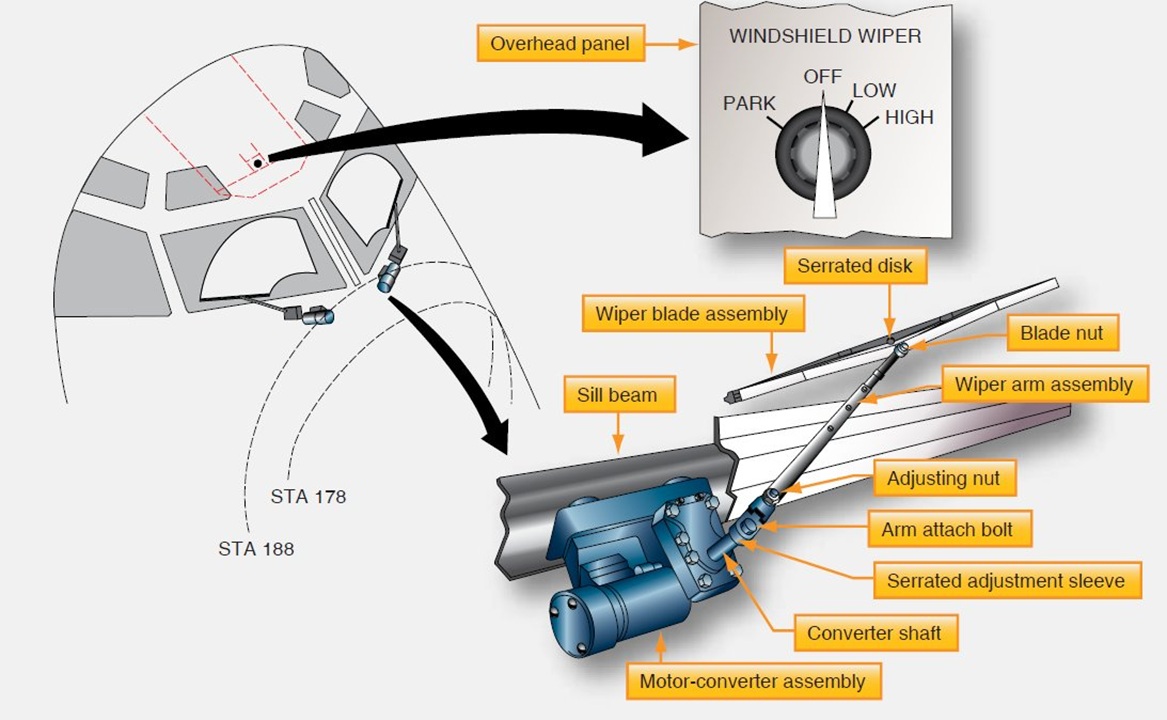
Planes do have some methods to deflect and control water. A visible method that you’ve likely seen is a windshield wiper system. Most transport aircraft with wipers use electric motors to move the wipers, and some older types use hydraulics. However, as the FAA notes, slipstream aerodynamic forces reduce wiper arm pressure, therefore reducing the effectiveness of the wiper system. Likewise, the wiper can run only so fast, and there are situations where the plane has to deal with so much water that the wipers are ineffective.
There are other ways to control water on the flight deck’s windows, like hydrophobic coatings.

The FAA explains how that works:
Some aircraft models use a surface seal coating, also called hydrophobic coating that is on the outside of the pilot’s/copilot’s windshield. The word hydrophobic means to repel or not absorb water. The windshield hydrophobic coating is on the external surface of the windows (windshields). The coatings cause raindrops to bead up and roll off, allowing the flight crew to see through the windshield with very little distortion. The hydrophobic windshield coating reduces the need for wipers and gives the flight crew better visibility during heavy rain. Most new aircraft windshields are treated with surface seal coating. The manufacturer’s coating process deeply penetrates the windshield surface providing hydrophobic action for quite some time. When effectiveness declines, products made to be applied in the field are used. These liquid treatments rubbed onto the surface of the windshield maintain the beading action of rain water. They must be applied periodically or as needed.

Another alternative to windshield wipers is the pneumatic rain removal system. Some aircraft use electric blowers to jet heated air at the flight deck windows to both warm the windshield to prevent icing and break up water into smaller particles.
An older, discontinued method of water control was the use of “Rainboe,” a chemical repellent that was sprayed onto windshields while the aircraft was in flight. It was found that Rainboe contained toxic CFC 113, and its production was banned in 1996. That aside, chemical-based repellents had the downside of hazing up or smearing when inadvertently applied to dry windows. CFC-free fluids have since taken the place of Rainboe.
Keeping Rain Out Of Planes

Another concern of aircraft engineers is keeping rain out of the aircraft while it’s at a gate. When the cabin doors are open, rain has a path of getting into the aircraft. At a minimum level, this can make passengers miserable as they board or deplane the aircraft. It also adds to the workload of the flight crew as they now have a mess to clean up.
Water ingress can also go further than just wetting the floor and passengers, too. On some types, like the Boeing 747, the main avionics bay is located right under the forward cabin door that’s open during the boarding process. As shown in at least one incident with the 747, there is a risk that, if water gets in through the open main cabin door, it can seep into the avionics bay.

On passenger aircraft, a jet bridge can help reduce water ingress. Jet bridges have a seal that leans against the aircraft, which helps to keep the weather out when boarding. However, the effectiveness of the seal on a jet bridge can vary wildly due to the weather, aircraft type, condition of the seal, and how well the jet bridge is aligned.
Planes have a built-in way to lessen the blow from rain. At the top of every door is a thin rail. This rail (below) serves the very simple purpose of keeping rain that runs down the top of the fuselage from leaking into the interior. The benefit is three-fold. Passengers don’t get rained on the moment they arrive at the cabin door, the flight crew doesn’t have to clean up water, and the maintenance crew doesn’t have to worry as much about water ingress. Some gutters also stretch out over the door hinge mechanism, too.

When a jet bridge is resting on the side of the aircraft, the rain gutter adds one extra layer of protection. Water that leaks past the jet bridge seal can drip down the aircraft away from the passengers and aircraft interior.
I have not been able to determine exactly when rain gutters were introduced to aircraft. However, I noticed that vintage prop-driven airliners like the Douglas DC-3 and the Douglas DC-6 do not have rain gutters. I have found that early jet airliners like the Boeing 707 and Douglas DC-8 do have rain gutters.

Some aircraft use flat rain gutters, while other designs have their rain gutters curve with the airflow around that part of the fuselage. Rain gutters are such a big deal that Boeing highlighted that it changed the Boeing 787’s rain gutters after input from airline customers:
Rain gutter: When customers found that water was not being properly deflected over a passenger entry door, they requested a change. Boeing relocated the gutter to function more efficiently. The solution means happy customers, who had fewer water and maintenance issues, and happier and drier passengers. This was a significant enough change to process to require certification work with the FAA.

There are limitations to rain gutters. They can be only so large, so if there’s enough water streaming down the fuselage, the water can dam up on the gutter and spill over. Likewise, the gutter can’t do anything about heavy rain or wind. It can only try to control the water streaming down the top of the fuselage.
That brings us back to the post that’s getting shared around social media (click here if you cannot see the embed below):
United trials onboard showers
byu/skyfaring55 inunitedairlines
Apparently, this all went down at Newark Liberty International Airport. It’s hard to tell exactly what went wrong here, but it looks like the jet bridge seal is overlapping with the rain gutter on the aircraft. That alone can cause an issue with the jet bridge seal while also defeating the purpose of the gutter at the same time. There could have been other causes, like the seal on the jet bridge was in poor condition or the jet bridge wasn’t in perfect alignment. Either way, there was enough water that the plane’s and the jet bridge’s defenses against water weren’t working.

It appears this flight continued without further incident, so the immediate aftermath was a big mess to clean up and some wet passengers.
There you have it. Multimillion-dollar planes are not a whole lot different than your house or your car when it comes to water evacuation. Planes employ some helpful technology to keep pilots’ vision clear and your head dry. Yet, unlike so many airplane parts, the rain gutter is so refreshingly simple. It’s just a strip of metal that redirects water. It doesn’t even have a special name like some aircraft parts; Boeing says it’s just called a “rain gutter.” I love that.
So, the next time you’re boarding a plane on a rainy day and you don’t see water about to drip on your head, you might have a jet bridge seal or a rain gutter to thank for that. It’s such a small thing, but even the small things can make flying just a little bit better for everyone.
Top graphic image: Author


Oooo…can you do the little wheel in the jetbridge that pushes against the fuselage??
Needing FAA approval to move the strip reminded me of Youtube’s Heavy-D Sparks who had to get FAA approval to install a Go-Pro mount on his Blackhawk helicopter. They don’t mess around. At all.
So RainX is hydrophobic? I confuse this with rabies.
Mercedes, even though this is an automotive website, I look forward to your aviation articles!
Flying little Cessnas was so therapeutic for me back when I worked in a high-stress (non-aviation) environment. You make sure the plane is safe, take off and climb up above all your earthly problems. Make sure you don’t run into weather or terrain and it’s just a great few hours. I owned a quarter share of a Cessna 150G and it was about the cheapest way to fly. 4 GPH and an A&P mechanic that let us help him do the annual inspection. While learning, a couple of the planes were so old that they had manual flaps (think of a handbrake) that really helped you realize what was going on when you deployed them.
I took many a commercial flight in and out of SEA and IAH in my working days. Intuitively, I recognized what that rail was for and wondered about how much drag that induced in flight. But there was really no way around the reasonable need for it. It’s not like the airlines could say “Yeah. Sorry about your suit or dress or T-shirt getting wet. (Next time, maybe, wear a bra.) Rain happens.”
Is there a “The PLANETOPIAN” and “The TRAINTOPIAN” future for this site? Don’t forget “the BOATOPIAN”.
My guess about the Newark situation was just about publicity. We haven’t heard about how much EWR sucks recently and they felt it was a good time to remind all of us, especially the people on that plane.
EWR was my preferred airport to fly to when I had projects in Manhattan. Land, get your stuff and take the train to Penn Station and cab it from there. So much quicker than JFK or LaGuardia. I’m not sure I’d recognize EWR now. It was going through some changes when I retired. And flying into JFK during its remodeling was horrible.
Oh. So sorry. First world problems.
Before automobile aerodynamics became a big deal, cars and trucks had rain rails over all the doors. Easy-Peasy.
Yeah. That’s what I was assuming and wondered how it could be more simple than a rain gutter.
Other official old here. I remember when your ski racks had to have special adaptations in the 80’s when rain gutters went away for aero doors.
Riddle me this. My car has 4 seats (5 in a pinch) and four doors, Why is it that an aircraft can have 100+ seats and only one operating door? I know the answer, but I’m always revisiting the question when in line to board or disembark a flight.
Humans are stupid and vain. We should be using multiple doors to both fill and empty a plane out.
Pay attention to the preflight briefing. There are two doors up front. Two over the wings (and often) and two in the back. They are equipped with slides.
To be certified, the plane has to be able to be completely evacuated within 90 seconds. That assumes people don’t try to grab their luggage stored in the overhead bins.
Any airliner with 100+ seats will have a minimum of 4 operating doors (under FAA/EASA regs at least). The current regs state you need 1 functional emergency exit per 50 passengers, and you have to assume half of your exits will be blocked in a crash, so that ends up being 2 per 50 PAX (there’s a waiver for 10 seats, so it ends up being up to 110 PAX you still only need 4 exits).
The limiting factor is jetways, which unless you have the big double tube ones for the A380 can only board 1 door at a time.
LLCs sometimes use airstairs in tbe front and back, but that requires a whole different type of infrastructure.
Fastest I’ve ever boarded a plane was in Rotorua New Zealand when they rolled 4 airstairs up, one on each side, front and back. Took maybe 5 minutes total. Bonus points that all the aircraft flying out there are so small NZ regs don’t actually require security, so no lines to deal with there either.
*LCCs
Ryanair’s 737s even have built-in airstairs at the forward door, so they don’t even need to wait for the stair truck to start unloading. Although, they are much more likely to be associated with trips/falls than a regular set of stairs.
Control and cost. It’s not really more complicated than that.
So the tiny ledge serves exactly the obvious purpose. I have always thought that they were rain gutters.
I was sure tha DC3s had rain gutters/drip rails, and after googling a bunch of FC3 pictures, it looks like some do and some don’t. Given how persnickety the FAA is about type certification, some having and some not having is quite a puzzlement.
The FAA wasn’t as persnickety (and technically didn’t exist, it was the predecessor Civil Aeronautics Board) when the DC3 was certified, so you have a lot more leeway to make changes as long as they fall under the original (much more lax) regulations.
That makes sense.
I remember a lot of hot hod Stearmans with Wasp Juniors and all sorts of stuff hanging of of them for ag use when I was a kid. Something about an age related regulatory gray area. The bar to cut through power lines was a nice touch. The new planes had more rules
It’s how you end up with ludicrous things like the “P-51’s” used in air racing. The only original component is the airframe data plate (which is for regulatory purposes the one irreducible component of the original aircraft), and then you bolt on carbon fiber frames, skins, modern engines, avionics, etc and still get to maintain and modify it under 1940s rules.
Really?
Well that make me feel better that no actual flyable airplanes are being destroyed.
There are some vintage racers that I would feel better about if there was more emphasis on preservation than winning races. Although it is fun to see the Bugatti drivers race the snot out of their cars. They tend to not “restore” their cars either, but they aren’t above keeping an English wheel in the paddock. Note, real Bugattis, not those VW things.
This reminds me of Jimmy Walker’s short bit in the movie Airplane! where he cleans the windshield of the plane, then pops the hood and checks the oil dipstick.
Ha! I’ll have to rewatch to catch that scene. But no engines up there. Just the radar.
Surely you’re not claiming Airplane took liberties with aircraft systems.
I am. And don’t call me Shirley.
Roger.
I am. And as sure as Joe Isuzu was a Hare Krishna, I will bitch slap you like a nun.
This seems obvious to me but I was born in the before time when cars had rain gutters above the doors and this is obviously the same damn thing. I haven’t read the article but this seems awfully long to say “Aircraft have rain gutters!”
Seemed obvious to me.
It’s not like they mount ski racks on airliners.
I’m always confused by those logic puzzles that start with “the answer isn’t the obvious one!”, and I spend the rest of the day wondering what the wrong answer was.
WeatherTech has missed a niche.
5000 words to say, “They are rain gutters to divert water.” ???? Sure, there was plenty of other information, but one sentence answers the question that was the title of the article. ????
???? is where I inserted emojis. I guess you’ll have to use your imagination. ????????????
When you get paid by the word, there are no one sentence answers.
Huh. I thought that rain on planes was mainly a concern in Spain.
By George I think he’s got it!
The rain gutters actually are more important in Spain (and the rest of Europe) where lots of flights board at remote stands via stairs instead of the jetbridge.
I remember those flying into Burbank and Ontario (California). I think Alaska Airlines even lent umbrellas to people back then!
I cannot lie: it’s 8AM, I’ve been up (inexplicably) for a couple hours already, and am only a single sip into my morning coffee. For that reason, I must admit that I have not yet read this surely fascinating article. To do it justice, I require more neurons to be firing, and that’s simply not the case in my present state.
I’d always assumed the purpose of that little angled strip of metal above the door (which I’ve noticed and thought about many times being the vaguely autistic armchair engineer that I am) was to divert water running down from the top of the curved fuselage so that it didn’t drip down a first class passenger’s neck and back as they made their stately egress from the aircraft. The flexible canvas accordian thingy at the end of the jetway hardly seems completely watertight, since you can often see daylight peeking through, especially at the top (and also I assume at the bottom, though that’s harder to see).
Aircraft are so interesting! 🙂
I’m always looking down, not up, since down is where things fall through the open gap,
Mind the gap!
Cool series!
You should do a deeper dive into deicing systems. Boots are particularly fun since if you get the timing wrong, you can end up with a hollow shell of ice on the leading edge that can’t be removed until you find warmer air.
Also a fun system is the water deflection device on some nose wheels, like this one on the 717:
https://www.airliners.net/photo/AirTran/Boeing-717-2BD/54999
Catching up with my guilt over not reading all the articles.
PlaneX
The “squarebody” GM pickup trucks as launched in 1973 didn’t have rain gutters over the doors. Whatever hidden solution GM’s engineers in the waning days of their 52% market share didn’t work and for ’74 gutters were back, in the meantime they were made available to owners of ’73s over the parts counter; if you ever see an early squarebody without them or with chrome ones – the parts-counter ones were chrome to save owners the trouble of painting them one of 15 or so different colors on offer – that’s a ’73.
It’s funny, as a person who grew up with normal cars normally having rain gutters, that a person born from the ¿80s onward could not know what that rib is for. But it makes sense.
The Wrangler is the only car I know of that still has them, though there are probably more. Probably the Ford Wrangler and the Mercedes Wrangler too.
The true purpose of rain gutters was as a way of welding the roof together. If you aren’t welding the roof together with a seam that can function as a rain gutter it’s a pain to put it there. Hand built cars generally don’t have rain gutters. I don’t think Rolls Royce ever did.
That makes sense, and would imply that rain gutters disappeared not for fuel economy-aero reasons, but because metalforming technologies had improved, removing the roof seams. I do remember my first car without gutters had a new sucky aspect to it, when opening the door to exit in the rain.
Fascinating as always! Although–being from Seattle–I’ve seen those gutters in use plenty of times, this reminded me of my old Saab, which had *excellent* rain gutters on either side of the windshield. Never any streaming water on the side windows in that car.
The real question, since Mercedes says that almost everything on a jetliner serves a practical purpose, is what parts serve an *impractical* purpose? I haven’t thought of any yet, especially as most planes with ashtrays have been retired by now….
If you fly on Ryanair, there is often an alcoholic drinks advert on the seat back in front of you to tell you that “The Bars Open”. As far as I can tell its only purpose is to annoy grammarians, and this doesn’t appear to be critical for flight operations.
Do Bombardier’s aircraft have eavestroughs?
Some Fokker’s look like they have dutch gutters.
Dang it! Now my mind is in the gutter.
To bring this back to the world of ground vehicles, I have the same kind of rain gutters over the door of my Scamp.
The modern airliner ‘s rain gutters would only divert water running down the surface of the fuselage. It would be the jet bridge that diverts rain from the sky. So before jet bridges (or even prop bridges), there was no need for rain gutters.
I feel like this article either needs an article-length comment by Torch, or a link to a seperate article, that rants about the loss of rain rails on our cars, the liquids they might divert, and the people whom he sweatily grasps trying to raise awareness.
A cinematographer friend told me about a movie that they had to reshoot a couple of scenes because a car in a stunt scene didn’t have raingutters, and a stuntwoman was supposed to be hanging onto the roof during a chase.
So I guess rain, ski racks, and women hanging onto the roof are all uses for this things.
My guess would be that older aircraft didn’t have these gutters because they predated airports that had jet bridges. When you flew on one of those old DC-3’s they drove the ladder truck out to the plane and you walked down onto the ramp yourself. (Do they still do this in Vegas? Last time I was there 15 years ago I had to walk across the ramp and up into the terminal).
I haven’t done that in Vegas, but I have at small airports in California, Oregon, and Hawai’i!
It still happens in Europe. I’ve walked up the stairs into a 747, which felt really epic.
Imagine walking up the stairs into a 747… And then climbing the spiral staircase up to business class.
From peasant stairs to royalty stairs in a matter of seconds.
Pretty hard to find a spiral stair 747 anymore, unfortunately. They’d switched to straight stairs by the 300 series.
My trips were always on the NWA 747-200 model. I was scheduled to have a flight on a 747-400 once, but there was a weather issue somewhere (DTW or MSP, probably) and the flight wasn’t full so they swapped a -200 for our flight. My upstairs seat got switched to a seat up in the nose.
I hope you turned and waived at the adoring crowds that were gathered to watch you depart!
Flash the old Nixon V for Victory!
Happened when I arrived once. Stopped at the stop of the stairs and waved, and the huge crowd at the terminal waved back.
I turned to the little chap next to me and said: “Folks sure are friendly here!”
“Yes,” said the Pope…..
I was on a flight from London to Hong Kong during a long deluge that had already lasted a few days. The bridges in the terminal were failing, apparently due to the water. After several hours delay, they handed out umbrellas and had us walk out to the plane and climb the stairs.
They told us to keep the umbrellas as souvenirs, I don’t think many people did and just left them in the overhead bins. The funny thing is they had a large cart at the end of the flight and invited people to deposit their unwanted umbrellas in it. You would have thought they would collect the umbrellas before take off to save flying them halfway around the world.
Quantas was decent enough to start serving drinks before we even got to the taxiway. I guess Australians aren’t all that backwards.
It was also funny to hear so many passengers chuckle when the pilot was making announcements. He did a pretty good job of pronouncing “check lap cock.”
Yep. I’ve used stairs to deplane both an A380 and 747 in Frankfurt. I also used stairs for boarding a 747 in Shanghai- during a typhoon. The Shanghai flight ended up getting canceled after boarding since water was leaking into the plane from one of the upper deck doors and dripping through a lighting fixture on the main deck. The Captain was justifiably worried about something shorting out and causing a fire.
I haven’t been on a plane in a long time but the Vegas airport does have mobile stairs on storage/standby at least. No idea what plane they are for but if I had to hazard a guess it was for non-commercial airline use because it was on the western portion of the airport.
Janet Air, probably.
I remember disembarking down a staircase on some family vacation when I was a kid, which would have been the early 2000s. No idea where though.
I was on a chartered 737 for my daughter’s club futbol team (the club had actually 10 teams onboard) in Feb..
We landed at Tampa and walked down portable stairs before heading out of the airport through the FBO. Rest of the ramp was all private jets and 1 (pt6 turboprop) Platus PC-12