

The tire pressure monitoring system (TPMS) is a great advancement in automotive technology. When it’s implemented well, there’s little guesswork in knowing if your tires are at safe pressures. Normally, you don’t have to think much about your TPMS until something breaks, but Spanish researchers want to sound an alarm about a potential vulnerability. It could be possible for a bad actor to use your car’s tire pressure sensors to see when your vehicle leaves a location. But before you panic, there’s good news.
This report comes to us from the IMDEA Networks Institute, and on the surface, it sounds like the stuff of dystopian science fiction. The institute published an eight-page peer-reviewed report supporting its claim. IMDEA Networks was founded by the Madrid Regional Government in 2006 to advance the science of computer networks. The institute says it largely focuses on research into network design, wireless communications, and cybersecurity, among other projects.


On February 25, the IMDEA Networks Institute published a wild headline that states “Your car’s tire sensors could be used to track you”. In its news publication, the institute said that it conducted a study over ten weeks where it successfully “collected signals from more than 20,000 vehicles,” and that common TPMS sensors have a critical vulnerability that could be exploited by hackers, criminals, governments, and others. Let’s take a look at this.
How Your Car Monitors Tire Pressure

Tire pressure monitoring systems have existed in the automotive world for 41 years. Schrader claims to have invented the first pressure monitoring system for cars in 1985, and that the first car to use a Schrader-branded TPMS was the 1997 Chevrolet Corvette C5. While Schrader says it invented the technology, Porsche was quicker in implementing it, as the 1986 Porsche 959 had a feature called Reifen Druck Kontrolle (Tire Pressure Control), which was developed by Bosch and PSK.
There are two general kinds of TPMS today.
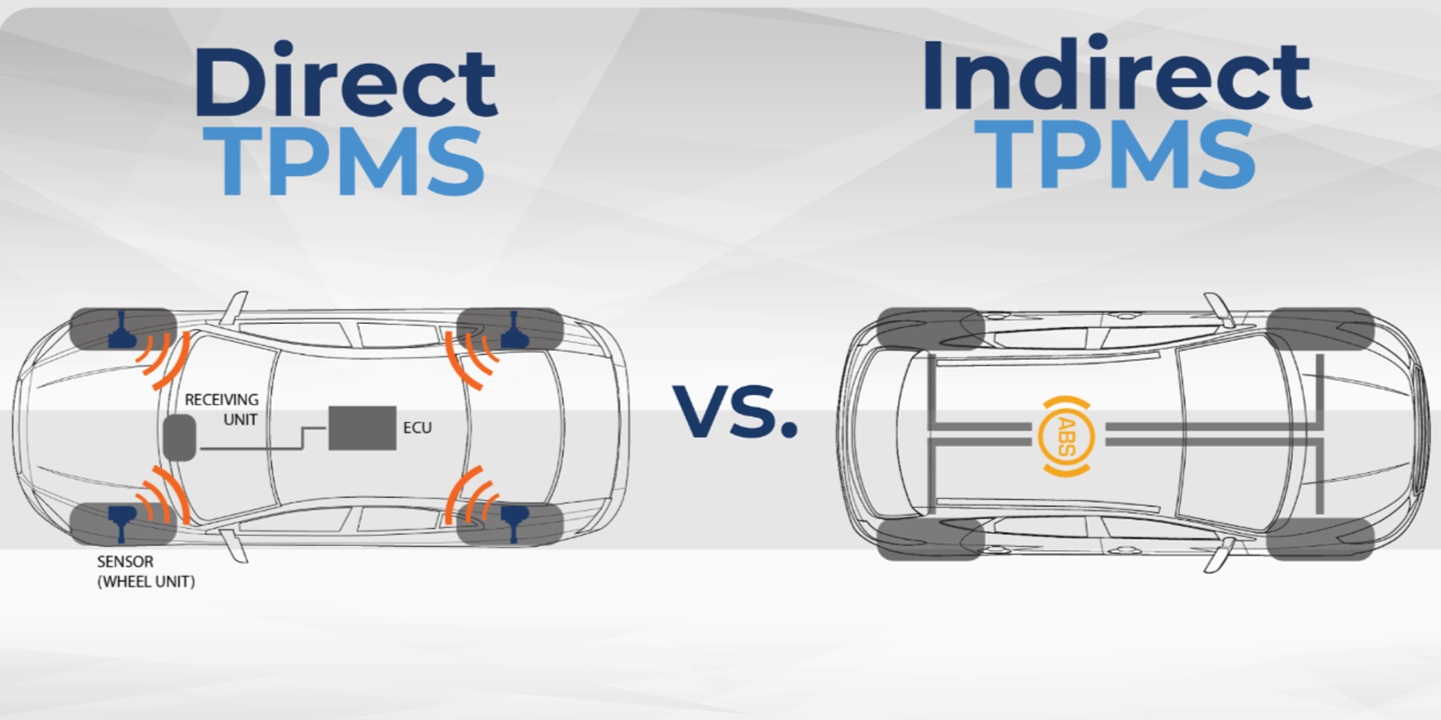
Indirect TPMS utilizes the vehicle’s wheel speed sensors. This is the same system that feeds active safety systems like traction control and ABS. In an indirect TPMS, the vehicle monitors wheel rotation, and if it detects that a wheel is moving too slowly (overinflated) or is moving too quickly (underinflated) compared to the others, it’ll illuminate a warning on the vehicle’s instrument cluster.
Indirect TPMS isn’t measuring tire pressure at all. This is why the cars that have indirect TPMS can’t tell you what your tire pressures are, and can only warn you when the system thinks something is off. These systems are also less precise because they aren’t monitoring tire pressure. If you own a Volkswagen Group vehicle, there’s a chance you’re running indirect TPMS. As Bridgestone Americas says, indirect TPMS is cheaper to implement and maintain than direct TPMS.
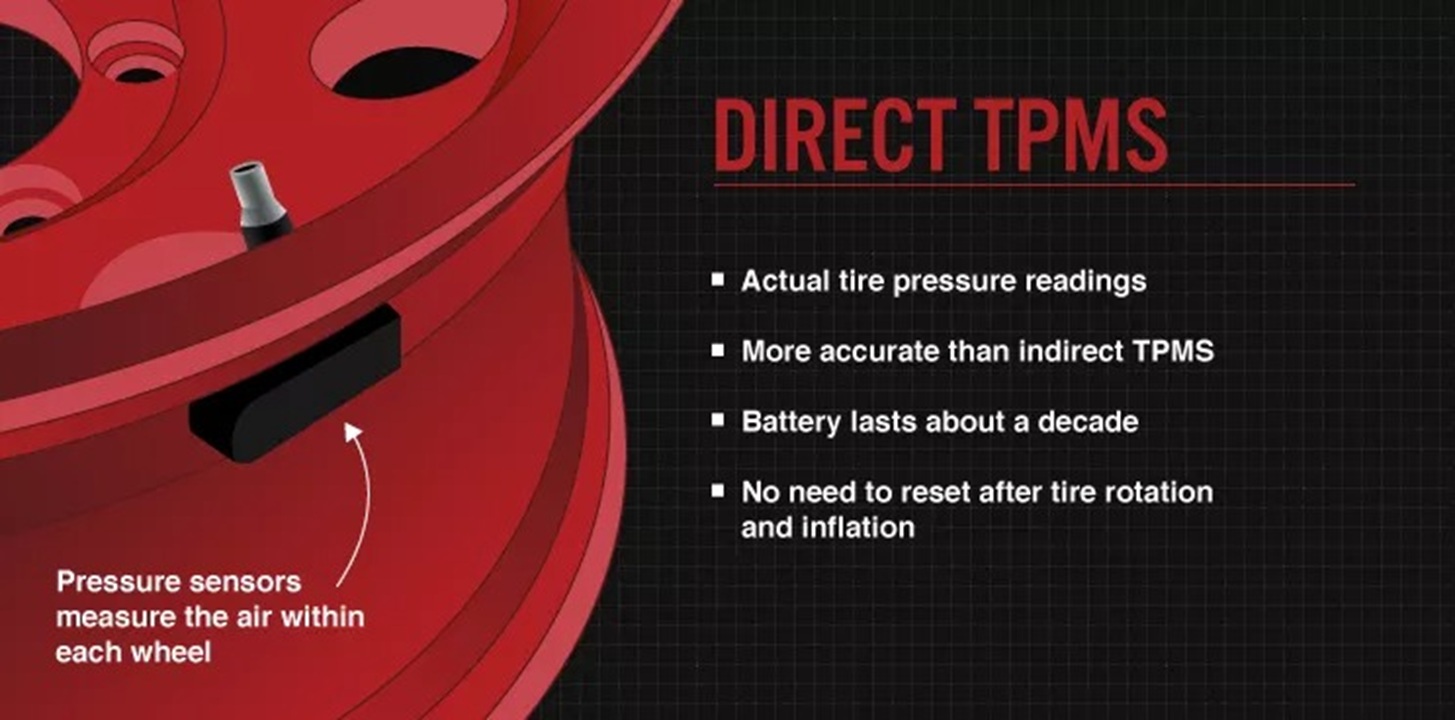
That brings us to direct TPMS. This system utilizes battery-powered sensors that are mounted onto the wheels that measure tire pressure. Some sensors also measure tire pressure. These sensors send text data to a module in the vehicle, which interprets the data. Many vehicles use direct TPMS to display actual tire pressures and temperatures to the driver. Some vehicles have direct TPMS, but utilize only a TPMS light. Direct TPMS, while more expensive, tends to be more useful to the driver.
That communication part is important, from the IMDEA Networks Institute:
As there is no open dTPMS standard, dTPMS communication is based on proprietary protocols and simple modulation schemes (for instance, ASK or FSK at 315 MHz or 433 MHz). Each TPMS sensor transmits the information about tire pressure and identifier to the Electronic Control Unit (ECU), located inside the vehicle. Manufacturers like Toyota, Renault, Hyundai or Mercedes typically favor these systems over iTPMS. The length of the message varies depending on the manufacturer, but the dTPMS messages usually are 100 bits in length with a symbol rate of 20 kbps, which means that a full transmission takes 5 ms. A TPMS message contains the following fields: preamble, with common hex structures like 0x55555556 or 0xaaaaaaa9; textbfID, which is a 24 to 32 bit hexadecimal string with the dTPMS sensor identifier; temperature; pressure; different flags which may contain parameters like battery status; and a checksum.
Although the operation of these devices varies among different manufacturers, most of them transmit pressure information when sudden changes in tire pressure are detected or when the vehicle is moving. When the vehicle starts to move, motion sensors trigger the pressure sensor to start data transmission with a period of 30-120 seconds. Another way to trigger transmissions from a TPMS sensor is to send a pulse in the LF band (125 kHz), which is the operation principle of many TPMS monitoring tools used in repair shops.
The TREAD Act of 2000 mandated the use of monitoring systems. If you drive a car that was built on September 1, 2007, or later, you have a TPMS that’s silently working in the background. Alright, so that’s how TPMS works. How can it be used to track cars?
The Study

The IMDEA Networks Institute opens its study by talking about the ways in which people are being tracked through their activities with their car. The institute says that car manufacturers monitor the position of vehicles through cellular networks, normally for maintenance reasons. Meanwhile, the institute says, even if you aren’t driving a connected car, your phone reports its location data. Even if you drive a Ford Model T and refrain from using technology, your vehicle can still be tracked by the increasing number of license plate cameras posted on the side of the road.
IMDEA Networks says that this is a big deal because this data and imagery may not always be used in good faith. The information in the hands of government entities and corporations can be used to catch criminals and find lost dogs until it isn’t. IMDEA Networks even has an example, from the report:
Although continuous car tracking is becoming ubiquitous, it also comes with privacy risks. Car movement data entails a lot of private and sensitive information. Movement data provides insights into the everyday private lives of their owners. For example, in a recent data breach that affected four large European car brands[1], researchers were able to systematically observe the activities of police officers, military officials, or individuals visiting medical facilities, raising serious privacy concerns for those affected entities.
As of July 2022, some 54 countries have implemented regulations around United Nations Regulation No. 155, which established cybersecurity requirements for vehicle manufacturing and type approval. These regulations do not include TPMS sensors, and IMDEA Networks decided to see how much of a vulnerability there is. IMDEA Networks says that previous research had indicated that TPMS signals could be read from as far away as 40 meters from a car, but it wasn’t clear how much risk there was.
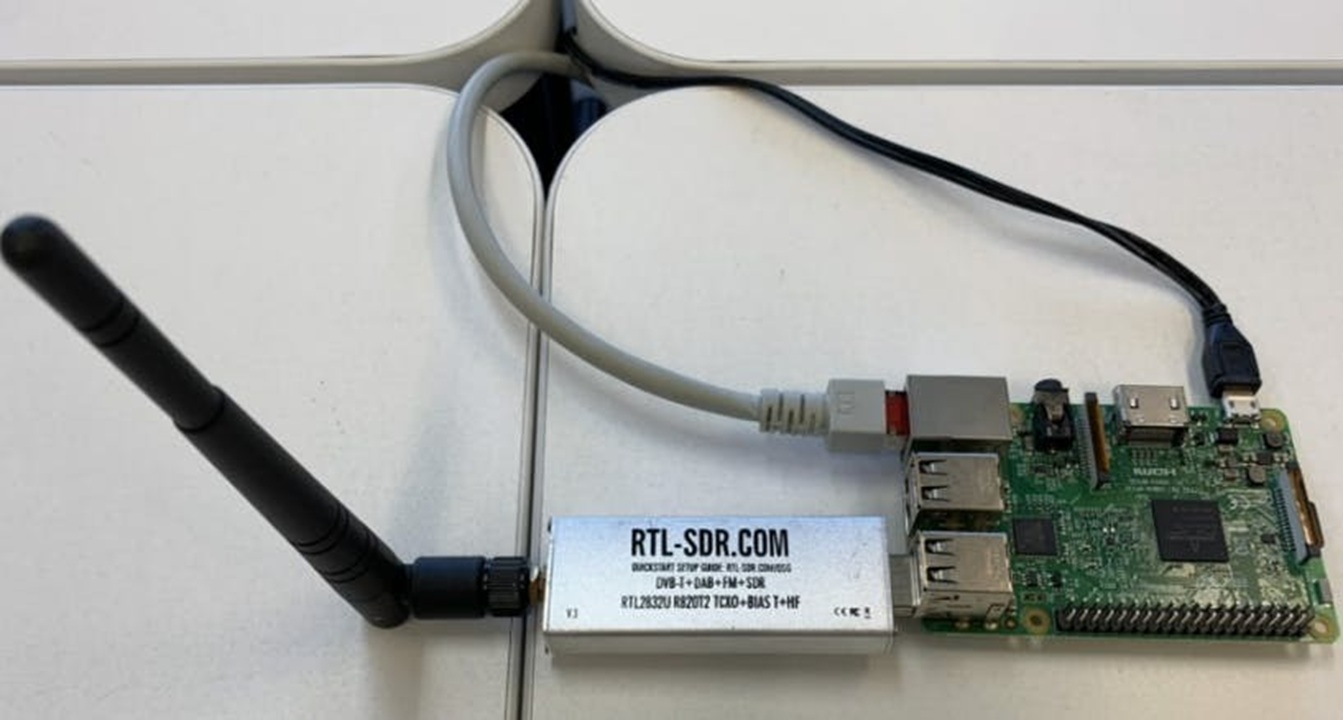
To test how big a deal this could be, IMDEA Networks acquired five RTL-SDR (software-defined radio) devices, which were then connected to Raspberry Pis. Open source rtl433 software was used for message decoding. The institute noted that it sourced all of the parts and software for its testing on the public market and that anyone could build a TPMS signal receiver for about $100 per receiver. Even data collection is easy, as you could connect the device to Wi-Fi, to Ethernet, or just have the receiver store the data on an SD card for later retrieval.
In its test, IMDEA Networks placed the five receivers in buildings in the same neighborhood near windows and pointed them at parking lots and roads. Distances between the receivers to the pavement ranged from 10 meters to 50 meters, and IMDEA Networks says that the receivers had no problem picking cars from 50 meters away. That’s without specialized equipment. The institute believes that, with an antenna designed specifically to pick up 433 MHz signals, the capture range could be extended even further.
Anyway, over the testing period of 10 weeks, the homebrew receivers caught six million TPMS messages from over 20,000 vehicles. IMDEA Networks also specifically tracked the data from 12 vehicles from volunteers. The institute took the data it received from the vehicles, plugged it into an algorithm, and was able to discover far more than you might expect from tire pressure monitoring. IMDEA Networks says that “TPMS transmissions can be used to systematically infer potentially sensitive information such as the presence, type, weight or driving pattern of the driver.”

To illustrate that, IMDEA Networks demonstrated what it was able to infer about some of the vehicles from the study:
We study the profile of four workers. This car is systematically seen at a fixed time at 8:00 am (except for a day) during the week and always leaves at 5:00 pm. Due to the working hours, we can deduce that this profile belongs to a full-time worker of the company. We can also extract more information from these patterns. On Day 12, they went outside to have lunch and we measured their car’s IDs at a time around 12:00 pm to 1:00 pm, as it took around 1 hour to have lunch. Another insight we can extract is that their car is never seen on Fridays, because they usually work from home on those days. Thus, from TPMS transmissions, we can also infer the remote/in-person work patterns of individuals.
[…]
In addition to regular working hours, we can also observe anomalies. First, on day 14 the driver left at their usual time, but appeared later in the evening. This can be explained because the driver attended a university course in the vicinity and on their way home, they passed through a road near the workplace. The next day, we can also see that the same driver attended another class and decided to go back through the same route. The second day, the workplace was still closed for holidays, and yet we were still able to capture transmissions from the nearby road.
[…]
The next case is of an external part-time worker, who comes a few days every week and does a shorter schedule than full-time workers. What is interesting is that we can capture TPMS transmissions every hour even when the vehicle was not moving. During our experiments we observe that each TPMS brand transmits with different strategies, as it can be seen in both Fig. 7b and Fig. 7. We observe that the TPMS sensors used by Toyota tend to transmit continuously, brands like Ford or Nissan do it less regularly, and brands like Renault only transmit when movement is detected on wheels.
The good news is that, as the institute notes, all of this is only hypothetical and inferences. The volunteers gave nothing but their permission to track their cars. Thus, IMDEA Networks doesn’t know their identities or what they actually do. TPMS cannot provide that data. However, the institute thinks it’s a big deal that its researchers were even able to get this far by taking consumer electronics and reading tire pressure data.
Why IMDEA Networks Thinks This Is A Threat

Why was the institute able to do this? IMDEA Networks says that TPMS transmissions are not encrypted or secured in any meaningful way, and they also carry unique identifiers. The institute continues:
Malicious users could deploy passive receivers on large scales and track citizens without their knowledge. The advantage of such a system, over more traditional camera-based ones, is that no direct line-of-sight is needed with the TPMS sensors and spectrum receivers could be placed in covert or hidden locations, making them harder to spot by victims. A data mining company could deploy receivers, gain insight on the types of traffic and routes taken, and then sell that data, all without the knowledge of the users (the drivers).
By establishing such a network of spectrum devices over a city, malicious users could track cars and infer behavioral patterns. In fact, another type of attack that results from passive surveillance could be for burglars in suburban residential areas. By tracking the vehicles of each household, they could infer the schedule and pattern of a particular household and take advantage of their absence. Finally, by combining passive monitoring with active spoofing, threat actors could track logistics trucks, spoof flat tire alerts to force stops, and then hijack the cargo.
Additionally, IMDEA Networks says, if a broad receiver network is combined with photo surveillance or physical addresses, it could be used to stalk specific people on a more personal level. IMDEA Networks notes that there have been proposals to secure TPMS, but to the institute’s knowledge, there’s no vehicle in production that does this, and no regulation for it, either. So, the institute hopes that, with this report, perhaps governments or auto manufacturers may consider improving TPMS security.
A Lot Of Work To Burgle A Home
Before you start yanking your tire pressure sensors out, you should know that there’s another side to this. As it currently stands, using tire pressure to stalk people is really impractical. If a burglar wants to break into your house, they probably aren’t going to set up a network of radios at $100 a piece to track your tires to see when you leave home. There are other, easier methods to figure that out.
IMDEA Networks talks about bandits using these hypothetical trackers to hijack trucks or to follow specific people. But remember, the bad guys would have to set up an entire network of receivers, spanning who knows how many miles, in order for that to work in reality. Again, there are easier ways to achieve this.
Likewise, if a government or corporation wants to monitor you, well, other methods already exist. As the study also states, TPMS doesn’t reveal private details like your identity. Simply placing cameras next to the road, something that already happens in much of America and Europe, already generates so much information.
However, the study is still fascinating in the sense of what you could infer from tire surveillance. The fact that you could even determine when a certain car is going to appear in or leave certain places is pretty interesting. So, IMDEA Networks seems to have a valid point that these sensors could be more secure. Now, I imagine that many Autopians are going to feel even better about driving something like a two-stroke Saab over anything modern.
Top graphic image: DepositPhotos.com


It’s lookin at my gut! I’M WORKING ON IT!!!
So I *shouldn’t* be annoyed at my Mazda6’s indirect system that just says “low tire” instead of WHICH tire is low or how low it is?
I am thankful that changing sensors has never been a thing for me when getting new tires, and I guess I’m also thankful I’ve never been hacked through sensors?
Most direct systems give you the same info, but you have to shell out $300+ for sensors every 5 years, because you can’t replace the batteries.
You’re much better off.
I wish I still had a car with indirect TPMS, although our Mazda occasionally cried wolf when driving on gravel. Our Fiat’s sensors apparently have weak batteries because they throw errors when it’s below freezing. Either way I don’t like the idea of people tracking my wheels anymore than the idea of hacking Shimano Di2.
I’m commenting just to say how much better Indirect TPMS is, and I wish that the direct sensors would go away. It’s just another way to add unnecessary costs to a car and to the maintenance.
Indirect uses the wheel speed sensor which is also used for ABS, it costs nothing to sustain or to set (there’s a button I push after I check/fill all the tires. The button just calibrates that “this is normal”).
Direct uses a specialized sensor that costs $70++ each to replace, then they charge money to “reprogram” the car.
Do you really need to know that your tires are at 35psi, 34psi, 25psi? What does that information actually do for you? Does it matter that a tire is at 28psi, or just that it’s “a little low”?
All you really need to know is that one is low. Indirect on my Mazda will light up when one is a little low (minor wheel speed deviation). If you let it get too low, the light will start flashing (larger wheel speed deviation).
The result is the same. I need to check tires and add air.
Replying to myself.
I especially love when the tire shop mounting my new tires tries to charge me for new TPMS sensors (which has happened twice), when I know damn well my wheels don’t have them. It turns into a fascinating scene of stammering about a paperwork “accident”.
Had this happen once, I caught it before paying. I’ll happily replace a bad sensor, but not for a car never TPMS equipped!
You make a very compelling argument for indirect TPMS. I’ll consider direct TPMS an excess complexity/anti-feature issue going forward.
When I bought direct TPMS sensors for my Acura winter wheels they were $30 each from Rock Auto. $70 to $100 is the tire shop price.
My VW Sportwagon has indirect sensors and they worked OK. It was nice not to have to reprogram twice a year when changing from summer to winter tires and then back. However, they also don’t work at low speeds – something I found out after driving for more than an hour on a forest service road only to discover a puncture when I came back from my hike.
Personally I’ll spend $120 every ten years to be able to read the actual PSI of each tire quickly from a screen.
Since I don’t mount & dismount my own tires, I, like most other people, am at the mercy of tire shops. They won’t let me bring in outside parts, so they will charge $70-100. So that’s $400.
It sounds like you’re a lucky edge-case where you change your own tires, and you often never go above 30mph.
I still fell like Indirect is better for most people.
I am in this same situation with my ’16 Explorer. Three of the four sensors are dead, and I get to deal with the TPMS light and the dash singing ‘I’m A Ford! I’m A Ford! I’m A Ford!” song every startup.
Can you tell that Ford (and the Explorer, natch) is the reason TPMS even exists?? Ford’s own over-the-top warning(s) wants you to remember.
I also work somewhere that gets me a significant discount on new tires.
My local tire shop ALWAYS charges me extra (like $25 more per corner) when I bring my own tires, and will likely bend me over for a set of sensors next time.
As such, I am going to have a mobile tire installer come and do my tires in the driveway, I provide my discounted tires and new sensors. Sure it’s going to be a bit more on paper – but I’m not being raped with ‘own tire’ fees and 500% marked up TPMS sensors…
No lucky edge case. To took my TPMS sensors and wheels / tires with me to Discount Tire – (a massive tire chain that does business in 39 states) and they dismounted the tires, installed the sensors, mounted the tires – all for $100. That is $20 more than just doing the tires.
I disagree. Indirect TPMS is next to useless. By the time it notifies you, your tire is probably pretty low – if not already flat. Direct TPMS can warn you much sooner, and I like being able to see the pressure in all 4 tires whenever I want. Rotating tires is automatic, no relearn is necessary on my vehicles. I’ll pay a few hundred in 10 years to replace the TPMS sesnsors if I keep the car that long for the added conveneince and safety of direct TPMS.
That is not my experience. My Mazda, Indirect, light comes on when one is only a few pounds low.
My Volt, direct, requires “reprogramming” if they are rotated. I think, that’s what the manual says, but haven’t had to do it yet.
So YMMV.
I’ve got direct TPMS in my Sienna.
It doesn’t tell you tire location or pressure, just an amber warning lamp.
In Toronto, we generally run snow tires for 5 months of the year, so it’s either warning lamp for 5 months or shell out the $300-$400 for sensors.
So, for my 7 months a year of TPMS use, I get 6 to 8 years of sensor life.
I bought new all weather tires recently, so I asked them to check my sensors and replace if needed.
They didn’t do that.
The sensors died weeks later, and it will cost me at least $200 for the tire re&re plus the cost of sensors.
So now I just have new expensive tires, a warning lamp on, and no TPMS.
Indirect TPMS = YES PLEASE.
How accurate is your Mazda? Because I got a warning on my GTI and seriously, it was maybe 3 PSI? Enough to send me over a median at Cars and Coffee for sure, but that’s sensitive…
Pretty sensitive. Probably also 3psi or so. I fill to 32, and the light comes on around 28-29?
That’s amazing…
Please just tell me that the tpms sensors are not equipped to transmit advertising
Very interesting, any information on if a tpms has broken down does it still transmit data? Because in my experience these last about 5 months.
Oh dear, everybody and everything is spouting identifiable radio waves and some bright sparks decide to pick on the tire sensors. That’s worth a head shake.
You all forget that FedEx has AI cameras in each truck that are plate readers also.So anytime you pass a FedEx the location is captured.
Keep in mind they are filming when they pull into your driveway also.
It is primarily used for accidents etc however they have a deal with Flock also for data.
I can vouch that public transportation vehicles are overly loaded with cameras for the same reason
If you want to make your tinfoil hat tighter, license plate readers are also widely and are often terribly insecure. Here’s one instance:
https://www.cisa.gov/news-events/ics-advisories/icsa-24-165-19
That’s just what’s publicly available.
And for theft. In this case it was a UPS delivery. Driver backed up to our loading dock, was followed in by driver in car. Driver got out, told the UPS driver he had a package on the truck for him, but he had to leave now and could not wait at home for the delivery. He had the order information (invoice, etc from the sender to him showing his delivery name, address), and the UPS tracking number as well, on his phone. The driver gave him the package. It was two I phones. The driver was an imposter. I do not know if the UPS driver asked for ID. We have it on our security cameras, handed this over to the police. High tech porch pirates that have eliminated the porch. Be careful out there.
“It could be possible for a bad actor to use your car’s tire pressure sensors to see when your vehicle leaves a location”
Well. That’s no good. No way I’d like Kirk Cameron to know where I am.
Hot tip: this is already what retailers do with the Bluetooth on your phone when you walk in a store
Gonna get some roofing lead to wrap my phone in…
Instructions unclear, already drilled em out and filled the tire with spray foam /s
Weight is mentioned but no further discussion is had. I don’t remember the Ideal Gas Law, but if small changes in load (weight) can affect the measured pressure from internal volume compression of the tire, giving a proportional signal up or down, then it could be inferred who is driving the car, if you know their weights, or if there are passengers present.
PV=nRT. So if the internal temperature of the tire changes that’s to to change the pressure too.
Honestly I doubt the sensors are accurate enough for such a system distinguish between the few lbs different drivers weigh. Any such difference could just as easily be lbs of dog, gas, rocks or groceries.
Probably right. I’m giving way too much credit to consumer grade automotive components. They just don’t have the resolution.
Plus the pressure changes as the tire warms up through driving the vehicle too. I’m throwing the BS flag on the weight measurement being anywhere near reliable.
The paper assumes that tires with much higher pressures are larger vehicles.
I have a general dislike for TMPS as I don’t tend to buy new cars, so the damn batteries are always expiring, causing annoying lights on the dash. Forever, because I’m too cheap to buy new ones, and too lazy to demount tires just to replace them.
Aside from that, there is an edge case; tracking and monitoring people (cars) where specific measures have been taken to avoid surveillance. If I were an actor who wanted to track a person or people who left behind or disabled radios around them (bluetooth, wifi, etc), I might still be able to do this, and a few thousands or tens of thousands might not be any deterrent at all to implement for a completely passive and warrantless(?) tracker.
Very good explainer on TPMS, but I do have one thing to add. Indirect TPMS has no way to know when you have added air and corrected the situation. I won’t say always, but in most cases if you have the indirect system there will be a reset button. Kind of an easy way to tell if you have the indirect system.
All of the indirect systems I’ve used reset automatically when they track all the wheels rotating within normal parameters.
That is why I didn’t say always, any car I ever encountered you were instructed to reset the system after airing tires
My 07 Camry has a reset button
My Mazda has indirect, and the button. I love it, it works great.
My Mazda has indirect and no reset button
The good news is that mine are always malfunctioning. The one “British electronics” thing I’ve found since I bought the car.
Yeah. your phone is already doing this. Unless you’re a full tinfoil enjoyer there are much easier ways to do this, and if your current headgear is Reynolds Wrap you already drive a car with no computers in it.
Yes, I’ve found this to be the key to remaining both anonymous and unnoticed.
Beige Camry FTW!
And they all said I was mad. They all laughed…
But look at me now! I’m about to become a millionaire with my patent pending whole wheel Faraday cage.
Some Teslas use Bluetooth TPMS sensors. Yikes.
This is my shocked face that there’s yet ANOTHER giant security hole in a car that’s basically privacy dark matter
All TPMS sensors have unique identifiers and are generically used to monitor traffic. If one was so inclined to link a unique ID to a person’s car it could be tracked all over but why do that when everyone has a phone we can do that with cheaper equipment and longer range. Your car stereo has Bluetooth as well and that also can be tracked. Having Bluetooth in TPMS is not any more concerning that it on your stereo, phone, headphones, watches, and other devices.
Hah my car’s stereo has no Bluetooth, and neither does my headphones, watch or other devices. Now I’m safe.
Don’t carry a cell phone if you want to be safe.
The newest ones do. Boggled my mind recently. I suspect it allows them to increase service/accessory revenue – they’re not cheap.
Going back to Toyota’s infamous unintended acceleration debacle, it was found that modern electronic throttle actuators could be controlled wirelessly. A baddie could remotely take control of your throttle for nefarious purposes.
It turns out this never actually happened in our known history, because the average baddie still prefers to do things the good old American way and shoot you in the face.
A few years later, a Chinese company was able to take over a Tesla wirelessly, making it sing and dance and put on a lights show. Again, we were all worried about what baddies would do with this new found ability.
It turns out they never used that one either, instead continuing to capitalize on opportunities where the vehicle is unlocked or left with the windows down.
In more modern times, everyone’s car gets stolen, because you simply don’t need keys to do that anymore.
Car owners were delighted to find that you can just hide and $20 keychain in your car that will tell the boys in blue exactly where to catch the baddies red handed with your stolen vehicle.
This is when the police clarified that while they do take reports from victims, they are not in the business of recovering stolen property or protecting your assets. That is the business of the insurers.
But yeah, the implications of Bluetooth tpms sensors are pretty scary.
I don’t seem to have been born with a paranoia gene.
I’m sanguine about it, but after working in advertising, I don’t want to make it easy for them to make money off me without my consent. So much of what’s sold as “convenience” is not, but it sure is lucrative
Meh, my feeling is shit needs to be paid for. And I am perfectly happy to pay for things with other than my hard-earned cash. We Gen-Xers ignored TV and radio commercials for many decades when that was all the entertainment there was outside of a movie theatre, and I am just as good at ignoring them today (and I have some damned good adblocking software too).
What needs to be paid for, tho? This info doesn’t get used to benefit me, yaknow? It’s most often used to bolster a company’s bottom line, and those companies OFTEN use their power, money, and influence to cause me further harm or at least aggravation
I use the Hell out of Google’s services, as one example, without giving them a dime in real cash money. Google Maps alone would be worth a lot of cash if I wasn’t paying in data. Same with streaming services – I am perfectly fine paying a pittance for Netflix in exchange for there being some ads vs. what it would costs to go ad-free. Given what I do for work, I intimately know that it costs to provide IT services at scale.
Yeah – similar. I’m sure Apple Maps has a lot of my info. I do like my artisanal nav capabilities (I can use paper maps). With the entertainment stuff, I either choise not to (Spotify, because they don’t pay the artists but they sure profit from their work), or find a way I can feel ok about. It would make things harder if I had bad FOMO, I guess
Yeah, I don’t stream music other than iHeart Radio occasionally, which is basically just radio stations over the Internet. I have a 2000+ CD music collection, and I actually like old-fashioned OTA radio.
Most of what I stream is podcasts and WUMB
WUMB sounded familiar. I was a WUMA volunteer – probably a major cause of my being a UMASS – Amherst dropout in 1964…
Amherst’s calls are now WMUA.
WUMB is broadcast from UMass Boston in South Boston (and a bunch of translators and repeaters across the region). The school holds the license, but the station is its own entity.
WERS is Emerson’s station and that’s got more school involvement, as you would expect.
Isnt that where Click and Clack the Tappet Brothers was produced?
Nah, that was WBUR
Yep WBUR, Boston University is the license holder for that one.
I should also finally just get the Pi-Hole adblocker set up here
Me neither. I also don’t particularly care if someone did track my cars. They’d just have weeks of data of nothing moving. lol
Misfire reply
I think maybe you meant that for me rather than Mercedes, since she lives in IL. But cold FL is WI, not ME. Though MI gives them a good run for the money.
Not that there isn’t PLENTY of crazy in ME, and I am related to an awful lot of it. My family tree should have had a lot more branches… Thankfully my Mom put LOTS of chlorine in that particular gene puddle. 🙂
You read faster thanI realized it wasn’t a reply from you hahah. And I will accept WI, that also makes sense.
Anyone who wants to watch my life it going to be horrifyingly bored in short order. I only have three cars that sit all the time, but the other two don’t go anywhere more interesting than the airport a couple times a month, then Maine once a year, where I live just as boring an existence.
My life is literally an open book – I even have a not-quite lowest level security clearance for work reasons, so the Feds know about all there is to know about me.
I’m getting old, Kevin. Ive ALWAYS been grumpy
Pfft – my mother says I was born a senior citizen (AND I was raised by my grandparents, so my sensibilities are Greatest Generation even more then Gen-X). But I reserve the majority of my ire for politics and the auto industry at this point. With dishonorable mention to the health insurance industry due to the beginnings of my career. 😉
This sounds like me haha
We both liked Volvos at VERY young ages – if that isn’t a sign of being born old I don’t know what is! 🙂
We really do need to figure out a Swedishbricks meetup again – it’s been far too long. And I have never actually met Ryan, despite his being top of my list for many years, and now he’s relatively local.
Oh for sure born old. Stadler and Waldorf were my favorite Muppets, AND I’m old enough to remember them on broadcast TV
If some of your cars you have TPMS units that only transmit when moving, they might last a lot longer than that ten years.
Anyone surveilling me would also become stone cold bored very, very quickly.
If they used that surveillance to break into my house hoping for treasure they would find nothing but disappointment. Unless their idea of treasure is my collection of vintage 80s bikes/parts, cat shredded furniture, long outdated and in some cases poorly written college textbooks ruined by too much highlighter and an unreasonable number of surveillance cameras of my own. This ain’t the Louvre or a casino but I do like to be able to look in on the place while I’m out.
I honestly think this is the way. The means in which people can be tracked for commercial gain is routinely WAY ahead of a normal person’s ability to protect themselves. This isn’t new either… it goes back decades.
I don’t *exactly* just give up – I have some limits – but trackers that are more of a PITA to block I just let them do what they want. Whatevs.
Except those traffic speed monitors on the road – I will ALWAYS goose it to make sure there are weird outliers in their data.
Bandits may not set up expensive hardware, but a surveillance state sure would.
This may be a higher effort thing but when you’re interested in building a giant database that you can monetize and use for oppression, the extra data points are a good failsafe.
OR – some advertising network will be the first to exploit it and inundate you with screen based annoyance. This will be what happens. You’re just a metric in a machine.
I mean, it’s a nice thought, but there are so many other ways to be tracked.
Of course.
Indirect TPMS should not be a legal way to meet the regulations. The amount of false positives inherent in those systems means they’re completely untrustworthy, and it leads people to ignore the warnings altogether.
The direct TPMS light in my car is always lit, but when I check the tires they are the correct pressure. If the sensor said which tire was off, or what the pressure is it would be sort of useful. Yet another light to tape over.
Measuring the circumference of the tires relative to each other may be less informative, but the system is more robust.
It was used mostly for getting into compliance with the mandate that had a hard deadline while automakers have generational cycles for their platforms.
It’s not as good or accurate, but it was a way to do it with the hardware they had. I would be very surprised if any current models in the North American market has indirect TPMS
I’ve had several cars with speed-sensor-based TPMS, and one of my BMWs that came with wheel sensors has been coded to do that instead, because a sensor failed. It works just fine, zero false alarms. The only thing that IS a legit concern is that it really can’t tell you if ALL the tires are low due to dropping air temperature. I will take the simplicity over that added ability every time.
My 14 yr old BMW uses in-wheel sensors & a reset button, so I believe it does both. The dash did tell me which tire had a big old bolt go through it, so there’s that.
The VW is indirect, so when the light goes on, you can be wandering around the car, trying to figure out which 40 series tire has lost some air. The 9yr old pickup has sensors that tell you the pressure (none for the spare) that induces some tension, as I can never seem to get all 4 tires to exactly the same pressure. I’m buying new tires tomorrow and just got a set of sensors from Amazon for $40. America’s tire claims they will install them for free. We’ll see.
e9x and e8x platform cars can do either method, I assume other BMWs of the same age are the same. TPMS was really only used in North America, the rest of the world used FTM. I would not trust $10 Chinesium sensors to last any length of time – really can’t complain about the originals lasting as long as they do, at least on my low-miles cars (55K and 75K currently). I may or may not get new sensors when it’s tire time again on my 128i, which is the car I coded from TPMS to FTM when a sensor failed. The sensors on my 328! are original and still working fine, but after 15 years I expect them to crap out any time now. As you say, it is kind of nice to know which tire has a problem, but on the other hand it’s about 30 seconds per tire to find out with a tire pressure gauge, and I have better uses for the $200 that a set of decent sensors costs when the FTM system is more than good enough.
The only alert I ever got with my GTI was when driving north from SW FL and the temps went from mid-80s to mid-40s. Just enough temp-caused change to trigger the alert. NBD.
FWIW, I had to replace the sensors in the BMW 6 years ago. The sensors were about $120 and paid a tire shop $100 to pop the beads, insert the sensors and check the balance after.
So, the chinesium sensors have lasted about as long as the OEM. To be fair, the car gets driven about 20% of the miles it did before.
My OEM sensors are 15 and 16 years old, and only one out of 12 of them has failed (snow tire set too). Good luck with the Chinesium lasting that long. And ultimately, for my purposes, FTM is good enough, and free. I only drove cars with no sensors at all for 25 years or so.
Me ten years ago: *shrug*
Me, now seeing what Flock is doing: *SECURITY BREACH*
And cities are using Flock together with Shotspotter – two for profit companies with absolutely no issues at all with being fast and loose with daya to meet ginned up promises to their customers
I do have to laugh that people in the know have been yelling about flock et al for years along with the Amazon deal. Masses seemed uninterested and unaware. Then Amazon spends $9m advertising that alerted the masses and has to flush the deal.
My Focus’ TPMS does a great job of revealing to me if it’s cold outside, as that’s always when the “tire pressure sensor fault” warning comes on.
My GMC Canyon does the same. As soon as it gets below 10ºF.
Yes, I need this receiver. One sensor on my GMC pickup is bad, and since the tires were replaced and the wheels were swapped I do not know which wheel is low on the display. I still have to get a gauge out and do it manually. To fix this, I’d use this reciever to see whuich sensor is bad! Is that a commercial unit that does this at tire shops?
yes, its nice to know that the one tire that has the same pressure as all the other tires is somehow the only one that’s low
People are walking signals now. You can easily and cheaply track various Bluetooth devices on them with a $3 esp32. Those rtl sdr you can get for about $9 a usb tv tuners. Though power budget and something that has support for them maybe $45 total but still that’s just tracking their car. They probably have a smart watch Bluetooth headphone or a phone emitting Bluetooth. Or wifi checking for networks. It’s all nonsense to win money and show different attack surface that will probably be never used except by some State actors as the target has has protective measures. I’m sure the state actors have better means and already had that concept. So it’s really just white paper for money.
Not to mention that plenty of people will voluntarily reveal exactly where they are, what they’re doing, via social media.
No one ever went broke by shrilly scaring the hell out of people with stuff they don’t understand