

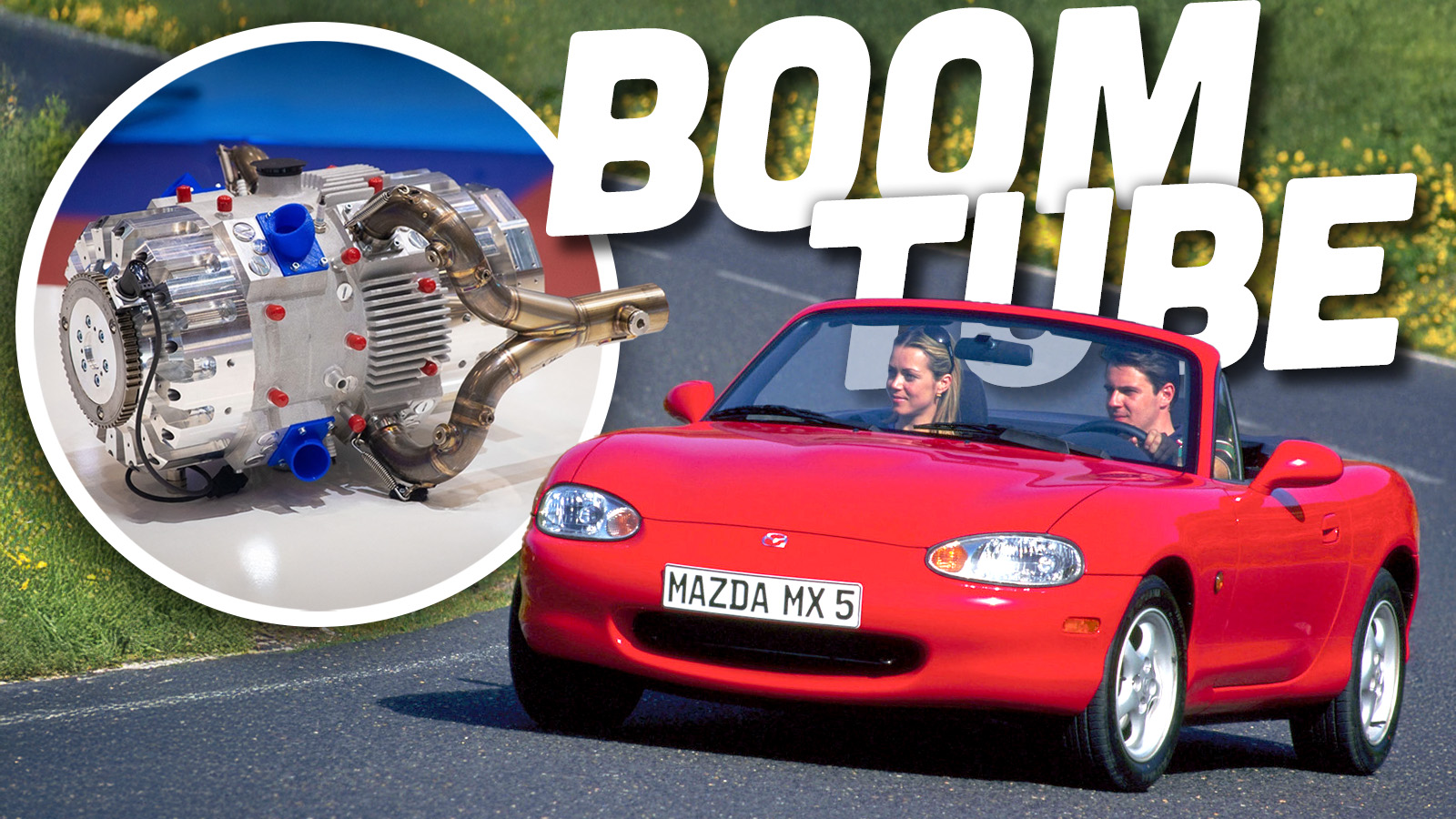
The piston engine has reigned supreme in internal combustion vehicles for longer than a century. While the piston engine is not perfect, even after so long, it’s reliable, predictable, and just works. Throughout history, countless engineers have challenged the supremacy of the piston engine with gas turbines, Wankels, and even bizarre crankcase-spinning rotaries. Now, a new engine wants to enter the ring. This is the INNengine e-REX, and it’s a compact, tube-shaped engine with eight pistons, four cylinders, no crankshaft, and not even a cylinder head. This engine has even powered a Mazda MX-5 Miata already.
Countless engineers throughout automotive history have identified weak points in typical internal combustion engines. The powerplant that moves your car has a lot of moving parts, like a crankshaft, camshafts, valves, pistons, and connecting rods that can wear out over time. Then there’s thermal efficiency, where a good piston engine might see around 40 percent efficiency or so. Many of these engineers thought that piston engines weren’t powerful enough for their size, weren’t reliable enough, weren’t fuel agnostic, or polluted too much.


The world has seen valiant efforts to beat the piston engine. I have now written about seemingly countless gas turbine projects and a handful of Wankel rotary cars. There have even been derivatives of the piston engine, like the free-piston engine and the opposed-piston engine. Most of these ideas dream of a future with fewer moving parts, higher power-to-weight ratios, and compact builds.
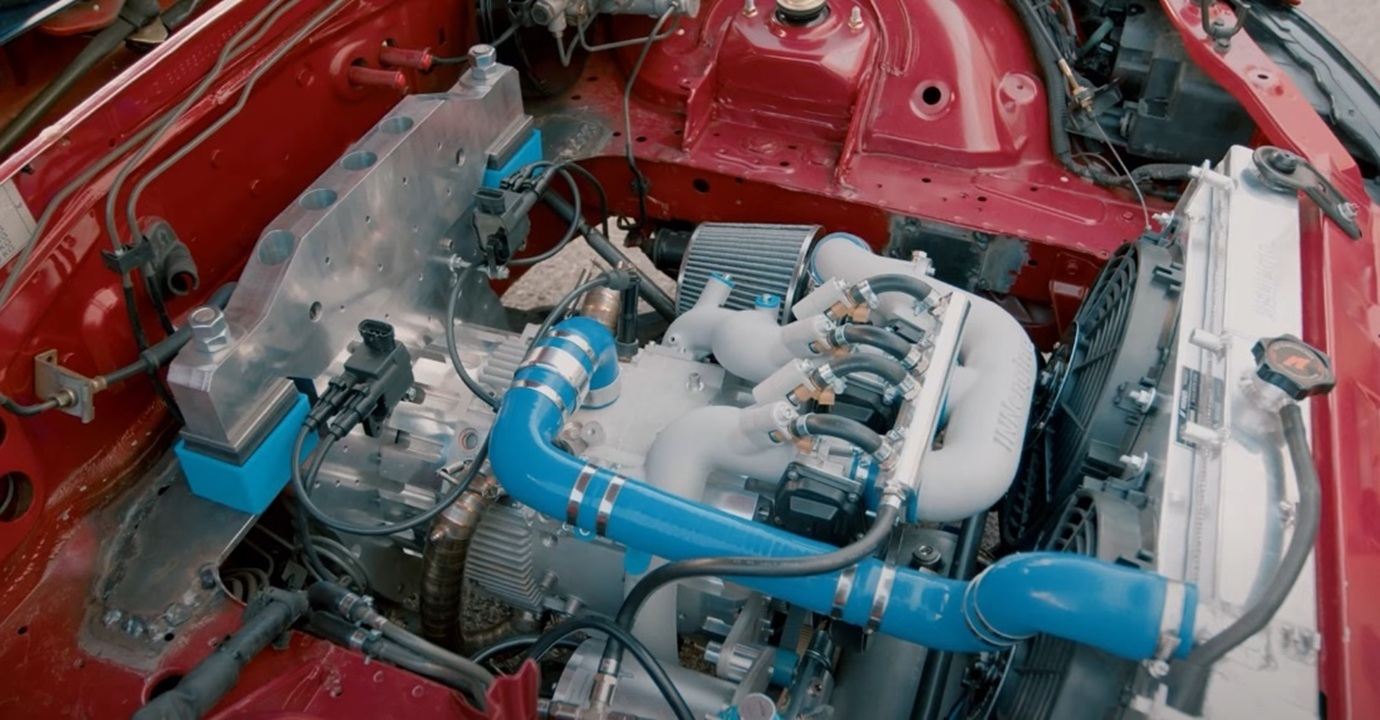
Yet, with only some exceptions, these technologies just haven’t been able to replace what already exists in cars, planes, locomotives, and trucks. Historically, gas turbines were loud, laggy, thirsty, and expensive. Wankel engines were unreliable, thirsty, and pollute more than desired. Free-piston engines were complicated and hard to control. Some great opposed-piston engines have succeeded, like the iconic Napier Deltic and the Commer TS3. Yet, for how awesome those engines were, they were also horribly complicated.
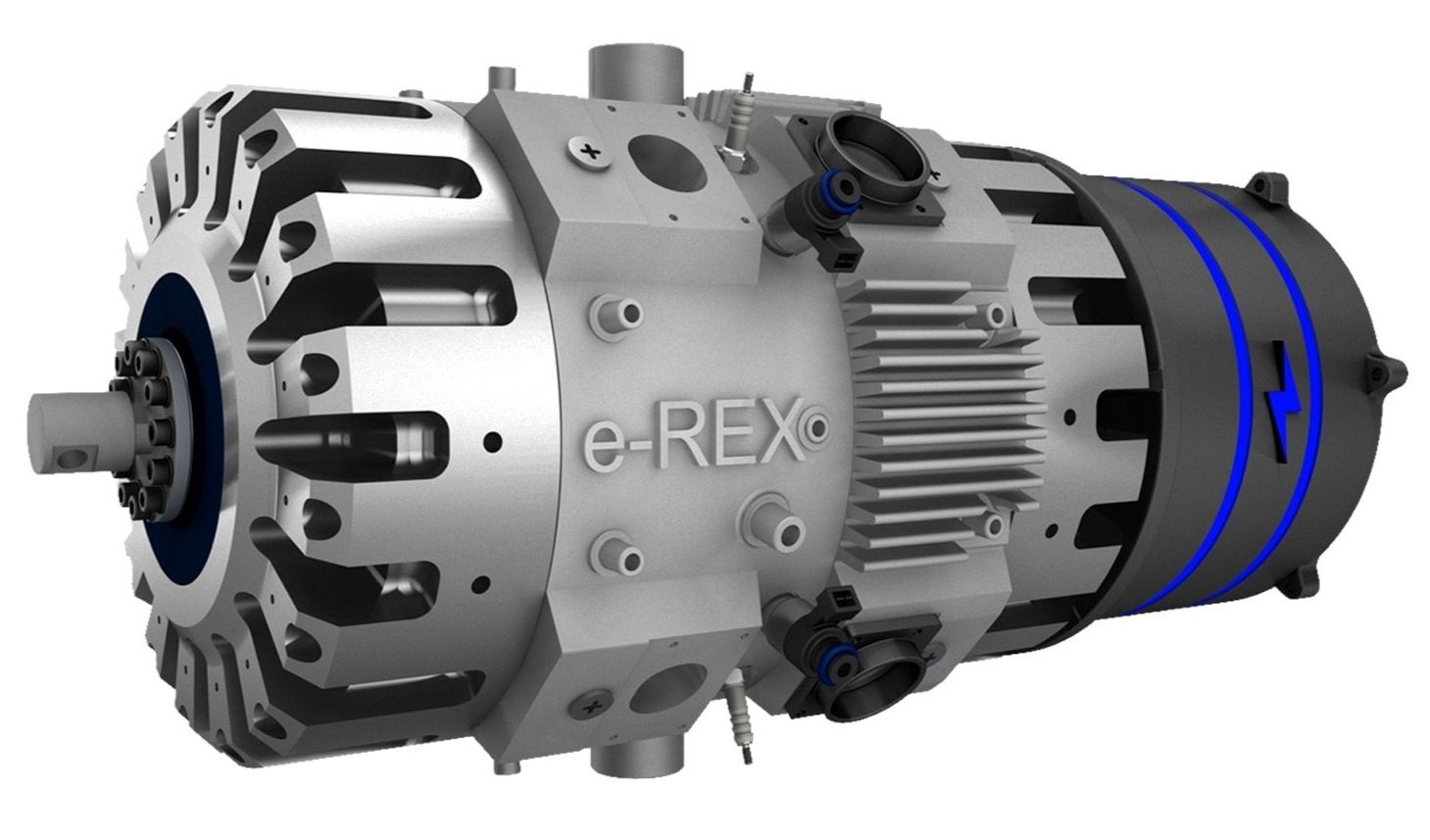
The INNengine e-REX (above) is yet another engine that is being promoted as a better alternative to a typical piston mill, and it’s a real weirdo. The company that designed it even goes as far as to call it a “one-stroke” engine.
One Man’s Dream

The maker of the e-REX is a small company called INNengine. It was founded in 2011 in Granada, Spain, by Juan Garrido Requena, and INNengine tells its founder’s story:
1995
When he was only 9 years old, Juan Garrido Requena was taken to a karting course with his brothers. There and then, among speed wheels and screeching breaking sounds an obsession was born: one day he would make his own kart.1998
To everyone’s surprise and many incredulous smiles, he got right to work. Any money he could make was put to the task. Rusty metal, second hand tools and reclaimed parts were acquired and manufactured turning his parents’ garage into a makeshift workshop. By the age of 12 Juan had designed & built a go-kart from scratch.2010
Juan went on to study a Bachelor of Science in Mechanical Engineering. His obsession with engines did not dwindle during his university years but rather grew culminating with the presentation of his Senior Thesis: Garrido Engine: a new Internal Combustion Engine. Thanks to 2 angel investors, INNengine started like the quintessential start-up: with a group of friends and just a garage. The very same garage where many years before, a 12 year old built his own go-kart from a pile of metal rods.

Garrido Requena made his dream a reality in 2012 when the first prototype (above) of the INNengine came to life. The M40_2C_2R was a tiny engine with only two cylinders and a 40cc displacement, but it proved that Garrido Requena’s concept worked. He then went on to patent the design in 2013, build a second prototype in 2015, and a third prototype in 2018.
Nowadays, INNengine says it has “reinvented” the old Otto engine concept with a “revolutionary new multifuel engine which positions INNengine at a unique competitive advantage to license its patented ICE technology to the more than 226 million units/year expected by 2027.”
INNengine says that its new engine, called the e-REX, is as clean and efficient as a four-stroke engine but as power-dense as a two-stroke. It can drink pretty much any fuel or hydrogen, is supposedly a “one-stroke” engine, and INNengine wants it to power the world’s future range-extended electric vehicles.
INNengine is promising a lot here. So what is the e-REX, exactly?
Opposed-Piston Engines

The e-REX actually utilizes technologies that have already been proven in decades past. It’s an opposed-piston engine like the Commer TS3 and the Napier Deltic. While those two engines are perhaps the most famous examples of opposed-piston engines, the technology goes back well beyond a century.
Here’s what Motor Trend wrote about the beginnings of the opposed-piston engine:
The original idea dates back to 1882 and James Atkinson, who developed the Atkinson differential engine. The Atkinson engine used two pistons in a single cylinder actuated by a flywheel and connecting rods to create compression in a four-stroke cycle. The first large industrial two-stroke gas OPEs appeared in 1898 and were built by Dr. Oechelhauser in Germany. The earliest powerplant was a twin-cylinder that used one crankshaft with rods. It was a spark-ignited engine that made 600 hp. A French company, Gobron-Brillie, developed smaller versions of gas OPEs suitable for motor vehicle use around 1900. In 1904, a Gorbron-Brillie car with an OPE set a “World’s Record Speed” of more than 100 mph in the flying kilometer. The first diesel version appeared in 1907. Russian designer Raymond A. Koreyvo built a working prototype and received a patent for it in France. He then displayed it at international exhibitions, where other developers saw it and began building their own versions.
There have been many different OPEs built through the years (gas and diesel versions), but smaller versions (compact enough for a car or truck) were not at the forefront. Most companies produced large-displacement versions that were used in ships, locomotives, submarines, and airplanes. The most famous diesel OPE is the Junkers Jumo developed by Professor Hugo Junkers. The Jumo 205 was the first successful diesel aircraft engine. There were several different versions of the Jumo built (205, 206, 207, and 208) from the 1930s through World War II.
All the Jumos were vertical two-stroke, six-cylinder, 12-piston, supercharged engines that had two crankshafts and used four injection nozzles per cylinder. Two camshaft-operated injection pumps were used per cylinder to feed the fuel nozzles. Air was drawn in through the intake port located under the lower piston and spent gases exited the exhaust port located under the upper piston. This layout worked because the lower crankshaft was located 11 degrees behind the upper. By adjusting the timing, the pistons opened and closed the ports at different times to create proper scavenging in the cylinder.
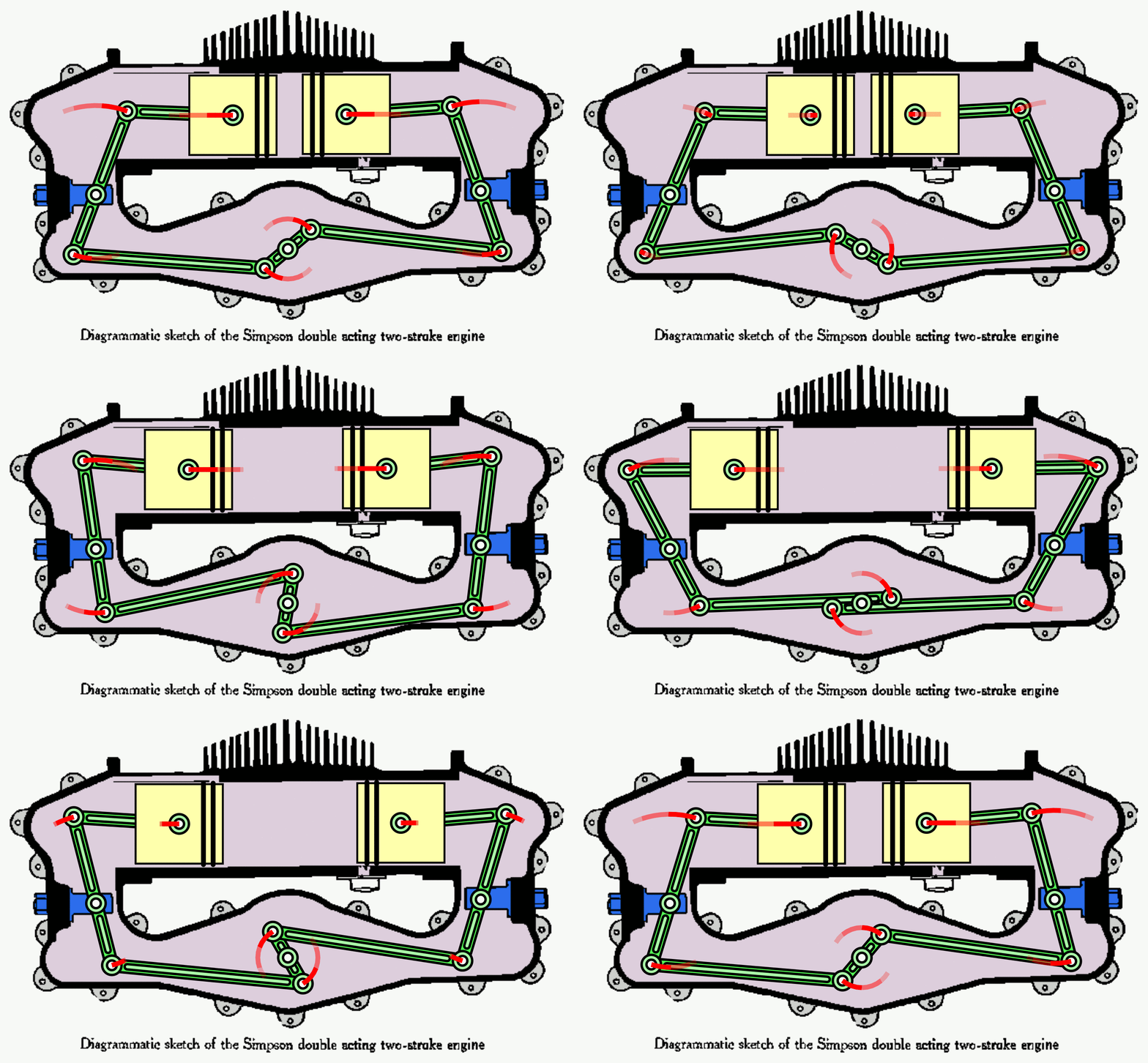
Opposed-piston engines even made it over to America, where Ransom Eli Olds adapted the technology to solve the problem of early diesels being so heavy for their power output. Instead of the typical piston engine, which had its pistons firing up and down in their own cylinders, Olds made an opposed-piston engine that cut down on material by having the pistons fire horizontally.
During the 20th century, opposed-piston engines also solved another problem, and it was with the exhaust scavenging issues faced by typical two-stroke piston engines. In a two-stroke engine, intake (“scavenging”) and compression are done in one stroke, then combustion and exhaust happen on the next stroke. Unlike a four-stroke, where combustion occurs every second time the pistons reach the top of their travel, with a two-stroke you get combustion every time the pistons reach the top of the cylinder. The graphics below are from Yamaha:

In a basic, crankcase-aspirated two-stroke, the exhaust port is exposed during the power stroke, and exhaust begins to exit. As the piston continues down, the transfer port opens, which sends a fresh air-fuel charge to enter the combustion chamber, pushing remaining exhaust gases out while preparing for the next power stroke. When the piston starts heading upward again, the transfer port closes, the exhaust port closes, and the intake port opens.
Scavenging is the process by which the incoming charge of air and fuel pushes exhaust gases out.

The transfer and exhaust ports were often located across from one another, resulting in cross-flow scavenging. One of the quirks of the basic two-stroke was that the fresh air-fuel charge wasn’t perfect at scavenging, and thus, some exhaust gas would become trapped in the combustion chamber after the end of the exhaust portion of the stroke. This reduces the engine’s output. Another quirk was that some of the fresh air-fuel charge was wasted out of the exhaust during scavenging, causing higher emissions and robbing the engine of potential even further.
Opposed-piston engines were seen by some engineers as the solution to two-stroke scavenging issues because their intake and exhaust ports are located at opposite ends of any given cylinder, rather than across from each other, resulting in straight-through airflow.
A Barrel Of Power
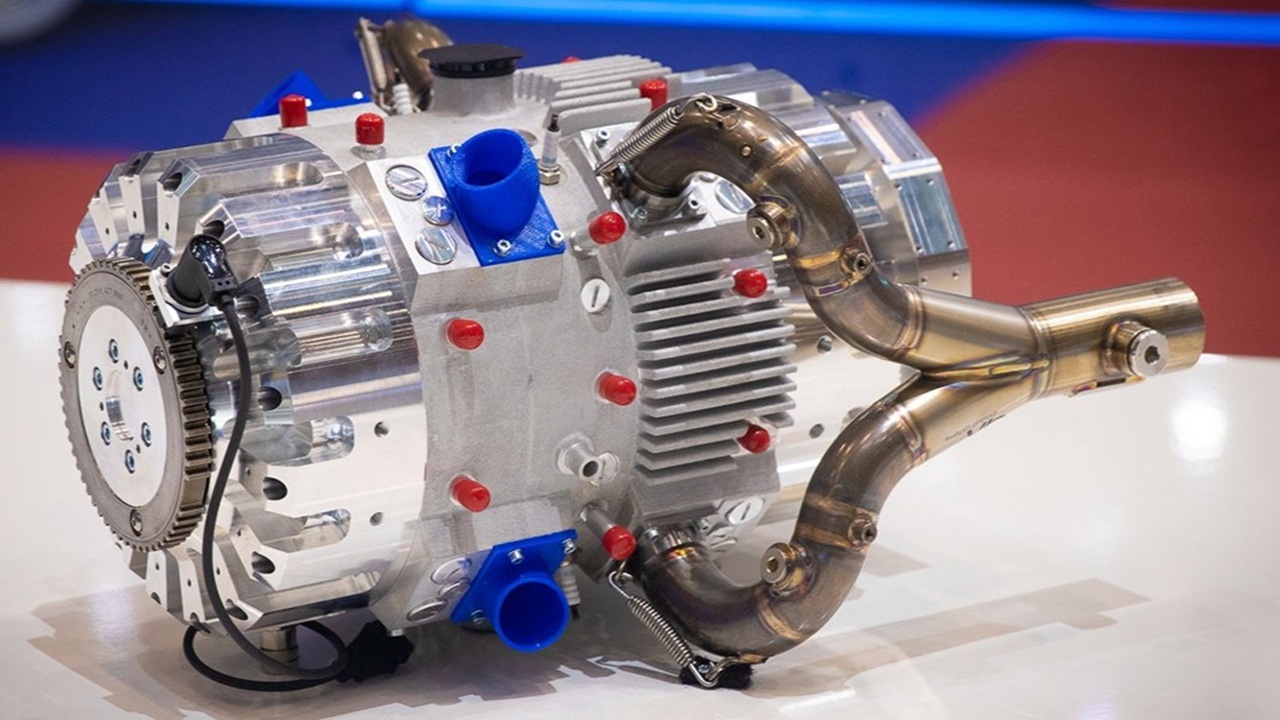
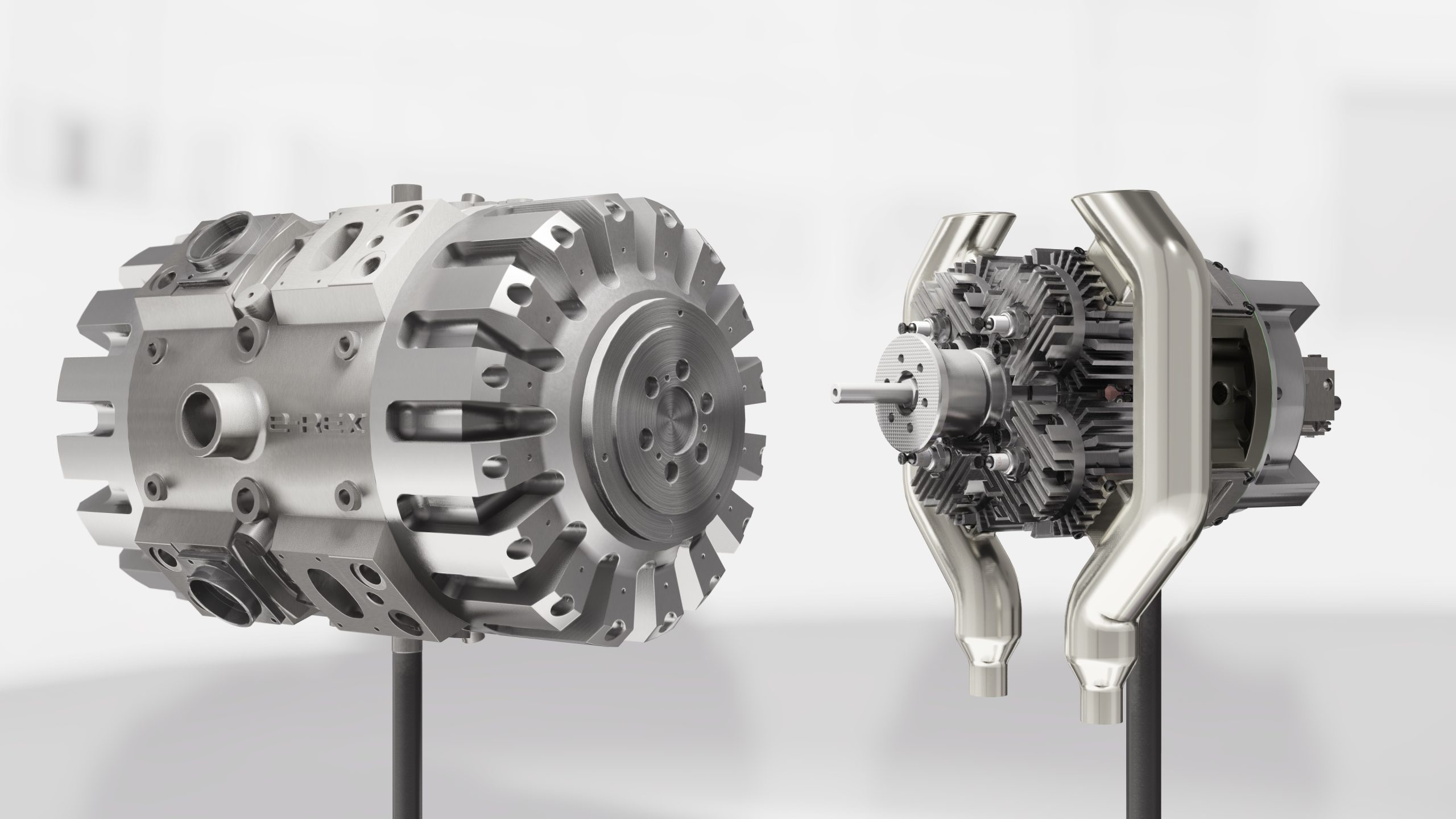
The INNengine e-REX is also an opposed-piston engine, but it does things differently. The most immediate difference between an e-REX and other opposed-piston engines is how the pistons are arranged. There are four cylinders, which have eight pistons within them. These cylinders are arranged in a rotary pattern, sort of like the chambers of a revolver.
Hot Rod magazine explains what you’re looking at here:
Instead of connecting rods attaching to a crankshaft, each piston moves up and down on a little piston-shaped cart of sorts. These feature two wide rollers that convey the combustion energy to the cam-track, and a third narrower one that’s trapped beneath a smaller diameter cam track that helps finish pulling the pistons apart after the combustion energy has exited the exhaust ports. The company claims the exhaust rushes out with sufficient force to create a vacuum capable of drawing in atmospheric intake charge, though supercharging is also possible.
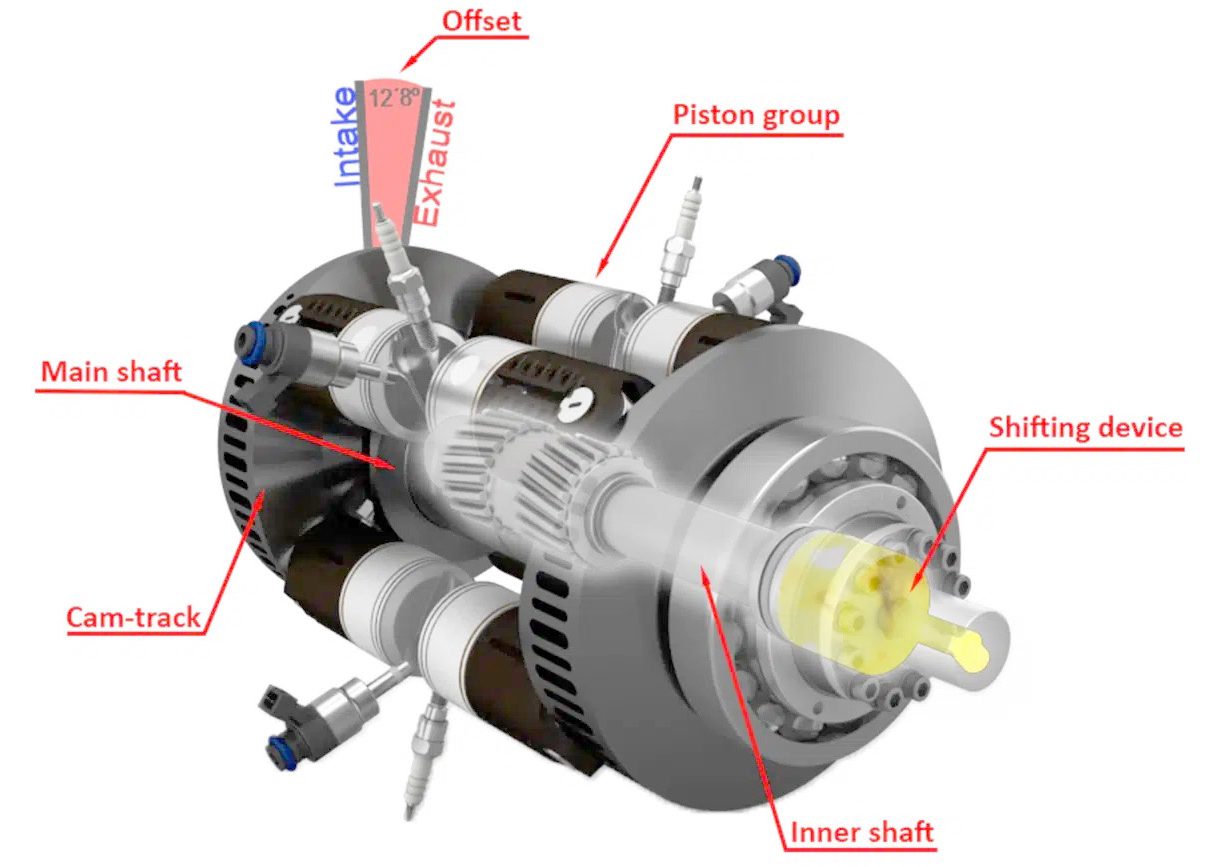
Each main cam track is keyed to the common output shaft by means of an angled gear. Moving collars that engage these gears can change the timing of the left and right cam track, altering the intake/exhaust timing gap by up to 12.8 degrees, and thereby altering the compression ratio. This would be most useful in applications where the INNengine is used as a primary drive motor, pairing low compression (9.1:1) with super- or turbocharging, and higher compression (16.7:1) with low- or no boost operation for peak efficiency.
The oily blue smoke we associate with old Lawn Boy mowers, dirt-bikes, and Trabants came from mixing lubricating oil with the intake air to lubricate the (usually roller-type) crankshaft bearings. The smoke problem was largely been solved years ago by segregating the crankshaft lubrication from the intake and exhaust systems, and by employing direct fuel injection (this engine does both).
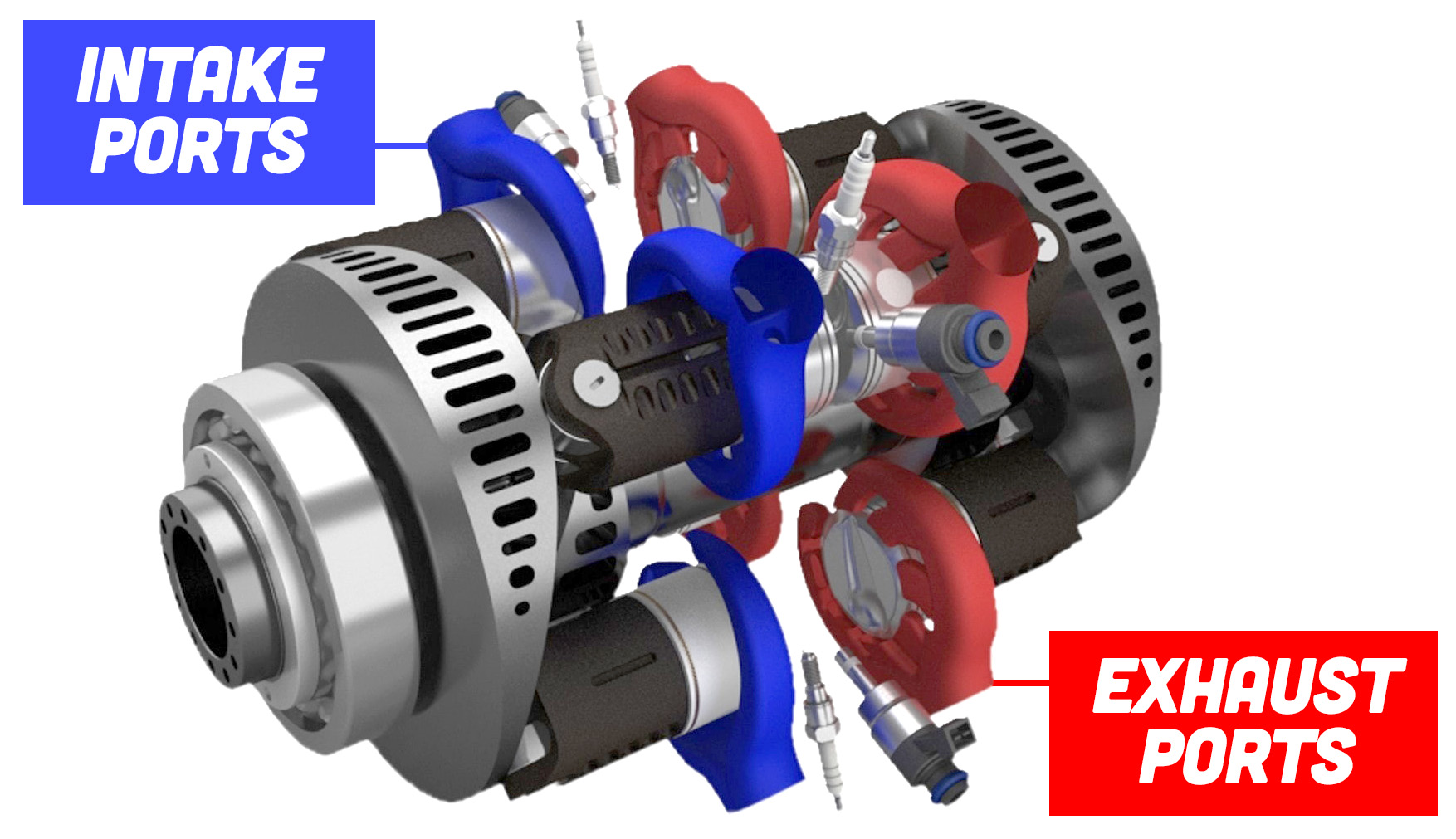
Since this engine combines intake and compression on one stroke and combustion and exhaust on the next stroke, it is a two-stroke engine. It’s a very complex design, but still a two-stroke at heart. But as Hot Rod noted above, it’s a modern one. As was common in two-cycle diesels, the fuel isn’t being used to lubricate the internals of this engine.
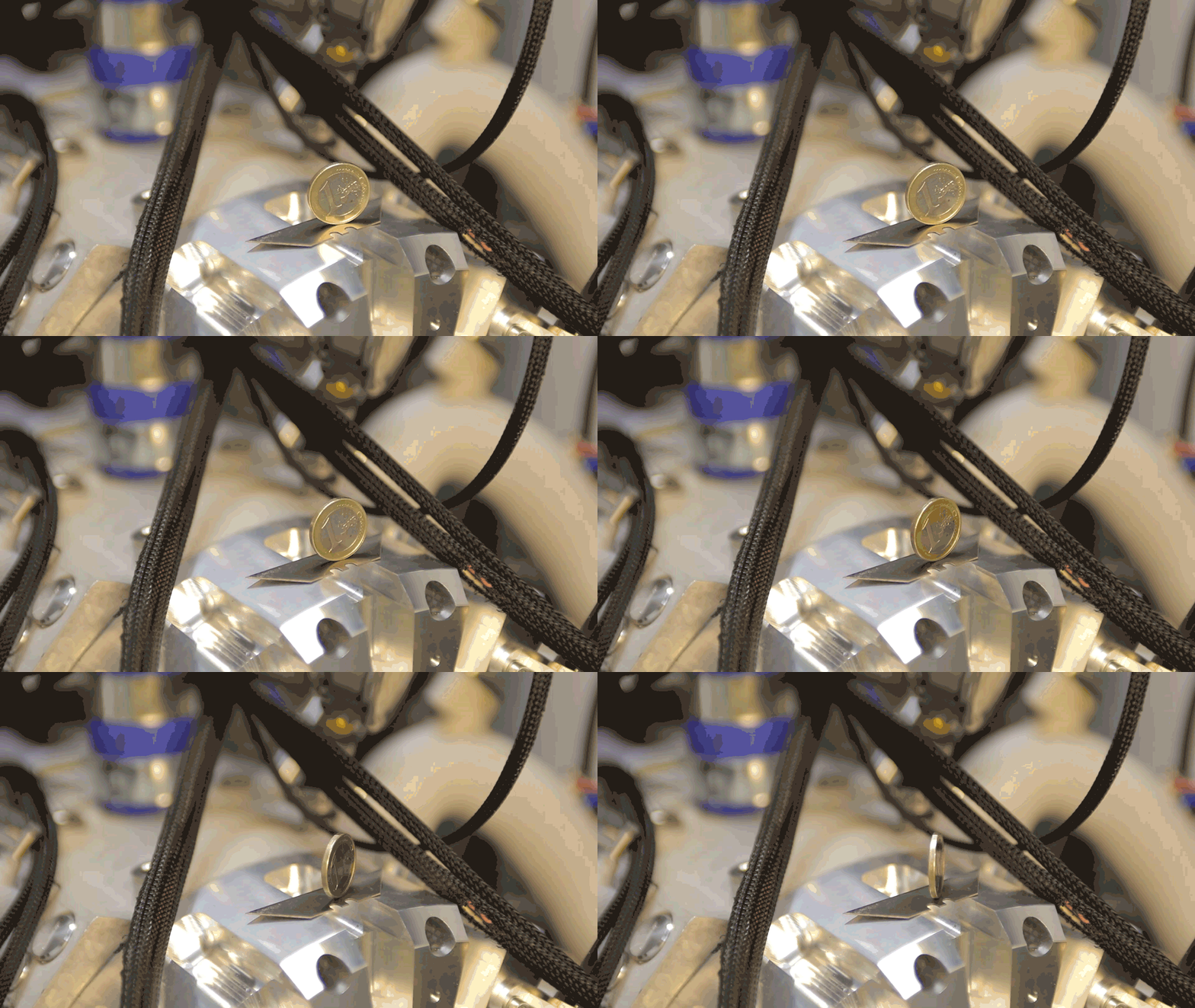
Something else that’s neat about this engine is that since it can have a variable compression ratio, it can be a multi-fuel engine. Apparently, when the e-REX is running, it’s so smooth that you can balance a coin on it.
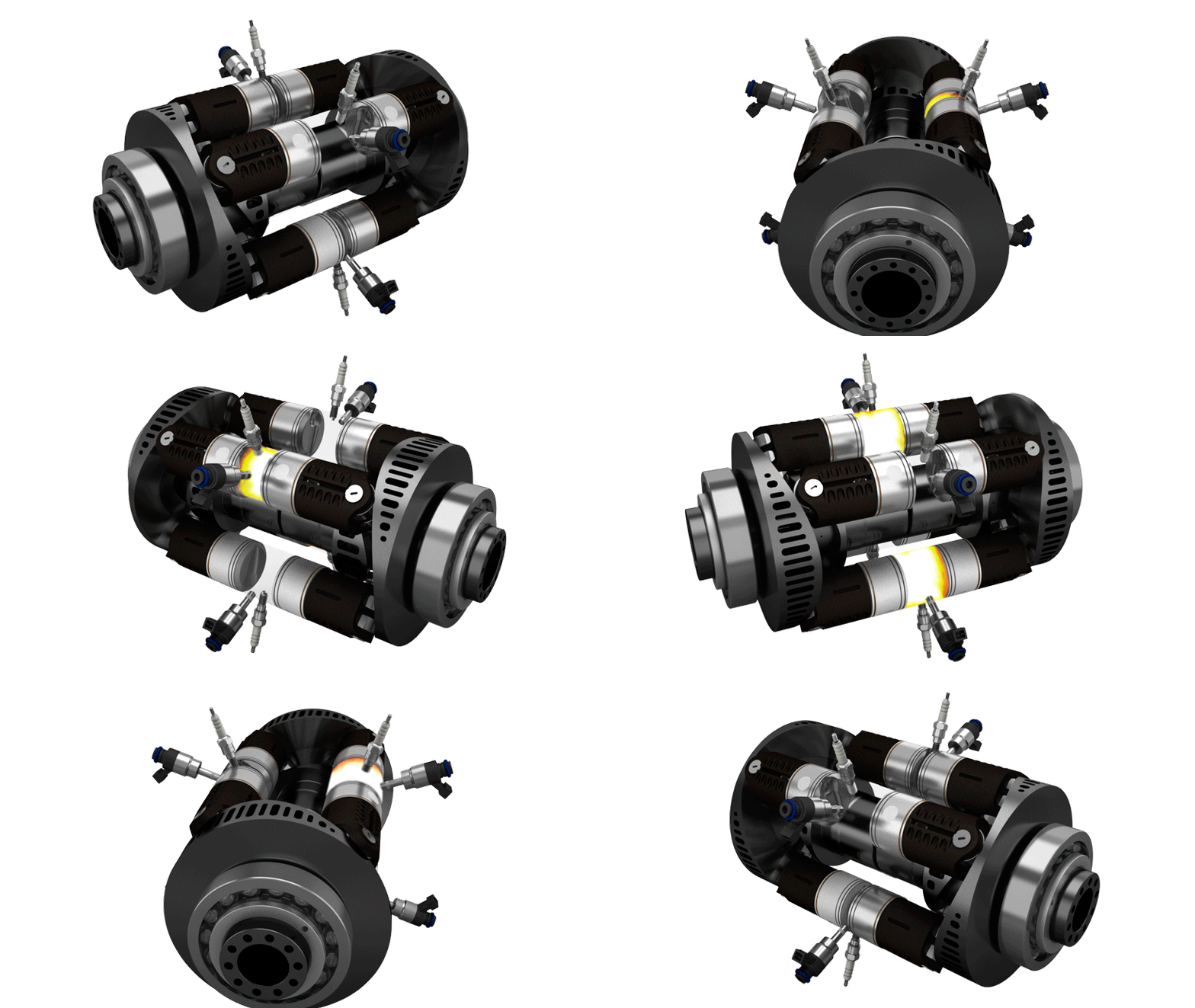
The e-REX also has an impressive spec sheet. INNengine claims that the e-REX makes 120 HP and 180 lb-ft of twist from 700cc of displacement. The engine measures 19 inches long, is 11 inches tall, and weighs 84 pounds.
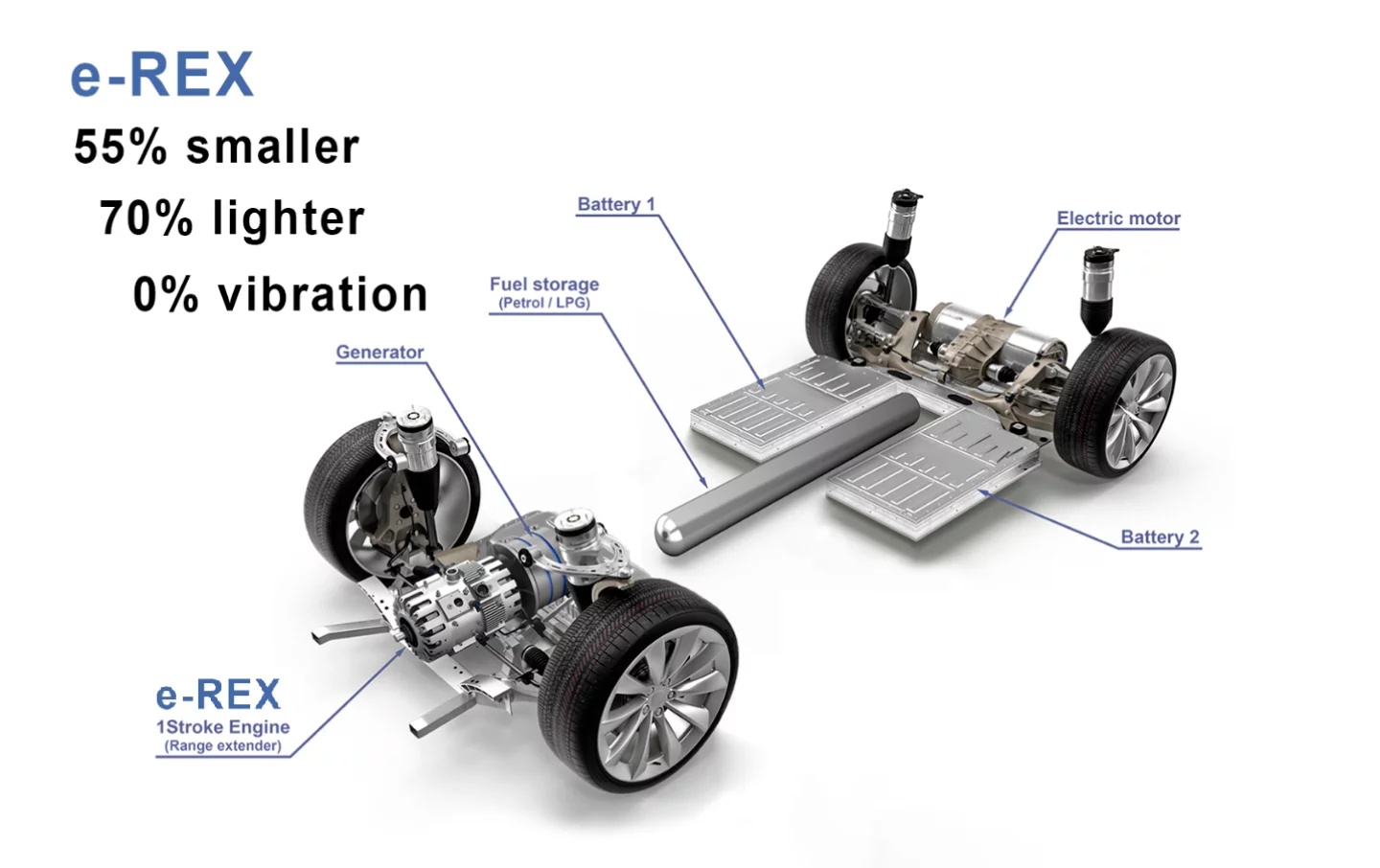
INNengine says that the e-REX is 70 percent smaller and lighter than an equivalent engine, while also having 53 percent fewer parts, no crankshaft, no valvetrain, and no cylinder head. INNengine also claims that, since this engine is so simple (in its eyes, anyway), it will even be 40 percent cheaper to make than an equivalent inline piston engine.
About That Whole ‘1Stroke’ Thing
What’s not neat is how INNengine continues to market the e-REX. Even today, the company claims it’s a “1Stroke” and “Patented 1Stroke,” but this seems to ignore how everyone else defines engine strokes. In theory, an actual one-stroke engine would mean an engine that would fire every single time the piston reaches top dead center and bottom dead center. This engine doesn’t do that. INNengine says this is a “1Stroke” engine because:
The REX-B can do this thanks to having twice as many power strokes per cylinder than a 2 stroke engine and 4x that of a 4 stroke one.
Basically, since the cylinders have two pistons that fire per engine revolution, it’s a “1Stroke.” But that doesn’t make sense. The pistons in those cylinders still work on a two-stroke principle; there are just two of them. Confusingly, elsewhere in INNengine’s marketing, it says its “1Stroke” label is just so the public doesn’t think of the e-REX as a dirty two-stroke:
We call it 1Stroke because it has none of the emission issues of the 2Stroke. There is no oil in the mix and pressurized lubricated areas are far from the combustion chamber. There’s also the fact that the piston never works as a pump (sucking air) and Variable Port Timing… and so much more.
But this is also weird because there are two-stroke engines out there that don’t mix oil into their gasoline. Honestly, INNengine should just drop the whole “1Stroke” schtick because no amount of mental gymnastics makes it true.
There’s more, too. As Hot Rod notes, since this engine is still using old-school ports rather than poppet valves, there’s still a risk of scavenging issues and pollution resulting from them. Bolting a supercharger to the engine can help ensure burned gases escape the engine, but there’s still the possibility of getting some of the fresh air-fuel charge in the exhaust. This isn’t anything new. Classic Detroit Diesel two-cycle engines employed superchargers, not to increase power, but to improve scavenging. INNengine claims the engine is capable of effective scavenging without a supercharger, but it’s unclear if the INNengine team solved the issue with unburned fuel reaching the exhaust.
Hot Rod also notes that the e-REX has other potential downsides, including potentially as much friction as a V8 engine as a result of having 24 rollers on the swashplates’ tracks. A report by Engine Labs noted a concern that the engine might deliver torque like a Wankel due to its lack of a lever effect from not having a crankshaft. Then there’s the rollers themselves, as it’s not known how long they’ll last.
The E-REX Has Powered A Miata
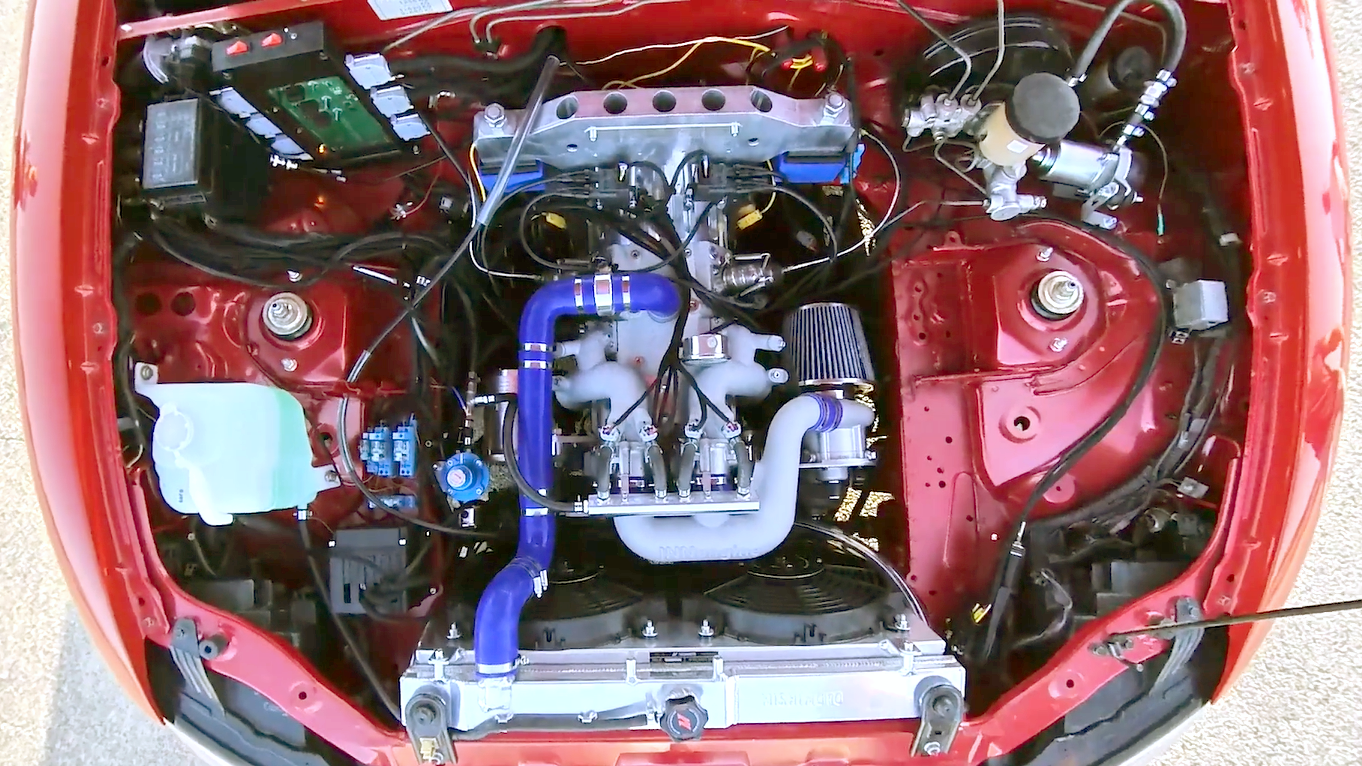
INNengine has proven that it has a working 500cc version of the e-REX by placing it into a Mazda MX-5 Miata NB. There’s a video of the car scooting around, and for a brief moment before some annoying music is added into the video, you can hear how the engine sounds. The soundtrack is sort of a cross between a four-cylinder inline-four and a Wankel.
Take a listen (click here if you can’t see it):
Weirdly, you can see that the INNengine guys added a supercharger to the e-REX in the Miata, but they never explain why. They still claim a 120 HP output, however. There are two possibilities here. Either the supercharger is for scavenging, which would seem to invalidate INNengine’s claim about effective scavenging without a supercharger. Or, it’s there for power. I reached out to INNengine for clarification because a supercharger isn’t a part of the marketing.
While INNengine made the e-REX power a Miata, it says the goal isn’t to have this engine powering your track car. Instead, INNengine hopes OEMs pick it up as a range extender for electric cars. The elevator pitch is that the e-REX is smaller, lighter, greener, cheaper, more powerful, and more efficient than using a typical piston engine as a range extender.

There’s also a smaller REX-B 300 version of the engine. This mill targets light aircraft and makes up to 50 HP. INNengine sees itself selling three different types of the REX-B, one that’s a direct replacement for an aviation two-stroke engine, one to be used in hybrid-electric aviation setups, and one that can be used as a range extender in electric aircraft.
INNengine also has a 125cc version of the REX-B that makes 21.5 HP. The company claims this engine makes 80 percent more power than the typical 125cc engine. This engine does exist, and was tested in a large RC plane. If this engine actually makes the advertised power, I’d love to see it in a small-bore motorcycle.
INNengine also hopes to see its engines used inside boats and as stationary generators.
Why You Can’t Buy An E-REX
Of course, there’s a reason why there are no production vehicles using an INNengine. The company says it needs investment to industrialize and then scale the e-REX and the REX-B. Once INNengine can create production versions of its engine, it wants to license the technology out to OEMs. Yes, that is a roughly similar path that led to so many of the world’s largest car companies to play with Wankel engines.
At this time, the biggest company that’s publicly interested in the technology is Horse Powertrain, which will help INNengine validate the e-REX. It’s unclear if any automakers are currently interested. As it is, some automakers are pumping the brakes on their green vehicle initiatives. Will they be interested in experimenting with an entirely new engine? We also haven’t even seen how this engine would work in its intended application as a range extender. INNengine hopes to start slinging these things to OEMs beginning in 2027, so maybe we’ll have answers to the questions posed here.
Really, all of this just means that INNengine probably has a long way to go. Maybe this will be like another Wankel, where it gets made, licensed out to some companies, and we get to see how it works out.
Regardless of where it goes, there’s no doubt that the e-REX is a weird engine by today’s standards. It’s a tiny cylinder of power that makes some incredible promises. Will it actually go into mass production? I have no idea, and I’m not holding my breath. But it is seriously cool that one man had a dream to make a futuristic engine and then actually made it happen. I love a story about people making their dreams come true.
Top graphic images: INNengine; Mazda


We worked with them a few yrs (early) back, exploring for erev application in Brazil for a road-licensed dune buggy, for which there is a substantial market in the Northeast states (semi-arid, lots of dunes). The INNengine is smoooooth. We didnt move forward with that application, altho the buggy (“Duna”) is already being sold and driven all over, and the hi-po comp version (not street legal, “Guepardo” or Cheetah) is already winning races https://adventuresoffroad.com.br/# These were designed and built by a team of ex-Troller (ex-Ford) engineers and are an absolute blast to drive. I use my Duna around town as well as in the dunes. Its great rowing your own gears and it is nimble
Oh those are COOL!
It’s not a 1 stroke. Marketers gonna market. I will give them the benefit of the doubt that with two pistons, it is sort of a 2/2 stroke (2 pistons with a power stroke each per 2 strokes), which is a fraction that reduces to 1 in a cheeky sort of way.
Their have been many variations proposed by start-ups on this concept in the last 3-4 decades.This will fail in the same way all other variations of this engine have failed. The bearings in the rollers that follow the swash plate do not survive the impulse of the combustion event. Typical designs use needle bearings that wear out and need to be replaced regularly.
The plain bearing in the big end of the connecting rod on a common piston engine is a marvel of absorbing load spikes in the oil film without damaging the bearing surface. Until a roller bearing that can do the same is found, all of these designs are doomed for automotive applications. The rebuild cycle will make Wankel engines look durable.
thanks for the information. TIL
Even if the crankshaft lubrication is separated from the intake air flow, there is still a need to lubricate the piston rings which sweep over the open ports, so you still end up getting engine oil mixed with the intake air. Or are these not oiled (which brings its own set of issues)? Certainly the oil consumption won’t be as much as older 2-strokes where you needed to premix some oil in with the fuel, but it’s still an issue for preignition, particulate emissions and catalyst poisoning (most oils have additives that can hurt a TWC effectiveness over time).
Its cool to see new things being tried, but nothing about this design seems to improve efficiency vs conventional 4-stroke piston engines.
Nothing here that hasn’t already been tried in various forms.
Honestly I think the odds of any new internal combustion technology catching on in the automotive world are basically zero. The infrastructure for existing engines is too well established and the designs too well optimized, and electric is slowly taking over. By the time any new engine modality gets good enough to replace what we already have, ICE as a whole will be increasingly irrelevant.
This might have a future as a range extender or as part of a hybrid electric powertrain.
But I suspect this will more likely go nowhere because on one side, it has established piston engines, and on the other side, it has small jet turbine engines.
It’s two quatenary piston pumps facing each other.
That rotating GIF reminds me of a Silicon Valley episode IYKYK.
They designed it from the middle-out
The smaller versions would make a nice range extender for large electric motorcycles.
So what’s the projected thermal efficiency of this thing? Can it match or beat the current 40% benchmark? If not how far off is it?
A less efficient engine needs a bigger fuel tank and more cooling which partly negates any packaging or weight advantage of the engine. If the efficiency isn’t there it’s going to fail just like the Mazda rotary REX did which also offered smoothness, compactness and simplicity. It wasn’t enough.
The spec sheet here is kinda… ambiguous. Like, what is the power available with different fuels? Thermal efficiency with different fuels? How is tuning controlled? How do you even measure output (RPM? Pistons firing/minute?) How does this thing get cooled?
And the weight of the engine here is relevant. You can get away with worse efficiency with a lighter engine in some use cases (especially in things like UAV applications). But for aviation applications, you usually need some kind of turbo or super charger for it to work. And the other common steady-state applications are things like generators or maritime applications where the engine is running at a constant state for hours at a time.
I’m all for new technology, but if they want to encourage adoption, there needs to be a lot of engineering info available.
“But for aviation applications, you usually need some kind of turbo or super charger for it to work.”
Which is why turbo props/fans/shaft/jets work so damn well in airplanes. The whole engine is just a big turbo.
Look, even if it’s thermal efficiency is less than 40%, the (much) smaller size of the engine could make it an attractive proposition as a range extender.
On range extended EVs, do the engine and range extender share the same cooling system? Is the battery and/or the range extender air cooled?
I don’t know the routing of coolant through battery packs, but I would think the possible metal shavings in engine coolant could cause a big problem in the battery.
No idea on REX vehicles, but at least on my hybrid Maverick there are two entirely separate cooling circuits one for combustion engine and the other for the electric motor, battery pack and various electronics and convertors. I’d assume you’d do the same on a REX.
Technically they aren’t entirely separate on the Maverick. There are valves that allow the battery/HV electronics/ICE loops to intermix if needed.
That was the argument for rotary REX but here we are.
Range extenders need to harness energy for electricity the way we’ve always done it:
-Boil water to make steam.
I like this thought. No need for gas station – just collect some sticks.
Possibly single digit thermal efficiency, but it could get you home.
Slightly more efficient that solar power by growing grain in the roof of the car and feeding it to hamsters, who in turn generate electricity running on their little wheels. With a mix of male and female hamsters you get a “breeder reactor” so it’s essentially free power!
Aside from that, external combustion steam engines have terrible thermal efficiency. Ultra-supercritical Rankine cycle engineswith reheat and regeneration are about 40-60% efficient but are pretty dangerous in a car.
When they perfect the Carnot cycle then you’ll have something.
Yes, I know it’s a joke,
Oh no, every car is getting a CANDU reactor.
Since it uses a swashplate for power, will Swashbucklers use them to power their ships?
I appreciate a good Dad joke.
If only my wife and daughter did as well.
Oh, it’s an opposed-popposed-piston version of a torpedo engine. Those swashplate designs are popular in those.
I don’t have any calculations to back up my intuition, but translating linear power to rotation through rollers on a cam track feels inefficient.
So is the rex-B considered a 1/2 stroke since there doesn’t appear to be a cam-track swashplate on the prop end? Judging by the pic where it’s mounted on the RC plane it looks more like an air-cooled, 4 piston, 2-stroke to me.
Sounds INNovative.
Dumb question
I’m guessing the last hundred years of ICE R&D was 98% dedicated to propelling automobiles.
As the world transitions to EVs, could the focus internal combustion engines move to generating electricity, and if so, does change the calculation of how engines, generally, are developed?
I thought we’d see a lot more Volt style PHEVs by now. Is burning fuel just too inefficient, too dirty, or is a second powertrain too expensive and complicated?
I’ve been working on range extenders and weird ICE generators for over 20 years, and I only worked for a tiny sports car company.
The problem was the lack of a market. The development process is actually easier, because you don’t need to worry about drivability, just min and max charging loads.
My thoughts on any wild new engine concept is always, if Honda hasn’t done it already, there’s a reason it won’t work.
*See also: Mazda
If they’re targeting aviation and range extenders, I imagine this thing has one particular rev range where it can effectively scavenge itself, losing a lot of power and efficiency at other speeds. That would explain the supercharger in the Miata, as it would be necessary to widen the engine’s usable torque curve.
Still, I like this kind of stuff when it seems truly usable, but the piston carts have their rollers sandwiched between two cam ramps, and anything that cams two ways usually ends up having short service intervals, just look at Desmo valves. Unless one of the rollers has some sort of hydraulic lash adjustment setup that can deal with the piston’s reciprocating mass, I’d be skeptical of this design’s longevity, but as always, I hope they prove everyone (including myself) wrong..
AC compressors use pistons driven by swash plates, and they are pretty reliable.
It’s a proven technology for pumps.
Sure, but that’s a fundamentally different concept to how these are running. Swash plates being a flat disc on an incline, and that plate is what is driven to act on the fluid (refrigerant). In this case the disc is effectively a cam-type profile, and is what is being acted upon by the pistons. We know that cams driving valves in a typic OHV via pushrods or directly OHC configuration is reliable, but this is the opposite, where the valves would be driving the cam. The loading path being in reverse makes the issue of lash more pronounced and harder to control without adjustment.
That’s a good point, and looking at it AC compressors seem to employ a similar mechanism for constraining the pistons (two rollers oriented in opposite directions), but the loads appear a lot smaller: besides the lack of combustion, the A/C pump has tiny, lightweight pistons and relatively slow rotation compared to the revs I would expect from an engine whose pistons only displace 62cc each.
To make the advertised power, I’d expect this thing to rev pretty high, and its pistons are much larger and heavier than those of an A/C pump. The rollers are a lot beefier, but I’m still worried about wear. I’d like to see the results of long-duration durability tests, if they get that far.
I’ll go along with his logic on “1-stroke”, as it’s double-two-stroke, as I think it’d be toxic to call an engine “2-stroke” and carry that blue-haze legacy.
But displacement is an odd measurement. It’s a bit like trying to directly compare watts of an LED bulb to an incandescent bulb to understand brightness.
Throw this in a golf cart or riding mower.
I want one in my GT6.
Double the power!
This seems like the right spot to quote Ice Cube…better check yourself before you e-REX yourself.
Stop. I can only get so e-REX.
Interesting, but until it’s in production at scale it’s just another dream.
I think the Omega One (aka H2 Starfire) from Astron Aerospace compares? That’s also an alternative to piston engines that claims great HP to weight ratio, fewer parts, multi-fuel and great efficiency. They’re also looking for OEMs and are targeting airplanes and E-REV range extender applications.
https://astronaerospace.com/h2-starfire/
This is stupid. Just a silly engineering folly in the light of the endlesly improving pure electric cars. There just is no future in this sort of thing. Even if it’s claims were to be true.
But I love it.
Very cool. I wonder how it will work in an EREV.
I do feel bad for engineers trying to do something new and people expect it to be as perfect as ICE engines that have been improved for over a century.
If the engineering is truly sound, I see a Japanese outfit, such as maybe Daihatsu exploring these engines to power future kei vehicles. Laws would need to catch up though as they currently limit power outputs in addition to displacement limits.
Additionally, I’d love to see how fuel efficient these really are when compared to a traditional engine of similar power output characteristics as well as compared to modern engines with similar displacements.
The torque figures alone seem like this could be a big deal. Scaled up, this could even power large pickups and even agricultural equipment, generators and much more.
On the plus side, it stays e-rex despite being exhausted after only one power stroke.
And it’s being marketed as an extender.
It’s not the size of the piston, but how you use it.
8==D~~ᗡ==8
So, is this half the effort to produce the same amount of power? Or is it the same amount of effort resulting in twice the amount of power?