


Motorcycle technology generally trails behind what consumers can buy in cars today. Motorcycles didn’t get blind-spot detection until 2021 in the Ducati Multistrada V4 S, yet cars got the system nearly two decades sooner. Now, bikes also have radar cruise control and collision alert systems, again, long after even common cars got the same technologies. Engineers have also been trying to integrate airbags into motorcycles for years. Now, the world’s first production scooter with an airbag has been launched. This is the 2026 Yamaha Tricity 300, and it’s a three-wheel scooter that leans and would throw an airbag at you in a frontal crash.
Yamaha launched the new Tricity 300 only yesterday, and it marks an important milestone. Until now, there hasn’t been a single scooter in production with an airbag. But it’s also a bit of a weird distinction because airbags are extraordinarily rare to find on regular motorcycles as it is. Honda is credited with inventing the first production motorcycle airbag in 2006 for the Gold Wing. Yet, since then, the Gold Wing has been the only motorcycle with an airbag. Otherwise, if you wanted to land in a bag of air during a crash, the only other choice was to buy an airbag jacket. [Ed note: Mercedes, you completely missed “or crash into a politician.” I will note this on your review. – Pete]


Yamaha didn’t do this on its own, and it partnered up with Swedish automotive safety supplier Autoliv. The latter company has been working on a motorcycle airbag for the past five years. Now, we finally get to see what it looks like. Yamaha and Autoliv believe that if you get into a frontal collision with the new Yamaha Tricity 300 scooter, injuries might be reduced by the bag that deploys in front of you. But getting here wasn’t as easy as slapping a car airbag on a scooter.

The Idea Behind Putting Airbags On Bikes
The concept of an airbag attached to the motorcycle itself has been an idea pursued by a handful of companies. Yamaha, Piaggio Group, Honda, and Autoliv have all run analyses of crash data and have come to the same conclusion. According to this data, a lot of motorcyclist injuries and deaths occur after a frontal collision with a car, an object, or something else.
Honda looked into motorcyclist injury data from 2003 and found that, in Japan, a whopping 68 percent of motorcycle accidents that cause an injury or fatality are frontal collisions. That data also found that 71 percent of the time, the cause of a motorcyclist’s injury or death after a crash was an impact with the road surface or obstacles. Impacts with cars were determined to be a cause of injury or death 25 percent of the time.

Autoliv is one of the world’s largest suppliers of automotive safety equipment. As of 2025, Autoliv has captured a 44 percent share of the automotive safety product market. Further, the company says that its devices saved 40,000 lives and reduced 600,000 injuries in 2025. That’s a pretty large spike from 2021, when the company said that its devices saved 35,000 lives and prevented more than 300,000 serious injuries.
Naturally, this safety-obsessed company now wants to get into motorcycles. In 2021, Autoliv partnered up with Piaggio, targeting the 2025 model year to launch a production motorcycle or scooter with an airbag. I wrote about Autoliv’s journey to making a motorcycle airbag when I saw the company’s booth at the Detroit auto show in 2022.

Autoliv spoke with Cycle World in 2023 about why it even got into the business of motorcycle airbags and why they’re difficult:
“We need a crash sensor,” Ishii said, “We need a detection ECU, we need a harness and we need an airbag module. So it’s not that different to a car. However, one of the trickiest things on a motorcycle is that on a car you have a crash deformation cell… So you don’t have to be super quick. On a motorcycle, you don’t have the crash deformation, so you need to have really, really good algorithms in order to trigger the airbag fast.”
The airbag itself is mounted below the bars and, like car airbags, uses an electrically triggered chemical reaction to inflate rapidly. Although the use-case scenarios are relatively limited—essentially, the Autoliv bags, like those on the Honda Gold Wing, are focused purely on crashes where a car pulls out in front of a bike—that’s because these are the types of accident where there are the most immediate gains to be made in terms of safety. “When we were showcasing this solution at EICMA, we actually had a motorcycle manufacturer ask, ‘Why are you pursuing this? This is only maybe 10 percent of all the crash cases,’” Ishii said, “Yes, it is, but if you are that rider, and you have a head-on collision and it saves your life, I’m pretty sure you’ll be happy you had the system.

“We need to start somewhere, so we are starting with the position that we know can save the most lives, and it will creep down to other cases, side impact, lowsides, highsides, and other crashes. You can make a comparison to cars. In the beginning, they had the airbag on the steering wheel, but today you have side curtains, everything. The motorcycle business needs to make the same journey.” To develop the motorcycle airbag, Autoliv has had to create modified crash test dummies—motorcycle-specific dummies don’t exist—and test their ideas both in simulations and in full-scale crash tests. The results are stark. Looking at the Head Injury Criterion (HIC)—a set of measurements designed to work out the risk of head injuries—a crash without an airbag into the side of a car at 31 mph gave a result of 6,794 against a target of 500. With the airbag, the HIC dropped to 118, well below the danger zone. Head deceleration dropped from 130 G to 51 G, against a target of 72 G. The risks of neck injuries in the same crash scenario were also substantially reduced.
Autoliv missed the mark by a year, but, amazingly, it did it.
The World’s First Airbag-Equipped Scooter
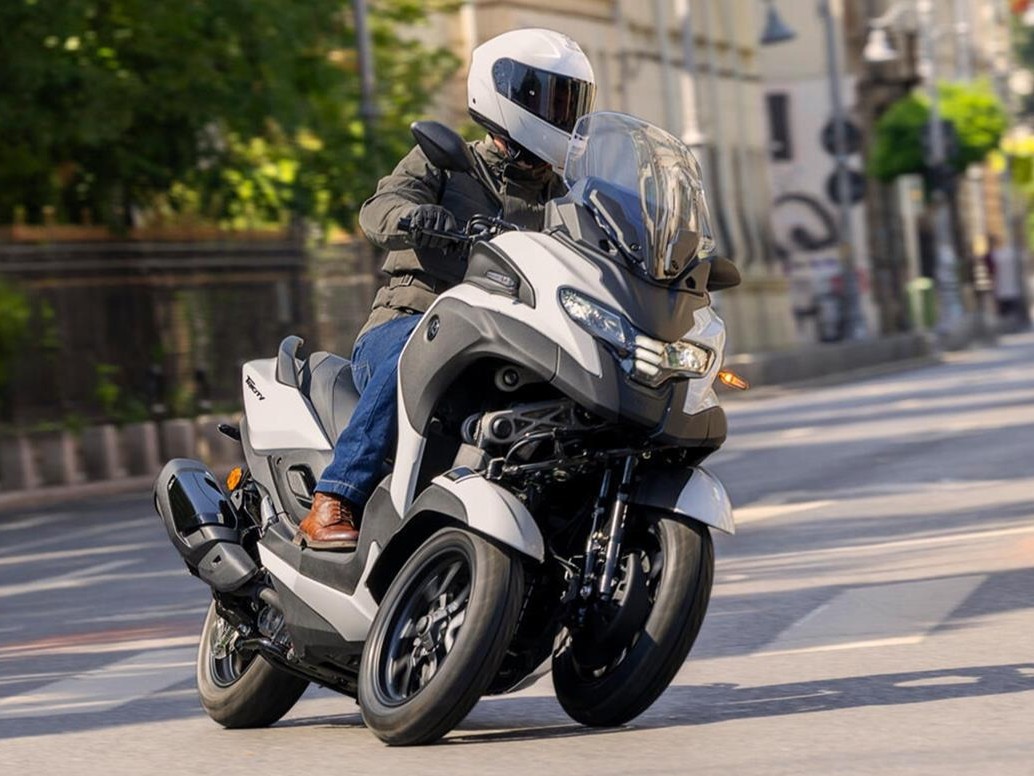
Yamaha says that its mission brief for the 2026 Tricity 300 was to make one of the safest scooters on the planet. The Yamaha Tricity itself has been around since 2014, and it was launched with the idea of getting car drivers into motorcycles by making a scooter with three wheels that was super easy to ride. This was one of two of Yamaha’s crazy three-wheel motorcycle ideas to come out of the mid-2010s, with the second being the faster Niken.
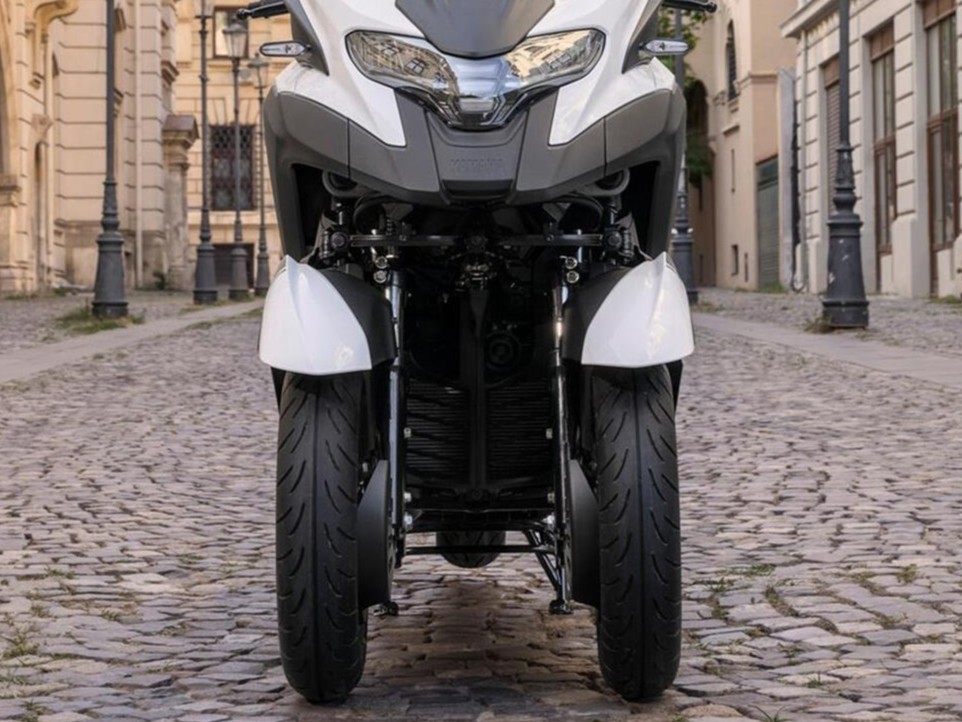
The first-generation Tricity had the problem of its front wheels being so close together that, legally, riders in the EU still had to have a motorcycle license to ride it. In 2019, the second-generation Tricity rectified that with a wider stance that made it a true three-wheeler by EU standards. The new scoot also got a larger, faster 300cc engine.
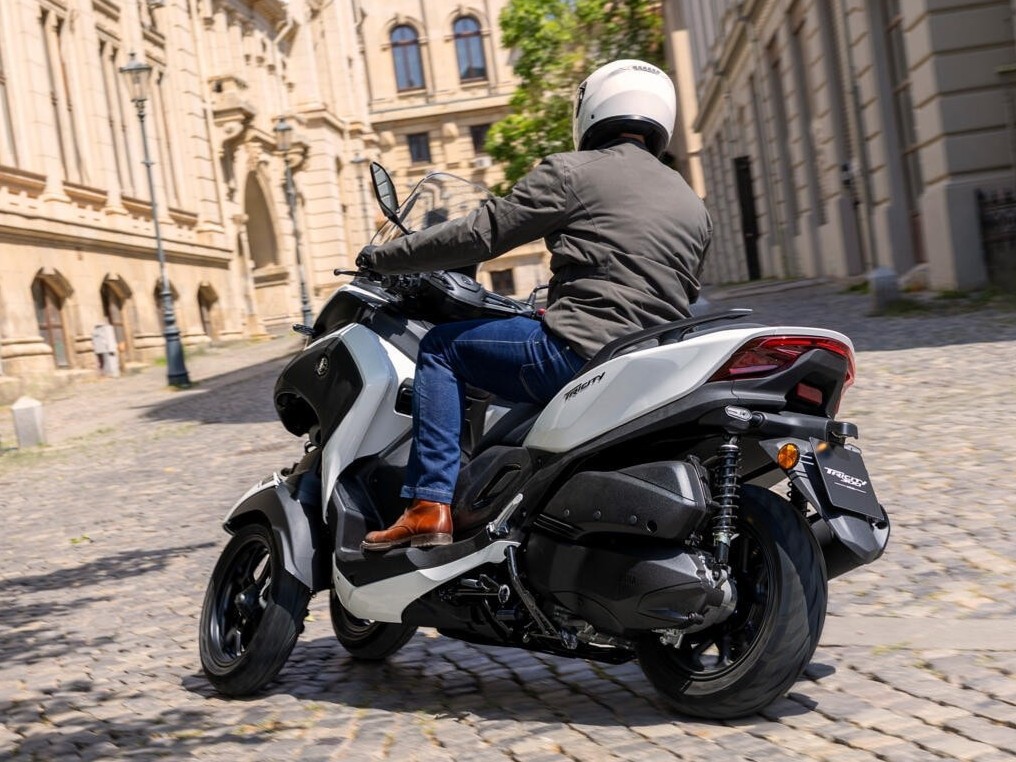
Now, the Tricity is getting another update, and this one is supposed to make the scooter safer. In a video, Yamaha Tricity 300 Project Leader Daisuke Asano talked about how the updates to the three-wheel scooter include an active leaning system, sensor-based safety features, rider aids, and more. The airbag idea came up because the Tricity 300 is ridden by people of all ages and demographics, from beginners to businessmen. The engineers of the Tricity rode their bikes to work every day, wondering what they could do to help reduce traffic fatalities and to give families peace of mind.
Then, it hit them: This is a big scooter, big enough to cram in an airbag up front. So, Yamaha’s engineers teamed up with Autoliv to make it so.
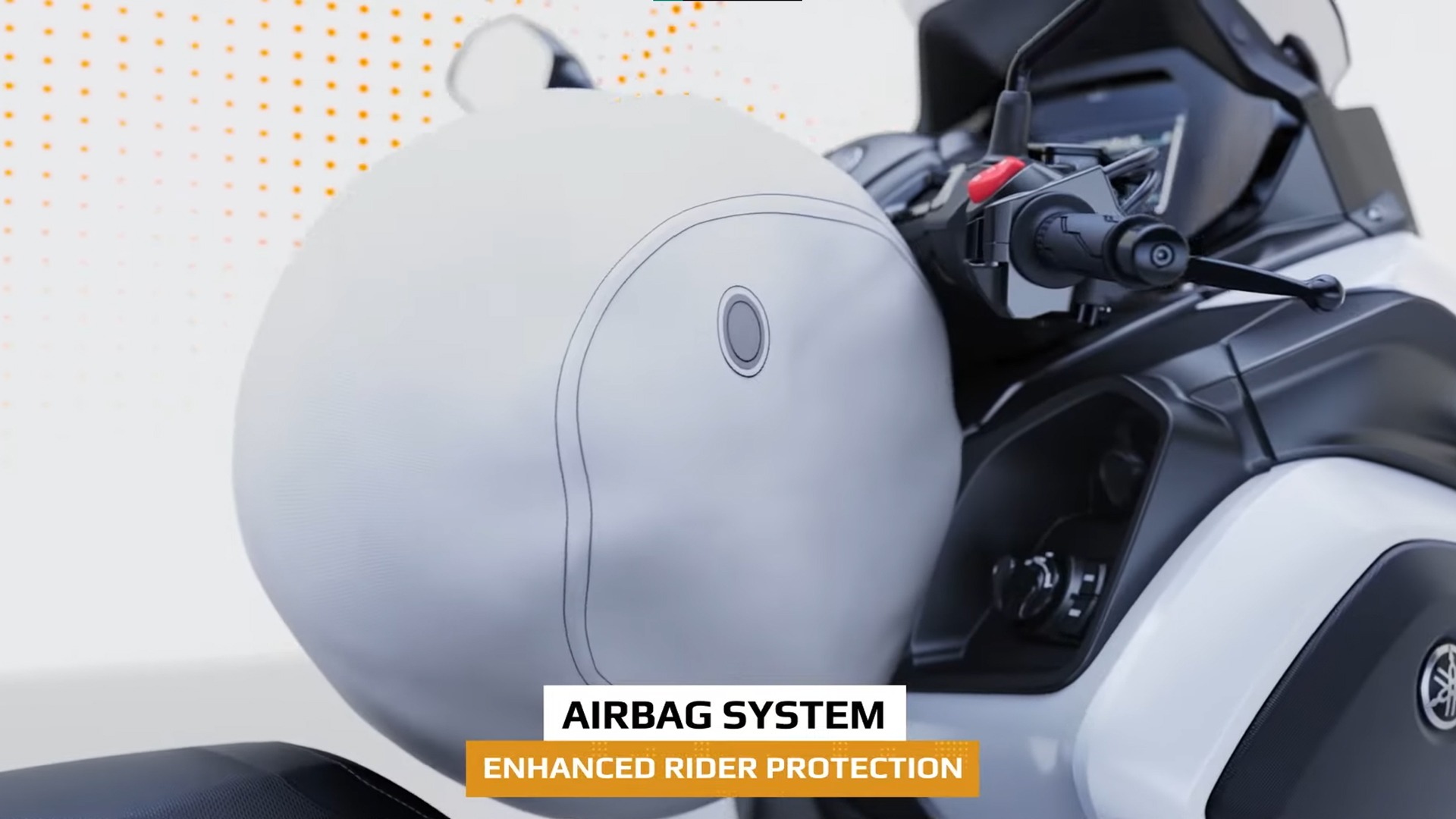
Yamaha says that the scooter uses G-sensors in the center of the scooter to measure deceleration, and if a frontal crash is detected by the sensors within the correct parameters, the airbag deploys from just under the handlebars. Yamaha says the bag deploys so fast that it can absorb some of the kinetic energy of the rider’s acceleration before they’re thrown off the bike.
According to Yamaha, the airbag will only deploy after the system detects deceleration and compares it to a stored value. This value is not public. But the idea is that the bag will blow only in a frontal crash and not side impacts, low-sides, high-sides, aggressive braking, or just tipping the scooter over.
Autoliv fully realizes that a motorcycle airbag in itself has a very limited use case. That’s why it’s pushing for the use of a suite of safety gear, from motorcycle-mounted airbags and rider-worn airbag vests to airbag backpacks and airbag helmets. Autoliv basically wants a world where a motorcyclist is just surrounded in airbags when they crash.
As for the scooter itself, it’s a pretty neat unit. Power comes from a 292cc Blue Core single with 27.6 HP and 21.3 lb-ft of torque. Those ponies reach the rear through a CVT automatic with a belt drive. 267 mm disc brakes front and rear handle stopping, and there’s a lean-sensitive three-channel ABS system to handle all of the wheels. Up front is a double-telescopic fork that allows for motorcycle-like leaning. A feature I really dig is that the underseat storage is large enough for two full-face helmets.
Will You Want An Airbag?

The price for this 533-pound weirdo is £8,780 ($11,630) and, for now, it has been announced for Europe. According to Motor Cycle News, anyone over the age of 21 can ride one of these in the UK with just their car license. Yamaha has toyed with bringing the Tricity to America in the past and, in 2024, even filed documents with CARB to get it approved. However, it’s unclear if this scooter will be U.S.-bound at this time. Likewise, if it did come to America, it’s unclear if we’d get the version that has the airbag.
It’s also unclear how many motorcycle riders even want an airbag. For many, ditching all of the technology and the nannies behind is part of the draw to motorcycling. I like to dress up like a Power Ranger with a decent helmet and armor. It has gotten me through two crashes entirely unscathed. But I’m not sure I’d be racing to the Yamaha dealer to spend five figures on a three-wheel scooter with an airbag.
Still, it’s pretty cool to see technology like this hit the marketplace, if for no other reason to show that it was possible. Besides, you won’t see me complaining if someone out there says that this airbag or a Gold Wing’s airbag saves them. I’m always for saving lives. It’s also awesome to see that the motorcycle world is still not afraid to get really weird.
Top graphic images: Yamaha



My mind immediately went to “what happens when you’re in a tuck and that thing goes off”.
But on the cobbled european streets pictured, it’s probably more likely to go off when you hit some pedestrian in Rome that just stepped into the road while lighting a cigarette and not looking at traffic. That seems to be the only way that locals cross the street there.
FOOMP! there it is