

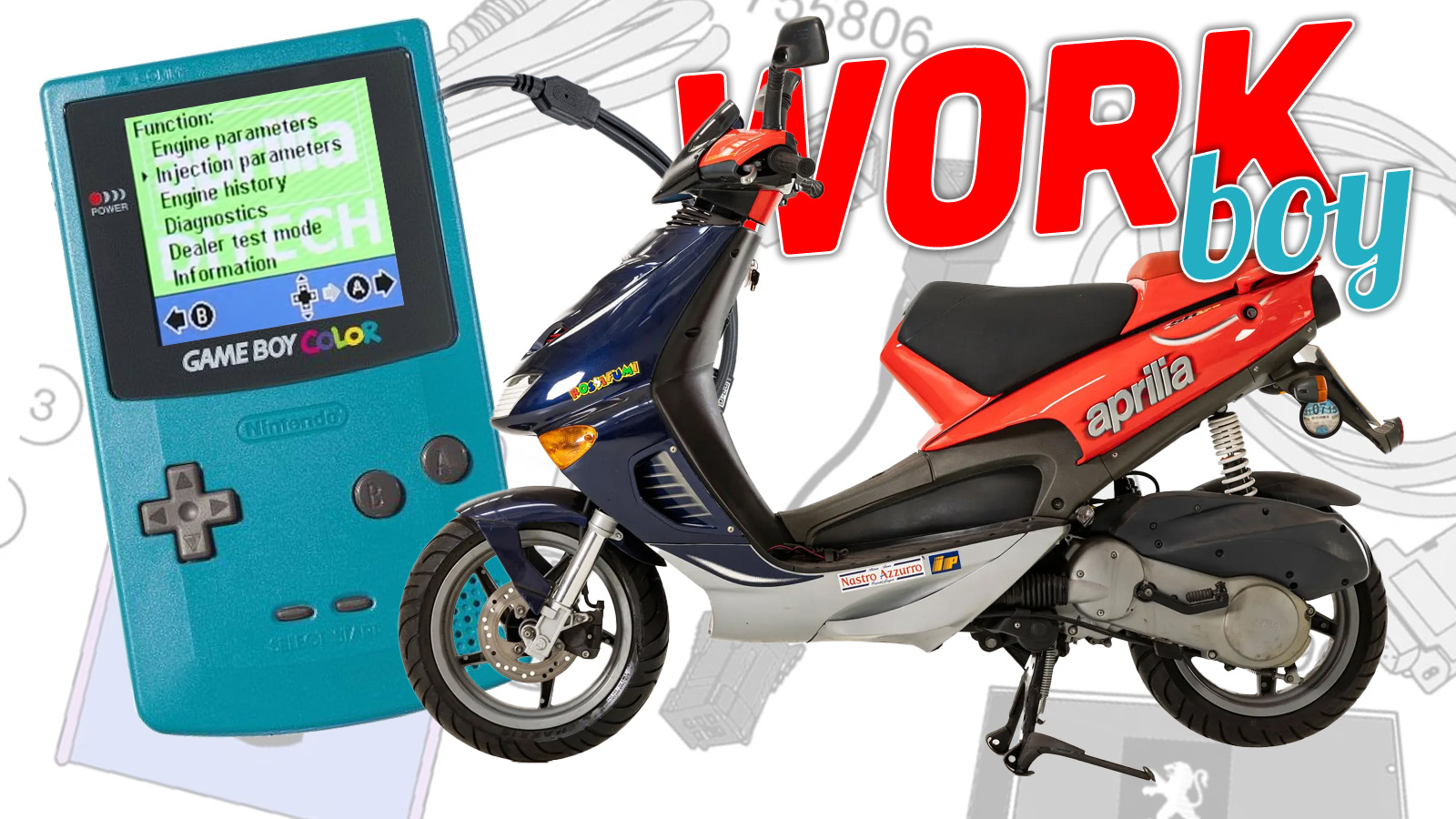
You know what’s a fun thing to think about? For a good number of years, encompassing pretty much all of the 1990s and even into the early 2000s, the cheapest, most capable hand-held computer you could buy was a Nintendo Game Boy. Remember, this was an era before there were ubiquitous smartphones in everyone’s pocket. Personal Digital Assistants like the Apple Newton and Palm Pilot didn’t come out until 1993 and 1996, respectively, and those cost way, way more than the Game Boy’s $89. A Newton was about $700 and a Palm Pilot was about $300. A Game Boy was less than 1/3 the price of a Palm Pilot and offered a screen with nearly as much resolution as the Palm, a reasonable amount of computing power, and ran on AA batteries.
This fact wasn’t lost on some clever companies with the ability to look beyond the surface of things. If you wanted to build something that required a fairly capable small computer to control it, but needed to keep the price down, you could leverage a small handheld computer many of your potential customers already had: a Game Boy.


That’s how the world ended up with sewing and embroidery machines that used a Game Boy for their brains:
I love the idea of this so much. Something sold as a toy found use as the brains and display/interface for, among other things, medical equipment, a sonar tool for fishing, and the thing I want to talk about today, a diagnostic tool for working with fuel-injected two-stroke scooter engines. Scooters that used these systems were made by Aprillia, Suzuki, and Peugeot.
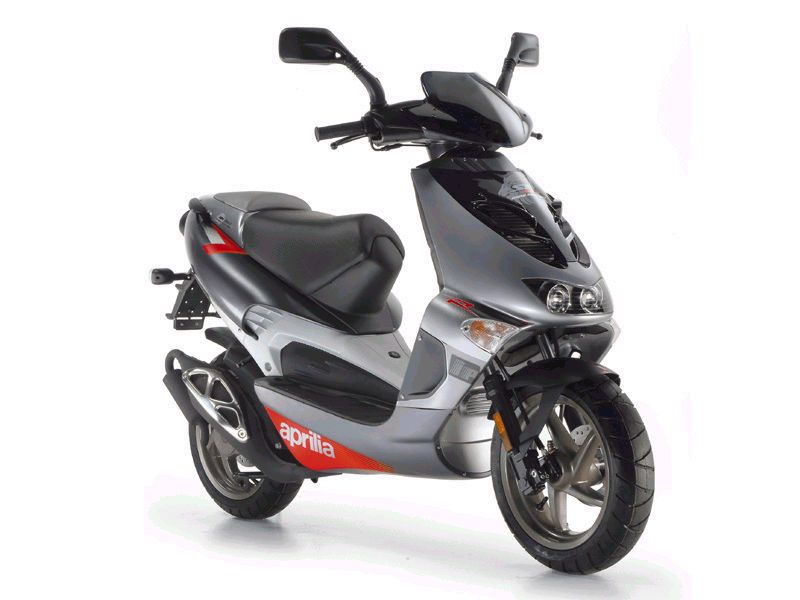
This has all been written about before, of course, but I love the idea of it all, conceptually, so much that I think it merits discussing again. Because, again, a major manufacturer – well, multiple manufacturers of scooters using two-stroke engines with the Ditech fuel injection system. There were versions of these diagnostic cartridges for Aprillia, Suzuki, and Peugeot scooters, each incompatible with the others, despite their similarities.
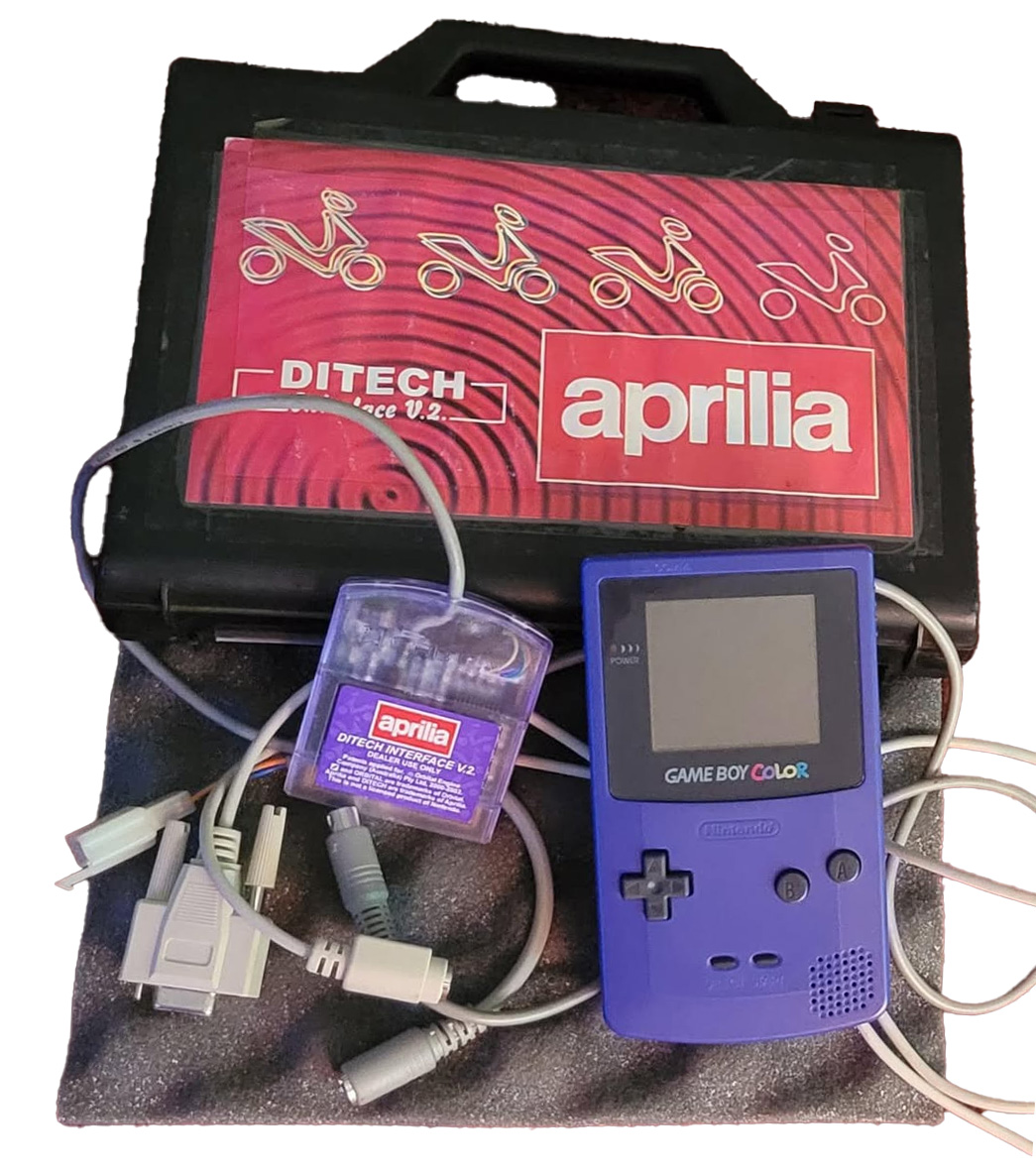
Here’s some video of an Aprillia version in action, running on a Game Boy Color – these needed the GB Color to work, not just an original Game Boy. In 1998, a Game Boy Color was $79.99, which is a bit over $160 today. Oh, right, the video:
In the case of this video, the scooter is a 2002, and you can see some of what the Game Boy displays: engine RPM, voltage, temperature, throttle position, ignition advance, engine cumulative hours, and it allows for modification of some engine parameters.
The diagnostic system consists of a cartridge that plugs into the Game Boy and has a pair of wires coming from it, one of them going to the ECU via a mini-DIN connector, and another set of wires that connect to the brake system.
There are, of course, more videos of people showing off these remarkable Game Boy-based devices, like this one:
…and this one:
This one right above here shows the VHS-like cases used to package the tools, and also the branding differences on the Aprillia and Suzuki versions.
The fuel injection system used by these engines is quite interesting, as it really helped small two-stroke engines meet stricter Euro 1 emissions controls. Developed by a partnership between Aprillia, Orbital, and Siemens, this was a direct-injection system that delivered atomized fuel into the top of the combustion chamber. Unlike most two-stroke systems that mixed oil and fuel, in the case of the Ditech engines, oil was introduced into the cylinder via the traditional intake port, but the fuel was directly injected.
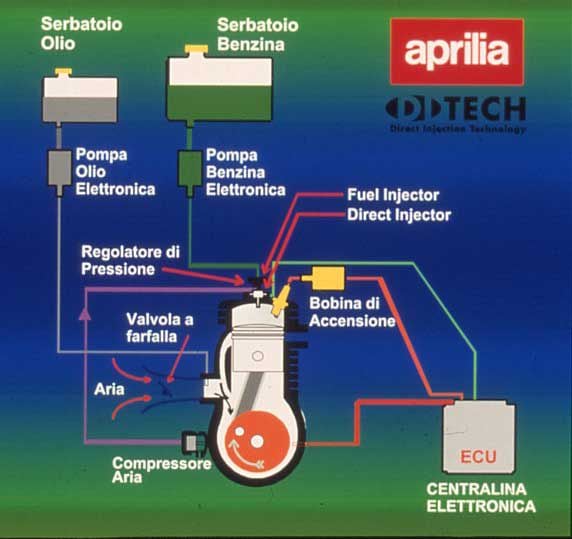
These engines first hit the market around 1999, which is about when ECUs became computationally powerful enough to manage and regulate such a system. It’s also why a computer was needed to diagnose and work on these engines, which led to the clever repurposing of a handheld video game machine that happened to have a reasonably powerful Z80-compatible CPU and a decent display interface.
Don’t underestimate the power of toys, friends.



“Don’t underestimate the power of toys, friends.”
Uhhh…do sex toys count? Uhhh… asking for a friend. Ha ha
I mean, I have an OBD2 scanner that uses a wifi connection to my iPhone. Is that so very different?
I use a Bluetooth OBDII reader that is hooked up all the time. It displays the data right on my Android head unit (or on my phone).
And tech like, this is cheap, too. Like <$20 for the OBDII reader, plus maybe 10 bucks for the Torque Pro app.
If you squint, you can see the direct line from the GameBoy-tuned scooters to this practice.
My Bluetooth OBD2 reader has a tendency to drain the battery if I leave it plugged in for too long, so it only gets plugged in for special occasions
Goes to show the most creative/genius ideas are born from constraints. Look at what the Apollo computers could do, with memory that was copper wires woven by hand. Things are exponentially easier now, but exponentially more boring.
I haven’t thought about those crazy Aprilia Dragster 180s in awhile. I guess they hooked up to Gameboys as well
https://bringatrailer.com/listing/2000-italjet-dragster-180-3/
I wonder how big the fuel pump on that is……?
Just think what they could have done with some salami, hard cheese, and a little help from Torch.
Not surprising.
Check out Pacific Northwest Hillbilly who is single handedly restoring a 1990s Hitachi excavator. Yeah…those huge yellow tracked back hoe things.
https://www.youtube.com/watch?v=723NyVyQLzw
Hitachi uses a PalmPilot as the front end for reading error codes and providing live operating data in the ECU computer!
If you have never checked in with Pacific Northwest Hillbilly’s YouTube channel…you should. He is fearless. Watch him restore a bulldozer, skid loader, and excavator ALL BY HIMSELF. It will leave you feel like dropping the tranny in your VW is like a Lego game rather than a DYI victory.
I love the idea of tuning an engine, playing Donkey Kong at lunch, and embroidering work shirts in the afternoon all with the same Game Boy.
I’m also glad Orbital’s design reached production on something after reading about their research engines
Today you can go on AliExpress and buy an ELM327 OBDII-Bluetooth dongle for $10 and a cheap Android phone for $30. Download the free version of the Torque app, and you can do more stuff for half the money. Sometimes technology is good.
How does this help me with my 1980 Fiat?
I Jest. Of course you’re right about technology being good sometimes.
Customer: So, were you able to figure out what was wrong with my scooter?
Technician: Well, every time we enter Turtle Rock we keep getting punched back to the beginning.
Customer: What?
Technician: Look, we’re asking everyone we can, but it’s a difficult mini boss. We’re going to need another two weeks.
Repurposing something cheap and ubiquitous is Peak Engineering imo. Cost effective for both the company making it, and the consumer using it, a rare double win (unless of course those carts were stratospherically priced). But the idea of charging out the nose for diagnostic software is a more recent concept. My company has a truck with a Scania engine. At one of our sites, they only have one of these trucks, yet they have to pay the same license fee as a diesel repair shop that services any number of vehicles a month. Just to be able to do any level of diagnostics.
My mom was really into sewing and embroidery in that period. She picked up one of the singers that had the Gameboy as a controller. I think it was about $300 maybe less on sale because they couldn’t sell them. At the time that was a crazy deal for an embroidery machine. I thought it was sort of interesting but seemed problematic compared to her other more full featured units. She never quite got used to it and never really used it. My younger siblings were sort of interested in it because they were or had been game boy users but still didn’t really result in any use.
Around the same time a buddy that worked at the patent office showed me a very early color compaq pocket pc with its higher res larger full color touch screen and arm processor running windows ce / pocket pc. Compared to the palm os devices that were still low res black and white even the color version that came out not much after that made the pocket pc with its arm processor as well as various wireless interfaces it looked and felt like like the future. He was convinced it would change the world. It’s interesting that just a year or two later they started integrating that hardware and software into the heigher end embroidery machines. Along with showing up in different industries for diagnostic and control.
I remember seeing this Gameboy diagnostic system somewhere around that time and thinking interesting but too late. I think there was at least one Japanese manufacture floating some kind of Gameboy interface as well but not sure if it was ever released.
I am so here for Game Boy related content.
Alas I have only an OG Game Boy and a GBA, no GBC.
[Ahem] it’s Aprilia, not Aprilla
Old man fun story time!
Back in December of 1997, as the year was drawing to a close I went to the office supply store looking for a replacement insert for my Day Planner. You see before we had computers in our pockets, we carried around a small notebook to take meeting notes and make sure our calendars were up to date, and in the case of back to back meetings, knew where we should be when.
Anyways, as mine was nearing obsolescence as the year was ending, I needed a new one, and then I saw it, the US Robotics Palm Pilot display. Did some quick mental math and came to the (brilliant) conclusion that buying one Palm Pilot would save me money after three years of day planner inserts.
Which, was actually true those things weren’t cheap, except I proceeded to upgrade like every 14 months. I had an original Palm Pilot, then a Pro (512K of storage, and the IR Blaster!), then a Handspring Visor, in that cool translucent blue, then a Handspring Visor Deluxe (with 256 Color Display) A Sony Clie, one of the metal Palms, and a couple of phones. Unlike PCs, I mostly kept the same data across each device, as I Could just dock it to the computer and use the same(mostly) software to backup one and restore it to another. What a time to be alive.
I still have that blue Handspring Visor: it has a 2MB backup module that contains notes I took at a conference in 2001. 😀 Every so often I’ll put a fresh battery in it to see if it still works.
Also have a Sony Clie and Palm something (T/X?). One of them (the Palm, I think) would work with a small folding wireless keyboard AND at the time, Microsoft Office was free for handhelds. I had Word, Excel, and Powerpoint on a PDA with a keyboard – awwww, yeah.
Yeah there were keyboard options from Handspring too. I totally forgot about all the modules. I had a memory upgrade for my originals and probably the Visor too. I mostly used it to play Space Invaders during team meetings, and Later Bejeweled when that came out. I probably still have my save game data kicking around somewhere. I did not save any of mine, too much old tech lying around as it is.
If you’re talking the Franklin branded planners, those were an absolute fortune.
I had one of the first Palm devices with a camera, a hefty 640×480. I couldn’t see details but it was immensely useful when someone wanted to show me a concept and it saved me from trying to sketch it myself.
Mine was nice, but it wasn’t Franklin Planner nice.
I drew a picture of a lighter on mine, that I would hold up at concerts long before iPhones were a thing.
I found amongs all of my things an old Palm IIIe. Pop batteries into it and it works! Bring it into the office every once in a while to show the yutes.
Sometimes I bring my slide rule into work to baffle the yutes!
A PalmPilot was a godsend when we had to juggle doctor appointments and related data. Ultimately we had to replace it for some reason and I was dismayed to find that they just weren’t available anymore because the market had turned to some “Blackberry” thing? Some sort of PDA that could make phone calls – amazing, but I didn’t like that I had to pay someone every month to use it. On the plus side, we didn’t have to carry a separate cell phone anymore.
Yeah I clung to mine until I got an iPhone, though by then it was not being used very often.
Fun fact: a typical mid-1960s twin-cylinder two-stroke Japanese motorcycle would have a multi-part throttle cable. A single cable would be routed from the throttle housing down toward the carburetors, and just above the engine it would suddenly turn into three cables. Two would actuate the carb slides and the third would operate a small oil pump that lived under a cover on the right side of the engine, just ahead of the clutch.
Often this pump was fed by an oil tank located behind the cosmetic side cover just below the seat. In fact, in some cases the [metal] tank was painted body color and served as the cosmetic side cover itself. A narrow tube allowed oil to gravity-feed down to the pump, and the pump then supplied the appropriate amount of oil into the intake according to how open the throttle was (based on the motion/position of the third cable).
We should note that this oil tank was separate from the crankcase/transmission, and it would be filled with Castrol or some other two-stroke oil that could be used for pre-mixing fuel. If you had a two-stroke motorcycle that did not have oil injection, you would need to add the oil to the gas in e.g. a gas can before adding it to the bike’s fuel tank. This was the standard procedure before oil injection came along.
From after oil injection, I recall a guy on a Suzuki water buffalo at a rally needing oil, and I sent him to an outboard motor shop since in the early 90s most outboard motors were still 2 stroke
My oil injector indicator cracked on my Vespa PX, so I had to pre mix the oil myself for awhile.
One time I managed to miscalculate how much I needed in there to keep the engine from seizing.
Ask me how I know I didn’t add enough oil that one time.
Such a great idea. If you need is a small CPU, screen and some buttons to interact with a diagnostic system/software, why not choose something cheap and ubiquitous?
“Hey, what’s taking Frank so long? Let’s see…”
“…Frank! That’s not the diagnostic cartridge, that’s Pokémon Crystal! Now get back to work!”
“…Besides, Mom said it’s my turn next…”
What a delightful thing to learn, this information made my day!