

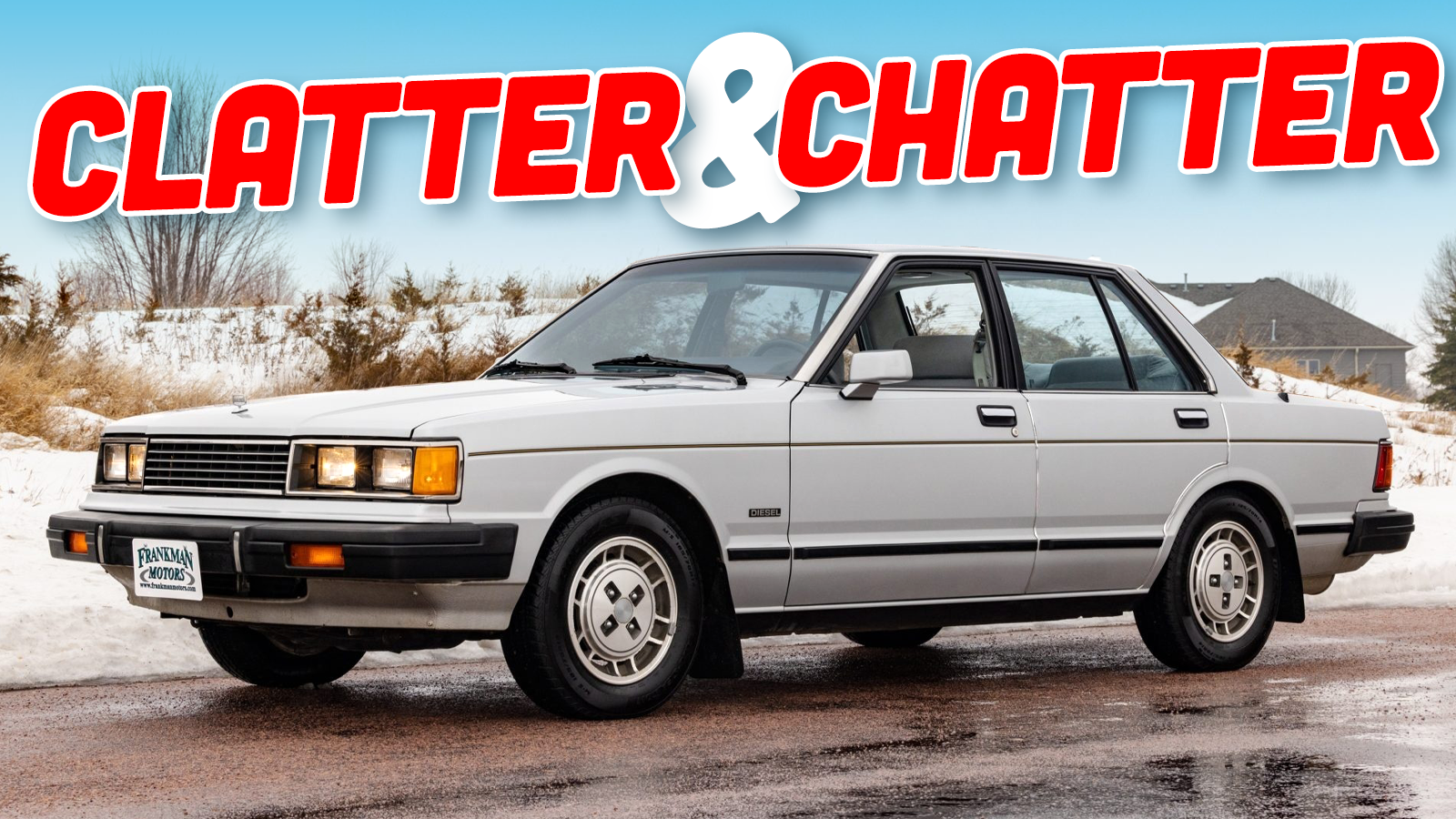
Back in the 1970s and the 1980s, Japan flooded America with affordable, fuel-efficient cars and motorcycles that countless Americans found too irresistible. Toyotas, Datsuns, Hondas, and Mazdas offered something unique that Detroit didn’t have for great prices. Japan also took on the luxury market, and one of the most ambitious cars from this effort was the Datsun 810 Maxima. This car had so many gadgets, including voiced warnings using a phonograph record player, that it seemingly did American luxury better than America did. It even had the option for a diesel engine.
The 1970s were a transformative era for Japanese cars in America. Toyota and Datsun had landed on our shores in the 1950s and had made large progress in our market. Mazda and Honda officially arrived during the 1970 model year. Mitsubishi was also technically here thanks to its marriage with Chrysler, and Isuzu was here thanks to General Motors.


All of these brands faced a challenge. America wasn’t just another car market, but a unique nation where the Japanese brands had to overcome assumptions, domestic brand loyalty, and biases to sell cars. Back in the early decades of Japanese vehicle imports, something like a Toyota or Honda was seen as disposable. You bought one of these vehicles because they were cheap, and you didn’t even expect them to last more than a couple of winters. Some buyers were old enough to have lived through World War II, and might have had a non-complimentary view of Japan. But that wasn’t all, as Japan also had to figure out what American buyers even wanted in a car.

Datsun landed in America in 1958 with the 1000, which had all of 37 HP to its name. In December 1958, Road & Track found that a Datsun 1000 required 46 seconds to reach 60 mph and the car had no more than 66 mph in it. The publication didn’t hold back, saying that the 1000’s performance was “melancholy” and that “Any car that is to be successful must have either better performance or better economy than its rivals, or some fascination.” “The Datsun has a shortage of all three.”
Datsun wasn’t alone, as the Toyota Toyopet Crown also came to America in 1958 to disappointing reviews. Japan took the harsh criticism from the Americans and used it to make their cars better. Little by little, Japanese cars went from being considered jokes to becoming forces to be reckoned with. Just a decade after the Datsun 1000 was the 510, a hot sort of discount BMW that remains one of Nissan’s most iconic historic models.
Datsun, like its rivals, also came swinging at multiple segments. Long before Infiniti, Acura, and Lexus were founded, Japan’s brands even tried their hands at luxury. For its second generation of the 810 and technically the first generation of the Maxima, Datsun created a car that did luxury better than some American cars did.
A 240Z As A Sedan
The story of the 810 begins in the mid-1970s. America was deep in the so-called Malaise Era, which was punctuated by downsized, unreliable cars with pokey engines choked by emissions equipment and adorned with huge 5 mph bumpers that looked like the automotive equivalent of old dental braces.
Datsun was a late adopter of inline-six sedans in the American market. Domestic automakers had been doing them since forever, and even Toyota had been slinging sixes since the Crown in the 1960s. Datsun? In the mid-1970s, its largest car was the 610, which was sold as a coupe, sedan, and wagon that Datsun was happy to advertise with terms like “first class,” “elegance,” and “luxury flyer.” It wasn’t just fluff, either, as the 610 sported such niceties as bucket seats, full carpeting, vinyl upholstery, an independent rear suspension, power brakes, a woodgrain steering wheel, air-conditioning, and more.

But for everything it had, there was one thing missing: power. Under the hoods of these attractive family haulers was a 1.8-liter four-cylinder engine, which was good for just 94 horses (net) in 1973 before being upgraded to a 2.0-liter four with 97 ponies in 1974.
In 1977, Datsun replaced the 610 with a bigger, faster, and more luxurious family of cars, the 810. According to a period review from Road & Track, Datsun decided to chase down the Ford Granada, Volkswagen Dasher, the Dodge Aspen, and the Plymouth Volaré. To do this, Datsun doubled down on features and on power. From Road & Track:
Frankly, we’re not sure they haven’t set their sights a bit too low, because we find the 810 has many features found on the more expensive European sports sedans such as BMW and Alfa Romeo. And if such a statement surprises you, welcome to the club.
The new 810 (previewed in “Miscellaneous Ramblings,” R&T, November 1976) replaces the 610 as the top model in the Datsun fleet. Nissan is quick to point out, however, that it is not just a luxury car, but also a true touring sedan with a decidedly European flavor in looks and performance. We agree about the performance but not the looks. As with most, if not all, Japanese-made sedans, the styling is lacking in panache; as the Editor says, “When you look at an Alfetta, you know immediately it’s an Alfa Romeo, and when you look at a 320i, you know instantly that it’s a BMW. But, when you see the 810, there’s virtually nothing to distinguish it from any other Japanese sedan.” It seems to be a case of Japanese cars being designed by committees and computers to maximize acceptance, whereas European cars are more identifiable as the result of one person’s very strong feelings about styling. So, the 810’s styling does not excite us. But the rest of the car does. As the Engineering Editor said, “Lurking beneath an innocuous exterior is the best sedan Datsun has produced, including the late, lamented 510.”
The 810 uses the 2393-cc inline 6-cylinder engine that powered the original 240Z. It’s been updated with electronic fuel injection (L-Jetronic, the same as is used on the current 280Z) but because of emission controls the compression ratio is now 8.6:1 instead of the original 240Z’s 9.0:1. The net horsepower rating is virtually unchanged, however, and the 2.4-liter engine in the 810 provides more than enough horsepower and, just as importantly, plenty of torque. The standard gearbox is a 4-speed manual that feels very much like that of the Z-car but it’s easier to shift and has different ratios. A 3-speed automatic is available as an option ($275).
Road & Track continued raving about the 810, talking up its snappy power without having to race the engine, great drivability, predictable handling, and comfortable ride. Its 12.2-second sprint to 60 mph put it in the same category as the Alfa Romeo Alfetta GT, BMW 320i, and the Ford Granada.
The magazine also applauded the car’s features, which included a quartz digital clock, full instrumentation, a height-adjustable steering wheel, high-quality cloth seats, an AM/FM multiplex stereo, a rear window defroster, intermittent wipers, and even a fault warning system. The car could also warn you if you had a brake light or headlight out. Road & Track even claimed that the car was as quiet as a European touring sedan and had zero blind spots.
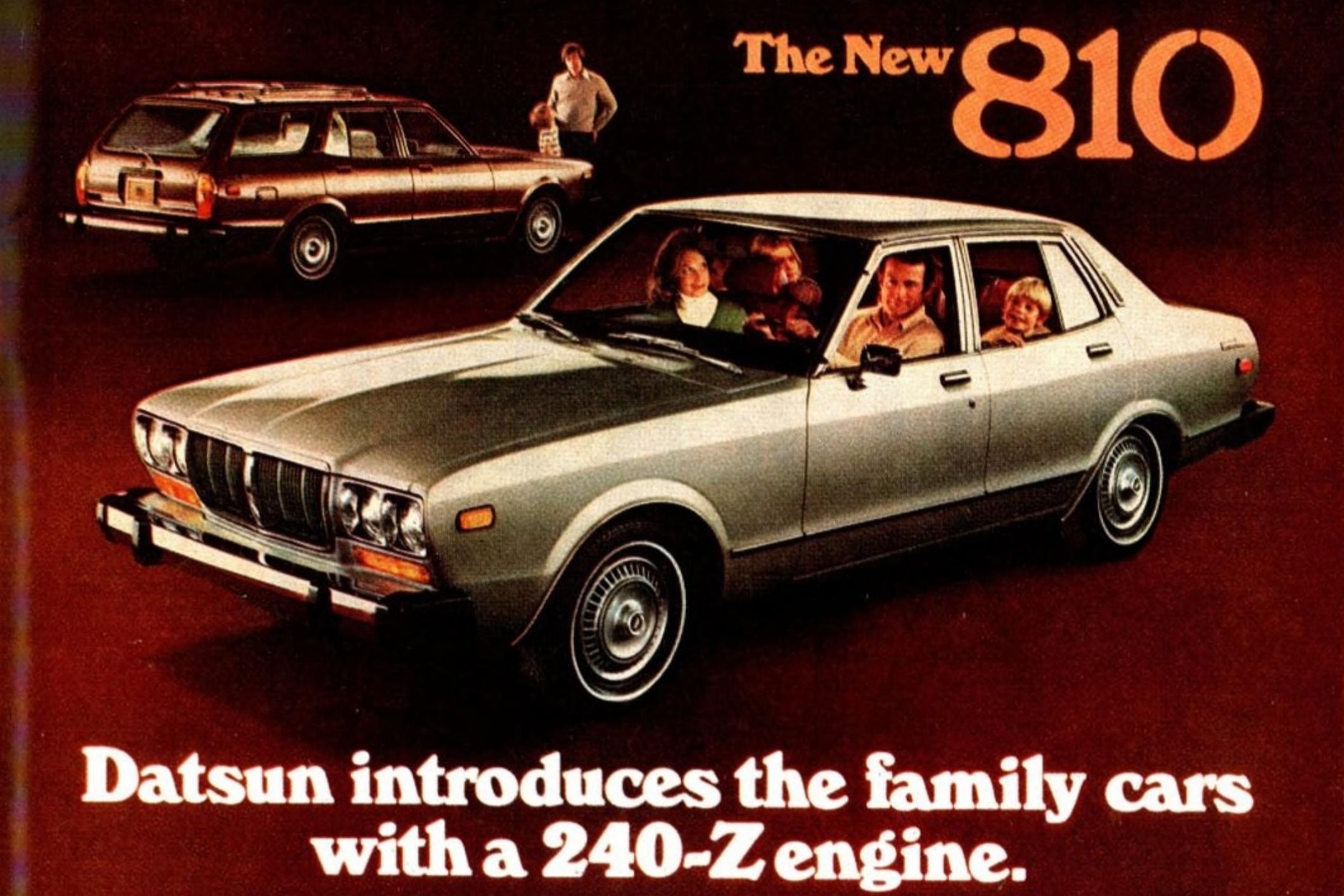
The magazine’s conclusion was that “we feel it’s the best sedan to come from Japan yet,” which was incredible praise. Datsun took the positivity from the press and ran with it, calling the $5,499 car ($29,485 in 2026) the “World’s Most Underpriced Luxury/Performance Car.” In other ads, Datsun proudly proclaimed that the 810 was a family car with a 125 HP 240Z engine.
Datsun Leans In On Luxury

When it came time to follow the 810 up, Datsun got innovative. It also got confusing, too. Technically, the 810’s replacement came in 1979 with the Datsun Bluebird 910. However, the car largely kept that name only in Japan. In most other places, this car became the second-generation Datsun 810. Things got extra weird here in America when the new 810 arrived in 1981. At first, Datsun called them two trim levels: the 810 Deluxe or the 810 Maxima, the latter Maxima name being borrowed from the short-lived Stanza Maxima.
After 1981, the Deluxe trim and the 810 badge were discontinued, and all 810s sold in America became the Maxima. But then there’s an additional twist. The second-generation 810 launched right in the middle of the massive Datsun-to-Nissan transition that was announced that year. Until then, trucks built by the Nissan brand would be called a Nissan, while cars built by Nissan were usually called Datsuns. In the 1970s, tiny “Datsun by Nissan” badges began appearing on cars built by Nissan. Thus, technically, the early 810 was the Datsun By Nissan 810 Maxima. The later model was still the Datsun By Nissan Maxima. Finally, by 1984, all the name shenanigans were finally worked out, and the car was just the Nissan Maxima.

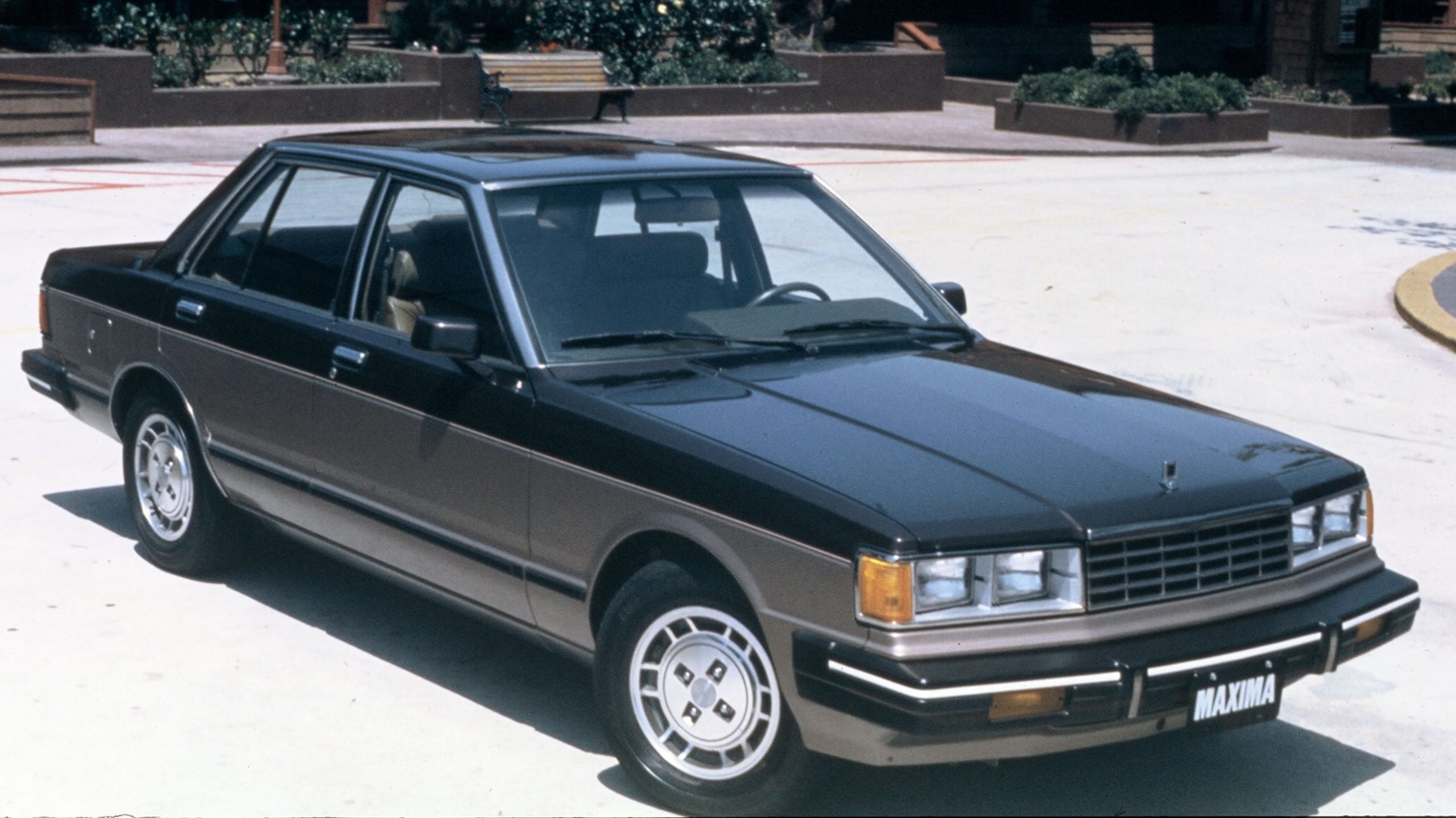
Name confusion aside, the car was a tour de force. In designing the 810 Maxima, Nissan said it ditched the “Coke Bottle” styling of its predecessor and went back to the clean-cut straight lines of the revered 510. Likewise, Nissan says that the 810-based Maxima would be the only Maxima in Nissan’s history to be rear-wheel drive. In its review in 1981, Motor Trend noted that the car was a blend of bits carried over from the old 810 and new technology:
The 810 has been completely restyled for ’81, inside and out, and major engineering changes have been made to the suspension to provide better ride and handling. The fully independent suspension is basically a carryover from the previous model, but with improved road noise isolation, zero-scrub front end geometry, variable-rate springs on the MacPherson strut assemblies, and heavier front and rear stabilizer bars. Steering is a power-assisted rack-and-pinion setup with a very quick ratio, and stopping power comes from large, 9.4-inch-diameter disc brakes on all four wheels. The engine is the proven 120-horse-power overhead-cam fuel-injected inline six derived from the original engine used in the 240Z sports car. It is a very smooth engine but not one for wheel-spinning acceleration. The 2.4-liter six has a good reputation for reliability and comes with an EPA rating of 22 mpg city, 27 highway. On our 73-mile test loop, the sedan recorded 21.6 mpg, an acceptable performance for an engine of this size pulling a 2800-pound car.
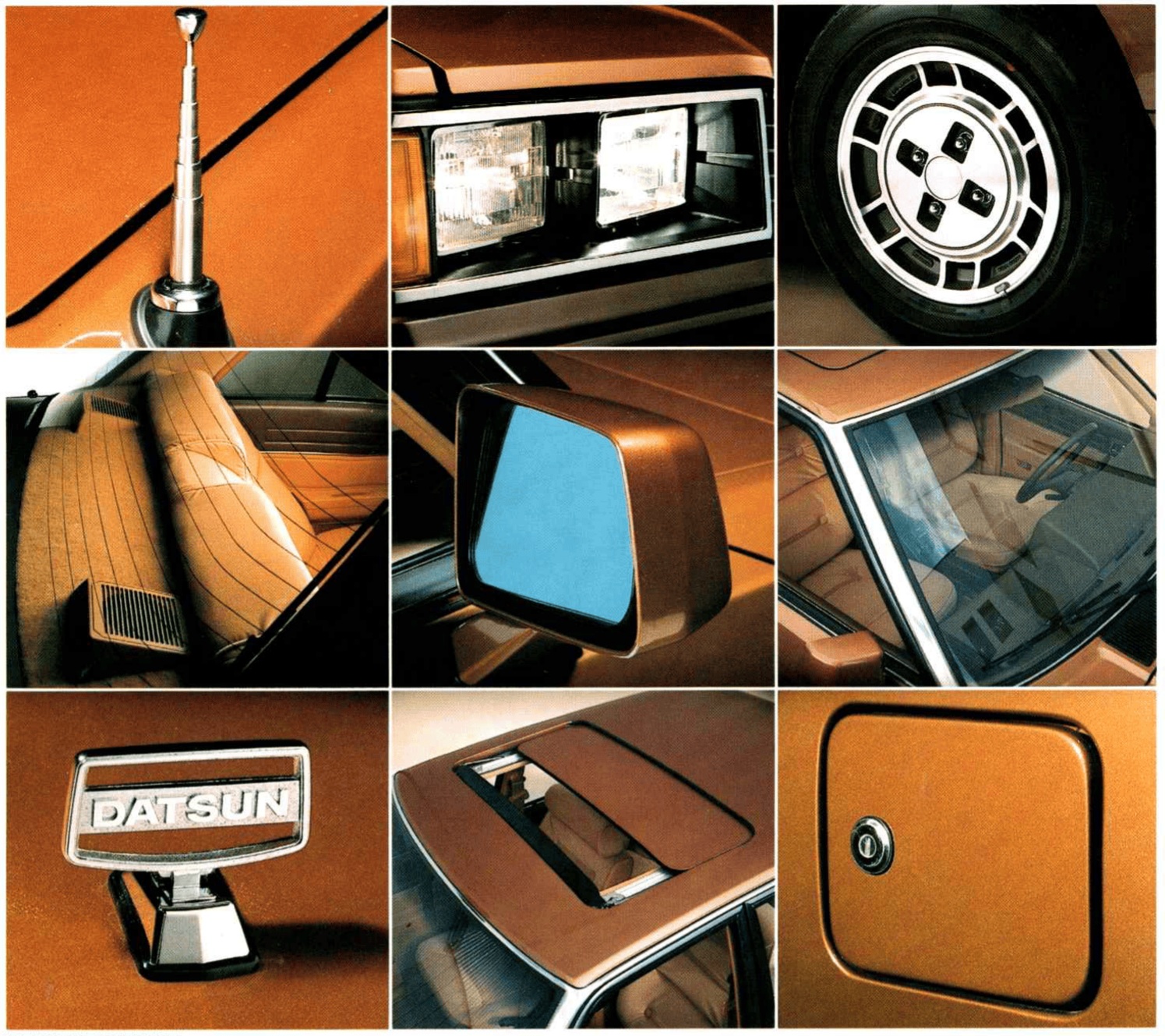
Major restyling has drastically changed the look of the 810 from a stubby, boxlike car to one with a long, sloping hood, increased windshield slope angle (and glass area), thinner roofline and a much-improved integration of greenhouse into the rear deck. The staggered rectangular headlamps are set wide on a horizontally barred grille. The urethane-covered bumpers wrap around the sides of the car and are blended smoothly into the fender skirts. Styled alloy wheels and steel-belted radial tires are standard equipment on the sedan models. Datsun has spared no attention to little details and to the fit and finish of the 810. The paint on our test vehicle was excellent, and the doors, decklid and hood had just the right amount of clearance.

Inside, the quality and fit were the same. Every effort has been made to insure maximum comfort for the passengers and ease of operation for the driver. The individual front bucket seats, with loose-cushion styling and adjustable headrests, have the usual fore-and-aft adjustments and fully reclining backs. The driver’s seat has a knob control for raising or lowering the seat angle, and an extra lever for selecting a firm or soft lumbar support. Front leg, hip and head room will satisfy the long and lean as well as the short and plump, and the same roominess is carried over to the rear seating. Designed to carry three adults, the rear seat has a folding center armrest, which increases comfort when only one or two occupants are being accommodated. The wraparound configuration at the ends of the seatback provides a very cozy feeling of sitting in individual bucket seats, especially with the center armrest down.
Motor Trend also noted that the designers at Nissan decided to make the car a bit more accessible. The old Datsun 810, like the Toyota Cressida, came loaded with a laundry list of luxuries standard. But this meant that, thanks to inflation, their prices would quickly near $10,000 ($38,519 today), putting them in competition with European sedans.

Nissan started taking note that not every big sedan came loaded to the gills anymore and not everyone was selling a million different body styles. So, here in America, the Datsun got the stripper Deluxe model and the fully-loaded Maxima. These two cars would share only a sedan and a wagon, while much of the rest of the world got the car as a hardtop sedan and a coupe in addition to a regular sedan and a wagon. The Deluxe was $7,579 ($29,194 today) for a sedan or $7,929 ($30,542 today) for a wagon, while the Maxima was $9,979 ($38,438 today).
The Deluxe was mechanically the same as a Maxima, but its interior was a bit more basic, sporting bucket seats, a heater, a stereo, and full carpeting. Notably, the Deluxe was the only trim level to offer a manual transmission. Nissan didn’t feel like the five-speed manual was a good fit for a luxury car. Datsun 810 ownership surveys also confirmed that most people bought them with automatics, anyway. As noted earlier, the Deluxe was sold for only a single year.
Every Gadget, Even Voiced Warnings
What did you get when you bought a Maxima? Everything. From Motor Trend:
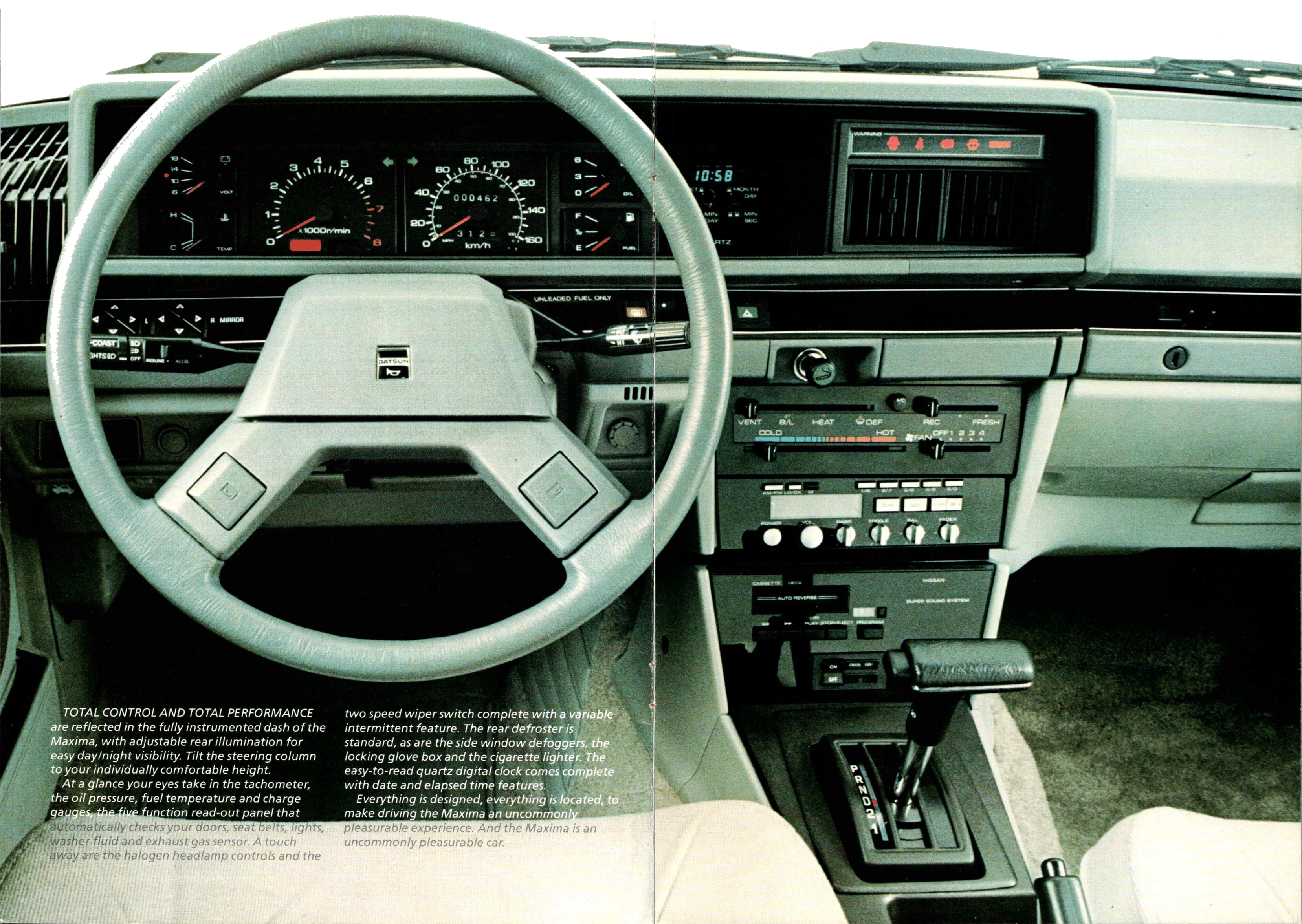
The Japanese have been very successful at packaging vehicles, and their system is currently being followed by American car builders, but more in the form of “specials” than regular models. Our test car, a $10,000 Maxima 4-door sedan, was a perfect example of thoughtful packaging. It had nearly every luxury and convenience option known to man, from sunroof, remote electric side mirrors, cruise control and electric windows, door locks and antenna, to AM/FM/cassette seek/search digital readout sound system, variable-speed wiper and intermittent washers. There also are a few extras, such as a method of securing the remote trunk lid opener, a hand crank in case of electric sunroof failure, an extra set of lug nuts for the mini-spare wheel, and a synthesized feminine voice that warns to “please turn out the lights” should the driver fail to do so after removing the ignition key. This audio feature is a first as an automotive application, but the military has similar warning systems in jet aircraft to supplement the usual flashing lights and warning buzzers.
At launch, the only options for the Maxima were simulated woodgrain and a roof rack. Everything else came with your nearly $10,000 admission price. The synth voice that read out warnings to you? Yeah, those were recorded on tiny three-inch vinyl records and played through a tiny phonograph record with circuitry. Let automotive legend Murillee Martin show you how it works:
When Car and Driver tested the Maxima in 1981, it said: “Judging by the 810, Datsun understands Americans better than Detroit does.” The review itself was mostly glowing, from Car and Driver:
What you don’t get in the Maxima is a manual transmission. Datsun feels that, while the Deluxe is a suitable repository for either the three-speed automatic or a five-speed stick, the Maxima provides the wrong sort of ambiance for manual gear changing. This is an unduly silly way to think, but the automatic proves not a bad deal behind the frisky 2.4-liter single-overhead-cam six. This is a junior version of the 2.8-liter engine that propels the 280-ZX, and it likes its work, but it cries out for the five-speed. You’ll want to override the automatic quite often. Given its placid druthers, it will upshift from first at less than 40 mph and step out of second in the mid-60s. Holding it to your wishes will belt you into second just short of the national speed limit, and the swiftish march to third carries up close to 100 mph before you need to move the handy T-bar shifter again. Manual downshifts to second are quick enough, but your speed has to drop to a crawl before you can get first no matter what you do with the lever and throttle. But the engine is smooth and free, turns in 22 mpg, and managed nearly 18 mpg during our 70-mph-average overland cruising. And it’s a double-fine hustler from 60 mph back up to 90 after easing past slower traffic. Slightly sapped by the automatic, the Maxima still pushes up to 60 mph in a scrappy 10.5 seconds, and on to a top speed of 111 mph.
At anything over 82 mph the cruise control refuses to participate. No matter. The engine has that take-it-for-granted torque that requires few throttle adjustments, and the car feels better as you go faster. The steering is trued as if by a deft gyroscopic guidance system. The wheel works a little in your hands over sudden crests and stutter bumps, the tail does a soft step-out if you brake hard while turning, and the skinny Bridgestones sometimes skate a little, but the coil-spring, independent suspension (front and rear) deals firmly with the errant details of the terrain. The reasonably assisted steering cleverly and automatically increases its required effort as you press ahead faster, and the Maxima just tracks on home. The only changes we’d be tempted to negotiate would be better tires and slightly wider wheels, though the original alloys are plenty handsome enough. For four-wheel discs, the brakes should be better. They produce vague sponginess, heavy fade under hard use, and merely modest stopping distances for a car with otherwise strong performance. Further work on pad material and some attention to cooling-airflow enhancement would be a real boon.
In a counterpoint, Car and Driver tester Rich Ceppos said that the Maxima went too far into its Americanization quest, and that the cheaper Deluxe and its five-speed manual was actually the sweet spot.
Most buyers got their Maxima with the 2.4-liter 120 HP straight-six gas engine. Later, the Maxima would even get a four-speed automatic to complement it. But Nissan also got a little weird.
The Manual Diesel Nissan Maxima

Nissan joined a flurry of automakers that offered diesel power in the early 1980s as a way to beat high gas prices. But Nissan took a different tack than most. Instead of just talking about how much money you’d save, Nissan marketed the Maxima diesel as a diesel car that didn’t drive like one or feel like one.
Power in the diesel version came from a 2.8-liter LD28 straight-six with 80 HP and 125 lb-ft of torque on tap. That engine came with mechanical indirect injection, and Nissan bragged that, with a manual transmission, you’d get up to 42 mpg on those 55 mph highways. That’s right, technically, getting the diesel was the only way to buy a first-generation Maxima with a manual transmission. Or, more specifically, a diesel sedan, as the manual wasn’t offered with the diesel wagon.

The Maxima diesels were the same inside as the gas-powered ones, and Nissan touted the diesel’s Saxony carpeting and rich velour upholstery. Further, Nissan said that because the LD28 was designed for passenger vehicles, it offered “effortless” acceleration. Meanwhile, the Maxima was supposed to be so supple and so luxurious that you were supposed to forget that you were driving a diesel. Nissan was also quick to point out that you still got the record player in the diesel, too.
Of course, the diesel also came at the worst time. As I noted in previous articles, in the 1980s, the price of diesel shot up above the price of gasoline. Meanwhile, gas engines gained enough efficiency that they were easier to live with, even when gas prices were high. The gas straight-six? Nissan said it was good for up to 34 mpg in the Maxima. So, not only would you have to pay more to buy the diesel Maxima, but you’d have to pay more per gallon for diesel. Your benefit was, per Nissan, 8 mpg at best. I could not find an exact MSRP for the diesel version, but it was common for diesel versions of Japanese cars to be about $1,000 more expensive back then.

The math didn’t really work out on the diesel. To buy one new, you would have had to put up with paying more and going slower just to get a single-digit gain in fuel economy. As such, when Popular Mechanics ran an owner satisfaction survey in 1982, it polled 1,000 Maxima owners across America, and not a single one owned a diesel. The diesel would be sold from 1981 to 1983. Nissan didn’t even bother selling it in the first-generation Maxima’s final year of 1984. I couldn’t even find a buff mag review of the diesel, just a Car and Driver cheap car challenge years after the fact.
A Largely Forgotten Diesel
Nissan never released actual production numbers, but enthusiasts believe that there were at least 8,000 Maxima diesel wagons sold, and maybe more sedans. That doesn’t sound that bad until you realize that Nissan moved 198,605 Maximas in America during the first-generation’s run. So, the diesels aren’t the rarest rides out there, but I cannot imagine that there are many out in the wild today.

The few who do own them today suggest that the diesel Maximas will not get you anywhere in a hurry, but the engine itself is a reliable unit. To give you an idea of how little people are really collecting these things, one absolutely mint-condition Maxima diesel sold for only $15,000 on Bring a Trailer in 2023.
But all this does mean that, technically, for just a few years, Nissan’s flagship car in America was a luxurious sedan that used a record player to talk to you and had a slow diesel engine. I’m sure that if I never told you the era this car came out of, you’d still get it was the 1980s.
It wasn’t a dead-end, either. Today, the Japanese automakers have solid foundations in America – some “Japanese” cars are arguably more “American” than some from Detroit brands – and they also operate their own famed luxury brands. The 810 Maxima was one of many stepping stones that led to the likes of Infiniti. It was also one of the cars that proved to America that Japan knew how to make great cars. Now, if only I could find one of those record players.
Top graphic image: Bring A Trailer


Always learning something at The Autopian…didn’t know the Maxima name went this far back or had a diesel. I think as far as old skool Nissan goes, the Maxima is my favorite especially the 90’s ones (besides their awesome trucks back then)
“synthesized feminine voice that warns to “please turn out the lights”
Ooooh, I do like that…ha ha
$15K seems like a very good price for a Maxima Diesel – if it had been a NPOCP at that price, I think it would have been like 20/80 at best.
GF had one new. GREAT car.
This was back in the day when Nissan was considered a peer to Toyota in style, performance and quality. How things have changed….