


The Mazda Miata holds a special place in the hearts and driveways of a great many gearheads. The little roadster is among the last of its kind, born as a rebirth of a kind of basic, light, fun sports car, in the style of many early sports cars like MGs and Triumphs and Austin-Healeys, all about the joys of driving something affordable, light and tossable, with less emphasis on raw power. They’re great. And Mazda deserves a lot of credit for keeping the Miata going, though where it goes next may be a bit of a question.
Recently, Mazda CEO Masahiro Moro told German outlet Auto Motor und Sport that the next MX-5/Miata may need to not use a combustion engine. Here’s the quote:


“The successor must also be ready for a scenario without a combustion engine . The challenge for us is to make the basic structure lighter without using exotic materials like carbon fiber.”
Previously, EV power for the Miata had always seemed to be a non-starter for weight reasons. EVs are heavy because batteries are heavy. Very heavy. That heaviness is antithetical to what a Miata is, which is why Moro made a point to talk about making the basic structure lighter, while avoiding expensive, exotic materials.

Now, okay, great, lighter is better for a Miata, sure. And exotic materials I absolutely agree are not what the Miata is all about. But what that hypothetical resulting light, sporty EV may become could still be cool, but I’m not sure it’ll be a Miata.
EV powertrains are high-torque, high power, smooth, and fast. Those are great, but they’re not really what I think would be part of Miata DNA? And even with some clever body lightening techniques (will this resulting car look like a trypophobic’s nightmare?) can it match or even beat a current Miata’s weight of 2,300 to 2,500 pounds?
Maybe. But there will definitely be a cost for range, which is still largely a function of how much battery a car has. Sure, aero and weight and gearing and a host of other factors are important, but fundamentally, battery capacity is the analogue to the combustion aphorism of there not being any replacement for displacement. But you know, for range instead of power.

That’s just not a Miata! Miatas should be light and agile, and not too heavy on the power. The current highest-horsepower Miata is still below 200 hp, and that’s fine. Personally, I think even approaching 200 hp is starting to miss the point.
I just don’t know who the market for an EV Miata is, really. Even an automatic Miata I can understand, because there are people who can’t drive stick who want to feel all of the other engaging qualities of the car. I mean, I think the manual experience is the better one, but I don’t want to gatekeep too hard here, because that’s jerky.
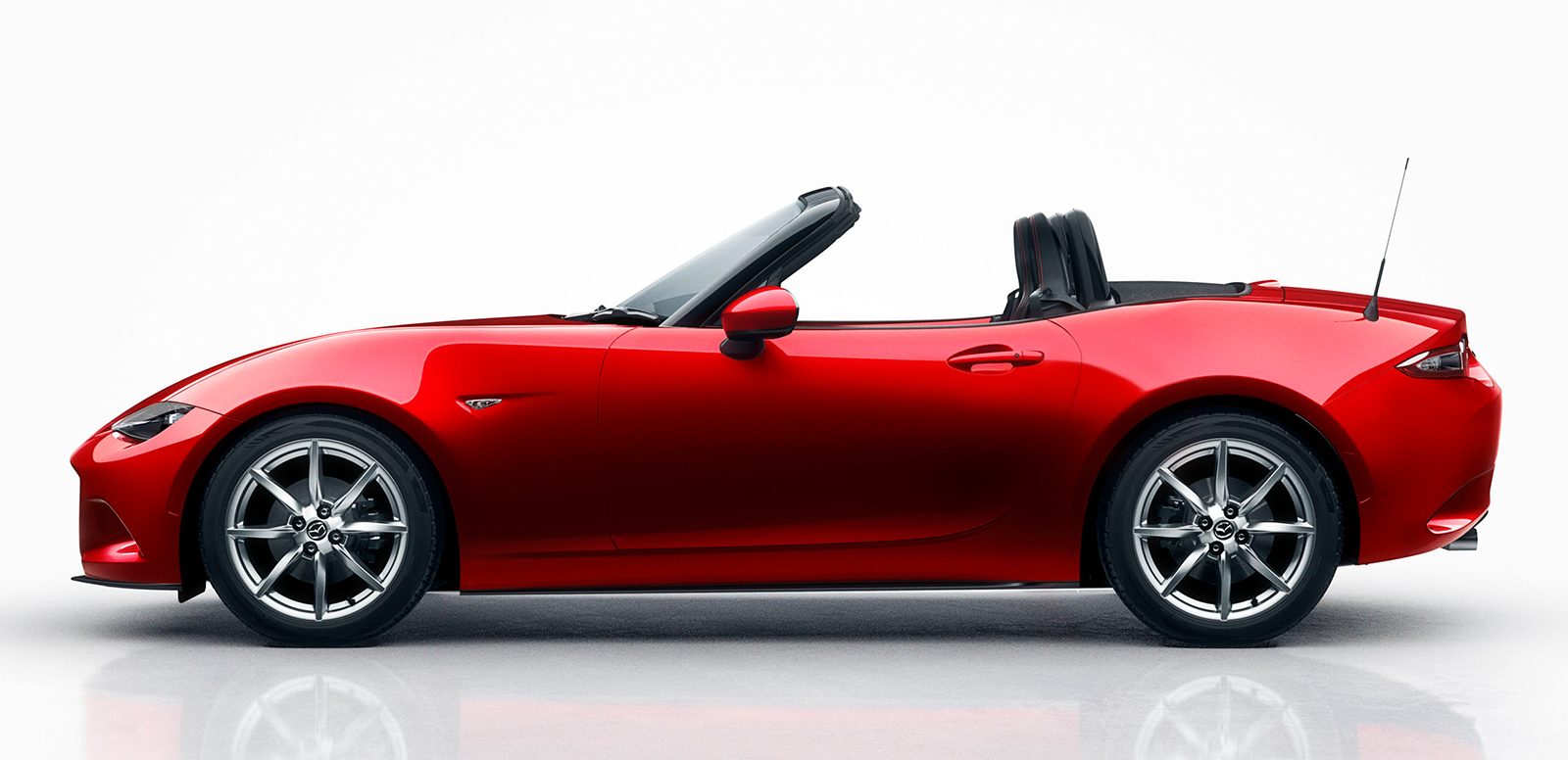
An EV Miata is even more different, though. It’s just not a Miata at that point. It’s somehow too refined, too advanced, too smooth, too, well, just too much.
Now, that said, I do think there is one context where electrification can make sense for a Miata, and the answer to that is a mushroom.
Well, a metaphorical mushroom. I’m thinking of the Mario Kart-style mushroom, which is an instant speed power-up.
You know what I’m talking about – it’s brief, limited-run speed boost. These sorts of insta-speed boosts actually do exist in the real world, but not via fungal means. It’s electrical, and it’s usually known as a KERS (Kinetic Energy Recovery System).
Here’s a good explanation from – holy crap, 14 years ago, look how young our man Jason Fenske looks! – Engineering Explained:
F1 cars have used electric KERS systems since 2009; in 2014 they moved to a more modern energy recovery system that also adds a heat recovery system.
What I’m thinking for the Miata is more like an old KERS system, with a motor that can act as a generator and a small battery. Small is key here! I’m imagining a small electric motor, maybe one that adds, at most, 50 hp or so, in the car’s drivetrain, and a small battery to store recovered braking/coasting energy.
The implementation would be a simple SPEED BOOST button; maybe it has an LED behind it to show when it’s ready or not – red, not ready, yellow, charging, green good to go! Our hypothetical, very mildly-hybrid’d future Miata driver could push the button and get a momentary burst of extra horsepower to pass or get up a steep hill or just enjoy a kick in the pants.
I’m talking a burst that lasts, oh, maybe 10 to 15 seconds of an extra 50-ish hp, and then can recharge after a few minutes of driving. It’s not constant high power; it’s a literal boost, and part of the fun of using it is figuring out when to use it.
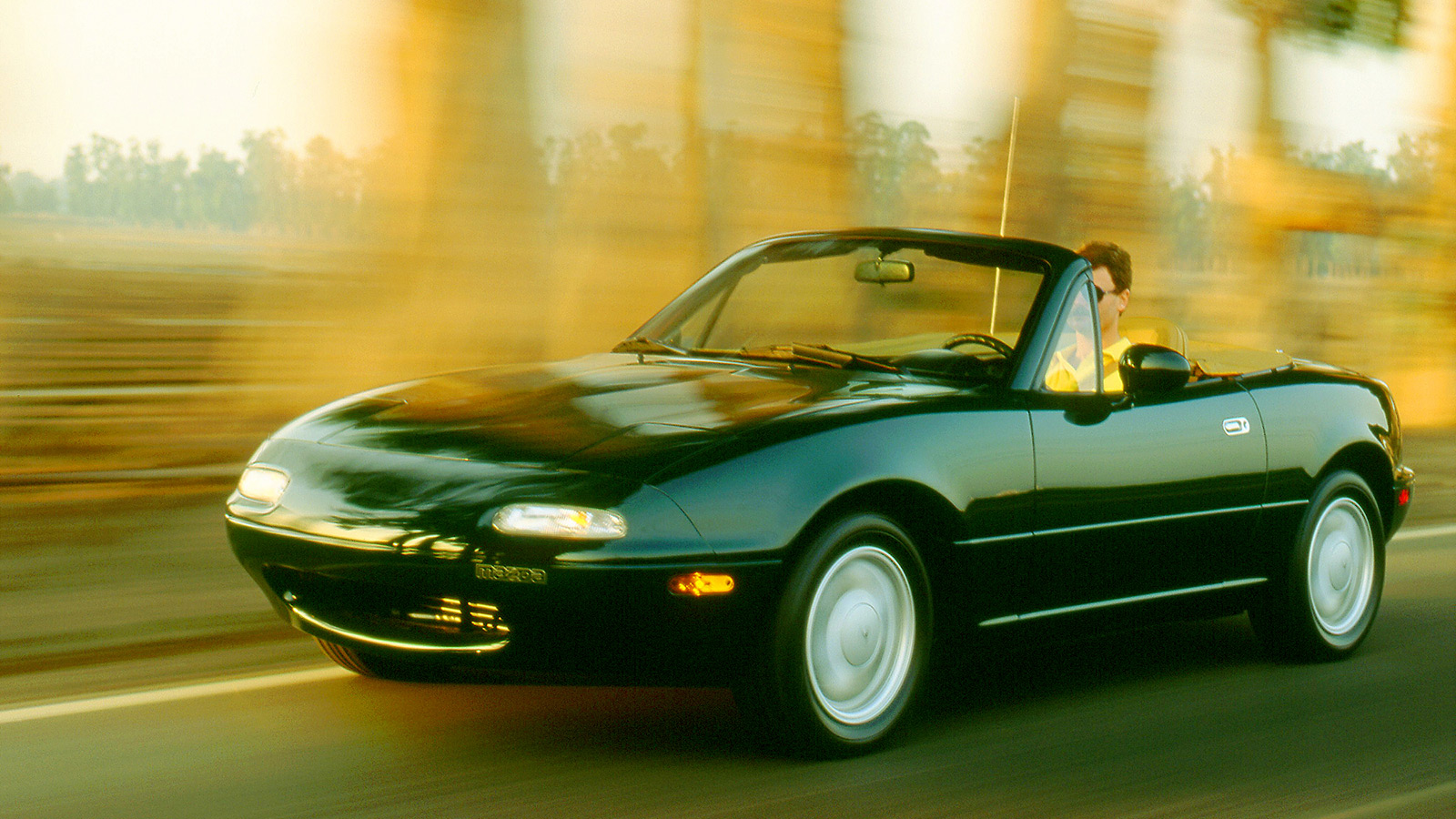
That’s all I’d want from an electrified Miata – an extra bit of fun. A KERS system like this maybe has an effective electric-only range of, oh, two miles at 35 mph or so, if you, say ran out of gas and had to desperately get to the next exit or something. But it’s not for that.
And it’s not to improve gas mileage, which on a Miata is already quite good. I suppose it would save a bit of fuel, since you can get bursts of speed without mashing on the throttle, but again, that’s not what it’s really about.
What it’s about is fun. And that’s why it’s different than an all-EV Miata with a carefully-engineered lightweight body. Because that’s less fun. Impressive, sure, but a Miata? I don’t think so.
So, Mazda, if you’re so dead set on having an electric motor in a Miata, I think this is the way. The way of the mushroom.
Top graphic images: Mazda; Nintendo


Miata is not about bursts of EV speed. It is about balance and about being able to have fun driving without having to get in trouble. I really hope the next Miata stays just a naturally aspirated 4 with a 6 speed and an automatic option. It’s the only affordable roadster game in town. No need to change the formula. Our ND has a lifetime MPG of 33. It’s pretty efficient for a fun sports car, especially considering that a convertible is not aerodynamic.
The Miata sales totals each year are an insignificant amount of total auto sales.
A rounding error as we used to say.
Thus it should be exempt from ever going EV.
An EV or hybrid Miata is not a Miata.
I 100% think an electric Miata makes sense for a lot of people.
I have two cars. One is a large station wagon for long trips and family outings. My other car is a fun car to take to Trader Joe’s, etc. It is currently a BMW 330ci convertible. I’m 59 for reference. I could see me moving into an electric Miata as the fun car. The only thing stopping me is I’m 6’2 and I don’t fit comfortably in Miatas
I guess it all depends on what you deem as fun, but what makes my NC Miata fun to me is it’s ability to be light, zippy, and fun to toss around. An EV may help with the zippiness, but it would be detrimental to the other two qualities. A Miata you can’t toss around is perhaps no Miata at all.
A Miata that you don’t have to maintain/service as much may be just as attractive to buyers
As an owner of a Mini EV and a Z4 23i manual, I could see a Miata EV or Z4 EV or Cayman EV be a good car for many people.
Something like the Vonnen hybrid electric flywheel system in the bb-Auto 911 works with a manual and doesn’t add much weight. Net weight increase on that 911 with a 1.0-kWh battery is only 170lbs for electrification and an extra 150hp. Could be less weight gain if scaled down maybe and combined with a smaller engine.
The electrification that Mazda is expecting is anticipating future regulations that would require lower emission, so of course they need the efficiency/gas mileage improvement (assuming hybrids survive into that era).
I’d love it if Mazda can figure out the light, agile, driver-connected EV.
I fundamentally disagree that smooth instant power is inherently disconnecting. My hypothesis is we wouldn’t talk about how uninspiring EVs can be if they weren’t so dang fat.
IF (capitalized because it’s a big if) the above can be true and they can keep it light, then so many downstream things from suspension to steering to tires fall into place to make the car feel like it’s reading your mind just as much as the current one does.
Someone needs to do it, if that someone is Mazda and it means we get another 35 years of Miata, then I’m all for it.
Mazda will f that up.
They will spend 80%+ of their development budget on a rotary solution and then end up licensing a Prius drivetrain.
Mazda has squandered whatever small opportunities they have been presented on stupid rotaries. You’re the only Japanese OEM willing to launch a performance car post-bubble? Let’s kill it with a rotary! Want a range-extended EV? Let’s kill it with a rotary. Want to build a bubble car? Kill the rotary with turbos!
Glad to see I’m not the only one who hates rotaries and that Mazda still wastes money it doesn’t really have to throw away on that dead end.
It seems like they could use a rear axle mounted electric motor. Figure out how much weight you can put in the floor for a battery then maybe throw in a small generator and possibly more battery in the front.
I’m not sure Mazda has the best track record with alternative powertrains. I offer the rotary engine and the diesel CX-5 (and Mazda 6 in the rest of the world) as examples.
That said, I would sooner buy an electric MX-5 with no transmission than the current one with an automatic. I’m not especially thrilled with the extra complexity of a hybrid powertrain. Simplicity is one of the reasons I bought a Miata, and electric power would theoretically continue that part of the car’s tradition.
Emissions controls are what kills the rotary and diesels by Mazda. Mazda was at the forefront of Dieselgate as they couldn’t figure out how VW was meeting emissions as they couldn’t even though the design was very similar. It is why they promised the diesel in 2012, then ’13, then ’14, etc. but couldn’t figure out why it couldn’t pass emissions and kept reworking the ECU.
The rotary makes so much sense pre-70s emissions.
I’m sure the VW target didn’t help, but BMW made a really competitive 2.0L diesel in the same timeframe that was fully emissions compliant. GM also had a really nice 1.5L diesel in the Cruze and Equinox.
I’ll admit that I don’t know much about the rotaries, except that they had reliability and fuel efficiency reputations that were not legendary. It may have been emissions, but aren’t efficiency and emissions integral parts of making a powertrain?
In fairness to Mazda, they do sell global diesels without an issue. The SkyActiv-D was essentially stillborn in the United States, thanks both to “Dieselgate” (f.u. VAG), and Mazda limiting the diesel to only the Signature trim, which made it an even heftier premium over and above that of the top-spec trim. All the more unfortunate as they reengineered the intended models with elongated fuel doors to allow for two filler ports for (diesel and DEF).
Iirc Mazda had an energy recovery system on early 3rd Gen Mazda6s. It used the captured energy to power the air conditioning and other accessories. But they stored most of the setup in the front bumper which led to issues from moisture and collisions.
It was a Super capacitor and makes sense except for they weren’t durable for the lifetime of a vehicle and basically cost more to replace then the savings they were supposed to save (1-2mph)
I get why Mazda dropped it for the midcycle refresh.
Had to skip half the story because much of it I couldn’t see because ads, constantly playing video and a link to go to the comments. Frankly 50% of the screen was blocked. So guessing what JT was saying about the Miata it used to be a low powered little 2 seater runabout that was successful. Now it is a torqued up heavy ICE car. EV not light but better speed it might replace what the Miata originally was. The Miata is failing to keep the market so why shoot down an alternative because it doesn’t match the failure?
Of all the ideas, I like the small battery boost mode.
I feel like this has existed already – specifically for Miatae. I remember reading about add-on hybrid kits for the Miata back when I bought mine (~2007). It bolted a motor on to the engine like an alternator, and added the power through the belt attached to the front pulley.
I don’t remember it being a stout-looking belt, so it probably didn’t add much power. It also wouldn’t handle regen braking, but do I want to deal with the regen / actual brakes handoff in a Miata? I don’t. I really don’t.
They can do what they want with the Miata. I have had my time with one and I will remember it fondly. When I get rid of my Ioniq 5, I won’t miss it like I do my interesting cars.
I have done parade laps at Limerock with my Miata. Before we hit turn 1 (Big Bend), my wife turned to me smiling and said “It’s like I’m in a pack of angry bees.” I want future Miata enthusiasts to have that same experience without having to pay X times the original Miata price for a collector car.
Electric cars are great. I have one. I love it for commuting and a quiet ride to a destination. I arrive as calm (or more) than when I left. It does not stir my soul (or whatever the atheist equivalent is. Gonads? Butt Cheeks?), even with blistering acceleration.
EVs are the future, and batteries are only getting better. This theoretical EV replacement is still many years away.
Personally, I’m quite interested to see what they come up with. If there is a brand that has the gumption to actually design an EV in the name of light weight & agility, it is Mazda. I’m sure the range won’t be record breaking, but the vehicle will have a small frontal area and could be quite aero. Just like those small battery/long range EVs Toecutter always described.
Since we’re on the topic of ‘Gate-keeping”, why gate-keep the small & light roadster behind an ICE engine?
If the smooth torque of an EV Miata makes it not like a Miata “at all”, one could argue the original Miata itself is nothing like the British roadsters it sought to emulate.
How can an ICE Miata even be a “proper roadster” when it doesn’t have Lucas electronics to cause it to break down every other outing?
Are you even “motoring” if you aren’t pushing your stranded roadster into a lay-by in the rain?
This whole article is kinda nonsense. The Miata drivetrain & transmission setup has always been unremarkable and frankly irrelevant. The car isn’t about changing gears, it is about enjoyable drop-top motoring in an agile chassis. Electric propulsion doesn’t have to change that.
I think the Miata is about driver engagement. It’s about a direct-as-possible connection between the driver and machine. Driver does X, car responds.
I do think changing gears is part of it, especially for people who swap stock parts as upgrades. My Miata’s original engine had a bearing failure, which happened not that long after the second gear synchro on the five speed had given up.
I bought a JDM engine and six speed transmission as a replacement. The rear ends of the five and six speed transmissions must be geared quite differently, because my revs in 6th at highway speeds are noticeably higher than they would have been on the five speed.
I could claim I knew this in advance and planned the changes for better acceleration, but I did not. If I did the research in advance, I’m sure I would have found plenty of enthusiasts who had done the swap intentionally.
Depending on the year, the 5-speed used either a 4.3 or 4.1 rear end. The 6-speed used a 3.9.
Swapping a 3.9 onto a 5 speed car is a somewhat common swap for some to get the revs down on the highway (at the loss of acceleration of course). Turbo boys also swap it sometimes to give 1st and 2nd longer legs while on boost.
I knew Miata people would know these things!
I get it. I agree that a manual transmission is probably the most ‘connected’ transmission readily available in a typical ICE passenger car. That said, I have driven some high performance vehicles with CVTs, which challenged my preconceptions.
Once you become accustomed to the specific power-band of say, a well-calibrated modern snowmobile, you realize that the act of physically shifting gears isn’t inherently linked to the feeling of connectedness or enjoyment.
Sure, you may not be directly controlling the exact ratio of the CVT belt, but the consistency and predictability of the mechanism means your brain quickly maps the behaviour and you can enter and accelerate out of corners with extreme precision.
I bring up the snowmobile example because there was a team in 24 hours of Lemons that built a Miata with an old snowmobile engine. While it created a smoky racket, drivers reported an amazing sense of composure while racing, allowing them to focus their mental energy entirely on cornering, and their position in the field. As such it was an incredibly pure and rewarding driving experience.
I believe an EV has the potential to extend this feeling even further, with an even more direct connection between accelerator pedal and motion. At least, that’s possible if the vehicle is tuned and set up properly. I think our concept of EVs is warped by the fact that almost all EVs constructed have been commuter CUVs that seek to provide the most numb experience possible.
I have an EV and in sport mode the sensitivity of the accelerator feels very direct. The EV does 0-60 ion 4.5 seconds so that direct connection results in some quick acceleration if that’s what you’re going for.
I backed my Miata into the garage the other day, and then after I shut off the motor I shifted from reverse to first (to keep me from taking out my table saw the next time I went to drive it). In the confines of that bay I could clearly hear the clunk of the gears shifting. It was satisfying even stationary.
Not the fastest machine by any measure, but satisfying in the way most other vehicle are not.
I had ready years ago that people who operated demolition machines had some of the highest job satisfaction ratings. I can believe it. There’s nothing about that process that we have automated yet. You still need someone at the controls who knows where to push to get that brick wall to fall correctly with no nannies intercepting the inputs and deciding if they are appropriate.
I have no problem with a hybrid Miata as long as it still has a manual.
Have you checked the glove box?
(tap-dances offstage)
forget that nonsense. just make a coupe miata.
Coupe Miata would suck ass in a bad way. I won’t even drive mine with the top up. It’s like being canned.
Not if it were a fastback with a hatch, though it would all but preclude the soft top as it would require a different BiW, but a fastback with a hatch would have better aero, provide actual space to carry stuff, and no accommodation for a soft top would allow the seats to go back so that someone over 5’10” could be comfortable on a drive over 5 minutes long unless they’re the type who enjoys sitting bolt upright like in a wooden chair of some Victorian waiting parlor where guests were intentionally made to feel uncomfortable so as to be made to feel inferior to the host.
A Miata version of an MG-B GT would basically be a perfect car, yeah.
I have the PRHT on my NC, and I put it up for motorway drives, and I realised the other day that it reminds me of being in a light aircraft, because you’re in a small space, you can feel that everything around you is very light but also stiff, and it’s REALLY BLOODY NOISY.
I swear putting the top up just concentrates the diff and exhaust noise in the cabin. It really is quieter with the top down, until you get above about 50mph.
But if you really want a Coupe MX-5 Mazda sold them already, they’re called the RX-7.
I know mine has had some mods that increase NVH a bit, but I only notice if I drive with the top up (which I try never to do).
I feel incredibly claustrophobic without the open roof. Obviously it’s a small car, but it doesn’t feel that bad with the top down. With the top up I feel like I’ve been stuffed in a locker.
They have before. It wouldn’t hurt my feelings if they did again. The world needs a pretty five-figure sports coupe with the Jaguar F-Type having been put out to pasture.
My NA Miata-owning, car-obsessed brain has been having shower thoughts about this for weeks, and you’re gonna hear them.
Electrify the Miata with an electric motor at the rear differential, geared to the pinion. If this sounds like a standard EV motor+diff drive unit with accommodation for a driveshaft coming from a manual transmission, that’s because it is.
For the ICE hybrid, that EV drive unit contains a small motor that does normal hybrid things and can also do 10-second speed boosts on command from a ZOOM ZOOM button. You only need a sub-1kWh battery for that, which can eat a bit of trunk space.
For the full EV, the gas tank and trunk get replaced with batteries and associated electronics. The engine bay becomes a frunk. The drive unit from the hybrid gets a bigger electric motor but otherwise doesn’t need to change. If that layout seems a lot like a Tesla Roadster, that’s because it is.
So you get two drastically different Miatas on one platform: 1) a lightweight, tossable, still-analog gas-powered sports car that happens to be a hybrid, or 2) functionally a 2nd gen Tesla Roadster.
Your #2 puts 80%+ of the mass over and behind the rear axle. Not good, and not a Miata
50/50 weight distribution at rest is a worthless goal.
“For the full EV, the gas tank and trunk get replaced with batteries and associated electronics. The engine bay becomes a frunk. The drive unit from the hybrid gets a bigger electric motor but otherwise doesn’t need to change.”
Okay, Anoos, so go make that formula work–and sell.
(Daniel T., there’s a difference between mid and rear engine/battery pack. The Teslafied Lotus Elise carried its heaviest stuff in front of that rear axle.
You’re right.
RIP Porsche 911. It would have been great to see a second generation but your static weight distribution doesn’t meet the internet’s standards.
Once the car is moving, static weight is meaningless. Braking sends 80% of the weight to the front wheels regardless of what tires that weight sits at when the car is still. Accelerating sends more weight to the rear. Turning loads the outer front.
As long as you tune the suspension for the weight distribution, there is no penalty to weight distribution until you exceed the limits of the tires (which can, of course, be corrected with tires).
What discussion are you in? Let’s see, the only person here who mentioned anything about 50/50 or internet standards is…Anoos. So, are you trolling yourself? Daniel T. suggests putting a battery pack and associated controllers that would constitute, say, 1/3 the total mass of a Miata behind a combination rear axle/drive motor unit, set in a fulcrum position with the front end heavy bits deleted to make a frunk, and all that seems both difficult to conceptualize let alone to create with both rear-end crash worthiness and traditional Miata-grade (or any balanced) handling characteristics that results in a saleable product. I’m no engineer, so I’d be keen on some insight from Huibert Mees or Dave Larkman here. You didn’t address that point, though, and instead jumped right into a self-righteous 911 soliloquy about cars that maybe reached about 63% rear distribution (lots of variations over many decades, take that as today’s Turbo S Coupe’s stat). You might as well mention that most of the 21,500,000+ rear engine VW Beetles didn’t end up in ditches upon driving out of showrooms. I don’t believe Butzi requires a sort of self-appointed super Stan on guard defending both real–and, in this case, clearly imagined–slights to his honor.
The moniker seems appropriate.
I’m 98% sure that the MX-5 is a money-losing halo car, worldwide. I’m not sure how much they’d want to sink into a total redevelopment
My friend and I considered doing something similar as a way at cheating at spec miata racing. The alternator can be rewired to be a 60v generator / 3 phase motor. You’ll only get about 5hp of regen or power, but in a car that light it makes a world of difference in a spec race.
Battery size does also work as a direct analog to displacement as the larger battery of a given type can discharge more power safely in a specified time.
In theory, I like this idea better than an EV or even an EV as an option. The compromises in a platform to allow for multiple energy types seems to increase weight fairly dramatically, though in the case of the Miata, maybe that wouldn’t be as big of an issue since it wouldn’t be expected to underpin a wide range of vehicles with different load ratings and the EV hardware could be packaged in the same areas as the ICE components as much as possible.
OK, there’s merit here, but the manufacturer is wrong.
It Needs to be a white Rabbit.
And you’ve just had some kind of mushroom
And your mind is moving low
Go ask Alice
I think she’ll know
Throw the radio in the tub!
I thought this was going to be Torch writing something ridiculous for entertainment purposes, but I genuinely like this idea. I presume the mushroom button could be part of a typical hybrid system that makes the car more efficient in normal driving. This doesn’t seem farfetched at all – has no one done this already??
On perhaps a more farfetched note, some of other Mario Kart items could be very useful as well. I would pay a great deal of money for a car that has the ability to drop banana peels in front of tailgaters and launch guided turtle shell explosives at aggressive drivers. An invincibility star would also be brilliant for when you are driving in adverse conditions (or are running late), but that might be too big of an ask.
Jason, you mean a ZOOM ZOOM button
I applaud the wonderful accuracy of this comment. COTD
Good use case for supercaps, maybe.
Came here for this, this absolutely seems like the ideal use case for capacitors, lighter, lower energy density, fast discharge. Are they cheaper though and durable enough?
I think the closest comparison I know of is the early hybrid Hondas. Those had a 15hp motor that was separate from the transmission and a lean-burn engine instead of Atkinson cycle, and it seems like the hybrid Civic was about 200lbs heavier than the standard one. And that was with NiMH cells, 20+ years ago.
Everyone ended up copying Toyota’s homework for hybrids because they’re more energy-efficient, but the old technology is still there!
There are still modern IMA hybrids – while the planetary E-CVT toyota came up with is the most efficient (and arguably the most elegant), it seems like it needs to be engineered to match the ICE engine it’s mated to, whereas an IMA hybrid is just adding an electric engine to an existing driveline. Toyota uses an E-CVT on the regular hybrid Crown, for example, but for the ‘hybrid MAX’ version, they use an IMA hybrid system.
With current batteries this will be a terrible compromise between weight and range. This needs to wait until the next leap in batteries.
Range doesn’t matter here! this is just for 15 second bursts of speed!
You’re hauling those batteries around all the time and the boost thing is only usable on the way out of a corner or in a straight-line.
Not the way I drive or where I live, I’ve got plenty of roads I drive where a quick shot of boost would be so welcome, with time to regenerate to the next boost, maybe.
What of they just use supercapaitors? Lighter and the technology exists for them right now.
I think KERS style system paired with a smaller (preferably non turbo) motor feels like the right answer for a lot of sports cars in the near-mid term future. Personally not a big fan of the boost button per se, but maybe it’s just if you push the gas pedal past a certain resistance point or something? For me it needs to feel like organic part of the experience, not super video game-y, YMMV.
“I mean, I think the manual experience is the better one, but I don’t want to gatekeep too hard here, because that’s jerky.”
I mean it will probably be a jerky experience if you gatekeep and start putting automatic only drivers into manual Miatas.
Only until they figure it out. Then, the smiles, oh, the smiles!
I think it’s a failing of ours to say that people “can’t” drive stick. What we really mean is, they haven’t been taught how. If we teach them, they will choose it.
Also, I like jerky.
There are a percentage of drivers that literally can’t drive stick(or it’s very inconvenient). People with no legs, one leg, one arm, no limbs, paralysis in leg(s), or arm(s), people with other issues I’m not thinking of, small children, most dogs.
Dogs! Hee, hee. Likely all cats innately can, but simply won’t.
(Who’s professional-grade at working a stick? Yo momma! Ha ha ha. JK.)
True, but I wasn’t referring to them. I was referring to people without challenges who say they can’t do it. Also, small children and dogs probably shouldn’t be driving on public roads. I don’t have children, but my dog would be hell bent on hitting small animals and then jumping out to eat them as the car goes down the road.
Not to be ableist, but every car other than a Miata is available for those uses.
I’m short, fat and genetically male. Clothes that look great on a 6′ 100 pound female model look terrible on me.
We all have struggles.
Nah, I spent hours teaching my spouse and she could get around okay. But until you daily drive a stick, you’ll never be comfortable when you are stuck at a dead stop on a hill with a car on your bumper.
She never got comfortable, so she rarely drove it. So I got rid of it.
Now that the kids are gone, I’m planning to get another. Automatic transmission. Disown me if you must/
nah, two of my 3 cars are autos. it’s all good.
I’m one knee injury away from an auto for life, they both make weird noises at the moment. Doesn’t mean I shouldn’t have fun.
Most people in the UK learnt to drive a manual in order to pass their driving test*, but plenty of people still choose to drive an automatic car.
That said, there’s probably not much crossover between someone choosing an automatic car and choosing an MX-5, they’re for totally different types of driving.
*(You can do an auto-only test, but then you can only drive autos)
An auto Miata has its place, like if you’re missing a leg or arm.