

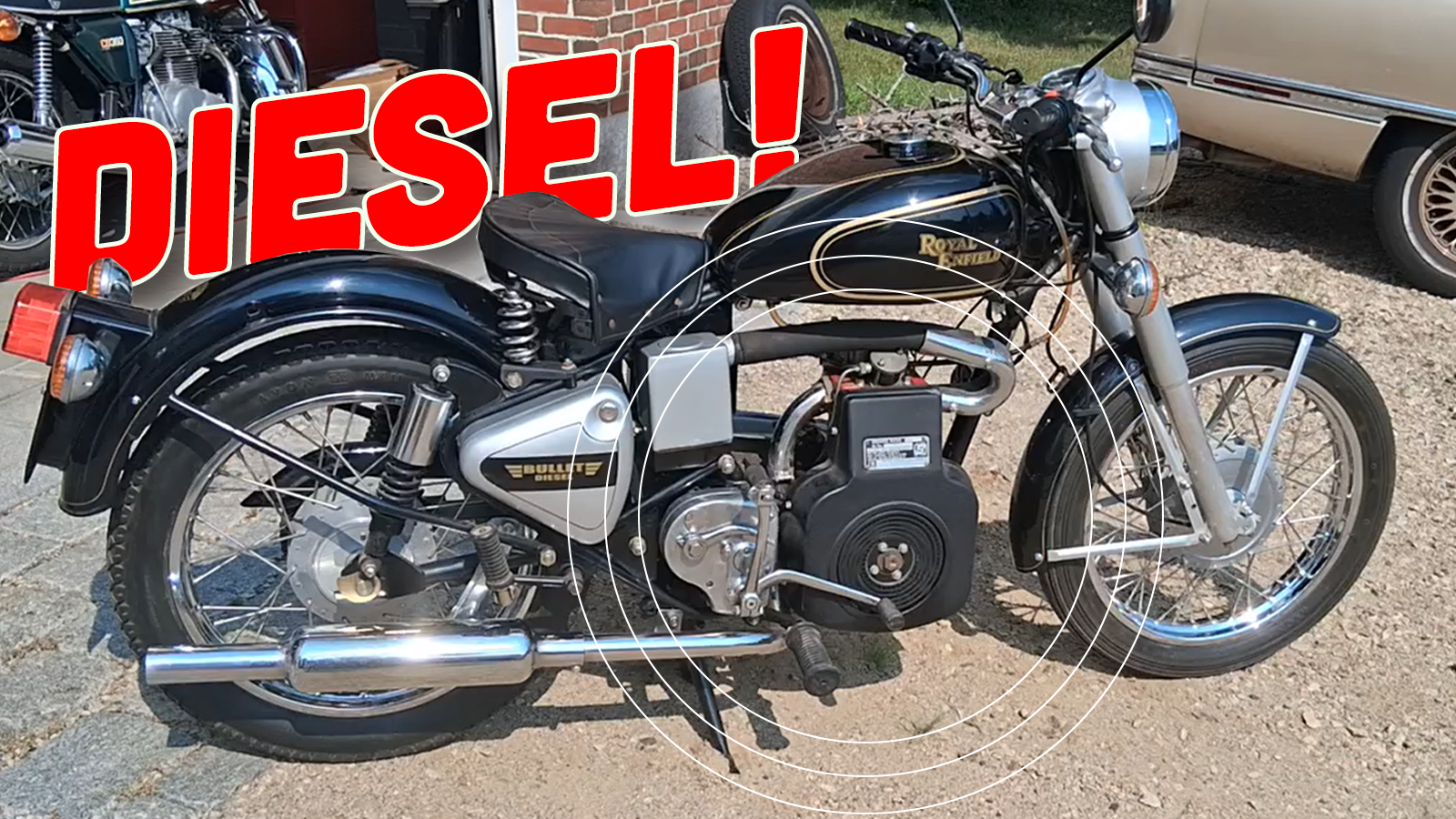
The words “diesel” and “motorcycle” are not often seen paired together. Diesel engines move the world, but they aren’t usually the choice for fun-loving motorcyclists. There have been a few exceptions in history, with one standing above the rest. The Royal Enfield Diesel was the most mass-produced diesel motorcycle in the world, known for trading performance for 200 mpg frugality. These weirdos were never sold in America, but there’s one for sale here right now for a tantalizingly low price.
Diesel engines are a relative rarity in the motorcycling world, and for good reason. Think about the people who ride motorcycles. Americans usually ride motorcycles for fun with a side benefit of getting to work. For everyone else, there’s over a century’s worth of highly economical gas engines and more recently, penny-pinching electric motors. Places like India and China have mastered the art of getting from A to B on two wheels for barely any money.


Historically, diesel engines are known for being heavy, bulky, shaky, and not particularly high-revving. Add the fact that diesel fuel itself can be more expensive than gasoline, and in the modern day, much more expensive than electricity, and diesel power for motorcycles seems even more unrealistic. Yet, weirdly, there have been a handful of times when diesel-powered motorcycles made at least a little sense.

I’ve written about so many obscure diesels: the HDT M1030M1 multi-fuel combat bike, the Boccardo 1200 Aéro Diesel commuter bike, the Star Twin Thunder Star 1200 TDI sport bike, the Axiom Diesel Cycles cruiser, the Hero RNT 150 TDi, and the Track T-800CDI adventure bike. The world is full of many more custom builds, like the Ebster 720 Diesel, which was built by a German man who was really into construction equipment. All of these motorcycles were built to serve an incredibly specific purpose, or in some cases, to prove a point. All of them went nowhere.
That is, except for one motorcycle, the one with the distinction of being the only diesel motorcycle in history to reach true mass-market status. For a period of about a decade or longer, Royal Enfield sold as many diesel motorcycles as there were riders to scoop them up. But the only reason why it worked was due to a specific set of circumstances in India at the time.
Why India Built Diesel Motorcycles

Sadly, while I frequently try to dig further into the history of the Royal Enfield Diesel, one detail remains extremely confusing.
Royal Enfield says it began production of the Diesel in 1993. However, it’s rather frequently reported in Indian enthusiast publications – DriveSpark is one example – that Royal Enfield actually started building diesels even earlier, in the late 1980s. It’s also extremely easy to find late-1980s Royal Enfield Diesels on India’s equivalent of Craigslist. These bikes often have the exact engines and graphics found in later Royal Enfield Diesel models.
One potential explanation I’ve seen is that, in the 1980s, India had a culture of shed builders who mounted diesel engines to brand-new Royal Enfield Bullets. Then, in 1993, Royal Enfield itself cut out the middleman by making its own diesels. That would explain why 1980s diesel Royal Enfields are plentiful, but it doesn’t explain how, coincidentally, the ’80s bikes often have the exact engines and designs of the later examples. Maybe one of these days I’ll be able to talk to someone who was involved in this project and get an answer once and for all.

Thankfully, I do know the details that matter most, and you can read the juicy details from my previous coverage:
When the Taurus was introduced, a Bullet 350 made about 18 horses from its 346cc four-stroke single. This was good for a top speed nearing 70 mph, depending heavily on conditions. Royal Enfield’s history page doesn’t say why the Diesel was put into production, but DriveSpark reports that it had to do with fuel prices at the time. Diesel was reportedly about half of the price of gasoline back then, making a diesel-powered bike compelling, even if the motorcycle was more expensive upfront.
Housed in the familiar Bullet frame is something different. The Taurus ditched spark ignition for a 325cc diesel single made by Greaves Lombardini in Italy. This air-cooled industrial engine is good for 6.5 HP and 10.7 lb-ft torque. As you could imagine, these are slow and top speed hovers around 49 mph. That makes its performance about on the level of a 110cc gas motorcycle. According to an owner’s manual that I found, these weigh in at a heavy 370 pounds as well.
In my continued research, I have discovered that the Indian government recognized two versions of Royal Enfield’s diesel Bullet. One is called the Enfield Diesel, while the other is called the Taurus. Both versions are the same, but have small visual differences.

According to the owner’s manual for the 1999 Enfield Diesel, the Greaves-Lombardini mill spins up to 3,950 RPM. The aforementioned peak power comes on at 3,600 RPM, right before you have to shift to the next gear, if one’s there. I say that because, in stock form, the paint shaker diesel will get the Enfield Diesel up to a blisteringly fast top speed of 49 mph. Also, the transmission has only four speeds. Financial Express Drives claimed that you’d be rewarded with a whopping 190 mpg to 211 mpg fuel economy.
As amazing as that fuel economy sounds, a 100cc gas-powered motorcycle from India today could hit roughly the same fuel economy numbers and go at roughly similar speeds. However, back in the 1990s? Getting 200 mpg out of a nominally middleweight motorcycle was a big deal, even if you weren’t getting anywhere fast.

The biggest reason why the Royal Enfield Taurus made sense was that diesel fuel was dirt-cheap in India in the 1990s. Riders were willing to give up gas engines and leave behind better performance to get around 200 mpg on a bike that was cheaper to fuel than an equivalent machine that burned gasoline. If your main goal was a daily rider that saved oodles of cash, and you didn’t care about ride comfort or having fun, the Royal Enfield Diesel was it.
Royal Enfield never released sales numbers, but the continued abundance of the bikes well after two decades past their discontinuance seems to suggest that loads of them were sold. Today, Indian bikers seem to look back on the Enfield Diesels with fondness.

So then, if they were so popular, what happened to them? Based on the reports I’ve found, two issues proved to be insurmountable. Eventually, the price of diesel fuel rose in India, eroding one of the bike’s primary benefits. Then, stricter emissions regulations shut the door on further production. It appears the last Enfield Diesels were made around the year 2000.
The glorious thing about this is that the entire production run of Royal Enfield Diesel and Taurus motorcycles is legal to import into America, and some do trickle through the border. Sadly, due to a dearth of specialist importers, getting vehicles to America from India isn’t nearly as easy as getting one from Japan or Europe. But some people do figure it out.
This Royal Enfield Diesel
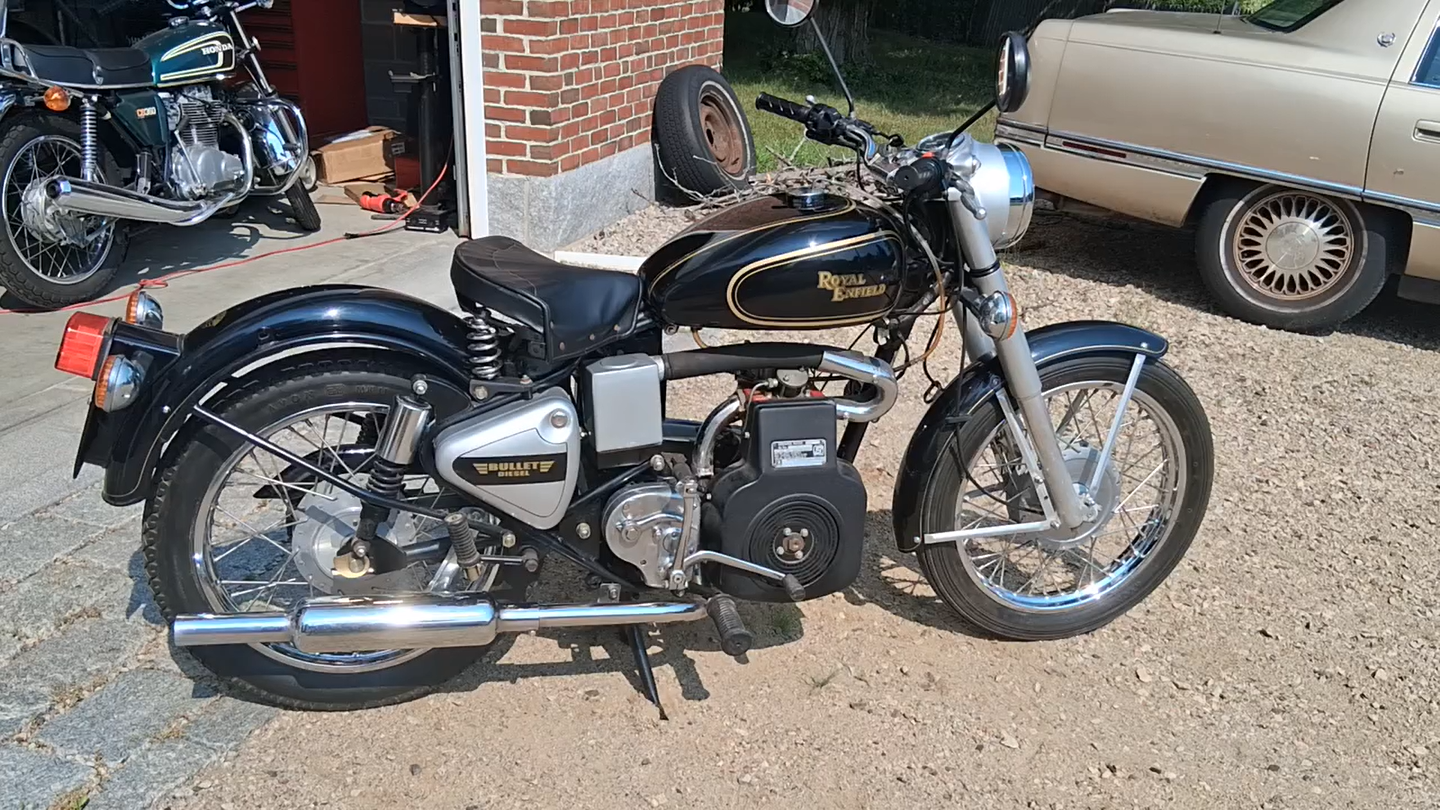
That brings us to the 2005 Royal Enfield Diesel that’s for sale today in South Berwick, Maine.
I nearly fell out of my chair when I saw this motorcycle because, at first glance, it’s the Enfield Diesel I’ve been dreaming about for years. It appears to be in immaculate condition, and I cannot get over how agricultural the engine sounds. If this were a gas engine, I’d assume it was broken. But this sounds like a bucket of bolts by design! I’m also deeply amused that the thing shakes so much it’s basically trembling like a chihuahua. Harley guys would be jealous.
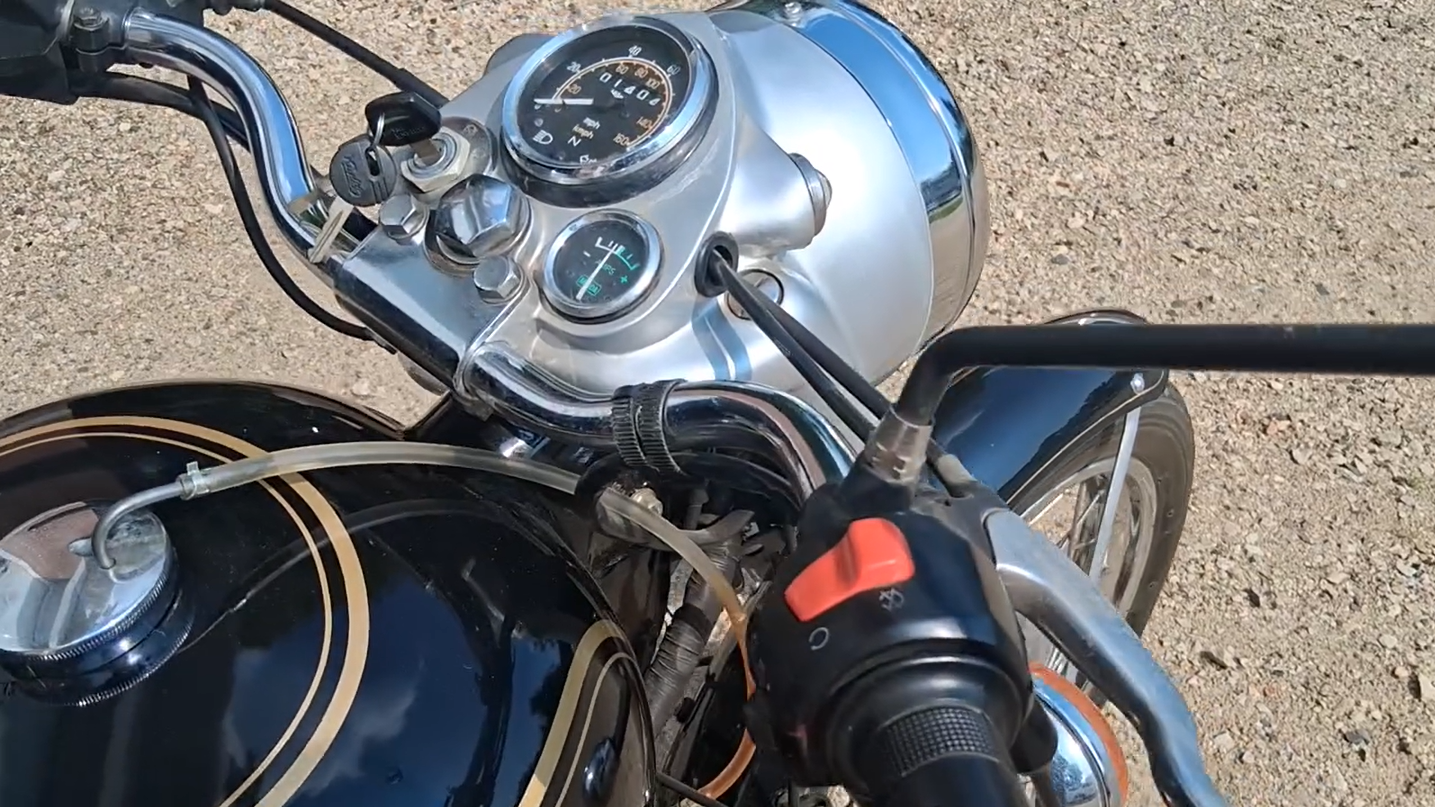
But, as many of our readers know, I am a detail-oriented person. It hit me that, wait, Royal Enfield didn’t build diesels in 2005. If it did, a 2005 model would still be too young to import into America.
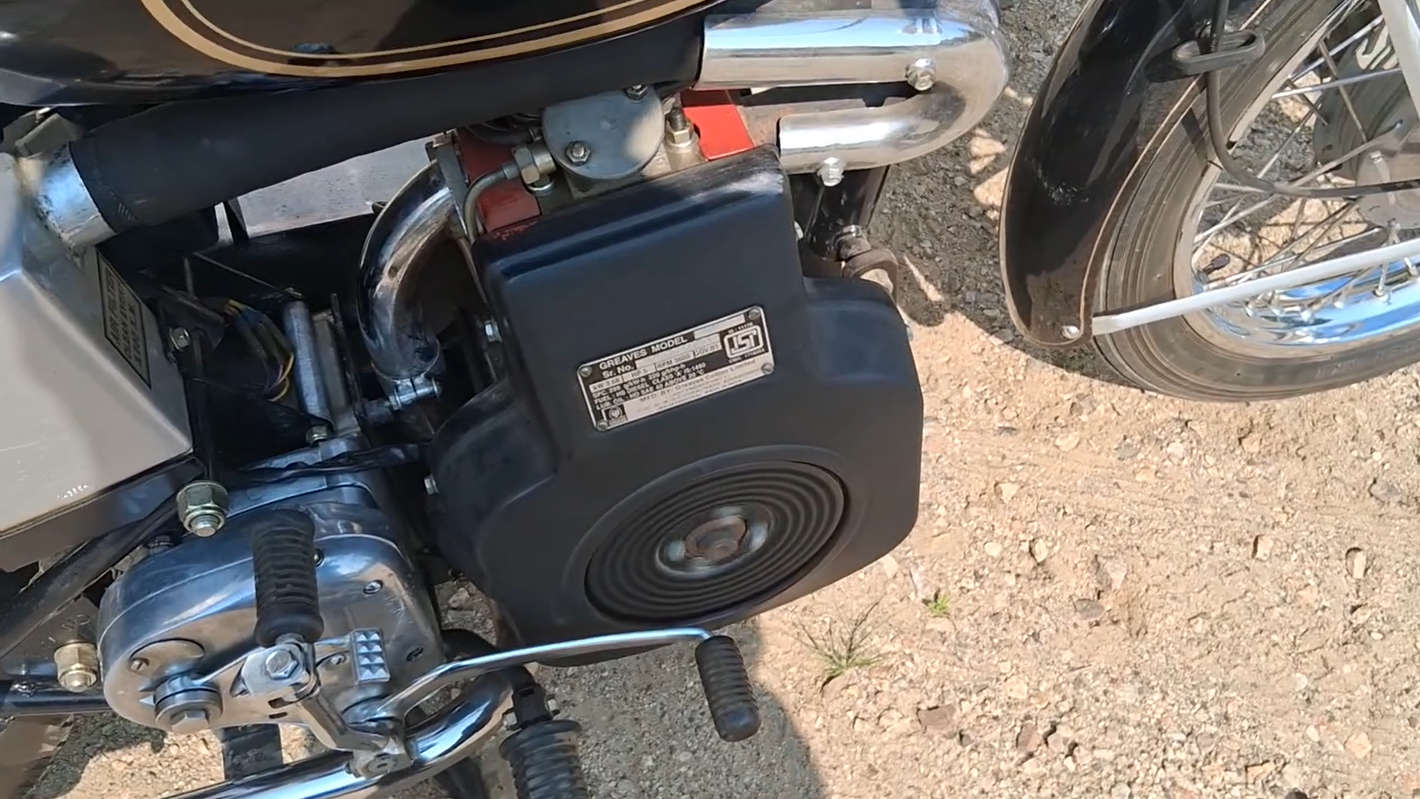
Yet, this motorcycle does have a real Greaves-Lombardini engine. Specifically, this one is a Model 5520, which is a 325cc single with five horsepower at 3,600 RPM and 10.7 lb-ft of torque.
At the same time, the bike has a speedometer in mph and an odometer in miles. This bike is almost certainly a Royal Enfield Bullet turned into a replica Enfield Diesel, but I think that’s actually just fine!
Whoever built it paid very close attention to what they were doing. This Greaves-Lombardini engine makes almost the exact output of the Greaves-Lombardini that powers an Enfield Diesel. Likewise, this bike has the correct stickers from an Enfield Diesel. Amazingly, this one even has the old-school four-speed transmission with a right-foot shifter that has first gear up, and the other three gears down. Bullets of the mid-2000s often came with five-speed left-foot shifter transmissions.

The seller told me that he thinks that this was a Bullet that was sent back to India, converted to diesel, and then brought back to America. Really, this motorcycle should perform just like a factory-built Enfield Diesel! It even has drum brakes front and rear, for that authentic classic Royal Enfield experience of taking three business days to come to a stop.
It’s So Cheap
I’m also willing to give it a pass on authenticity because of the price. At the rock-bottom price of $2,950, I’m not sure you’ll ever find a cheaper diesel Royal Enfield in America. The Enfield Diesel I wrote about in 2023 sold for $12,500 on eBay; this is a fraction of that. I’m not even sure you’d find any other running Royal Enfield in good cosmetic condition for this price.

Sure, the motorcycle you get out of the other end will be so slow that you’ll be outrun by kids on electric scooters. The vibration will also be good enough to rearrange your internal organs. But with this bike’s three-gallon tank, it’ll probably go a whopping 500 miles between fuel stops.
You’ll also get a weird piece of motorcycling history. This is one of the few exceptions to the rule that companies just don’t build diesel-powered motorcycles. If you love dead-end tech like me, this is full of it.
Honestly, if this bike wasn’t an entire day’s drive away, I’d be making plans to pick it up right this second. If someone doesn’t buy it before me, I just might make the trek out to Maine to pick it up. It would be a great excuse to test out a Ford Maverick or some other small trucklet. Please stop me from doing that. Or don’t; my wife has already said yes.
Top graphic image: Facebook listing


When I was in India as a lad, some friend of a relative had a diesel. Starting with a kick was a bit tricky, and involved slowly cranking to the beginning of compression before giving it a swift kick. I recall there was the fear of it kicking back.
Ah-mazing. Royal Enfield bullet is already a strange duck… now even stranger.
Ha! Slippery, meet Slope. Have fun!
I look forward to the “this is everything that’s wrong with my new diesel motorcycle” article
The good thing about the Royal Enfield diesel it that it is dead simple. The chassis is ancient 50’s technology and the engine is a universal stationary engine that is used to power anything from generators to tractors.
Get it you want it and I’m sure we will love an “I bought a
Diesel Royal Enfield will it ride home in a week?” article. (-:
I was expecting the headline to have changed to that in between me clicking it and the page loading.
It’s a bike I’d love to rent for about 30 minutes to experience, but having bought all sorts of oddball bikes, have come to realize that the novelty very quickly wears off and then it’s just a painfully slow, uncomfortable, largely useless bike. I’m not the “take crap to shows and yak about it to strangers” type, so yeah. I’m sure it’d be back for sale again before long.
I’ve noticed some oddball/rare bikes I’ve owned tend to float around the same enthusiast circles, reappearing for sale on a semi regular basis. Everyone comes to the same conclusion. Neat, wanted to experience it, but then realized why it wasn’t more popular.
RE’s even today are noted for their stellar fuel economy. That’s a much bigger deal in the Indian market than it is to Americans, who largely see motorcycles as toys, fuel here is quite cheap compared to the rest of the world, so the fueling cost is negligible and nobody cares. But in India, motorcycles are daily transportation, fuel is expensive, so economy is a headline figure on the spec sheet.
I have a Himalayan 450 and I’m averaging low-70s MPG with it. That’s routinely carrying a set of Givi panniers (which add considerable drag), and probably a 50/50 mix of fast Texas highways (75-80mph) and around-town riding. That’s pretty good, even by MC standards for a bike that’s fullsize and freeway comfortable. And I don’t mean “capable” as in “top speed is 70”. Top speed is north of 100, it cruises at 75 quite easily with power to spare.
If you are cruising 50-55 on side roads, the MPG rapidly pushes into the 80s and even low 90s. I’m guessing if you went full hypermiler mode could get it to crack 100mpg. Given it’s 4.5 gallon tank, the range is stellar. Similar to most cars, which is a very refreshing change of pace. I daily that bike and still only put gas in it maybe every 2 weeks. So many bikes consider 100-120 miles of fuel range “enough” these days and it gets tedious if you use your bike as transportation and not just an occasional toy.
The Himalayan is an interesting bike for Royal Enfield because it was when they broke from their historic pattern of only selling retro bikes based on their history and nostalgia. The 411 was a bit of a baby step in that direction but with the 450 they just said “We are going to do a modern bike – deal with it”. And it has sold well so good on them.
Mercedes, are you in Maine yet picking it up?
Have you done a story yet on the most efficient ICE bike? Is there anything that can top 200mpg?
Let me introduce you to a man named Craig Vetter
https://www.craigvetter.com/pages/470MPG/Vetter%20Fuel%20Economy%20Contests.html
Very cool, however I’m interested in what’s the most efficient bike in stock form.
Hard to find as most places do not have mandatory fuel economy test / reporting for motorcycles. India does and the best I found with the current test cycle is the Hero Splendor XTEC 2.0 at 73 km per liter which is 172 mpg. (They used to claim 83 km per liter on the old test cycle.)
Honda claims 160 mpg for the Grom but that is based on how much it burns during the EPA test cycle for emissions not a road test. Fuelly shows about 125 mpg.
Type of riding is key. The maximum speed limit for motorcycles in India is 80 km/h. Cities or 30 to 50 km/h but traffic makes that difficult to hit.
The committee has spoken. You must buy this bike.
The thing about the Royal Enfield Diesel is that it wasn’t cheap transportation.
While in the USA we think of Royal Enfield as a maker of cheap and cheerful motorcycles in India they are LARGE and premium motorcycles. They kinda sit where Harley Davidson does in the USA: Large, expensive, and focused on heritage not performance
Someone it 1990’s India that wanted to just save money would be buying a 50cc Honda clone for a fraction of the price. The RE diesel was a way to ride a large and flashy bike but save a bit on fuel.
Speed really isn’t an issue for motorcycles in India. The highest allowed speed limit for motorcycles is 80 kph and a few highways. Most roads are 40-50 kph.
I had to Google if you can even fit a bike in the 4′ bed of the Maverick, but apparently you can get two in there with the tailgate down.
4.5 feet with the gate up and 6.6 feet with it down.
Specifically designed to carry 4×8 sheets of plywood or drywall.
I think it needs an upgrade to a dry clutch, and open cover to complement the diesel sounds with the sounds of bolts shaken in a metal can.
In the video you can see some internal bit spinning around. I figured that was the dry clutch but maybe not?
The Autopian Diesel Cycle Challenge: 1) Buy this sight unseen right now for $2500. 2) Use only public transportation to reach the bike where it sits…bus, train, taxi, uber, etc.. Minimize the cost.. 3) Spend no more than $500 on public transport, food, housing, fuel for the trip. 4) You can only use the fuel you can carry to make the entire trip back. That means whatever is in the tank plus a yellow jerry can strapped to the fender or whatever cobbled up method of carrying extra diesel you decide.
This needs to be a membership/re-up challenge.
This sounds like both a nightmare and such a delight at the same time. lol
We starting a show called “Bottom Gear”?
I’d also like to see you hypermile this. As long as you are ok leaving some “performance” on the table, I bet you can get well over 200mpg.
This sounds like a Miles in Transit / Autopian cross over episode.
I’d watch.
That thing is cool! Basically a motorcycle with a diesel rototiller engine. Then again I rode around on nasty 2-stroke scooters when I was in college so I like that kind of thing
I want to ride this, while wearing leather and spikes and be swinging around my diesel chainsaw. My kids shall forever know me as DAD MAX.
COTD
But they should !!!
This article is some nice Listerine to gargle away all the electric bike atrocities of lately. Thanks for that. Please buy it.
“my wife has already said yes.”
Buy it and Sheryl can show those snobby Illinois courts what REAL performance poverty is all about!
When she eventually shows up.
If it’s a *performance* she can trailer it to just around the corner from the courthouse and get bonus performanve poverty points for pushing it into the parking lot.
Good luck getting “orbital sander arms” in a new record time on this one.
“Should Mercedes buy this?” poll:
1) Yes
2) Also yes
3) Why hasn’t she already??
She realized she CAN quit any time she likes?
Does it ride the same on the other side of the street?
#dadjokes
It was also a (maybe spoiler alert) a key plot point in an episode of Alice In Borderland
You’re not gonna fly out and (slowly) ride it back? Is our Mercedes losing her daredevil streak? Say it ain’t so!
I love the look, from the right side, of what seems to be something more appropriate on a Rupp or homebuilt minibike stuck in an Enfield frame. And that it was that way from the factory (though admittedly not on this particular one.) The left side, though, you almost can’t tell what’s up. It’s a bike of two sides, and I appreciate that.
“Harley guys would be jealous.” I laughed out loud at that line!
I had DRZ with aftermarket yosh pipe ages ago (it was unbelievably loud), and took it to a local tire shop for service (it’s frequented by just about every local biker due to cheap prices on tires). The tech, when he took it off the lift decided to fire it up and ride it out of the shop. Every single old guy that came in on a cruiser had to walk back to see what that was.
I was proud of that little bike that day.