


The mass-produced camping trailer is something that’s known all too well by Americans. The RV industry practically prints these things out to the tune of hundreds of thousands of units a year, but it wasn’t always that way. A century ago, if you wanted a camper, you were either building one yourself, buying a tent trailer, or getting one of a handful of low-production units. The Covered Wagon Company changed that, and one of its early mass-produced campers was this one from 1934. It’s a wonderful time capsule of camping nearly a century ago.
The earliest days of the RV industry were a fascinating, experimental time. Nobody really knew the right formula to build a camping vehicle, so everyone had vastly different ideas. Some of the earliest camping vehicles were little more than horse-drawn covered wagons with some provisions in them. Many of the earliest motorhomes, which were called house cars back then, had some of the comforts of home, not unlike today’s motor coaches. The Pierce-Arrow Motor Car Company often gets the credit for creating the first production RV with the 1910 Touring Landau. In 1913, the Earl Trailer was built for a Caltech professor. It’s believed to be the earliest surviving trailer in the world. Meanwhile, the oldest surviving motorhome, which looks like a boxcar grafted onto a truck, is believed to be a 1914 Ford Model T Motor Caravan.


None of those RV pioneers could be called mass-produced. In the early days of RV history, a company might have built a handful of trailers before going bust, or they sold products like tents mounted to trailers. One company changed that and planted the seeds for the modern RV industry. That company is Covered Wagon, and a true time capsule of an example is for sale.
Tents Gone Wild
As the Smithsonian Magazine writes, the Covered Wagon camper was built out of one family’s frustration with the campers of the day.
Back in the 1910s, the magazine writes, families of average means could not afford the aforementioned house cars. A Pierce-Arrow Touring Landau was solidly a camper for the rich. Instead, families turned to trailers that they could tow behind their existing cars. The first camping trailers in those days were little more than utility trailers with ice boxes, tents, sleeping bags, and provisions strapped to them. Then, people began exploring the idea of using the trailer itself for camping rather than just to carry camping gear.

Soon, these trailers evolve to have collapsible, built-in tents. Camping publications printed around America started chatting about companies that sold tent trailers that promised the comforts of home on the back of your car. As the Smithsonian Magazine writes, one buyer of a tent trailer was Arthur G. Sherman, and his disastrous camping trip changed history, from the magazine:
Tent trailering, however, had some drawbacks that became clear to Arthur G. Sherman in 1928 when he and his family headed north from their Detroit home on a modest camping trip. A bacteriologist and the president of a pharmaceutical company, Sherman departed with a newly purchased tent trailer that the manufacturer claimed could be opened into a waterproof cabin in five minutes. Unfortunately, as he and his family went to set it up for the first time, a thunderstorm erupted, and claimed Sherman, they “couldn’t master it after an hour’s wrestling.” Everyone got soaked.
The Covered Wagon

Sherman was so aggravated from this experience that he decided to design his own camper. His camper wouldn’t be a tent like his lousy trailer was, but would have hard walls and actual weather protection. Sherman’s camper called for a body of Masonite, a board made out of steam-cooked and pressure-molded wood or paper fibers. These boards ran 9 feet long, spanned 6 feet wide, and were no taller than the average car of the late 1920s. Cut into the board was one window per side, plus two up front.
Inside, Sherman didn’t just say it was like a home, like the tent trailer companies did, even though his camper actually had the comforts of home. The Sherman trailer had cabinets, an icebox, furniture, and a stove. Reportedly, Sherman paid a carpenter $500 ($9,445 in 2025) to build this camper in 1929. His kids named it the “Covered Wagon.”
Sherman took his family camping in the Covered Wagon, where they discovered that a family camper with a low roof sort of sucks, but the rest of the concept was sound. Tent trailers couldn’t hold a candle to the Covered Wagon. Reportedly, as Sherman traveled with the camper, others tried to buy it from him.
Detroit Historical Society – 1956.373.001This turned on a light bulb above Sherman’s head. Clearly, people were interested in buying a camper that was more sophisticated than a tent on a trailer. Sure, Sherman’s camper wasn’t even close to being America’s first hard-sided camper, but it wasn’t like someone in 1929 could just drive down to the ye olde Camping World and buy a trailer.
Sherman built two more Covered Wagons in 1929, selling one to a friend and then displaying the other at the 1930 Detroit Auto Show. The Covered Wagon gathered enough interest that he sold 118 units by the end of the exposition. The Covered Wagon Company was born. For many RV historians, the Covered Wagon Company marks the start of the first modern mass-produced camping trailer.
As Airstream notes, Sherman saw meteoric sales. His Covered Wagons, which were priced at $395 ($7,462 in 2025), were considered expensive, especially in the wake of the Great Depression. Yet, that didn’t stop Covered Wagon. The company sold $56,000 ($1,057,934 in 2025) worth of campers in just its first year alone, and by 1936, the company was slinging 6,000 campers a year and making $3 million in sales ($70,227,826 in 2025). Covered Wagon wasn’t just successful; it was the largest producer of campers in America. By the end of the 1930s, Smithsonian writes, the hard-sided camper industry was more than 20,000 units per year strong, and Americans had largely abandoned the janky tent trailers of the past.

The Smithsonian writes that Sherman’s success in changing the RV industry was one of being in the right place at the right time. The Covered Wagon Company was headquartered in Motor City, Detroit. Not only was the Great Lakes region a hotbed for camping in the 1930s, but Covered Wagon was located near the heart of the American auto industry. This gave Sherman access to auto parts, as well as skilled workers who had lost their jobs during the Great Depression.
Of course, his hard-sided trailer was a game-changer to anyone who hated the tent trailers of the 1920s. Now, a man traveling to find work could hitch up a trailer and hit the road.
According to a 1930s Covered Wagon brochure obtained by the Henry Ford, the production version of the Covered Wagon was 11 feet long, 6 feet wide, and 7.5 feet tall. The trailer had a chassis made out of white oak and a floor made out of plywood. The brochure continues by saying that the Covered Wagon’s walls were covered in Cobra grain fabricoid (a sort of leather material), the roof is covered in canvas and painted aluminum, and the trailer rode on a 1 3/8-inch chrome nickel steel axle.
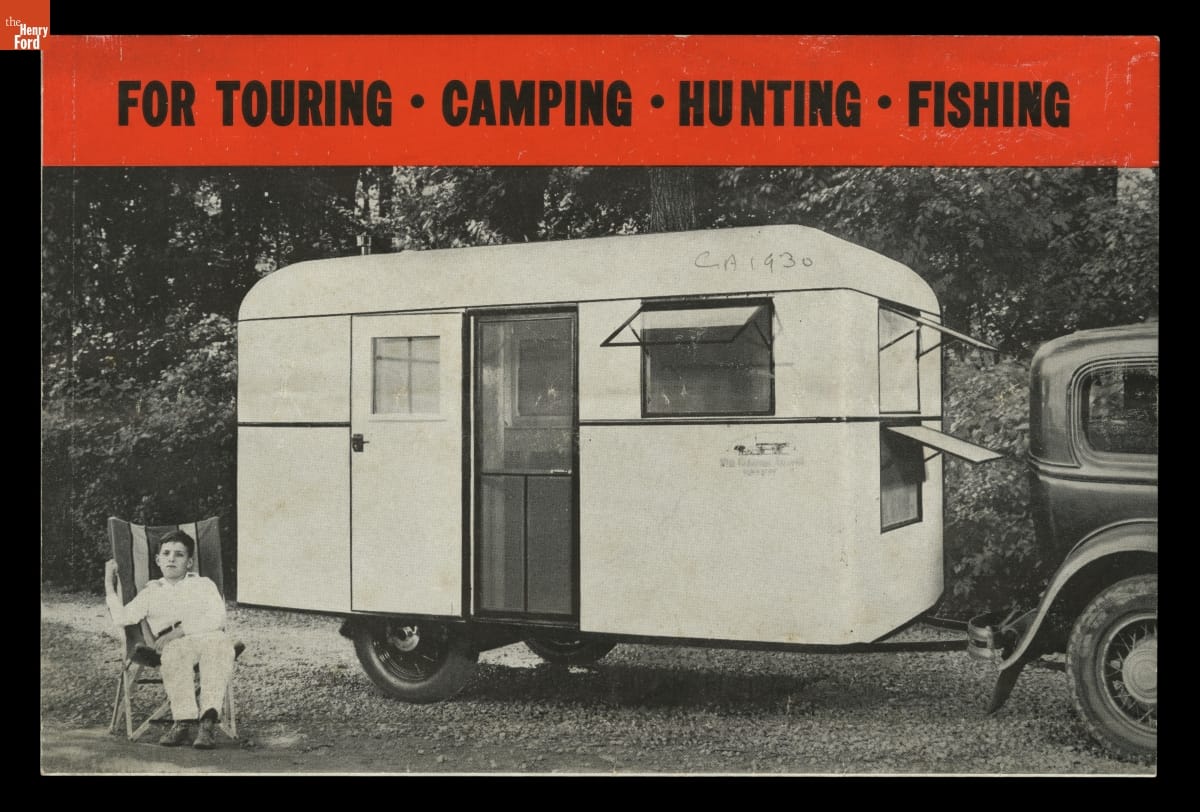
Inside, a basic Covered Wagon had six windows with screens, an automotive-style door lock, full-size beds, cabinetry, a wardrobe, a 75-pound ice box, a sink, and a galvanized steel 5-gallon water tank. You also got 110-volt lights and six-volt lights. Add it up, and a Covered Wagon was just 1,200 pounds with a tongue weight of 125 pounds to 225 pounds.
The Covered Wagon was marketed as being truly like home, with real residential beds, a real dining room, and a real kitchen for your wife to cook in. Yeah, the brochure really did sell the trailer to women as a great place to cook and clean dishes. It was the 1930s, after all.
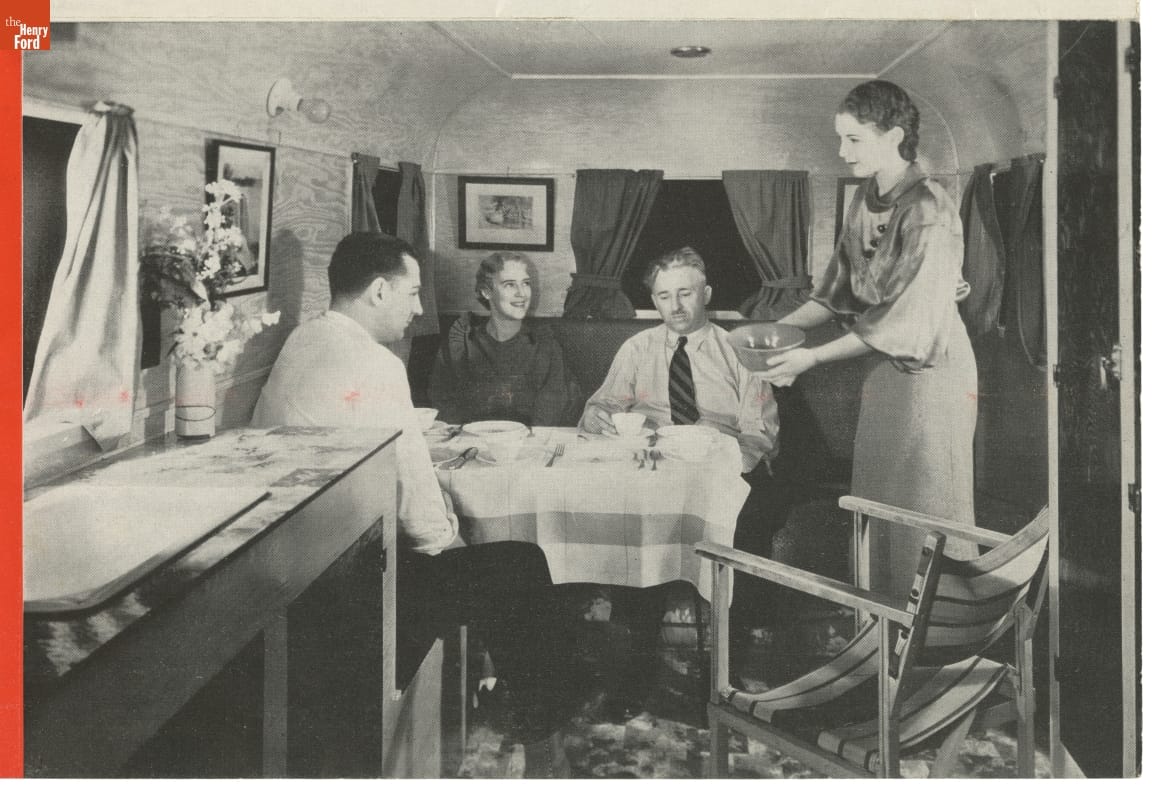
The brochure continued by talking about how a man could easily hitch the trailer to his small Chevrolet, Essex, or Ford Model A, and pull the trailer at 50 mph all day long with barely an impact on fuel economy. You got all of that for the price of $417. The options list was short and included a $9 Coleman camp stove, a $15 chemical toilet, $3 curtains, an extra spring mattress for $25, a stainless drainboard for $10, and more.
Covered Wagon would grow its product line to include larger and more expensive trailers. The company would also begin using Shermanite for its exterior skin, which was made out of stamped zinc-coated steel and plywood. Covered Wagons also became known for their use of electric brakes.

Not everything was so rosy. The Covered Wagon Workers Association union went on strike for 10 days over wages and worker dissatisfaction. Covered Wagon production shifted to producing cargo bodies for the U.S. Army during World War II. Then, after the war and after the Army no longer needed Covered Wagon’s help, the company never restarted camper production, and instead, the factory was leased to the Ironrite Ironer Company and was used to produce Ironrite ironers.
In 1958, Herbert Reeves Jr., a serial RV entrepreneur, approached the Sherman family and gained the rights to the Covered Wagon name to put onto aluminum-bodied trailers, which reportedly had industry firsts like sewer line storage in the rear bumper. The Covered Wagon name carried on for another decade before dying again, and this time, it didn’t come back.
This 1934 Covered Wagon

That brings us to the 1934 Covered Wagon that’s for sale on Bring a Trailer. This camper was built during Covered Wagon’s peak, when it was the first name in campers in America. It was also built only four years after the start of production, making it one of America’s earliest modern mass-production campers.
Here’s what the listing states:
The body panels were re-covered in green leatherette with a beige stripe under prior ownership, while the roof is finished in silver. The wood entry door has a window and a separate screen panel, and other exterior details include slanted nose and tail panels, awning windows with screens, a single taillight, and a bright rear bumper. A scratch in the leatherette is present on the right-front corner, ripples are visible on the tail panel, and checking is evident in the finish on the roof. The Buick automobile and outdoor camping accessories shown in some of the gallery photos are not included in the sale.


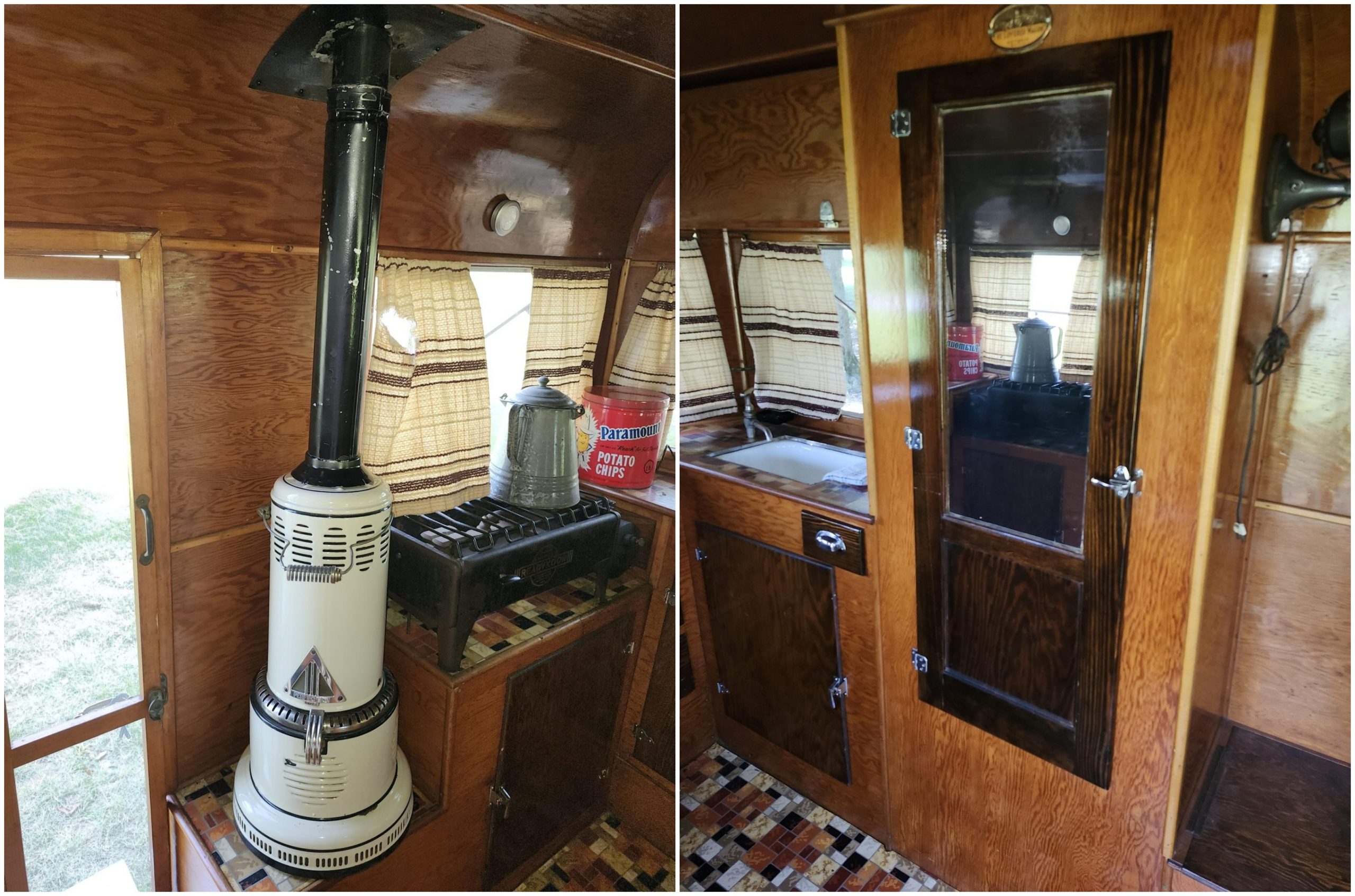
The interior has patterned Congoleum flooring, wooden side panels, curtains, a closet, and a ceiling vent. Windows surround the forward lounge area, which is furnished with a sofa that converts to a bed and has patterned cushions. The lighting fixtures do not work. The blanket pictured above is not included in the sale.
The kitchenette is equipped with a Congoleum countertop, a Readykook gas stove, and a porcelain sink with a pump-style faucet. It also has an icebox, a retractable work surface, an overhead cabinet, and under-counter drawers. The curtain above the stove is torn, and the operating condition of the appliances and plumbing is unknown.

It’s said that this trailer spent time in Pennsylvania and Missouri before ending up in the hands of the Classic Car Club of America Museum in Michigan in 2023.
This trailer is a touch heavier than the original Covered Wagon at 1,400 pounds dry with a tongue weight of up to 275 pounds. The museum also states that the trailer is a total of 15 feet long, is 7 feet, 8 inches tall, and is 6 feet, 5 inches wide. Of the trailer’s length, 13 feet is the box. Classic Car Club of America Museum says it’s time to move on because it’s a car museum, not really a camper museum, and it believes an RV collector will really love it. Besides, as the Classic Car Club of America Museum notes, two more mint-condition Covered Wagons are already in museums. The Volo Auto Museum near me has two Covered Wagons!

So, as far as the museum is concerned, this can go to an enthusiast to enjoy guilt-free. Well, so long as they replace the dry-rotted tires first.
Honestly, this would be a terrible camper to use regularly. There are no replacement parts, and it’s likely to be at least two or three times as old as you are. However, it would be an absolute delight to take to the local state park or vintage camper show. At only $1,110 with 5 days ago in the auction, this trailer is also cheap enough that I’m considering bidding on it.
I love that multiple people have preserved this unit for over nine decades. It’s truly a time capsule of how camping used to be. It came from a time before RVs became hilariously excessive, before swoop decals, and before campers became so huge that they required gigantic trucks to tow them. I love campers like this; they show us where we came from, and for some, perhaps something to go back to.
Topshot: Classic Car Club of America Museum


On my bookshelf I have a copy of Tom Swift and His House on Wheels
Or, A Trip around the Mountain of Mystery from 1929.
“ye olde Camping World”
This was fucking hilarious!
These are so interesting. Great article
This is awesome. Mercedes I hope you bid on it and win the auction. This would fit nicely in your wheeled fleet. The textured pleather-ish exterior covering on this little rig is a hoot!
I wonder if anyone ever looked at the layout of the covered wagons and adapted that layout instead of marketing just using it as a ploy? If I win the lottery I’ll design a perfect RV and call it the Conestoga. It will be wrapped in turnips as was the style in those days
Well, even at its age, the quality can’t be any worse than anything else you can pick up at Camping World.
BTW, Americans’ desire for poor quality RV garbage they use has very real and disastrous consequences. But Americans wanting a faux nature experience that helps destroy actual nature is completely on-brand.
Someone sent me quite the bombshell NYT report about that environmental aspect. I am brewing a hot (?) take that it’s about time for the RV industry to move on from lauan. Sure, other materials might be more expensive, but there’s no reason not to have higher standards.
There’s is nothing but unconscionable excuses and rationalizations not to buy certified lauan. The wood isn’t necessarily the problem, it’s the sourcing based on lowest price only. Sadly, regulation probably won’t happen during this current rape and pillage administration.
From this administration, the RV industry will likely get tariff exemptions based on how destructive they are to the ecosystem and how many brown people they kill.
The RV industry is 99% cheap junk because its consumers prioritize price above all else. There are brands that do better than others, but obviously, that hasn’t resulted in those companies gaining meaningful market share.
The people who buy RVs are generally not people who make purchases based on sustainability or ethical business practices. The RV industry as a whole isn’t likely to change unlessed forced to do so, and there is zero chance of that happening.
Have to disagree here. RVs are one of the vehicles used less for their purpose than pickup trucks for hauling, 4 WD vehicles for off-road and sedans for 5 passengers.
Then what are they used for? Taking up space in a driveway is not a use, but that is what they do the most.
When they are 40+ years old and nonfunctional, they get becime garbage collection/homeless housing units with long expired plates.
Thank you for sharing these wonderful glimpses into our past!
I suspect the pic in the trees was taken at The Gilmore Museum North of Kalamazoo. The Red Barns Show always brings out a number of vintage camping rigs. That said, the Red Barns has been known to bring out all manner of things with motors or wheels.
This would be absolutely perfect behind your pre-war car.
Bringing period-correct campers to vintage car shows is absolutely the move. You’re the Belle of the Ball, AND you get to have a relaxation point when you’re in the hot sun all day long.
The questions on the BaT listing ask a lot about towing it. Yikes this needs to be flat bed carried to some Glamping destination to be decoration and preserved and possibly rented out. It is do much of a survivor to be hauled around behind a modern truck on todays highways.
I would argue that given what qualified as a road when this was built, it’d probably trundle along quite happily using non-interstate routes to your destination.
But would it pass inspection
Where I live in Canada, inspections on trailers aren’t required unless it’s for commercial use.
Which is wild, but explains the rotted out trailers I see.
I would haul it using a period-correct car, and stick to country roads. I definitely wouldn’t rent it out, though. I’d be so worried about rando renters breaking my 91 year old camper.
Your Plymouth is close enough to period correct.
It’s perfectly period correct. Think of the age disparity between travel trailer and tow rig. There’s 2025 F150s pulling 1985 trailers, and vice-versa.
Oh I agree. But the closer in age the combo is, the more special it is. That pic of the Buick above is chef’s kiss perfect.
I’m reminded of a newer version of a combination like this which I saw about seven years ago while traveling with my in-laws:
https://live.staticflickr.com/1812/43136450735_83ef038e91_b.jpg
No discussion of vintage travel trailers is complete without a viewing of ‘Mickey’s Trailer‘ from 1938
Despite it’s age and decades of use, I’m betting it’ll still have fewer leaks than the average new camper coming out of Indiana.
Just the relative simplicity will make it infinitely more reliable than any of those new rigs.
Brought a trailer to Bring a Trailer. Someone studied for this exam.
This is pretty cool, crappy, but wonderful.
I think way back when it got it’s Congoleum floor and countertop somebody gave it new drapery consisting of kitchen dish towels. I think it would be safe to use after some investigation and repair. I would guess it would be made of generic stuff that you could hunt down easily. The scary thing would be water or damp.
Any evidence of caravan style racing? I only ask since in Michigan in my experience they will race anything. (-:
In the 1970’s there was both caravan racing and rallying;
https://www.youtube.com/watch?v=OdMTLN7gCc8&t=63s
The track races died out when manufacturers of both cars and caravans got involved, I think that Graham Hill won one year!
These days it is not as professional;
https://www.youtube.com/watch?v=IWK5Ltg3ZOI&t=26s
As someone who drives a Model A, I can’t imagine driving at 50mph while towing a 1400lb trailer. Furthermore, I can’t imagine stopping from 50mph while towing a 1400lb trailer.
A friend’s father had a Model A; “stopping” was a challenge the best of days.
I do suspect there was some fluff in the ad copy, but that does sound hilarious. Or terrifying…maybe that second one.
Psst. This thing would be perfect behind the Plymouth.
I KNOW! I’m sort of watching this auction to see how crazy the bidding gets. I can make garage space happen.
That is incredibly charming, but the proximity of those curtains to the gas stove in the kitchenette is worrying.
You find all sorts of stuff like that in super old campers. It makes you appreciate how much thought is put into safety today. 🙂
And what are the chances those floors/countertops have asbestos in them?
1 in 0.5
Came to say, it’s too bad those counters definitely contain asbestos because I kind of love them.
Congoleum used asbestos from the late 1940s until the early 1980s.
It’s much nicer looking from the outside than from the inside. In 1930, it was the latest and greatest. Now it’s quaint and very cool but kind of depressing at the same time, to be honest. It’s a great collector’s item, but very much behind the times in ergonomics, comfort and functionality.