

Every year, carmakers wait nervously for a report from analyst John Murphy, one of the best prognosticators in the automotive industry. It used to be called the “Car Wars” report, and now it’s the Murphy Automotive Product Pipeline. This is an independent, thoughtful, and typically clairvoyant view of what could happen. This year’s report is an absolute bombshell, noting both that EV adoption is going to flatline and that automakers caught up in EV hype are likely to suffer or maybe even vanish.
The Morning Dump is going to have a bleak note to it if you’ve thought electric cars are the future of American propulsion. Instead, according to Murphy, we’re in for a long period where hybrids are not a bridge, but a “durable solution.” I reluctantly agree. One of Murphy’s charts is about brand survival, and it’s not as likely that Volkswagen is going to be one of those as the company faces down difficult cuts. Nissan is also a company a bit on the bubble, which is bringing back the ghost of CEOs past.


I also think if you’re an EV person, the news that Texas is likely to take over the car market in the United States is also maybe bad news (as a native Texan, I am less bothered by this).
Murphy Thinks Electric Cars Peaked In 2025 And Aren’t Coming Back Soon
You ready for it? Here it is:
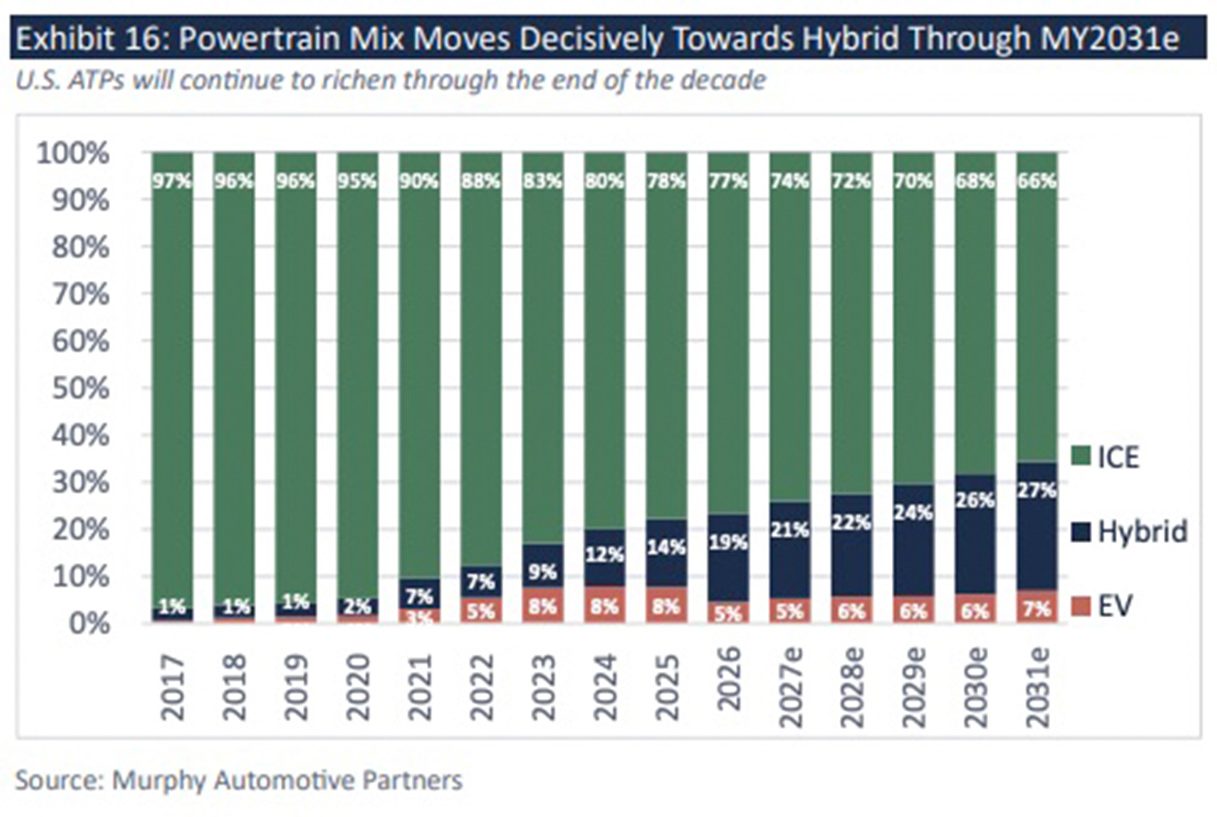
Via the new report from Murphy Automotive Partners, this simple chart pretty much knocked me off my chair when I saw it. Not because I think Murphy and his associates are wrong. They probably are not. It’s just such a bold repudiation of the last few years of hype that it feels almost dangerous to say it out loud.
Through MY2027–31e we expect the ICE powertrain to lose share to Hybrids as they represent a steadily larger share of
launches. Conversely, pure EVs are likely to make little headway with only a partial recovery from MY2026 lows, but still below peak 8% penetration. This is far lower than the industry expected even up until recently, and the inflection many investors underwrote has been pushed well beyond this study’s window, especially for mass market. We would go
further, hybrids are not a transition to pure EVs, but where the industry will find the right practical solution for
consumers, justifiable economics, and potentially for the environment.
This is absolutely wild stuff. What the MAPP is arguing is that we’re not experiencing a little stumble this year due to a change of politics and policy, but a long-term and durable abandoning of full electrification that sees the move towards hybrids as inevitable and the EV market as something of a consistent but flat alternative. In this view, electric cars aren’t gathering many new converts but, instead, recycling a lot of the same customers.
I’d like to point out that even two years ago, groups like S&P Global Mobility were treating electrification as an inevitability in their forecasts of powertrain mix:
As we edge closer to 2030, hybrid electric vehicle and BEV powertrain are likely to steer the future of automotive industry trends in North America. Despite more rapid electrification in other regions, North America’s production trails slightly, at just between 9% and 10% for BEVs and fuel cell vehicles. However, projections suggest a significant leap, with 44% of vehicles forecasted to be BEVs or fuel cell car models by the decade’s end.
It was this kind of analysis that felt wrong to me, and led me to first declare in 2023 that 2024 was going to be the “Year of the Hybrid” and then, last year, to declare this the “Decade of the Hybrid.” There simply weren’t enough customers and, unlike in China and Norway, the overall governmental and societal push ran out of steam too early. While politics is a part of this, I do think that the economics and buyer interest are the far bigger reasons, or as Murphy’s report says:
Pure electric vehicle programs have been deferred, re-scoped, or canceled, while hybrids have moved from hedge to headline. The economics are the key driver. Hybrids carry relative pricing power and healthy variable margins, while most pure EVs still lose money at the unit level. Crucially, those advantages look more structural than transitional. Furthermore, the practical use case for most Americans leans heavily towards traditional hybrids.
I cannot fault that logic, which is why so many brands that were recently invested in EV programs have either walked them back or, for the American market at least, entirely abandoned them. It’s possible that environmental concerns, political shifts, and higher gas prices might help full BEVs rise a little faster than forecast, but there simply aren’t going to be enough cars or customers.
On one hand, this does kind of suck. I love hybrids, and bought one, but there are plenty of consumers who would probably do well with an EV if there were more affordable options. The hype cycle caused automakers to overpromise, over-invest and under-deliver in terms of performance and pricing. Not that many automakers ended up making a better, more affordable EV than a Model 3, and by the time they did, they realized there just weren’t that many customers, even with $7,500 on the hood. For American competitiveness in the global market, where Chinese EVs dominate, it ain’t great. I still think that if the industry and those who covered it were more realistic, we could have gotten a future where hybrids and EVs could have grown together, as opposed to one where a single powertrain has to dominate.
Eventually, EVs will catch up, but it’s going to probably be way out in the future.
The other portion of this report, which is subtitled “Survival of the Freshest,” is that the EV “head-fake” caused many brands that weren’t Toyota to be forced to delay the redesign of key models (having expected to replace them with EVs) and now the market is about to become very old:
“The next five years aren’t about who has the most hyped concept, they’re about who actually shows up with the freshest product portfolio after the worst drought in history,” said John Murphy, Founder of Murphy Automotive Partners. “Some of the most familiar names in this industry are closer to the edge than the market realizes. The MAPP is how you see it coming.”
That’s a great sales pitch, and the media preview of the report shows which brands are in trouble, but the only brand named is Toyota (at the top, also the automaker with the most hybrids). There are seven brands in trouble in the United States, and I’ve got some guesses as to which ones those are.
Volkswagen Wants To Cut 100,000 Jobs, Might Not Be Able To

Does anyone know who this guy is? He might be retired by now, but I’d love to talk to him given that he’s sort of the mascot for Volkswagen’s production woes. Here’s another stat, this time from Bloomberg, that should tell you what’s going on in Wolfsburg: Volkswagen employs 628,893 people compared to 383,853 for Toyota. Last year, Toyota sold roughly 11 million cars across its brands globally, compared to just under 9 million for Volkswagen. That’s an extra 250,000 employees to sell fewer than 2 million cars.
The math doesn’t work, and Volkswagen announced a plan to cut 100,000 jobs and four plants. This isn’t really a surprise, given everything, but it’s not great, and VW’s powerful union has something to say about it, especially because of this:
Major strategic decisions at VW need approval from its supervisory board, where labor representatives normally hold half the seats. Currently, they occupy a majority after independent board member Susanne Wiegand didn’t stand for reelection.
According to that Bloomberg report, VW’s labor union is pushing back and can continue to do so. At the same time, VW’s union understands the company needs to survive, so cuts are certainly coming and coming fast.
Oh, Shut Up, Carlos Ghosn

This is a little bit my fault, because last week it was too amusing to not write the headline “Nissan’s Shareholder Meeting Was So Bad That Someone Nominated Fugitive Carlos Ghosn To Run The Company Again.” It’s kinda funny! It’s also not serious, because Ghosn would be a terrible leader of the company.
Unfortunately, saying Ghosn’s name means that a bunch of reporters, including Hans Greimel, were given an excuse to call him, so we have to listen to this nonsense:
“They say bring back what you had before. We want to come back to the golden age of Nissan. It lasted 18 years. It went very well,” Ghosn said. “Common sense speaks. If there is somebody who can fix it, it is somebody with my profile. Obviously, I mean, I’ve done it before.”
I think Ghosn did a good job, but he didn’t do a great job in the end, and a lot of the products he was responsible for were (though we love them) kind of mid. He was smart enough to see the EV wave coming, but absolutely unable to adjust when Tesla showed up and demonstrated the right way to do an electric car. Ghosn had plenty of business sense, but not enough product sense.
At least Ghosn here is reasonable enough to understand that it’s probably not happening, while also insisting he’d be able to save the company.
Texas Might Overtake California As The Biggest Car Market Soon

As a native Texan, I am not surprised that Texas might soon overtake California as the biggest car market. In general, my view is that if California wanted more people, it would invest more in making the state affordable to live in, including making simply having a place to live possible for more people. The alternative plan, as seen in Texas, is a mix of higher density development in historically low-density areas (Austin, Houston, San Antonio, and somewhat Dallas) for more affluent people, and a bunch of crappy, low-quality suburban housing for everyone else. This makes for increasingly fun cities and pretty miserable traffic.
Again, from Automotive News, this has an impact on the car market:
Since 2019, California’s share of U.S. retail light-vehicle sales has been dwindling, to 11.4 percent this year from 12.5 percent, according to JD Power. Texas, meanwhile, has trended in the opposite direction, climbing to 10.8 percent today from 9.3 percent seven years ago. Less than 1 percentage point now separates the states.
Texas already has become the nation’s leader in consumer spending on new vehicles, as Texans favor pricier pickups, JD Power found.
If these trends persist, Texas will become the nation’s new automotive “center of gravity,” said Tyson Jominy, senior vice president of OEM customer success at JD Power and the report’s author.
“California is the place where a lot of new ideas are sort of tried out, whereas Texas is a place where trucks and SUVs win,” Jominy said. “Texas is sort of the prototype of the typical American consumer these days.”
Texas forever.
What I’m Listening To While Writing TMD
Well, this is timely. It’s “A Slow Dance” from post-rock band Explosions in the Sky as featured on the Friday Night Lights movie soundtrack.
The Big Question
Name the seven brands that Murphy thinks might not survive the decade.
Top photo: MAPP/Tesla


Another complicating factor that I think may work out in the long run, is if and when the US gets affordable, practical E-REVs with 60-100 miles battery range + range extender/generator.
In my opinion, an E-REV is an EV, at least most of the time for most users. The small, lower cost battery can easily be topped off over night in most instances with just a common 120v level-1 charge cable, making them a pragmatic solution for many who can only have one vehicle in the stable.
Imagine a Ranger/Maverick E-rev with 80/500 mile range or a Rav4/CX50 E-REV, or a even small Hyundai/Kia sedans and CUVs all with similar battery/total range.
I think they’d all be great sellers, but we just don’t have them in the US.
We need practical E-REVs starting in the low 30s. Right now, I think it’s only the SCOUTs that are on the horizon, and the SCOUT E-REVs are way too big and way too much for most. Not everyone is looking for an off-road beast, and they’re not needed for a daily commute.
E-REVs are a great solution for the US where 120v is the only at-home charge option.
As a former Volt owner, I can endorse this message. I know it complicates the drive train significantly, but it’s not like this is a magic tech no one can figure out, and it makes so much sense for like 90% of all vehicle owners.
I think the Volt may have had an extra-complicated drivertrain, where the latest E-REVs are a bit simpler with no mechanical coupling between the ICE and the wheels. I think the improvements in motor, ICE and generator designs allow an E-REV running a generator powering an electric motor to he efficient enough to justify keeping it simple, especially if the ICE/generator is only in play for the occasional use.
My daughter drives a PHEV Escape . It gets about 30-40 all battery range. She tops it off every night in the garage and her commute is just at the max battery range. She hardly ever needs to run the gas engine and when it does run, it’s only for the last few miles. Once the battery is depleted, the escape goes from EV to a kick-ass hybrid getting 40+ MPG in the city and low 30s on the highway depending on speed.
The US needs E_REVs, but even a well designed PHEV like the Escape or Rav4 PHEV would be a big help.
“I think the Volt may have had an extra-complicated drivertrain, “
The Volt’s transmission was an e-CVT similar in principle to the Prius.
But I recall it did have a provision where under some circumstances, there was a mode where engine could power the wheels directly.
Pure EVs make sense for like 90% of vehicle owners…
90% of vehicle owners don’t make pure, sensible purchase decisions.
We’re weirdly emotional creatures prone to irrational behavior. Marketing is very effective. We don’t buy what we need so much as we’re sold products that maximize money extraction, and not real value.
If car dealers had a fiduciary duty, the retail market would look very, very different from what it does. We’d likely see far fewer four doors pickup trucks parked in suburban driveways, for example.
“If car dealers had a fiduciary duty, the retail market would look very, very different from what it does. We’d likely see far fewer four doors pickup trucks parked in suburban driveways, for example.”
And if that was the case, I think dealers would need to employ an arbiter decide if the buyer’s needs and wants were in sync… and for the people whose wants were totally out of what they needed, that arbiter wouldn’t have to yell at them for being stupid and give them their suitable options that met their needs.
I think I could do that job.
You’re a good man(wich).
I think I can give good advice, but I’m not very good at getting people to follow it. For example, I failed to prevent my stepmother from buying a used Chevette way back when.
For anyone who can charge at home/work every day at low residential rate, I agree. Most homeowners can probably have at least a level-1 120v charger plugged in and top off their EV with 40-60 miles every night.
But… if you have to rely on ONLY public level-3 charging, then unfortunately I think a PHEV, or E_REV is a more practical choice, though I am sure that also depends on where you live and work and where the reliable, open and affordable level-3 chargers are.
I live in the South, and I’d never recommend a pure EV for someone who can’t recharge daily at home or work. Too painful to rely on the public charging network.
I’d argue if you don’t have decent charging access at home, a PHEV or EREV isn’t really any smarter of a choice over a BEV. I mean, yeah, sure, it works cuz you can just fill up with gas. But you are spending a lot of extra money for something that you’ll never actually take advantage of. You should probably just get a standard hybrid or ICE vehicle.
That was the point I was hinting at in my original comment, but I certainly left a lot to the imagination.
I get ya. At least the phevs and erevs can make do with 120v and be fine…. EVs as an only car sort of cry out for level 2 if you can do it.
Here is the kicker with erevs, you have an electric motor, battery, gas tank, and regular piston engine.
How are you as a manufacturer going to make $$$ when you basically have two drivetrains. You price it to make a profit, it becomes so expensive vs an electric or regular gas model its salesproof.
The e-rev battery is about 1/3 the size of a full EV battery with maybe 80-100 miles range max. That huge cost savings from the smaller battery gets moved to cover a purpose-built ICE + generator. Helps if the REV is designed with efficiency in mind to start off with too, reducing the need for a large ICE/gen.
Since the E-rev ICE would be built for just one optimum speed, it can be tweaked to maximize efficiency with its companion generator, and perhaps it won’t be as large, nor as complicated, as you might expect.
The drivetrain remains 100%, the ICE is can be smaller and simplified, and the companion generator is just one moving part.
FWIW I’ve read that RAM’s EREV pickup (way too big, but that’s where the money is) is going to just use their standard 6 banger tacked onto some generator. Not exactly the best way to go about it. Designing an ICE specifically for generator duty would be a better approach.
“How are you as a manufacturer going to make $$$ when you basically have two drivetrains.”
False logic. It’s still just one powertrain… only with a different setup where a larger starter-generator replaces the traditional starter and alternator and other differences.
In some ways it’s simpler and cheaper. For example, the modern single speed “e-cvt” is a way simpler design compared to modern 8, 9 or 10 speed automatics.
No, look at the BMW i3 REX from about ten years ago. Its a BEV that happens to have a “motorcycle engine” under the cargo floor out back. Admittedly BMW made that a complicated system (see Rich Rebuilds) but it doesn’t need to be that complicated I think.
The Prius driveline may have advantages (see Technology Connections) but I’m unsold.
I actually don’t think it’s that much of a net complexity increase. It’s more components, but some of those components get individually simpler. An eCVT is mechanically way simpler than basically any other common transmission, and the PHEV drivetrain allows the elimination of some of the complexity that’s normally needed to squeeze real-world efficiency out of the ICE. Things like VVT and cylinder shutoff just aren’t needed when the RPMs are no longer directly tied to control input and drivetrain output all the time.
It’s great until you try to engineer it. Then you’re doing a turducken of powertrains. IF the engineers can package it all well, then the product can be good for users, but I’d be highly concerned about longterm service costs. – Engineer who had to deal with packaging issues on an erev
Still the smaller battery in the E_REV should make space for the ICE/generator, as well as greatly reducing the costs.
I’m not an automotive engineer, but I think if you plan out the e-rev from day-1 to be an e-rev, you can find space for the ice/generator and it’s cooling/fuel/exhaust needs as well as space for the smaller batter and electric drive. At least there’s no complicated transmission to deal with.
..all I ask is you make room for a spare tire, and for god’s sake, skip the electronic door handles and touch screen controls 🙂
Look to the vintage VW flat-four engines. Not literally but the boxer design, 2-4 cylinders. Watercooled this time. Compact exhaust system, compact cooling system, fuel injection. Would fit under the rear bed of most pickup trucks and cargo floors of larger SUVs. Make it easy to service or easy to remove to service.
EREVs are not a great solution. Making the generator not able to run the wheels results in a lot of losses. It also makes them much more expensive An EREV needs much larger motors than a PHEV which adds significantly to the cost and weight. The fact that the starter/generator is divorced from the traction motor means that a EREV is much more complex and expensive to produce and also adds weight. Finally the larger battery that most EREVs propose also adds weight and cost.
Here is a study done by CA from the first crop of PHEVs and the sole EREV that shows the diminishing returns of larger batteries. Doubling the EV range from ~20 mi (Fords) to ~40 mi Volts does roughly double the percentage of EV miles driven. Meanwhile doubling from the Volt’s 40 mi to the i3 REX’s ~80 mi range only increases the utilization rate by ~20% instead of the ~100% increase from doubling from 20 to 40. It looks even worse when you look at total EV miles driven where those Volt owners drove more total miles in EV mode than the i3 REX drivers.
https://ww2.arb.ca.gov/sites/default/files/2020-01/appendix_g_pev_in_use_and_charging_data_analysis_ac.pdf
Yes, parallel hybrids have significant efficiency losses if they are run as hybrids all of the time, but this is contrary to actual usage patterns. Most people drive <60 miles a day, which means on an EREV with say 80 miles of electric range, they can do most of their driving 100% electric. Having an available range extender than can be refueled at a gas station for whatever longer trips they want to do is a powerful psychological safety net that allows them to make the purchase they would otherwise insist they need (expensive) large batteries for more range.
EREVs are imperfect from an engineering POV, but they are fantastic from a marketing POV, and that is at least 50% of the battle.
My thoughts exactly, plus unlike the large SCOUT, if an E_REV is smallish and built from the ground up to be as efficient as possible, including newer lighter batteries + latest motor designs + adding lightness (48v backbone?) + aero + purpose-built ICE/generator, then I think the moderate inefficiencies of ice > generator > motor > wheels vs ice > wheels can be forgiven.
I agree that for some people there is definitely a marketing advantage.
As far as EV only range, you can do a PHEV in 80 mi range too. However past 40-50 mi the law of diminishing returns is very steep.
The average vehicle travels 37 mi per day. Now that includes a mix of lengths of drives since the average commute is less than 20 mi per day.
Per the study I linked the Volt was able to do ~70% of owner’s total driving while driving more than the average vehicle per year. Beyond that the benefit is minimal. Yes it gets a few more people able to do a 100% EV commute at the expense of a higher cost and worse efficiency for the 80-90% of the people that would be served perfectly fine by that 40 mi range.
A PHEV can simply do anything an EREV can do better. The only real reason to do a EREV is for mfgs to amortize the platforms designed for EV and the power-trains designed for them. .
Erevs provide 100% of the power 100% of the time since they are only electric drive. Phevs need both the electric and gas motor combined to reach rated power. The phevs, when in ev mode, are limited to just the electric drive. The extra hp and torque of the ice isn’t there unless the engine fires up.
Yes and on modern vehicles that PHEV’s electric drive is more than sufficient in normal everyday driving. Yes when you need max power the engine needs to play along, but otherwise you are just trading more cost, weight and complexity for the small amount of time you actually need all the beans.
Really depends. If you only go 10-20 miles, and only on city streets, yes the electric drive on a decent PHEV is going to get you there and back without ever needing the ICE.
Our 25 Escape PHEV with the (excellent) Ford/Toyota eCVT powertrain will run on all electric on city streets for 30-40 miles total, but once you get it on the interstate and hit 70 or so, the ICE really wants to take over. If your commute has on-ramps, interstate speeds, hills, etc, the electric-only mode has a tough time. Still much better than just a plain hybrid or ICE.
I’m not anti PHEV, I just think an E-REV with a bit more range and full power all the time is a more useable electric-drive solution for most users than a PHEV, but I see your points.
We keep our Escape PHEVs in EV now mode, well except when we are under a “use Auto only” mandate and have no problems getting on the freeway, up hills ect. Yes it definitely sucks up the charge much quicker when you are doing 65 but even in our hilly area it gets the job done. Yes more power would be nice but not at the added cost of a larger battery, to provide greater sustained current, and a larger motor.
Yes there are crappy PHEVs out there that can’t accelerate any faster than Torch’s snail or do 75 mph w/o assistance from the ICE but that does not mean that PHEVs can’t be built properly like Ford did for over a decade and Toyota’s more recent offerings where they copied Ford’s design.
There are significant engineering trade-offs that are made in the series vs parallel hybrid powertrain decision. Yes, you can make a longer range PHEV series hybrid, but since you need an ICE motor capable of driving the car on it’s own you have to make a conventionally arranged engine compartment, and cram in a battery somewhere. This is an extremely difficult packaging problem, which is why there are very few PHEVs with EV-only ranges above 30-something miles. Contrast with a parallel hybrid where the battery and electric motors are the center of attention, with an ICE generator crammed somewhere else (most likely where you would have put the extra 50 kW of battery pack), which results in a near-BEV like form factor- it’s much easier to get 50+ miles of electric only range with that setup.
EREVs trade powertrain efficiency for packaging efficiency and a marketing advantage. Is that right for every driver? No, but it’s not automatically worse either, and IMO it’s the right mix for a lot of people.
The new RAV-4 PHEV actually tops 50 mi of EV range w/o any packaging compromises.
Packaging efficiency in a EREV? No quite the opposite. The upcoming Scout sticks the engine on its side where they spare tire is supposed to be and now it has to be hung off the back of the vehicle, the worst place for it. The upcoming Ramcharger uses up all the space under the hood just like a conventional ICE, Hybrid or PHEV.
The PHEV has a smaller cargo space and less vertical space than the standard hybrid, because the 22 kW-h battery has to go somewhere. Also, that battery weighs about 300 lbs more than the one in the standard hybrid, which involves a non-trivial change to the weight distribution. Those are kind of the definition of packaging compromises.
That’s a great illustration of exactly why the EREV is efficient with packaging- because your ICE does not need mechanical powertrain connections, just comparatively tiny power feeders, you have a lot more freedom where to mount things. Whether you use that freedom wisely is a different question.
I have to bring up the Nissan Qashqai again, since the latest iteration of their series hybrid looks to be quite good according to some tests. Like just a bit worse at lower speeds than a 2.0 liter Corolla Cross Hybrid, and a bit better at 80-85 mph (all that while the Nissan is about 400 lbs heavier, and about a second better at 60-100 km/h and 80-120 km/h acceleration).
Well 80-85 is a pretty uncommon use case. The reason that Nissan is heavier is because it is a series hybrid and as such needs those larger and heavier motors and battery pack.
I am waiting to see the EPA numbers on the upcomming Rouge and of course the real world results.
Yes, we will be smarter when the official numbers and the reviews for the new Rouge start to come.
Edit: the mild-hybrid Qashqai with a 1,33 liter turbo 4 cylinder and a CVT weighs still ~170 pound more than a 2.0 liter hybrid Corolla Cross, so it is not just the hybrid system.
It’s okay to be skeptical. I’ll just skip the skeptical stage and look closer at the Chinese EREVs that are already in production and for sale in the rest of the world.
What did they get right and what could they improve upon.
A BYD Shark would fit my pickup truck needs quite well.
Not being skeptical just looking at the facts. An EREV is simple more expensive and heavier that a similar range PHEV. Add more range and it just gets even heavier.
Add more range and it just gets even heavier.
And more expensive.
The BMW I3 REX engine is ~220 lbs. Add cooling, fuel system and exhaust. The weight of a big American football player?
More work to maintain for sure, and more expensive. Still, if I’m driving on battery most of the time, the savings adds up.
Right now I’m saving about $1500 per year with our EV on fuel alone.
Wow I had no idea the REX was that heavy.
“Making the generator not able to run the wheels results in a lot of losses. It also makes them much more expensive An EREV needs much larger motors than a PHEV which adds significantly to the cost and weight.”
The alternative is an eCVT which adds its own losses, costs, complexity, bulk and weight.
An eCVT does have losses but less than fully electric power transfer. It is cheaper, lighter and smaller since the motors don’t need to be as large as they do in a Series.
The other option is a virtual eCVT as used by Honda which does away with almost all of the mechnical losses when it is in direct drive mode. All being in one package makes packaging simpler, smaller and lighter than having the generator and traction motor in separate places and housings.
Well the name of the game is efficiency so whatever works best. If an eCVT can allow the ICE to be tuned for maximum efficiency and keep it there, even if that sweet spot only has a variance of +/- 25 RPM then so be it.
Yup the only reason that CVTs exist is that their added losses allow the engine to operate in its sweet spot more of the time. Though with variable valve timing that sweet spot is not as small as it used to be.
“The small, lower cost battery can easily be topped off over night in most instances with just a common 120v level-1 charge cable, making them a pragmatic solution for many who can only have one vehicle in the stable.”
Those chargers can have terrible efficiency though, sometimes losing as much as 30% of the energy though typical losses are between 10-15%. That has to be accounted for in the maths.
You don’t want to let perfect get in the way of good.
Sure there are compromises if you go E-REV vs PHEV, but I think the pros far outweigh the cons. Unfortunately, we have no good EREVS in the US market to compare (and just a handful of PHEVs) right now. I hope that changes. China seems to have some kick-ass EREVs in the market.
I submit an E_REV with 100% of the hp and all that instant torque available all the time since it’s always in electric drive, with 80-100 mile battery range and combined 400-500 mile total range is a preferred choice compared to a PHEV that has maybe less than half the available power when just on electric drive, maybe 40 miles of electric/battery range.
The EREV will have larger electric motors and a larger (but still smaller than an EV) battery. No transmission. Ideally the range extender won’t be an off-the-shelf 4-banger, but a purpose built/tuned single speed hyper efficient combo ICE/generator happy meal (tiny simple next gen Mazda rotary?)
The PHEV will have smaller electric motors, a smaller battery, and an eCVT, as well as an ICE that has to handle all the variable conditions for driving the vehicle, so not exactly optimized for one speed.
For most users, the EREV will probably spend 95% or of it’s time using just the battery alone since it’s got better battery range. Its range extender will only be used on longer drive, and the driver will always have all the Hp and torque on tap as needed. The range extender is there only for when the on-board battery is depleted..
The PHEV has much less range and much less electric-only power. It is much more likely to start/stop the ICE engine, even on shorter trips, to provide the added power/torque needed for acceleration and highway speeds as well as it will kick in as the battery is depleted. More gas, more pollution, more wear and tear.
Sure, the overall efficiency when running the EREV range extender -might- be lower ( maybe just a little) than a PHEV running its ICE, but over the lifetime, I suspect the EREV would absolutely leave a shorter ranged PHEV in the dust when it comes to total gas use and pollution created. The range extender is also going to probably need a lot less maintenance and last longer.
I’m a big believer in EREVs as being part of the solution. If I could only have ONE vehicle, and I had a place to plug it in every day (even 120v would do), an EREV AWD 4-door trucklet, nicely optioned with all the safety nannies ( + real door handles + physical controls + carPlay dammit), like the Maverick with 4K towing and 80 miles of battery range would be nearly perfect for me. A do-everything vehicle that stays in electric mode on every trip I make in town, and has the range extender to get me out of town and when towing/hauling
Alternatively I’d be first in line for a Mazda Vision Coupe (or ICONIC concept sports car), EREV sedans with a small, lightweight spinning Dorito range extender.
All better than nothing. Overall, I’d prefer an E-REV over a PHEV, A PHEV over Hybrid, and a Hybrid over an ICE, if I could only have 1 vehicle.
“You don’t want to let perfect get in the way of good.”
Of course not but that will play into the maths. I PG&E country where I live electricity is expensive AF. Even with gas prices as high as they are filling up overnight with electricity is not necessarily cheaper than filling up with regular in the same PHEV. Factor in charging losses, higher off peak and public charger rates and better fuel economy by pure hybrids and electricity may not be the slam dunk its supposed to be.
The average consumer isn’t surprised to see this. The industry analysists, automotive CEOs, and very vocal early adaptors that felt they could push BEVs on the general public forgot to consider one thing – the voice of the customer. Most average consumers said they wanted the focus to be on hybrids because the charging infrastructure and battery technology wasn’t ready for the masses. In the end, the old adage remains true – the customer is always right. Don’t get me wrong, I’m thrilled BEVs exist and continue to get better, and I’ll even wager that we WILL be almost full BEV eventually. 8% of market share is still a lot of cars. I hope automotive companies continue to make a profit meeting the market demand. Undoubtedly this will be a business study case for years to come.
Bingo!
7 Car Brands likely to be gone?
Lancia
DS
Abarth
Infiniti
Polestar
Maserati
And while I don’t have anything to base it on, I gotta wonder is Aston Martin has the funds to be building their own everything in low volume and still be around int he next 5. But they have already survived what 7 or so bankruptcies? So maybe they have it all figured out now?
If you’re going to count brands without US presence, you could probably double the number with Chinese brands alone. They’re just starting to go though a major shakeout and the lost brands would be less like Studebaker and more Haynes-Apperson.
My work buddy’s wife went back to gas. After leasing two Leafs the dealership quoted her a go-away price on the new model and then offered her a very good deal on a nicely loaded Kicks. He and I both think they were sick of her charging at their dealership (which is a block from their apartment and a mile from the rest of “auto row”).
I don’t doubt the dealer thing but leasing companies are taking a hit and not as much free money to soften the blow at the front and becoming extremely regional. In many cases now it’s cheaper to buy a bev then lease. Especially with cheap financing offers and discounts. But there doesn’t appear to be much room on the new leaf maybe a few $k. The leaf she returned will maybe get $14k wholesale at the very high end if they are lucky with a slightly hotter used bev market then it has been. Off lease leafs were retailing for about $14k just a few months ago.
The lease buy-out numbers on BEVs are too high so people are turning them in. In the market near me (upstate NY) cars with $23k residuals are hitting the used market at that price but I don’t know if they are moving. In similar news, KIA just put out a lot of support for EV, PHEV and Hybrid leases so there are deals to be had again.
Thats true everywhere I’ve seen. The residuals were too high to bring the lease down. You can turn in the lease car then buy another off lease car for less. Leasing companies are taking on all of them. I haven’t seen a one that a dealer has bought off a leasing company in a while they are all going to wholesale auctions. Picked up for significantly less then the residual. Plus now that gas prices are falling dealers wont be able to to move them as well and will have to lower prices again. The $14k leaf with under 20k mi is coming back to retail along the under $20k Toyota and HK. The numbers leasing companies reflect loosing money on that last cycle.
It’s also interesting that for the last few months used bev have heated up while new bev have been sitting on lots. That’s why Hyundai wants to get them out. That under $25k group is buying low mileage 1 to 3 year old off lease bev partly because of the gas prices. The delta between new and used bev has shrunk where it can be about $10k for many models between currently inflated used market and heavy discounts on new.
Key here is charging remotely and “apartment”. If you can charge at home it’s a whole different ball game. Charging in public sucks if that’s the only option.
$18K in fuel plus ICE maintenance vs $6500 to drive the same in an EV.
TBQ: Rivian, Lucid, Chrysler, Buick, Jaguar, Mitsubishi, and VinFast
Out of curiosity, what did the 2024 version of ‘the MAPP’ project for powertrain mix through 2031? I’d be careful crowing about the clarity of my crystal ball if I was Mr. Murphy, unless he was not part of the groupthink back then, either.
For the record, I do think that hybrids are viable long-term as a powertrain solution that makes a lot of sense for a lot of customers in the US – and coupled with advances in the federal Renewable Fuel Standard is a fully viable alternative to full electrification from a transportation decarbonization perspective, too.
TBQ:
I’m ranking these from most certain to die to least certain.
Maserati
Alfa Romeo
Lucid
Chrysler
Mitsubishi
Rivian
Nissan
So we should expect Tesla’s P/E ratio to more closely follow its peers, surely?
They sold 589K cars in the US last year, which is less than Subaru, almost tied with VW, and a little ahead of Mazda and BMW. So, about the same value?
Why would you not count the additional 1.1 million cars Tesla sold in other parts of the world? As with many things automotive, US sales are NOT the majority of workdwide sales, merely one of the largest single outlets.
I’m not saying the stock is fairly valued but to just leave out 2/3rd of a company’s sales total is not correct. Stocks of all of these companies are based on their worldwide footprint and more importantly, expected future performance, not just US sales.
Honestly, because I was lazy and I couldn’t find a list of automakers by total volume that included Tesla. Possibly they’re not in the top 10.
They aren’t in the top 10 when all automakers are considered (1.6 million vehicle sales last year), but they certainly are when EVs are separated out. That’s a large part of their enterprise value that the others you mention don’t have with the obvious fact that those 1.1 million of their vehicles sold in other parts of the world show that there ARE in fact plenty of people interested in EVs and that the world is far bigger than just the U.S., irrespective of what some people would have one believe.
Ah, Texas. The only state dumb enough to commit treason because they couldn’t tell the difference between human beings and farm equipment twice.
I look forward to an eternal future of personal monster trucks. We deserve it.
I love that in this current election cycle Texans get to choose between:
1). An adulterous criminal alcoholic grifter who wants to take your money and give it to the Epstein class
Or
2). A nice man who wants to help people with centrist policies
And it’s somehow a toss up that’s leaning towards the adulterous criminal alcoholic grifter. What a…special place.
They don’t “get to’. They “chose to” choose between those two. Baffling. Or perhaps not.
As likely many people experience, I have a seemingly large contingent of Texans living in my area, most of whom keep going on about how great a place it is. Yet none of them seem to be in any rush to ever return to this nirvana.
I also have a seemingly similar contingent of Ohioans living in my area, most of whom will readily mention where they hail from, yet they don’t talk about it being a great place and they also stay put here.
If it makes you feel better, pretty much every house in my neighborhood that was purchased in the past 6-12 months seems to be California expats. Most are Karen’s that cannot fathom that parking on the street in the general vicinity of there new house is legal. I feel like they will do well in an HOA though.
Give it another 12 months and you will see the local populace complaining about how the Californians are driving up housing prices locally. Those locals will complain all day long about it UNTIL it comes time to sell their own house and then the last thing they will do is sell their house to another local at a “fair” price, they will take every CA dollar they can, thus perpetuating the cycle of hypocrisy. (Not saying they are wrong to look out for themselves, just would prefer they be less vocal.).
I went to college in Ohio and it’s basically a giant run down public bathroom under a cloudy sky in the middle of a dead cornfield that’s lined with Trump and HELL IS REAL signs….it surprises me very little that they produce more astronauts than anyplace else
So why do you want to leave the earth? Oh, you’re from there. OK, we get it.
Ouch.
Dear god yes. I am from Colorado. The number of Texans who come here is staggering. Some to vacation, some to live. But they won’t shut the fuck up about Texas. I really would prefer they just stay in their favorite state. It’s a frigging delusion. It’s the only state whose former residents seem to pine for the times they used to live there.
Yeah, if there were no downsides besides only the criminalizing of a woman’s right to try to survive with a doomed pregnancy or removing a rapist’s seed from their body, a highly unreliable power grid, zero desire of the state to help one’s fellow man not go bankrupt due to healthcare issues, a distinct possibility of getting shot just being an elememtary school student or a churchgoer and remarkably corrupt, inept, and apparently immoral politicians, yall’d still be there, no? /s
As someone who likes efficient cars, screw Texas becoming the automotive barometer of the country. I mean, just screw Texas in general, TBF. As an entity it’s a net loss for the rest of us, what with the 5th circuit, the board of education, the lawsuits, the attitude, the normalization of state religion, Houston, Dallas, and so on. This behavior should be actively discouraged if we want to suck less as a country.
TBQ: Rivian, Lucid, Slate, Fiat,and Alfa, for sure. Chrysler, Acura, Lincoln, maybe.
OTOH Texas gave us Hardibro. He chooses to live and raise his kid in New York, though, which is probably saying something since Westchester County’s not known for its’ BBQ.
The man retains too much nostalgic fondness for Texas. I think he needs therapy. Not that New York is that much better from a “state with cult-like loyalty” perspective.
All the big states are like that. I’d say it has something to do with it being a very long way to the state line, but New York’s population distribution disproves that.
In my experience, Texas is literally a cult that indoctrinates kids with an insane amount of Texas state history.
I believe that you meant Texas state “history”.
Hey now, they’ve diversified their programming! They’re about to indoctrinate public school students with the Bible as well….
Maybe the kids will stand up and push back ’cause the adults surely aren’t.
From what I see there are a whole lot of pages missing from the particular bible that some people in charge in Texas seem to be reading from.
I live in Tennessee and I would trade state governments with Texas right now.
That’s desperation.
Yeah but Kid Rock lives in your state.
Winning bigly. Bigly I say! LOL.
This reminds me of when Al Gore could not carry his home state in a national election.
(This criticism is not aimed at Al Gore.)
Man I’m paying double what I paid at the tank last year and despite the headlines, this Iran/oil price thing isn’t ending any time soon.
Someone is going to break this ICE market with a killer product and my money is on Toyota. These things can’t all cost >$50k and they can’t present an unfamiliar and buggy driving experience.
Toyota is going to be the company that does that. I thought it would be GM but they are intent on monetizing their UX and can’t seem to launch a product without it being broken.
Glad to see our government represented in the commentariat.
If anyone would follow the entire supply chain, the only real patriotic answer to transportation is full EV. Eventually, once we reclaim the battery title from China.
If we were to build all our own batteries, with US sourced components (no I’m too dumb to know if this is possible) powered by local nuclear plants, we would remove all our dependance on other (hostile) countries to move goods, services, and people around this great land of ours.
It’s really the only answer the puts America first. Which is what most people dissing EVs seems to be all for.
It’s possible, though the smart play would be to shift to sodium-ion chemistry and accept the compromises that brings by upping the charging infrastructure and going big on renewable-fed grid storage to industrial-scale batteries to enable that charging infrastructure buildout.
Unfortunately, it would also take a truly MASSIVE re-investment in rebuilding our manufacturing and extraction sectors, and we’d need to be willing to accept the environmental and social costs that would entail.
While my comment was mostly sarcasm, I agree. We like to bang the Made In American drum as a nation, we are also mostly unwilling to do the actual work to make things in America.
I’m including myself here, I have a cushy desk job, and would not easily pivot to a manufacturing or labor intensive job at this point in my life, nor would my salary expectations. It’s not a comfortable mirror to gaze into.
Unwilling to pay for the actual work to make things in America. I remember the great offshoring, all too well.
I live in the rust belt and have lived the devastation it has done to the region first hand.
Sad as hell. Talking to a friend the other day I was reminiscing about my hometown. Almost everything is gone now, the local businesses, all the car dealers, all gone. I know it’s the same all over the US.
But share price goes up!
At one point Nike had targeted one of the old factories as somewhere they’d like to acquire and move into. The city shut it down as they insisted GM HAD TO COME BACK SOMEDAY!
It’s now a 6 square block open field.
Great for the R/C plane club though – right?
“ Eventually, once we reclaim the battery title from China.”
You mean the rights which were sold to China from a US company which went defunct because the US Government couldn’t continue to subsidize the technology for future use?
Yes, those exactly.
I’m Mayor Emeritus at best!
I mean to me, what is best for our country’s economy should also, inherently be patriotic. That doesn’t necessarily mean the full supply chain has to be domestic, but what policies provide the largest net benefit for the largest number of people..
To me, the most patriotic thing would be to mine this shit in other countries (mostly kidding)!
We can mine it here, we got the stuff. Once federal and state governments start caring enough about domestic battery production. Unfortunately they haven’t cared until recently like this last year.
I’m talking about the pollution buddy
Definitely a possibility if done wrong, however modern mining techniques are nothing like the 1800’s where tailings were dumped wherever, mining is clean in the US. Plus we can save on the emissions of shipping across an ocean.
Wat?
Lithium and cobalt mining is extremely dirty and to make it clean is extremely costly. Look at coal mining right now in America. It is still extremely dirty.
Brine processed lithium completely clean, cobalt could be more of an issue if you went with that chemistry.
That’s completely false. Lithium extraction requires billions of gallons of water and the evaporated salts that are left behind are highly toxic. There are ways to remediate this but it’s super expensive. Obviously I don’t think we should mine elsewhere so we can pollute other countries and was just joking about the patriotism thing. However, your statement is very misleading
I see this as that BEVs got more and more people out of ICE and to hybrids. Fleet fuel economy goes up overall and that’s a good thing. Sure, we could look at this as a failure that BEVs aren’t finding better adoption, but the reality is that we (In the US at least) are not ready yet.
If you charge at home and mainly drive in your local community, a BEV is fantastic. If you live anywhere that does not have private, dedicated and reasonably fast charging, it’s a massive pain. I rented a Mach-E one time and I had to waste so much time finding charging. Hotel didn’t have it, tried a few different charging options, some were broken, some were not actually public charging (one was at an apartment building for residents), it was a huge pain. Now do that on trip that exceeds your there-and-back battery range. Charging in this country outside of major metros is really bad. My experience was on the outskirts of Chicago, so it’s not like I was somewhere rural. This is fine if you have a 2nd or 3rd car with an ICE/hybrid backup. If a BEV is your only car, I cannot imagine willingly signing up for such a rotten experience.
Until we have charging infra that mirrors the experience and ubiquity of gas stations and don’t require a MFIng app and account to use them, it’s going to keep on being misery and scuttle adoption. It’s not like gas stations are luxurious, but charging stations are just WORTHLESS. No bathrooms, no windshield wash, not even a cover from the rain. You will get your overpriced, app-dependent charging with ZERO frills or you can just walk home. I think the word enshittified is applicable here.
Yeh I think some of the EV evangelists are a little too hand wavy about the range and charging infrastructure problems. Visited my brother in Salt Lake City a handful of few years back (so maybe this has improved some) and he let me borrow his used Tesla Model S while I visited for a week, driving it fully converted me to the idea of how good an EV could be (at least for a commuter). But because he didn’t have charging at his apartment, AND throwing in a few day trips into the mountains it illustrated to me that range and recharging concerns are legit and that unless you have home charging and primarily use it for commuting there are legitimate major drawbacks to EV ownership. IIRC he said driving to visit our parents in SW Montana in the Tesla added 2+ hours onto what is typically a 6+ hour driving in a gas car.
The sad part is it seems to me that a lot of this tech was pushed too fast too early on the general public (even if well intentioned) bc now the current crop of EV stuff seems much more ready for the limelight-with more range and much improved fast charging. Granted from what I read the public charging infrastructure you mention is still garbage besides the random scattering of Tesla stations.
I think the trick is to be able to charge NACS and CCS with adapters. And don’t rely only on the car’s mapping capabilities.
Plugshare and ABRP show far more options than my car’s NAV does – although that has improved.
We went to the GSMNP. Charged at the exit, drove past chargers in Sevierville, spent a couple of days in the mountains. Could have charged at Cherokee but didn’t go over the mtns. Rode all over the place. And when we returned to the interstate to go home, we had 35%-40% left.
Now there are chargers in Pigeon Forge too. Not sure about Gatlinburg. We did not seek a hotel with L2 chargers but they do exist.
No doubt the charging picture has improved since my experience, good to know about the 3rd party apps. I don’t know about GSMNP bc I haven’t been since I was a kid but most of the National Parks out west a person tends to get pretty good mpg (or EV equivalent) in National Parks bc they tend to have low speed limits. Maybe I’m cherry picking a problem bc of where I live, but in states like MT, ID, UT, eastern WA and OR where you’re typically driving at 70-80 mph on the freeway and even gas stations aren’t always super abundant let alone chargers. Which I think was @dingus original point, it’s not that charging infrastructure doesn’t exist it’s that it doesn’t have the fall off a log simplicity that gas powered road trips do-which is probably where it needs to be for average joe/jane car as appliance owner to reach the adoption point.
You can’t make assumptions about charging infrastructure and road trips based on one experience you had a few years ago (when DCFC were much less common and less powerful) in a car that charges pretty slowly.
Also, DCFC aren’t advertised along highways like petrol stations are. Open Plug Share and I bet you’ll be amazed how many DCFC there are now.
FWIW, I did note that things may have improved since my experience. And it’s good to know, my wife and I have discussed replacing one of our cars with an EV at some point here. My fear is if you want the average NPC car buyer to switch to EV though they’re not going to want to use a 3rd party app to find charging, or anything else that feels “fussy.” Hell most of the people over a certain age I know still have a weirdly strong aversion to just plugging in Google maps to get somewhere. When I think about this issue I think of my 70 something in-laws who are environmentally conscious and for whom a car is an expensive microwave and what would it take for them to adopt an EV. IMO that’s the bar that has to be reached for widespread EV adoption that will have a real impact on climate change. And idk maybe it does require folks like me to get more on board to be at the vanguard to help drive the change.
Well, with both of my EVs, I don’t actually need to use an app to find charging stations. The car can plan all of my charging stops for me.
I just don’t like the factory navigation software, and I think I’m better at planning charging stops than the car is (e.g., I’d rather go an extra 2 miles out of my way to charge at an Ionna station because they’re cheap and awesome, than stop at an EA station that’s technically closer but more expensive).
Now, for people who don’t want to use GPS… not much anyone can do about that! They are in the minority now.
But really, if you take a look at research studies, you’ll see that concerns over range anxiety and chargers fall off a cliff within a month or so of EV ownership. Once you realize how darn easy it is to “refuel” most of the time and how much of a non-issue finding DCFC is, that worry goes away.
Yeh that makes sense, fwiw I looked at Plug Share to see what station availability is like in an area I most recently did a weekend camping trip to (and somewhere I would be somewhat nervous about range+recharging) and there are more chargers in some of these rural towns than I expected!
That being said, quite a few of them do have reports of mechanical/electrical problems, un-even charging rates depending on which side you use etc. Truly I don’t understand how this is so hard, electrical systems in houses (and cars!) are typically quite reliable and long lasting. How are these car charger systems so janky still??
I wonder if you’re looking at Level 2 chargers. Confusingly, Plug Share shows Level 2 chargers in green and DCFC in yellow.
For the longest time I thought yellow=partially out of service or something. Not the color scheme I would have chosen.
Anyway, Level 2 chargers, which are a lot more common than you might expect, tend to have more issues than DCFC. The DCFC are all internet connected and report problems as soon as they occur, letting the company know to send a technician. L2 chargers are often pretty “dumb,” so problems won’t be discovered until someone comes out to inspect the site.
I have personally only encountered a partially malfunctioning DCFC once, when one out of four chargers was down, which didn’t impact me at all. Uptime has gotten considerably better in the last year or so, even with companies like Electrify America, which used to have a reputation for being unreliable.
You do have to be a little careful with Plug Share. Some reports of malfunctions could be years old, and the reports are 100% user generated, so I’ve seen negative reviews because people didn’t like the app or didn’t understand how charging curves work.
Regarding uneven charging rates, that again could be user error. A lot of chargers, specifically older Electrify America ones, had different max charging speeds at different chargers within the same spot. Now, that’s changing. All new EA chargers are 350kW and they’re retrofitting their old chargers. All IONNA chargers are 400 kW, etc. It can be confusing if you’re new to the EV world to pull up to a charger and see one rated for 150 kW and one rated for 350 kW and not know which one to choose, but again, thankfully that’s mostly a thing of the past.
Appreciate the info!
I don’t know – I’m in a red state down south that you’ve heard of and there are a good selection of DCFC along the interstates and in the cities. And the towns. They are close enough together that my ~250 mi EV has plenty of range to reach the next rural spot with a charger if I stray from the interstates.
I’ve been driving EVs for years now and not had but one close call. The car’s there and back range was just about the same as the trip with no intermediate charging opportunities. Now the small town in the middle of the rural part of the state has several charging options at the county hospital.
I still don’t drive off into unfamiliar territory without spending a few minutes in the Plugshare and the ABRP apps just to verify everything will be fine. Yes, there are chargers there and yes, someone has used it recently.
I used to have a couple of “impossible” trips I checked the apps about from time to time. No problem in 2026, plenty of charging stops along the way.
I can reach an east coast beach near the relatives’ house or a Gulf of Mexico destination we like in our EV (both ~500 miles from us) with an extra hour of charging (three stops of 20 minutes or so).
I’m astounded to see you’d have much trouble in Chicago. I just checked for a trip to Lake Geneva that we once took. 3 stops of less than 30 mins. Many chargers available locally at Lake Geneva too. I would not hesitate to make that trip today.
How long ago did you rent a Mach-E? One quick glance at Plug Share shows that the greater Chicago area is blanketed with DCFC and public L2 options. It had to be at least a few years ago.
None of us BEV owners are “willingly signing up for… a rotten experience.” I’ve done a ton of road trips with my EVs and have never experienced any inconvenience at all, let alone issues like you described.
January this year.
I’m not trying to sow FUD about the situation, my beef is that it should be just as easy as finding a gas station. You shouldn’t need an app, you should be able to drive through any neighborhood, confident that you can easily spot a charger from the road. You should be able to head down the freeway knowing that damn near every exit will have a charging station. I just drove from Ohio to NC to days ago. Not a SINGLE sign on the freeway about where I could find a charging station if I wanted one. I’d have to either scout them out prior to my trip with an app or I’d have to use a navigation app to build them in. I’m old and know the way, I don’t use a navigation app, I don’t want to be required to.
I honestly would LOVE a BEV personally. I commute between the northern edge of Chicago and the far north burbs for work four days a week. I could probably make the trip with even the oldest air-cooled Leaf or compliance BEV (maybe not in the winter). But at my office there are about 20 charging points (big company, far too few) that are always full starting at like 7:00 AM. They’re so slow that those who use them never unplug because even after 8 hours, they’re still charging. There are no other chargers anywhere near the office. I park in the street at home and there are no chargers in the neighborhood. I would have to take an uber or hope to find a scooter to get between home and charging if I wanted to charge. Fine now, not so much in a Chicago winter. City chargers are hit or miss, often broken.
All I’m saying is that it should be as easy to charge as it is to get gas. Also, why the hell don’t gas stations have chargers?!
Okay, that makes a little more sense. The trepidation you have about finding chargers is something that every EV owner understands is totally spurious, but it’s difficult to convey that until you actually live with an EV for a while.
I’ve put well over 10,000 miles on my EVs and can count on both hands how many times I’ve used DCFC. The vast, vast majority of charging is done at home, so DCFC don’t need to be nearly as ubiquitous as gas stations. With an ICE car, you need to refill at a gas station. There is no other option. With an EV, using a DCFC is an exception for road trips, not the norm.
I’d much rather have a way more convenient “refilling” experience 95% of the time and have to use an app a couple times a year than be tethered to filling up at gas stations every single time I needed fuel. Planning charging stops in an EV is not more difficult than road tripping in a petrol car; it’s just different.
My EVs, and almost all other ones on the market, can actually plan charging stops for you, so you wouldn’t need to do anything other than enter an address. The only reason I use Plug Share is because I don’t like the car’s factory navigation software, lol. I’d rather plug in the DCFC address and use Apple Maps.
That said, if you can make your commute in something like a Leaf, a proper 300+ mile range EV like my Ioniq 5 would mean you’d never need to use a DCFC for your regular commuting needs. You’d only need to plug in at home every 2-3 days.
Range/on-the-road charging/can’t charge at home and the price differential are the two big hurdles. That $7,500 subsidy was a big difference, but not sustainable. And if you can’t charge at home, looking for some place to charge remains a huge PITA.
“That $7,500 subsidy was a big difference, but not sustainable”
Yet Big Oil subsidies, keeping US fuel prices lower than market rate in ROW, appears to be infinitely sustainable.
Yep, and tying into another article, Texas who makes their money largely on oil, is all-in on big trucks and SUVs and climate change denial.
brands that were recently invested in EV programs have either walked them back or, for the American market at least
And the rest of the world is moving on and needs us less and less with every passing day. This might reverse in 2029, although the pessimist in me thinks this Republic is FUBAR and at best will only slow down its march toward complete irrelevance, even with sane leadership.
This is what I’m thinking. The U.S. market doesn’t exist in a vacuum, and EVs aren’t a mature product segment. EVs and the EV infrastructure will continue to improve. Other countries are going to be friendlier environments for EVs (or will mandate them), and at some point, carmakers will be producing ICE vehicles as throwbacks, if at all.
The pro: everyone American will have the freedom to finance huge, gas guzzling trucks and SUVs they can’t really afford forever!
The con: our vehicles will be completely irrelevant internationally within the next 5-7 years
But yeah, V8 go BRRRRR! SUCK IT, SOY BOYS!
I think they mostly are… already?
Pretty much, yeah
Rest of the world might keep moving on, but plans get changed here too. For example, Nissan wanted to replace their european bestseller, the Qashqai with an EV. The latest news say they wont.
They’ll keep building it. They prob wanted to build more Nissan Airya and cancel the Rogue but decided not to.
Automakers weren’t just caught in the “hype” some were staring down massive CAFE fines if a majority of the fleet was not electric or hybrid. This is more represrntive of what % people want from these expensive EV’s. I think the Ford and Slate EV’s will increase the %EV though.
It’s hard to buy what doesn’t exist. EVs are not even remotely represented in most product categories in the U.S.. And makers being squeamish does little to represent confidence in their product for the buyers. Two years ago GM was riding high on future EV product. Today that same product exists but they don’t seem supportive of it so why should buyers.
If people just want to spend more on vehicles than the rest of the world, well, I suppose that’s their prerogative, the domestic makers certainly would (continue to) welcome it, but it’s not sustainable. Large pickups may be the single best selling nameplates in the US but still only represent around 15% of the total market (or thereabouts, it’s not like it’s HALF or even remotely close to that no matter what it seems like at times). Lots of opportunity for more nimble companies there, of course at an existensial threat to the companies stuck in their own rut and of course the obvious protectinism. Free market, indeed…/s
It really sounds like VW needs to figure out how to produce what they produce with 200,000 less people rather than just 100,000 less if they want to run with the leader. I read last week that apparently they are looking to reduce their massive product portfolio wordwide in favor of a more streamlined list of offerings, which will likely pay dividends in the cost of designing them, as long as they don’t just remove product that doesn’t make sense to remove while not investing in product that actually might sell (such as removing the regular Golf and Golf wagon in the US but not looking at a VW version of Scout’s “products”.)
The individual in question conclusions are in error. Simply applying the economic principle of the ‘economies of scale’, in regards to the direction the whole of the global automotive manufacturing industry is heading in, which includes hundreds of parts suppliers, will tell you that very soon, a certain type of vehicle with dwindling production numbers will begin to see rising costs, from losing the advantages of mass production. Secondly, as for Texas becoming the peak automobile state, did we just forget what the oil crunch did in regards to personal finances of some? I remind you Texas is a very tiered economy. It’s been called the Walmart economy by some economists, as Walmart at one point was the largest employer. That divergence of the haves and have nots is increasing.
Wal Mart sucks.
So does Texas.
No offense to those who live there though.
BTW I escaped Texas 45 years ago.
Not planning to ever go back. YMMV.
In the near term, the wave of great, affordable, still low miles, still under warranty 2-year EV lease returns that are going to flood the used car market will certainly dent the take rate on new EVs at anywhere near their MSRP. So for the next year or two, I agree new EV sales are going to continue to suffer.
But I see hope:
Maybe 1-2 years from now though things will change.
The d*#khead in the Oval will be replaced, hopefully with someone with an IQ > a turd
The low cost EV tucklets from Ford and SLATE will start shipping in quantity
Low cost from EVs from Hyundai/Kia, Toyota and other brands will hit the market.
Maybe the tax burdens for foreign EVs will get stabilized and reversed to the point we might even start seeing those very good low priced Chinese EVs sneak in
The build-out for level-3 stations continues, and new building codes and such will see more level-1/2 outlets for apartments/condos providing even more at-home charging options
Climate change is continuing to get worse, with EV adaptation being part of slowing the catastrophe. Although common knowledge, perhaps as heat waves and storms continue to increase in amplitude and frequency, maybe, just maybe, the message will get through to the idiots who won’t believe it even after it swims and bites them on the ass! The US market may be hostile to EVs, but not the world market.
I agree with everything but the building codes, the trend is in the other direction toward not requiring parking to be provided at all.
I didn’t know that. I don’t live in CA but I thought I read somewhere that new construction required level 1/2 support of some kind.
If I was an apt/condo builder, I’d make (metered) EV outlets a feature and up-sell it on at least a large portion of my units.
Typically that’s only when the property being developed is within walking distance to a mass-transit station.
And while low-income and urban housing is being allowed with just one space per unit – those spaces should be electrified.
This is the biggest issue with people that are on a certain side of the political spectrum. They just do not care about other human beings who they don’t directly interact with. The flip side is they often care quite deeply about their communities the people they do interact with directly (family, friends, etc)…but these issues simply do not matter to them until they’re on their doorstep.
This was dragged out and held up to the light as honestly as ever during COVID. Most people were willing to wear a mask and get a vaccine in an effort to protect others, but many were giant pissbabies about it because it mildly inconvenienced them and other humans don’t exist in their mind outside of their circles.
Unfortunately millions of people died and the internet was loaded with sob stories about how “I thought COVID didn’t matter, then I gave it to my me maw and she died…I sure regret my prior stance”. The tragic reality is I think this is what’s going to have to happen with climate change as well. I’d much prefer that we just care about our planet and species and agree to do the right thing for the greater good, but unfortunately that’s just not how humanity works…
As you said, COVID put the selfishness and narrow-mindedness of a lot of this country (and other countries) on full display.
The same people see a wildfire in California and say “why would anyone want to live in California”. Another hurricane hits Florida “well duh, that’s what you get in Florida”. But then a flood or tornado in their community and suddenly it’s “we’ve never seen anything like this!” like it isn’t part of a larger trend that’s been developing for years if you aren’t too stupid to shut up and listen for once.
Thanks for being the walking stereotype. It’s pretty well established at this point that while the right can accurately judge the moral foundations of the left, the left is terrible at doing the same for the right, and devolves into stereotyping and bigotry. To save you the reading, no the right does care about people they haven’t met, you are just bad at judging that because you marinate in an ideological bubble.
Or to put it into other language, it’s the sympathy vs empathy gap. You feel sorry for people because you project your experiences, values and emotions onto them. Someone with a higher degree of empathy than sympathy (typical of the right) would do their best to understand the other person without personal bias and judge accordingly, and this may result in outcomes that seem harsh to those with more sympathy than empathy (typical of the left).
So consider that roughly half of your fellow citizens you’ve written off do in fact have moral principles they are following as they see fit, and you are just bad at reading that. You may disagree with those principles, which is fine, but given they are likely trying to be a moral person, just as you hopefully are, maybe dial back the hate just a tad.
The greater good being defined as “whatever helps my pet political cause the most” of course. Because as I see it, leftist climate policy has precious little to do with actually helping the climate and everything to do with control. There’s even a term for it- “Blue Tape.” Which is why California still can’t build renewables worth a damn, and Texas leads the nation in them. Or why Germany, after their Green party seized enough power to write legislation, managed to shut down all of their nuclear plants and thus vastly increase the amount of coal they had to burn. In the long run, the only number that matters is the cost of carbon-free energy, and leftists are terrible at making that number go down. Since I care about the planet, why would I listen to them?
I like my EV, but I loved the hybrid I had before it. Our next vehicle purchase was already guaranteed to be a hybrid, as it would be to replace it family hauler/road trip vehicle, as the EV charging infrastructure in our area is woefully inadequate. If I didn’t have the ability to do L2 charging at home, having an EV in my rural-ish area wouldn’t make sense. Unfortunately, that is true for a fair amount of this country, so I think hybrid will make sense for most people until there is a big shift in EVSE deployment and EV range.
The rest of the world gives great pause when oil shipments don’t.
Stellantis
Mitsubishi
Nissan
VW
Not sure of the rest.
What do those four have in common? They mostly sell bottom-of-the market cars. Cheaper cars. be careful what you wish for.
Trust me, I want Stellantis to thrive. Long live Chrysler!
Based on the findings of the report, I’m guessing Rivian and Lucid in addition to those four
That tracks.
I think Rivian has a pretty good shot at staying alive. I also think that BEV and Hybrid market share will be a bit stronger than that report predicts.
The reason they aren’t taking off is simple. The entire point of EVs is cost savings, using a simple, long-lasting, reliable vehicle that doesn’t ever give the owner problems. But the EVs available are over-teched, enshittified things with constant problems that usually can’t be fixed outside of handing your wallet to a dealership, and a high MSRP because most of them are luxury vehicles. In this economy, average working people have less spare money after bills, and expensive luxury vehicles that emphasize novelty over being A to B transportation are not something this demographic buys.
It is possible to make a brand new EV that makes as much sense as a used ICE Corolla or Camry. The Chinese have many. The problem is that US buyers don’t yet have that option. When the Slate truck comes onto the market, they’ll have something that gets more than halfway there, but it will still appeal only to a small niche.
Slate swung the pendulum. I’d argue it’s a bit too far.
We don’t need electric door handles. Mechanical ones work just fine.
I don’t want this to fall into the world of discount airlines where, once I add a few items: roof, heated mirrors, rear seats, etc… – that I should have just purchased a different vehicle.
I want to get one for my elderly step mother to use in order to replace her 2000 Silverado that burned down, but she absolutely requires AWD for the winters here because of her steep uphill driveway, so until that is available, it’s probably not happening. She needs a truck to do truck stuff, but today’s market is abysmal and thus she does without.
The upcoming Ford EV trucklet may be the ticket. I think they’re planning on offering an AWD variant and even SLATE said it may be ina future product (assuming SLATE has a future). .
Fords products have too much tech bloat and enshittification. I want something that can be fixed outside of a dealership with basic tools. Hoping the Slate is it. And I don’t want it to be a part of Ford’s surveillance hellscape ecosystem.
We’ve 3 recent Fords in the family (25 Mav Hybrid AWD, 25 Mav 2WD, and a 25 Escape PHEV). So far, about a year in, they’ve been fine. There have been some recalls, but they’ve been minor and taken care of either over-the-air or with a quick visit from the mobile dealer tech at home.
A common point on all 3 is that they’re not brand new models. The earlier MAVs had growing pains for sure, and the Escape it at the end of it’s production run.
The moral of the story is maybe watch out for 1st model years, including Ford and Slate and everyone else.
Question for you RE:Slate. I’ve been staring at their configurator for a while, and noticed the Telematics Module is required for battery pre-conditioning.
How important is that? Going to claim complete ignorance here and not know what that does in practice.
I haven’t looked into the specific unit, but at minimum, it means the vehicle’s GPS location can be tracked by 3rd parties and/or government. Similar devices have been federally mandated in new vehicles for over a decade under the guise of “safety”, unfortunately. The degree and type of data collected matters. Lots of new cars are recording your conversations inside!
So kind of like the phones that we all carry with our name and billing address attached to?
Indeed. DARPA’s goal is to have a record of every conversation it can, in a searchable database. Personally, I use an electric velomobile or quadricycle and have a flip phone for when I need it, all my appliances are over 20 years old, and my computers have neither built-in microphones nor webcams. Aside from becoming Amish, it’s almost the best I can do.
No one voted for this crap, and when 3rd parties collect the data, the government considers it as if you “voluntarily” provided it to them, even when you didn’t thanks to the certain provisions of the PATRIOT Act that are still in effect.
Only a matter of time before people collectively tire of this and take matter into their own hands, because neither voting nor the courts are ever going to fix this, even if 99% of the population one day decided they want it fixed.
They won’t (people collectively tiring of this, I mean), just look at the numbers of people that don’t vote.
And now look at the numbers of people actively looking to see if they can achieve citizenship elsewhere as well as actually moving forward if eleigible. Many of the potentially most useful individuals are deciding it’s no longer worth fighting for or that doing so may well be at the risk of their own personal wellbeing and security.
The people who don’t vote have mostly figured out the truth: that you can vote one way or another, but the surveillance state marches on regardless. The people allowed onto the ballot are the same ones who will perpetuate it.
For many, leaving this country is literally a life or death decision.
No, I Was more co0ncerned about the battery pre-conditioning. I know what a telematics unit does otherwise 🙂
My best guess is that the pre-conditioning is weather-related. I’ll have to look into this after work.
There are comments further down that state the same, so yes. It’s not a use case problem for me, and I too do not want telematics going to the automaker, which is why my newest car is over 13 years old.
This warms the battery in cold weather so it will charge faster in cold weather. It is redundant in hot weather.
Example: 1st gen Kona. In sub-freezing weather when I first plug in the car, it charges at 24 KW. The car has no preconditioning available in my market (US south) that year. When I plug in the car, the battery heaters start to warm the battery. As the battery warms, the charge speeds come up, until generally topping out at 54 KW. In the summer speeds can reach 77 KW with a warm battery.
That cold battery takes a long time to fast charge. Maybe ~45 minutes to an hour depending on how depleted it is. At home I charge overnight and it takes hours on L2 but I’m asleep so I don’t care.
On a summer road trip, my stops are usually <30 mins b/c we typically don’t drive more than one charge from the house – although I have roadtripped this car. Mostly on warm weather roadtrips it is a series of <30 min stops. 3 stops per ~500 miles.
The one time during freezing weather and I was out of town and needed a charge. I needed a nap b/c it was 10-11PM and I still had a two hour drive ahead of me. I didn’t care how long it took to charge (within reason).
Nobody buys a slow charging car for winter roadtrips. MANY other brands and models pre-condition and charge much faster even in the cold.
Doesn’t affect my usage at all. If it did I’d replace the car or drive our ICE on that occasion.
I don’t know why they don’t just put a “precondition” button on the dash. Push it when you are ~30 minutes distant from the charger.
Why would you do that? You must bury it in the menus of the touchscreen… 😉
You are correct AND give the voice recognition the ability to fire up those heaters that way too.
It allows the battery to be warmed up to the best temperature for maximum charging speed. How important that is depends on how often you plan on visiting charging stations. If you will be charging from home the vast majority of the time, not very important. If frequent road trips, especially in the cold time of the year, are part of your life then it is probably pretty important.
Perfect, thank you. This is not a problem for me. Most drives are short and well within total range; and I don’t need to use a charging station.
Preconditiong matters if you are traveling and charging repeatedly or charging in a VERY cold climate. It uses some energy while moving to get the battery into its prime thermal state to be able to charge at its most efficient rate, in short it can save a lot of time when charging. So it doesn’t really matter when charging overnight at home but does when on a roadtrip or if you are an Uber driver in Chicago during a deep freeze. That was what happened a few years ago and there were all kinds of news stories about how they couldn’t charge from 1% when it was -20 degrees out and the charge too forever – the problem was the drivers didn’t know anything about how the car worked, the car didn’t know it was going to a charger, didn’t precondition, and then had to somehow use the 1% remaining power and plug power to slowly get the battery up to temp to charge faster. When on a roadtrip the car “knows” when you are heading to a charger if you use the Nav system (for example in a Tesla) and let it tell you and route you the most efficient way and number and places and length of charging stops instead of just running it from 100 to zero and then “filling up” – which will take FAR more time than stopping 2-3 times for stops of far shorter duration while provinding the same total number of electrons…
Thanks, I am none of these things.
Toyota is going to lead the way. The Lexus Electric ES-350 is going to be a big hit at its price point, and the RX-350 is going to electrify after that, I’m predicting. That will filter down into Camrys and RAV-4s and they’ll sell like crazy.
But you’re right: a regular car, but electric is the formula, not some cheap Nordic interior garbage with a big screen controlling your windshield wipers and air vents.
People who have switched to EV typically don’t want to go back so there’s a critical mass of people who are still going to demand them.
Nah, it’s 75% down to Trump’s ev hostile policy changes.
Trump was making noises along those lines in 2023/2024, even before he took office, and companies started responding by shifting their strategies and product mix.
Shift policies back and EV adoption will respond if there are EVs to buy.
Also, EV’s didn’t really get to be widely available across all market segments and price points. It’s slowly changing. I figure as there are more EVs in more segments with price parity to their ICE/Hybrid competitors, uptake will increase. We are only starting to see EVs hit price parity as well as enter more/most segments. A little bump down due to significant changes in policy doesn’t seem insurmountable.
Not just policy. EV’s have become embroiled in the “culture wars,” and because (brief time with Musk excluded) the regime hates EV’s, their followers tend to hate EV’s.
And even non-regime fans are consuming mis-information and fearing chage.
And even non-regime fans are consuming mis-information and fearing chage.
…thanks to an ever-hostile-to-humanity corporate media.
“Say whatever pays the bills” is the type of journalism that most people seem to consume these days.
Same as wind power apparently. Amazing that our gov’t and energy companies allow the WH guy to push them around like that. Big investments delayed or canceled in favor of COAL? Laughable. Unless someone can give me a good reason for it – some engineering explanation. Wouldn’t surprise me if there were a good reason but the media wanted something else controversial sounding to capture clicks.
It’s not actually down at all. The lower number trends are for years that are either currently happening or haven’t even happened yet. Any data trend is possible when they’re wrong or lying
Good point. The highest actual numbers were for the last year there was a subsidy. Then there was a panic buy that pushed buyers into 2025 then 2026 had fewer EV buyers but so far WAY more HEV / PHEV buyers.