

Every year, carmakers wait nervously for a report from analyst John Murphy, one of the best prognosticators in the automotive industry. It used to be called the “Car Wars” report, and now it’s the Murphy Automotive Product Pipeline. This is an independent, thoughtful, and typically clairvoyant view of what could happen. This year’s report is an absolute bombshell, noting both that EV adoption is going to flatline and that automakers caught up in EV hype are likely to suffer or maybe even vanish.
The Morning Dump is going to have a bleak note to it if you’ve thought electric cars are the future of American propulsion. Instead, according to Murphy, we’re in for a long period where hybrids are not a bridge, but a “durable solution.” I reluctantly agree. One of Murphy’s charts is about brand survival, and it’s not as likely that Volkswagen is going to be one of those as the company faces down difficult cuts. Nissan is also a company a bit on the bubble, which is bringing back the ghost of CEOs past.


I also think if you’re an EV person, the news that Texas is likely to take over the car market in the United States is also maybe bad news (as a native Texan, I am less bothered by this).
Murphy Thinks Electric Cars Peaked In 2025 And Aren’t Coming Back Soon
You ready for it? Here it is:
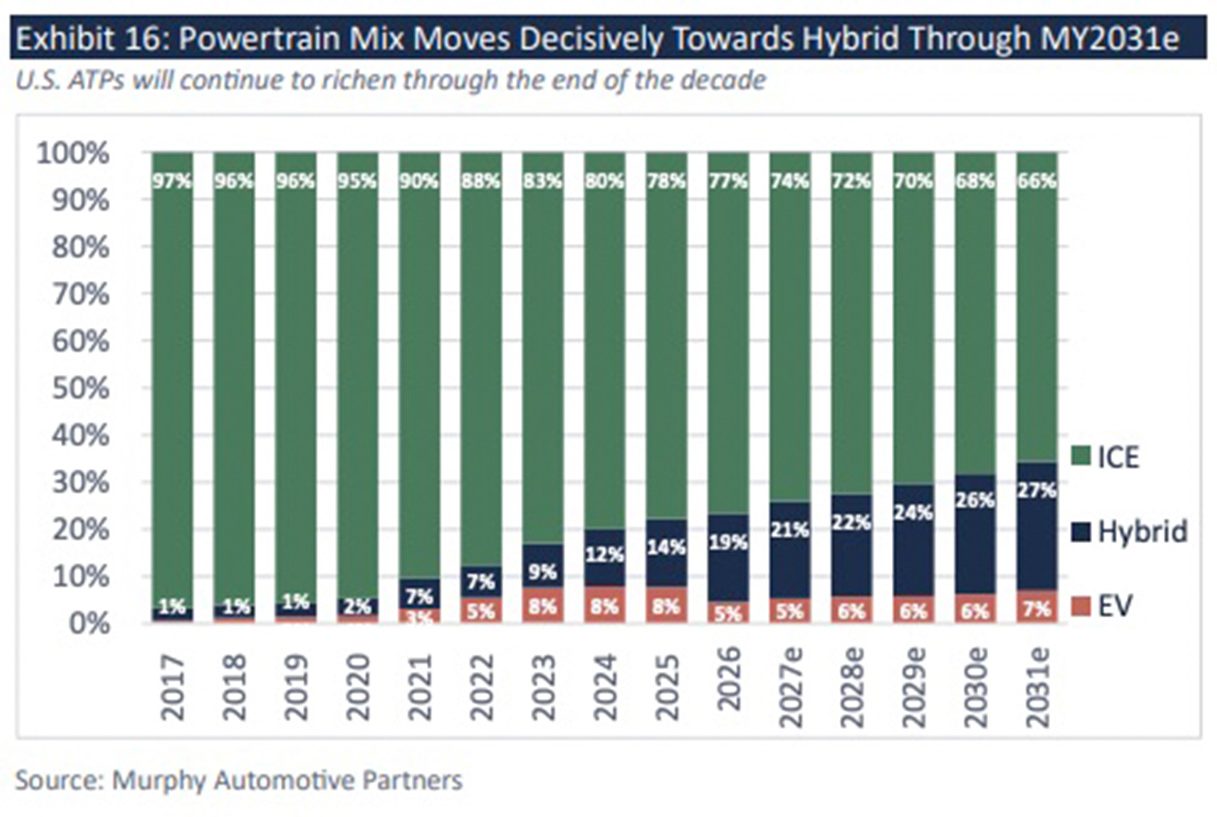
Via the new report from Murphy Automotive Partners, this simple chart pretty much knocked me off my chair when I saw it. Not because I think Murphy and his associates are wrong. They probably are not. It’s just such a bold repudiation of the last few years of hype that it feels almost dangerous to say it out loud.
Through MY2027–31e we expect the ICE powertrain to lose share to Hybrids as they represent a steadily larger share of
launches. Conversely, pure EVs are likely to make little headway with only a partial recovery from MY2026 lows, but still below peak 8% penetration. This is far lower than the industry expected even up until recently, and the inflection many investors underwrote has been pushed well beyond this study’s window, especially for mass market. We would go
further, hybrids are not a transition to pure EVs, but where the industry will find the right practical solution for
consumers, justifiable economics, and potentially for the environment.
This is absolutely wild stuff. What the MAPP is arguing is that we’re not experiencing a little stumble this year due to a change of politics and policy, but a long-term and durable abandoning of full electrification that sees the move towards hybrids as inevitable and the EV market as something of a consistent but flat alternative. In this view, electric cars aren’t gathering many new converts but, instead, recycling a lot of the same customers.
I’d like to point out that even two years ago, groups like S&P Global Mobility were treating electrification as an inevitability in their forecasts of powertrain mix:
As we edge closer to 2030, hybrid electric vehicle and BEV powertrain are likely to steer the future of automotive industry trends in North America. Despite more rapid electrification in other regions, North America’s production trails slightly, at just between 9% and 10% for BEVs and fuel cell vehicles. However, projections suggest a significant leap, with 44% of vehicles forecasted to be BEVs or fuel cell car models by the decade’s end.
It was this kind of analysis that felt wrong to me, and led me to first declare in 2023 that 2024 was going to be the “Year of the Hybrid” and then, last year, to declare this the “Decade of the Hybrid.” There simply weren’t enough customers and, unlike in China and Norway, the overall governmental and societal push ran out of steam too early. While politics is a part of this, I do think that the economics and buyer interest are the far bigger reasons, or as Murphy’s report says:
Pure electric vehicle programs have been deferred, re-scoped, or canceled, while hybrids have moved from hedge to headline. The economics are the key driver. Hybrids carry relative pricing power and healthy variable margins, while most pure EVs still lose money at the unit level. Crucially, those advantages look more structural than transitional. Furthermore, the practical use case for most Americans leans heavily towards traditional hybrids.
I cannot fault that logic, which is why so many brands that were recently invested in EV programs have either walked them back or, for the American market at least, entirely abandoned them. It’s possible that environmental concerns, political shifts, and higher gas prices might help full BEVs rise a little faster than forecast, but there simply aren’t going to be enough cars or customers.
On one hand, this does kind of suck. I love hybrids, and bought one, but there are plenty of consumers who would probably do well with an EV if there were more affordable options. The hype cycle caused automakers to overpromise, over-invest and under-deliver in terms of performance and pricing. Not that many automakers ended up making a better, more affordable EV than a Model 3, and by the time they did, they realized there just weren’t that many customers, even with $7,500 on the hood. For American competitiveness in the global market, where Chinese EVs dominate, it ain’t great. I still think that if the industry and those who covered it were more realistic, we could have gotten a future where hybrids and EVs could have grown together, as opposed to one where a single powertrain has to dominate.
Eventually, EVs will catch up, but it’s going to probably be way out in the future.
The other portion of this report, which is subtitled “Survival of the Freshest,” is that the EV “head-fake” caused many brands that weren’t Toyota to be forced to delay the redesign of key models (having expected to replace them with EVs) and now the market is about to become very old:
“The next five years aren’t about who has the most hyped concept, they’re about who actually shows up with the freshest product portfolio after the worst drought in history,” said John Murphy, Founder of Murphy Automotive Partners. “Some of the most familiar names in this industry are closer to the edge than the market realizes. The MAPP is how you see it coming.”
That’s a great sales pitch, and the media preview of the report shows which brands are in trouble, but the only brand named is Toyota (at the top, also the automaker with the most hybrids). There are seven brands in trouble in the United States, and I’ve got some guesses as to which ones those are.
Volkswagen Wants To Cut 100,000 Jobs, Might Not Be Able To

Does anyone know who this guy is? He might be retired by now, but I’d love to talk to him given that he’s sort of the mascot for Volkswagen’s production woes. Here’s another stat, this time from Bloomberg, that should tell you what’s going on in Wolfsburg: Volkswagen employs 628,893 people compared to 383,853 for Toyota. Last year, Toyota sold roughly 11 million cars across its brands globally, compared to just under 9 million for Volkswagen. That’s an extra 250,000 employees to sell fewer than 2 million cars.
The math doesn’t work, and Volkswagen announced a plan to cut 100,000 jobs and four plants. This isn’t really a surprise, given everything, but it’s not great, and VW’s powerful union has something to say about it, especially because of this:
Major strategic decisions at VW need approval from its supervisory board, where labor representatives normally hold half the seats. Currently, they occupy a majority after independent board member Susanne Wiegand didn’t stand for reelection.
According to that Bloomberg report, VW’s labor union is pushing back and can continue to do so. At the same time, VW’s union understands the company needs to survive, so cuts are certainly coming and coming fast.
Oh, Shut Up, Carlos Ghosn

This is a little bit my fault, because last week it was too amusing to not write the headline “Nissan’s Shareholder Meeting Was So Bad That Someone Nominated Fugitive Carlos Ghosn To Run The Company Again.” It’s kinda funny! It’s also not serious, because Ghosn would be a terrible leader of the company.
Unfortunately, saying Ghosn’s name means that a bunch of reporters, including Hans Greimel, were given an excuse to call him, so we have to listen to this nonsense:
“They say bring back what you had before. We want to come back to the golden age of Nissan. It lasted 18 years. It went very well,” Ghosn said. “Common sense speaks. If there is somebody who can fix it, it is somebody with my profile. Obviously, I mean, I’ve done it before.”
I think Ghosn did a good job, but he didn’t do a great job in the end, and a lot of the products he was responsible for were (though we love them) kind of mid. He was smart enough to see the EV wave coming, but absolutely unable to adjust when Tesla showed up and demonstrated the right way to do an electric car. Ghosn had plenty of business sense, but not enough product sense.
At least Ghosn here is reasonable enough to understand that it’s probably not happening, while also insisting he’d be able to save the company.
Texas Might Overtake California As The Biggest Car Market Soon

As a native Texan, I am not surprised that Texas might soon overtake California as the biggest car market. In general, my view is that if California wanted more people, it would invest more in making the state affordable to live in, including making simply having a place to live possible for more people. The alternative plan, as seen in Texas, is a mix of higher density development in historically low-density areas (Austin, Houston, San Antonio, and somewhat Dallas) for more affluent people, and a bunch of crappy, low-quality suburban housing for everyone else. This makes for increasingly fun cities and pretty miserable traffic.
Again, from Automotive News, this has an impact on the car market:
Since 2019, California’s share of U.S. retail light-vehicle sales has been dwindling, to 11.4 percent this year from 12.5 percent, according to JD Power. Texas, meanwhile, has trended in the opposite direction, climbing to 10.8 percent today from 9.3 percent seven years ago. Less than 1 percentage point now separates the states.
Texas already has become the nation’s leader in consumer spending on new vehicles, as Texans favor pricier pickups, JD Power found.
If these trends persist, Texas will become the nation’s new automotive “center of gravity,” said Tyson Jominy, senior vice president of OEM customer success at JD Power and the report’s author.
“California is the place where a lot of new ideas are sort of tried out, whereas Texas is a place where trucks and SUVs win,” Jominy said. “Texas is sort of the prototype of the typical American consumer these days.”
Texas forever.
What I’m Listening To While Writing TMD
Well, this is timely. It’s “A Slow Dance” from post-rock band Explosions in the Sky as featured on the Friday Night Lights movie soundtrack.
The Big Question
Name the seven brands that Murphy thinks might not survive the decade.
Top photo: MAPP/Tesla


When you consider RI (and I’m sure other states as well) just instituted an additional EV registration fee of $200 per year ($100 for PHEV, $50 for hybrid), that certainly doesn’t help the transition to electric.
I’m ambivalent about it for myself. Utility rates here are high enough that the math usually favors an efficient hybrid, but not overwhelmingly so. If one had solar that would obviously change the math, but we don’t (disappointed RI let the plug-in solar bill die this year, hopefully next year). So when I replace my Mazda 3 this year for something that can fit two rear facing car seats, it’ll most like be a (first for me) hybrid.
Wisconsin wants me to pay $2-300 a year to keep my $2500-3000 beater Honda Insight on the road.
Yup.
1/10th the cost of the vehicle every year.
I refuse, so instead I just register the plates on my old civic and swap it around because it’s so stupid.
The rules should be REWARDING people driving lightweight, fuel efficient, older vehicles that reduce the demand for oil, reduce the wear and tear on the road infrastructure, etc.
I have several cars, one of which is an EV. I really can’t see the majority of people who have an EV as a daily driver return to an ICE only vehicle. Once you have the ease of an EV (I’m talking a good EV, not a shitty one), then you realize how uncivilized an ICE car is for a lot of use cases, particularly for city driving and the usual in-town errands of drop off/pick up the kids, runs to home depot, etc. Doing those essentially guilt-free and for pennies versus an ICE vehicle really hammer it home.
I’m an enthusiast too, which is why I have an ICE beast for my weekend and road trip duties. But even I can see that most people in this country that are homeowners would be better suited running an EV if they would just give up their incorrect view that an EV can’t be for them.
I guess what I’m saying is: If EVs are 7-8% market share, I don’t see them going backwards from that. Once more people get a taste of the sweet sweet lack of gas station dependence, then they are gonna stick with it.
You’re spot on. EVs are absolutely better for running errands around town where range anxiety and charging times are not a factor. Great acceleration from a stop, no vibrations and noises, just quiet and relatively competent. I’ve been using an eBike for most local errands that don’t require hauling heavy/large objects, and it’s been a ton of fun and basically free to operate. Whenever I go anywhere further, I take one of my ICE cars.
I see the future as most suburban families having a truck/suv for towing/camping/large family duties, and a smaller but not micro sized EV for everything else. Keeps the miles off the truck as well.
Obviously I’m coming from a privileged position with the ability to have more than one car. But I’d wager most suburban families in the USA have more than one car. I use my EV as my weekday commuter and have about 12 miles each way commute to work. I only charge once a week max, usually once every two weeks. That’s the other thing people don’t really seem to get. You barely need to charge your car even with like 200 miles of range, and it’s so incredibly hassle free to charge at home overnight when you do need to that it’s not an issue to worry about.
From an European perspective having a say, a Tesla Model 3 (sorry couldn’t think of a better example that is available in the US) for running errands and then a F-150 crew cap 4×4 Lariat whatever for the rest sounds ludicrous.
Why?
Most EVs can’t really tow or go long distance.
Most trucks get garbage MPG and suck to drive around town.
As a European, I don’t think you grasp the distances involved in American road trips due to the scale of the country itself.
This is JUST Texas compared the UK
Which why I put at the beginning “from an European perspective”. It’s not wrong or right, just different.
From where I live, if I drive 100 miles up north everyone starts talking funny.
I mean you’re sort of right about EVs being compromised when it comes to towing, but most people I know who tow regularly are doing less than 100 miles round trip with their boat or track car, which pretty much every tow-rated EV can handle easily.
You’re entirely incorrect about “most EVs” being unable to go long distance. That’s just ridiculous and hasn’t been true for some time. Road trips in my Ioniq 5 are no slower than in a petrol car, but they are a lot quieter and more efficient! You couldn’t pay me to go back to road tripping in an ICE vehicle.
Maybe short road trips, but there’s no way your driving 12-15 hours straight in an EV
Well you aren’t driving 12-15 hours straight in an ICE car either as no vehicle has that kind of range.
Plenty of people have done 12-15 hour road trips in EVs, so it’s pretty obvious that you’re not interested in facts and just want to push your weird agenda not based in reality.
No, but when I stop for gas it takes 5 minutes. I’m not pushing an agenda. EVs do not have the range or long distance capability like ICE does. You are delulu, bud.
Keep living in your anti-fact RWNJ fantasy world. We’ll be over here saving a ton of money driving EVs and going on blissfully stress-free (and cheap) road trips.
Dude, there is literally NO WAY for an EV to cover a huge distance in the same amount of time as an ICE vehicle, because of the charging times. I’m not anti EV, I am anti BS, and you sir are full of it right now.
Oh, so you changed your argument from “EVs do not have the range or long distance capability like ICE does” to “…in the same amount of time as an ICE vehicle.”
Always a hallmark of a well-structured argument when you need to move the goalposts halfway through.
Also, I have spent 0 minutes waiting for my Ioniq 5 to charge when on road trips.
Ok bud.
> Most EVs can’t really… go long distance.
Uh, Tesla’s can, which is one reason they’ve bounced back after Elon’s brand destruction. I’ve driven my Model 3 Boston <-> Key West FL, Boston <-> Wisconsin, Boston <-> Texas, and Boston->San Francisco. It’s an awesome road trip car — quiet, comfortable, roomy, and illegally fast. The time spent at Superchargers is about the time we would spend on breaks anyway. Here’s a tip — get takeout, and eat it at the charger. On my first trip I planned around Hotels with L2 charging, but now I don’t even bother — just hop in the car and go.
I’ve taken our Kona on a 500+ mile trip. No problems.
I also towed a utility trailer carrying a small block Chevy and four speed Muncie transmission through the Appalachian mountains in 25F weather to a destination ~125 miles away. Two adults and a dog on board.
I’ve towed a forklift on a trailer obviously across town with a Ford F-150 Lightning, several trips towing ~25 ft cargo trailers with the same truck. Towed a box trailer with a sports car inside ~100 miles. No problems.
Would this be my first choice for towing a large RV to the mountains ~200 miles away? No. It could do it I’m sure. Not sure I want to stop every 125 miles for a charge.
Talked to a guy at a charger driving a Mach-E towing a trailer with three sportbikes back from NC.
lmao. They literally CANNOT, which is why you’re sitting around at superchargers.
I drive 10-15 hour days to get across the wasteland of the great plains states, and yes, there are chargers, but sorry, it will take wayyyyyyyy longer and it’s already brutally long.
Once they have ACTUAL full self driving so I can take a nap in the back, I’m sold dude
FWIW the fastest way to cover ground in an EV is “Drive fast, Charge fast”. This was the strategy used by the winning teams in the “EV Cannonball” rallys they used to hold in Germany. This means 100++ mph on the Autobahn, drive till you have 5% range remaining, a quick charge up to 60% (so you stay in the fastest charging region), repeat.
Still takes longer than refueling, so still slower.
Not everyone lives in Texas. 300 miles is a long way east of the Mississippi. 300 miles puts me into 4-5 different states here in the south.
Absolutely. I know a few people who had essentially Gen 1 EVs, like the first-gen Bolt or original Ioniq hatchback, who went back to hybrids because those cars were legitimately compromised when it came to road trips.
However, there’s a reason why over 90% of first-time EV buyers report that they won’t go back to ICE. I mean, even if I lost the ability to charge at home, there’s still no way I’d go back to an ICE vehicle.
Getting back into an ICE car literally feels like stepping back into the dark ages.
Yeah, we stopped using my ICE for road trips when my wife got her Ioniq 6 three years ago. It’s quieter, smoother, and more reliable. It’s not perfect, it parks like a barge and has half as much cargo capacity as my Impreza, but we only wondered once if we should take the Subie instead, and that was because there was a chance of snow in the mountains and hers is a RWD. We took the Ioniq instead though.
My partner has an Ioniq 6. I actually like the driving dynamics better than my Ioniq 5, but the shallow trunk apeature and Gen5W software steered me toward the Ioniq 5.
However I’m glad to hear you and your wife like the Ioniq 6! It’s a super cool car and I’m very sad the facelifted one isn’t coming to the US.
I think the group of people that hate EV’s just because they are EV’s is way smaller than internet Commenters think.
I’m pretty sure the number 1 reason is cost, followed by lack of choices in the form factor they want, (minivan EV?, wagon, small truck), lack of home charging, hatred of techy stuff… Probably more I’m not thinking of.
I don’t hate them at all.
But the reality is the primary weakness of EVs is range anxiety and charging times during longer trips. They are superior than ICE vehicles in lots of ways, but not every single possible way. There are pros and cons to everything.
The reason i think this projection will be a bit off is because of full self driving. Others are coming, but as far as I know, the best one available is tied to electric cars. I think FSD adaptation will rise as people realize how good it’s gotten, and that will in turn make electric car adaptation rise.
I’m hoping for a free trial of FSD V14 Lite in HW3 cars since they are starting to roll it out. The previous trials of V12 were horrendous and I needed to intervene frequently. All the the V14 videos on HW4 cars looked very encouraging.
Just rent it for $100 for a month when you have a trip. It’s gotten very good. I don’t agree with all of it’s decisions, and that’s when I intervene. For example, I don’t want to drive behind a gravel truck
I just want FSD to be geofenced to freeways, and if certain conditions are met (good weather, etc).
Being able to crawl into the back of my van and go to sleep/play games/hang out for 10 hours while my vehicle navigated the absolutely brutal mind numbingly boring drive across Nebraska would be WONDERFUL.
But “self driving” where I have to stay in the driver’s seat, have to pay attention, and have to keep my hands on the wheel? Yeah, that’s gonna be a ‘not worth it at all’ from me, dawg.
I don’t know why companies don’t do this. City driving, inclement weather, and other factors make FSD such a hard goal to achieve, but INTERSTATE travel, where everything is super safe, clearly marked, and relatively straight? Cmon… just give us COMPLETELY autonomous driving for these areas, the cars already have GPS so they know where they are.
You don’t have to keep your hands on the wheel. Just be there just in case. And wear sunglasses so it can’t tell if you’re paying attention
Looking at you Ford! (last week in a borrowed Lightning.)
It didn’t like my normal glasses!
To be perfectly honest, I lean more towards self driving being a net negative as it is, but once it hits the point where I can drive my car to a bar, get hammered, and legally have it drive me back home safely it’ll then easily be worth spending close to 10K for.
Wisconsin?
No, but close 🙂
I just wanted an over the top example, but when we reach that level cars have made a huge step in usefulness. For example, every morning that Otto misses his bus, instead of Torch giving us the same old excuse as to why the cold start is delayed again, he just has the car deliver him to school and is forced to come up with a new, unique, and creative excuse every time.
We’re at the point where you can drive it to a bar, get hammered, and have it illegally drive you home, but you’re chances of being pulled over for looking like a drunk driver are much less
I realize that FSD is pretty amazing most of the time, but I think you and other FSD users really underestimate how much of the general public doesn’t even want self-driving capabilities. I mean, I still know a lot of people who don’t even like using adaptive cruise control, let alone stuff like lane-keep assist. I’ve had people get super nervous in my Comma-equipped Ioniq when I let it drive itself on highways.
I’m not saying that trepidation is warranted, but just like a lot of people have entirely spurious reasons for not buying EVs, a lot of people really truly don’t care about the ADAS stuff. Adaptive cruise has been around for decades and still sees fairly limited use.
I just think adoption of self-driving technologies is really going to lag behind EV adoption.
Infiniti, Acura, Mitsubishi, Maserati, Alfa Romeo, Buick, Chrysler
Ironically, I suspect that the best president for getting the US to go to EVs will end up being Trump and not Biden.
Biden tried the carrot of incentives to get Americans into trying EVs. It worked until Trump turned off the incentives.
Trump has gone for the Stick approach. “You say you are ok with having a gasoline powered car? Well, what if you don’t have gasoline!”
You can see a major spike in Hybrid demand since Trump started bombing the Middle East and it shows no sign of slowing down. I don’t think 2026 will show this impact, because many of the early year 2026 buyers had snatched up an EV late in 2025 before the incentives went away. However, I see demand going up quickly now as gasoline prices and availability are still concerning.
I see it as a matter of time before cheap new EVs start flooding the US market as well. Perhaps by a domestic supplier like Slate, Ford and GM or perhaps because you can’t keep Chinese companies out forever.
Once EVs become cheap enough to be secondary vehicles, you will see more and more people get them as a commuter and then, perhaps realize that they can do what they want/need without gasoline.
I don’t think the Strait of Hormuz situation will cause us to run out of fuel. What it will do is cause prices to shoot up once the oil futures market realizes the ample supply it’s been expecting isn’t physically there. At worst, we may have brief localized shortages once the crude oil reserves in the SPR and Cushing, OK run low. I’ve seen estimates ranging from mid-July to late-October for when that happens.
I’ve been watching the delivery estimates for the base color, no options Tesla Model Y trims since this all started late February. I’ve been using that as a rough gauge for how gas prices have impacted EV sales. The estimated delivery windows have gone from 1-3 weeks to 4-8 weeks. We also went from ample numbers of new Model Ys in inventory to zero. Sadly, it looks like Elon’s backing of Trump is paying off for him.
Wait wait wait, you’re telling me that at some point these futures will actually back track to some actual reality of a limited supply?!?!?
Impossible! /s
I have been tracking Bolt Prices. They went from $12k to $16k for the same car in the last couple months. If we had a 1974/1979 restriction on fuel at the pump, I would likely look at the 2nd gen Leaf prices that haven’t gone up (check). CRAP
Inventory and delivery times for Ioniq 5s has gone through something similar. There are literally none on the lots and delivery dates keep getting pushed back. Demand has gone through the roof.
I got a pretty amazing deal on my used electric Kona that I picked up about 2 months ago, and the only reason why I was lucky enough to score it was because I could drop everything and drive to the seller immediately. He literally had to take down the listing because it was somewhat under market value and he was bombarded with people wanting to buy it within minutes of posting the ad.
I’ve also been trying to find a used Bolt for my brother-in-law, and they’re just flying off the lots.
“started bombing the Middle East to distract from the Epstein Files”
FTFY
In 5 years when everyone loves EVs, Trump will claim he only bombed Iran to get people to try a Tesla. Heck, he might be saying that now, if it hadn’t been for those darn kids letting their talking dog pee in his pool.
EVs are cheap enough as low mileage used cars. Mine was almost 50% off MSRP. Cheaper than even the Mitsubishi Mirage new. Friend went with a Mirage. Guess who has regrets? They are a big EV skeptic. Maybe my happy EV miles will help them understand.
EVs are no getting cheaper used, they are going up in price. Something like the Slate or Bolt that is cheap new, MIGHT hit a nerve.
Me personally, if I had to shop for a car today, a 2020 Leaf SL Plus with 66k miles for under $15k sounds like as good a place to start shopping locally as anything else.
I have alot of good experiences with exactly that Leaf. When I went EV shopping I was looking for a Leaf Plus with low miles. I knew that L2 charging at home was where the Leaf shined and that was my anticipated use case – as a second car mostly used locally.
Then our Kona presented itself several states away – and I took a chance.
Then my parent came down sick and I traveled across the state alot using the Kona.
At the same time junior started university and we traveled some for that too.
And then over the past year or so my wife has come down sick and we traveled quite a bit to the big university hospital where she could get the best care. .
At my parents’ house I could L2 charge. Any other trip and we needed at least a partial DCFC in all weather to return home.
I think those trips would have been pretty hard on an aircooled Leaf battery.
The Kona has been rock solid. It has 76K miles and the battery sits at 97% SOH.
I think the 2nd gen Leaf has a liquid cooled battery, but doesn’t have a big range and uses an outdated DCFC connector.
The 2026 Leaf has a watercooled battery. All the previous versions were aircooled. I was looking at older cars so – 2021 or thereabouts.
The new Leaf is a nice car that I would seriously consider buying. Also the Airya.
You are right, which takes the 2nd Gen Leaf off the shopping list for me. This means the cheapest EV available within 100 miles of me (that hasn’t been wrecked) is a Bolt with 61k miles for $17k. At this price range, given the slow charging, I would be tempted to look at Model 3s that are pushing 100k miles for basically the same money.
However, if I was going to spend $17k for a car that used a lot less gas than my current one, I can get a Prius or a Camry Hybrid for $17k with similar miles as a Model 3 and I don’t have to figure out EVs or having to get a big enough paperbag for my giant head when going into certain areas.
$20-25k opens a giant list of interesting options in the EV world. It also runs into Hertz selling off a batch of 2025 Camrys with 50k miles on them.
Per the war with Iran, I think all those prices were about $5k lower on the EV world.
You’re definitely thinking it through and through.
Better than “I chose this one b/c it is cool” or “I liked the color”.
What kind of engine does it have? “uh….”
Yeah, that is the CHADEMO charge connector. It’s definitely fading away. There is an adapter for CHADEMO to CCS though. Kind of expensive last I checked.
The Leaf Plus has about 220 miles of range. That would have done the job for us but would have required more short charging sessions to get home again. Hot summer afternoons and “rapidgate” might not be fun.
Any other EV would cool the battery and be better on those trips.
So, a second use case for me for an EV is if I can do V2H (Vehicle to home). I actually have a better use case for V2H for my secondary vehicle than long trips, since I lose power more than I use my secondary vehicle for longer trips (that’s what the primary vehicle is for).
If you look up V2H, the CHADEMO Leafs are listed, which is exciting. Until you read the rest of the story. They are designed to do that in Japan and they don’t work on US house power. Well, unless you follow internet instructions and don’t mind having 6 broken down Leafs and county wide Bug Zapper behind your carport (You know it’s working by the blue flashes and the ozone smell).
I think in a couple years, there will be an ISO standard V2H system where you can get a V2H setup from Circle D or the like that will use nearly any brand car as a battery backup for your house. But right, now, the V2H systems are brand specific (e.g. Telsa only works with Telsa, Ford only works with Ford, GM only works with…)
Outside of the Leaf/Bug Zapper, all the cars that are V2H compatible are pretty new and pretty darn expensive… today.
You’re suggesting the Bidenistas should actually try to get people to vote for them.
They have made it clear that’s never going to happen.
As a 1-year EV owner that’s definitely become a bit of an EV stan, my initial inclination is to look at this skeptically, but I think there’s some truth to the “durable” nature of hybrids, and they’ll definitely be here for a while (with many drivers probably having no clue they own a HEV).
But I still see an inevitable creep toward EVs. I think more smaller and lower cost EVs will hit the market, and with gas prices making people a little more cost senstivite about vehicle running costs I think you’ll see more people shift to EVs. A small percentage may end up hating it (apartment dwellers without a place to plug in at night) but most owners tend to never look back. The depreciation is still a deterrent for new vehicle purchases, but confidence in powertrain reliability and pack longevity should increase as hopefully most older EVs age gracefully (Nissan Leafs and i3s notwithstanding). But who knows, a lot of consumers may just assume the political pushback means that EVs just “don’t work” and never consider them.
Anyway, jury’s still out on how bad depreciaion will hit me, though my vehicle sold so poorly that I paid almost 20% below MSRP anyway, so hopefully that accounts for some of the hit. In the meantime, I’ve enjoyed driving the thing about 14k miles this year for a little over $400 in “fuel” costs.
Maybe the continued inflation on everything else including gas will eventually lead people to more rational choices i.e. an efficient EV rather than another 20 mpg ICE.
If inflation didn’t do that in 2022-2024 when it was way higher it won’t do it now. Lower price point EV’s are coming soon, that will make a difference.
I don’t know. The past year or two here has a been a slow climb of groceries, parking, entertainment, restaurants, carry out food, etc.
Electric cars aren’t even trying to be efficient.
If they were, they would have transmissions same as the more efficient battery bikes.
EVs: This report is very US-centric, and shows that one country is moving backwards while the ROW is moving forward.
And you can’t sell product lines that you cancel due to short-term regulatory conditions.
Meanwhile, the Chinese car market is 3.4X larger than the US market, and the EU car market is still 25% larger than the US market.
So – Whatever.
California vs Texas: There’s a meme going around which has Don Draper and a Marketing Minion in the elevator. The Minion says “I’m worried about you”, while Don responds, “I don’t think of you at all”.
Don is the 4th largest economy on the planet – which is California.
Texas is #8 on a global scale – which is pretty good for a state which prides itself on subjugating women to 2nd class citizenhood.
So – Whatever.
The EU car market is larger than US? I didn’t know that.
Yes, the EU has about 50 million more people than the US, and remember that doesn’t include the UK anymore, where EV adoption is also growing steadily.
Yes.
US sales are a bit over 10MM units annually.
EU sales were down to over 13MM units last year.
While California insists on repressing everyone’s human rights.
Best not to draw attention to cali’s record.
Doesn’t excuse the flaws in texas, but does explain refugees emigrating from California.
“California insists on repressing everyone’s human rights.”
Example please?
They take away your fruit when you cross the border, it’s barbaric!
I mean, Fruit Flies and Viruses have rights too.
It’s a conspiracy by big fruit so you have to buy new fruit when you get to California.
Moral superiority is a palpable stench in these comments…
Condolences for your suffering from a thin skin.
EV’s have gone from big carrot and some stick to no carrot and mostly stick. The incentives for purchase/lease are mostly gone that made leases really attractive. The massive depreciation is still there. The high gas prices that briefly increased used EV values are lowering again. Most states are penalizing ownership with high registration costs.
Even with all this, I think a used, 2-3 year old, EV is a great buy and darn near perfect for most people who own a home where they can install a charger and use it primarily for commuting, and have another car in the household for longer trip duties. We have an EV and a PHEV, but also 4 other ICE cars in a 4 driver household. The electrified cars get a lot of use and are great for quick trips and errands in addition to their daily commuting duties.
I hope that a lot of those pro-Big Oil and punitive EV taxes get struck down. Gas cars don’t pay their share either. Either make gas cars pay more or EV’s pay the same as the average gas car pays in fuel taxes.
When we got our first EV a few years ago, our thought was it’d be fine as our 2nd car. A Bolt EUV and we’d continue to use our gas cars as our primary vehicle.
I think it was when we drove the Bolt for about a week, and when we drove past our usual gas station that’s when we had our epiphany… we ‘got it’. Our EV very quickly became our go-to primary vehicle for anything in town or that didn’t need AWD or haul/towing.
Pretty sure that for most that get an EV as a supplemental vehicle, like us, it will quickly become their first choice.
Same-same-same with a Kona. ICE on reserve. prob drive the ICE less than 1500 miles per year now. Oh well, it is garaged. Ought to last forever.
Whoof.
Hopefully there’s room for Slate and Telo in that tiny slice.
Some Rivian too!
I worry that Rivian and Lucid will fall to this reality.
I would say Lucid would be first. Rivians are very common here in southern New England. Rivian just needs to keep its costs down, and it may survive.
Lucid meh, sorry. But I forgot the Scout! It should live, especially as an EREV
Don’t forget Alpha and Dacora
I suspect Slate will get its own slice of the pie. There’s a slice of the pie called “cheap cars”. It’s not a huge slice, perhaps smaller than EVs. It’s for the cheapskates that just want/need a new vehicle and don’t care if it is anything special, as long as the price is right.
The Slate’s price puts it as #8 in the cheapest cars available in the US list. The lower operating cost with no gas and oil makes it a very interesting vehicle for cheapskates.
The complete lack of features in the Slate might be a disadvantage in this market, but I don’t think as much as you think, because if you want cool features, you are more likely to shop for a nice used car than a cheap new one. The Slate’s bed opens up possibilities to some potential buyers that doesn’t exist with other cars in that price range.
How big is the “cheapskate that could use a small truck and doesn’t care how it is powered?” market?
20-30 years ago, it was large. Now, it’s completely abandoned and it’s hard to tell.
A cheap car can be the luxury alternative to a battery bike, adding relatively better weather and crash protection, in addition to comparative theft resistance.
The issue is that today’s cheap cars get meh gas mileage. Take an Elantra. I can get one for $25k ish. It gets 35 mpg. Other cars in this price range are in the same fuel economy zone.
I can get a 3 year old Ioniq 6 with 23k miles for $27k.Is this an exceptional car? No. Is it better than an Elantra? Yes. Will I save $2k in gas quickly with this? Yes. And that’s sticking at the Hyundai dealership. I can get a Bolt EUV for cheaper, or if I can live with the range, a 2nd gen Leaf with 66k miles for only $15k
Since I can charge an EV, if all I need is cheap transportation, a used EV thumps the cost calculation of a new cheap ICE car.
And, of course, the Slate changes the math by being an EV. How big is the pie slice of “able to charge an EV but not willing to pay a lot for a vehicle?” No idea, but if it exists, Slate is going to find it.
Yes, but as I am discovering, some people MUST have a new vehicle. They are not confident about buying used vehicles or simply won’t for some reason. The Slate type vehicles might be for them.
When we bought our Kona (barely) used, friend bought Mitsu Mirage b/c having a new car was important to them (warranty, etc).
Guess who wanted to replace their vehicle within a year of their purchase? It wasn’t that the car was bad but friend roadtripped the car several times. A road tripper it is not. It is a commuter with NHV drawbacks. 😉
Sometimes people miss a step in a logical analysis.
I know people that trade in cars just before they get to 100k miles regardless of condition.
If you get a brand new car vs a used car with 50k miles, it means you have 50k more miles or maybe 3 more years of driving that car before for you sell it.
If you couldn’t wait to get out of the POS during a 10 mile test drive, is it actually a good thing to plan on getting 50k miles out of it before you are forced to sell it?
The big question to me is how the Slate drives. Other than David Tracy, all I’ve read are people that took a whip around the block ride in the passenger seat and the reviews are not really glowing, only “well the doors shut with a thunk and it seems to have good low end punch” and, of course “roll up windows?”
(As for David Tracy, the newest car he has is a new WW2 era Jeep, so I’m no certain he is the best judge of what a typical American driver looks for).
If Joe Average agrees with D.T.s test drive, the lack of power windows and fancy stuff will be trumped by being cheap and nice to drive. If Joe Average really wanted a better equipped vehicle, they will regret getting new instead of used and the Slate won’t sell well for long.
Shoot, I’ve been saying this for years. Everyone bet big on EV’s and had they been right they would have been sitting pretty…but it was too much too soon and the world wasn’t ready. I mean specifically the infrastructure, culture, market, and technology hadn’t reached parity with the conventional incumbent. It has to be able to replace what is working now at at least 1:1 for mass market adoption and EV’s just can’t yet. While I grant that accelerating that timeline with the momentum they were building was noble, it wasn’t realistic.
In the US* needs to be added to that. China is eating everyone for lunch and laughing.
Yes, specifically the USDM. That being said, while EV market share is crazy high there, it still worth nothing that the fleet is still only 12% EV. Thats still way higher than here, but its definitely partly looking at who’s buying new cars and who isn’t. There is a new highly upwardly mobile middle class in China right now buying new. Its a very different market than the USDM.
Very true. They’re a great comparison tool, but the sales figures mean nothing without the other info.
The world =/= the US.
I’m sick of Texas.
As long as you don’t mess with it, you’re fine. They’re fine.
Nah, give them to Mexico.
Here’s a Texas song
duck://player/fBe5Dx6kSJg
Alternate link
https://youtu.be/fBe5Dx6kSJg?si=76qO78jIaAm3MLUL
The EV projections make me sad because it represents much more than just sales figures. The US was already drifting behind the world, this highlights it and underlines that fact. I love ICE cars, they provide more of a soul than EVs. There’s a mechanical spirit in them. EVs are just better in every way apart from a road trip. Driving 20-25k a year in an EV is life changing. Unfortunately the infrastructure and the willingness of the consumer to try something new seems is not there yet. I would pick a hybrid if I lived in an apartment, or somewhere I couldn’t charge at home.
That being said. My DD will never be ICE again. Even a Camry Hybrid for fuel and maintenance looks expensive after doing the maintenance and fuel calculations. Once I upgrade to an EV with 350-400mi of range there won’t be an issue. Unless I move into an apartment or condo haha. If only there was like a sponsorship, or incentive to offset the costs of installing apartment chargers and maybe the government provides them. What a world that would be right?
“government provides” = taxpayers provide = Texan taxpayers (and even non-taxpaying spenders) provide via taxes or inflationary loss. See comment above yours about messing with it.
Partially in jest, but also worth actual consideration. Enough of the US still remembers where “public” funding actually comes from that when a hot-button issue like this becomes not just a policy discussion but also a funding debate, things get stuck quickly.
Yeah. The worst thing about EVs was the politicization of it. I understand being annoyed at taxation especially when politicized, but we live in a time where even electricity supply is a political issue. Look at the coal plants being forced to stay open and the billion dollar payouts for the cancellations of the offshore wind farms. That and the inability to upskill the former plant workers to get better jobs.
This is a good take. Out of curiosity, what EV do you daily drive? My main EV charges super fast (Ioniq 5), so road trips take essentially the same amount of time as in an ICE car. I’m guessing whatever you drive charges more slowly.
I did two small road trips in my electric Kona, which has an atrocious DCFC curve, and only then was I like “ohhhh this is why some people don’t want to road trip in an EV” lol.
Kona shines when it only needs a partial charge to return home. 10-15 mins and back on the road.
Would not be my first choice Cannonball Runs for coast to coast travel.
Well, on the one road trip I did only needed to add about 30%, and OMG it took so long! I think about 20 minutes? My Ioniq 5 would have charged to almost 100% if I arrived with 50% SOC and let it charge for 20 minutes!
Don’t get me wrong though – I LOVE my electric Kona! Mine is a 2024, so it has ccNC software, just like my Ioniq 5. It’s also much easier to maneuver and park, and the HVAC controls are easier to use. I also like the regular door handles. Not as cool as the pop-out ones in the I5, but easier to use.
If I had to choose between road tripping in the Kona or an ICE vehicle though, I’d still chose the Kona 100% of the time. I’d rather the trip take a bit longer but be done in an EV. Sometimes saving a bit of time isn’t worth it compared to the trade offs in other areas.
I love (LOVE) the quiet, vibration free driveline of a EV. That’s especially nice in a small commuter car like the Kona which otherwise might lack a smooth quiet engine in the gas versions as equipped from the factory.
I’m used to the ~20 to 30 minute charges. I know there are faster EVs but this car suits our needs and wants just fine.
Yes, the Kona is very quiet in EV form – actually not far off the Ioniq 5. I imagine NVH is much higher in ICE/hybrid form. Honestly the electric Kona is shockingly nice and refined. It’s surprising how much an electric powertrain can improve an otherwise mundane economy SUV.
EXACTLY! I’ve owned alot of small engined economy cars. Always good cars, always reliable and durable. Also always a little higher on the NVH than I prefer.
Working up to a solid 7% of US sales by 2031 sounds fantastic to me. Yeah, it isn’t like every car is going to be an EV like some places are. But that’s a LOT of EVs!
Even where they’re at now, I got sandwiched between 4 other EVs today on the highway. In my state they’re everywhere. It’s kinda surreal to travel to another state and see almost none.
Yeah, the EV adoption rate is wildly different depending on where you are. Where I live in PA, they’re quite rare, and most other EVs are Teslas. When I head toward NY or NJ, they start getting much more common.
Where in PA are you? Plenty of EVs on the road in Pittsburgh.
Near Scranton. We did notice way more EVs in Pittsburgh when we visited, and the same is true in Philadelphia.
I can drive down a highway for 5 minutes, see an Acura ZDX, 3 Nissan Aryias, 20 teslas and a Spark EV… a neighbor of mine has a Kia Soul EV haha.
I have your neighbor’s twin – the Kona EV! Electric Konas and Niros are very rare! I really love my Kona. It’s outclassed in many ways compared to my Ioniq 5, but still a really excellent car, especially for day-to-day commuting.
I see an electric Niro and Kona fairly frequently which is pretty cool. I still see the Tesla Toyota Rav4s too. This morning on my drive I was on the highway in a line with a R1S, 2 Tesla MYs, a Mach E and me in a Mach E.
That’s the first I heard of the Rav4s with a Tesla power train! Very interesting!
That would be a pretty old EV by now wouldn’t it? That’s great!
I’ve been meaning to ask this for several months, and finally remembered… Does anybody know what’s going on with Amazon and their Rivian delivery vans? 6 months ago they were about 95% of the delivery fleet with the remainder being rental vans. Now they seem to be about 1%. Instead of seeing about 10 per day delivering on my street, now it’s roughly once every week or two. This is in urban Chicago so not representative of the country as a whole.
The Amazon delivery van fleet in the Richmond VA area appear to be almost 100% Rivian.
Maybe some of them moved to my area? I started seeing the Rivian delivery vans about two months ago. At first it was a rare sighting, now I see one anytime I drive more than 20 miles.
It’s been pretty much exclusively Rivian vans since 2021 around here, and then they all just seemed to disappear at once. Everything replacing it has been a run down rental van so maybe they simply ran out of vehicles or I’m within 10 miles of 3 of their biggest distribution centers so more efficient to deploy them other places that cover more miles?
Wow that’s weird! Maybe there’s some major fleet-wide maintenance going on? I haven’t seen a non-Rivian Amazon delivery van in probably over a year.
How many brand does Stellantis have right now? Surely they could lose 7 and still be in the double digits?
The MAPP analysis is for US only. The rest of the world is moving quickly to EVs. There are two big issues for US EV adoption: (1) big road trip range and (2) availability of smaller, cheaper EVs.
On the first issue, your old friend Patrick George said it best a couple of months ago: you need to have 300 mile/500 km range. Anything else doesn’t cut it. When I bought my Equinox EV in early April, the dealer told me that had yet to sell a single new Bolt. Not surprised, as the price difference (here in Canada) between the two was almost negligible and the Equinox EV range is better. The Germans have realised this, and almost every EV model’s new replacement has over 400 miles of range.
On the second issue, everyone selling in the US market went for the more profitable higher-end market, following Tesla’s lead. The small car and truck market were ignored, except for some low-range, obsolete technology models like the Fiat 500e and the electric Minis. Big pick-up trucks didn’t make sense for mass market because of the perceived need for long range and towing. The small EV car and truck markets are exploding everywhere else in the world, led by the Chinese and increasingly the European offerings.
One more potential EV incentive for the US: all the women in my family *hate* gassing up, and they are jealous of my Equinox. “You never have to gas up, so you should take my car to the gas station to fill it for me”. Now imagine if Cadillac developed or licensed a contactless charging system like the Porsche inductive charging pad. “Honey, you won’t ever need to gas up or charge again. Just drive it into the garage.” They won’t be able to keep up with demand.
Definitely here (Europe) the trend is irreversible. Even without the ICE ban we are moving towards that goal fast. Not all countries are Norway (incidentally I am there now in a business trip), but even with the infrastructure hurdles it just makes sense.
Another question is whether this is truly green in the end. I heard recently that in my region (Catalunya) renewable energies only account for 3% of the total mix. So you might not be using dead dinosaurs, but you are still polluting…
Charging EV’s is greener than directly burning the fossil fuel in ICE vehicles. Doing a well to wheel analysis makes that easier to see. It’s easier to control emissions at a large central point than dispersed vehicles. Thermal power plants don’t cycle as much as individual vehicles. So scrubbers work better. Plus the electrical grid is greening up. Installing solar plus storage is cheaper than operating a lot of fossil plants.
Don’t get me wrong, I’m all for BEV, but the push has to come from all directions, not just the end result that is the car.
One thing I’ve read that makes EVs still desirable even somewhere like where you mention with low renewable usage, is over time power plants can be made more green or replaced/augmented with renewable energy sources making even older EVs more green over their life span. The same cannot be said for ICE vehicles.
about the electricity mix, here’s some nice stats: https://www.google.com/url?sa=t&source=web&rct=j&opi=89978449&url=https://app.electricitymaps.com/map/live/fifteen_minutes&ved=2ahUKEwim_bf196yVAxVa5AIHHeSBAMwQFnoECBIQAQ&usg=AOvVaw1iROC-jGl82erbla8Qyug0
Great link, thank for sharing!
We are bit yellow currently…
And in some states you can CHOOSE green energy. Where I live our power company allows us to pay a little extra to support green energy.
https://energyright.com/business-industry/energy-programs/business-and-industry-renewables/green-switch/
And wife and I think this is important enough that we have for many years now.
That is great!
Limoncello, thanks for the chart. Would be even better if it could show the change over time, because the speed of the move to renewables, particularly when you pair solar and grid batteries, is staggering.
As an example, California has great data here https://www.caiso.com/todays-outlook/supply
Compare a recent weekday to an equivalent weekday from 3 years ago and you will be shocked at the increase in renewables and battery storage and the decrease in evening gas as the batteries discharge.
Imagine what this change will do in places like Africa. Local village can have its own power, can power a cheap Chinese EV, and these brilliant, fix-anything local mechanics will now get into electricity and electronic controls.
We have two EVs…not going back…ever. Our ICE vehicle is simply a hobby.
Once you experience the instant torque and crazy acceleration offered by EV, there is no going back.
The real test is when we travel and get an ICE rental…you actually experience the hassle of low torque and poor acceleration. The lack of instant twist was actually harrowing…not to mention how you used to accept poorly maintained and frankly creepy gas stations.
No visits to gas stations and no oil changes. Garage no longer smells like an old gas station service bay.
Current feeling is that “range anxiety” is a social media campaign run by big oil and traditional car dealers. Range anxiety quickly dissipated as we learned a different approach to fueling and trip planning.
The real fun comes when you toss the key to the Hotel valet and they ask if you want it put on the charger…most hotels don’t charge for this…those that do charge it is minimal $20 overnight to top off…good luck finding a tank of gas for $20!
I am happy to swap an additional $40 added to our monthly electric bill in place of $5.00 gallon gas.
So much this. I have an ICE Seadoo that is seemingly determined to remind me of why I dislike small IC engines. And all the things they need to be viable. I have one EV and one ICE vehicle. That ICE vehicle will get replaced with an EV once we’re done with it.
They say that once you go EV, you never go back.And I kinda thought I wouldn’t, either.
Then I kinda did. I grounded the lease on my 2024 HI5 this past weekend. Residual was higher than what new ones go for, and without the tax breaks (we had a pretty stout one in Colorado that now has an MSRP gate so most of it wouldn’t apply to a new one), a new lease costs approximately double what I was paying.
The timing was just terrible. A few months ago, Carmax and Carvana (which I’ve used as a proxy for actual prices because they’re easy to find data) were selling two-year-old 20,000 mile HI5s for $25,000. Now they’re over $30,000. I’m not spending an extra $5k+ because people are nuts.
Maybe as gasoline prices drop and everyone realizes this isn’t going to be like the 1970s, those prices will settle back out. Add in some glut from more lease returns, and there’s a decent chance I’ll buy another EV– but for the time being, there’s a ’95 Miata parked in the same spot of the office lot that used to have a 2024 HI5. I may not be buying a new ICE to replace my leased EV, but I’m also not getting another EV quite yet.
Assume this is a Hyundai I5?
FYI…2023 Model 3s Long Range are going for like $20-24k around here.
While I am not enamored with lord Musk…I am able to separate the art from the artist.
Sweet Miata. Definitely apples and oranges with the I5.
Ah, yes, an Ioniq 5.
I did consider a Model 3 — I don’t even need a Long Range variety, though it appears everyone else did — but no amount of separating art from the artist will make them available with CarPlay.
Leon discovered Lotus engineering for petrol cars. Added batteries.
Man, that sucks. However props on the Miata. If I ever get another ICE car (unlikely), it’ll be a Miata. Shifting my Miatas is the one single thing I miss about driving an ICE car.
YES so much on the “creepy gas stations”! You don’t realize how annoying filling up is until you don’t have to do it anymore, and the whole DCFC experience tends to just be… nicer in most cases too!
The acceleration benefits are wild too. My Kona electric has only 200 hp and 189 ft/lbs of torque. That sounds really modest, but I keep telling people that electric hp are very different from ICE hp. Getting into a “more powerful” ICE car still makes me wonder where all the power went because of the lag! It’s even worse compared to my AWD Ioniq 5.
Destination chargers are freaking awesome too. We specifically seek out hotels with free L2 chargers. We’ve done fairly long road trips that required no DCFC because they were less than 300 miles one-way. Getting to fuel up for free while the car is parked overnight is wild!
That basic Kona will do 0-60 in about 6.5 seconds. Enough to make many of us smile…
Yeah, and that 0-60 time belies its performance. It’s FWD, so traction limited, and therefore it’s a bit sluggish off the line. Once you’re above 20 MPH and all the way up to very fast highway speeds, it feels faster than even fairly powerful, V8 ICE cars.
Correct. I have only really drag raced it hard once. Traction control did it’s best but you are correct, 0-20 mph was about the tires.
We need a new, bigger oil shock. I think Trumpy is an EV fan in disguise and it makes sense he will start a new war somewhere soon just to speed up EV adoption.
Big oil would like to enter the chat.
I am not surprised at all to see EV adoption will be much slower than initial pie in the sky reports.
Just like if we tried mandating people have to now live in 100 sqft high rises, it would take quite a while to make meaningful progress.
Draconian mandates work much better in China or Europe. The first because China, and the second because of insane taxation schemes.
Hold on, this is a reasonable take, and not just one shitting on America and Americans as being dumb hicks while you (the commenter) and the ROW (rest of the world) are so so clearly smarter and more morally upstanding. This has no place here!
But seriously, the comment sections have become wild. I have 2 TVs as dailies for my wife and I – and on that daily front I ain’t going back. But I have a house I can charge at with cheap electric rates, and I have other gas cars at my disposal for use if I need them like trucks, fun stick shift cars, etc. It’s a unique scenario, but for me it works. I can totally understand why it does not make sense for a large swathe of people!
The mandating and wish casting and forcing down the throat of the consumer that was done by the government and by the media was totally counter productive. I doin’t think they are really ready for mass market prime time adoption in the US yet, but pointing that out you’d be made to feel like a backwards evil big oil sellout creep, or something. Americans by culture do not like being forced into something, and blatant attempts at that tend to backfire.
The idiots blocking roads to protest modern transportation did a lot of damage to all environmental issues, but esp cars.
They seem equally hated in UK
Good for them.
They even flew to the states to tell us what to do, blocking a single traffic lane in nevada desert.
The Paiute police saved them from the public.
They’re still whinging about being rescued.
I think there are going to be a lot of new EV adopters once the leases start coming back. Assuming the used values of EV’s stays depressed (heavy heavy depreciation), they’re going to be a huge value on the used market. I think once they start having wider availability, you’re going to see more people take a shot at EV ownership. Once they see the value of it, a snowball effect for demand might happen.
We got a very cheap EV lease coming to an end soon. We were in that bucket of people snagging cheap leases on Ultium platform vehicles – in our case an EVquinox but there were similar offers on Blazers and Prologues and Lyriqs that were running around the summer of 2024 and went through the cancellation of the tax credits a year later. It was previously noted on this site that those vehicles are starting to come off lease now, and there will be a bit increase in availability of used EVs.
So to your point – lot of people going to be looking at cheap used EVs, and a lot of people going to be in the market for new as their leases are running out. Right now incentives are low because someone dramatically increased the price of gas, but right up to the start of the war the deals were out there and I’m sure they’ll be back soon.
A few months ago by brother returned his leased Kona EV. He got it in ’24 for one of those subsidized too-good-to-be-true lease deasl (12K miles a year, $800 the first month then a little over $200 a month after). Their first EV and once the got it, not going to go back.
They wanted to buy their car after the 2 year lease, but the residual was over $29,000! Hard pass at that price The dealer knew it was high, and said Hyundai would wholesale it as they didn’t want it on their lot either.
Instead of paying wayyyyy too much for their lease buyout, they shopped local dealers and got a brand new 26 Ioniq 5 (medium level trim, 2WD) for only $33K. It had a $43K MSRP. They’re extremely happy with it.
Just an example of lease returns now hitting the market, and new EV prices getting a huge cut from MSRP in order to compete against them. This in outside of New Orleans but I think both gently used and some new EVs are greatly bargains right now.
Because of the way they applied the credit, the residual on the EVquinox is something like $34k, which is roughly the price of a new one with incentives (or a new FWD without incentives). So yeah, we’re not interested in buying it out. But used ones with 12k miles fresh off of lease in the same spec? $26-28k. and unsurprisingly a pretty hot commodity right now.
If gas prices hadn’t cut a lot of the EV incentives GM was offering, I had fully expected we’d replace the EVquinox lease with a new Bolt lease (my wife wants something smaller) but I’m not sure there’s going to be any deals there in the next 2 months.
We picked up our Ioniq 6 this January. It is a 24. Limited AWD top trim with long range battery. A Hyundai CPO. Only 6,000 miles on it.
MSRP was over $56K, We paid $28K
Still have 4/5 bumper to bumper warranty and 9/10 powertrain. Fantastic sedan for 1/2 the MSRP. Fast too!
Good times if you don’t mind expanding your search area. We got it from an out of state dealer and found it using autotempest.
That’s similar to how we bought our Kona. Was a former Enterprise rental but very clean. A dodge dealer was selling it on their used lot.
So we bought it by email and phone calls. Surprisingly easy. I told them as long as it was as presented online and in our conversations, I’d drive up, give them a cashier’s check and come home. It was A+.
A day up and a day back, overnight in a hotel down the street. Easy peasy.
Interestingly there was a duplicate of this same car in the city near us on an Enterprise lot for $3500 more. I tried to haggle the sales person down but they weren’t having it.
Oh well… I’ll jump through a few hoops to save money.
People seem to want plug in hybrids but want to pay hybrid or ice money for them. All the Tesla bros always cite some study from an EU country possibly Norway that people who buy phev don’t buy evs. That’s just nonsense. It’s market specific and from several years ago and probably not even true where it was taken anymore. In the real world people drive the phev either realize they don’t use much gas or do and the next cycle adjust accordingly. Just like many ev buyers have owned a hybrid before and some even go back.
I suspect certain countries will continue to go with bev. Especially when the population lives in big polluted cities. But who knows when the us will get to 10% bev sales. Fleets will help a lot. We are at a point where bevs are close to price parity with ice cars for many classes. But not necessarily truck and suv. When you compare the features maybe but buyers don’t always do that. Long term the bev could be cheaper but that first year or two of depreciation has been a killer for many. Its not as bad as of now but will probably go back to over 50% in the first 2 years.
I’ve long held the belief Tesla is many things mainly an energy company but isn’t a car company and will stop producing cars at a point. Much like ge and Westinghouse stopped many consumer facing product lines but continue to exist in one form or another.
GM could be go down yet again this time who knows if bailout or sale.
I think vw is over exposed with cars that aren’t that great and could have some issues and need a gm style bailout.
The bigger Chinese companies that keep spawning brands will probably simplify. GAW, Chery, Geely especially I expect will cull at least 1/3 of their brands and realign their models. Stalantis and vag will likely have to cull some their brands too. Some brands might go into the life style market or something else.
GE is still selling compact nuclear reactors, last I heard.
GE Hitachi or whatever they are calling themselves now are manufacturing SMR. About the closest that will get to consumers is a power coop or a friendly neighborhood data center.
Toshiba made a claim of a “nuclear battery ” 20 years ago. Essentially it was a closed loop micro reactor the size of 500kva transformer that had a life span of 20 years. Toshiba might have been the second worst thing to happen to nuclear power. The first being “journalist” who have no idea on the topic they are writing or speaking on.
I like Murphy’s Law more than Murphy’s chart.
Anyway, predicting the future has been kind of a depressing exercise for most of the 2020s, so I’ve pretty much rounded down my predictions to:
Things will get worse. And it will suck.
Happy Monday everyone!
Funny take. I had to go back and see which Murphy the article was referencing. Early on seems people were too bullish on EV’s — now too bearish. With EV’s like the Rivian R2 launching (albeit at a high price), demand will likely increase as the price of the technology decreases (and as the price of gasoline increases). Plus now Toyota is finally in the game, and they’re on track to be the largest seller of light vehicles in USA (currently behind GM, I believe). The 2028 election could be one of the largest indicators of the future of EV’s in USA by 2031.
So ev adoption could reduce fuel prices?
I like Murphy’s Stout better than the law or the chart, but I agree with your predictions with one addition.
Things will get more expensive.
Epidemics will multiply and accelerate until over population ends.
Any survivors may find paradise or not.
I am looking forward to the EV3, and hoping the launch goes smooth, then in 3 years buy an off lease one to replace my Niro HEV. I do see the point of the report but I think it is overly pessimistic.
Is the EV3 a 400V EV? In other words is this a restyling of the Niro/Kona Electrics?
If so I wouldn’t worry. If it is new battery and driveline electronics then yeah, perhaps wait on and see.
Oh good – the hybrid shift that needed to happen 20 years ago to make any difference for the climate is really kicking in now, after we’ve already passed a bunch of points of no return.
Any day now we’ll all be underwater! That is why key climate doomsday people buy beachfront property!
Any day! LOL
Yeah, not like wild weather patterns and prolonged heatwaves across Europe and the US or the prolonged droughts are any indicator. This is another example of why science literacy is so important.
Critical thinking abilities are just as important as science literacy