

Every year, carmakers wait nervously for a report from analyst John Murphy, one of the best prognosticators in the automotive industry. It used to be called the “Car Wars” report, and now it’s the Murphy Automotive Product Pipeline. This is an independent, thoughtful, and typically clairvoyant view of what could happen. This year’s report is an absolute bombshell, noting both that EV adoption is going to flatline and that automakers caught up in EV hype are likely to suffer or maybe even vanish.
The Morning Dump is going to have a bleak note to it if you’ve thought electric cars are the future of American propulsion. Instead, according to Murphy, we’re in for a long period where hybrids are not a bridge, but a “durable solution.” I reluctantly agree. One of Murphy’s charts is about brand survival, and it’s not as likely that Volkswagen is going to be one of those as the company faces down difficult cuts. Nissan is also a company a bit on the bubble, which is bringing back the ghost of CEOs past.


I also think if you’re an EV person, the news that Texas is likely to take over the car market in the United States is also maybe bad news (as a native Texan, I am less bothered by this).
Murphy Thinks Electric Cars Peaked In 2025 And Aren’t Coming Back Soon
You ready for it? Here it is:
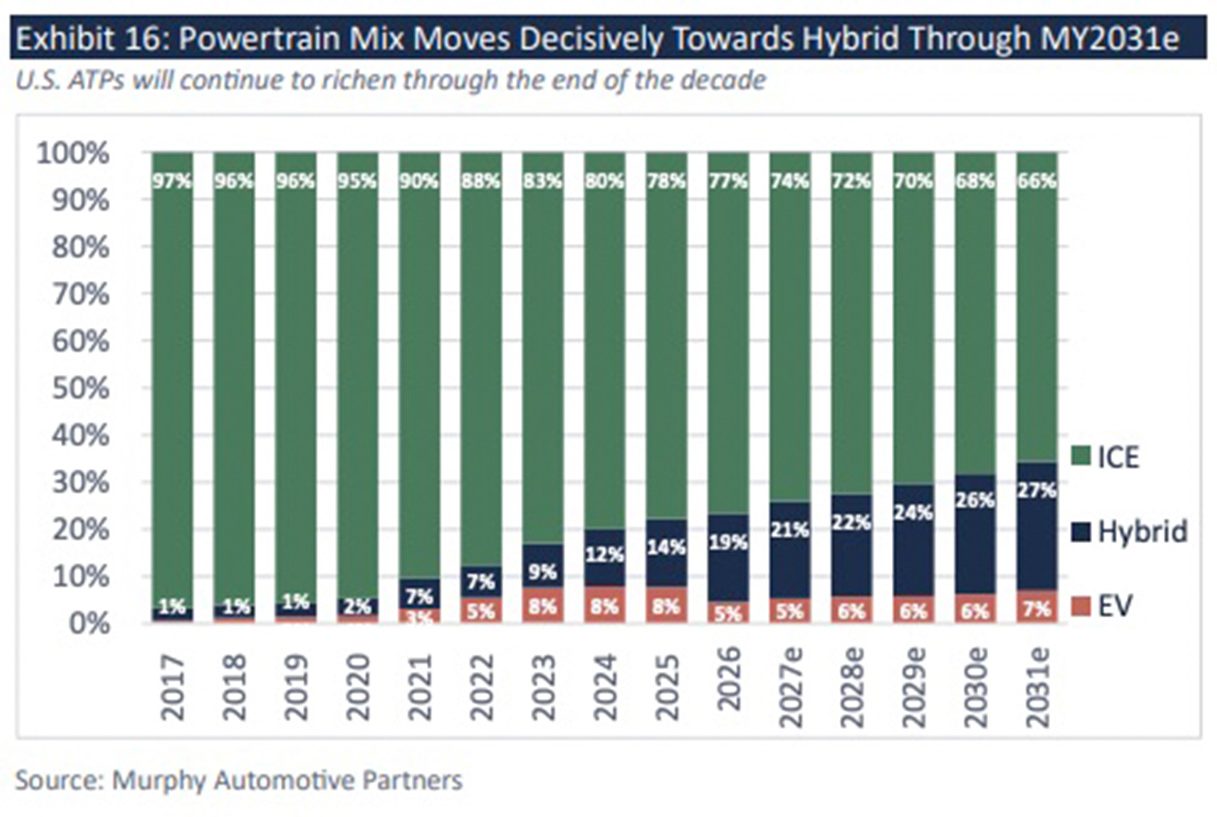
Via the new report from Murphy Automotive Partners, this simple chart pretty much knocked me off my chair when I saw it. Not because I think Murphy and his associates are wrong. They probably are not. It’s just such a bold repudiation of the last few years of hype that it feels almost dangerous to say it out loud.
Through MY2027–31e we expect the ICE powertrain to lose share to Hybrids as they represent a steadily larger share of
launches. Conversely, pure EVs are likely to make little headway with only a partial recovery from MY2026 lows, but still below peak 8% penetration. This is far lower than the industry expected even up until recently, and the inflection many investors underwrote has been pushed well beyond this study’s window, especially for mass market. We would go
further, hybrids are not a transition to pure EVs, but where the industry will find the right practical solution for
consumers, justifiable economics, and potentially for the environment.
This is absolutely wild stuff. What the MAPP is arguing is that we’re not experiencing a little stumble this year due to a change of politics and policy, but a long-term and durable abandoning of full electrification that sees the move towards hybrids as inevitable and the EV market as something of a consistent but flat alternative. In this view, electric cars aren’t gathering many new converts but, instead, recycling a lot of the same customers.
I’d like to point out that even two years ago, groups like S&P Global Mobility were treating electrification as an inevitability in their forecasts of powertrain mix:
As we edge closer to 2030, hybrid electric vehicle and BEV powertrain are likely to steer the future of automotive industry trends in North America. Despite more rapid electrification in other regions, North America’s production trails slightly, at just between 9% and 10% for BEVs and fuel cell vehicles. However, projections suggest a significant leap, with 44% of vehicles forecasted to be BEVs or fuel cell car models by the decade’s end.
It was this kind of analysis that felt wrong to me, and led me to first declare in 2023 that 2024 was going to be the “Year of the Hybrid” and then, last year, to declare this the “Decade of the Hybrid.” There simply weren’t enough customers and, unlike in China and Norway, the overall governmental and societal push ran out of steam too early. While politics is a part of this, I do think that the economics and buyer interest are the far bigger reasons, or as Murphy’s report says:
Pure electric vehicle programs have been deferred, re-scoped, or canceled, while hybrids have moved from hedge to headline. The economics are the key driver. Hybrids carry relative pricing power and healthy variable margins, while most pure EVs still lose money at the unit level. Crucially, those advantages look more structural than transitional. Furthermore, the practical use case for most Americans leans heavily towards traditional hybrids.
I cannot fault that logic, which is why so many brands that were recently invested in EV programs have either walked them back or, for the American market at least, entirely abandoned them. It’s possible that environmental concerns, political shifts, and higher gas prices might help full BEVs rise a little faster than forecast, but there simply aren’t going to be enough cars or customers.
On one hand, this does kind of suck. I love hybrids, and bought one, but there are plenty of consumers who would probably do well with an EV if there were more affordable options. The hype cycle caused automakers to overpromise, over-invest and under-deliver in terms of performance and pricing. Not that many automakers ended up making a better, more affordable EV than a Model 3, and by the time they did, they realized there just weren’t that many customers, even with $7,500 on the hood. For American competitiveness in the global market, where Chinese EVs dominate, it ain’t great. I still think that if the industry and those who covered it were more realistic, we could have gotten a future where hybrids and EVs could have grown together, as opposed to one where a single powertrain has to dominate.
Eventually, EVs will catch up, but it’s going to probably be way out in the future.
The other portion of this report, which is subtitled “Survival of the Freshest,” is that the EV “head-fake” caused many brands that weren’t Toyota to be forced to delay the redesign of key models (having expected to replace them with EVs) and now the market is about to become very old:
“The next five years aren’t about who has the most hyped concept, they’re about who actually shows up with the freshest product portfolio after the worst drought in history,” said John Murphy, Founder of Murphy Automotive Partners. “Some of the most familiar names in this industry are closer to the edge than the market realizes. The MAPP is how you see it coming.”
That’s a great sales pitch, and the media preview of the report shows which brands are in trouble, but the only brand named is Toyota (at the top, also the automaker with the most hybrids). There are seven brands in trouble in the United States, and I’ve got some guesses as to which ones those are.
Volkswagen Wants To Cut 100,000 Jobs, Might Not Be Able To

Does anyone know who this guy is? He might be retired by now, but I’d love to talk to him given that he’s sort of the mascot for Volkswagen’s production woes. Here’s another stat, this time from Bloomberg, that should tell you what’s going on in Wolfsburg: Volkswagen employs 628,893 people compared to 383,853 for Toyota. Last year, Toyota sold roughly 11 million cars across its brands globally, compared to just under 9 million for Volkswagen. That’s an extra 250,000 employees to sell fewer than 2 million cars.
The math doesn’t work, and Volkswagen announced a plan to cut 100,000 jobs and four plants. This isn’t really a surprise, given everything, but it’s not great, and VW’s powerful union has something to say about it, especially because of this:
Major strategic decisions at VW need approval from its supervisory board, where labor representatives normally hold half the seats. Currently, they occupy a majority after independent board member Susanne Wiegand didn’t stand for reelection.
According to that Bloomberg report, VW’s labor union is pushing back and can continue to do so. At the same time, VW’s union understands the company needs to survive, so cuts are certainly coming and coming fast.
Oh, Shut Up, Carlos Ghosn

This is a little bit my fault, because last week it was too amusing to not write the headline “Nissan’s Shareholder Meeting Was So Bad That Someone Nominated Fugitive Carlos Ghosn To Run The Company Again.” It’s kinda funny! It’s also not serious, because Ghosn would be a terrible leader of the company.
Unfortunately, saying Ghosn’s name means that a bunch of reporters, including Hans Greimel, were given an excuse to call him, so we have to listen to this nonsense:
“They say bring back what you had before. We want to come back to the golden age of Nissan. It lasted 18 years. It went very well,” Ghosn said. “Common sense speaks. If there is somebody who can fix it, it is somebody with my profile. Obviously, I mean, I’ve done it before.”
I think Ghosn did a good job, but he didn’t do a great job in the end, and a lot of the products he was responsible for were (though we love them) kind of mid. He was smart enough to see the EV wave coming, but absolutely unable to adjust when Tesla showed up and demonstrated the right way to do an electric car. Ghosn had plenty of business sense, but not enough product sense.
At least Ghosn here is reasonable enough to understand that it’s probably not happening, while also insisting he’d be able to save the company.
Texas Might Overtake California As The Biggest Car Market Soon

As a native Texan, I am not surprised that Texas might soon overtake California as the biggest car market. In general, my view is that if California wanted more people, it would invest more in making the state affordable to live in, including making simply having a place to live possible for more people. The alternative plan, as seen in Texas, is a mix of higher density development in historically low-density areas (Austin, Houston, San Antonio, and somewhat Dallas) for more affluent people, and a bunch of crappy, low-quality suburban housing for everyone else. This makes for increasingly fun cities and pretty miserable traffic.
Again, from Automotive News, this has an impact on the car market:
Since 2019, California’s share of U.S. retail light-vehicle sales has been dwindling, to 11.4 percent this year from 12.5 percent, according to JD Power. Texas, meanwhile, has trended in the opposite direction, climbing to 10.8 percent today from 9.3 percent seven years ago. Less than 1 percentage point now separates the states.
Texas already has become the nation’s leader in consumer spending on new vehicles, as Texans favor pricier pickups, JD Power found.
If these trends persist, Texas will become the nation’s new automotive “center of gravity,” said Tyson Jominy, senior vice president of OEM customer success at JD Power and the report’s author.
“California is the place where a lot of new ideas are sort of tried out, whereas Texas is a place where trucks and SUVs win,” Jominy said. “Texas is sort of the prototype of the typical American consumer these days.”
Texas forever.
What I’m Listening To While Writing TMD
Well, this is timely. It’s “A Slow Dance” from post-rock band Explosions in the Sky as featured on the Friday Night Lights movie soundtrack.
The Big Question
Name the seven brands that Murphy thinks might not survive the decade.
Top photo: MAPP/Tesla


John Murphy knows what he’s talking about